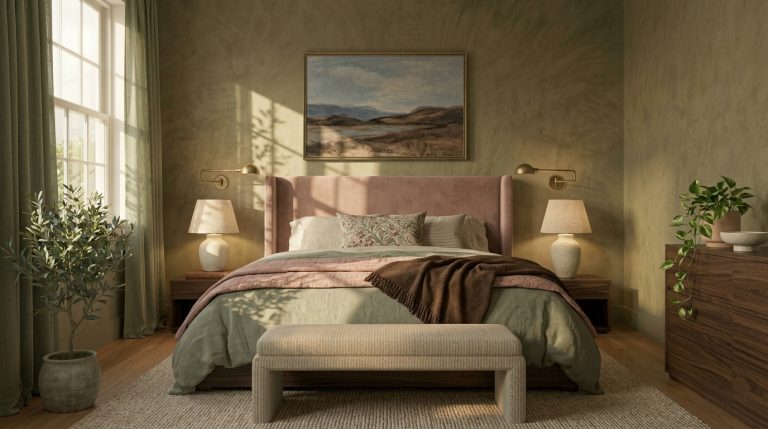
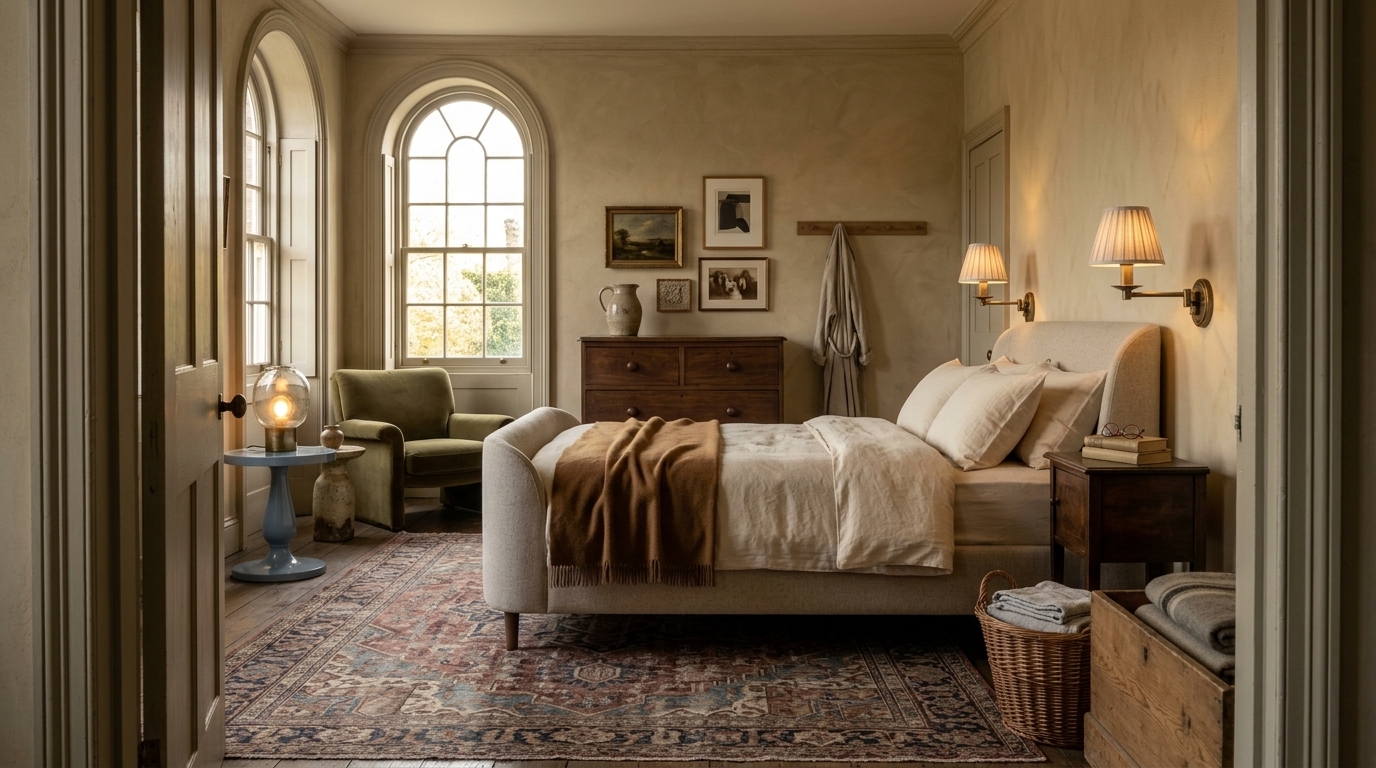
10 Eclectic Bedroom Tips for a Collected, Personal Retreat
Eclectic bedrooms often go wrong for the opposite reason minimal rooms do. Instead of removing too much, people keep adding interesting things until the bed is competing with patterned curtains, a gallery wall, three wood tones, colorful cushions, vintage lamps, and furniture from five different eras.
The better 10 eclectic bedroom tips for 2026 are not about using fewer styles. They are about creating relationships between them, the opposite discipline of these minimalist bedroom tips. Current bedroom design is moving toward warmer, more personal rooms, with vintage furniture, mixed eras, expressive headboards, deeper color, pattern, and objects that feel collected rather than purchased as a coordinated set. Architectural Digest specifically describes eclectic bedrooms as a mix of one-of-a-kind finds and bold ideas, with old and new furniture deliberately layered together.
The room can be unpredictable. It just needs a few rules holding everything together.
Build the room around one clear color story
Tip 1: Limit the palette before mixing styles
Eclectic does not mean every color gets equal attention.
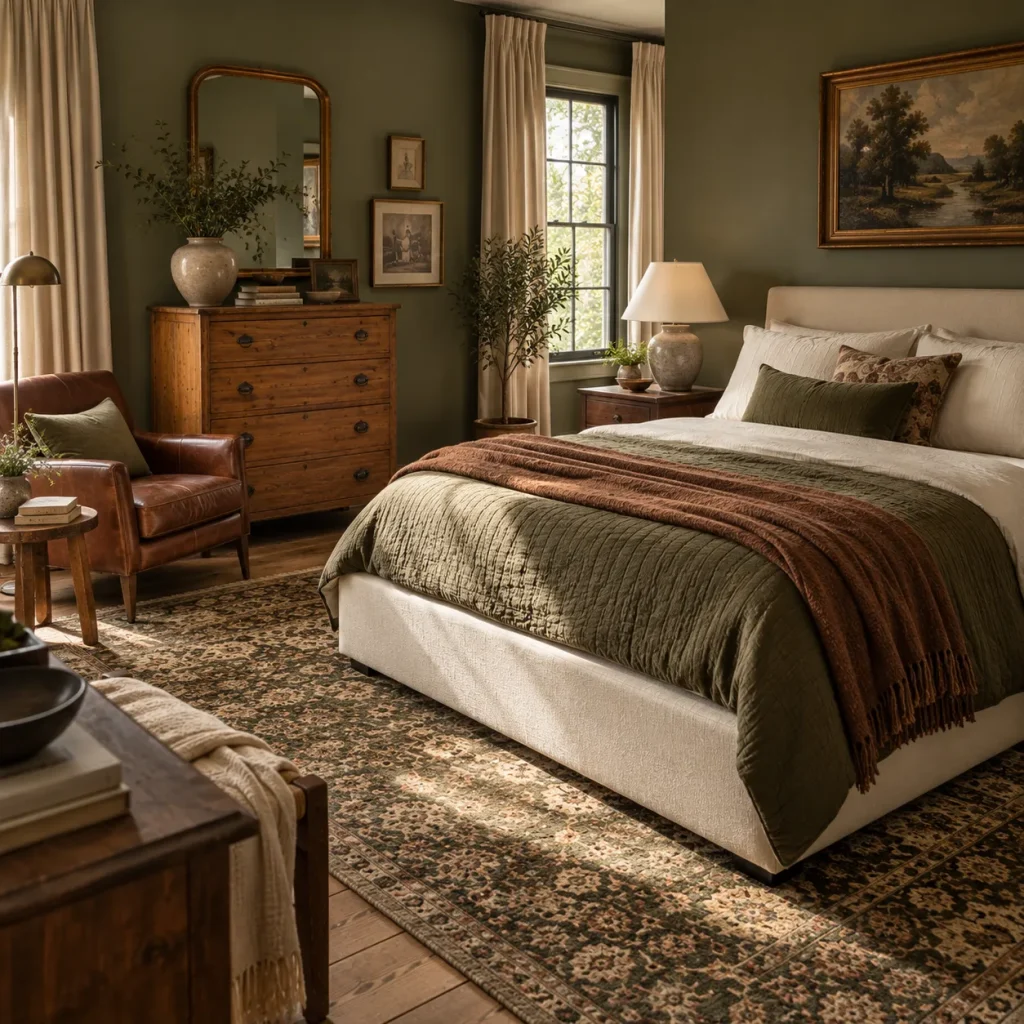
Choose two or three main shades, then let smaller accents stray outside the palette. This creates enough repetition for furniture and art from different periods to feel connected.
For example: mushroom with burgundy and dusty blue. Olive with tobacco and warm ivory. Plum with faded rose and walnut. Butter yellow with chocolate and powder blue. Terracotta with moss and parchment.
Chocolate brown is especially useful in eclectic rooms because it can visually connect colorful upholstery, vintage wood, patterned rugs, and brass. Designers are using it in 2026 to create the layered, vintage quality associated with interiors that feel built gradually over time.
Do not force every accessory to match your chosen colors. The palette should provide structure, not turn the bedroom into a coordinated set.
Mix furniture eras instead of buying one complete look

Tip 2: Pair old furniture with one clearly contemporary piece
A convincing eclectic bedroom should make it difficult to identify the exact year everything was purchased.
Try an antique walnut dresser beside a contemporary upholstered bed. Put a sculptural modern lamp on a traditional nightstand. Pair a vintage slipper chair with an abstract artwork.
Architectural Digest’s 2026 bedroom guide specifically recommends mixing periods, noting that historic homes naturally accumulated pieces over generations and that contemporary furniture can look particularly strong beside items with age and patina.
This is much more effective than buying ten pieces that all imitate different historical styles. One genuinely old item plus one obviously current piece creates productive tension.
And consider scale carefully. Older bedside tables and chests can be significantly smaller than modern beds, so check their height beside the mattress rather than choosing them solely for appearance.
Stop trying to match every wood finish
Tip 3: Use two or three wood tones deliberately
Matching furniture sets are one of the easiest ways to remove the eclectic feeling from a bedroom.
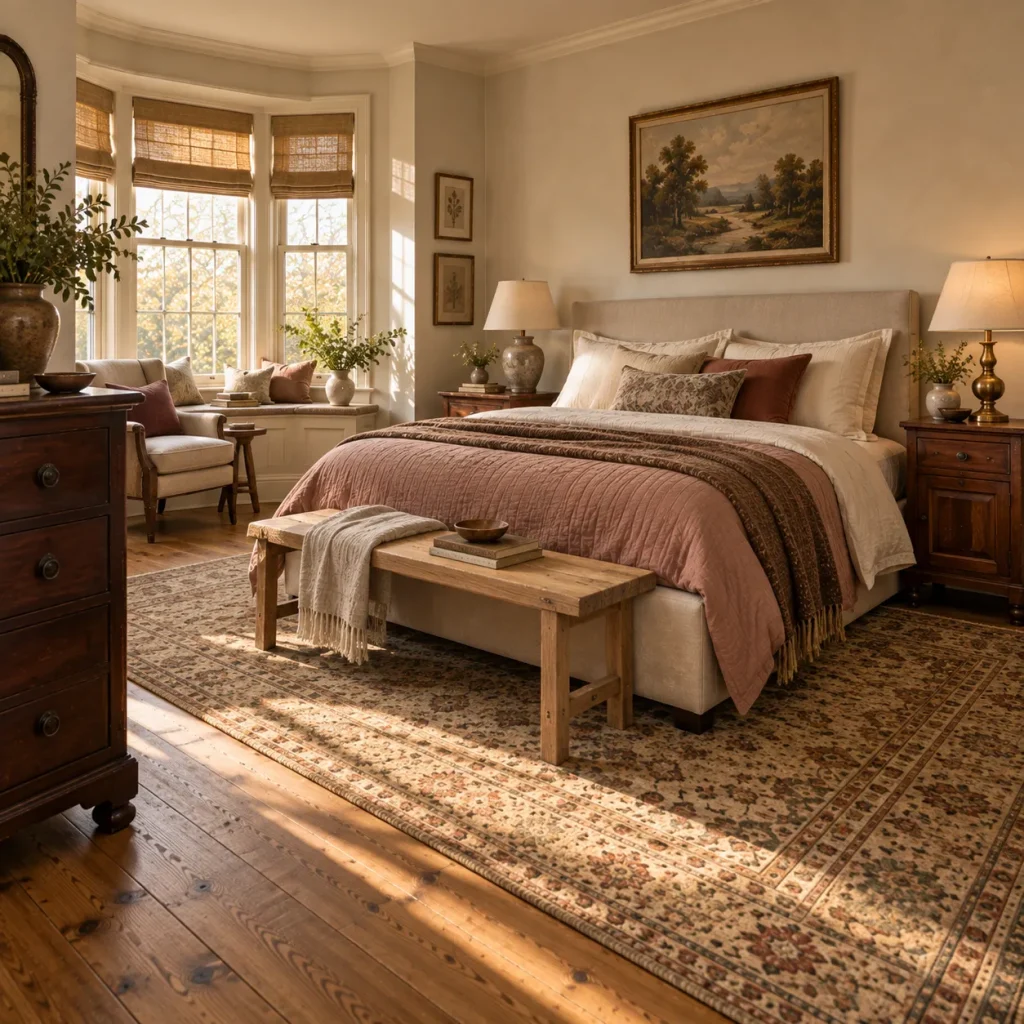
Current designers are actively moving away from identical bedroom furniture, instead combining different wood tones, silhouettes, metals, and upholstered pieces for greater individuality.
Try walnut nightstands with an oak floor and painted dresser. Or use a dark mahogany chest beside a linen bed and medium-oak bench.
The woods do not need to match exactly, but their relationship should make sense. Warm reddish walnut usually sits comfortably beside honey oak. Very gray washed wood may look disconnected beside rich mahogany unless another element bridges them.
I once worked through an illustrative room where the bed, dresser, nightstands, and bench were all the same medium oak. The owner had plenty of colorful art and textiles, yet the room still felt strangely conventional. Changing only the nightstands to dark walnut gave the entire bedroom more depth. The same logic applies to mixing periods, as seen in these mid century modern bedroom tips.
Eclectic style often needs contrast more than additional decoration.
Let one pattern dominate
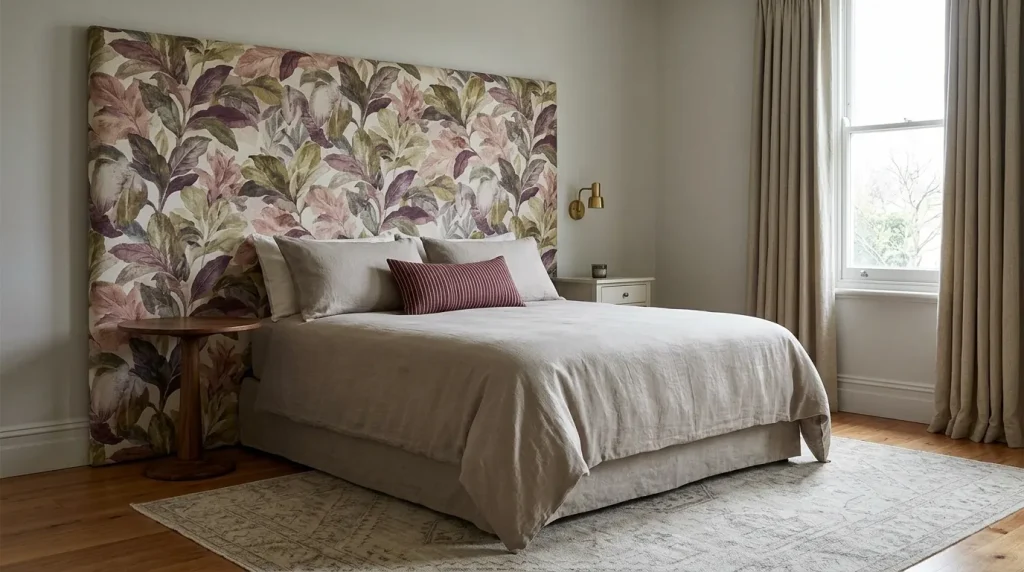
Tip 4: Use pattern hierarchy rather than equal competition
Pattern is important in eclectic rooms, but five equally strong patterns rarely feel layered. They feel noisy.
Choose one dominant pattern. It could be botanical wallpaper, a patterned upholstered headboard, a large vintage rug, or floral curtains.
Then support it with smaller and quieter designs. For example: a large floral headboard with a narrow striped cushion and faded geometric rug. Or scenic wallpaper with solid bedding and a small checked chair.
Current 2026 interiors are embracing more immersive pattern too. At London’s WOW!house, designers used a single repeated print across walls and ceilings, allowing the continuous pattern to behave almost like a backdrop for layered furniture and art.
That sounds counterintuitive, but repetition can sometimes be calmer than several unrelated patterns.
Connect your prints through one or two shared colors rather than matching the motifs themselves.
Make the bed the visual resting point
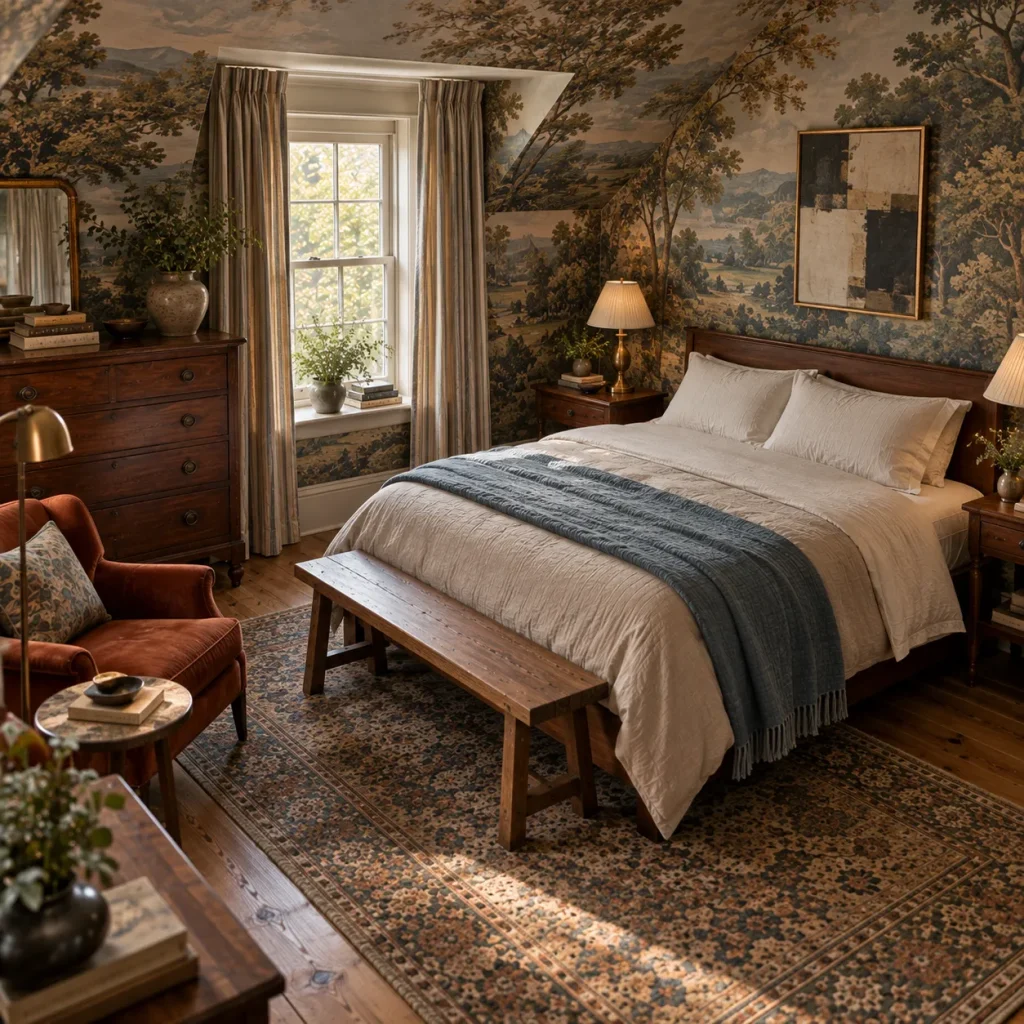
Tip 5: Keep the bedding simpler than the room around it
A bedroom can contain colorful wallpaper, vintage furniture, patterned curtains, and art without making the bed equally complicated.
In fact, the bed often works better as a visual pause.
Use cotton or linen sheets, one duvet or quilt, and perhaps a patterned coverlet or throw. Two or three tonal layers can still feel rich.
If the walls are busy, try warm ivory, mushroom, olive, dusty blue, or tobacco bedding. If the walls are quiet, the bed can carry more pattern through a floral headboard, striped quilt, or colorful textile.
Statement headboards are particularly relevant in 2026, with designers using pattern, stronger color, and expressive silhouettes to give bedrooms more personality without filling them with small accessories.
One useful contradiction applies here: an eclectic bedroom does not need an eclectic bed. Sometimes the calmest object in the room makes everything around it look more intentional.
Make the rug connect pieces that seem unrelated
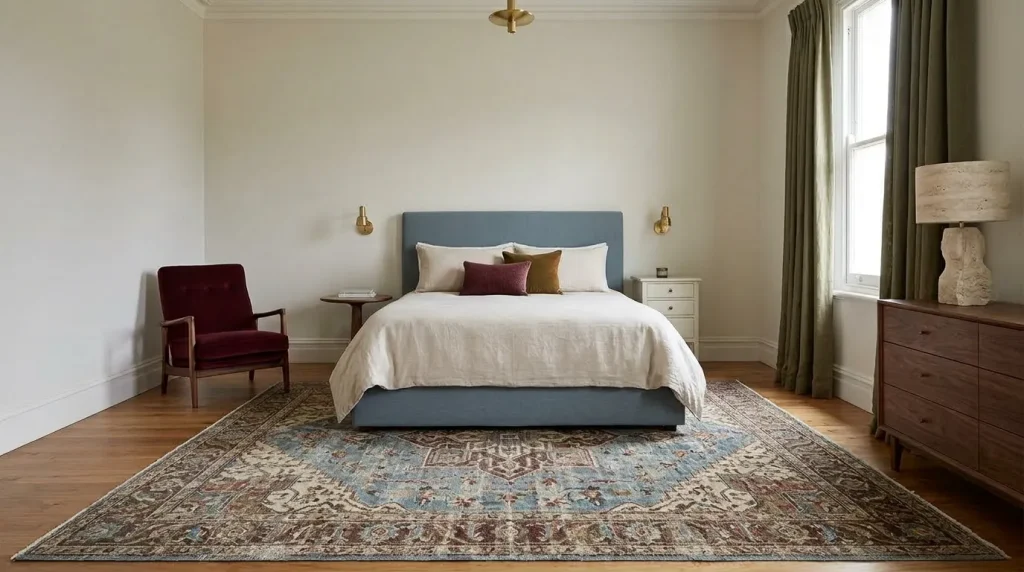
Tip 6: Use a rug as the palette bridge
A rug can explain why a burgundy chair, blue headboard, walnut dresser, and olive curtains belong in the same bedroom.
Look for a rug containing at least two colors already present elsewhere.
Vintage Persian-style patterns are particularly useful because their irregular, softened colors mix easily with furniture from different periods. Kilims, abstract wool rugs, and quieter geometric patterns can work too.
Scale matters. For a queen bed, an 8-by-10-foot rug is often a useful starting point where the room permits. A king may work better with a 9-by-12. Exact dimensions depend on furniture placement and how much flooring you want visible.
Avoid choosing a tiny rug because the room already contains lots of decoration. A larger rug can actually reduce fragmentation by visually connecting several pieces.
Make art personal rather than perfectly coordinated

Tip 7: Mix art formats and frame finishes
Eclectic bedrooms are ideal places for collections.
Hang an old landscape beside an abstract print. Add a photograph, textile, drawing, or botanical study. A small mirror or shallow sculptural object can break up a wall of rectangles.
Architectural Digest’s current eclectic bedroom guidance highlights unconventional wall displays that combine photography, masks, textiles, and unexpected vintage objects rather than relying on matching print sets, an idea explored further in these bedroom wall collage tips.
Limit your frame finishes to two or three recurring materials. For example: dark wood, aged brass, and simple black. Or oak, painted cream, and antique gold.
This gives diverse artwork a subtle common structure.
Do not purchase a six-print “eclectic gallery wall” set. The whole point is that the wall reflects your taste rather than a predetermined collection.
Use materials that deliberately disagree
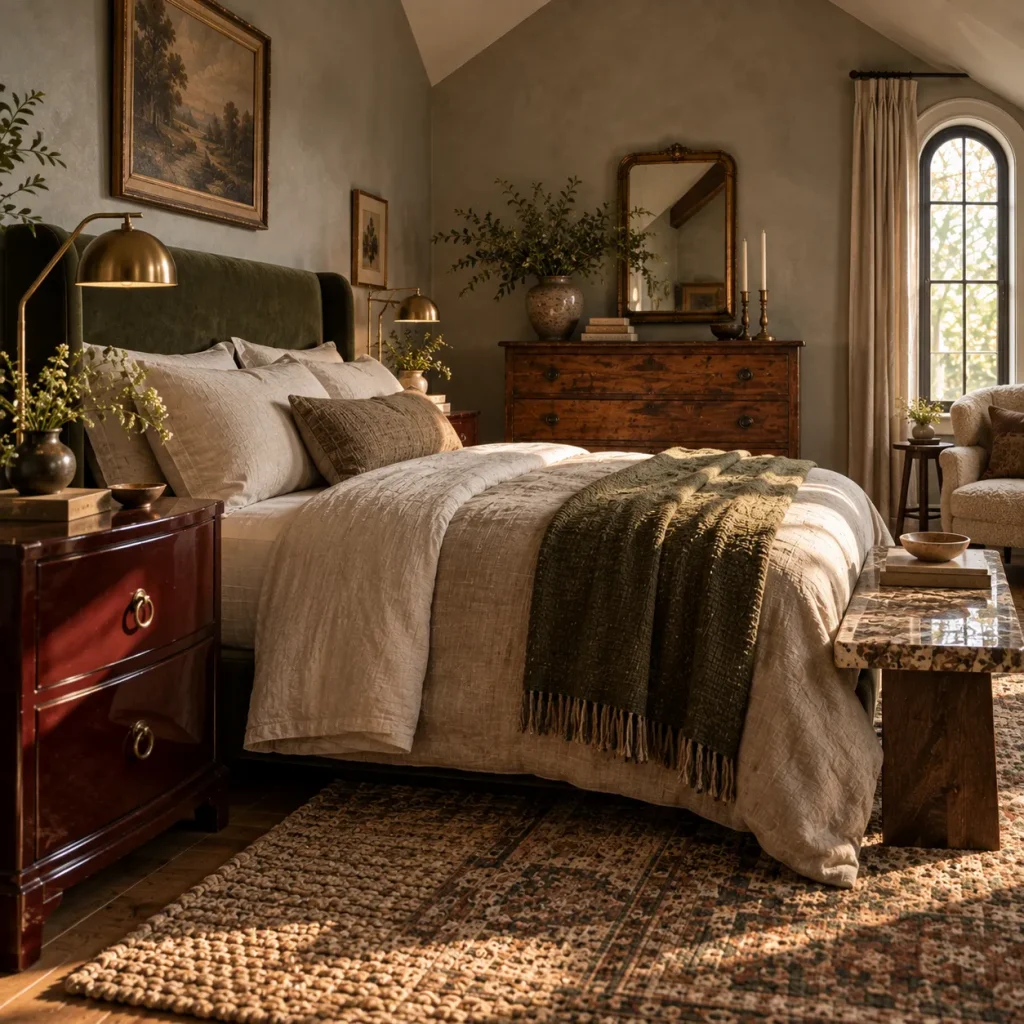
Tip 8: Pair polished surfaces with worn or tactile ones
Some of the most interesting eclectic bedrooms come from material contrast rather than color.
Put glossy lacquer beside old wood. Use velvet against raw linen. Place a stone lamp on a scratched antique dresser. Combine aged brass with ceramic.
The broader fall 2026 design direction strongly favors this kind of “material tension,” with designers combining rough and polished finishes while embracing patina and designed imperfection, a quality also present in these earthy bedroom ideas.
This prevents an eclectic bedroom from becoming a sea of soft vintage objects.
If you already have a floral bed, wool rug, linen curtains, and velvet chair, introduce something smoother such as lacquer, glass, marble, or polished metal. And if the room feels too glossy, reverse the relationship with wood, wool, plaster, or handmade ceramic.
Treat lighting like part of the collection
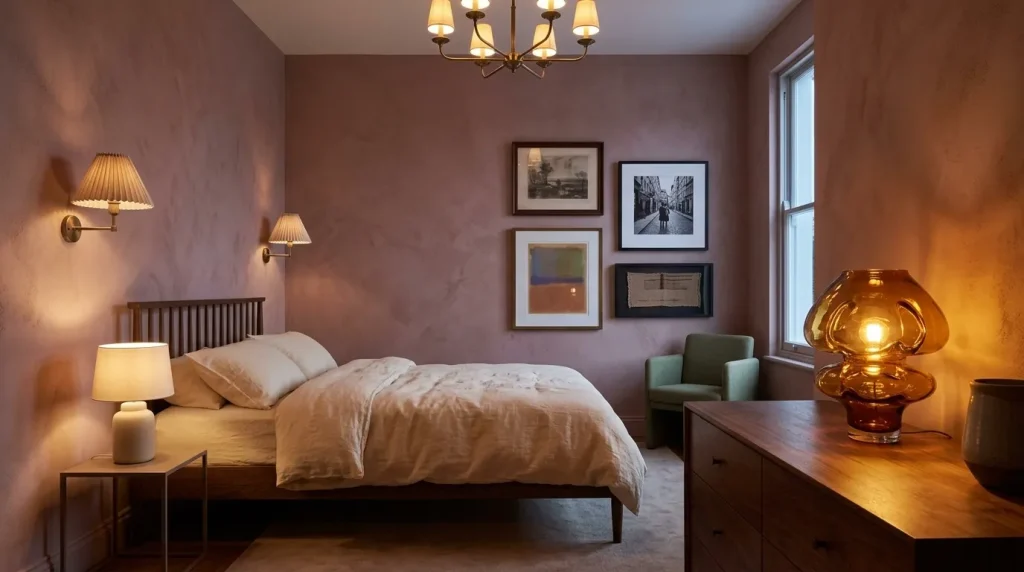
Tip 9: Mix lighting styles while keeping the light quality consistent
Your ceiling fixture, bedside lamps, and dresser light do not need to come from the same collection.
An aged brass ceiling fixture can work with ceramic bedside lamps. A pleated fabric shade can sit beside a contemporary colored-glass light.
This kind of mixing suits the current shift toward more expressive, nostalgic interiors. Designers are also moving away from impersonal grids of recessed ceiling lights and toward fixtures with greater shape, texture, and architectural presence.
But keep the actual light comfortable. Aim for reasonably similar warm color temperatures so one lamp does not glow amber while another feels icy blue.
Use a ceiling fixture for general illumination, bedside lamps or sconces for reading, and perhaps one lower accent light on a dresser or near a chair.
Not every lamp needs to be unusual. One standout vintage or sculptural fixture becomes more noticeable when the other lights are quieter.
Edit the room so the unusual pieces stay unusual
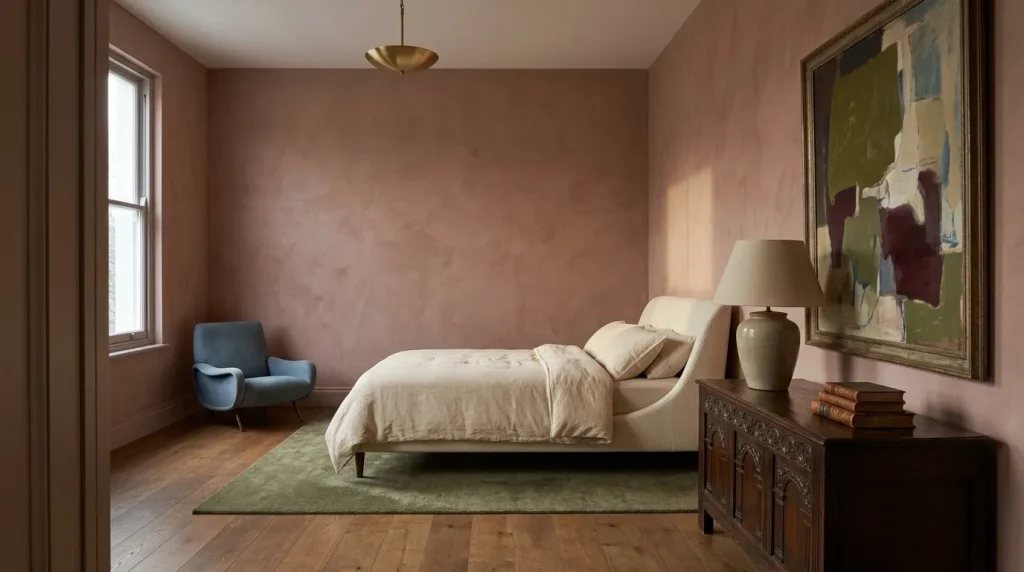
Tip 10: Leave visible space around your best objects
Eclectic is not another word for maximalist.
You can have an eclectic bedroom with relatively few objects if those objects come from different periods, materials, and visual languages.
Current 2026 bedroom trends emphasize rooms that feel personal and layered while still prioritizing comfort, storage, and calm.
So leave some wall visible. Keep part of the dresser clear. Do not fill the chair with decorative cushions if you actually want to sit there.
I like a simple editing test: stand in the doorway and identify the three things your eye notices first. If you cannot identify three because fifteen objects are demanding equal attention, remove or relocate the weakest pieces.
The best eclectic bedrooms have hierarchy. They let some things whisper so others can be strange.
A practical eclectic bedroom mixing guide
| Start with | Mix it with | What creates the connection |
|---|---|---|
| Antique dresser | Modern upholstered bed | Shared color |
| Floral wallpaper | Simple bedding | Repeated accent tone |
| Walnut furniture | Lacquered lamp | Warm color contrast |
| Vintage rug | Contemporary chair | Similar palette |
| Brass lighting | Ceramic lamps | Warm light |
| Abstract art | Traditional portrait | Repeated frame finish |
| Velvet upholstery | Linen curtains | Material contrast |
You do not need to deliberately use every combination. The table simply shows how differences can be connected by one shared characteristic.
What should you skip in an eclectic bedroom?
Matching bedroom furniture. Identical beds, dressers, and nightstands weaken the collected effect.
Using every favorite color at once. A limited underlying palette gives unusual objects enough structure.
Making every object vintage. Without contemporary contrast, eclectic can turn into a period room.
Five competing statement patterns. Decide which pattern deserves to dominate and let the others support it.
Decorating every available surface. Empty space makes unusual pieces easier to appreciate.
Try this if your bedroom currently feels too coordinated
Do not replace the expensive pieces first.
Keep the bed and dresser.
Swap one matching nightstand for a vintage table, painted chest, or different wood finish.
Change one lamp to something with a contrasting material.
Introduce a rug that contains a color already present in your art or bedding.
Then add one object that has no obvious stylistic connection but that you genuinely love, perhaps an old portrait, contemporary ceramic lamp, travel photograph, or sculptural chair.
Finally, remove two pieces that were purchased only because they matched.
The bedroom will often become more eclectic through subtraction and contrast rather than through buying more.
FAQ
What makes a bedroom eclectic?
An eclectic bedroom combines furniture, color, pattern, art, and materials from different styles or periods while maintaining enough visual relationships to feel intentional. Repeated colors, compatible proportions, and recurring materials are what keep the mix coherent.
How many styles can I mix in an eclectic bedroom?
There is no strict number, but two or three strong influences are usually easier to control than six equally obvious ones. You might combine mid-century furniture, traditional textiles, and contemporary lighting without labeling every piece by style.
How do I keep an eclectic bedroom from looking cluttered?
Create hierarchy. Use one dominant pattern, a limited underlying palette, adequate closed storage, and visible space around important furniture and art. Current bedroom design favors collected rooms, but it also emphasizes comfort and practical function.
What colors work well in an eclectic bedroom?
Almost any colors can work if their relationships are deliberate. Chocolate, olive, burgundy, dusty blue, plum, terracotta, butter yellow, warm ivory, and faded pink are especially useful because they pair comfortably with vintage woods and modern materials.
Let contrast tell the story
The strongest 10 eclectic bedroom tips do not require you to become better at matching things.
They require you to become better at deciding why different things belong together.
Let an old dresser sit beside a contemporary bed. Put floral fabric near abstract art. Pair walnut with lacquer, linen with brass, and a vintage rug with a modern chair. Then repeat just enough color or material to connect them.
If you make one change first, break up the most obviously matching pair in the bedroom.
Replace one nightstand, lamp, artwork, or textile with something from another period or material.
A good eclectic bedroom should feel as though its contents arrived from different places and different moments, but somehow ended up exactly where they belong.