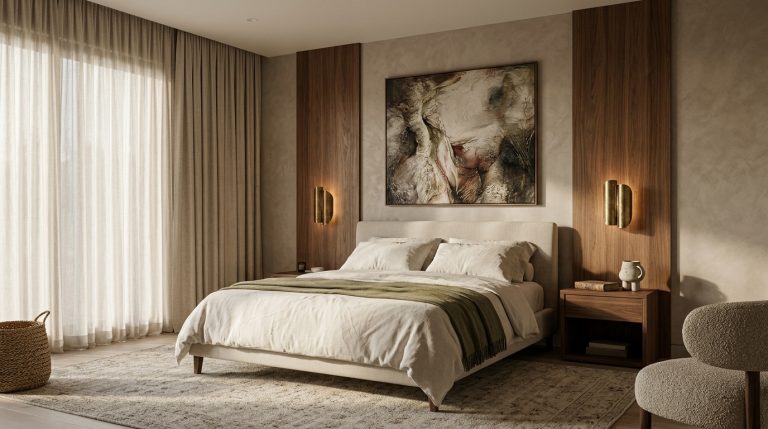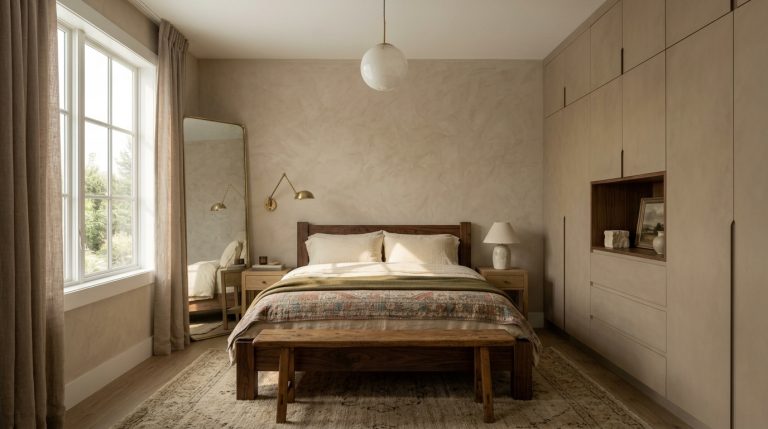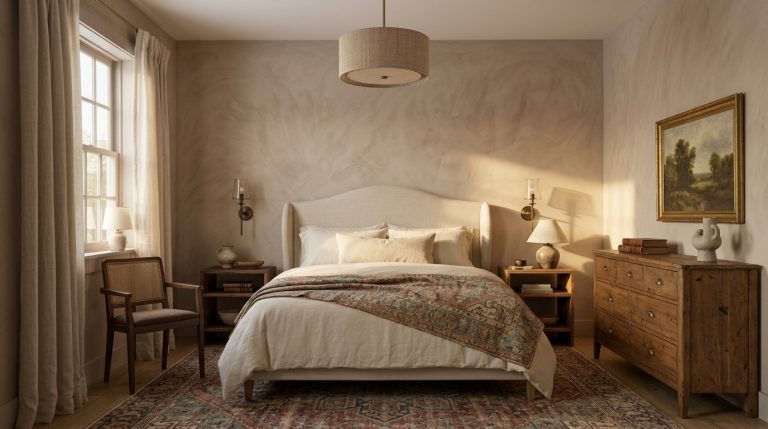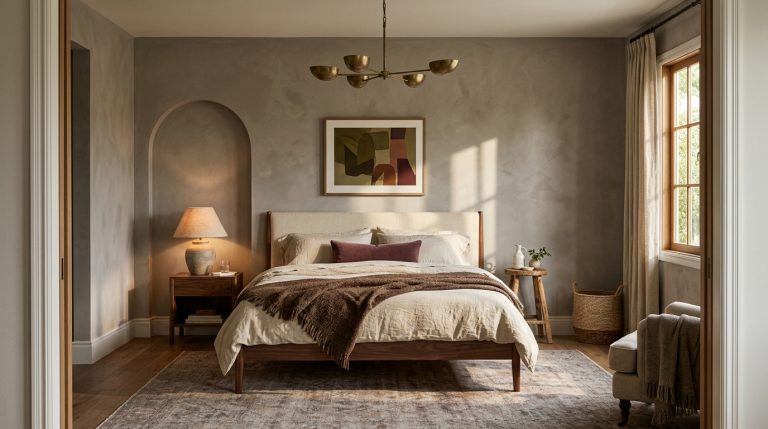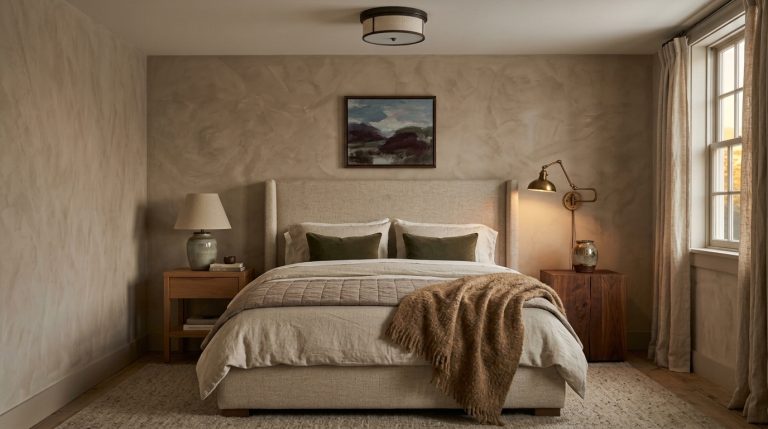

15 effortless chic bedroom ideas for a Polished Retreat
A chic bedroom usually looks as though nobody tried very hard to make it chic.
The bedding isn’t stacked with twelve pillows. Every surface isn’t styled. The furniture doesn’t arrive as a matching set. Yet everything feels considered, from the height of the bedside lamp to the way the curtains touch the floor.
That’s the thinking behind these 15 effortless chic bedroom ideas. And it lines up nicely with where bedroom design is heading in 2026. Designers are favoring warmer, more personal rooms with layered texture, stronger headboards, richer color, and softer drapery instead of sterile minimalism.
I once helped restyle a bedroom that already owned plenty of attractive furniture. We changed almost nothing expensive. We removed unnecessary decor, replaced the small lamps, added longer curtains, and introduced one old wood nightstand.
Suddenly, the room looked far more finished.
That’s effortless chic at its best.
1. Begin with a warm neutral base, then break it slightly
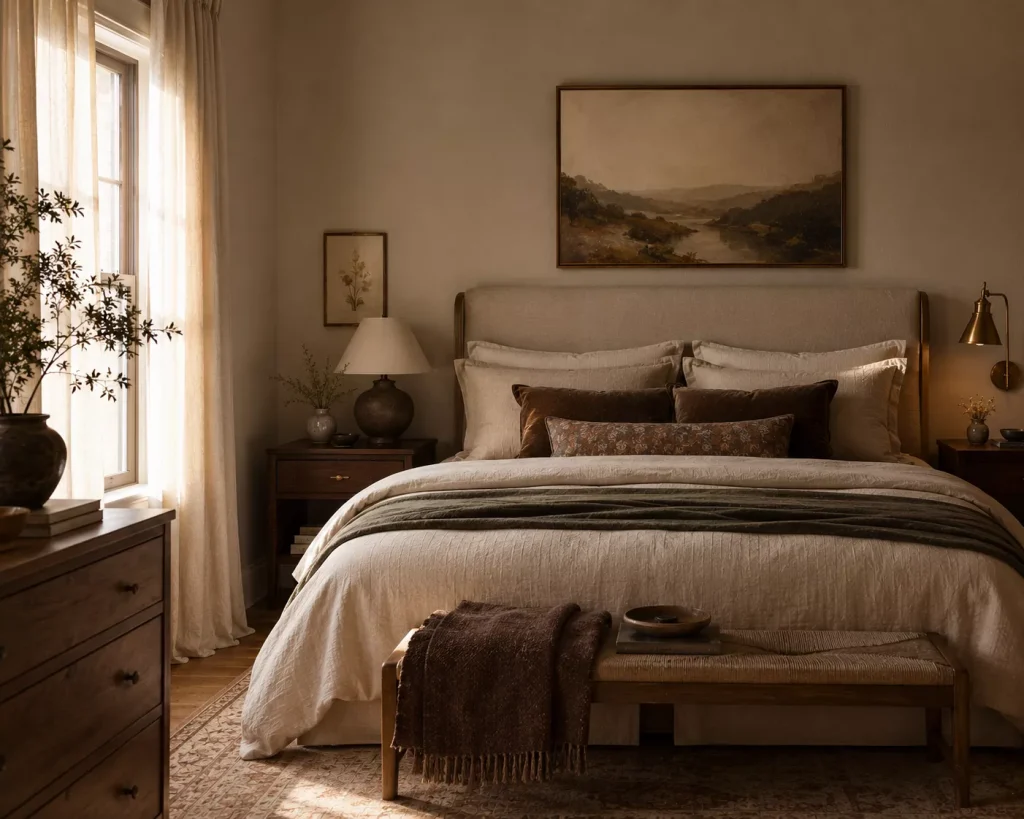
Idea 1: Choose a warm neutral that doesn’t feel flat.
Cream, mushroom, oatmeal, warm greige, camel, and pale taupe make excellent bedroom foundations.
But don’t make every surface the same color.
A cream bed against cream walls with cream curtains and beige flooring can start looking less sophisticated and more like you accidentally decorated inside a bowl of porridge.
Bring in contrast.
Medium walnut, tobacco brown, muted olive, dusty blue, terracotta, burgundy, or charcoal can give a pale room some weight.
Current interiors are leaning toward layered warmth, earthy colors, and natural textures rather than cool, impersonal neutrality.
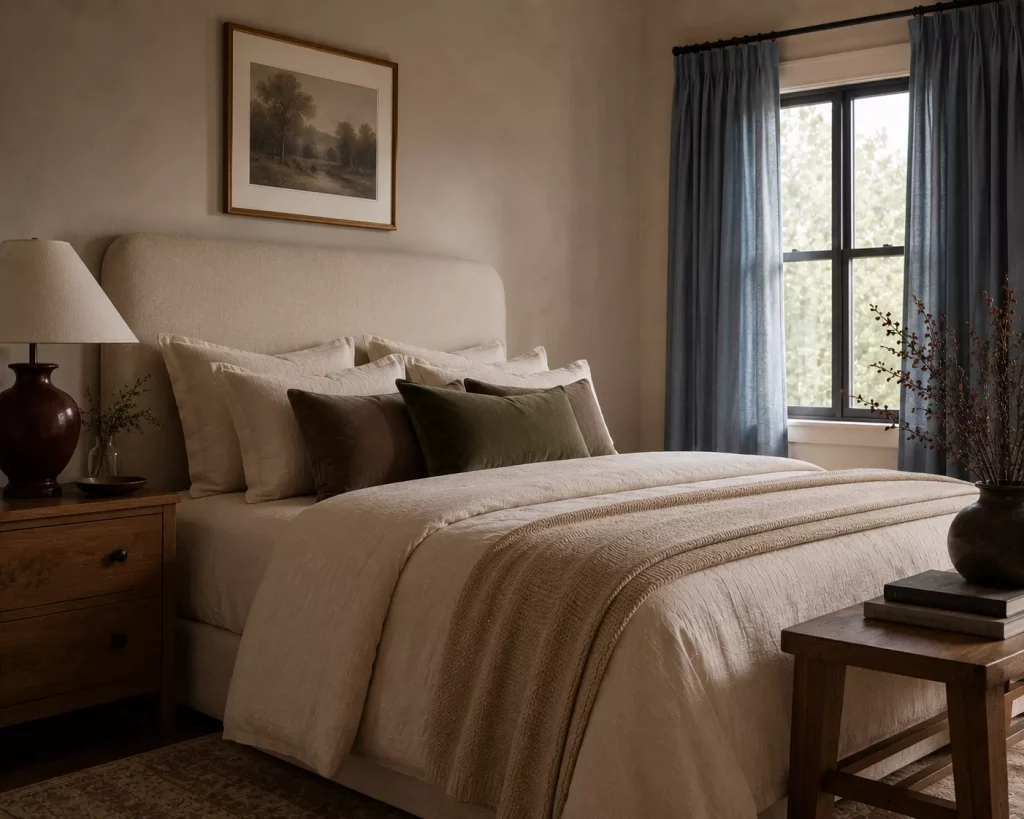
Idea 2: Let one slightly unexpected color interrupt the palette.
Try an olive cushion on an oatmeal bed.
Add a burgundy lamp beneath pale mushroom walls.
Use dusty blue curtains beside warm oak furniture.
You only need a little.
The room should feel controlled, but not so carefully coordinated that you can predict the color of every object before you see it.
That slight tension is often what separates a chic room from a matching furniture display.
2. Make the bed substantial without overstyling it
The bed occupies too much visual space to be treated casually.
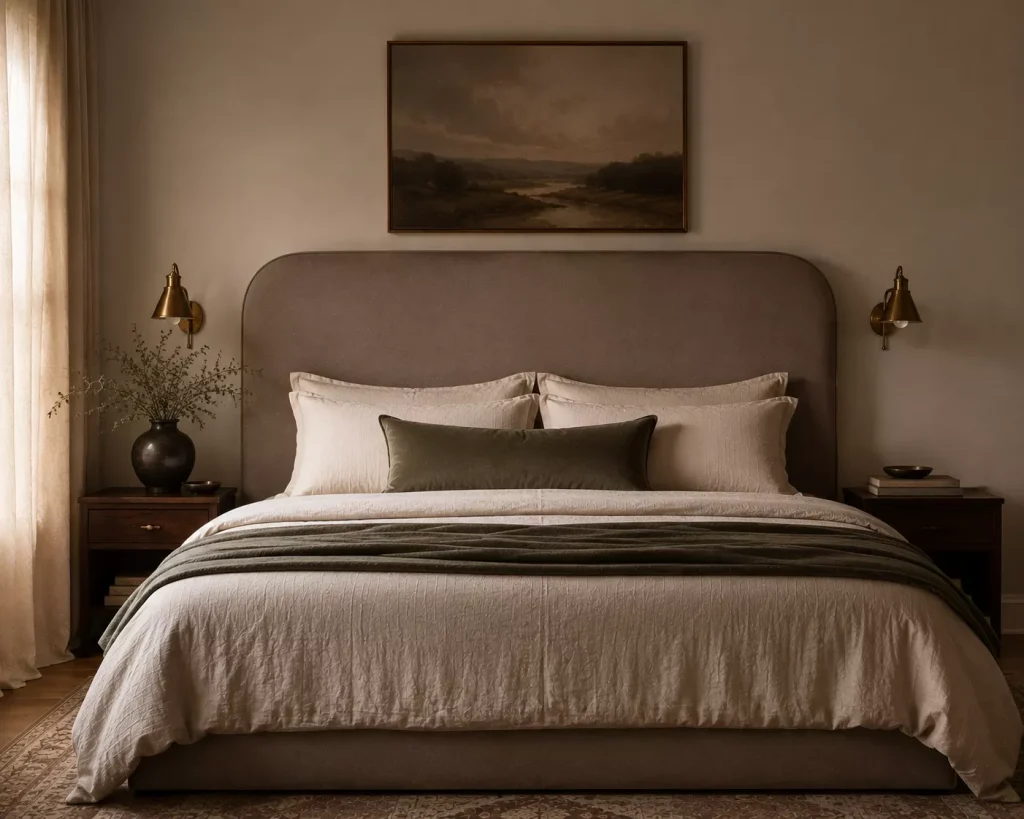
Idea 3: Give the headboard enough presence.
An upholstered headboard in oatmeal, tobacco, moss, dusty rose, or warm gray can make an otherwise basic bedroom feel far more intentional.
Curved and oversized headboards are particularly visible in current bedroom design, where they’re being used to create a stronger, cocooning focal point.
You don’t necessarily need a huge one.
In smaller bedrooms, a slim upholstered panel or simple wood headboard can create the same sense of structure without stealing valuable floor space.
Keep the bedding relaxed
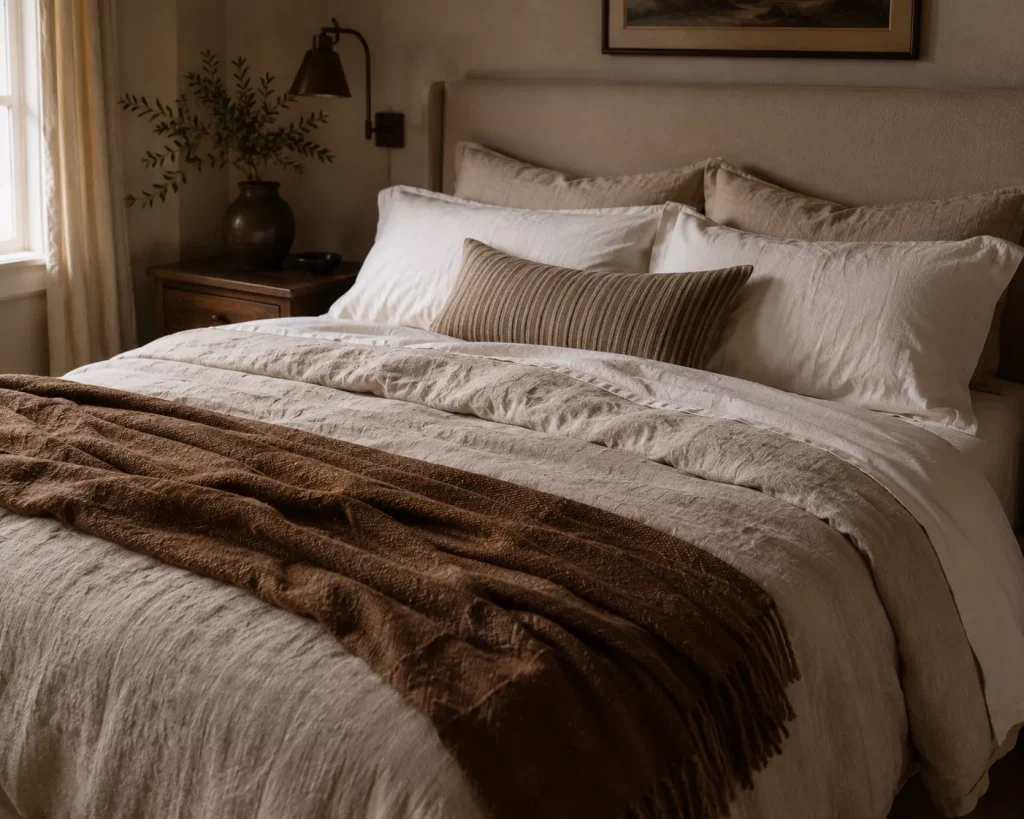
Idea 4: Layer bedding with texture rather than quantity.
Start with good sheets.
Add a duvet or quilt.
Then use one throw and perhaps one or two decorative cushions.
That’s often enough.
A simple bed might combine warm-white cotton sheets, a flax linen duvet, a tobacco-brown throw, and one striped lumbar cushion.
Layered fabric, warm wood, rugs, and softer lighting continue to be reliable ways to make bedrooms feel more inviting without cluttering them.
And please don’t build a pillow mountain you have to dismantle every night.
A chic bedroom should still respect the fact that you need to sleep there.
3. Mix old and new furniture instead of matching everything
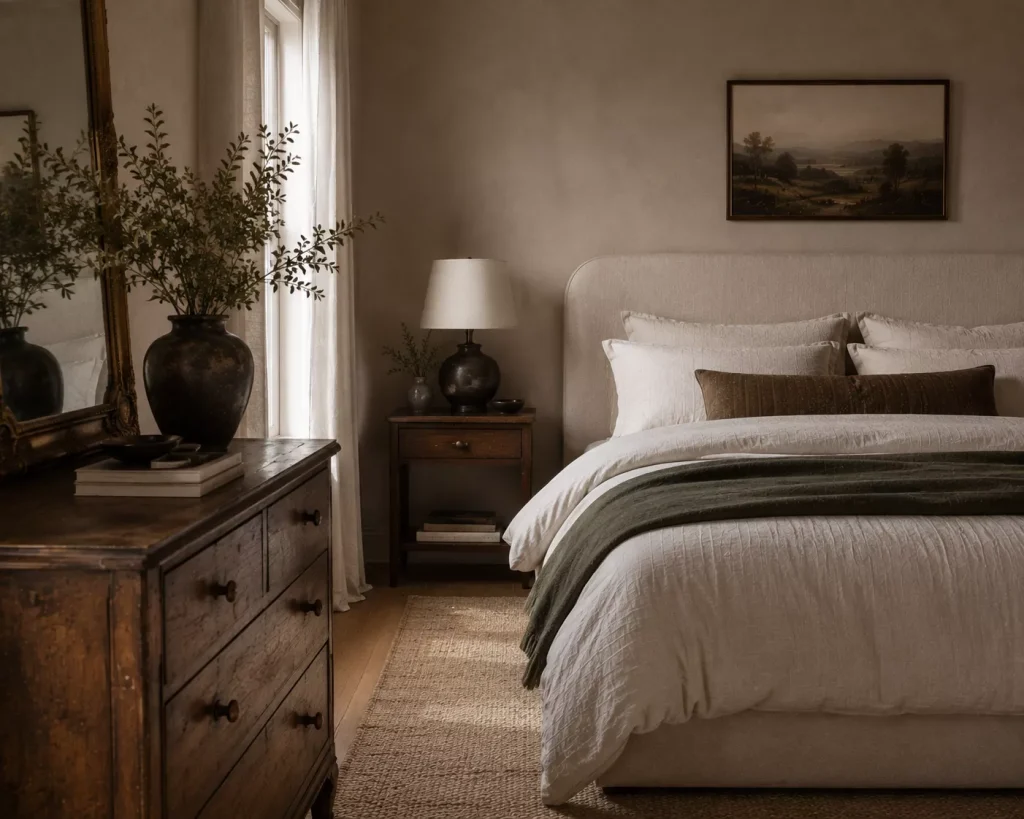
Idea 5: Introduce one piece that looks as if it has lived somewhere before.
This could be a vintage nightstand, an old wood dresser, a brass mirror, or a slightly worn stool beside the bed.
I love using one older piece in an otherwise clean bedroom because it breaks the perfection.
A new upholstered bed beside a walnut table with a little wear feels more interesting than a bed accompanied by two identical nightstands from the same collection.
You don’t need a valuable antique.
Flea markets, secondhand shops, family furniture, and online marketplaces can provide exactly the sort of character you need.
Idea 6: Mix wood tones deliberately.
Pale oak and medium walnut can coexist beautifully.
So can dark cherry wood beside cream upholstery.
The trick is contrast.
Three furniture pieces in almost, but not quite, the same orange-brown finish can look accidental.
Two clearly different wood tones feel more deliberate.
Here’s a simple guide:
| Combination | Why it works | Watch out for |
|---|---|---|
| Pale oak + walnut | Lightness with contrast | Too many extra wood tones |
| Cream upholstery + dark wood | Soft but grounded | Very bulky dark furniture |
| Black metal + oak | Clean and graphic | Too much black can feel harsh |
| Aged brass + walnut | Warm and refined | Highly polished gold everywhere |
| Painted piece + natural wood | Breaks up matching furniture | Too many unrelated colors |
Chic rarely means perfectly matched.
Usually, it means well edited.
4. Hang curtains properly and let them soften the architecture

Idea 7: Use full-length curtains even if your windows aren’t impressive.
Curtains can make an ordinary rental window look much more substantial.
Mount the rod several inches above the frame where possible. Extend it wider too, so most of the fabric can sit beside the glass when open.
Then let the panels fall to the floor.
I like warm white, flax, mushroom, muted olive, dusty blue, and soft brown for effortless bedrooms.
Decorative drapery is receiving renewed attention in 2026 bedroom interiors as designers look for ways to add softness, character, and enclosure.
Layer when you need privacy
Pair sheer curtains with blackout panels if your bedroom faces neighboring windows or bright streetlights.
That gives you soft daylight during the day and proper privacy at night.
There is a downside.
More fabric means more dust and more maintenance.
And if your room has one tiny window, extremely thick dark curtains can make it feel smaller.
Choose fabric weight according to the room, not the photograph you saved.
That’s a small decision that makes a big difference.
5. Use lighting to make ordinary furniture look better
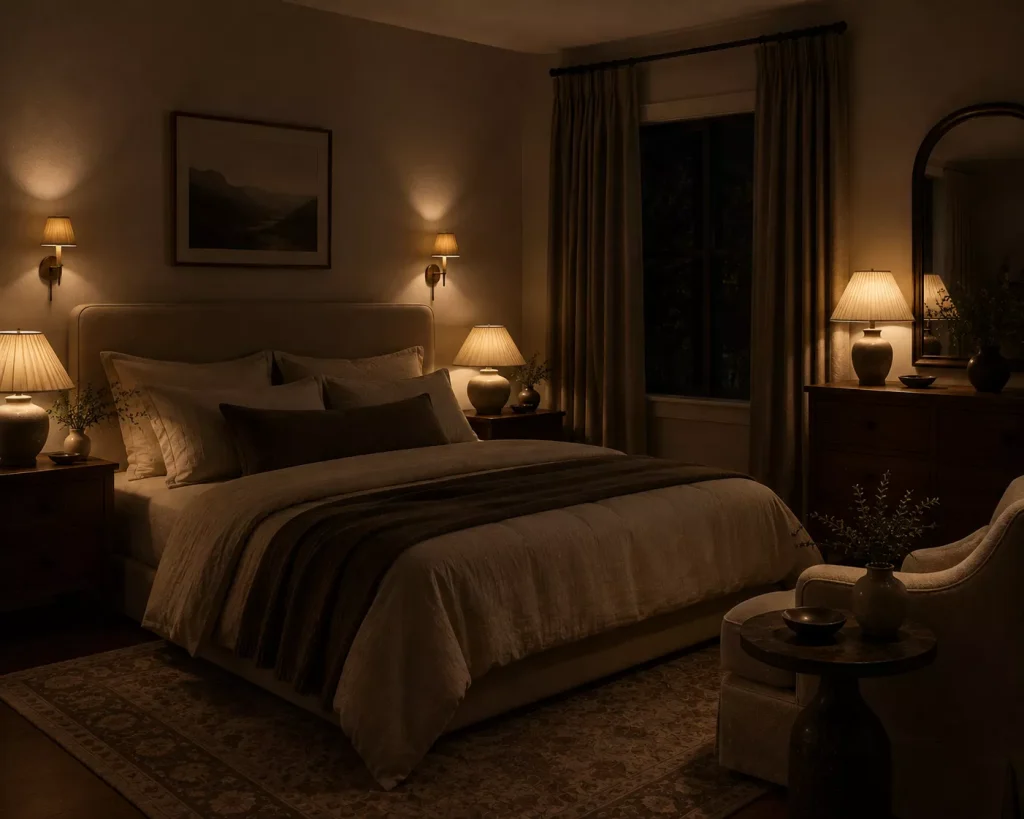
Idea 8: Stop relying on one ceiling light.
Lighting is one of the cheapest ways to change how a bedroom feels after dark.
Use a bedside lamp or wall sconce on each side of the bed where the layout allows. Then consider a smaller light on the dresser.
A warm bulb often works better than icy white light in a room built around wood, linen, taupe, brown, or muted color.
And the lamp itself matters.
Pleated shades, ceramic bases, dark wood, aged brass, stone-like finishes, and simple paper lamps can add personality without taking over the room.
Current lighting direction favors gentler illumination, sculptural silhouettes, and mixed materials rather than purely functional fixtures.
Idea 9: Let one light fixture act as jewelry.
Perhaps that’s an alabaster-style bedside lamp.
Maybe it’s a small brass ceiling fixture.
Or a sculptural paper pendant.
Keep the rest quieter.
A room with four statement lights feels less effortless because you notice how hard everything is trying.
And if your bedroom has low ceilings, don’t assume you need a hanging pendant. Updated flush-mount fixtures are increasingly being used as a practical, attractive option for compact bedrooms.
6. Make a large rug do the work of several accessories

Idea 10: Choose a rug with enough scale to anchor the bed.
For a queen bed, an 8-by-10-foot rug often works well in a reasonably sized room.
A 6-by-9 can suit a smaller bedroom.
For a king, you may want a 9-by-12 if the floor plan allows it.
The exact size matters less than making sure the rug visibly extends beyond the bed.
I’d choose subtle character over a completely plain rug.
Try faded rust and blue, muted olive, charcoal and cream, or an understated geometric pattern.
A vintage-style rug is particularly useful because it adds age and pattern in one move.
Patterned and richer-toned rugs are also showing up more strongly in current bedroom design as rooms move toward warmer, more layered schemes.
You can put a rug over carpet too.
Just keep it relatively low pile.
And remember the practical side.
Very pale rugs look beautiful when freshly styled. They’re less charming beside muddy shoes, pets, and your morning coffee.
Sometimes medium tones are far more elegant because you can actually relax around them.
7. Style nightstands as working surfaces, not displays
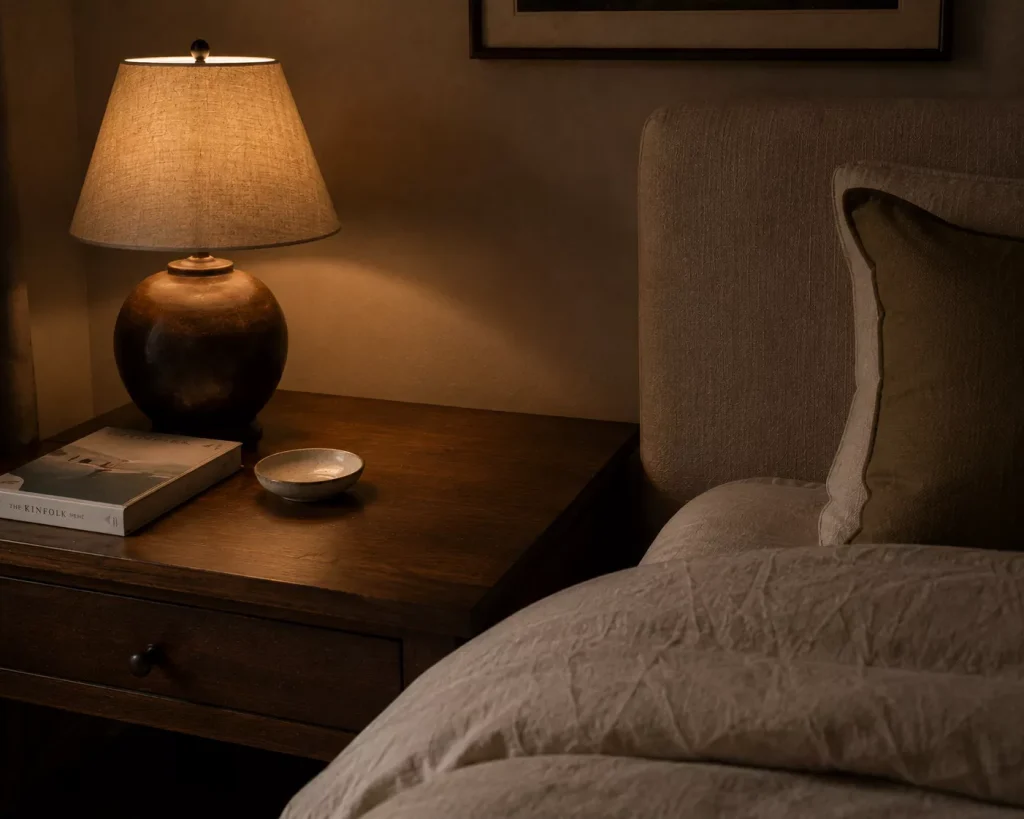
Idea 11: Leave part of every nightstand empty.
This sounds almost too simple.
But it changes the room.
A bedside table doesn’t need a lamp, three books, candle, framed photograph, vase, decorative box, alarm clock, diffuser, and tiny dish.
You still need somewhere to put a glass of water.
Keep one or two useful or meaningful objects besides the lamp.
Maybe it’s your current book and a ceramic dish.
That’s enough.
Idea 12: Don’t force matching nightstands into an uneven room.
Everyone says symmetry looks more polished.
It can.
But a small bedroom doesn’t always have equal space on both sides of the bed.
Use one proper drawer unit on the wider side and a narrow round table on the tighter side.
Connect them through height or material rather than identical design.
I’ve done this in bedrooms where matching furniture would have left one side nearly impossible to walk through.
The result often feels more personal anyway.
Effortless chic depends on knowing when visual balance matters more than perfect symmetry.
8. Add character through art, books, and one personal detail
Idea 13: Choose fewer pieces of art at a larger scale.
Tiny art scattered across every wall can make a bedroom feel busy.
Try one substantial piece above the bed or dresser instead.
A large abstract, vintage-style landscape, botanical print, or personal photograph can anchor an entire wall.
For a queen bed, a piece around 36 to 48 inches wide often works, though the exact dimensions depend on your headboard.
If you prefer a gallery wall, keep the spacing consistent and treat the entire group as one composition.
Idea 14: Add something that couldn’t have come from a bedroom styling kit.
A stack of old books.
A framed photograph from a trip.
A ceramic piece made by a friend.
An inherited wooden box.
These objects prevent the room from becoming generic.
Current design direction strongly favors homes that feel collected, warm, and individual rather than brand new from top to bottom.
That’s also what makes effortless design believable.
A room should reveal a little about you without requiring an explanation.
9. Remove something before you add the final layer

Idea 15: Give the room deliberate breathing room.
This is probably the most important of all 15 effortless chic bedroom ideas.
Once you think the room is finished, remove one thing.
Maybe the bench at the foot of the bed isn’t actually useful.
Maybe the chair in the corner has become a beautifully upholstered laundry rack.
Perhaps the dresser has six decorative objects when three would look stronger.
I once worked on a bedroom where removing a narrow console made more difference than anything we added. Suddenly, there was enough empty wall to make the artwork matter.
That’s what nobody tells you about chic interiors.
They depend as much on what isn’t there as what is.
Before buying another decorative object, try this order:
- Clear every surface that feels crowded.
- Put back the objects you genuinely use.
- Add one or two things you genuinely love.
- Stop before the surface feels “finished.”
- Live with it for several days before adding anything else.
Most bedrooms don’t need another accessory.
They need a stronger edit.
What should you skip if you want the room to feel effortless?
Skip the complete matching bedroom set.
It’s convenient, but identical bed, dresser, chest, and nightstands can make the room feel more like a furniture showroom than a personal space.
I’d also avoid buying dozens of decorative accessories before fixing the fundamentals.
A beautifully shaped lamp will do more than six little ornaments. Proper curtains will make more difference than another cushion.
And don’t confuse effortless with bland.
You can absolutely use burgundy, green, deep brown, floral fabric, stripes, or patterned rugs. Current bedroom design is actually becoming more expressive, with richer color and pattern returning alongside warmer materials.
The trick is editing.
Let one pattern lead.
Let one darker color provide weight.
And give beautiful pieces enough empty space around them to be noticed.
FAQ About Effortlessly Chic Bedrooms
How do I make my bedroom look chic on a budget?
Start with the visible proportions. Hang curtains properly, improve the lighting, simplify the bedding, and use larger artwork. Secondhand furniture can add character without requiring a large budget.
What colors make a bedroom look sophisticated?
Warm white, mushroom, taupe, olive, dusty blue, tobacco brown, burgundy, and muted terracotta all work well. Choose a limited palette and repeat a few tones rather than introducing a new color with every object.
Do bedside tables have to match?
No. Mismatched tables can look intentional if they have similar heights or share a material, color, or visual weight. They’re also more practical in bedrooms where the two sides of the bed have different amounts of space.
How do you make a bedroom look finished without adding clutter?
Focus on scale first. A substantial rug, full-length curtains, one large artwork, proper lamps, and good bedding can finish a bedroom without covering every surface with accessories.
That bedroom I mentioned at the beginning already had decent furniture.
What it lacked was editing.
Once the short curtains disappeared, the lamps were properly scaled, one older wood table broke up the matching furniture, and several decorative objects left the room, everything else looked better.
That’s how I’d approach these 15 effortless chic bedroom ideas in your home.
Don’t start by shopping.
Start by looking at the bed, lighting, windows, and the busiest surface in the room. Fix the thing that feels slightly off before adding another layer.
A chic bedroom shouldn’t make you think about how carefully it was decorated.
It should simply feel comfortable, personal, and quietly put together.