10 farmhouse breakfast nook ideas for Cozy Country Mornings
A breakfast nook should be one of the least formal places in the house.
It’s where somebody drinks coffee before anyone else wakes up, a child spreads homework across the table, or dinner happens because nobody feels like carrying plates into the dining room.
That’s why the best farmhouse breakfast nook ideas shouldn’t look too precious.
I once helped rearrange a small kitchen corner that had been decorated with every farmhouse signal imaginable. Distressed signs, galvanized containers, faux greenery, and a tiny table all competed for attention. We kept the old wood table, removed most of the themed decor, added a cushioned bench, and hung one proper pendant.
It immediately felt warmer and more authentic.
That direction also suits where kitchen design is heading. Current 2026 and emerging 2027 interiors are favoring warmer materials, built-in seating, characterful wood, and gathering spaces designed around real daily life rather than showroom perfection.
1. Build the nook around a comfortable farmhouse bench
The farmhouse breakfast nook practically begs for a bench.
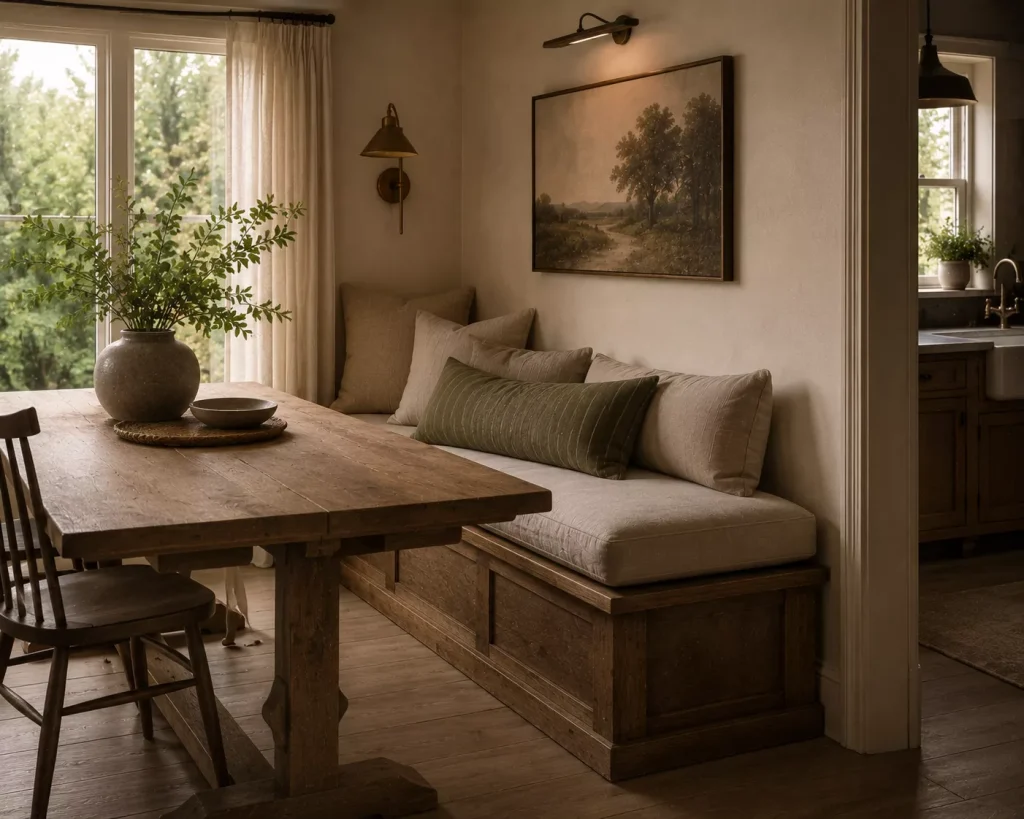
Idea 1: Put a simple wood or upholstered bench against the wall.
This can be a built-in banquette, a freestanding bench, or even a sturdy vintage church pew if the proportions work.
Banquettes are having a particularly strong moment because they make efficient use of walls and corners while creating a more inviting place to linger. Designers are carrying them into 2027 kitchens as both practical seating and a social feature.
For a casual nook, I usually like a seat height around 18 inches before adding a thick cushion. Keep enough table clearance so nobody has to squeeze awkwardly behind it.
Built-in or freestanding?
Built-ins look polished and can include storage underneath.
But they’re expensive and permanent.
A freestanding bench gives renters and budget-conscious homeowners much more flexibility. Current furniture options are increasingly mimicking custom banquette seating without requiring a carpenter, which makes this look easier to achieve in ordinary kitchens.
And please prioritize comfort.
A beautiful straight-backed wooden bench gets much less charming around minute 25 of Sunday breakfast.
2. Choose a table that fits the corner, not the number on the box
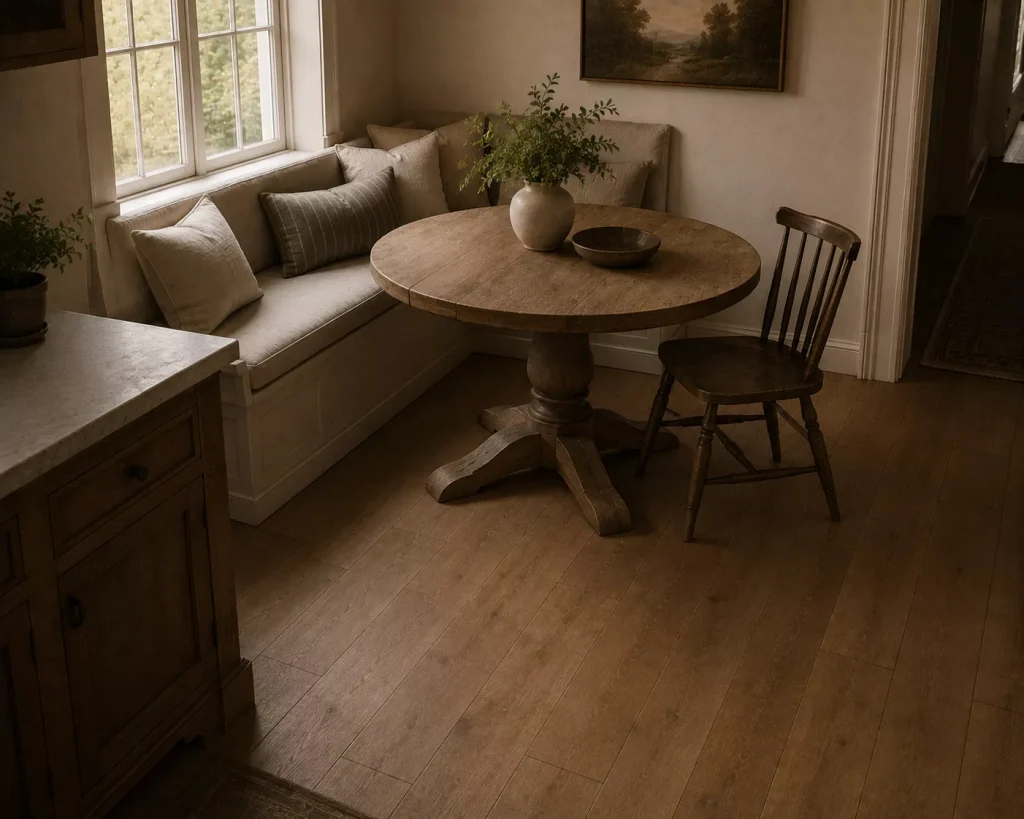
Idea 2: Let circulation determine your table shape.
Round pedestal tables are excellent for compact breakfast nooks because there aren’t four table legs fighting with four sets of human legs.
A 36 to 42-inch round table can work well for two to four people, depending on the chairs and available space.
For a longer banquette, try a rectangular farmhouse table around 30 to 36 inches wide. Narrower tables often suit kitchen nooks better than full dining-room proportions.
Everyone says farmhouse means a big chunky trestle table.
But actually, those substantial bases can be annoying in a small nook.
A pedestal or slim-leg table usually gives people more freedom to slide along the bench.
Try reclaimed-looking oak, medium-toned pine, walnut, or painted wood.
I’m less interested in heavily distressed finishes than I used to be. Genuine grain, knots, small scratches, and natural variation create plenty of character without artificially sanding every corner white.
The broader 2026 move toward patina and materials that age naturally fits farmhouse spaces particularly well.
Your breakfast table should look better after ten years of coffee cups, not require ten years of fake damage on day one.
3. Bring in checked or striped fabric without making it costume-like
Fabric is one of the easiest ways to make a hard kitchen corner feel cozy.
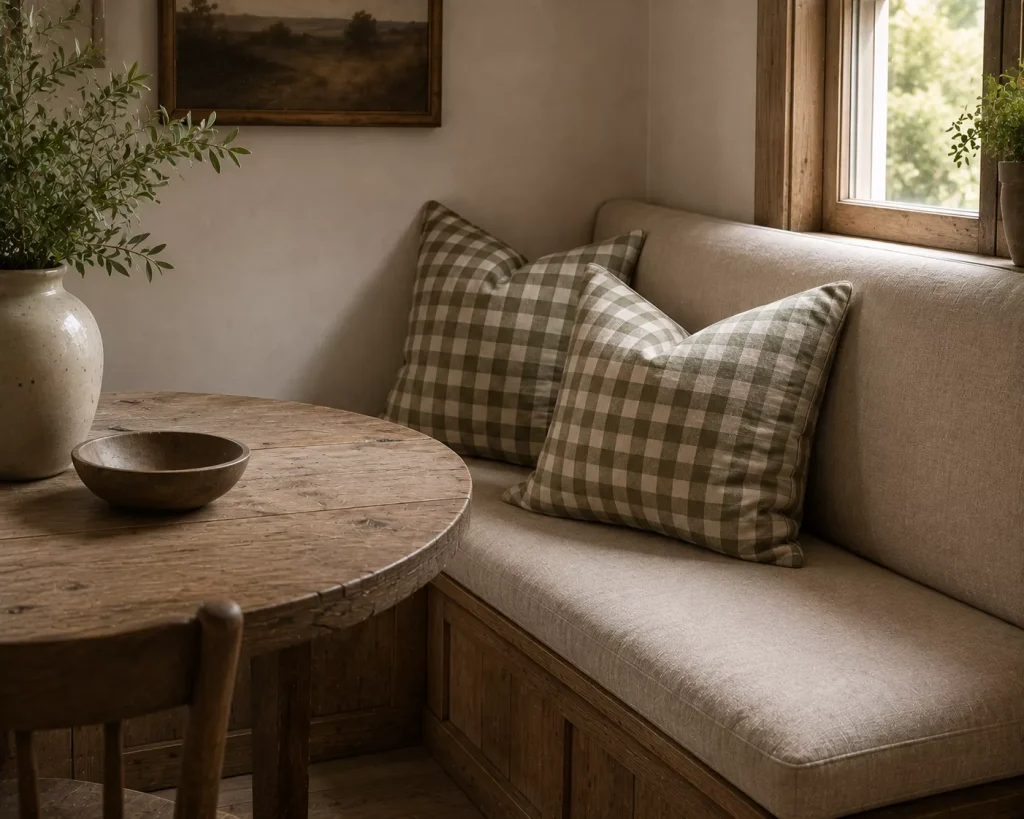
Idea 3: Use one traditional pattern in a restrained way.
Small gingham, ticking stripes, muted checks, faded florals, and narrow woven stripes all work beautifully in a farmhouse nook.
You might upholster the bench in oatmeal linen and use two olive gingham cushions.
Or choose a blue-gray striped seat cushion and keep everything else plain.
Classic textiles and craft-based details are resurfacing alongside the wider 2026 interest in Americana, traditional craftsmanship, quilts, honest materials, and objects with a sense of history.
The key word is restraint.
If the seat is checked, the curtains don’t also need to be checked.
And the rug definitely doesn’t need miniature roosters.
Here’s what nobody tells you about breakfast-nook cushions. Light cream fabric beside tomato sauce is a lifestyle choice.
If children, pets, or enthusiastic coffee drinkers use the nook, choose a washable cover or a medium-toned fabric with some visual texture.
Olive, faded indigo, camel, warm gray, and tobacco brown forgive everyday life much better than fresh ivory.
That’s practical farmhouse decorating.
4. Use warm wood with painted furniture for a collected look

Idea 4: Mix wood and painted finishes instead of buying a matching set.
A farmhouse nook feels more believable when the furniture looks gathered over time.
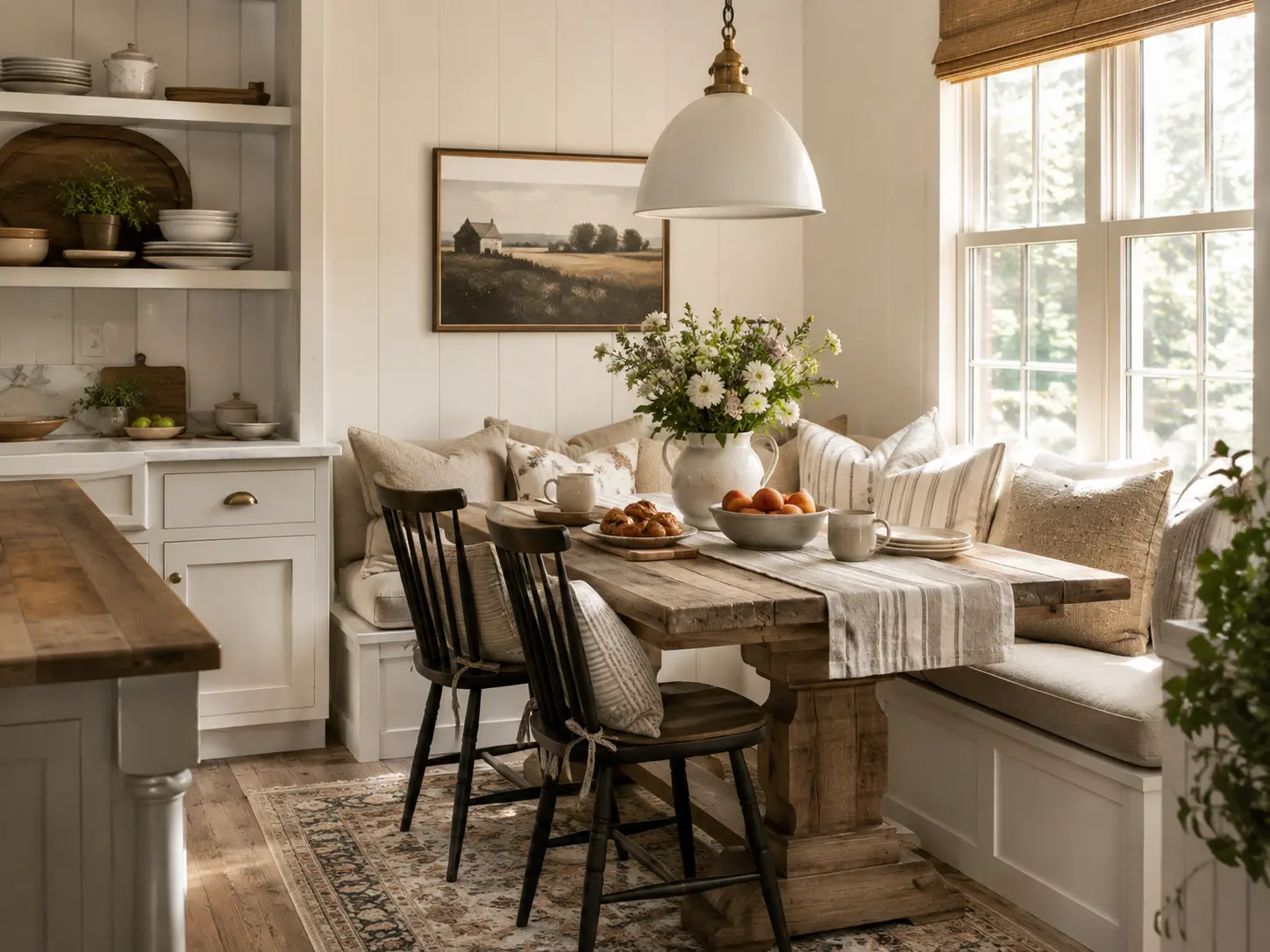
Try an oak table with black Windsor-style chairs.
Pair a dark walnut table with a cream bench.
Use a painted sage-green chair alongside natural wood.
The contrast keeps things relaxed.
Scandi-farmhouse interiors are also blending simple shapes, natural wood, warm neutrals, and practical traditional details rather than relying on overtly rustic decoration.
I particularly like mixing one darker wood into a light kitchen.
If you have cream cabinets and pale flooring, a medium walnut or aged oak table gives the nook enough visual weight.
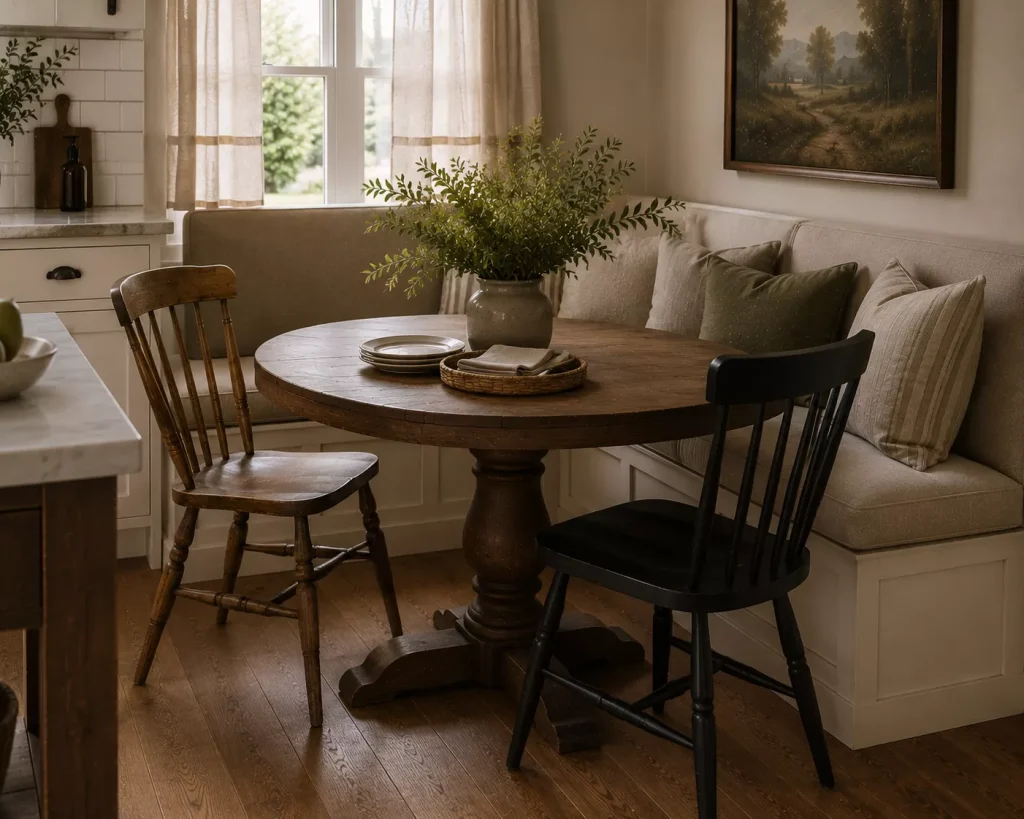
Idea 5: Add one vintage chair rather than an entire vintage set.
One old spindle-back chair at the end of a banquette can be enough.
It introduces age without making the nook uncomfortable or difficult to maintain.
Inspect secondhand chairs properly before buying. Wiggle the back, check the joints, and actually sit in them.
There’s charmingly imperfect.
Then there’s collapsing halfway through breakfast.
The first one is farmhouse character.
The second one is a repair project.
5. Make the pendant light the visual anchor
Breakfast nooks often occupy leftover corners.
Lighting makes them feel intentional.
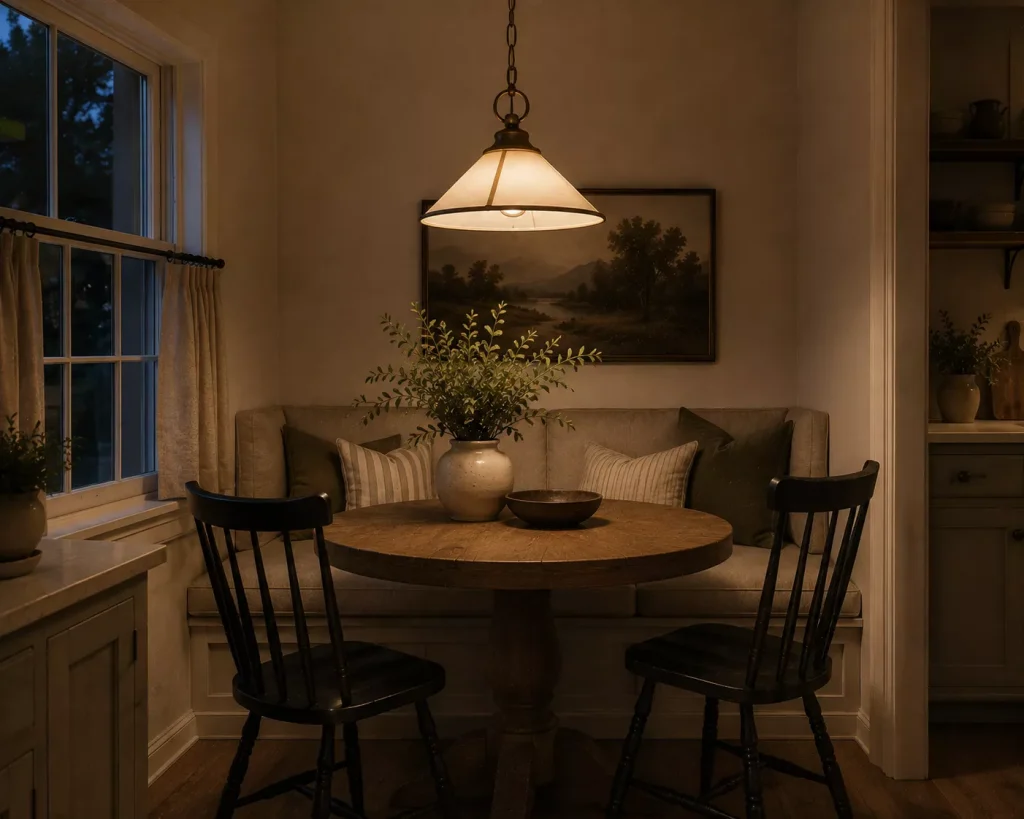
Idea 6: Hang one substantial fixture over the table.
Try aged brass, blackened metal, opal glass, woven fiber, or a simple fabric shade.
For a more traditional farmhouse direction, a lantern-style fixture can work beautifully.
For something cleaner, use a milk-glass globe or understated metal pendant.
Current kitchen design is treating decorative and mood lighting as a larger part of how gathering spaces feel, a direction expected to continue into 2027.
I’d rather use one properly scaled pendant than cover the surrounding walls in farmhouse accessories.
Don’t hang it at forehead height
Over a dining table, I generally start with the bottom of the fixture around 30 to 36 inches above the tabletop, then adjust for ceiling height and the actual fixture.
A large opaque shade may need to sit slightly higher.
A visually lighter lantern can often come lower.
The table protects the fixture from normal walking traffic, but you still want people seated across from each other to see comfortably.
Use warm light in the evening.
Breakfast may happen under daylight, but that nook will probably host dinner, homework, and late-night tea too.
6. Give the walls character with something other than farmhouse signs
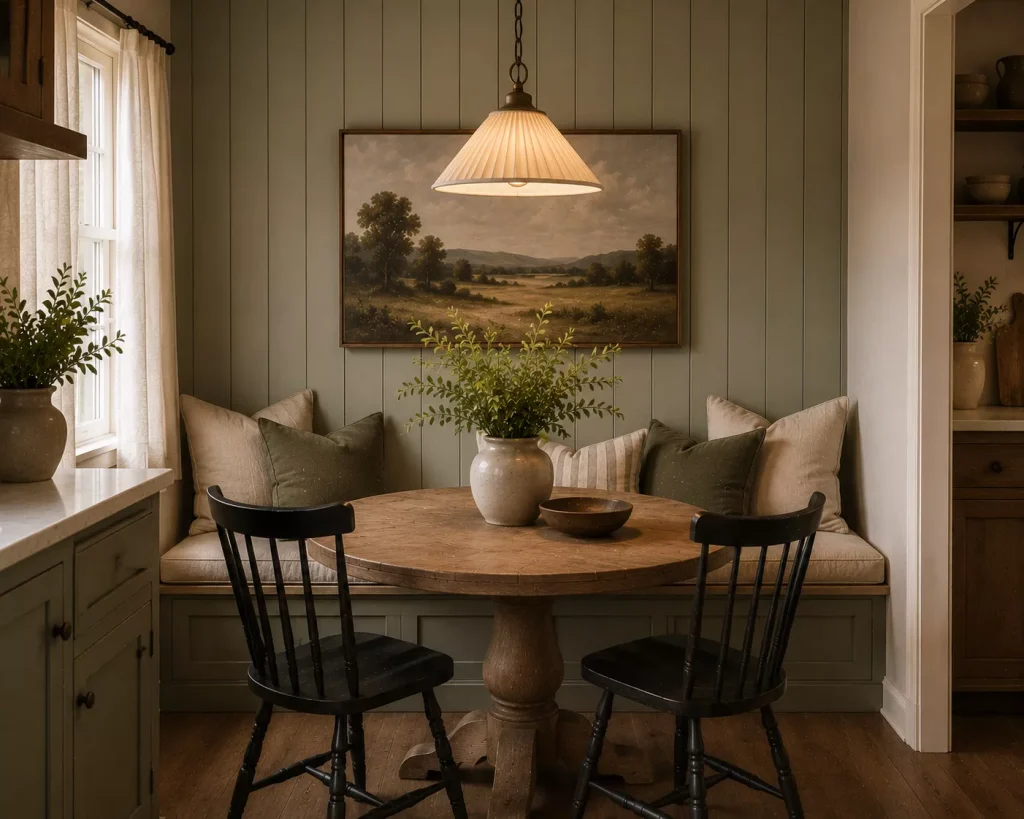
Idea 7: Use art, paneling, or wallpaper to define the nook.
This is where I’d move away from the older farmhouse formula.
You don’t need a wooden sign telling everyone to “Gather.”
They already know they’re sitting at a table.
Try tongue-and-groove paneling painted warm white, dusty sage, putty, or muted blue.
In a rental, one large landscape print or a small group of vintage botanical pictures can create a similar focal point without construction.
Wallpaper works particularly well in enclosed nooks.
A tiny floral, soft stripe, or block-printed botanical can make the corner feel like its own little room.
If your kitchen already has patterned tile or colorful cabinetry, keep the nook wall quieter.
Farmhouse style works best when traditional detail has room to breathe.
I like one substantial landscape painting above a wood bench, perhaps something with fields, trees, or muted sky colors.
Not because the subject has to be rural.
It simply brings softness to an area dominated by cabinets, counters, and hard surfaces.
7. Turn the bench into hidden storage if your kitchen needs it
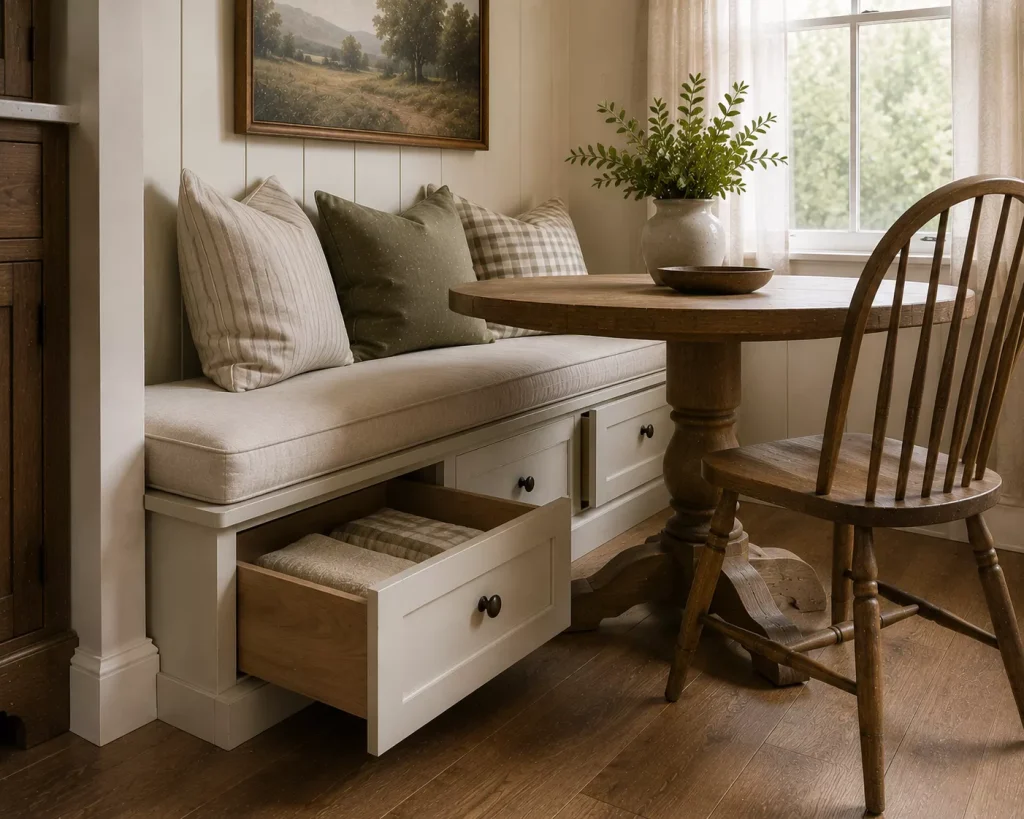
Idea 8: Make the seating earn its floor space.
A breakfast nook bench can hide far more than cushions.
Deep drawers or lift-up compartments can store table linens, baking equipment, seasonal serving pieces, children’s craft supplies, or small appliances you don’t use every day.
Storage banquettes are particularly useful in compact kitchens because they combine seating with a function that would otherwise require another cabinet or furniture piece.
But there’s a catch.
A lift-up seat becomes annoying if the tabletop has to move every time you need something.
For items you use frequently, front-facing drawers are easier.
Reserve lift-up storage for things you reach for occasionally.
You can also fake built-in storage with large lidded baskets beneath an open bench.
That works well for renters.
Just measure the baskets before buying the bench, not afterward.
Nothing makes a storage idea less useful than discovering the beautiful basket is half an inch too tall.
8. Keep the tabletop simple enough for breakfast to actually happen
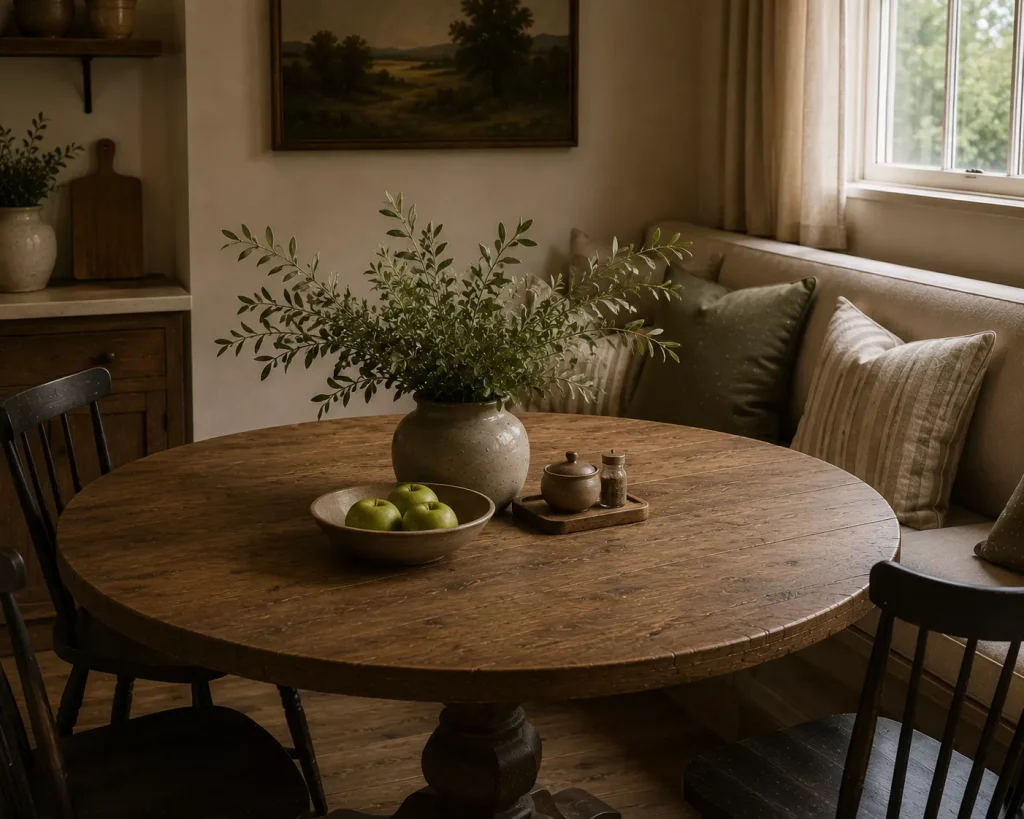
Idea 9: Style the table with one useful centerpiece.
A breakfast nook isn’t a formal dining table.
It doesn’t need an elaborate arrangement occupying the middle.
Try a low ceramic bowl filled with fruit, a small crock of fresh herbs, or a simple stoneware vase with branches.
That’s plenty.
Handmade-looking ceramics, woven baskets, aged wood, and other craft-based materials work especially well with the current return to more personal and lived-in interiors.
Leave enough room for plates.
That sounds obvious, but styled interiors regularly forget that tables eventually encounter food.
I also like keeping a small tray nearby for salt, pepper, napkins, or sugar if you use them often.
Practical objects become part of the decor when their materials are good.
Here’s how I’d prioritize a small nook:
| Feature | Worth prioritizing | Easy place to save |
|---|---|---|
| Table | Stable construction and correct size | Perfectly distressed finish |
| Bench | Comfort and durable fabric | Custom upholstery details |
| Lighting | Proper scale and warm light | Expensive designer fixture |
| Cushions | Washable, comfortable fabric | Large quantities |
| Wall decor | One meaningful focal point | Multiple themed signs |
| Storage | Easy access | Elaborate custom hardware |
The best farmhouse nook isn’t the one with the most accessories.
It’s the one people naturally use.
9. Add a little color so farmhouse doesn’t become beige and brown
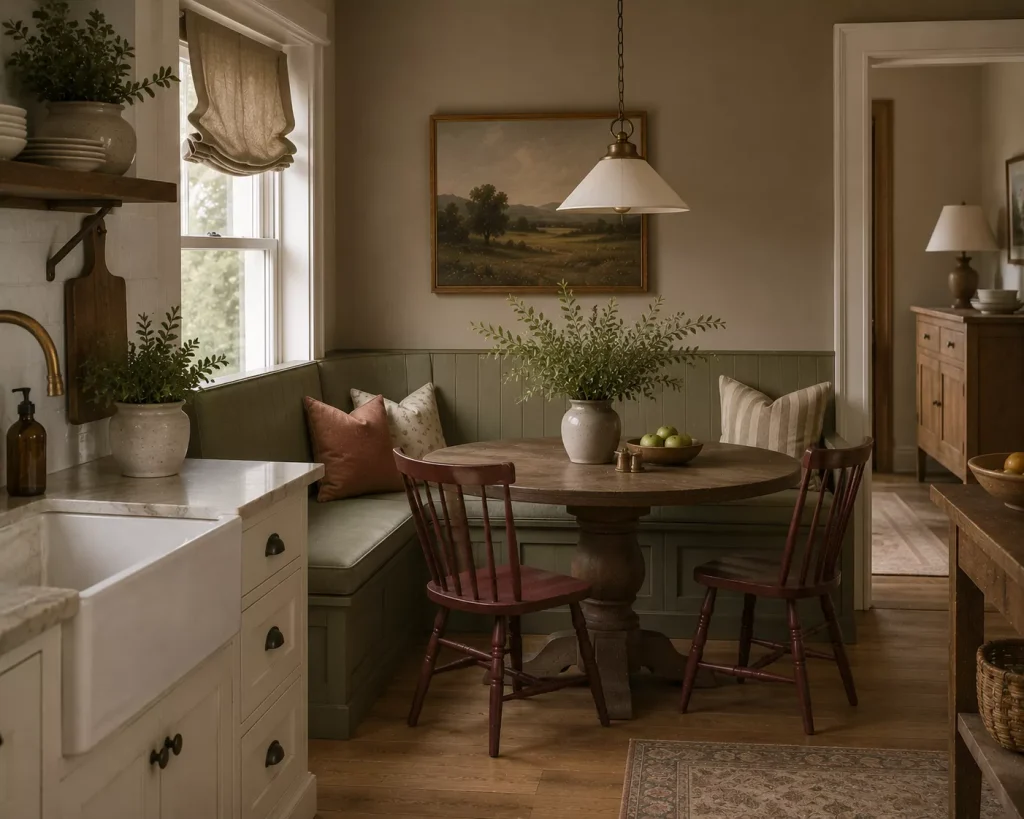
Idea 10: Bring in muted color through paint, upholstery, or chairs.
Farmhouse rooms don’t have to be white.
Try dusty blue, sage, terracotta, muted mustard, burgundy, or mouse-brown tones.
Warm neutrals and richer, more expressive shades are already appearing in forward-looking 2027 color direction, alongside a wider move away from cold gray and default white.
A sage banquette beside a walnut table feels rooted and calm.
Muted red spindle chairs can make a pale kitchen much more memorable.
Even one blue-gray cushion can break up a beige corner.
If you want something subtler, paint the wall behind the nook a putty or mushroom tone just slightly deeper than the surrounding kitchen.
That gives the area definition without creating a dramatic feature wall.
Farmhouse style has always been good at absorbing color because wood and natural textiles soften it.
So don’t be afraid of something beyond cream.
The room will often look more personal for it.
What should you skip in a farmhouse breakfast nook?
I’d start with excessive farmhouse wording.
Signs about coffee, family, kitchens, farms, and gathering don’t create character by themselves.
Neither does filling every surface with miniature galvanized buckets.
Skip furniture that looks distressed solely because somebody attacked the edges with sandpaper.
Natural wear is warmer.
I’d also avoid an oversized table in a tight corner.
The table might technically fit, but if people have to move it every time someone gets onto the bench, you’ll get tired of the arrangement quickly.
And don’t prioritize appearance over the seat cushion.
Thin foam on a hard bench looks neat but feels terrible during a long meal.
The current direction toward banquettes and gathering-focused kitchens makes sense because comfort is becoming part of the design conversation, not an afterthought.
A breakfast nook should encourage you to stay five minutes longer.
If it doesn’t, the decor isn’t solving the right problem.
FAQ About Farmhouse Breakfast Nooks
Does a farmhouse breakfast nook need built-in seating?
No. A freestanding bench can create almost the same effect and gives you much more flexibility. This is especially useful for renters or anyone who doesn’t want to pay for custom carpentry.
What table shape works best in a small breakfast nook?
Round pedestal tables are particularly useful in tight corners because they simplify movement and eliminate corner collisions. A narrow rectangular table can work better with a long straight banquette.
What colors work well in a farmhouse breakfast nook?
Cream, warm white, oak, walnut, sage, dusty blue, muted red, terracotta, and soft brown all fit naturally. Keep the palette warm and slightly muted so the nook still feels relaxed.
How can I make a breakfast nook feel cozy without clutter?
Focus on comfort and scale. Add a proper seat cushion, warm pendant light, one piece of substantial artwork, and perhaps two cushions. Leave the tabletop mostly clear.
The farmhouse nook I mentioned at the beginning improved when we stopped decorating around the word “farmhouse.”
The old wood table already had character. What it needed was a comfortable bench, better lighting, and enough empty space for those elements to matter.
That’s how I’d approach these 10 farmhouse breakfast nook ideas in your own kitchen.
Measure the corner first. Then decide where people will sit and how they’ll get in and out before choosing paint, cushions, or wall decor.
After that, add one old-looking material, one soft layer, and something personal.
If the finished nook makes you linger over your coffee a little longer than planned, it’s doing exactly what it should.