10 rustic farmhouse bathroom designs for Warm Country Charm
A rustic farmhouse bathroom should feel like it belongs to the house, not like somebody bought a box labeled “farmhouse decor” and emptied it beside the sink.
The rooms that work best have a few honest materials doing most of the decorating. Think warm oak, painted cabinetry, aged brass, stone, simple tile, woven storage, and towels you’re actually happy to use. They can feel old without being outdated and rustic without becoming rough.
That’s the approach behind these 10 rustic farmhouse bathroom designs.
I once helped rethink a small bathroom that had shiplap, a distressed vanity, galvanized accessories, and several wooden signs. Strangely, it still felt cold. We removed most of the themed pieces, changed the lighting, brought in a natural wood mirror, and added a muted green vanity.
The bathroom immediately felt warmer, quieter, and much more believable.
1. Start with a wood vanity that has real visual weight
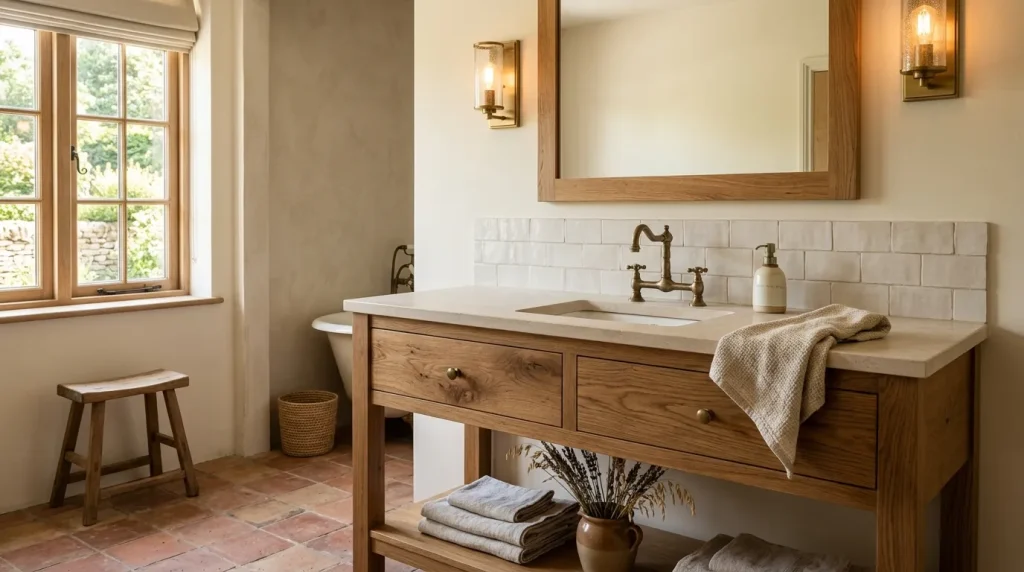
Design 1: Make the vanity the rustic anchor.
Bathrooms contain plenty of hard, cool surfaces, so wood makes an immediate difference.
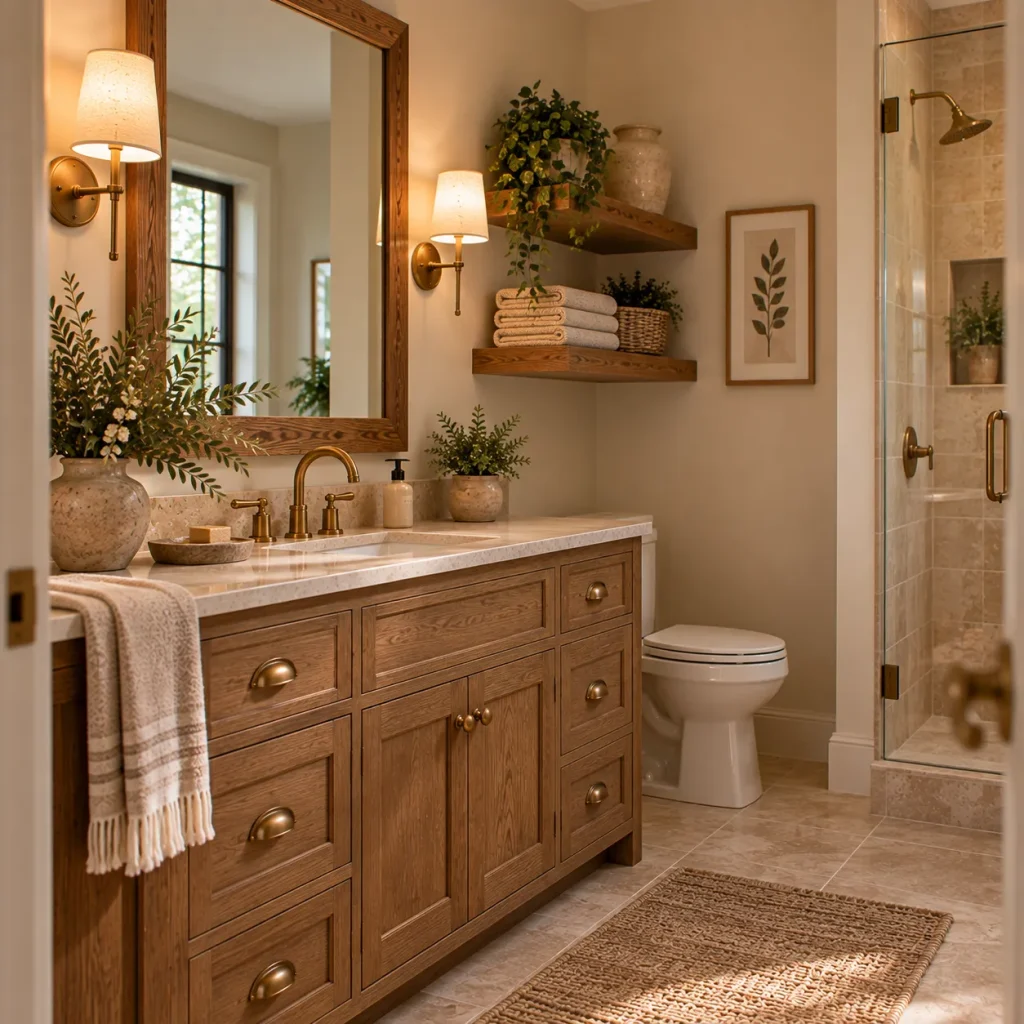
A medium-oak vanity can warm white tile without making the room dark. Walnut works beautifully with cream walls and brass fixtures. Pine or reclaimed-looking wood suits a rougher country style.
You don’t need obvious distressing.
Visible grain and slight tonal variation usually provide enough character.
For a 5-by-8-foot bathroom, a 30 to 36-inch vanity may give you useful storage without overwhelming the floor. In a larger primary bathroom, something around 60 inches can support double sinks if your plumbing and layout allow it.
Protect wood properly
Bathrooms are wet.
That sounds obvious, but rustic inspiration photographs sometimes make unfinished timber look more practical than it is.
Choose bathroom-suitable cabinetry and protect exposed wood from standing water. Wipe splashes around the sink rather than letting moisture sit.
If you love old furniture, converting a vintage dresser into a vanity can look wonderful. Just remember that cutting for plumbing, sealing the top, and adjusting drawer interiors can turn a cheap secondhand find into a more involved project.
Sometimes a new vanity with a convincing wood finish is the smarter choice.

2. Mix painted cabinetry with natural wood
Design 2: Use earthy paint to keep the bathroom from becoming a wall of brown.
Rustic doesn’t require timber on every surface.
One of my favorite combinations is a muted painted vanity with a natural wood mirror.
Try dusty sage, deep olive, mushroom, warm cream, muted navy, or clay-toned taupe.
A sage vanity below a walnut-framed mirror feels softer than another matching wood cabinet. A cream vanity with brass hardware and an oak stool can make a small bathroom feel lighter.
This is also an easy way to work with what you already have.
If your vanity is structurally sound but the finish feels dated, paint may be more sensible than replacement. Preparation matters, especially around surfaces exposed to moisture.
Keep the color slightly muted
Bright grassy green can look energetic.
Muted olive usually feels more settled beside stone, tile, and timber.
The same applies to blue. Dusty indigo or blue-gray tends to fit rustic farmhouse rooms more naturally than a vivid coastal blue.
You’re aiming for color that looks comfortable beside natural materials.
Not color that makes the vanity the only thing you notice.
3. Use classic tile, but avoid making every surface busy
Design 3: Choose simple tile with texture or slight variation.
Subway tile works because it’s simple.
But standard glossy white isn’t your only option.
Look at warm white, cream, pale greige, handmade-looking square tile, or softly irregular subway tile.
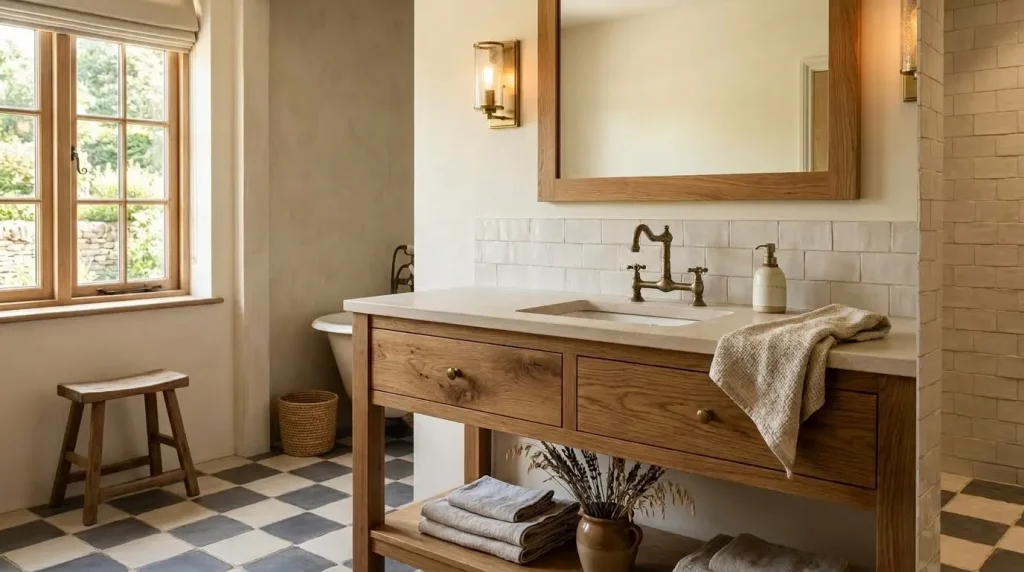
For floors, small hexagon tile, muted checkerboard, limestone-look porcelain, or brick-inspired designs can bring more character.
Design 4: Let either the floor or shower carry the stronger pattern.
If you use a bold checkerboard floor, keep shower walls relatively quiet.
If the shower has a patterned tile, choose a calmer floor.
I’ve seen small bathrooms where patterned floor tile, decorative shower tile, wallpaper, striped towels, and colorful art were all individually attractive.
Together, they were exhausting.
Here’s a practical comparison:
| Surface choice | Farmhouse strength | Main trade-off |
|---|---|---|
| Cream subway tile | Simple and flexible | Grout needs maintenance |
| Checkerboard floor | Strong vintage character | Can dominate a tiny room |
| Limestone-look porcelain | Warm and practical | Less natural variation than stone |
| Real stone | Beautiful aging and texture | Higher maintenance |
| Small hex tile | Classic bathroom feel | More grout lines to clean |
Real stone is lovely if you’re comfortable with its maintenance.
If not, good porcelain can provide much of the visual warmth with fewer worries.
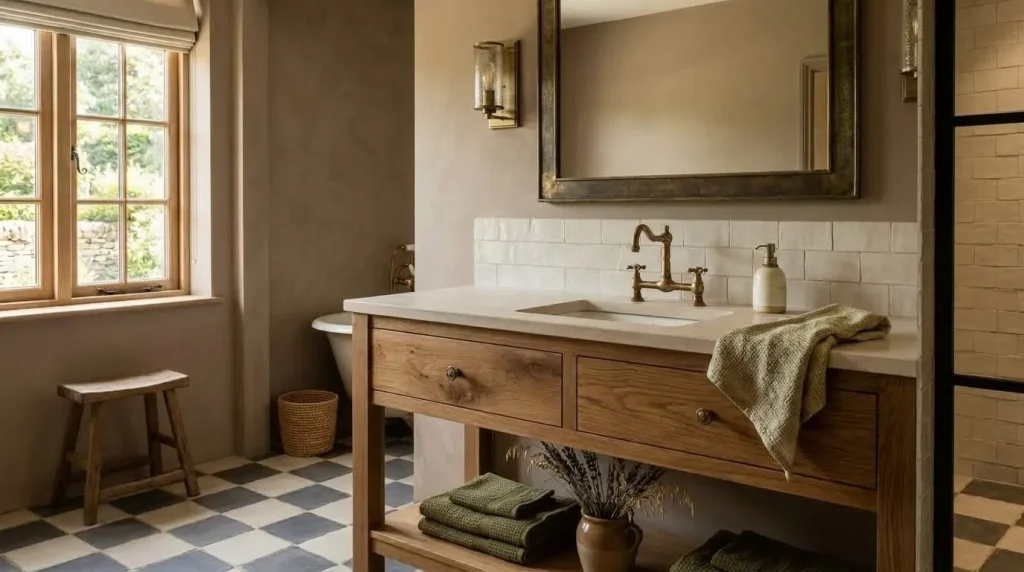
4. Bring in aged brass or blackened metal carefully
Design 5: Choose one main metal finish and repeat it.
Aged brass works beautifully with warm wood, cream tile, olive paint, and stone.
Blackened metal gives the room a slightly stronger, cleaner edge.
Polished nickel can also work if you want the bathroom to feel more traditional than rustic.
The key is consistency.
You don’t need an exact match on every fixture, but the finishes should feel related.
For example, use aged brass on the faucet, mirror, and cabinet pulls. Let the shower frame remain black if replacing it would be impractical.
That’s fine.
Real bathrooms often inherit fixed finishes.
Trying to replace every fitting purely for visual purity can become expensive very quickly.
Don’t use “aged” finishes everywhere
One brass faucet has character.
A brass faucet, brass towel rail, brass light, brass toilet-roll holder, brass hooks, brass shelf brackets, and brass soap dish can start feeling like a showroom display.
Choose a few points where the metal actually matters.
Let wood, tile, textiles, and paint do the rest.
Rustic rooms usually look better when no single material is trying too hard.

5. Let the shower or tub feel simple and substantial
Design 6: Use a freestanding tub only if the room genuinely has space.
Claw-foot tubs and farmhouse bathrooms are an easy match.
But they need room around them.
If squeezing one into the bathroom leaves three inches between the tub and vanity, the charm wears off quickly.
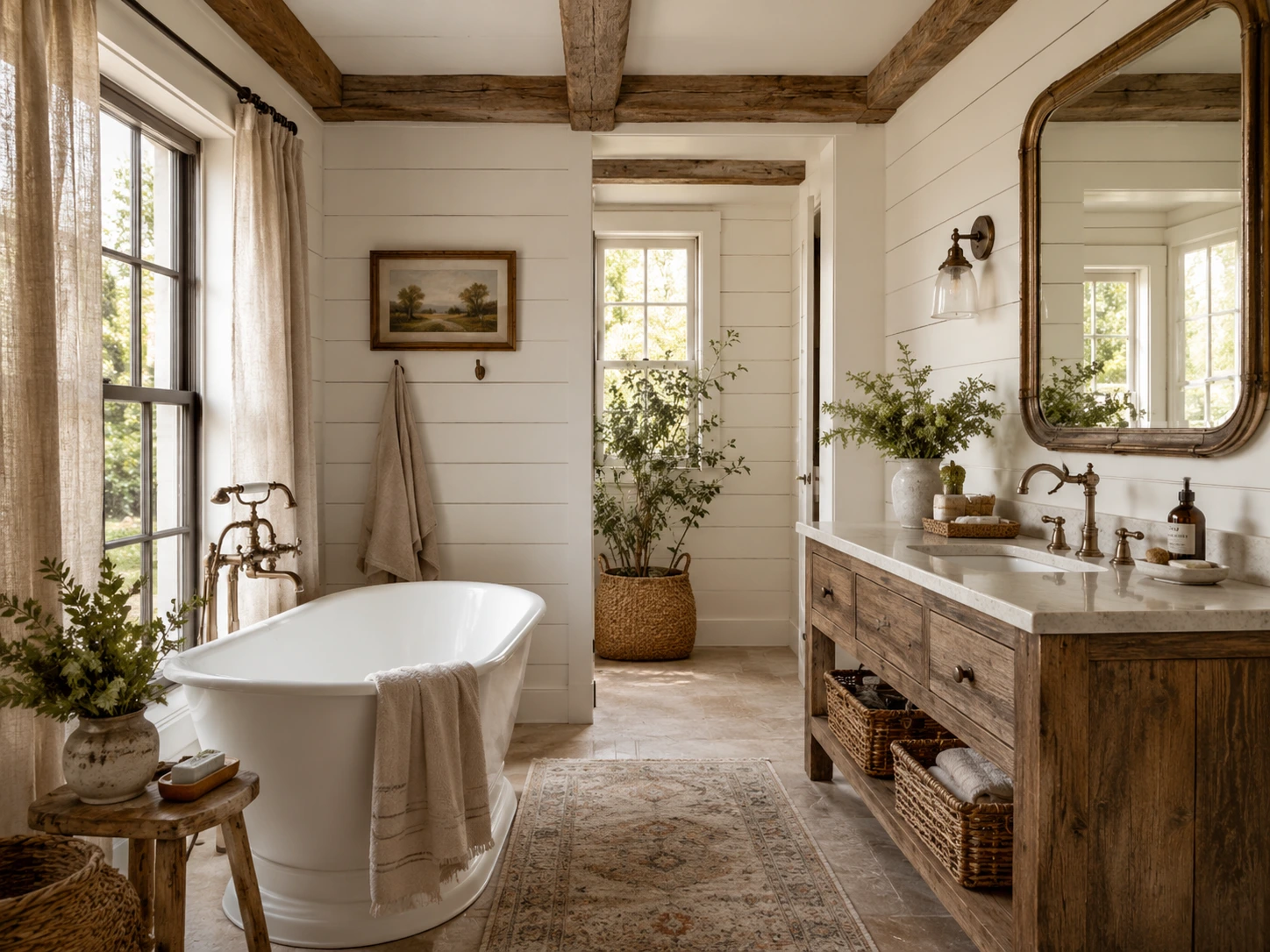
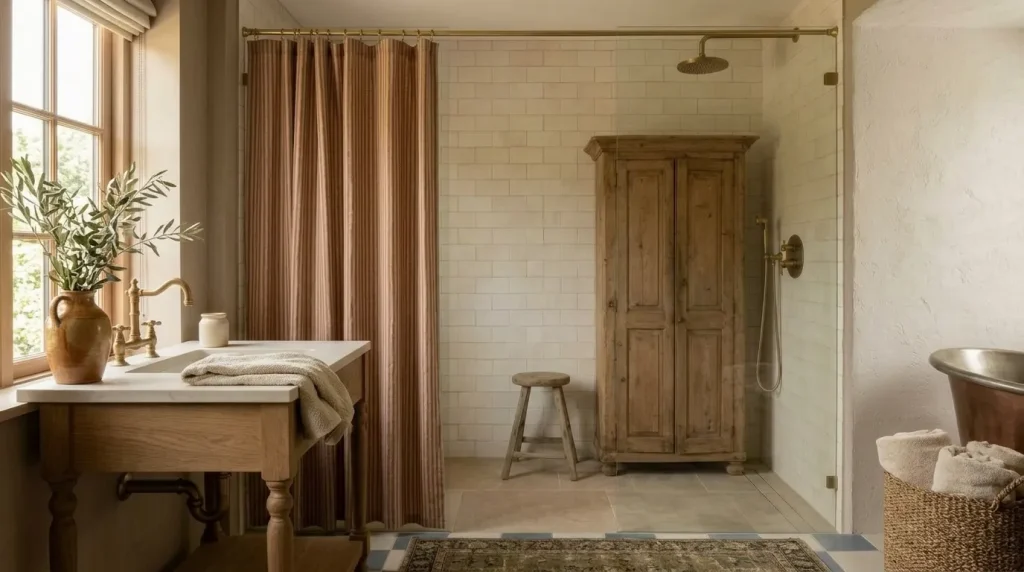
In a larger bathroom, a white freestanding tub against warm plaster-colored walls can look beautiful. Add a simple stool nearby for a towel or book.
In smaller rooms, keep the existing built-in tub and improve what surrounds it.
Warm tile, a proper curtain, new fixtures, and better lighting may create more impact than replacing a perfectly functional bathtub.
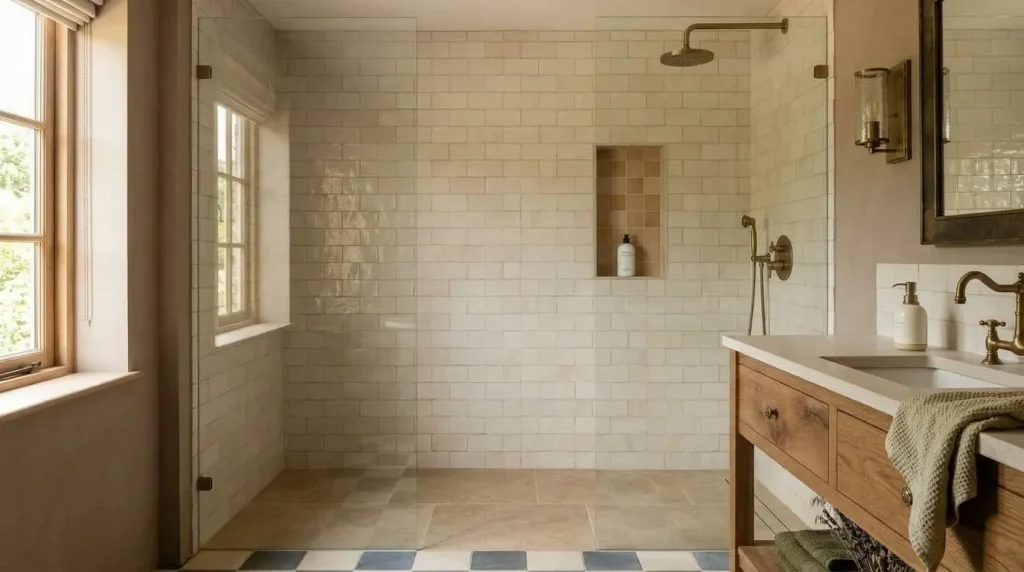
Design 7: Make a walk-in shower feel warmer through material, not decoration.
Use cream tile, stone-look flooring, aged metal fixtures, or a small built-in niche with a wood-look or contrasting tile detail.
Avoid adding decorative objects inside the shower.
Nobody needs a tiny wooden sign next to the shampoo.
A practical shower should stay easy to clean.
That’s especially important in rustic bathrooms because textured materials already introduce plenty of visual detail.
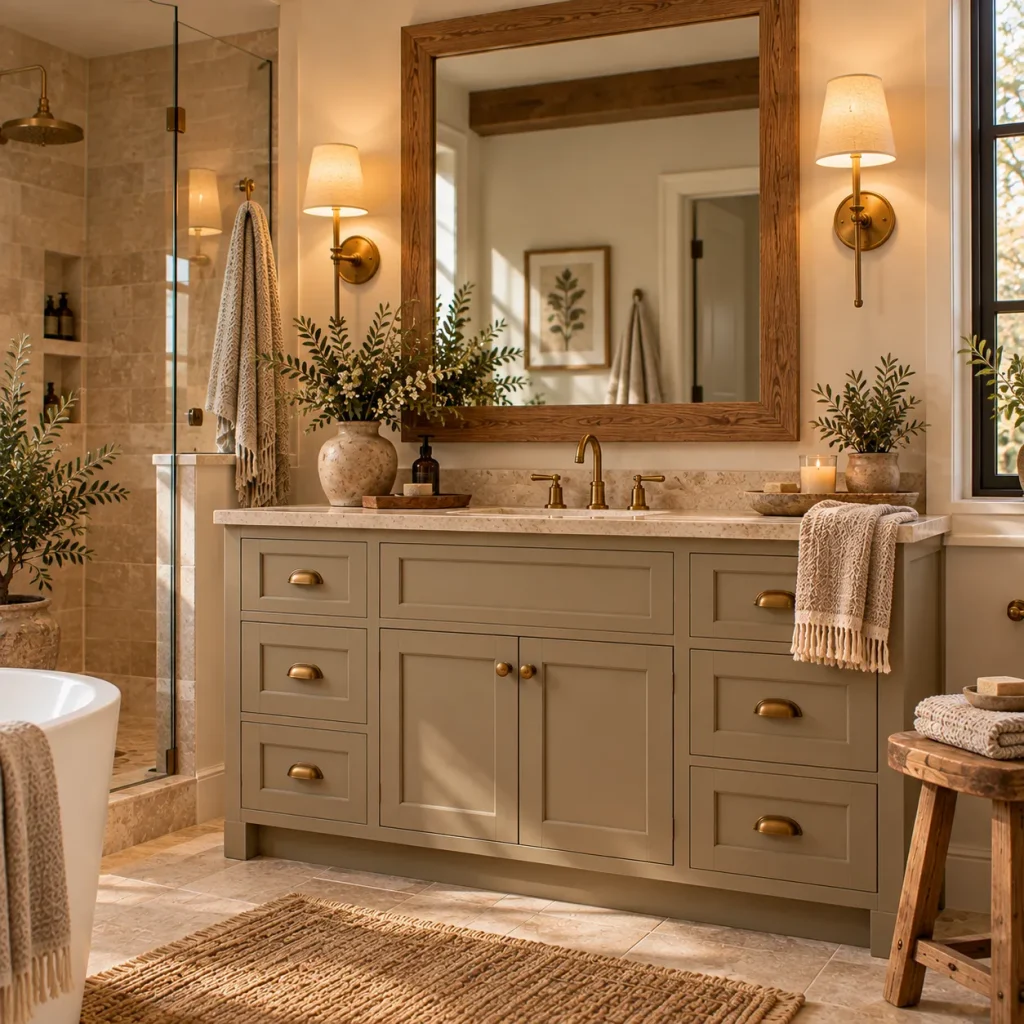
6. Use mirrors and lighting to soften all the hard surfaces
Bathrooms can become surprisingly cold under bright overhead lighting.
Design 8: Choose a mirror with enough material presence.
A wood-framed mirror is an obvious farmhouse choice, and for good reason.
Try medium oak, walnut, or a slightly aged darker wood.
For something different, an antique-style brass mirror can add warmth without adding another wood surface.
In a small powder room, a round mirror around 24 to 30 inches wide may soften the straight lines of the vanity and tile. Over a larger vanity, a substantial rectangular mirror often gives you better function.
Then fix the lighting.
Wall sconces beside the mirror usually provide more flattering facial light than one fixture directly overhead.
If side sconces aren’t possible, a well-scaled light above the mirror can still work.
Use warm enough light that the bathroom feels comfortable, while keeping it bright enough for shaving, makeup, and getting ready.
I’m all for atmosphere.
I’m less enthusiastic about applying mascara in near darkness for the sake of rustic charm.
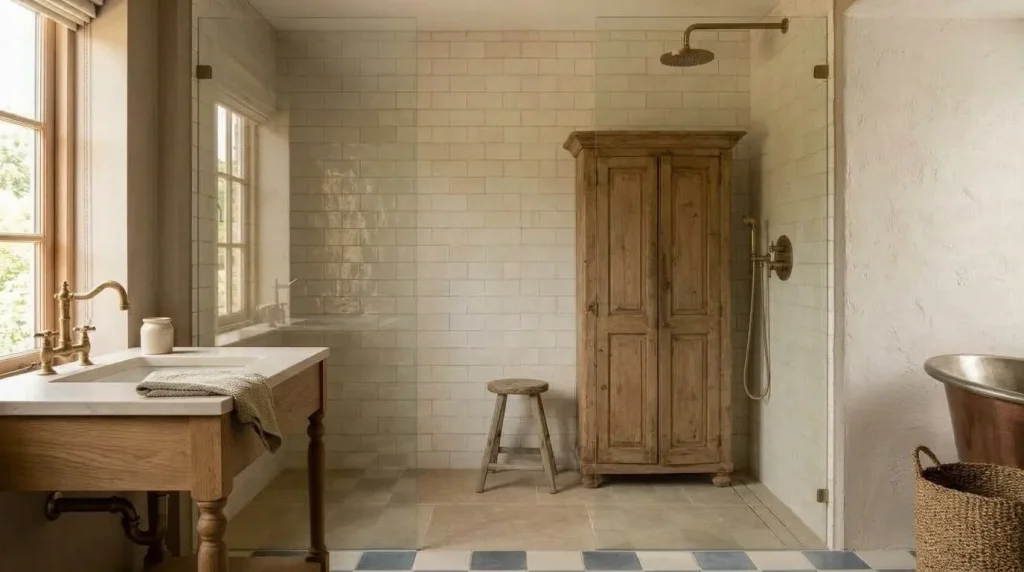
7. Add storage that looks like furniture
Design 9: Use one freestanding storage piece where the room allows it.
A narrow cabinet, old painted cupboard, wood stool, or small chest can make a bathroom feel less built-in and more collected.
This works particularly well in larger bathrooms where wall-to-wall cabinetry would feel heavy.
A vintage cabinet can store towels and toiletries behind closed doors.
A simple wood stool beside the tub can hold one folded towel.
A narrow ladder can work for towels too, although it’s less useful if every rung ends up holding clothing.
For smaller bathrooms, wall-mounted shelves may make more sense.
Use one or two solid wood shelves above the toilet or beside the vanity.
Keep everyday objects in baskets, boxes, or simple jars.
Open shelving should contain things worth seeing.
Spare toilet paper can look perfectly neat in a basket.
Seven half-used bottles of cleaning products are better behind a door.
Choose closed storage for visual clutter
Farmhouse rooms are sometimes styled with everything visible.
Real life is less cooperative.
Toothpaste, medicine, razors, spare toiletries, hair tools, and cleaning products rarely improve the room visually.
Hide most of them.
Then let towels, ceramics, baskets, and a few useful objects provide the rustic character.
8. Soften the room with textiles and one natural detail
Design 10: Use towels, rugs, and fabric to interrupt the tile.
Bathrooms need softness.
A muted striped shower curtain can add pattern without construction. Warm white linen-look curtains work beautifully if you have a window that needs privacy.
For rugs, look at washable cotton or low-pile options in rust, olive, taupe, faded blue, or charcoal.
Avoid putting an expensive antique rug beside a tub if you know the floor regularly gets soaked.
A pretty rug that causes anxiety every time somebody showers is not a successful purchase.
Then add one natural detail.
This might be a ceramic vase with clipped branches, a small plant suited to the bathroom’s light, or a woven basket filled with towels.
You don’t need all three.
One small plant beside the window can provide enough life.
And don’t assume farmhouse means dried eucalyptus hanging from every showerhead.
It can look lovely, but it’s become such an automatic styling move that bathrooms quickly start feeling copied.
Use greenery because the room needs it.
Not because the aesthetic checklist says so.
What should you skip in a rustic farmhouse bathroom?
Start with obvious bathroom signs.
You probably don’t need a sign telling people where the bathroom is once they’re standing beside the toilet.
Skip fake distressing on every piece of furniture too.
One worn cabinet can have charm. An entire bathroom covered in factory-created scratches feels forced.
I’d also be careful with excessive shiplap.
It can work beautifully on one wall or around part of the room. Covering every wall in a small bathroom may create more lines than the space needs.
Then there’s wood around wet areas.
Use it intelligently.
A wood mirror frame is easy. A wood stool is manageable. Raw timber inside a constantly wet shower is another situation entirely.
Rustic style should never require fighting moisture damage.
Finally, avoid crowding every surface.
A farmhouse bathroom can still be clean and restrained.
Leave part of the vanity empty.
Give the mirror room to breathe.
Let the grain of the wood and texture of the tile count as decoration.
Try this if you’re updating a rental bathroom
You can get surprisingly close to this look without replacing tile or plumbing.
Start with the mirror.
If the existing one can’t be removed, consider framing it where your lease allows.
Next, change easily reversible items such as the shower curtain, rug, towels, and countertop accessories.
Use warm white, sage, muted blue, oatmeal, and rust rather than trying to cover everything in brown.
A woven basket can hide spare toiletries.
A small wood stool adds warmth.
If your lease permits swapping hardware, changing cabinet pulls can make a basic vanity feel more considered. Keep the originals so you can reinstall them when moving.
Then add better lighting where possible, even if that simply means choosing warmer bulbs.
A rental bathroom doesn’t need fake shiplap to feel rustic.
Material contrast does most of the work.
FAQ About Rustic Farmhouse Bathrooms
What colors work best in a rustic farmhouse bathroom?
Warm white, mushroom, cream, sage, olive, muted blue, clay, charcoal, and natural wood tones all work well. Use one deeper shade for contrast so the bathroom doesn’t become entirely pale.
Can rustic farmhouse style work in a small bathroom?
Yes. Use one strong wood element, simple tile, closed storage, and a restrained palette. Avoid filling a small bathroom with several heavily distressed furniture pieces.
What flooring suits a farmhouse bathroom?
Stone-look porcelain, small hex tile, checkerboard tile, and warm neutral porcelain all suit the look. Bathroom flooring also needs to handle moisture safely, so practicality should come before recreating an old farmhouse floor exactly.
How can I make a farmhouse bathroom look more current?
Use fewer themed accessories and concentrate on natural materials, warmer color, simple cabinetry, substantial lighting, and one or two vintage-inspired details. Let the room feel rustic through its materials rather than its decorations.
What to do next
That bathroom I mentioned at the beginning improved because we removed more than we added.
The signs disappeared. The artificial distressing stopped dominating the room. A green vanity, wood mirror, and better light gave the space enough character on their own.
Use these 10 rustic farmhouse bathroom designs the same way.
First, identify the largest surface that feels too cold, perhaps the vanity, floor, or wall color. Then introduce one warmer material. Finally, remove one themed accessory that doesn’t actually earn its place.
You don’t need your bathroom to look like it belongs in a century-old farmhouse.
You just need it to feel warm, sturdy, comfortable, and a little better with age.