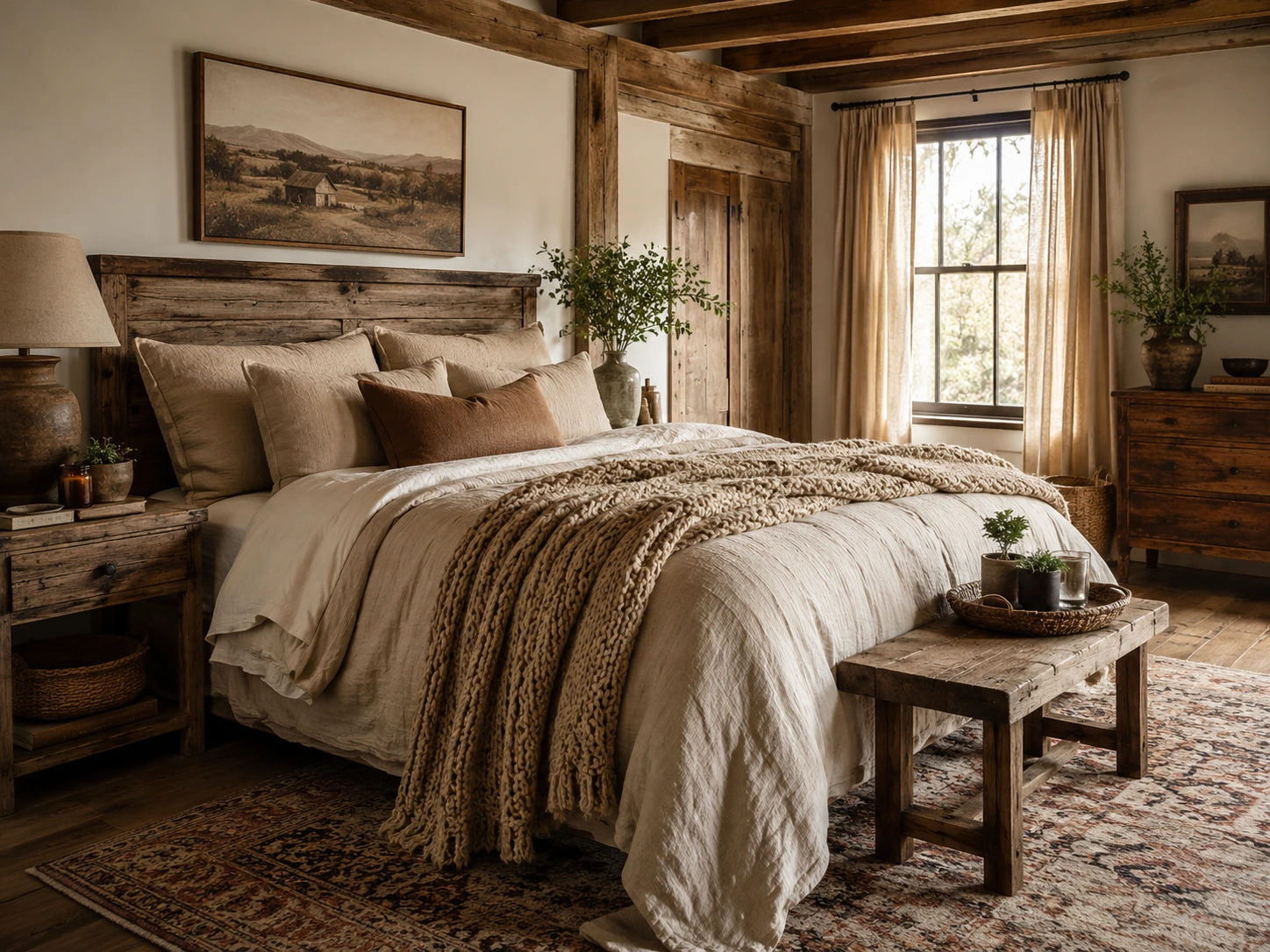
14 rustic bedroom ideas for a Warm, Restful Retreat
A rustic bedroom shouldn’t feel like a cabin-themed hotel room.
You don’t need antler decor, fake weathered signs, or enough knotty pine to make every wall disappear. The rooms that get rustic style right usually feel simpler. They rely on honest wood, comfortable bedding, slightly imperfect furniture, warm color, and materials that look better after being lived with.
That makes these 14 rustic bedroom ideas especially useful right now. Bedroom design in 2026 is moving toward warmer woods, handcrafted details, richer neutrals, vintage-inspired textiles, and spaces with more personality. Early 2027 color forecasts point in the same direction, with earthy shades and deeper nature-inspired colors gaining ground.
Think less themed lodge.
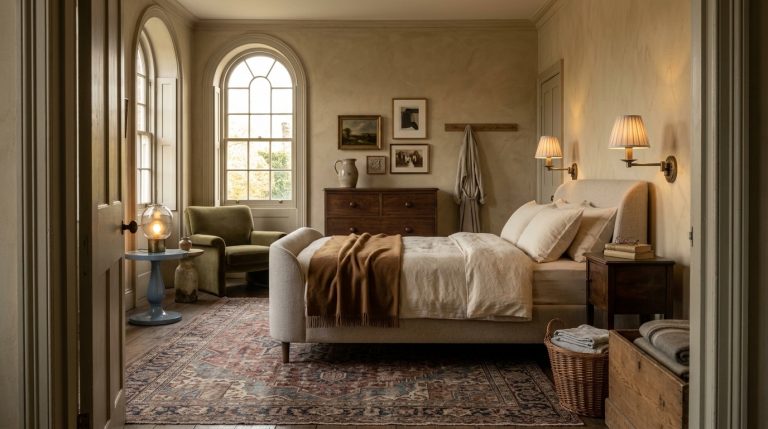
Think more quiet room with a beautiful old dresser, linen bedding, a substantial rug, and wood you can actually see and touch.
1. Let real wood become the strongest material in the room
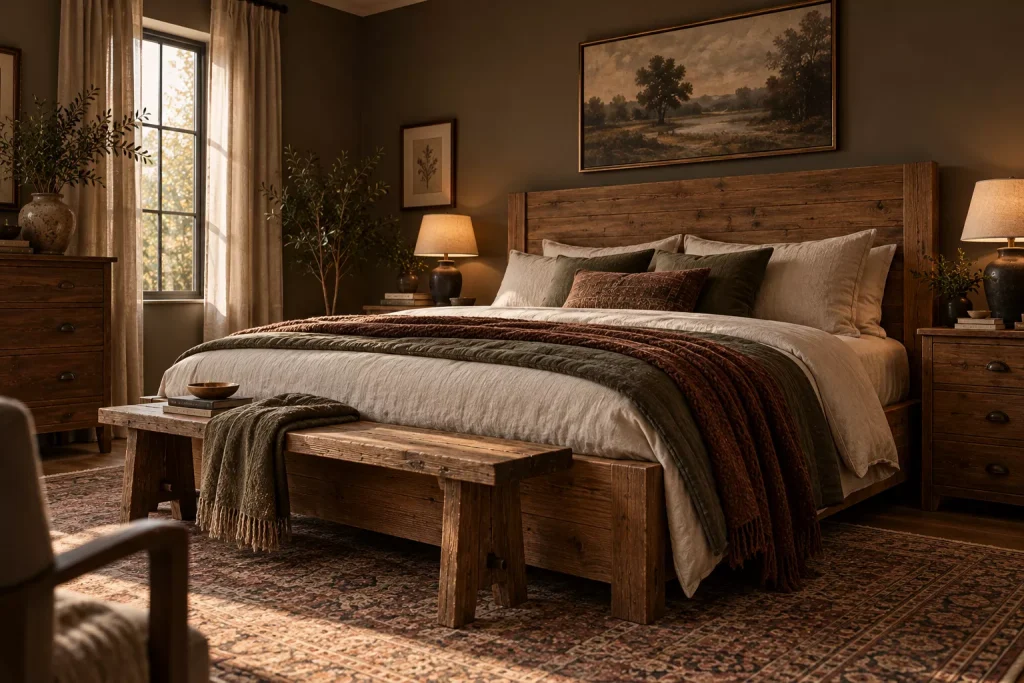
Idea 1: Start with one substantial piece of natural wood.
A rustic bedroom doesn’t need wood everywhere.
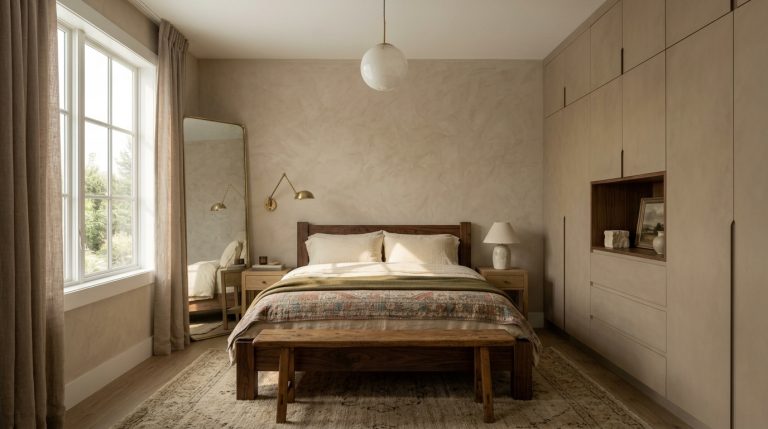
One oak bed, walnut dresser, reclaimed-looking bench, or pair of pine nightstands can establish the entire direction.
Current interiors are embracing more expressive wood grain, including oak and walnut with visible knots, tonal variation, and natural irregularity instead of flat synthetic-looking finishes. Wood paneling has also returned in a more refined form, with designers using it selectively for warmth and architectural depth.
If your bedroom furniture is already painted, you don’t need to replace it.
Bring wood in through a bench, mirror frame, bedside table, or ceiling detail.
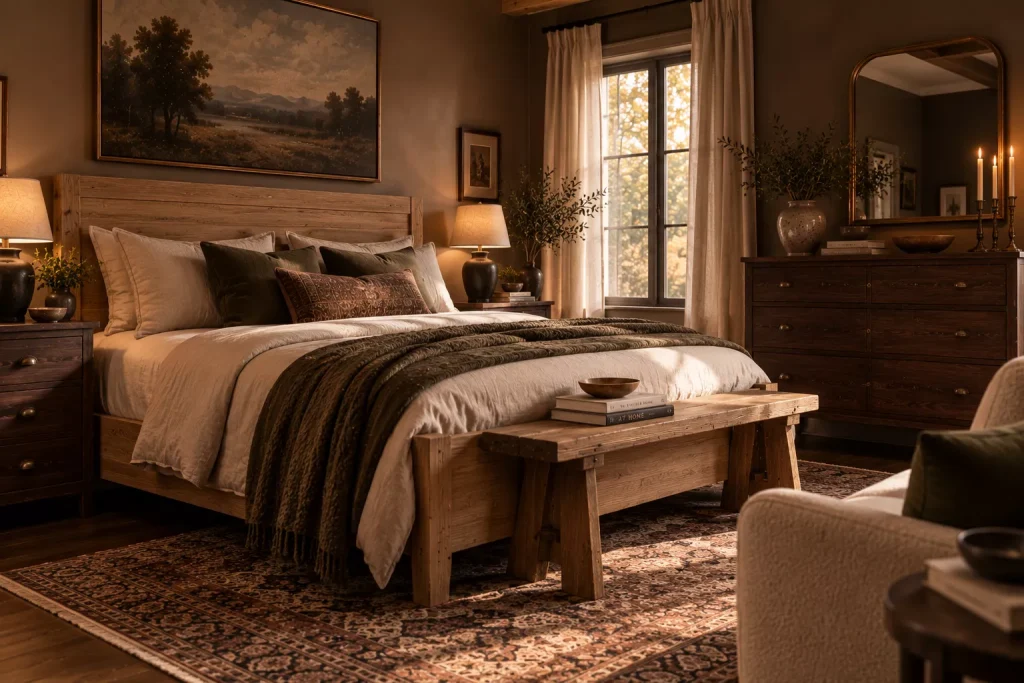
Idea 2: Mix two wood tones instead of matching everything.
Pale oak beside walnut works beautifully.
So does honey-toned wood with darker brown furniture.
The contrast makes a bedroom look collected.
Three furniture pieces in almost identical orange-brown stains can look more dated than two clearly different woods.
That’s one of those cases where matching less actually makes the room feel more considered.
2. Use warmer bedroom colors than standard beige and gray
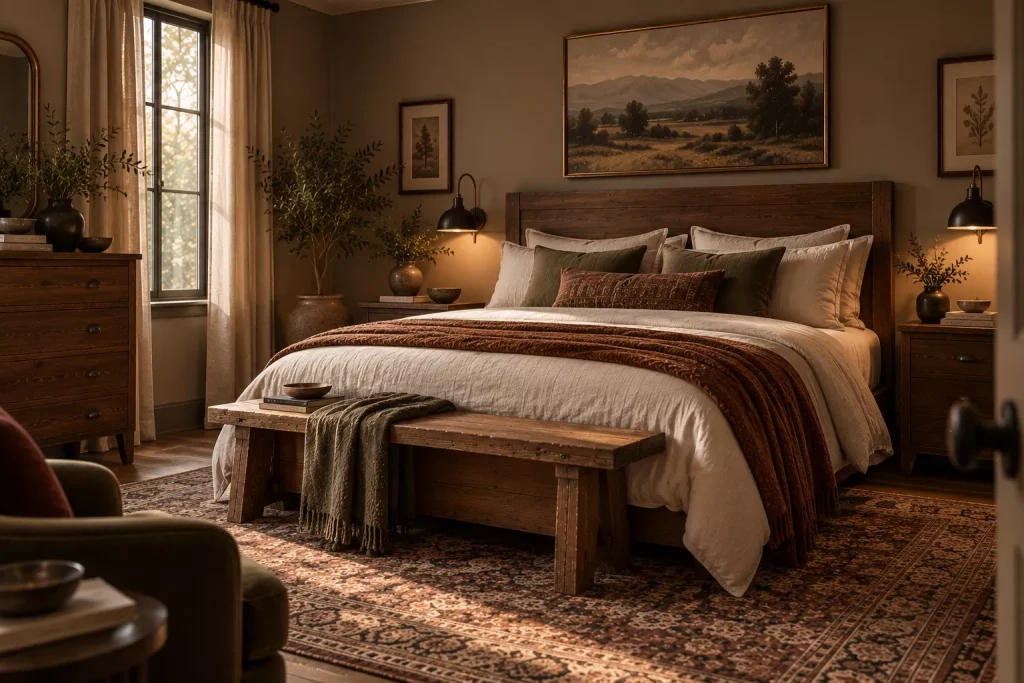
Idea 3: Build the palette around earthy neutrals.
Warm white, putty, mushroom, soft brown, clay, and taupe all work well with rustic materials.
But don’t stop there.
Sage, forest green, muted rust, burgundy, and charcoal can give the room more depth. Designers are treating these warmer and earthier shades as useful neutrals in 2026, while 2027 forecasts continue toward nature-led colors and stronger contrast.
One combination I particularly like is:
- mushroom walls
- walnut furniture
- cream bedding
- muted rust accents
- blackened metal lighting
Another is pale putty with oak, olive green, and dusty blue.
Let the darker shade appear once or twice
You don’t need green walls, green bedding, green curtains, and a green rug.
Try an earthy green headboard or one painted chest instead.
Rustic rooms feel better when colors look as though they developed naturally rather than arriving as a coordinated package.
And yes, white still works.
Just choose something slightly warm rather than icy blue-white if the rest of the room contains brown wood and natural fibers.
3. Make the bed feel layered without piling it with pillows
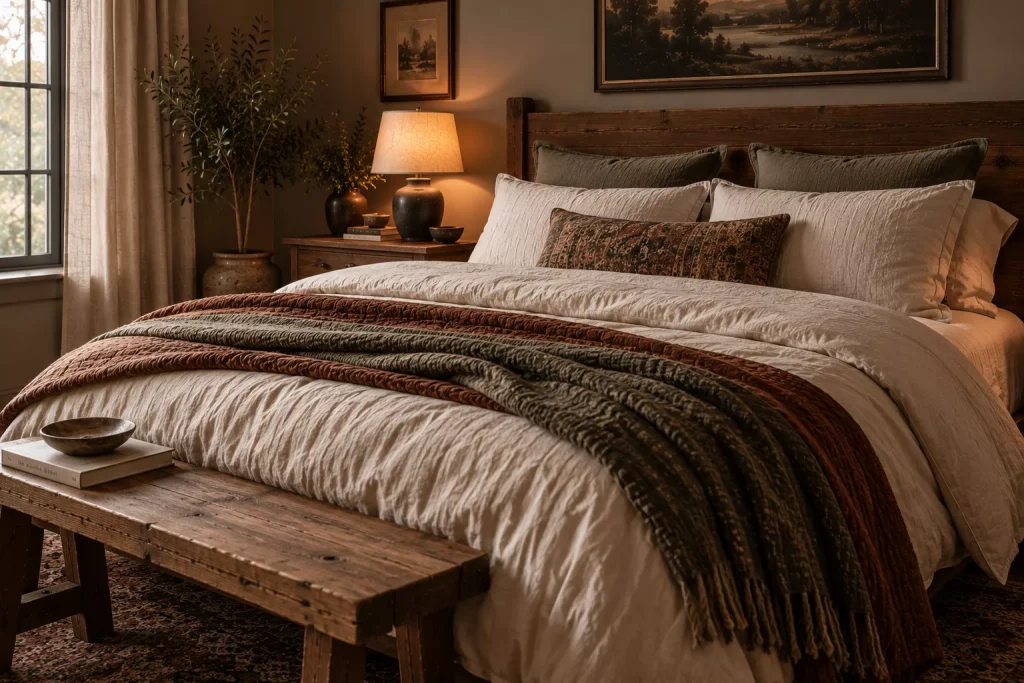
Idea 4: Use simple bedding in several textures.
Rustic bedrooms are at their best when the bed looks genuinely comfortable.
Start with cotton or linen sheets.
Add a duvet in warm white, oatmeal, muted green, or clay. Then finish with a quilt, woven coverlet, or wool-blend throw.
Reclaimed wood, soft cotton, quilts, checks, and handmade-looking details remain common ways designers build rustic warmth without making bedrooms overly decorative.
You don’t need eight pillows.
Two sleeping pillows, two larger back pillows, and perhaps one lumbar cushion are plenty.
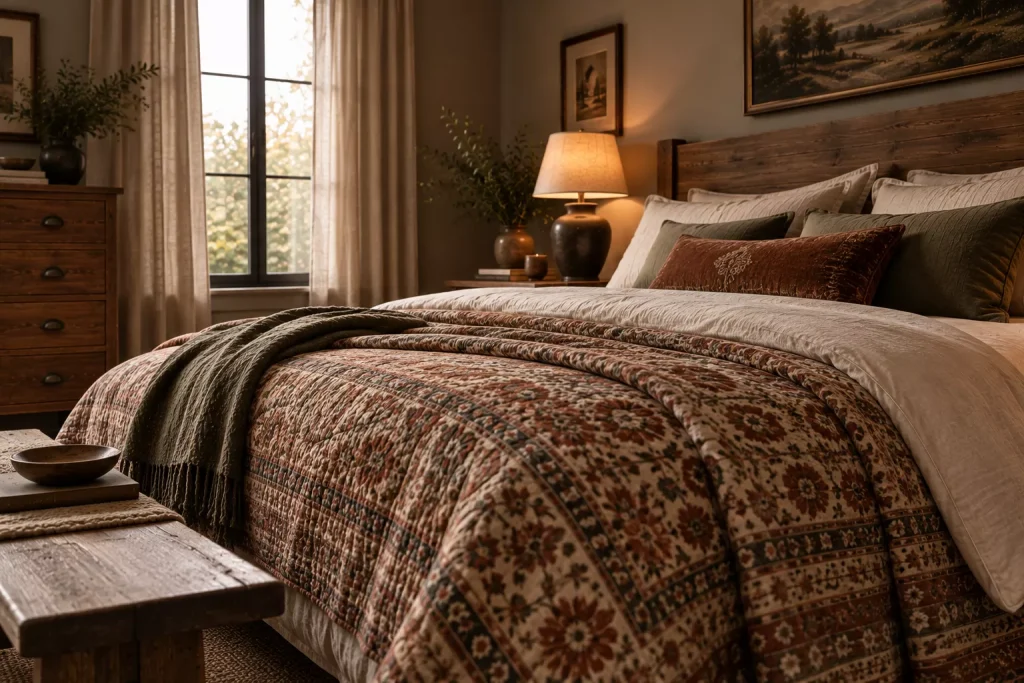
Idea 5: Add one pattern that feels slightly traditional.
A faded stripe, small check, block print, or vintage-inspired quilt can keep the room from becoming a collection of brown and beige surfaces.
Patchwork and handcrafted-looking textiles are especially visible in 2026 interiors, but the strongest examples are softer and less kitschy than old-fashioned country styling.
If the quilt has a strong pattern, keep the rug quieter.
Let one fabric lead.
4. Bring in one vintage piece with visible character
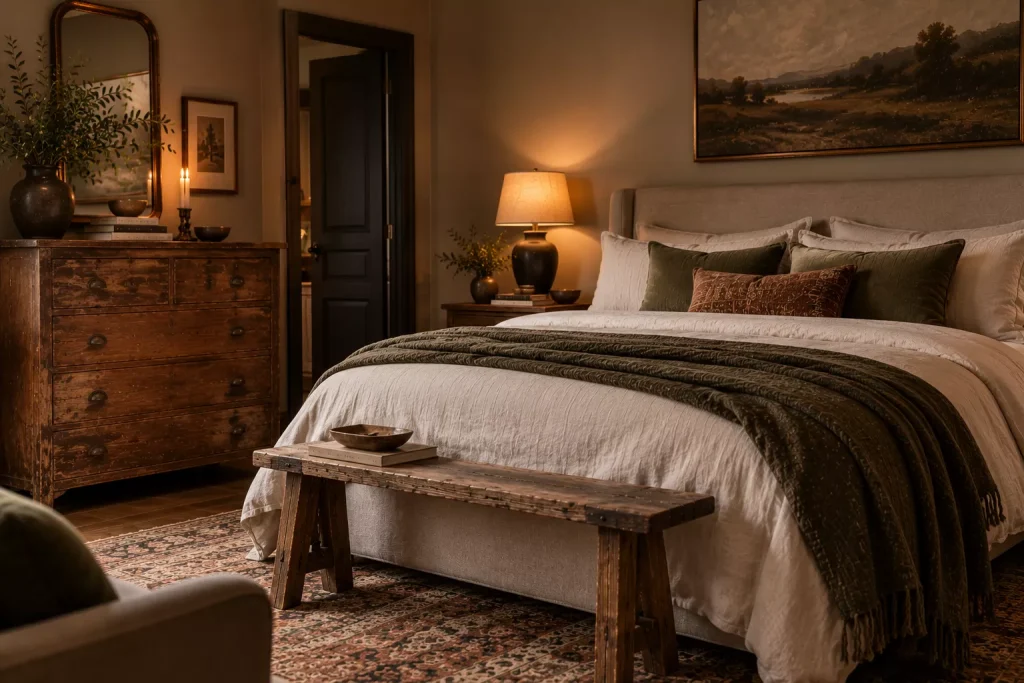
Idea 6: Add furniture that looks as though it has already had a life.
This could be an old pine dresser, oak bedside table, painted chest, small stool, or vintage trunk.
It doesn’t need to be expensive.
A $100 secondhand table with worn corners can bring more personality than a brand-new matching nightstand set.
I once helped restyle a bedroom where the owner had a perfectly decent modern upholstered bed and two identical white bedside tables. We replaced only one table with an old dark-wood cabinet.
That tiny mismatch changed the whole room.
Suddenly, it felt collected rather than furnished.
Don’t repair every imperfection
Tighten loose joints.
Fix broken drawers.
Clean surfaces properly.
But a small scratch or faded patch isn’t automatically a problem.
Rustic style depends partly on materials showing use.
Current design coverage is leaning heavily toward authenticity, natural variation, and interiors that feel lived in rather than copy-pasted.
The caveat is upholstered vintage furniture.
Inspect it carefully before bringing it into a bedroom. Some bargains require far more cleaning and repair than they’re worth.
5. Use a substantial rug to soften all that wood
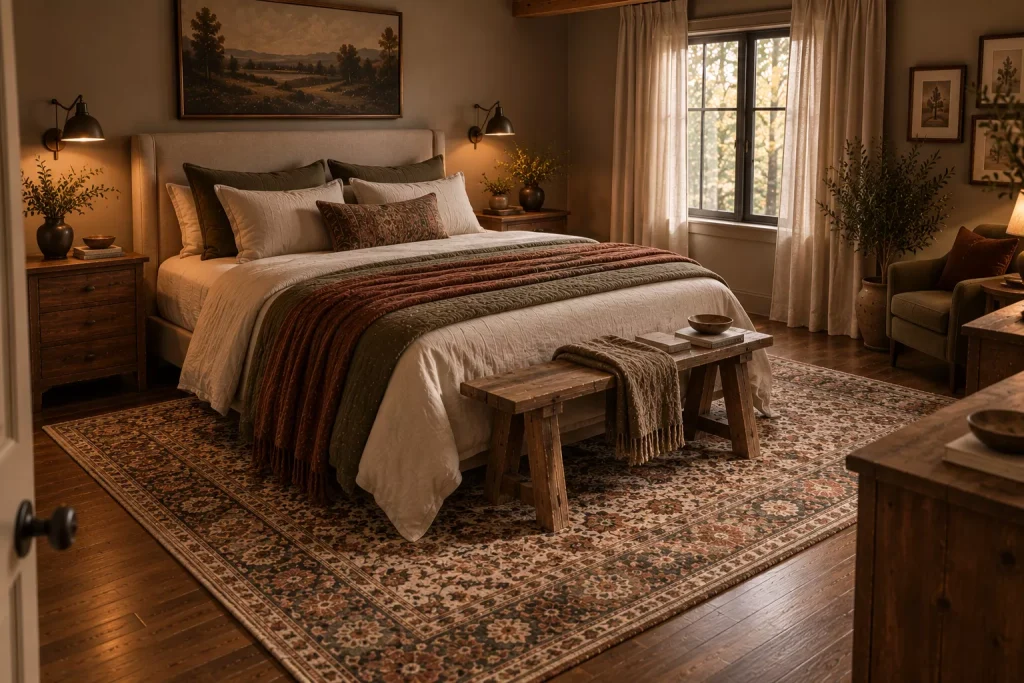
Idea 7: Put a properly sized rug beneath the bed.
Wood floors and wood furniture need something softer nearby.
For a queen bed, an 8-by-10-foot rug often provides comfortable coverage. A 6-by-9 can work in tighter bedrooms.
For a king bed, a 9-by-12 may give better proportions if the room allows it.
Choose wool, cotton, a jute blend, or a low-pile washable rug depending on your budget and lifestyle.
| Rug type | Why it works | Main drawback |
|---|---|---|
| Wool | Soft, warm, substantial | Higher upfront price |
| Vintage-style rug | Adds age and muted color | Strong patterns can compete |
| Flatwoven cotton | Casual and lightweight | Less padding |
| Jute blend | Strong natural texture | Rougher under bare feet |
| Washable rug | Practical for pets | Some feel quite thin |
I like faded rust, olive, cream, brown, and dusty blue in rustic bedrooms.
Pure beige works too, but a little pattern helps disguise everyday wear.
And here’s the practical warning about jute.
It photographs beautifully.
It’s considerably less romantic when your bare feet dislike it every morning.
6. Add wood paneling or beams only where they improve the architecture
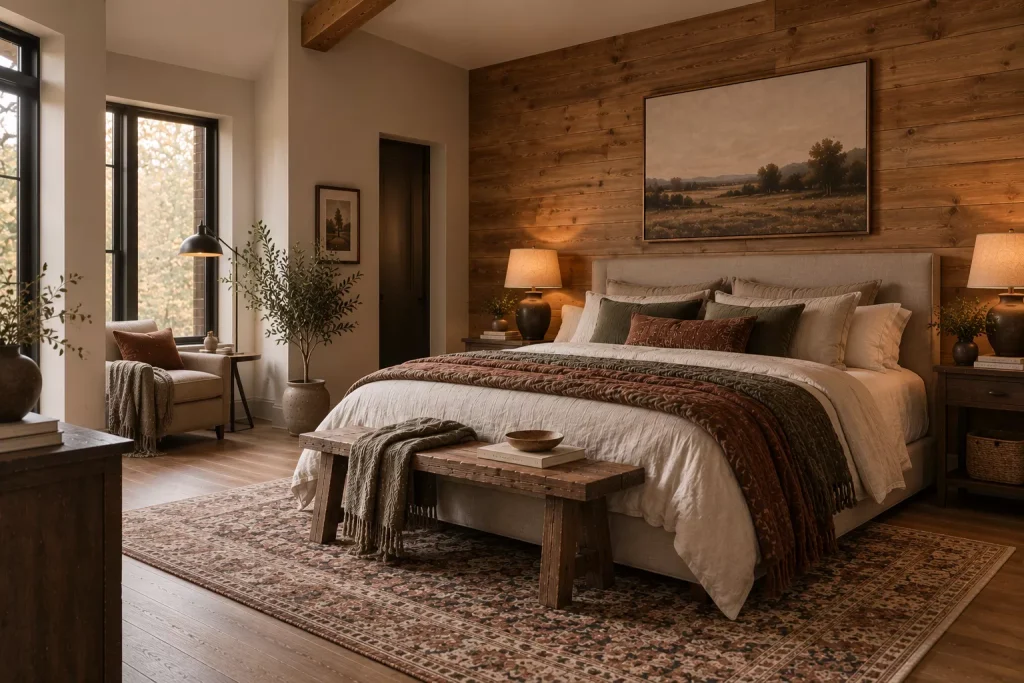
Idea 8: Use timber as an architectural layer, not a costume.
Wood paneling is back in a more sophisticated form in 2026. Designers are favoring real-looking grain, wider boards, thoughtful placement, and natural variation rather than the dark synthetic paneling associated with older interiors.
That can work beautifully in a bedroom.
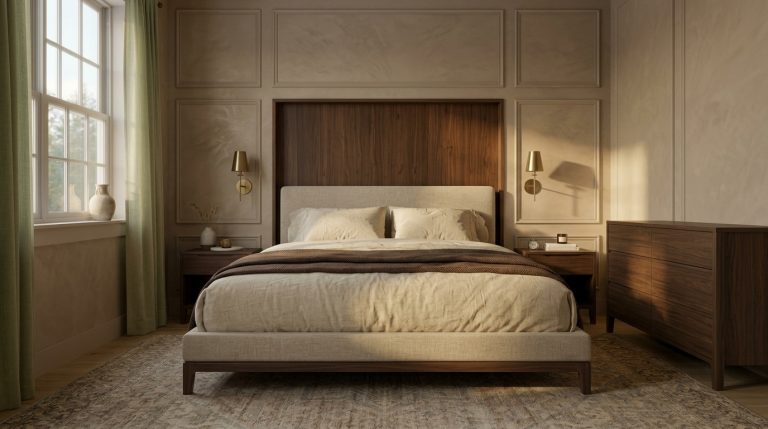
Try wood on the wall behind the bed.
Line a sloped ceiling.
Use paneling inside a reading nook.
Or add a simple tongue-and-groove treatment halfway up a wall.
Idea 9: Keep existing beams natural if they’re genuinely worth seeing.
Exposed beams can bring enormous character.
But decorative faux beams aren’t necessary just because you want a rustic room.
A normal drywall ceiling can remain a normal ceiling.
This is one place where rustic decorating often goes wrong. People add architectural details the house never needed.
Work with what’s believable.
A newer apartment may look better with one walnut headboard and linen curtains than with fake barn beams screwed across the ceiling.
Rustic doesn’t require pretending your home is 150 years old.
7. Layer the lighting so the room feels warmer at night
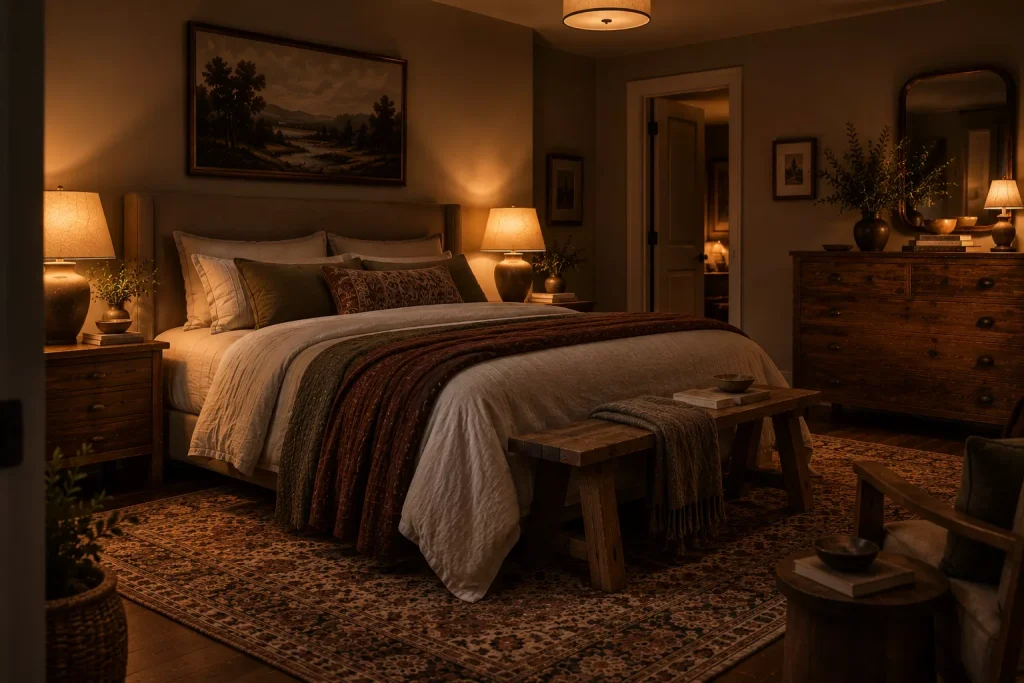
Idea 10: Use bedside lighting that sits lower than the ceiling fixture.
Natural wood looks especially good under warm, lower light.
Use ceramic table lamps, aged brass sconces, wood bases, or simple blackened metal fixtures.
Then add a smaller light on a dresser if the room needs another layer.
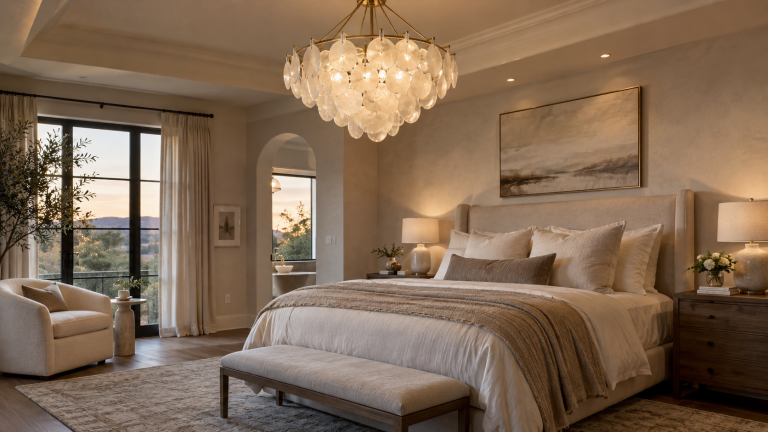
Bedrooms in 2026 are increasingly being treated as sensory retreats, with softer lighting and more deliberate zones for reading and winding down rather than one purely functional overhead source.
Idea 11: Let one fixture bring a little contrast.
Rustic doesn’t mean every lamp needs a burlap shade.
Try a mid-century wood lamp beside an antique dresser.
Use an opal-glass ceiling light above reclaimed-looking furniture.
Or place a simple black metal sconce beside warm oak.
That contrast keeps the room current.
And choose scale carefully.
Tiny lamps beside a chunky bed can look apologetic.
A substantial bedside lamp around 22 to 28 inches tall often has enough presence, depending on the nightstand and mattress height.
The best lamp is still one that lets you read comfortably.
Atmosphere shouldn’t defeat eyesight.
8. Make a small sitting area feel useful rather than decorative
Idea 12: Add a chair only if you’ll actually use it.
Reading zones are appearing strongly in 2026 bedroom design, particularly as bedrooms become more layered and multifunctional.
Rustic bedrooms lend themselves nicely to this.
Try a worn leather chair near the window.
A spindle-back wood chair with a cushion works in smaller spaces.
For something softer, choose an upholstered chair in olive, camel, plaid, or muted rust.
Add a floor lamp and tiny side table if space allows.
But don’t force it.
A chair squeezed between the bed and dresser isn’t creating a retreat.
It’s creating somewhere to pile clothes.
If your bedroom is small, a bench at the foot of the bed may be more useful.
Leave enough floor around the furniture
This is the part photographs hide.
The bedroom still needs walking space.
Don’t sacrifice comfortable circulation just to fit another rustic-looking object.
An empty corner can be completely finished.
Sometimes what makes a room restful is the fact that nothing is there.
9. Finish with useful natural details instead of cabin-themed decor
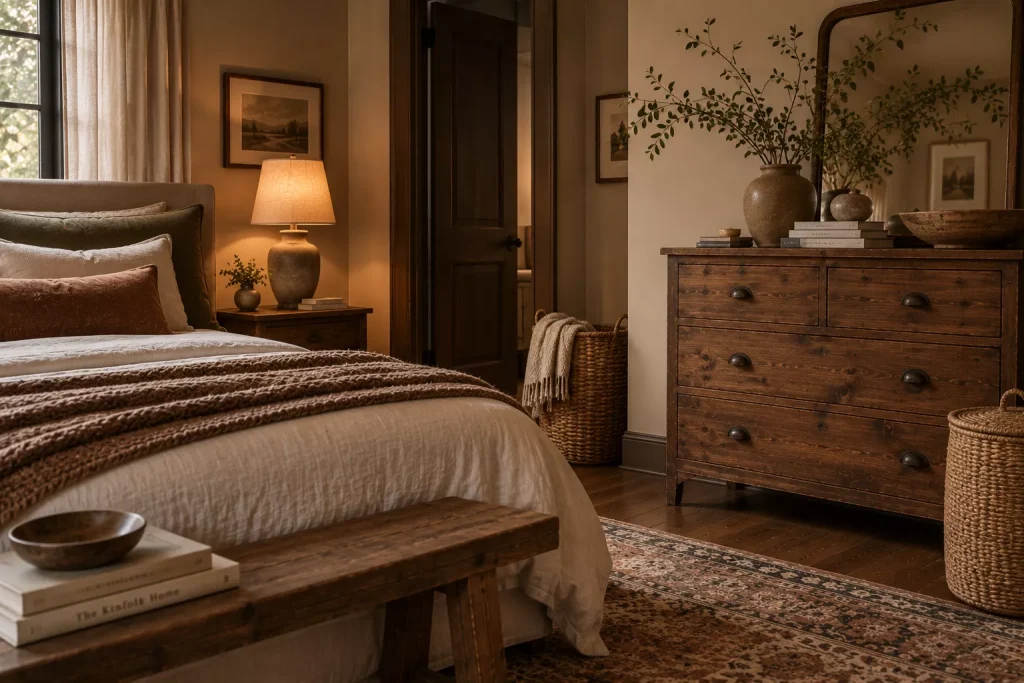
Idea 13: Decorate with ceramics, baskets, books, and simple branches.
You don’t need wooden signs saying “Cabin Life.”
A stoneware vase, woven basket, stack of real books, linen-covered box, or ceramic lamp already supports the rustic mood.
Use baskets for actual storage.
Keep extra blankets in one beside the bed.
Put laundry inside a lidded woven hamper.
Those functional details feel much more convincing than accessories purchased purely to announce a style.
Idea 14: Bring nature in through shape and material rather than themed imagery.
A framed landscape can work beautifully.
So can a simple branch in a large ceramic vase.
You might use dried grasses, but don’t cover every surface with them.
The wider direction for 2026 and emerging 2027 interiors favors spaces with stronger personal expression, warmer natural materials, and more individual combinations rather than safe, uniform rooms.
That’s good news for rustic decorating.
Your room doesn’t need to match anyone else’s version.
A modern bed, old dresser, brown wool rug, striped quilt, and black lamp can belong together perfectly well.
What should you skip in a rustic bedroom?
Start with anything that feels aggressively themed.
Fake antlers, mass-produced cabin signs, bear motifs, and excessive plaid can work in very specific homes, but none of them is required.
I’d also skip the complete matching furniture set.
Current bedroom guidance is moving away from flat, matchy rooms in favor of more layered combinations.
Don’t distress new furniture just because you think rustic furniture needs scratches.
And avoid covering every wall with wood.
One paneled surface can feel warm. Four walls plus the ceiling can become visually heavy, especially in a modest bedroom.
Finally, don’t confuse rustic with cluttered.
A room can have history and texture while still being edited.
Leave the dresser partly empty.
Give artwork space around it.
Let the wood grain and textiles provide some of the decoration.
The room should make you want to rest, not inspect twenty-five accessories.
FAQ About Rustic Bedrooms
What colors work best in a rustic bedroom?
Warm white, mushroom, brown, olive, muted rust, dusty blue, charcoal, and burgundy all pair naturally with wood. Current palettes are moving toward warmer neutrals and deeper earth-inspired colors rather than cool gray alone.
Can you create a rustic bedroom without wood walls?
Absolutely. A wood bed, vintage dresser, woven rug, linen curtains, and traditional textile pattern can provide plenty of rustic character without changing the architecture.
How do I make a rustic bedroom look current?
Use real-looking materials, mix old and new furniture, limit themed accessories, and bring in deeper color. Contemporary rustic rooms are increasingly combining natural wood with simpler furniture, crisp bedding, and more sculptural lighting.
Can rustic decor work in a small bedroom?
Yes. Use one strong wood piece rather than several bulky ones, keep the walking path open, and add texture through bedding, curtains, and a rug instead of extra furniture.
The best 14 rustic bedroom ideas don’t require a mountain view or exposed timber beams.
Start with what you can touch.
A warm wood nightstand. Cotton sheets. A wool rug. One old piece with a few marks. A lamp that makes the room feel softer after dark.
That’s often enough to change the atmosphere.
The bedroom I mentioned earlier became far more interesting after we replaced just one matching nightstand. Nothing about the room suddenly looked like a cabin. It simply felt less manufactured.
Try the same approach.
Choose one piece that feels too polished, too matched, or too generic, and give it a little contrast.
A good rustic bedroom should feel warm because it has material depth, not because it’s wearing a costume.