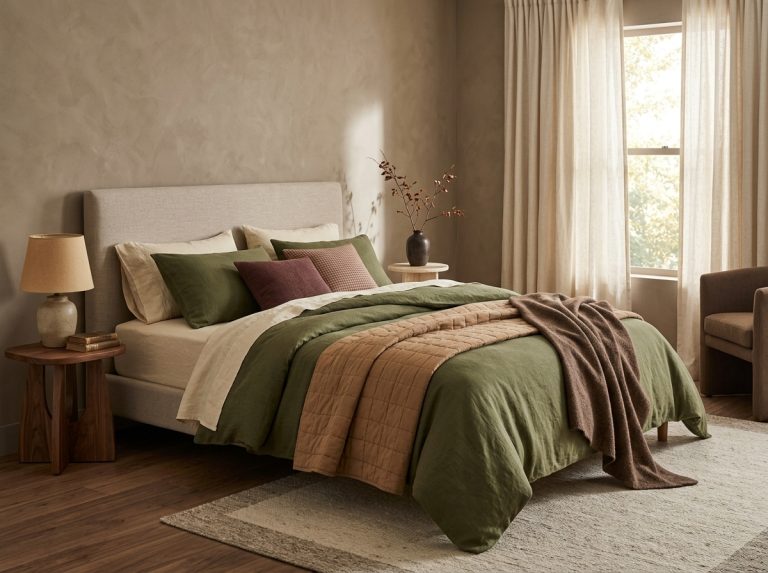
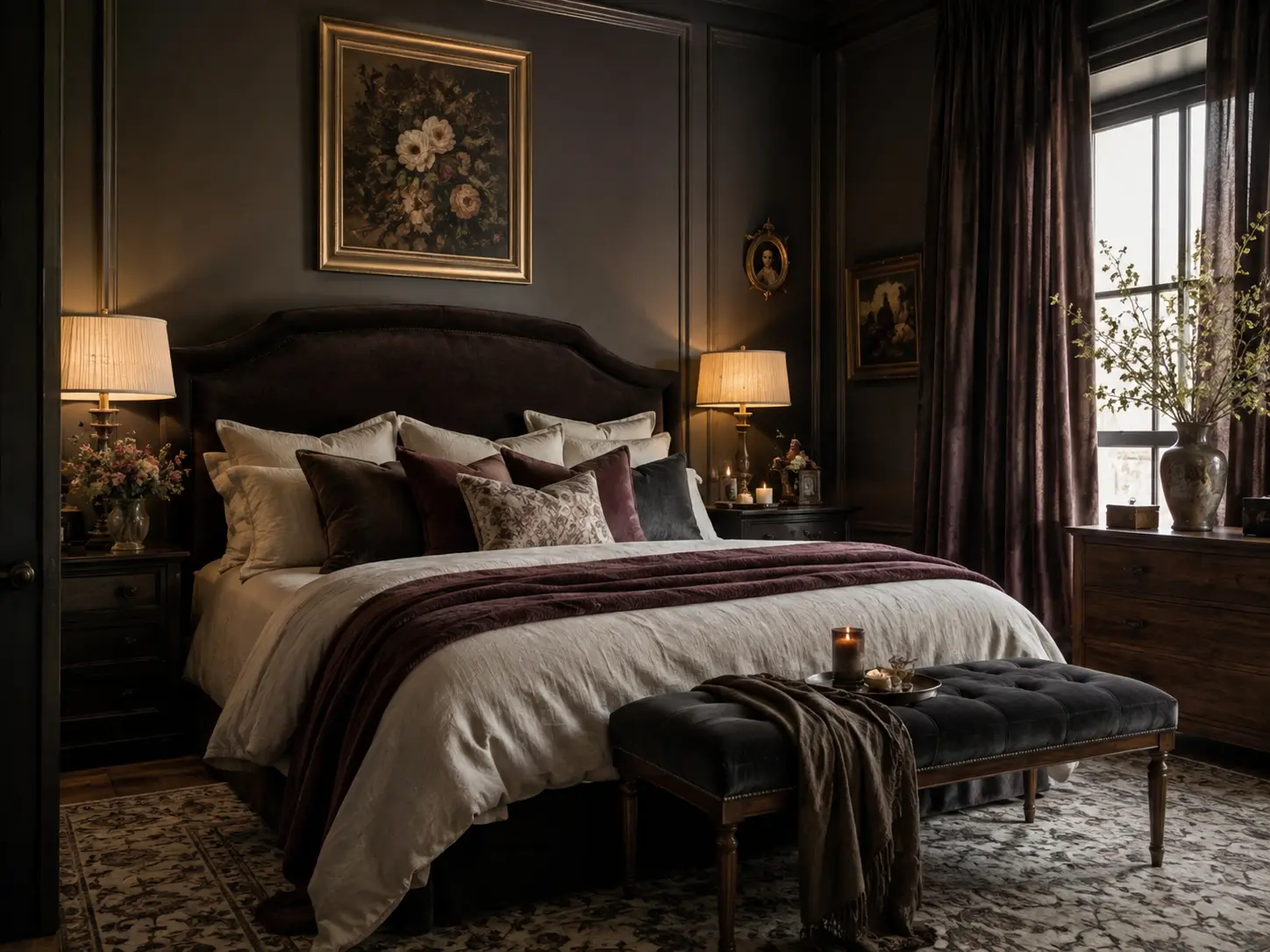
13 dark feminine bedroom ideas for a Moody, Elegant Retreat
A dark feminine bedroom shouldn’t feel like someone simply painted the walls black and added a few velvet cushions.
The most convincing rooms are softer and more complicated than that. They mix deep color with warm lighting, old wood, tactile fabric, metallic details, and just enough romance to feel intimate rather than theatrical.
That balance is especially relevant now. Bedroom design in 2026 is leaning toward cocooning spaces, with burgundy, enveloping color, drapery, and statement headboards showing up prominently in designer-led interiors.
These 13 dark feminine bedroom ideas are about creating that mood without turning your bedroom into a gothic film set.
Think aubergine rather than jet black everywhere. Merlot velvet rather than pink satin. Aged brass rather than glittering gold.
Rich, yes. But still comfortable enough for a Tuesday night.
1. Start with burgundy, aubergine, or deep plum instead of pure black
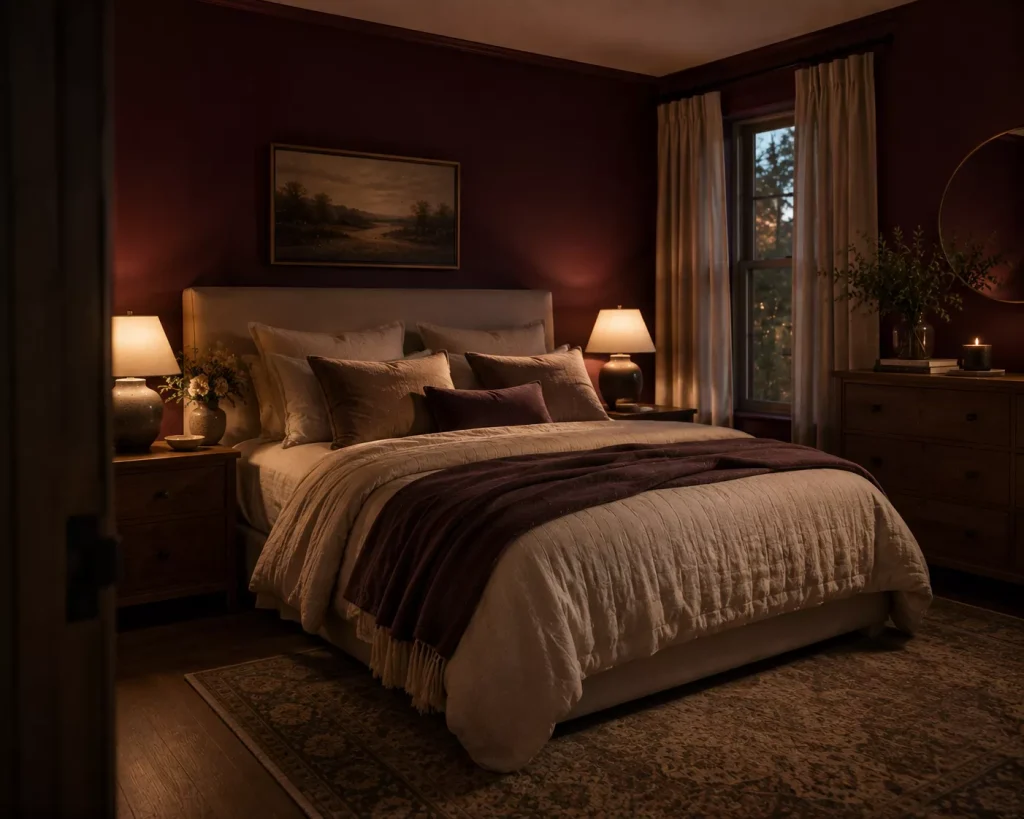
Idea 1: Choose a dark color with warmth underneath it.
Black can look striking, but it isn’t your only route to a moody bedroom.
Deep burgundy, aubergine, blackberry, oxblood, chocolate brown, and dark plum often create a softer backdrop. They still provide drama, but skin tones, warm wood, and brass tend to sit more comfortably against them.
Burgundy is particularly useful right now. Designers are using richer reds in bedrooms, while aubergine is also appearing among notable 2026 bedroom color directions.
Try burgundy behind the headboard with warm taupe elsewhere.
Or use plum walls with ivory bedding and walnut furniture.
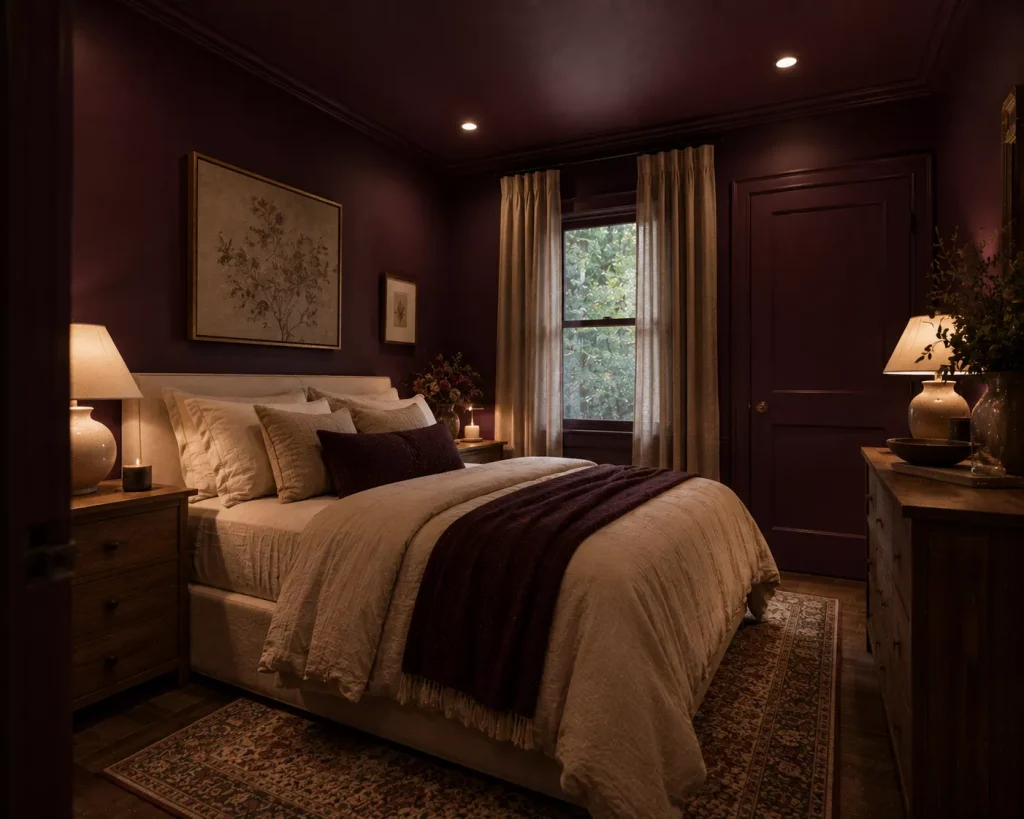
Idea 2: Color-drench a small bedroom if you want a stronger mood.
This means carrying one deep color across several surfaces, sometimes walls, trim, doors, and even the ceiling.
Everyone says dark paint makes a small bedroom feel smaller. But that isn’t automatically a bad thing.
Bedrooms can benefit from feeling enclosed and cocooning. Designers increasingly use dark, saturated color in smaller bedrooms for exactly that reason.
The trick is giving the darkness some light to work with.
2. Make the bed feel substantial, not overly delicate
The bed should be the strongest object in the room.
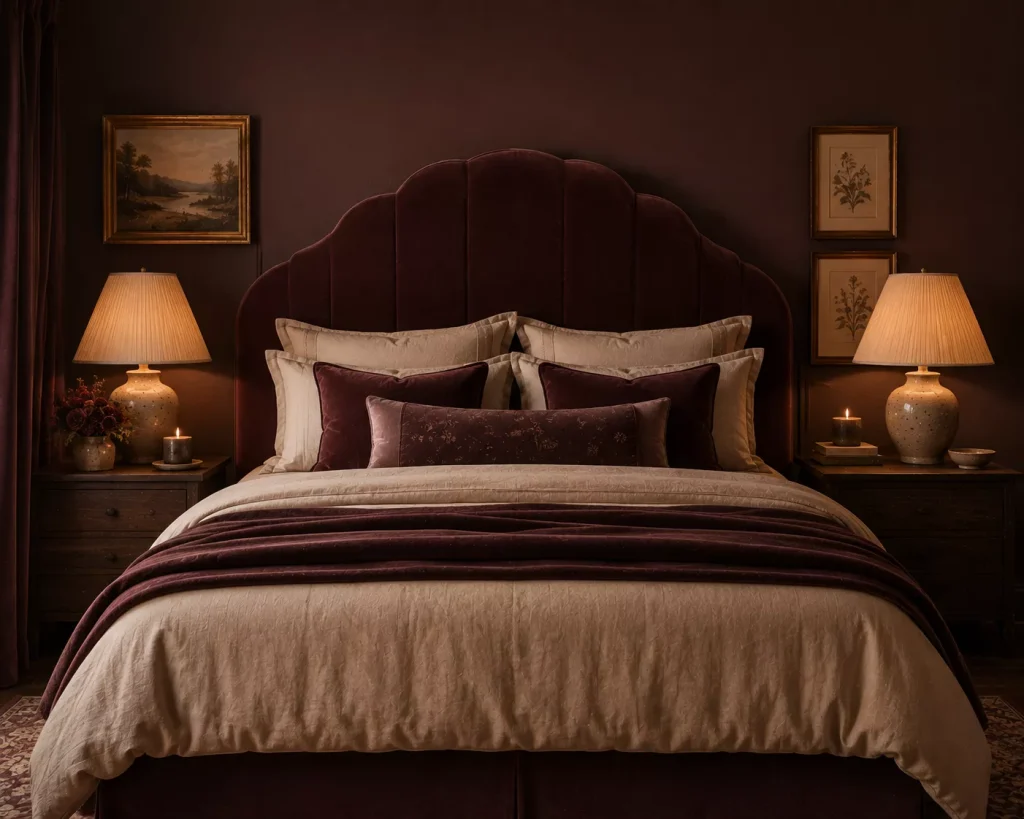
Idea 3: Choose an upholstered or architectural headboard.
Velvet, brushed cotton, linen, channel tufting, scalloped shapes, and curved silhouettes all work beautifully with dark feminine bedroom decor.
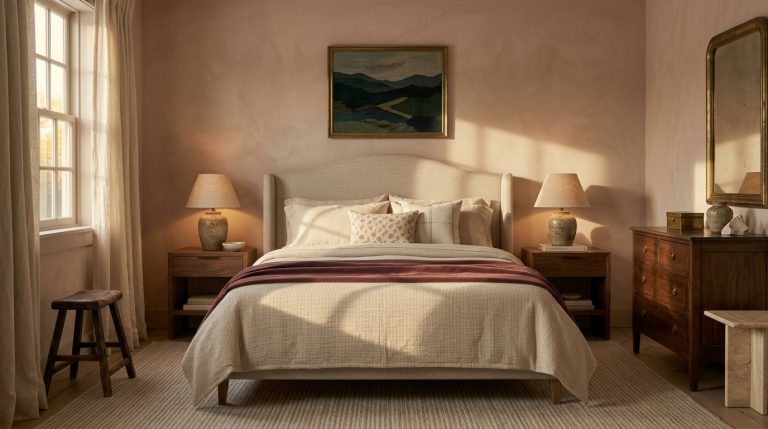
A deep merlot velvet headboard against mushroom walls feels romantic without becoming sugary.
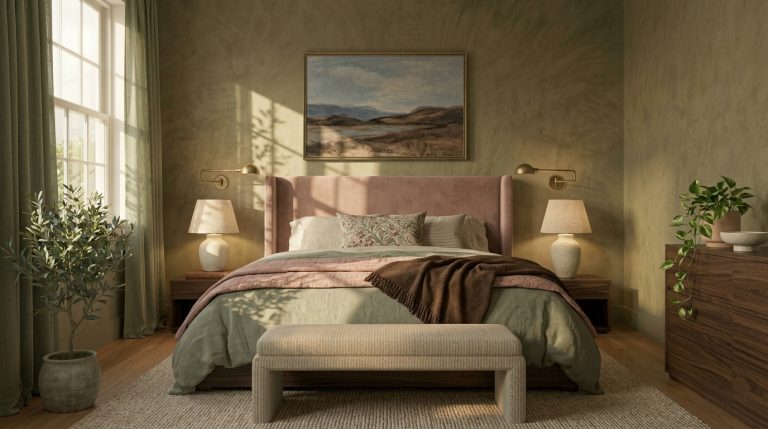
An olive upholstered bed against aubergine walls can be even more interesting.
Statement headboards are a major part of 2026 bedroom design, which suits this look because they give a darker room one clear focal point.
You don’t need a huge custom piece.
A simple upholstered headboard in rust, plum, or tobacco brown can create enough presence.
Skip the overly ornate bed unless you genuinely love it
A carved four-poster or canopy bed can be wonderful, and canopy beds are seeing renewed design interest.
But a large, ornate frame can overwhelm a 10-by-11-foot bedroom.
In smaller spaces, I’d choose one dramatic feature. Either the bed gets the attention, or the walls do.
Giving everything equal drama makes the room exhausting.
3. Layer dark colors with warm neutrals
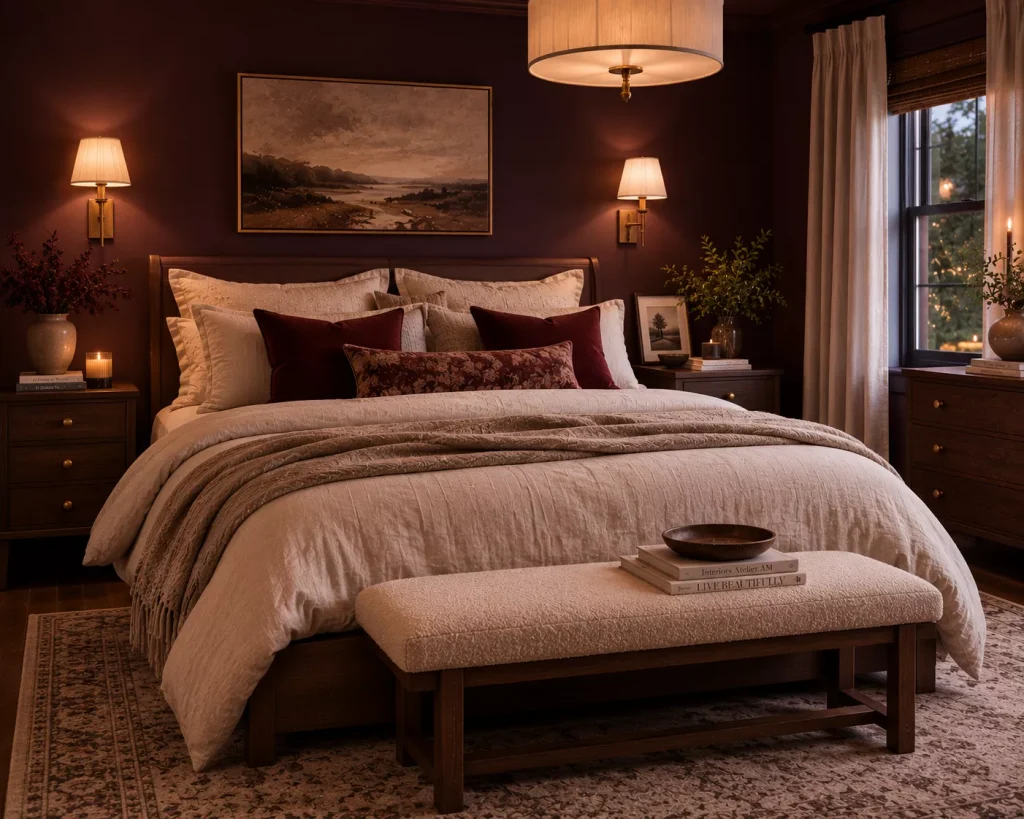
Idea 4: Give all that darkness something soft to sit against.
A bedroom entirely covered in black, charcoal, and deep red can lose dimension at night.
Warm neutrals prevent that.
Think mushroom, camel, oatmeal, antique ivory, dusty rose, and warm taupe.
A good combination might be:
- aubergine walls
- walnut bed
- oatmeal linen bedding
- burgundy velvet cushions
- aged brass lighting
Another could pair chocolate walls with blush-beige bedding and dark cherry wood.
Warm taupes and earthy pinks are also being used as adaptable bedroom colors in 2026, which makes them useful supporting shades for deeper palettes.
The contrast doesn’t need to be dramatic.
Even an ivory sheet folded over a dark duvet creates enough interruption to keep the bed from becoming one solid block.
That little bit of softness makes a moody bedroom feel inviting rather than severe.
4. Mix velvet with linen, cotton, and wool
Dark feminine rooms need texture.
But covering everything in velvet is where the look starts becoming costume-like.
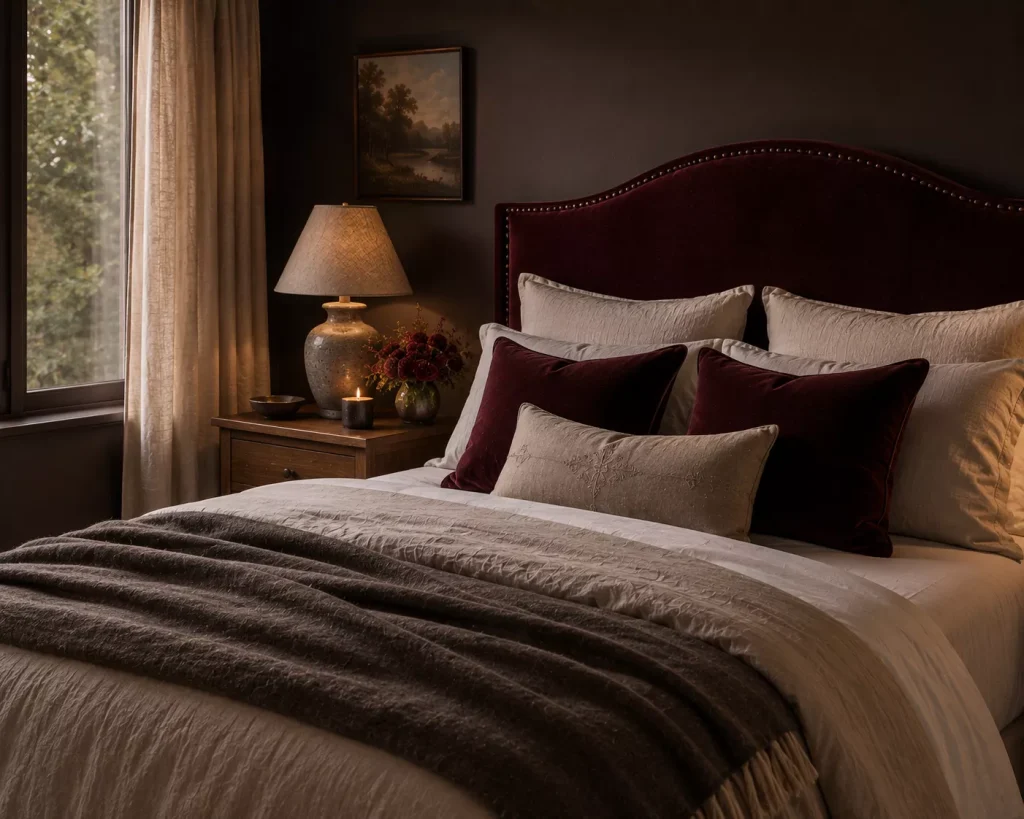
Idea 5: Use velvet as an accent instead of the entire room.
Choose a velvet headboard, one chair, or two substantial cushions.
Then contrast that sheen with matte fabrics.
Washed linen curtains, crisp cotton sheets, wool throws, boucle, and woven rugs keep the room grounded.
Designers regularly use textile contrast to give moody bedrooms depth, mixing materials such as velvet, cotton, leather, and natural woven surfaces.
Here’s a simple way to balance it:
| Material | Good place to use it | Main trade-off |
|---|---|---|
| Velvet | Headboard or accent chair | Shows pressure marks and dust |
| Linen | Curtains and bedding | Naturally wrinkles |
| Wool | Rug or throw | Can cost more |
| Cotton | Sheets and quilts | Less visually dramatic |
| Satin-look fabric | Small accent only | Can become overly glamorous quickly |
My preference is one noticeable velvet element.
After that, let the quieter fabrics carry the room.
A bedroom should feel touchable, not like nobody is allowed to sit down.
5. Use layered curtains to make the room feel more intimate

Idea 6: Treat the windows as part of the atmosphere.
Curtains matter enormously in a dark feminine bedroom.
Instead of thin panels hung directly above the window, mount the rod higher and let the fabric reach the floor.
For a richer effect, layer sheers with heavier curtains.
You might use warm ivory sheers behind plum, cocoa, olive, or burgundy outer panels.
Layered window treatments and more decorative drapery are part of the current move toward expressive bedroom interiors.
Keep heavy curtains away from tiny windows
There is a downside.
Very dark, thick panels can swallow daylight if the window is small.
Extend the curtain rod beyond the frame so the panels can sit mostly beside the glass when open.
That way, you get the drama in the evening without sacrificing the morning light.
And measure properly.
Curtains ending four inches above the floor rarely create the luxurious effect people are hoping for.
They usually just look like the wrong size.
6. Use lamps instead of relying on the ceiling light

Idea 7: Build pools of warm light around the room.
Dark walls need good lighting.
Otherwise, the beautiful plum paint you chose at noon can look almost black by 8 p.m.
Start with bedside lamps or wall sconces.
Add a small lamp to the dresser if the room needs another layer. For a larger bedroom, a floor lamp beside a chair can create a separate reading zone.
Warm light generally works better with burgundy, brown, blush, and aged brass than very cool bulbs.
I particularly like alabaster-style lamps, dark ceramic bases, pleated shades, smoked glass, and aged-metal sconces for this look.
Current lighting direction is also moving toward sculptural fixtures, aged metallic finishes, and softer forms for 2027, all of which fit naturally into romantic, moody rooms.
And put at least one lamp on a dimmer if you can.
A dark feminine bedroom loses half its appeal under a single bright ceiling fixture.
Good mood lighting is less glamorous than buying another velvet cushion, but it matters far more.
7. Bring in dark wood instead of filling the room with black furniture

Idea 8: Use walnut, mahogany tones, or dark oak for warmth.
One common mistake is pairing dark walls with matte-black furniture everywhere.
The result can become harsh.
Dark wood has more variation.
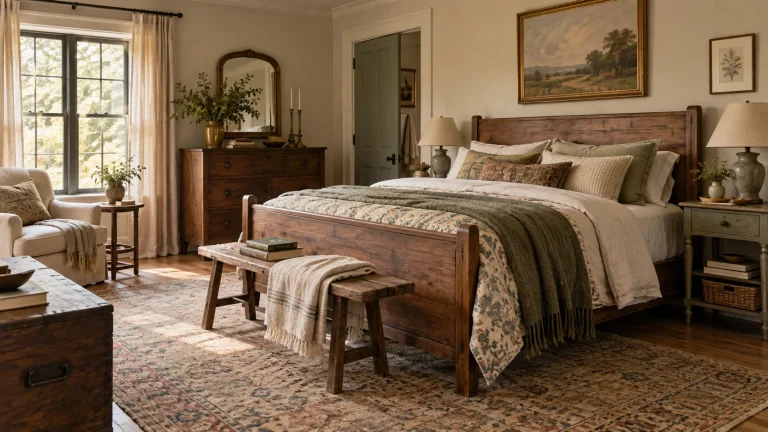
Walnut nightstands, a cherry-toned dresser, or an antique wood chest introduces brown and red undertones that work beautifully with plum, burgundy, and dusty pink.
Rich dark woods are also appearing alongside burgundy and mustard in more expressive 2026 bedroom palettes, reflecting a wider move away from very pale, all-beige interiors.
You don’t need a matching bedroom set.
Actually, I’d avoid one.
Try a walnut nightstand on one side and a small antique-style table on the other.
That unevenness makes the room feel collected.
Idea 9: Add one older-looking piece.
A vintage dresser, old mirror, carved stool, or small cabinet can bring the whole room to life.
It doesn’t need to be precious.
A secondhand wood table with slightly worn edges often brings more character than another perfectly coordinated new piece.
8. Add aged brass, bronze, or reflective details
Dark rooms benefit from a little reflection.
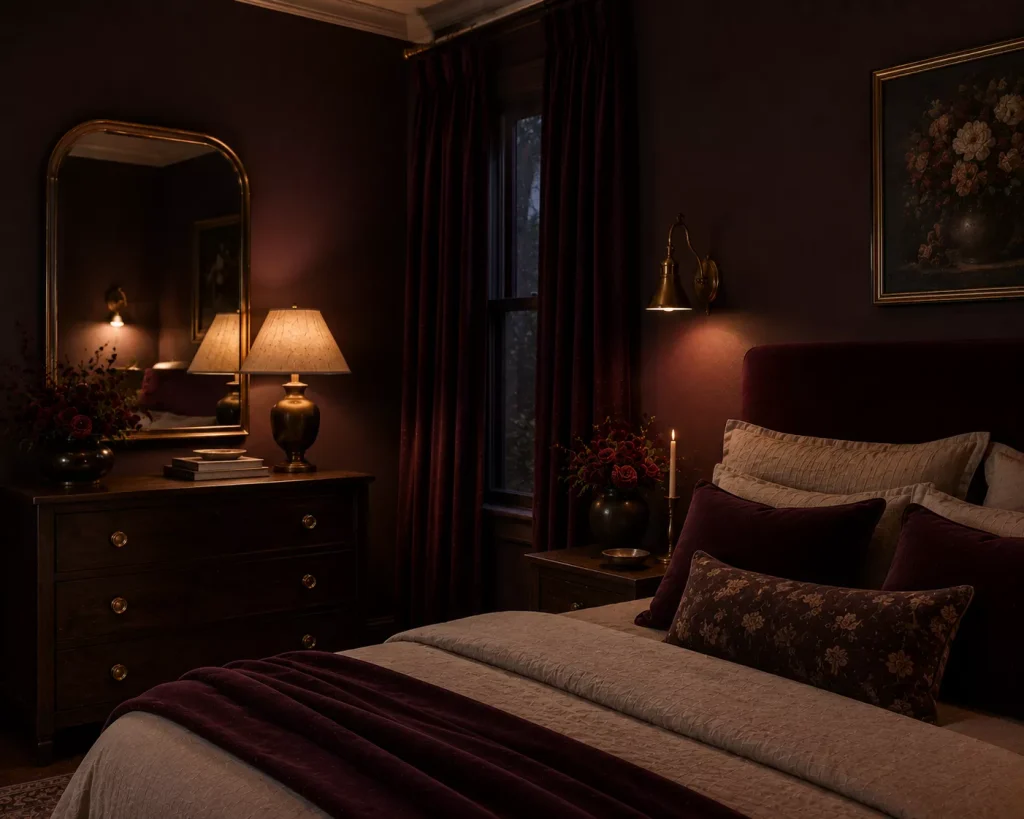
Idea 10: Use warm metal in small, deliberate amounts.
Aged brass sconces, an antique-brass mirror, bronze drawer pulls, or a small metal tray can catch light without making the room glittery.
High-shine and reflective finishes are particularly useful in deeper rooms because they interrupt matte surfaces and bounce light around. That contrast is showing up in current moody bedroom design as well.
I’d keep metals controlled.
Choose one main finish and repeat it two or three times.
For example, brass bedside lights, a brass mirror frame, and small brass drawer pulls.
Then stop.
Mixing gold, chrome, rose gold, copper, and black metal in equal amounts can make the room feel less intentional.
Mirrors should reflect atmosphere, not clutter
A large mirror can work beautifully opposite a lamp, curtain, or artwork.
Just check what it reflects before committing.
Doubling a pile of laundry isn’t the kind of glamour we’re aiming for.
9. Make romantic details subtle and slightly imperfect

Idea 11: Use florals, curves, and softer shapes without making the bedroom precious.
Dark feminine decor benefits from contrast between strength and softness.
If the walls are dark and the furniture is heavy, bring in curved lamps, rounded mirrors, botanical artwork, or a gently scalloped headboard.
Floral patterns can work too.
But choose something muted.
A faded botanical quilt in plum and olive feels more sophisticated than bright pink roses everywhere.
Quiet pattern is increasingly being used in bedrooms to add depth without overwhelming the room.
You could also add a small dusty-rose cushion, a pleated lampshade, or one ceramic vase with an organic silhouette.
The point isn’t to make everything traditionally feminine.
It’s the tension between softer and darker elements that makes the style interesting.
Black walls plus black furniture plus black bedding is simply a dark bedroom.
The feminine side appears through shape, material, color, and detail.
10. Finish with personal objects rather than themed accessories
Idea 12: Choose art that feels mysterious or personal.
Oil-style portraits, dark botanical prints, landscapes, abstract paintings, vintage photography, and figure studies can all suit the room.
One substantial artwork is usually stronger than six little decorative prints.
Above a queen bed, something around 36 to 48 inches wide can give the wall enough presence, depending on your headboard.
Idea 13: Add objects with emotional or visual weight.
Think old books, a ceramic jewelry dish, framed photography, a dark glass vase, a perfume tray, or a small box you actually use.
This is where your room becomes personal instead of trend-driven.
One of the strongest shifts in 2026 interiors is toward homes designed around personal taste rather than generic resale-safe choices.
That suits the dark feminine look perfectly.
It shouldn’t look universally appealing.
It should look like somebody specific sleeps there.
What should you skip in a dark feminine bedroom?
First, don’t automatically paint everything black.
Deep wine, brown, aubergine, plum, olive, and charcoal create far more nuanced rooms.
I’d also avoid putting velvet on every surface.
Velvet bed, velvet curtains, velvet chair, velvet cushions, velvet bench. At some point, the room starts feeling like a theater.
Then there’s the obvious gothic decor.
Plastic ravens, fake candelabras, skulls, and heavy black lace might suit your personal style, and that’s completely fine if you love them. But you don’t need them to achieve a dark feminine aesthetic.
The more flexible approach relies on color, shape, material, and lighting.
Finally, leave some empty space.
Moody rooms already carry visual weight.
Crowding every wall and surface can quickly make them feel smaller and busier.
A dark wall with one large painting often feels richer than the same wall covered in ten accessories.
FAQ About Dark Feminine Bedrooms
What colors work best for a dark feminine bedroom?
Burgundy, plum, aubergine, chocolate brown, charcoal, deep olive, and oxblood all work beautifully. Balance them with softer shades such as mushroom, dusty rose, camel, or antique ivory.
Can a small bedroom handle dark walls?
Yes. Dark color can create an intentionally cocooning effect in small bedrooms rather than automatically making them unsuccessful. Keep the lighting layered and use lighter textiles or reflective details for contrast.
How do I make a dark feminine bedroom look elegant instead of gothic?
Use fewer literal gothic references and focus on rich color, warm wood, velvet, linen, aged brass, curved shapes, and thoughtful art. A limited palette also keeps the room looking controlled.
Can I create this look in a rental?
Absolutely. Use dark bedding, floor-length curtains, a large rug, plug-in sconces, artwork, velvet cushions, and removable wallpaper. A walnut nightstand or vintage mirror can add plenty of mood without painting the walls.
The bedroom I mentioned at the beginning didn’t need more dramatic decor.
It needed better contrast.
Once the darker colors were balanced with oatmeal linen, warm wood, softer lighting, and a few aged brass details, the room stopped feeling themed. It simply felt intimate.
That’s the best way to use these 13 dark feminine bedroom ideas.
Start with one deep color you genuinely love. Then add something soft, something old, and one source of warm light.
You can build the rest slowly.
A good moody bedroom shouldn’t feel like a trend you copied. It should feel private, comfortable, a little mysterious, and completely convincing once the door closes.