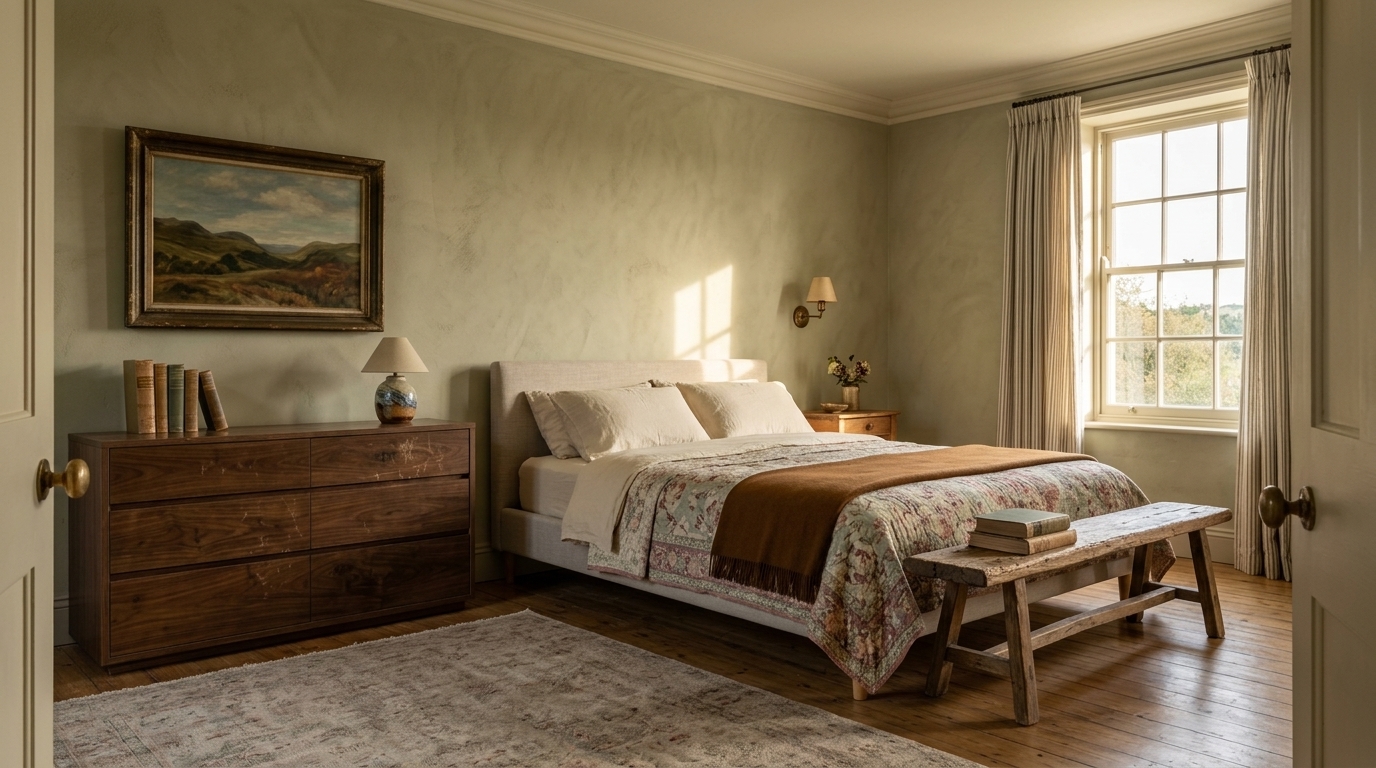
12 Ideas for a Sage Green Farmhouse Bedroom That Feels Warm and Collected
Sage green and farmhouse style sound like an easy match, but that can be the problem. Pale sage walls, white furniture, a distressed wood sign, rattan basket, and gray bedding may technically fit the brief while making the bedroom feel like an older decorating formula.
These 12 ideas for a sage green farmhouse bedroom take a warmer, more collected approach, similar in spirit to these rustic bedroom ideas. Sage is having a renewed moment in 2026, particularly in country and traditional interiors, where designers are pairing it with warmer woods, historic colors, pattern, and natural materials rather than cool gray. Homes & Gardens notes that sage is appearing repeatedly in designer homes this year, including bedrooms where it is layered with blush, antique textiles, and warm finishes.
The goal is a farmhouse bedroom that feels relaxed and rooted in nature without looking themed.
Get the sage green right before decorating around it
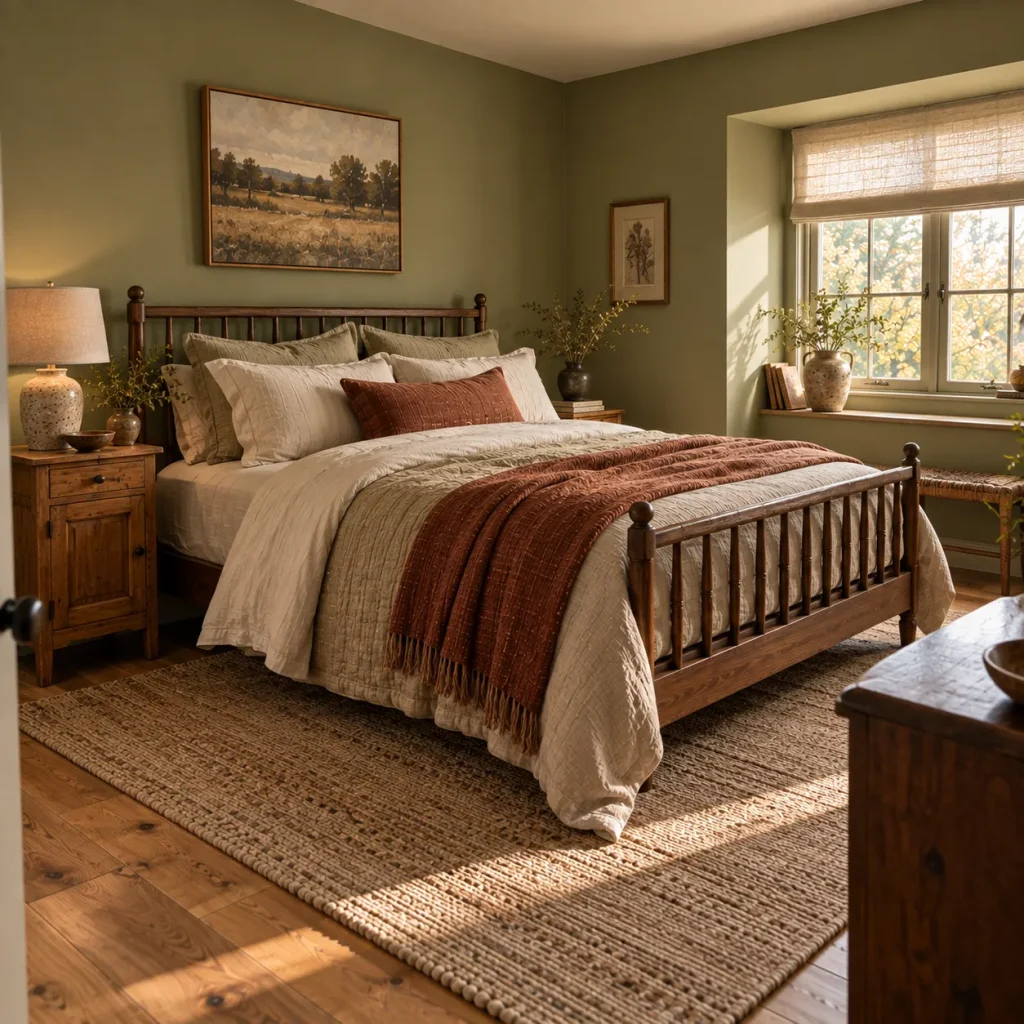
Idea 1: Choose a warmer sage instead of a cold gray-green
Not every sage works equally well with farmhouse materials.
If your room contains honey oak, old pine, walnut, warm carpet, or cream upholstery, look for sage with yellow, olive, or softly earthy undertones. Very blue-gray sage can make those materials appear more orange by comparison.
Current 2026 color direction is moving away from cool pale greige and toward colors with clearer identity. One designer quoted by Homes & Gardens specifically describes soft sage paneling as giving a bedroom more coziness and personality than a safe greige backdrop.
Paint large sample boards rather than relying on a tiny chip. Move them behind the bed, beside the window, and near the flooring.
Check them again at night. A sage that looks dusty and balanced at noon may become considerably grayer under cool artificial light.
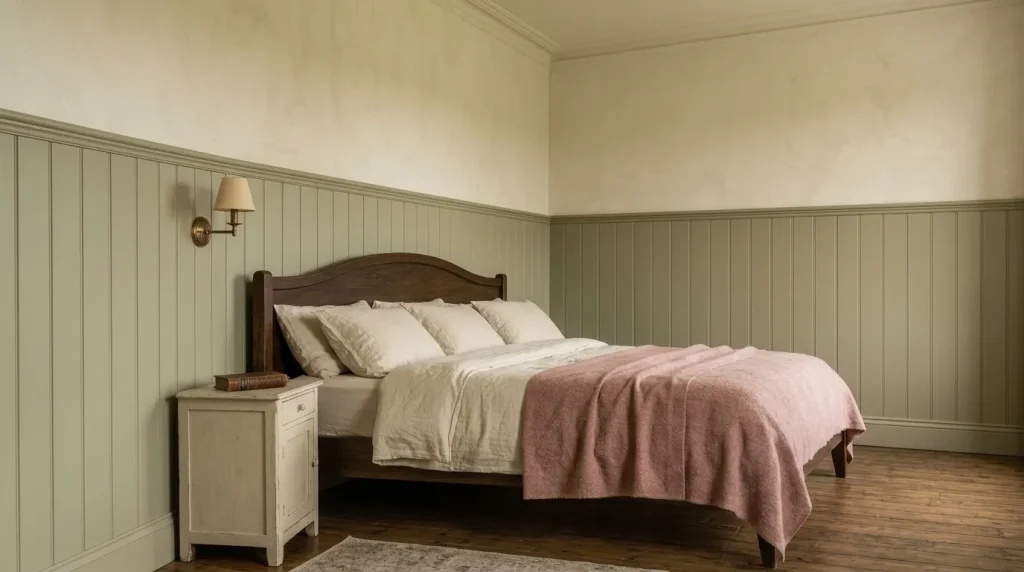
Idea 2: Use sage on paneling rather than automatically painting every wall
Sage green works beautifully on tongue-and-groove, traditional panel molding, beadboard, or lower-wall paneling.
Try sage below a dado-height trim with warm ivory or a subtle patterned wallpaper above it. The architectural division gives the farmhouse reference more substance than simply creating a green feature wall.
This is also a clever approach if you want noticeable color without surrounding the entire room in green.
For a smaller bedroom, painting the wall and trim in one continuous sage can also work. Fewer high-contrast lines often make compact rooms feel calmer.
Do not add paneling solely because farmhouse bedrooms are “supposed” to have it. If the room already has interesting architecture, let that lead.
Pair sage with warmer wood
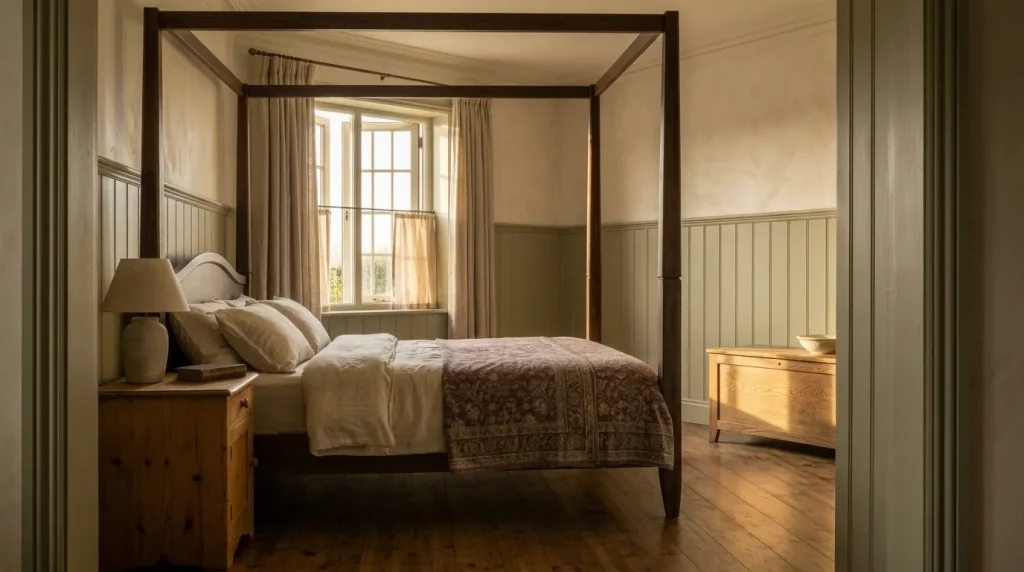
Idea 3: Bring in walnut, aged oak, or old pine
The old sage-and-whitewashed-wood formula can look surprisingly flat.
Instead, pair sage with wood that has visible warmth and grain. Walnut adds depth. Aged oak feels sturdy without becoming heavy. Old pine creates an informal country character that suits farmhouse bedrooms particularly well.
Architectural Digest’s 2026 bedroom guidance describes farmhouse style through reclaimed wood, natural materials, vintage pieces, quilts, stripes, and finishes that feel better with age.
If your flooring is already oak, do not feel compelled to match the bed and nightstands exactly. A medium oak floor can work beautifully with walnut nightstands or an old pine bench.
Matching every wood finish may actually make the room look more like a bedroom set than a space gathered over time.
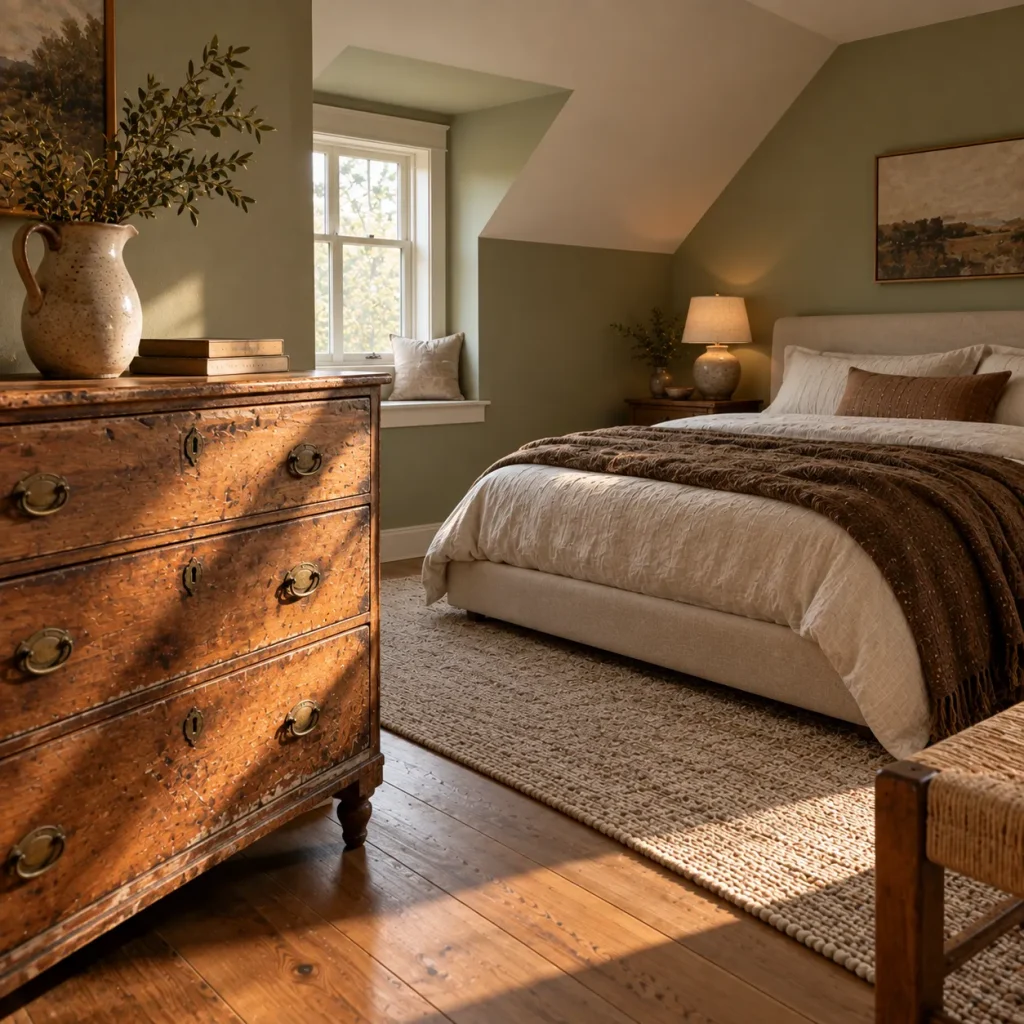
Idea 4: Use one vintage wooden piece with real age
One genuinely old piece can do more for farmhouse character than several new pieces manufactured to look distressed.
Try an antique chest, pine nightstand, old dresser, small wooden stool, or weathered bench at the foot of the bed.
I once worked through an illustrative farmhouse bedroom where the bed, dresser, and nightstands all had the same factory-distressed finish. It looked coordinated, but none of it felt convincing. Changing one nightstand for a darker old wooden table immediately improved the whole room.
Do not worry about minor scratches or uneven color if the piece is structurally sound. Patina is often what prevents farmhouse style from becoming overly polished.
Add a second color so the bedroom is not sage and beige only

Idea 5: Pair sage with dusty rose or faded blush
Sage and blush can sound overly sweet, but muted versions are much more sophisticated.
Look for clay pink, dusty rose, faded raspberry, or a brown-based blush. Use it through a lumbar cushion, floral quilt, upholstered chair, or small amount of patterned fabric.
Designers featured by Homes & Gardens in 2026 are pairing sage with blush tones and antique textiles because the warm pink counterbalances sage’s cooler green character.
The trick is proportion. Let sage lead. Keep the pink smaller.
A sage-paneled wall, cream bed, walnut furniture, and one faded rose textile can feel much richer than a room divided equally between green and pink, in the same way these neutral bedroom ideas lean on restraint rather than heavy color.
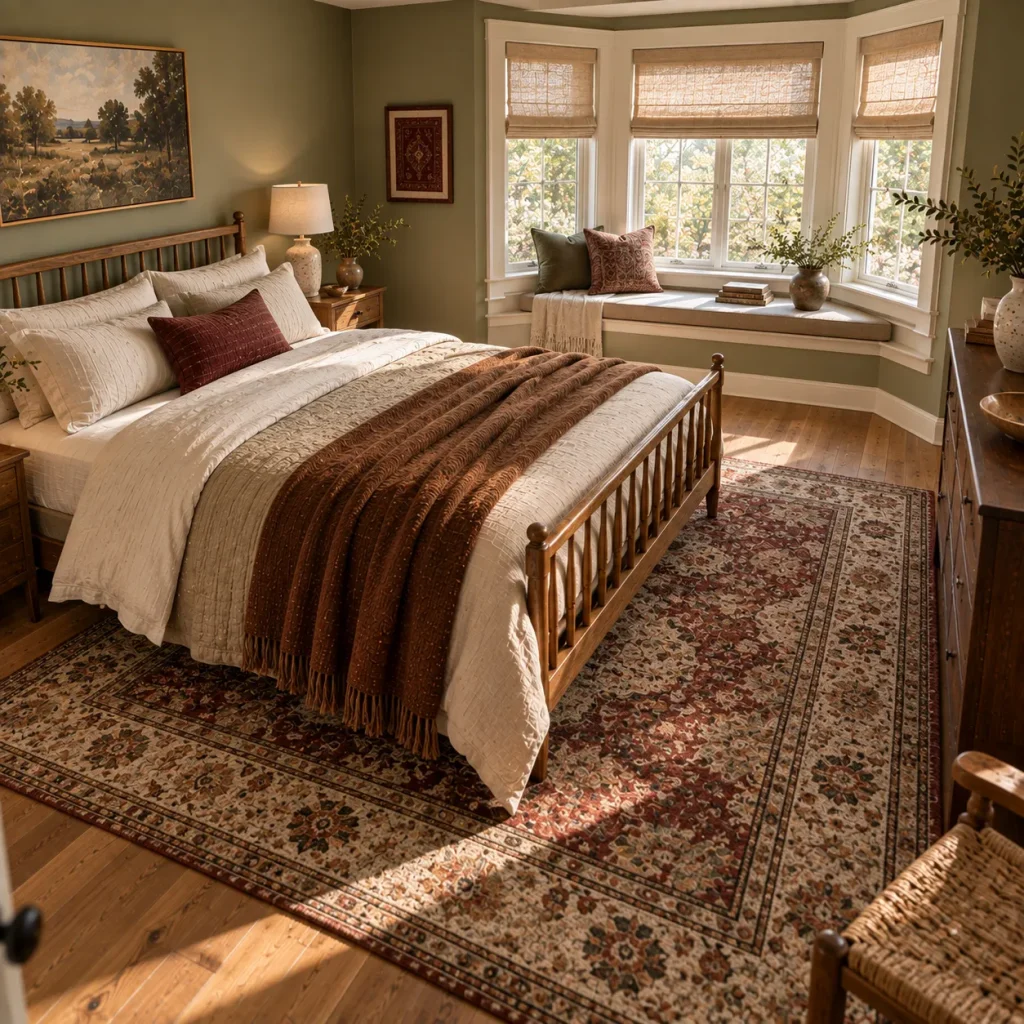
Idea 6: Add burgundy, rust, or tobacco for more depth
If blush is too soft for your taste, go darker.
Burgundy, faded rust, tobacco brown, oxblood, and terracotta give sage enough visual weight to stop the room from feeling washed out.
These earthier colors are also prominent in 2026 interiors, with terracotta, maroon, oxblood, bottle green, and chocolate appearing across current seasonal design palettes, a direction that also shows up in these moody romantic bedroom ideas.
Try sage walls with a tobacco wool blanket. Or use cream walls, sage upholstery, and a burgundy patterned rug.
You do not need many accents. One darker red-brown tone repeated two or three times is enough.
Make the bed feel farmhouse without making it fussy
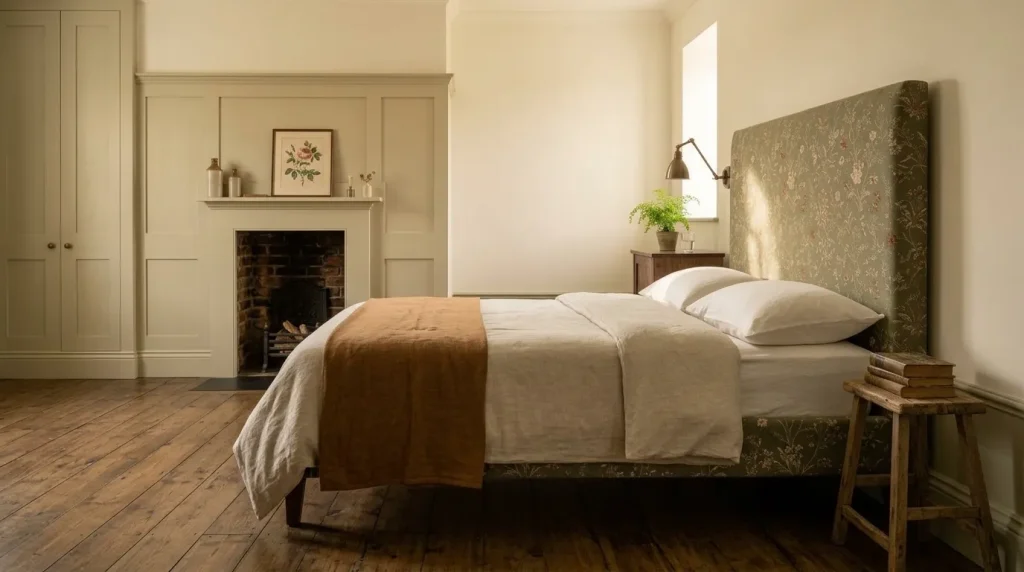
Idea 7: Choose an upholstered headboard with a small botanical or stripe
A simple upholstered headboard can soften the room while bringing in farmhouse pattern.
Consider a small botanical, ticking stripe, faded floral, or warm neutral linen. Architectural Digest’s farmhouse bedroom guidance specifically highlights quilts, checks, stripes, florals, and layered natural fabrics as part of the style’s relaxed character.
If the walls are already sage, a cream-and-red stripe or faded floral can create useful contrast.
If you use sage only in smaller doses, the headboard itself could be olive-sage linen or velvet.
One contrarian point matters here. A farmhouse bedroom does not automatically need a wooden bed. An upholstered bed can actually make reclaimed wood, antique furniture, and woven materials around it look more distinctive.
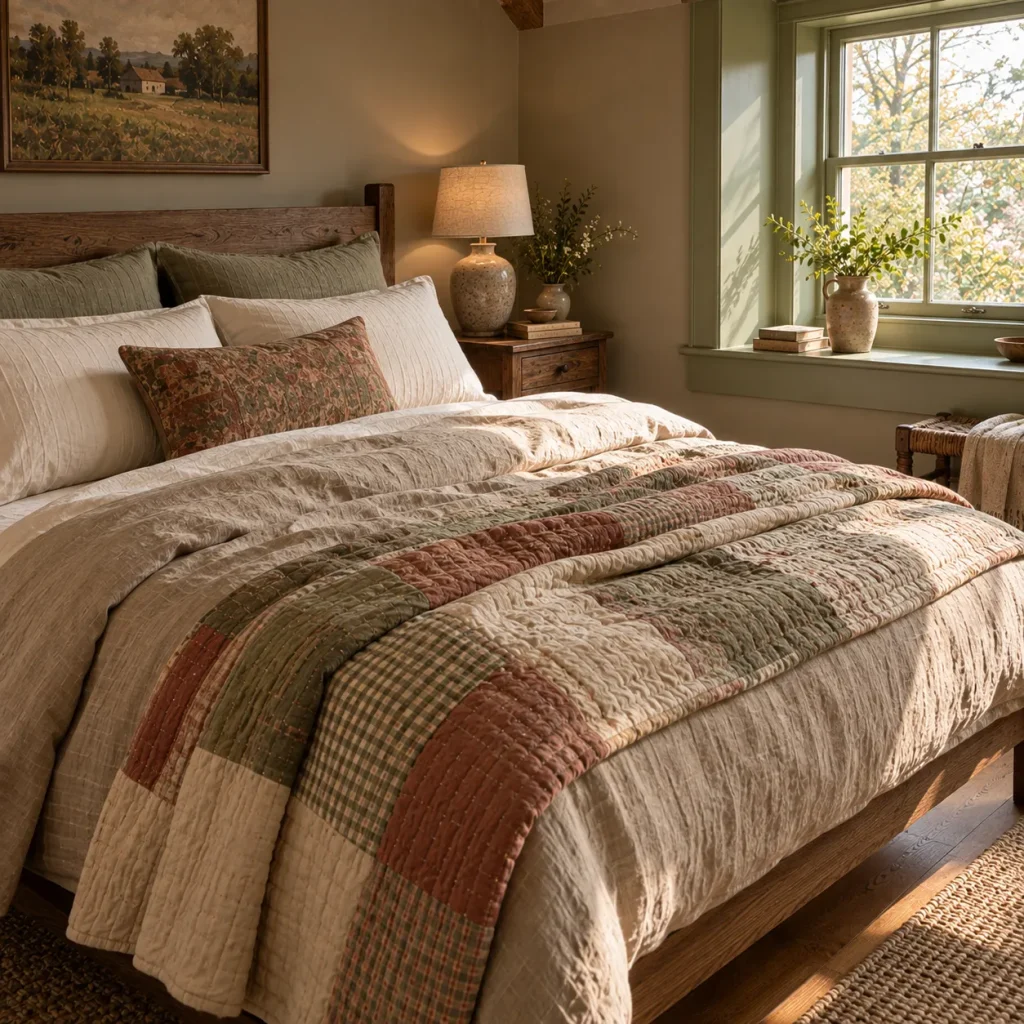
Idea 8: Layer linen, cotton, and a quilt rather than piles of pillows
Farmhouse bedding should feel comfortable enough to use every day.
Start with cotton or linen sheets. Add a duvet or simple coverlet. Then place a quilt or wool blanket across the lower third of the bed.
Use tonal variation. Warm ivory sheets, oatmeal bedding, and a quilt containing sage, faded rust, or dusty rose will create more dimension than six nearly identical cream layers.
Keep decorative pillows limited. Two sleeping pillows plus a pair of larger back pillows and one smaller patterned cushion are usually enough for a practical bed.
The goal is relaxed layering, not a pillow display that has to be moved to the floor every night.
Use pattern to make the farmhouse side more convincing
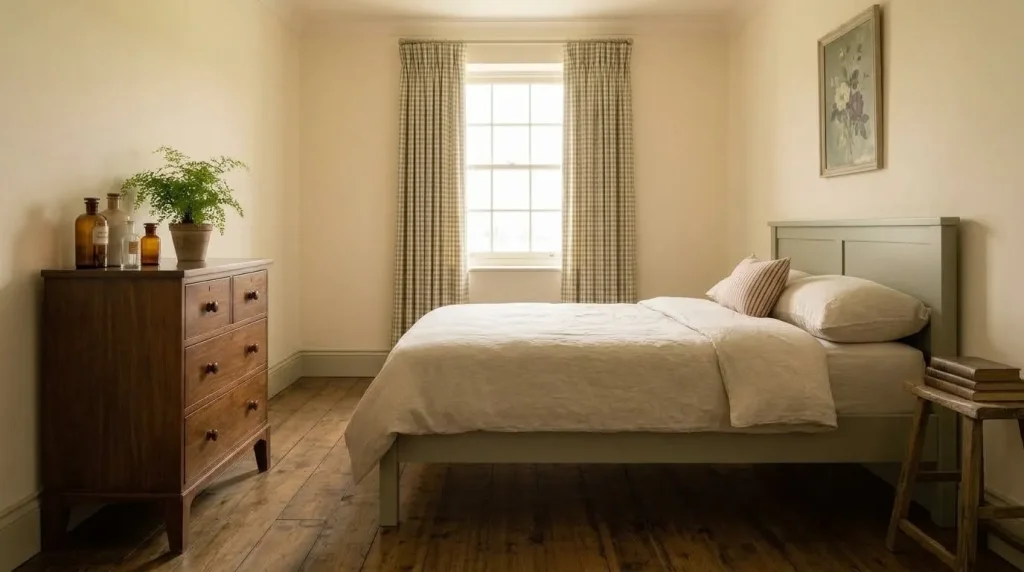
Idea 9: Introduce one traditional floral, check, or stripe
Pattern prevents sage farmhouse bedrooms from becoming another form of muted minimalism.
Try gingham curtains, a narrow ticking stripe, block-print floral cushions, or a faded botanical quilt.
Farmhouse rooms historically feel richer because patterns look accumulated rather than perfectly coordinated. Architectural Digest notes that the style works particularly well when quilts, stripes, prints, and checks are mixed without trying to make everything match exactly.
Connect different patterns through color instead. A floral containing sage and rust can sit beside a cream-and-burgundy stripe if the colors repeat elsewhere.
Use one dominant pattern and one quieter secondary print. Three equally strong prints can overwhelm a restful bedroom.
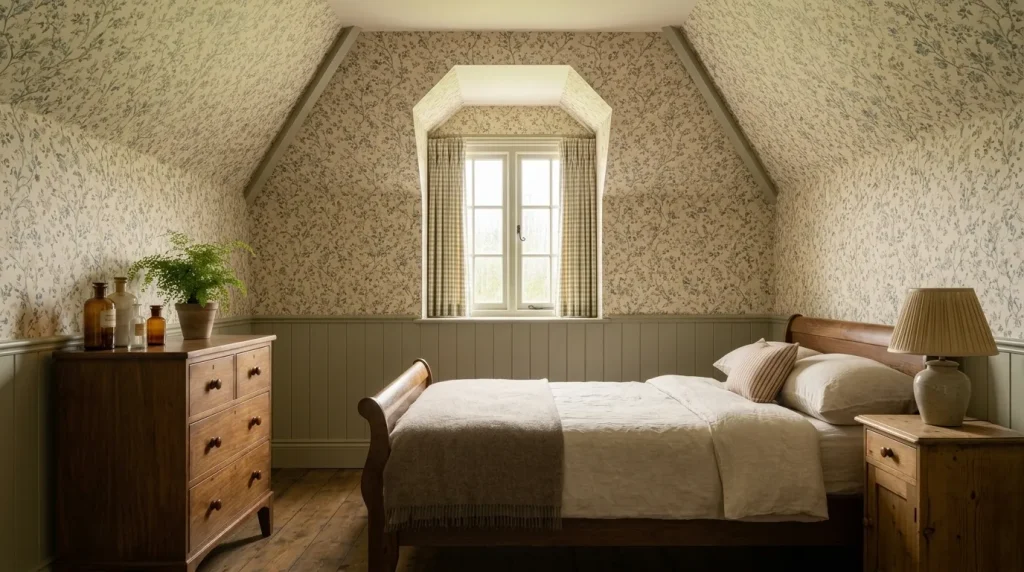
Idea 10: Add wallpaper in a soft botanical or heritage pattern
Wallpaper can make sage feel more architectural and less like a trending paint color.
Look for delicate botanicals, vine motifs, faded stripes, or designs where sage appears as part of a broader palette.
You could wallpaper above sage paneling or use wallpaper on all four walls while painting the trim green.
A current traditional-bedroom example featured by Homes & Gardens uses sage-gray patterned wallpaper with antique textiles, showing how muted green can function almost like a chromatic neutral rather than a dominant color.
Avoid installing a random wallpaper rectangle directly behind the bed. Let the wallpaper follow a complete architectural plane or clear molding boundary.
Finish with materials that feel collected
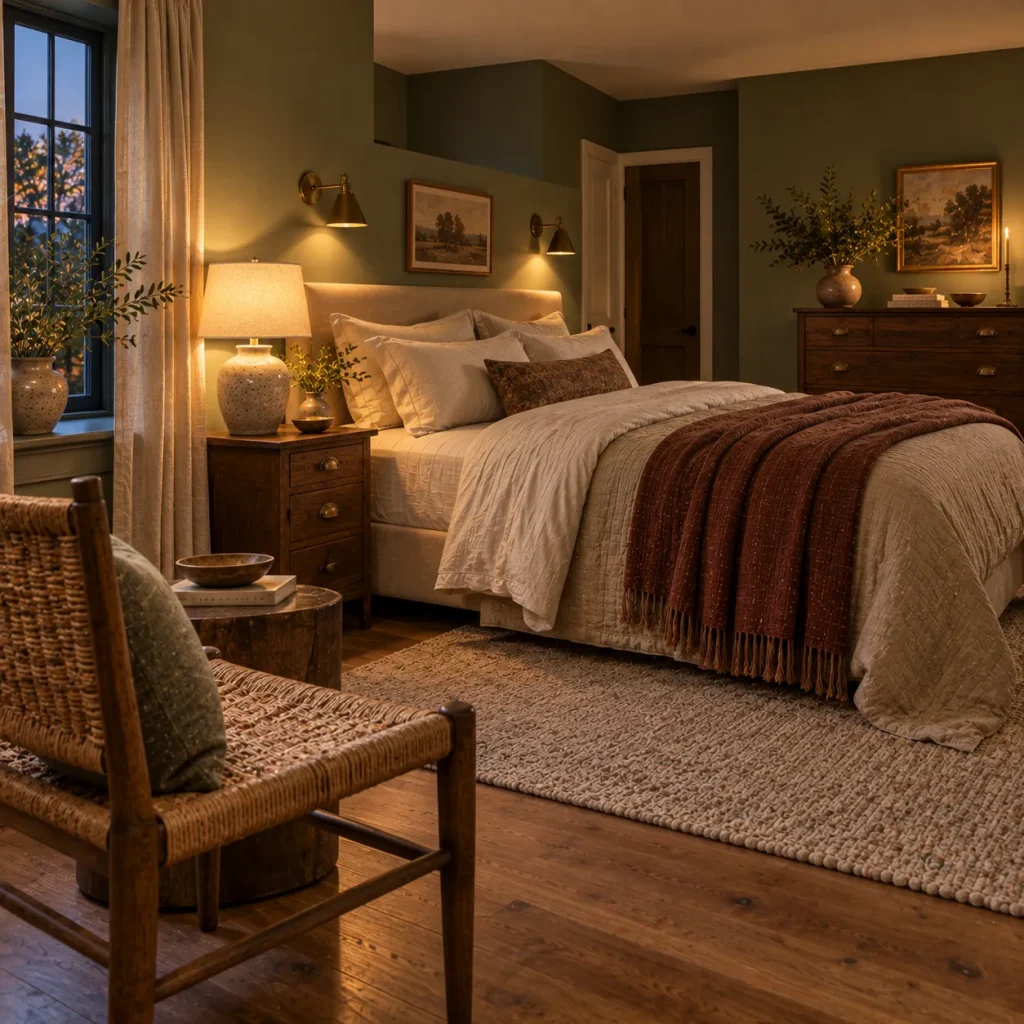
Idea 11: Use aged brass, ceramic, and woven fiber instead of matte black everywhere
Black metal became closely associated with modern farmhouse, especially through bed frames, sconces, handles, and oversized industrial fixtures.
You do not need to remove black completely. Just vary the finishes.
Aged brass sconces, ceramic lamps, bronze hardware, and woven shades feel softer beside sage.
Natural fiber also works beautifully, but use it selectively. One woven pendant or cane chair can introduce texture. A rattan bed, rattan nightstands, rattan mirror, and baskets everywhere will make the room feel more boho than farmhouse.
Balance woven pieces with solid wood, linen, ceramics, and metal.
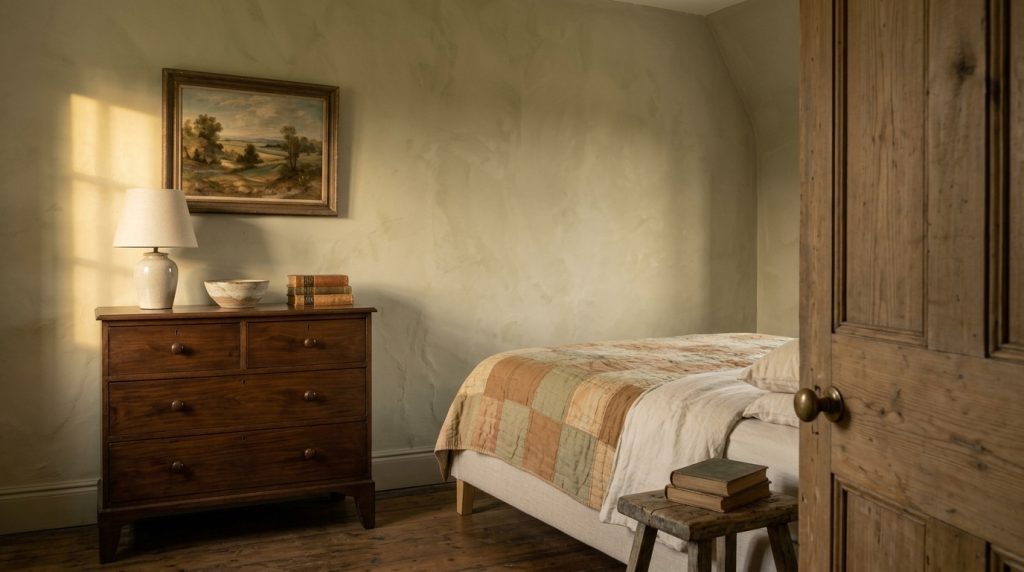
Idea 12: Add landscape art, books, and handmade objects
Farmhouse character should come from objects that plausibly belong in a home, not decorations that announce the style.
Hang a landscape painting, botanical study, old photograph, or small piece of textile art. Put actual books on the nightstand. Add a handmade stoneware vase or bowl.
Current farmhouse guidance emphasizes authentic, personal elements such as flea-market furniture, reclaimed wood, handmade details, and pieces connected to the homeowner rather than formulaic themed decor, echoing the same collected feeling found in these farmhouse living room tips.
A framed landscape above a sage dresser can provide more character than a wooden sign reading “Farmhouse.” And leave some surfaces partly empty. A bedroom feels restful because there is room around the interesting objects.
A practical sage farmhouse palette guide
| Main element | Strong choice | Works especially well with |
|---|---|---|
| Walls | Warm sage | Walnut, cream, dusty rose |
| Bed | Linen or patterned upholstery | Sage paneling, old wood |
| Wood | Walnut, aged oak, pine | Sage, ivory, rust |
| Bedding | Cream, oatmeal, soft sage | Burgundy, tobacco |
| Pattern | Floral, ticking stripe, check | Warm wood, simple solids |
| Metal | Aged brass, bronze, iron | Green, wood, linen |
| Rug | Wool or faded pattern | Sage, rust, dusty blue |
You do not need every element in the table. Use it to keep the palette warm enough that sage does not drift toward cool gray.
What should you skip in a sage green farmhouse bedroom?
Cool sage with cool gray furniture. The combination can make a bedroom feel dated and flat. Warm wood or brown-based accents give sage more life.
Farmhouse word signs. Let materials, furniture, textiles, and artwork communicate the style.
Fake distressed wood everywhere. One genuinely old piece has more character than a complete set of deliberately scraped furniture.
Too much white. Sage looks richer beside parchment, cream, mushroom, walnut, rust, and dusty pink than against stark white alone.
Relying on shiplap as the entire farmhouse identity. Paneling can work, but it should support the architecture rather than function as a style label.
Try this if your bedroom is already sage green
Do not repaint.
First, look at the wood. If everything is white or pale gray, add one warmer anchor such as walnut nightstands, an old pine bench, or a dark oak dresser.
Next, bring in a second color. Dusty rose creates softness. Burgundy or tobacco gives the room more weight.
Replace two generic accessories with something useful or handmade. A ceramic lamp and vintage landscape are good examples.
Finally, introduce one restrained pattern through a quilt, cushion, or curtain.
This small sequence can shift an ordinary sage bedroom toward a much more convincing farmhouse look without replacing the bed or flooring.
FAQ
Is sage green still popular for bedrooms in 2026?
Yes. Sage green is appearing repeatedly in designer homes in 2026, especially in traditional and country-inspired interiors. Its muted quality also fits the current interest in chromatic neutrals and colors that feel distinctive without being highly saturated.
What colors work best with sage green in a farmhouse bedroom?
Warm ivory, mushroom, dusty rose, burgundy, rust, tobacco brown, dusty blue, and cream all pair well with sage. Warm wood tones such as walnut, oak, and aged pine help keep the palette grounded.
What wood looks best with sage green?
Walnut, medium oak, old pine, and darker stained woods work particularly well. Sage naturally complements warm woods, and current bedroom guidance frequently pairs muted greens with timber and other natural materials.
Can sage green farmhouse decor work in a small bedroom?
Yes. Use sage continuously on walls or paneling to reduce visual fragmentation, then keep furniture properly scaled. Wall-mounted lighting, fewer furniture pieces, and one substantial rug can prevent a small farmhouse bedroom from feeling crowded.
Let sage become the background, not the whole story
The strongest 12 ideas for a sage green farmhouse bedroom use green as a starting point rather than the entire decorating concept.
Sage becomes much more interesting beside walnut, old pine, faded floral fabric, aged brass, wool, cream linen, and a little burgundy or dusty rose. Those materials and colors give the room history and warmth.
If you make one change first, look at what sits directly beside the sage. If it is mostly white, gray, and more pale green, add one darker natural material before buying another accessory.
A farmhouse bedroom should feel comfortable and collected before it feels coordinated. Let sage provide the calm background, then allow wood, pattern, textiles, and meaningful objects to give the room its character.