
15 Minimalist Bedroom Ideas for a Calm, Clutter-Free Space You’ll Love Waking Up In
A minimalist bedroom should make life feel easier.
It should be the room where visual noise disappears, where everything useful has a place, and where you can walk in at the end of the day without being confronted by piles of clothes, crowded furniture, or surfaces covered in things you rarely use.
But minimalism does not have to mean an empty white room.
The more appealing version emerging in 2026 is noticeably warmer. Current design direction is combining simplicity with tactile materials, natural wood, upholstered beds, softer forms, and colors that feel restful rather than clinical. Houzz’s 2026 trend reporting highlights warm colors, textured finishes, handcrafted materials, and dark woods, while Architectural Digest continues to feature bedrooms that combine restrained layouts with wood, upholstery, and natural texture.
That makes minimalist bedroom design particularly useful if your goal is not simply to own fewer things, but to create a space that feels calm, comfortable, organized, and genuinely pleasant to sleep in.
Here are 15 minimalist bedroom ideas that can help you create that feeling without stripping away warmth or personality.
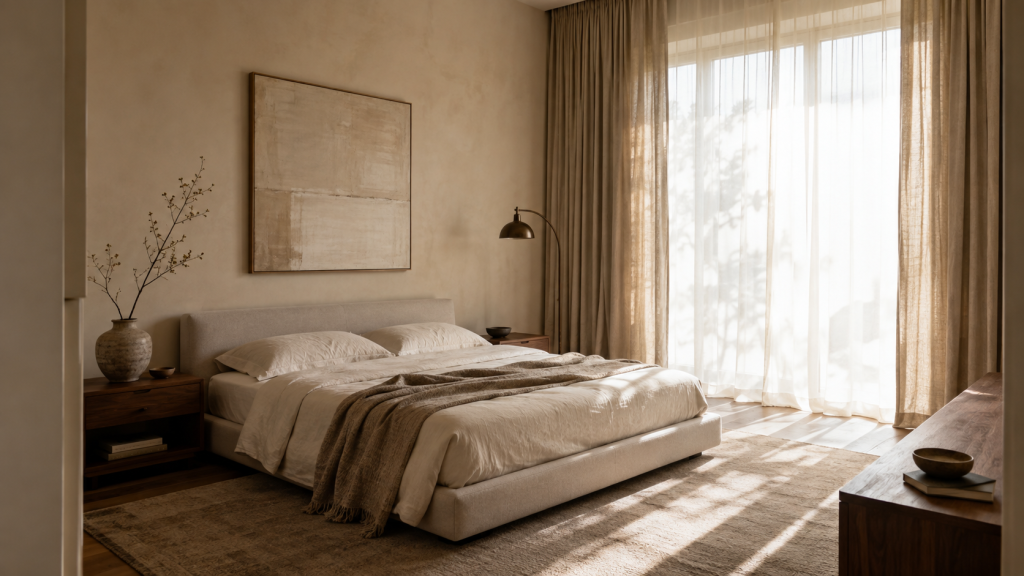
1. Begin With a Clear Visual Plan
Before buying anything new, decide what you want the room to feel like.
A minimalist bedroom works best when the major elements have a clear relationship.
Choose three or four words to guide the design, such as:
- warm
- quiet
- natural
- airy
Then build around them.
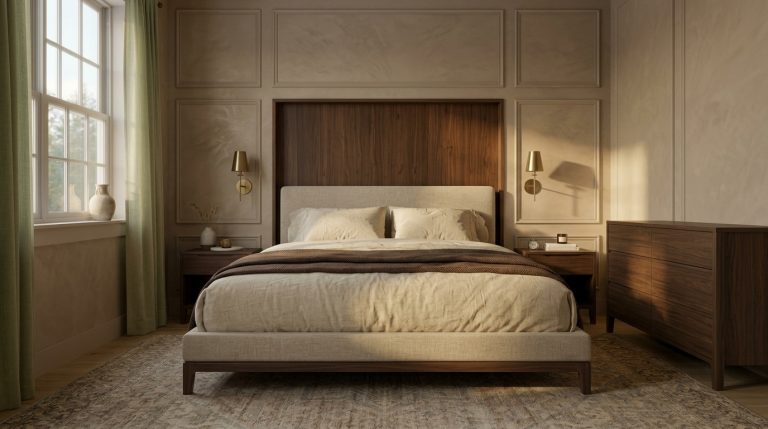
A warm minimalist room might use cream walls, walnut furniture, oatmeal bedding, and soft bronze lighting. A lighter version might combine warm white, pale oak, linen, and muted gray-green.
This prevents you from adding attractive pieces that individually look good but make no sense together.
Minimalism becomes easier when every new item has to fit the same visual language.
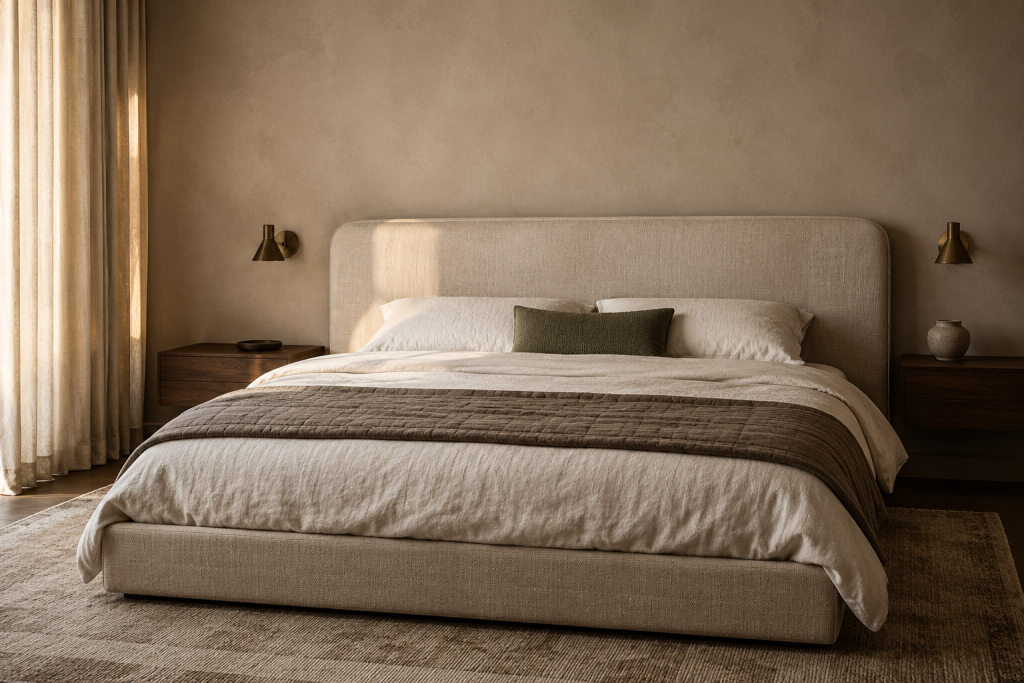
2. Choose a Simple Bed With Real Presence
Because the bed is usually the largest object in the room, it should do most of the visual work.
That does not require an elaborate frame.
A low wooden platform bed, softly upholstered frame, or simple padded headboard can anchor the bedroom without making it feel busy.
Architectural Digest’s current upholstered-bed coverage notes that clean-lined upholstered beds can add warmth and softness while remaining appropriate for minimalist interiors. Linen, cotton, and performance fabrics are particularly versatile because they introduce texture without needing pattern or ornament.
Try:
- oatmeal linen
- warm taupe
- cream
- soft mushroom
- natural oak
- walnut
If the bed already creates enough presence, you will need much less decoration around it.
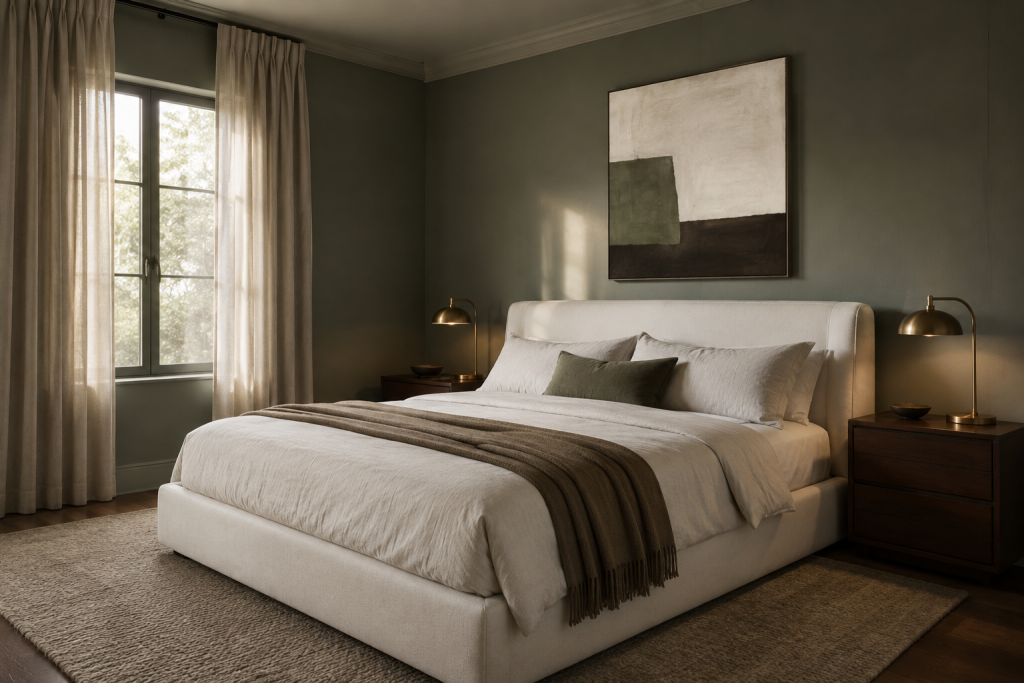
3. Keep the Color Palette Soft but Not Lifeless
White is not the only minimalist color.
In fact, using brilliant white on every surface can sometimes make a bedroom feel more clinical than calm.
Consider warmer shades such as:
- ivory
- cream
- mushroom
- pale taupe
- muted stone
- soft clay
- gray-green
- warm beige
Architectural Digest’s bedroom color guidance shows calming bedrooms across a much wider spectrum than plain white, from earthy neutrals to greens, blues, and more atmospheric shades.
The important part is restraint.
Choose one main background color, one secondary neutral, and perhaps one deeper accent.
For example:
cream + walnut + olive
or
mushroom + ivory + dark bronze.
A small palette makes the bedroom feel coherent even when the materials differ.
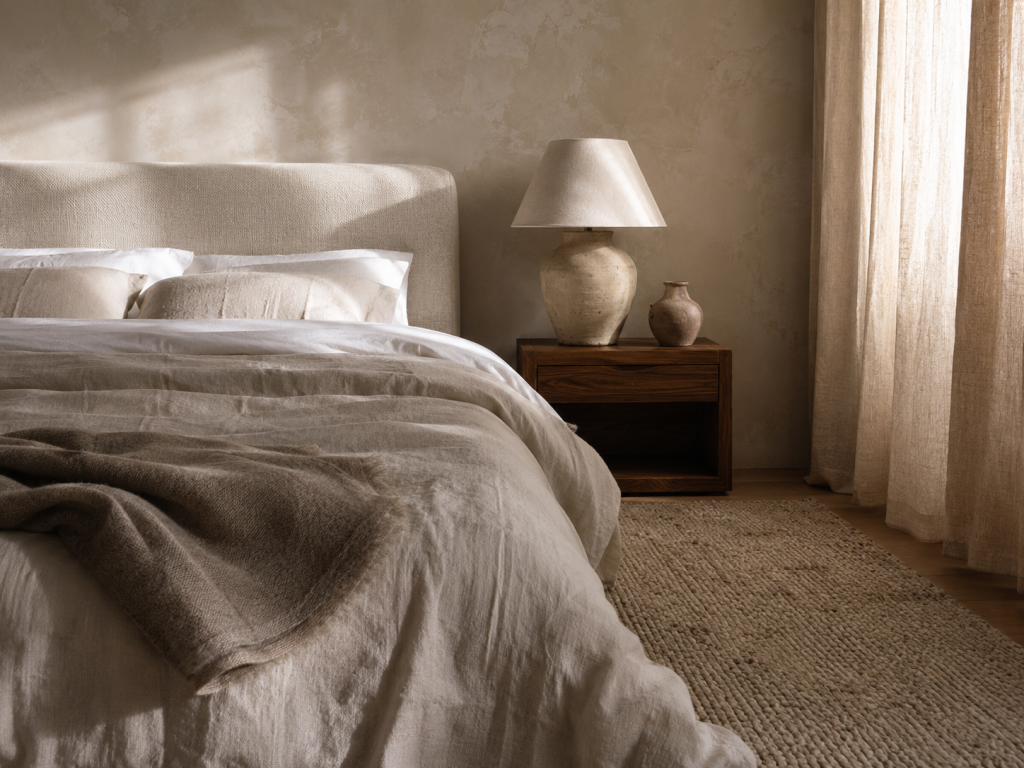
4. Use Texture Instead of Extra Decoration
One of the biggest mistakes in minimalist decorating is removing accessories without replacing the visual richness they provided.
The answer is texture.
Houzz’s 2026 surface-design coverage specifically notes that minimalist interiors can remain warm through tactile materials, including textile-like wallcoverings, plaster effects, handcrafted surfaces, and natural finishes.
In a bedroom, that can be much simpler.
Combine:
- washed linen bedding
- a wool rug
- cotton sheets
- a soft upholstered headboard
- woven curtains
- wood grain
- handmade ceramics
A room using only cream and brown can still feel incredibly layered when each surface reacts differently to light.
Texture creates interest without creating clutter.
5. Give Everything a Place
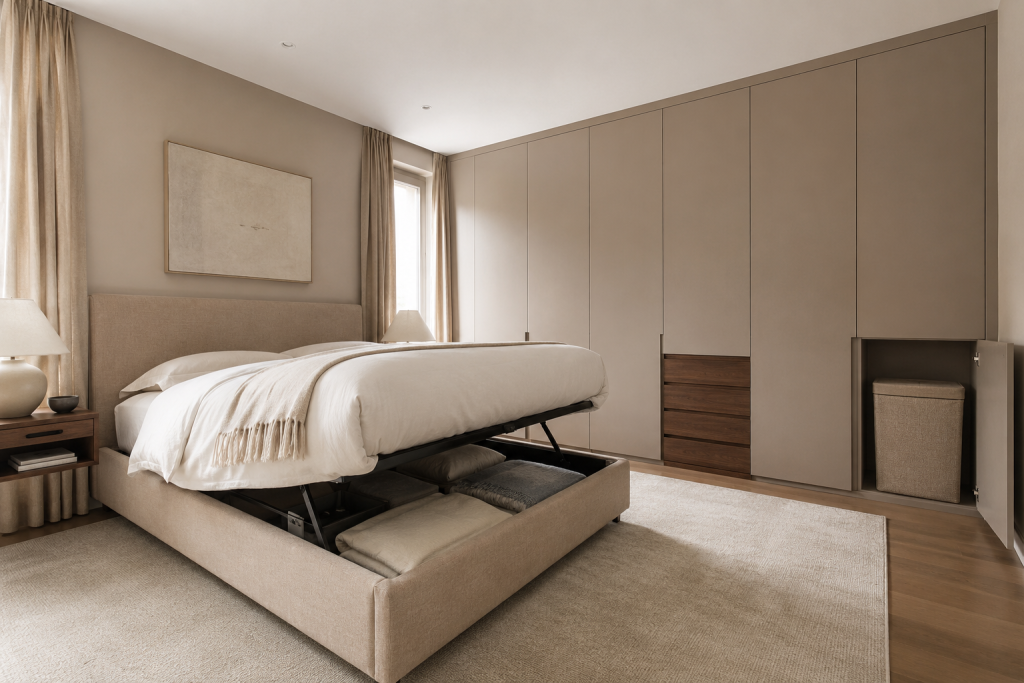
The difference between a minimalist bedroom and a temporarily tidy bedroom is storage.
If everyday belongings do not have proper homes, clutter will always return.
Prioritize storage for the things that actually live in the room:
- clothes
- shoes
- bedding
- chargers
- books
- laundry
- accessories
- personal care items
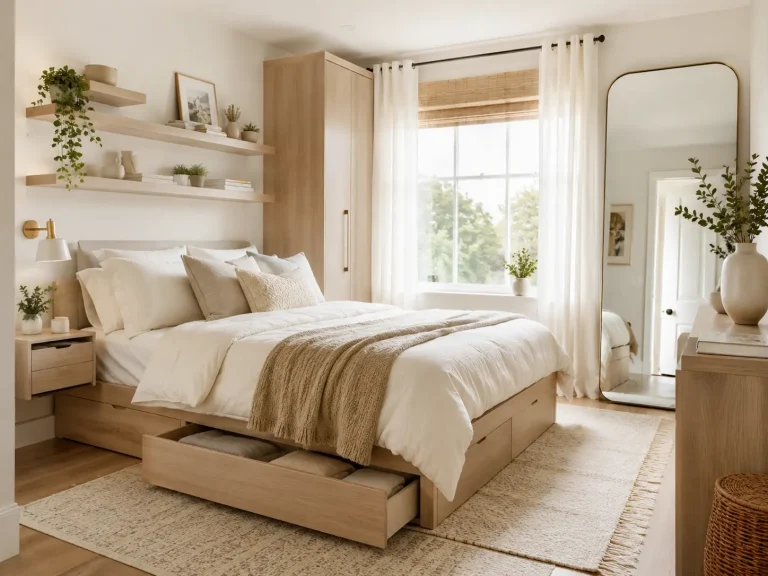
Storage beds can be particularly useful in compact bedrooms. Architectural Digest’s 2026 storage-bed recommendations include designs with drawers or lift-up compartments that preserve a clean exterior while using otherwise wasted space beneath the mattress.
Closed storage is generally easier to keep visually calm than large amounts of open shelving.
Minimalism should make everyday life easier—not require you to constantly hide evidence that someone lives there.

6. Keep Bedside Tables Almost Clear
Your bedside table does not need to become a display shelf.
Keep only what you genuinely use at night.
That might be:
- a lamp
- one book
- a glass of water
- a small dish
- your alarm clock
Everything else can go into a drawer.
If your bedside table currently holds cables, receipts, skincare products, medicine, glasses, books, headphones, and miscellaneous objects, adding another decorative vase will not improve it.
Reduce first.
Then decide whether the surface needs anything else at all.
Minimalist styling works when practical items themselves are chosen thoughtfully.
7. Layer the Lighting
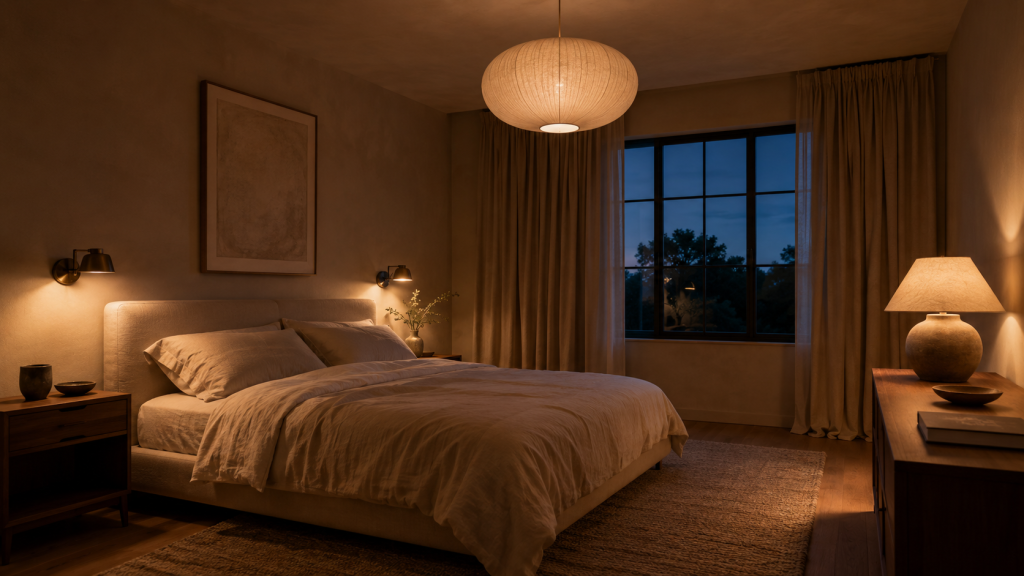
A room can be visually simple and still feel uncomfortable if the lighting is harsh.
Do not rely solely on one bright ceiling light.
Use several quieter sources:
- bedside lamps
- wall sconces
- floor lamp
- soft ceiling fixture
- reading light
ASID’s recent research has continued to emphasize wellness and the role interiors can play in supporting physical and emotional well-being; previous ASID trend work has specifically highlighted circadian-aware lighting as part of wellness-focused design.
You do not need an elaborate smart-lighting system to benefit from the principle.
During the evening, use warm, lower-level illumination instead of flooding the entire bedroom with bright light.
It immediately changes how calm the room feels.

8. Use Full-Length Curtains to Simplify the Windows
Minimalism works well when architectural lines are visually clean.
Window treatments can help.
Instead of several small decorative treatments around the window, use one generous pair of full-length curtains or a simple combination of blinds and curtains.
Take the curtains close to the floor.
When appropriate, mount them higher than the top of the window so the room feels taller and the wall treatment appears more intentional.
Choose a fabric that adds gentle texture:
- linen
- linen blend
- soft cotton
- light wool blend
Curtains in a color close to the walls create an especially calm effect because the window does not become a high-contrast visual interruption.
9. Leave Some Parts of the Room Empty
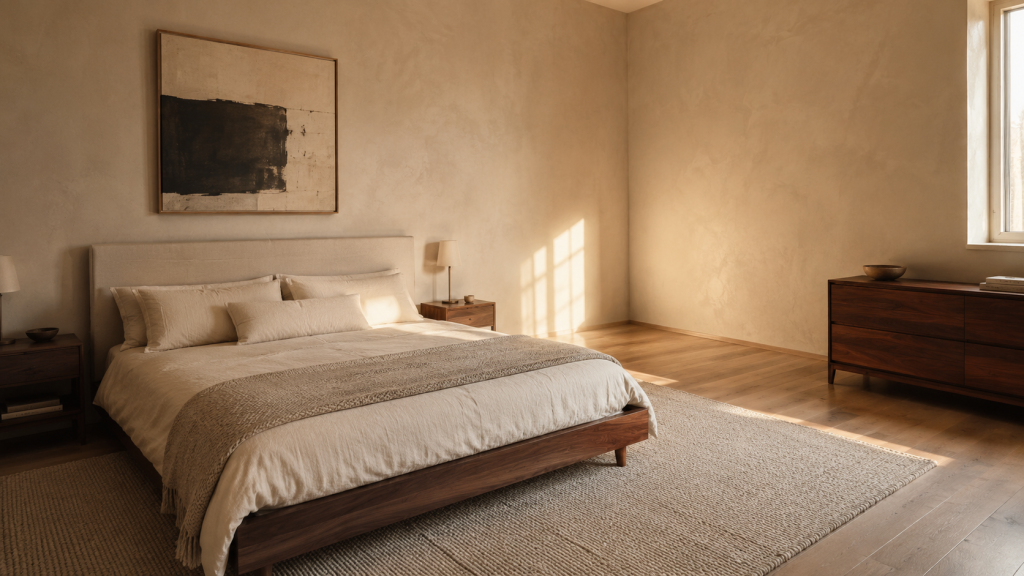
Not every wall needs artwork.
Not every corner needs a chair.
Not every surface needs styling.
Houzz’s modern-bedroom guidance explicitly notes that modern rooms do not need every empty area filled and that leaving additional space open can itself feel luxurious.
That idea is essential to minimalist bedrooms.
Empty space gives the eye somewhere to rest.
If your room already has a bed, two nightstands, a dresser, chair, bench, plant, mirror, floor lamp, and several baskets, do not automatically look for something to fill the final empty corner.
Try leaving it alone.
You may find that the empty area makes everything else look better.

10. Add Warm Wood to Prevent a Sterile Look
Natural wood is one of the easiest ways to make a minimalist bedroom feel warmer.
You can introduce it through:
- bed frame
- bedside tables
- dresser
- bench
- picture frames
- wall shelving
- small stool
Architectural Digest’s 2026 bedroom guidance recommends mixing wood with upholstery to create material variation while retaining a calm, quiet silhouette.
You also do not need every piece of wood to match.
A pale oak bed can work with a slightly darker dresser. Walnut nightstands can look beautiful beside cream upholstery.
The slight differences help the room feel natural rather than like a matching furniture set.
11. Use One Strong Artwork Instead of a Busy Gallery Wall
Minimalist walls do not need to be completely bare.
They simply benefit from stronger editing.
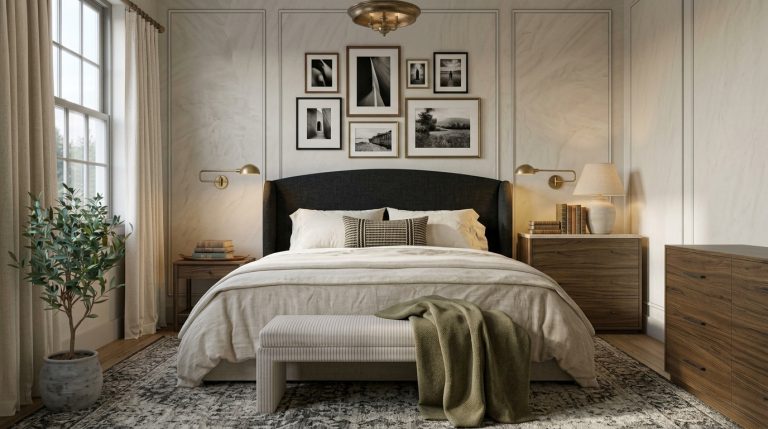
Rather than covering the room with many small frames, consider one substantial artwork above the bed or dresser.
It could be:
- abstract painting
- landscape
- black-and-white photograph
- textile artwork
- simple drawing
- vintage print
Choose something you actually want to look at.
The artwork does not need to match the exact shade of the bedding.
In fact, introducing one controlled moment of stronger color can keep a neutral bedroom from feeling predictable.
Leave enough wall around the piece so it feels intentional.
12. Limit Decorative Pillows
A minimalist bed should invite you to sleep in it rather than require a ten-minute removal ritual every evening.
Start with the pillows you genuinely use.
Then add one or two decorative cushions if they improve the composition.
That is usually enough.
Try layering texture instead:
crisp cotton sheets + linen duvet + wool throw.
The bed can look luxurious without being overloaded.
The same rule applies to blankets. One substantial throw placed casually at the foot of the bed will often look better than several competing layers.
The goal is comfortable simplicity, not hotel-room perfection.
13. Reduce Visible Technology
Few things disrupt a calm bedroom faster than cables and glowing electronics.
Create a deliberate place for:
- phone charging
- smartwatch charging
- headphones
- remote controls
- laptop
- cables
Run charging cords behind furniture where safe, or place a charging station inside a bedside drawer if the setup allows proper ventilation and manufacturer instructions permit it.
Keep the television visually secondary if you have one.
A minimalist bedroom does not require becoming completely technology-free. It simply prevents technology from becoming the main visual feature.
When you enter the room, the bed should attract your attention before a collection of devices does.
14. Add One Living or Natural Element
A minimalist bedroom often benefits from one organic element that interrupts all the straight furniture lines.
That might be:
- a medium-sized plant
- one branch in a ceramic vessel
- dried grasses
- a wooden stool
- a stone bowl
- handmade pottery
Do not turn the room into an indoor jungle simply because plants are associated with calm interiors.
One healthy, appropriately sized plant often has more visual impact than six tiny pots scattered around the room.
Choose according to your actual lighting conditions.
If living plants do not work in your bedroom, natural wood, stone, linen, wool, or botanical artwork can create a similar connection with nature.
15. Make Minimalism Personal, Not Perfect
A perfectly styled minimalist bedroom can still feel strangely empty if nothing in it means anything to you.
Keep a few personal objects.
Maybe it is a photograph on your nightstand.
Perhaps it is an old wooden box, a book you return to often, artwork bought while traveling, or a handmade ceramic piece.
Minimalism is not supposed to erase identity.
The broader design conversation is moving toward interiors that balance restraint with authenticity and personal expression. ASID has highlighted changing lifestyles and human well-being as important forces shaping interior design, while current 1stDibs research shows that organic modernism continues alongside strongly personal and eclectic approaches.
The goal is not to eliminate everything meaningful.
It is to eliminate enough distraction that meaningful things become easier to notice.
How to Declutter a Bedroom Without Making It Feel Empty
If your bedroom currently feels overwhelmed, do not begin by buying organizers.
First, reduce what is visible.
Work in this order:
Start with the floor.
Remove anything that should not permanently live there.
Clear the nightstands.
Keep only what you regularly use before sleep or after waking.
Edit the dresser.
Return clothes, cosmetics, papers, and miscellaneous objects to proper storage.
Look beneath the bed.
If you use under-bed storage, place items in proper containers rather than creating an invisible pile.
Review furniture.
Ask whether every chair, cabinet, bench, and side table is actually necessary.
Edit decoration last.
Once the functional clutter is gone, you can see which decorative objects genuinely improve the room.
The aim is not to reach a particular number of possessions.
It is to make the room easier to maintain.
Minimalist Bedroom Colors for 2026 and 2027
The current minimalist palette is considerably broader than white, beige, and gray.
In 2026, warm materials and tactile surfaces are becoming increasingly prominent, while bedroom color inspiration ranges from quiet earth tones to much deeper atmospheric shades.
For a restrained bedroom, consider:
- warm ivory
- mushroom
- taupe
- dusty olive
- pale clay
- soft blue-gray
- walnut brown
- muted charcoal
Looking toward 2027, Sherwin-Williams’ Rewild forecast includes 48 colors and ten designated Continuity Colors rather than prescribing one narrow palette, encouraging designers to create more individual combinations.
That is particularly compatible with minimalism.
Rather than chasing one “color of the moment,” choose a calm foundation and introduce deeper colors in controlled amounts.
Common Minimalist Bedroom Mistakes
Making everything bright white
Without texture, wood, or warmth, an all-white bedroom can feel sterile.
Removing too much furniture
A bedroom still needs somewhere to place a book, store clothes, and sit when useful.
Buying organizers before decluttering
Storage products do not solve excess belongings. They often simply reorganize them.
Making the room uncomfortable in pursuit of aesthetics
A beautiful minimalist chair that hurts to sit in or bedding that feels unpleasant defeats the purpose.
Displaying too many small objects
A few stronger pieces generally create more impact.
Ignoring lighting
Harsh overhead light can undermine an otherwise peaceful room.
Trying to hide all signs of life
Minimalism should make daily living easier, not make your bedroom resemble an untouched showroom.
Frequently Asked Questions
How do I make my bedroom minimalist?
Start by reducing visible clutter, removing unnecessary furniture, improving closed storage, and choosing a limited color palette. Then focus on a few comfortable, functional pieces rather than filling the room with decoration.
What colors are best for a minimalist bedroom?
Warm white, cream, taupe, mushroom, beige, soft gray-green, muted blue, and earthy browns all work well. Minimalism does not require a purely white palette.
How do I make a minimalist bedroom feel cozy?
Use natural wood, soft lighting, linen or cotton bedding, a properly sized rug, curtains, and tactile materials. Keep the layout simple while allowing enough texture to prevent the room from feeling empty.
Are upholstered beds good for minimalist bedrooms?
Yes. Current Architectural Digest guidance notes that smooth upholstered beds can work particularly well in minimalist spaces because they retain clean lines while adding softness and texture.
How can I create a minimalist bedroom in a small space?
Prioritize the bed, storage, and circulation. Consider a storage bed, wall-mounted lighting, compact nightstands, and fewer pieces of furniture. Leaving some floor and wall area open can also make the room feel calmer.
Final Thoughts
The best minimalist bedroom ideas are not really about seeing how little you can live with.
They are about creating a room with less competition for your attention.
Choose a comfortable bed. Give everyday belongings somewhere to go. Use warm, low lighting in the evening. Let natural wood, linen, wool, ceramics, and other tactile materials provide the visual richness. Leave some walls and corners deliberately empty.
Then keep a few things simply because you love them.
The direction emerging in 2026 makes minimalism far more livable than the cold, stripped-back version many people associate with the style. Warm colors, tactile materials, upholstery, craftsmanship, natural wood, and wellness-oriented design are allowing bedrooms to remain simple while feeling much more comfortable and human.
A calm bedroom does not need to contain nothing.
It needs to contain less of what distracts you and more of what helps you rest.