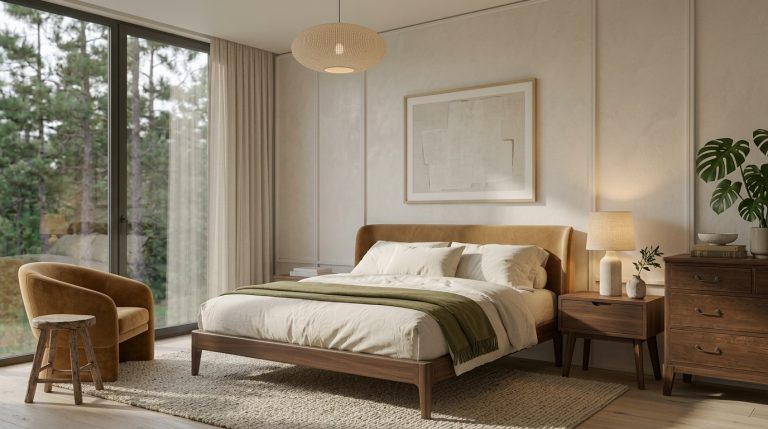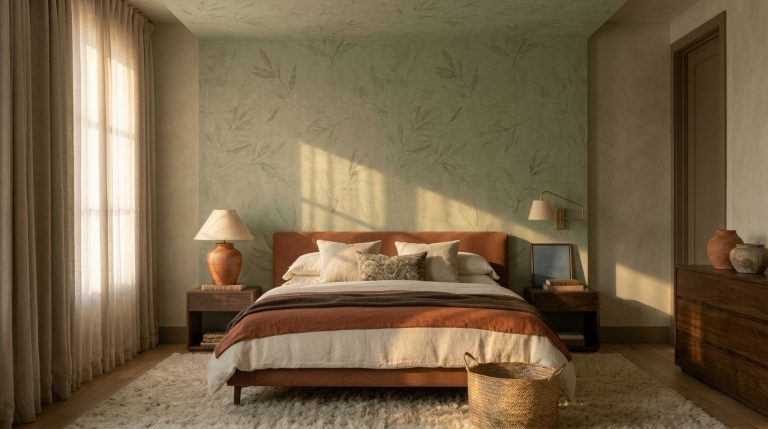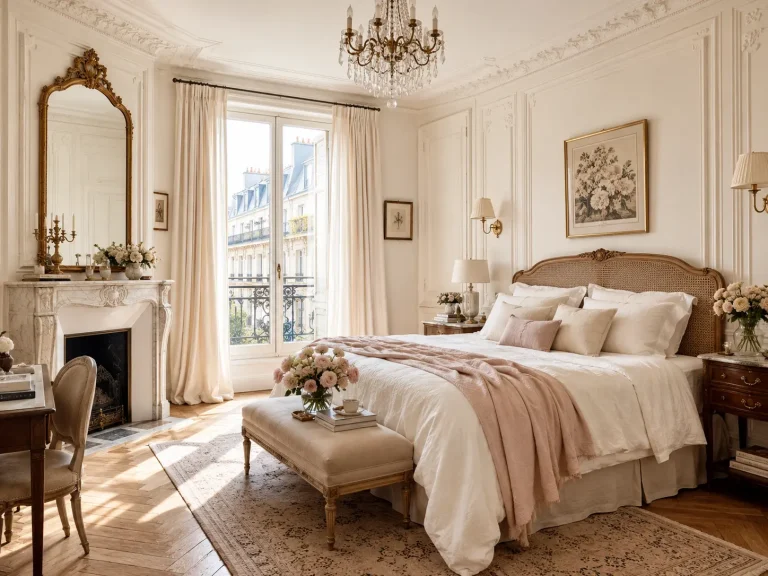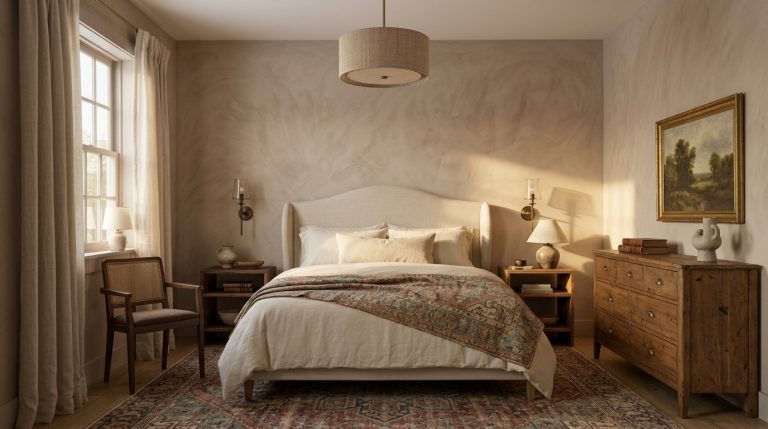
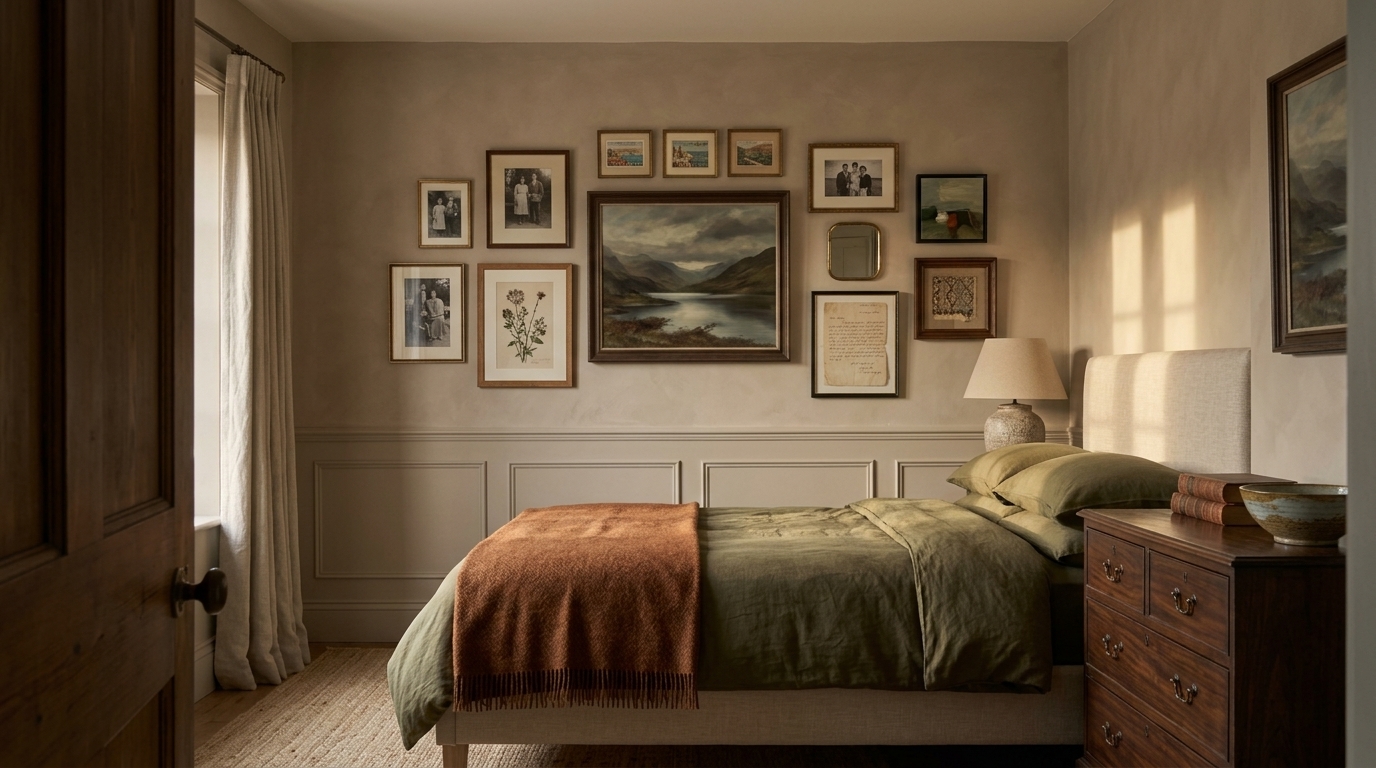
14 bedroom wall collage tips for a More Personal, Collected Look
A bedroom wall collage can make a room feel deeply personal, but it can also become visual noise surprisingly quickly. The usual problem is not having too much art. It is using twenty similarly sized prints, arranging them without a clear shape, then filling every remaining gap because an empty patch suddenly feels unfinished.
These 14 bedroom wall collage tips take a more considered approach. In 2026, gallery walls are shifting toward personal mementos, mixed media, vintage pieces, textiles, photographs, letters, and objects that actually tell a story. Designers are also favoring looser, collected compositions over mass-produced print sets. Homes & Gardens has even identified the emerging “memento wall” as a more personal evolution of the traditional gallery wall.
The goal is to make the collage look accumulated, not downloaded. For more ways to give a bed wall real character, these master bedroom wall decor ideas share the same instinct toward personal, non-generic styling.
Decide What Story the Wall Should Tell
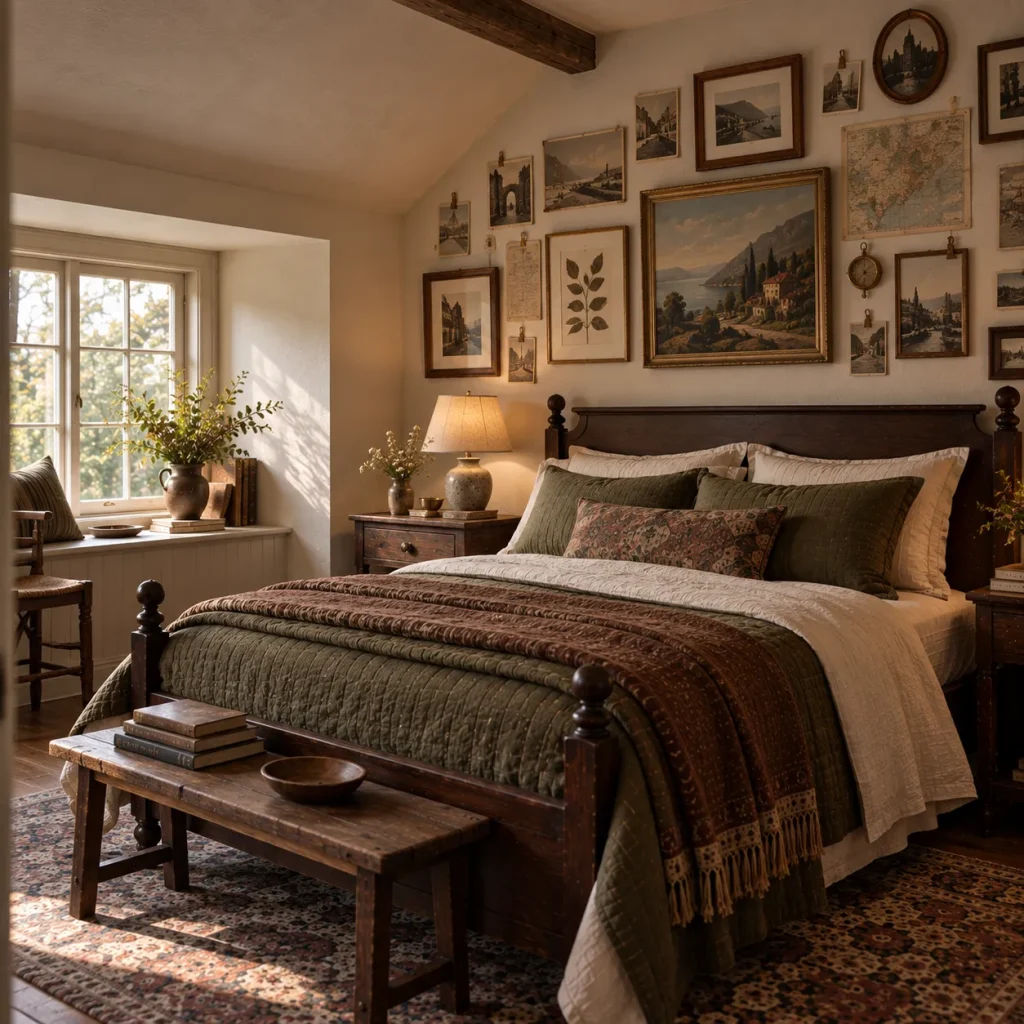
Tip 1: Choose a theme instead of a color scheme
Many collages fail not because the pieces clash, but because they only manage to share the same beige, pink, or blue palette.
A stronger theme might be travel, family, music, fashion, nature, photography, illustration, or simply things you have collected over several years.
That gives you permission to mix photographs, postcards, drawings, magazine clippings, concert tickets, handwritten notes, and art.
The 2026 memento-wall direction is built around exactly this idea. Instead of purchasing coordinated prints, people are framing letters, travel keepsakes, pressed flowers, newspaper clippings, recipes, and other pieces connected to their own lives.
A visually imperfect collection often feels more coherent when there is an emotional connection between the pieces.
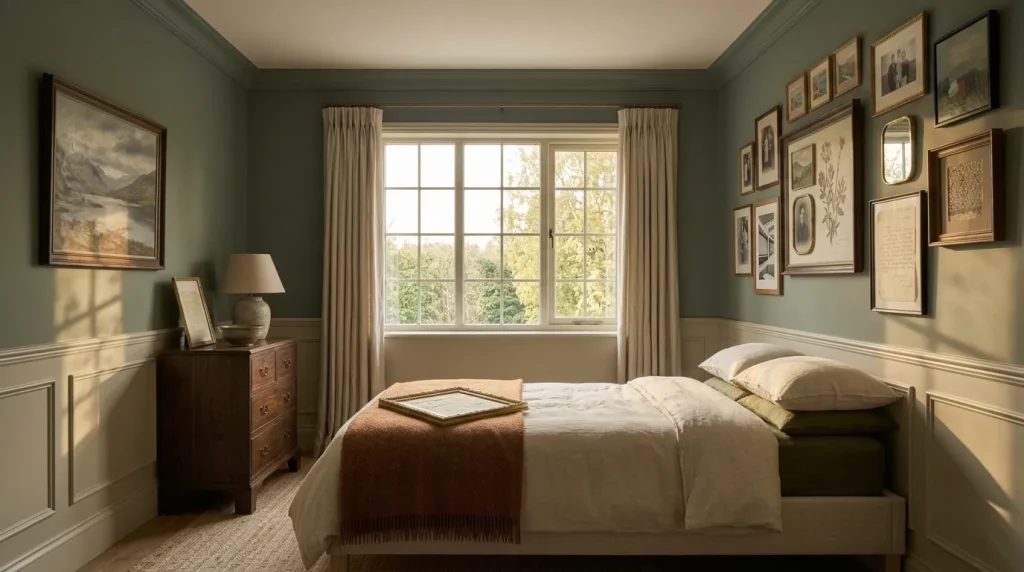
Tip 2: Limit the palette without making everything identical
Even a personal collage benefits from some visual repetition.
Choose two or three recurring colors that already exist in the bedroom. If your bedding is olive and cream with walnut furniture, look for artwork containing those same notes.
The palette simply gives your eye a few repeated notes to follow, the same principle behind these neutral bedroom ideas.
If you are using family photographs from different decades, converting some to black-and-white can help create consistency without making every image look artificially matched.
House Beautiful’s current gallery-wall guidance similarly recommends using frame materials and image tones to create unity while keeping the actual content varied and personal.
Build the Composition Before Making Holes
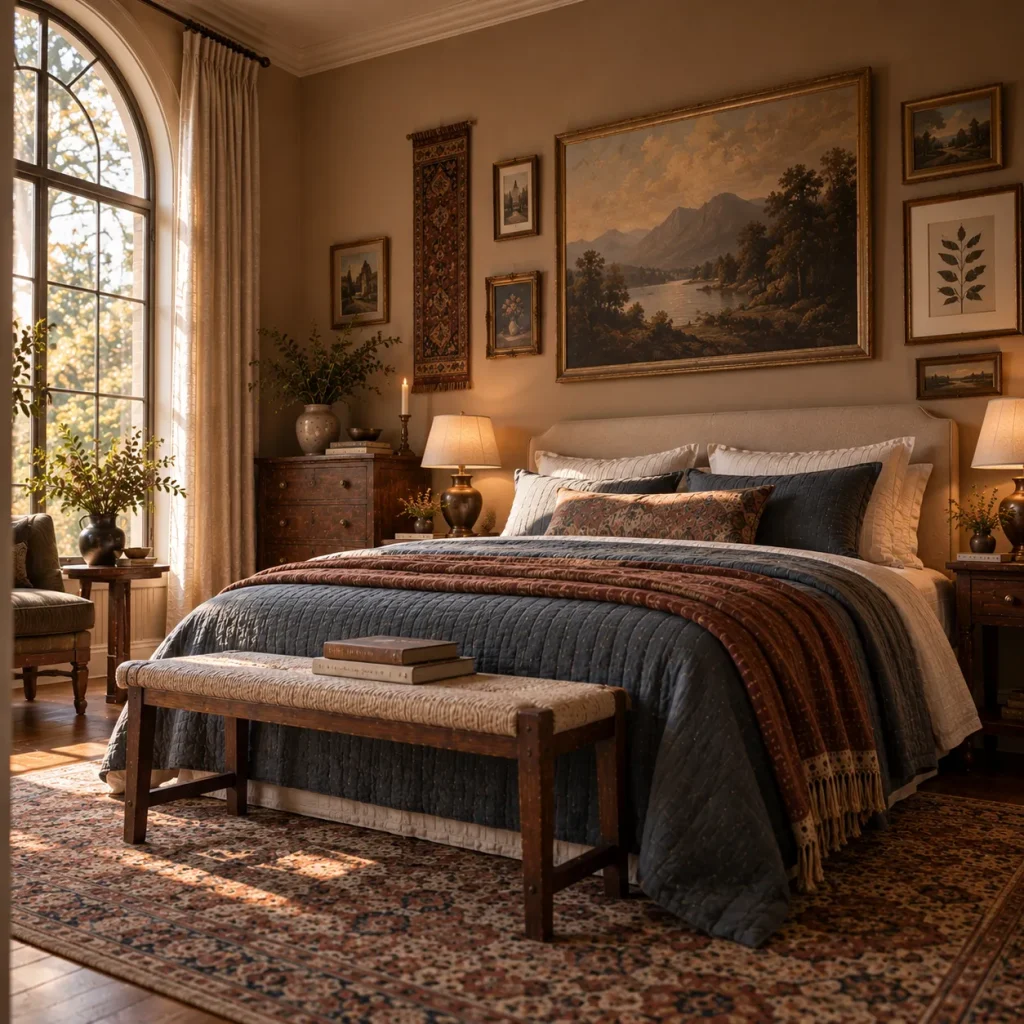
Tip 3: Start with the largest piece
One large piece gives the rest of the collage somewhere to organize itself around.
That might be a painting, oversized photograph, textile, poster, mirror, or framed print.
Place it slightly off-center if you want a relaxed composition. Then arrange smaller pieces around it.
Architectural Digest’s bedroom wall guidance recommends mixing artwork at different scales rather than treating every frame equally. Larger pieces help establish hierarchy and stop a gallery wall from reading flat.
And resist the urge to make every item 8 by 10 inches simply because those frames are easy to buy.
Scale variation is what gives the wall rhythm.
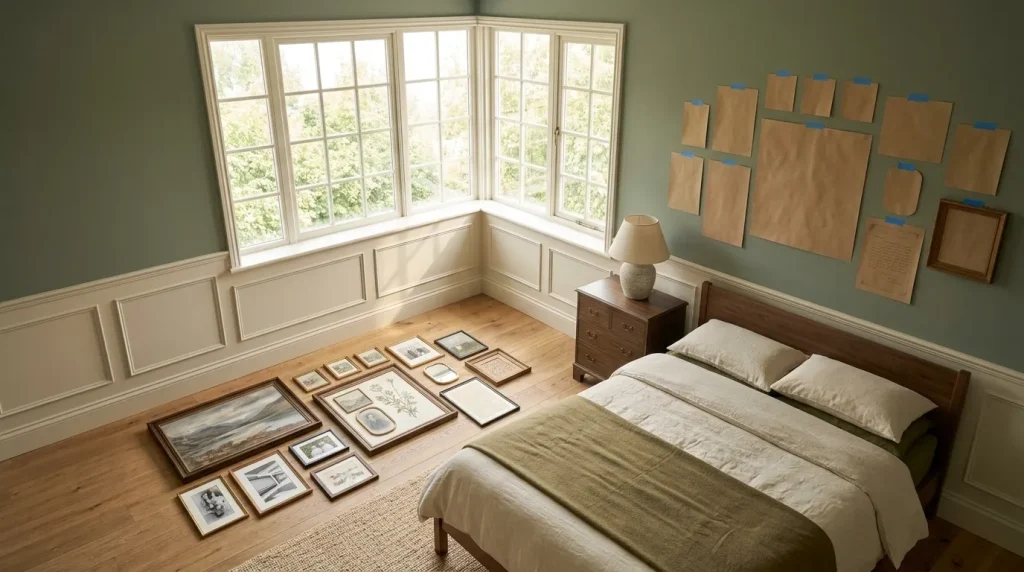
Tip 4: Lay everything on the floor first
Before reaching for a hammer, build the complete arrangement on the floor.
Start with the largest piece, then move outward. Photograph each version from directly above so you can compare layouts.
You can also cut kraft paper to match the frames and tape those templates to the wall.
This is especially useful above a bed, where mistakes become more noticeable because the headboard creates a strong horizontal reference.
A few minutes of planning can save several unnecessary holes.
For traditional picture hanging, Architectural Digest cites roughly 57 inches from the floor to the center of an artwork as a useful gallery-style starting point, but placement should still respond to the furniture and room.
Above a headboard, the relationship to the bed matters more than blindly following a universal number.
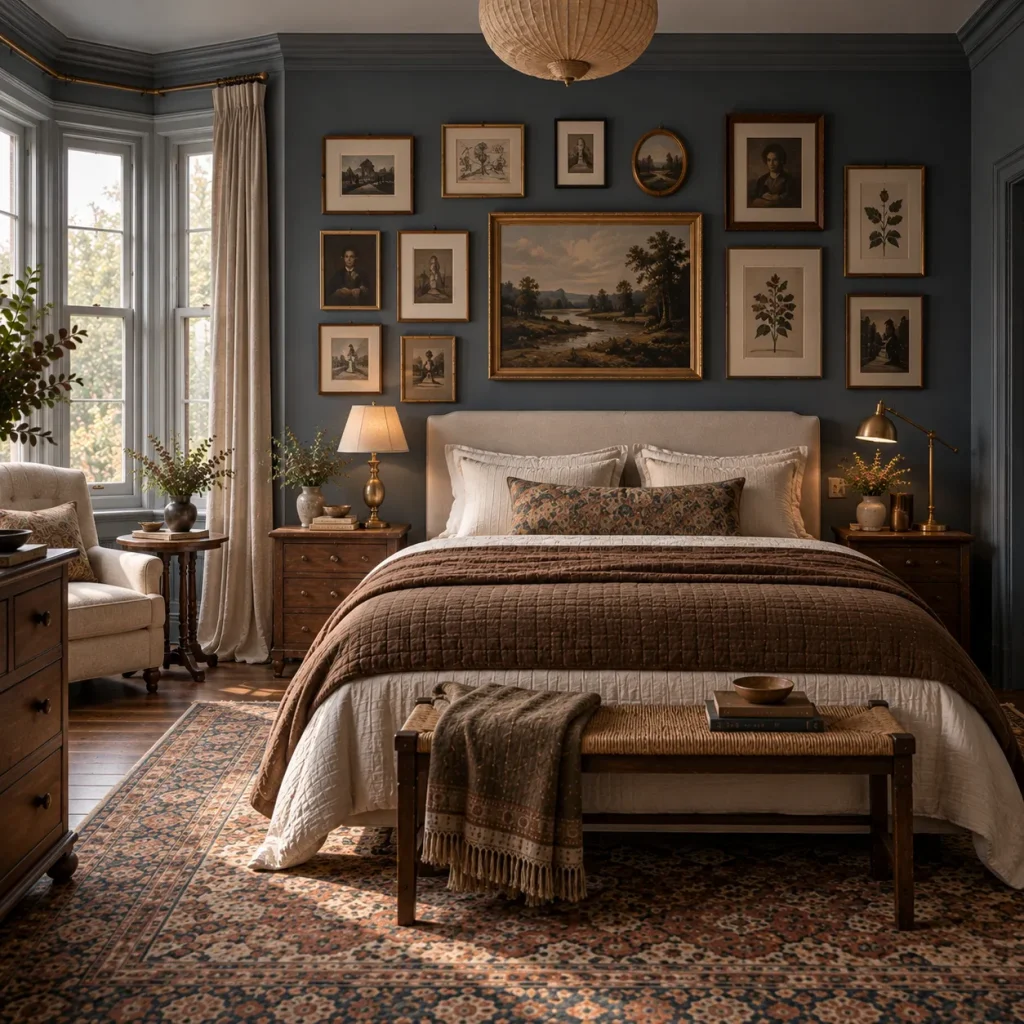
Tip 5: Keep spacing consistent even when the frames are different
An eclectic collage can still have disciplined spacing.
Around 2 to 3 inches between many smaller frames is a useful starting point. Very large pieces may need slightly more breathing room.
The spacing acts almost like invisible grout between tiles. When those gaps vary wildly, the eye starts noticing the empty spaces instead of the artwork.
House Beautiful’s June 2026 guide to common gallery-wall mistakes emphasizes consistent spacing and negative space as key tools for preventing a display from looking cluttered or disconnected.
You can still break the rule deliberately, perhaps leaving extra room around one larger piece. But make the irregularity intentional.
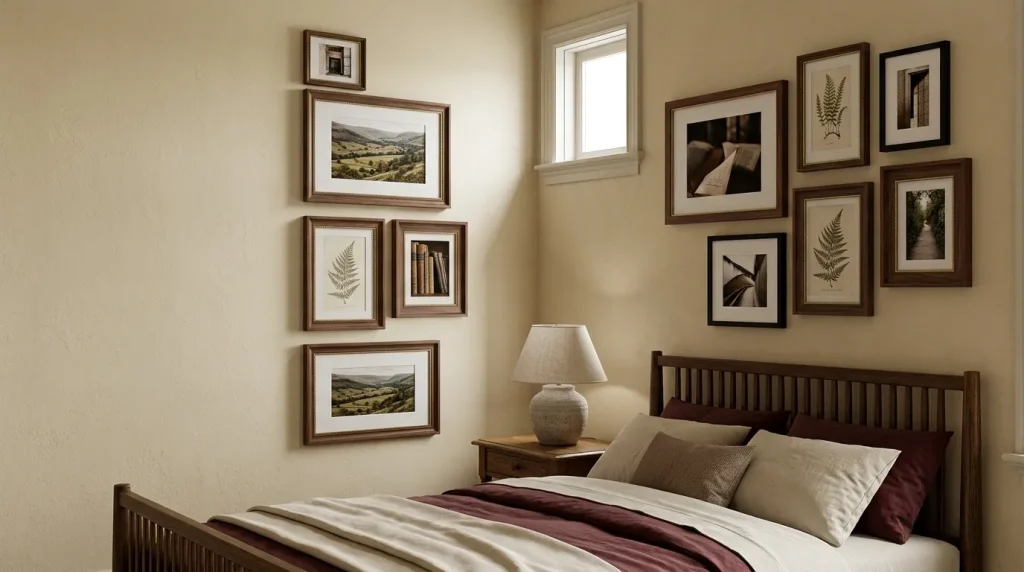
Tip 6: Mix frames, but repeat something
A wall of identical black frames can look polished, but it can also feel corporate.
Mix walnut, aged brass, black, painted wood, oak, or simple frameless mounts. Then repeat one or two materials several times so the collection still feels connected rather than random, similar to the curated approach in these mid century modern bedroom tips, where a little gold or brass repeats deliberately.
One illustrative collage had every frame deliberately different: six wood tones, silver, black, gold, and several bright colors. The artwork disappeared behind the frame competition.
Removing three finishes made the actual collection much stronger.
The frames should support the story, not become the story.
Mix More Than Photographs and Prints
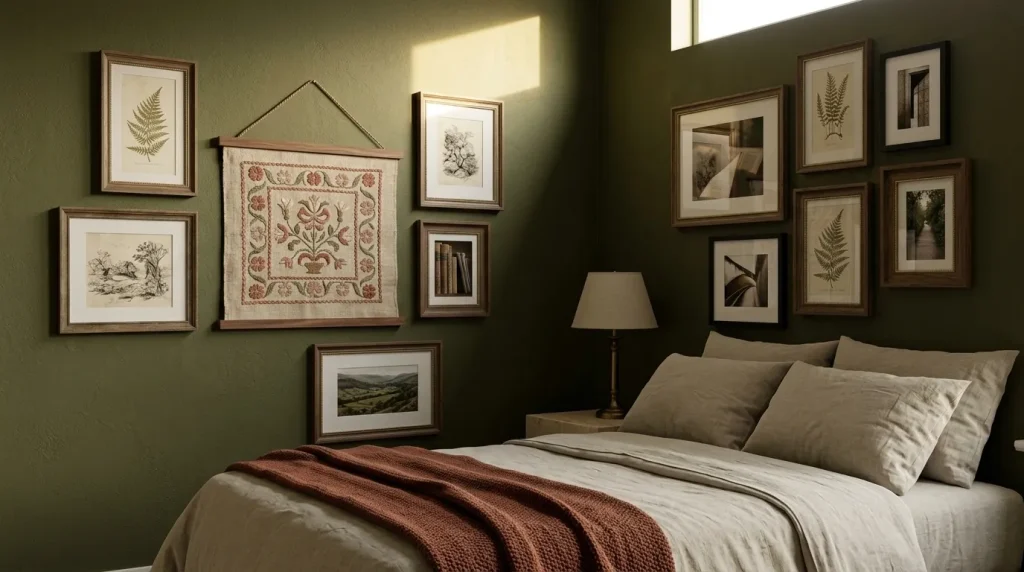
Tip 7: Add one textile piece
A small embroidered cloth, vintage scarf, woven fragment, fabric sample, or flattened textile can soften a wall dominated by glass and hard frames.
You can frame it traditionally or use a textile hanger if the piece suits that treatment.
Textiles are particularly effective in bedrooms because they connect visually with bedding, curtains, rugs, and upholstery.
Architectural Digest’s 2026 bedroom coverage continues to show tapestries and fabric-based artwork as a way to give sleeping spaces more depth and personality.
Use one or two fabric pieces. The contrast against a flat, glossy surface is what makes the textile noticeable.
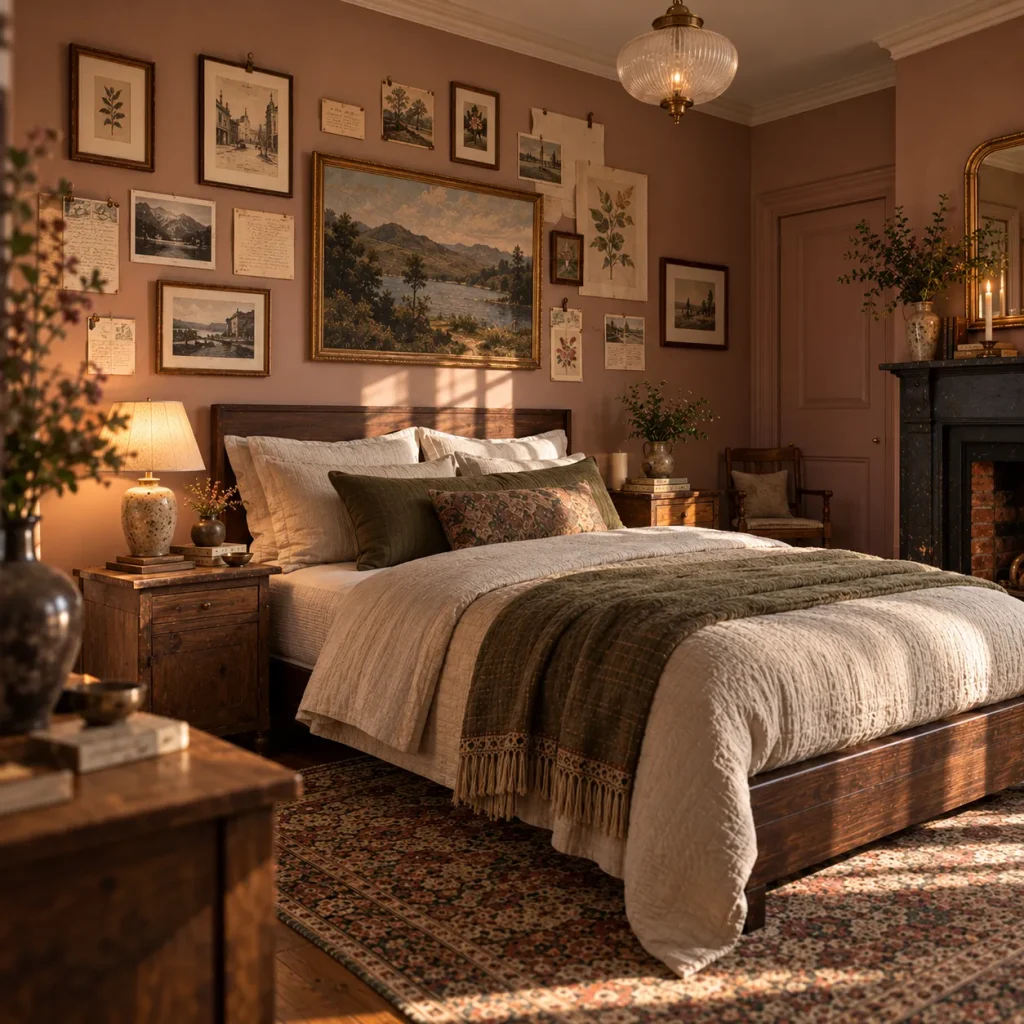
Tip 8: Include personal paper pieces
Save-worthy paper objects are ideal for a bedroom collage.
Frame postcards, tickets, handwritten notes, pages from old notebooks, photographs, invitations, sketches, or meaningful packaging.
These objects are helping push gallery walls toward the more personal memento-wall aesthetic in 2026.
Avoid framing something only because it looks vintage.
A concert ticket you kept for ten years is more interesting than a reproduction ticket purchased specifically as decor.
And if an original paper item is fragile or valuable, use archival materials or display a high-quality copy instead.
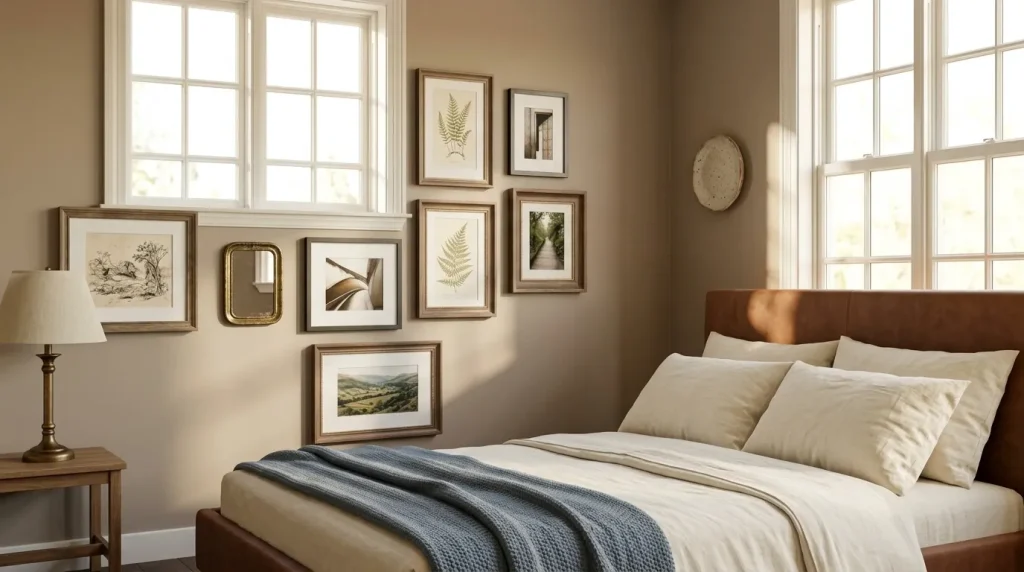
Tip 9: Add one small three-dimensional object
Not every object on the wall has to sit behind glass.
A shallow ceramic piece, small sculptural object, woven basket, vintage plate, decorative mirror, or small wall-mounted artifact can break up the rectangles.
House Beautiful’s 2026 gallery-wall advice notes that anything mounted beside the bed should be secure, appropriately lightweight, and installed using hardware suited to the wall and object weight.
Safety matters more than the composition.
Use the Bedroom Architecture as Part of the Design
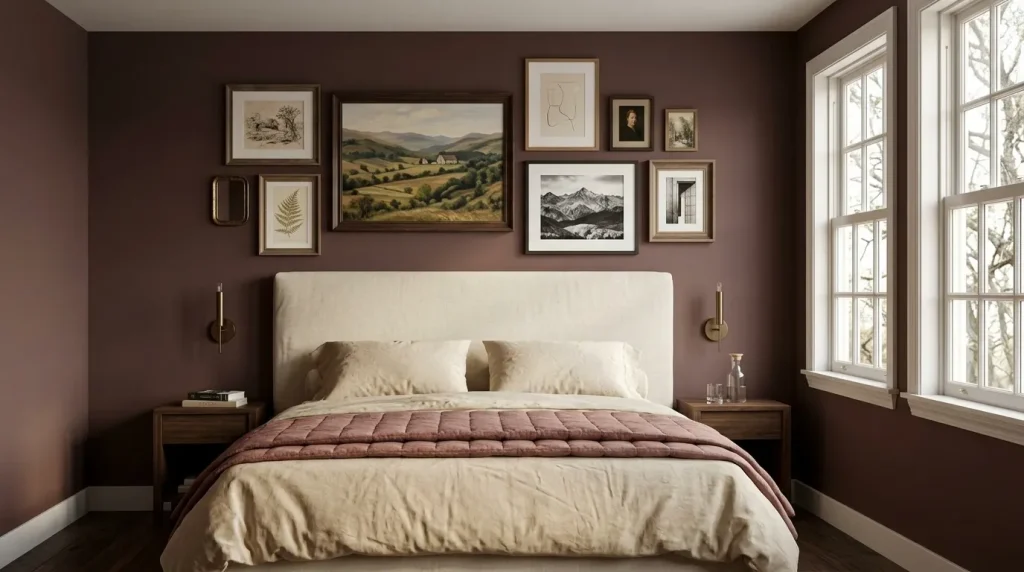
Tip 10: Let the headboard establish the collage width
A collage above the bed usually looks stronger when it relates to the bed rather than covering the entire wall.
As a rough starting point, aim for the overall artwork arrangement to occupy somewhere around two-thirds to roughly the width of the bed or headboard, depending on the room and composition.
A larger, looser gallery may extend beyond that when the wall is broad.
The important thing is visual connection.
A tiny cluster floating over a king-size headboard can look timid. A huge collage spilling far beyond a small bed may make the furniture look undersized.
Start with the bed, then size the collage.
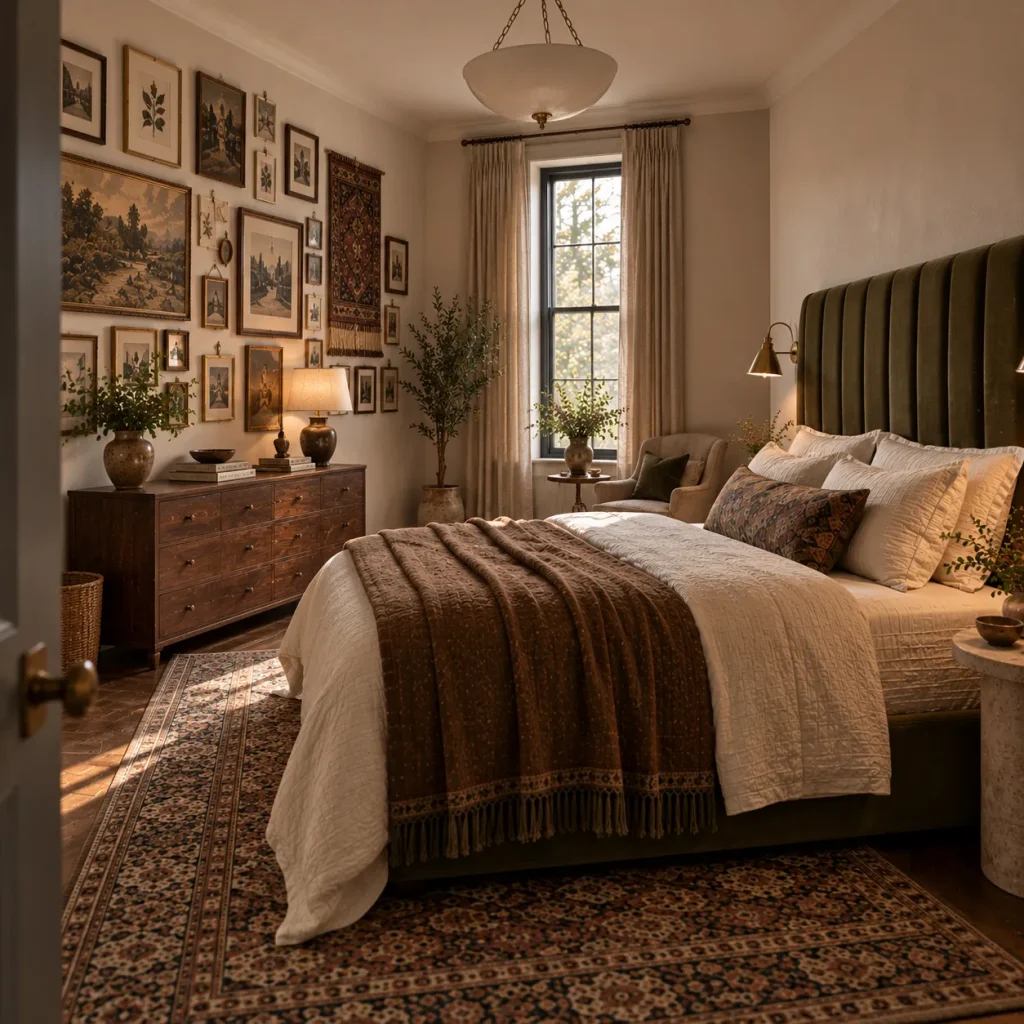
Tip 11: Use a side wall if the headboard is already busy
You do not have to place the collage above the bed if the headboard, wall color, or existing decor already does too much.
Architectural Digest notes that bedroom wall art can work above dressers, nightstands, or across a side wall rather than defaulting to the headboard every time.
A side-wall collage can also be easier to appreciate because you see it while entering the room rather than lying directly beneath it.
This is a useful reminder that more decoration does not automatically create more personality.
Try Softer Alternatives to a Fixed Gallery Wall
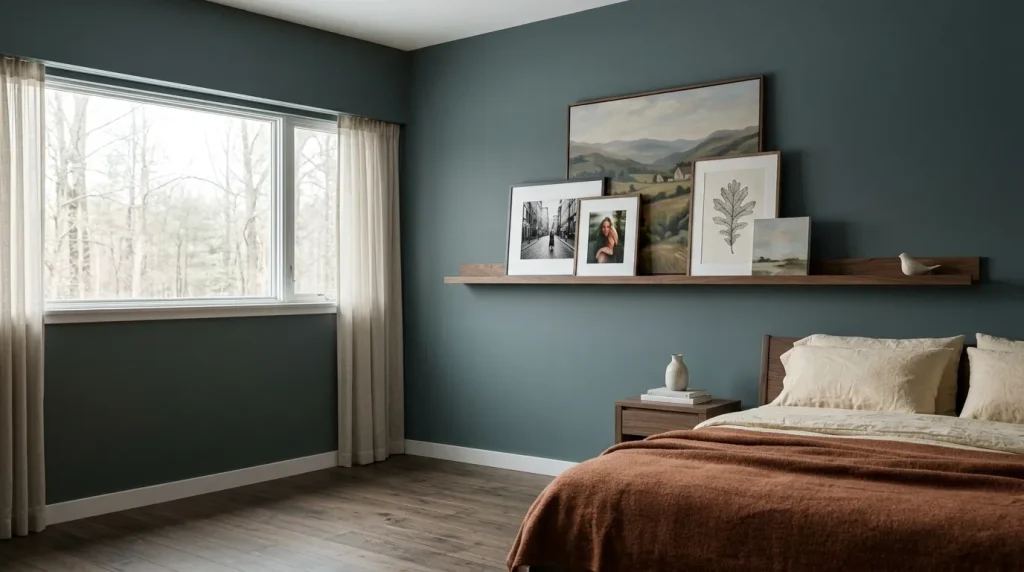
Tip 12: Use a picture ledge if your taste changes often
If you like rotating photographs, postcards, or art, consider a picture ledge.
Homes & Gardens identified picture ledges as a growing 2026 alternative to rigid gallery walls because framed pieces can overlap, move, and change without requiring new holes every time.
Use one long ledge or two aligned ledges rather than several tiny shelves.
Lean larger frames behind smaller ones. Add one small ceramic object or keepsake, but leave some open space for future installation and avoid placing heavy objects where they could fall onto someone sleeping.
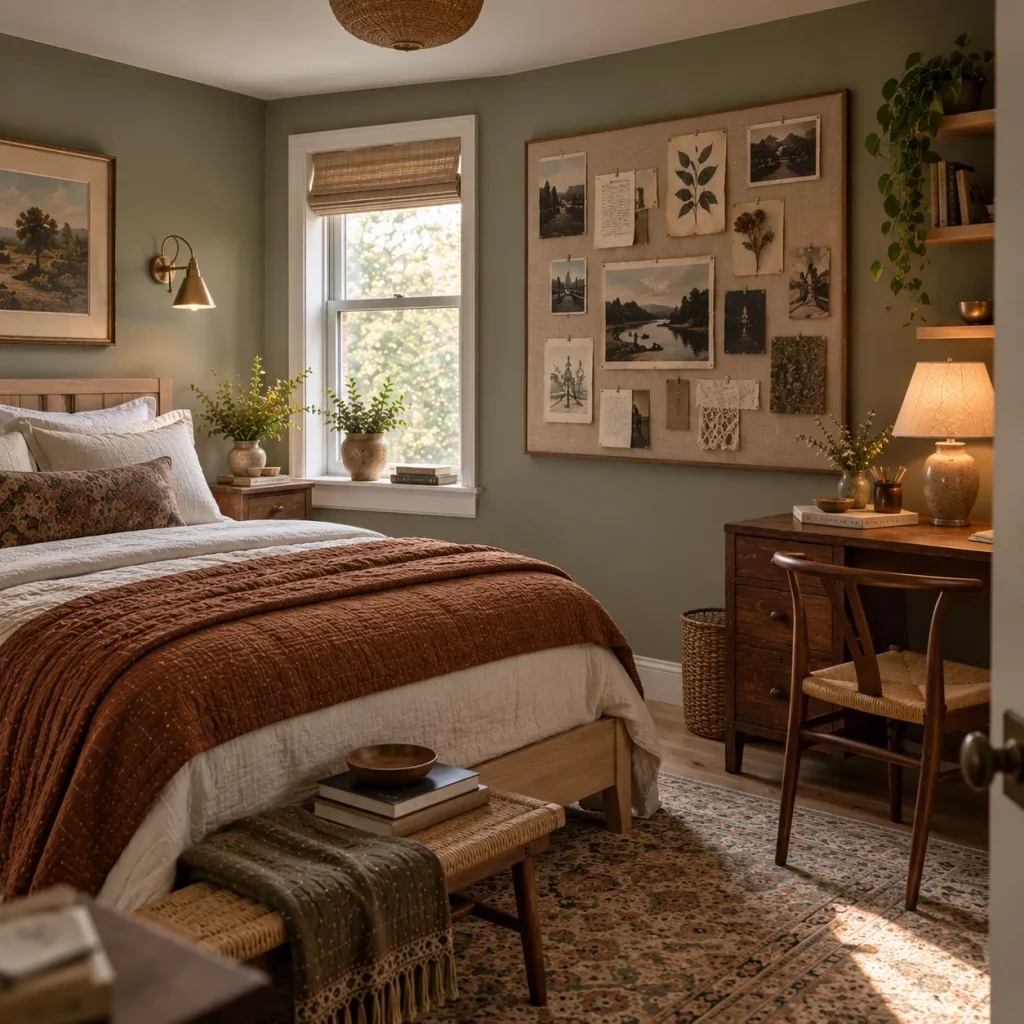
Tip 13: Make a renter-friendly collage without dozens of holes
A wall collage can work in a rental, but the mounting method needs more thought.
Use removable picture strips only within their stated weight limits and test them in an inconspicuous area first. Paint age, wall texture, humidity, and previous repairs can affect adhesion.
Lightweight unframed photographs and postcards can also be attached to a removable backing board, cork panel, magnetic surface, or large framed pinboard.
That gives you the collage effect while keeping the installation concentrated in one object.
A framed fabric-covered pinboard can look particularly good beside a desk or vanity and allows the collection to evolve, and pairs nicely with the compact styling used in these cozy small bedroom tips.
Edit the Collage After It Is Installed
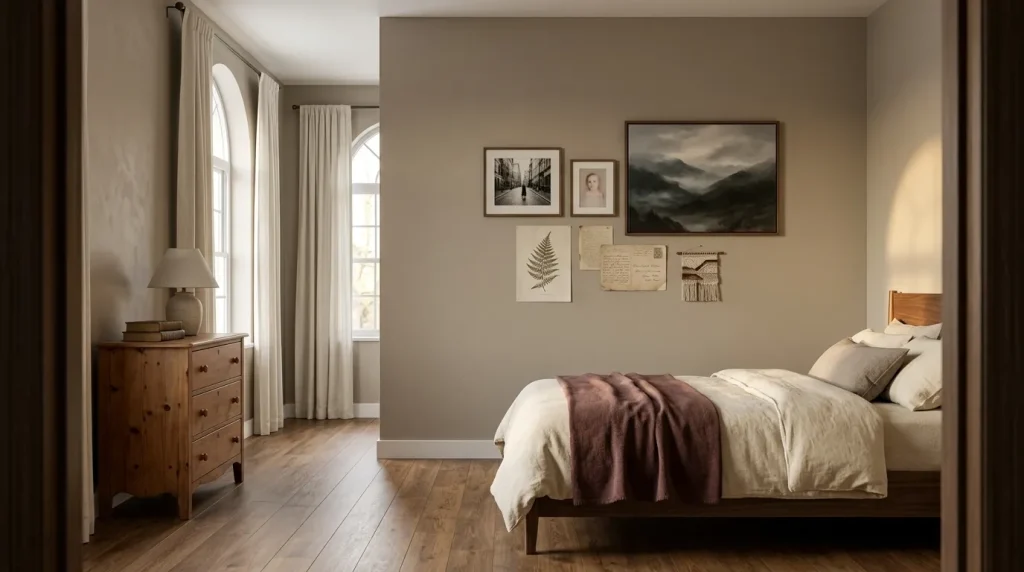
Tip 14: Leave some wall visible
The instinct with collages is often to keep filling gaps.
Stop earlier.
Negative space makes the outer shape of the arrangement easier to read rather than automatically covering entire walls with small prints.
Take a photograph from the bedroom doorway after installation.
If the wall reads as one noisy block, remove the weakest three pieces before moving anything else.
This is often more effective than rearranging every frame.
A good collage should have room to grow. You can always add the postcard or photograph you find six months from now.
A Practical Bedroom Collage Planning Guide
| Element | Useful starting point | What often goes wrong |
|---|---|---|
| Main artwork | One larger anchor piece | Everything the same size |
| Frame spacing | Around 2 to 3 inches | Random gaps |
| Frame finishes | 2 to 3 recurring materials | Every frame different |
| Color | 2 to 3 repeated tones | Forced exact matching |
| Media | Art, photos, paper, textile | Prints only |
| Placement | Relate collage to furniture | Floating randomly on wall |
| Empty space | Leave visible breathing room | Filling every gap |
Treat these as design guidelines rather than strict measurements. The exact arrangement should still respond to the furniture and room.
Bedroom Wall Collage Mistakes to Skip
Mass-produced matching print sets. They are convenient, but they rarely create the personal character that makes collage walls interesting.
Covering the entire wall automatically. Dense collage walls can work, but they need enough variation and intention to prevent visual overload.
Twenty identical frame sizes. Use at least two or three scales so the eye has somewhere to land.
Ignoring installation safety. Heavy frames and sculptural objects need appropriate anchors and mounting methods, especially near a bed.
Following a color palette so strictly that nothing personal survives. A meaningful photograph does not need to match the duvet perfectly.
Try This If Your Bedroom Wall Already Feels Cluttered
Do not buy more frames.
Remove every piece that you chose mainly because it filled a space. Keep the meaningful photographs, strongest artwork, and anything that gives the collection a real story.
Then identify the largest piece and rebuild outward from it.
Reduce your frame finishes to two or three. Keep more negative space than feels natural at first.
Most cluttered collage walls need a smaller, stronger collage rather than a better-organized version of everything you already had.
Frequently Asked Questions
Are bedroom wall collages still popular in 2026?
Yes, but they are becoming more personal and less formulaic. Memento walls, mixed media, picture ledges, vintage art, letters, photographs, textiles, and meaningful keepsakes are replacing some of the perfectly coordinated print grids of earlier years.
How many pictures should be in a bedroom wall collage?
There is no ideal number. Five substantial pieces may work better than twenty small ones. Start with the size of the wall and furniture, then add only enough pieces to create a balanced overall shape.
How far apart should collage pictures be?
Around 2 to 3 inches is a useful starting point for many smaller frames. Consistent gaps generally make mixed artwork look more organized, although larger pieces may benefit from additional space.
What can I put in a bedroom collage besides photos?
Try postcards, letters, paintings, small mirrors, vintage prints, and lightweight sculptural objects. The strongest 14 bedroom wall collage tips favor meaningful variety rather than relying on prints alone.
Let the Collage Change as Your Life Changes
A bedroom collage should never feel completely finished.
The strongest walls contain enough structure to look deliberate but enough flexibility to accept a photograph from your next trip, an old letter you rediscover, or a small painting you genuinely love.
Start with fewer pieces than you think you need. Use one large anchor, repeat a few colors and frame materials, then allow the personal objects to create the irregularity.
If you make one change first, remove the least meaningful print from your current wall and replace it only when you find something worth keeping.
That is the difference between decorating a wall and building a collection. One fills space. The other gradually records who lives in the room.