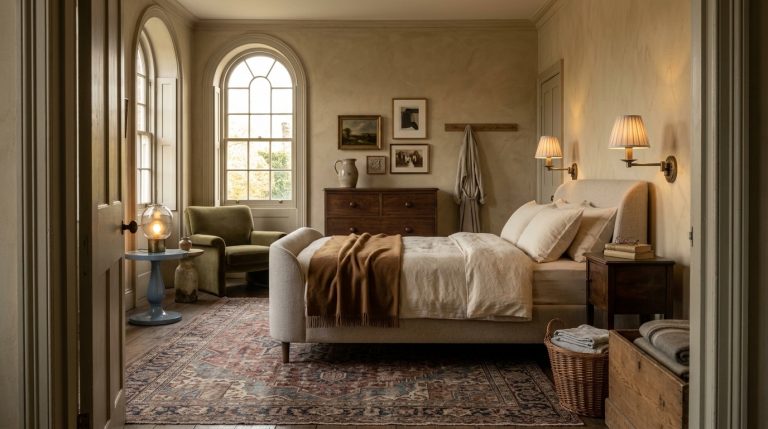
15 creative master bedroom wall decor ideas That Feel Personal, Not Generic
Bedroom walls are easy to underestimate. You choose the bed, bedding, nightstands, rug, and curtains, then suddenly realize there is a large blank rectangle above the headboard staring back at you.
The usual response is to buy a pair of framed prints.
There is nothing wrong with framed art, but your walls can do far more.
Some of the most interesting bedrooms in 2026 are using wall-to-wall upholstered headboards, scenic murals, tactile wallcoverings, personal memento displays, vintage textiles, dimensional woodwork, and architectural curtains instead of treating wall decor as a final accessory. Current bedroom design is moving toward more intimate, tactile, individualized spaces rather than anonymous hotel-style rooms.
These 15 creative master bedroom wall decor ideas range from easy renter-friendly updates to larger statement projects, so you can find one that fits your space.
Start by Deciding What the Wall Needs
Before buying anything, stand at the bedroom doorway and look at the wall behind your bed.
Does it need height? Warmth? Color? Texture? Architecture? Personality?
That question matters because an enormous abstract canvas solves a completely different problem from wood paneling or a patterned mural.
Architectural Digest’s current bedroom guidance takes a similar approach: bedroom walls can actively shape atmosphere through rich color, wallpaper, texture, and other treatments rather than simply fading into the background.
Once you identify what is missing, the right wall treatment becomes much easier to choose.
Make the Bed Wall the Main Event

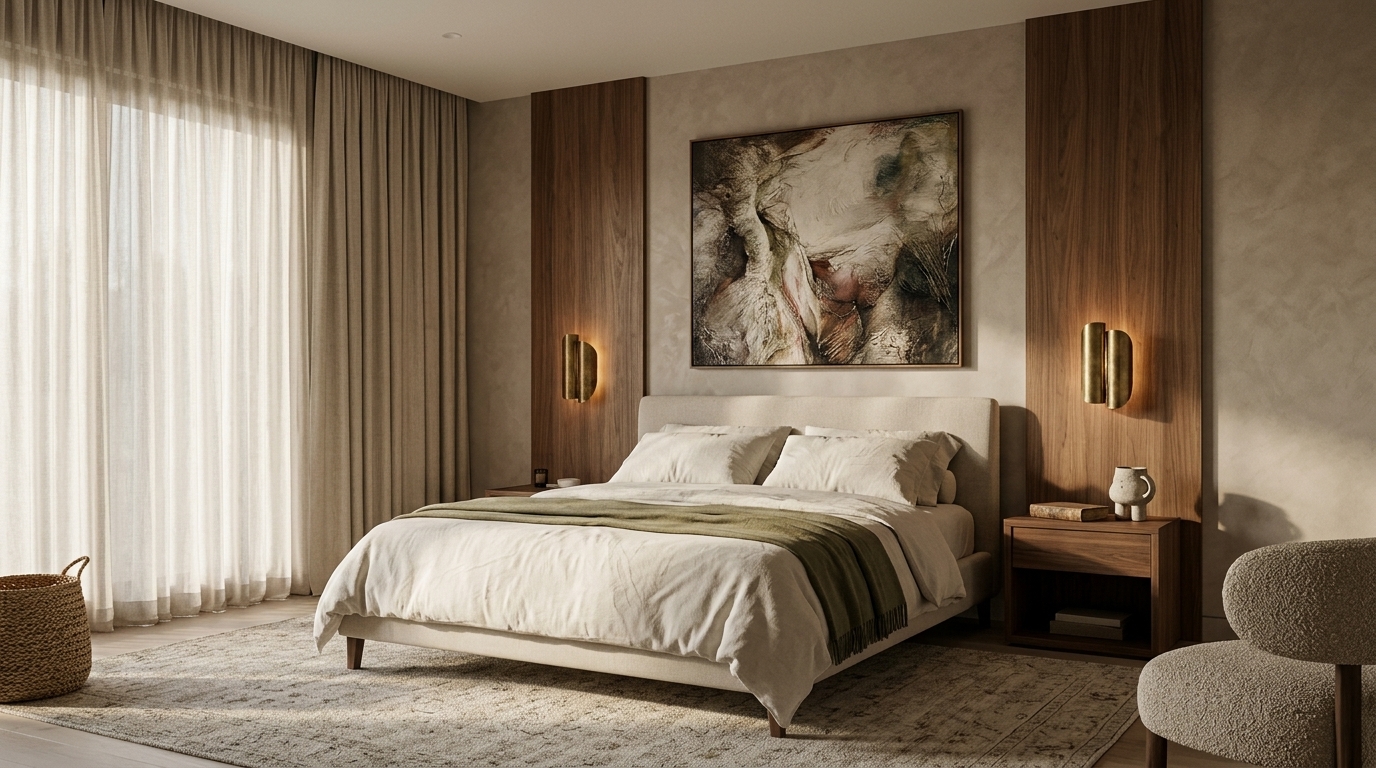
1. Install one oversized artwork instead of several small pieces
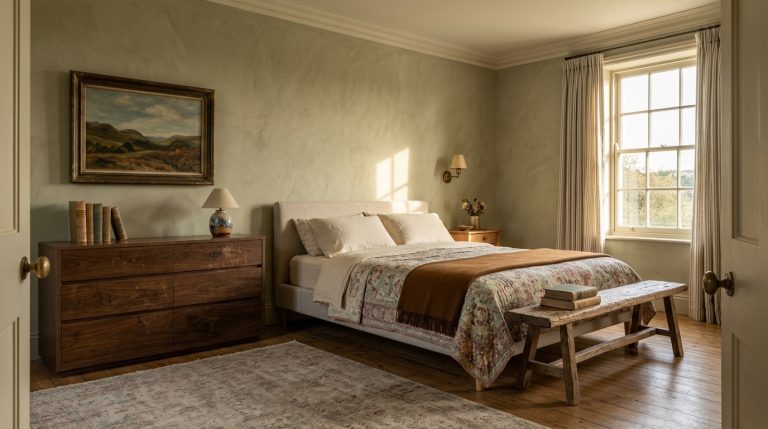
One large piece can make a master bedroom feel calmer than a collection of small frames.
Look for artwork approximately two-thirds the width of your bed or headboard as a starting point, then adjust visually rather than treating that proportion as a rigid rule.
Try an abstract painting, muted landscape, botanical work, large photograph, or textile-based piece.
The important part is scale.
A tiny 16-by-20-inch print floating above a king-size bed usually makes the wall look emptier, not more decorated.
And do not choose generic artwork purely because its colors match your duvet. Bedroom art should contribute to the mood of the room and feel personal enough that you enjoy seeing it every day. Designers increasingly emphasize that bedroom wall art should support calm, intimacy, and individuality.

2. Turn your headboard into wall decor
One of the strongest bedroom directions for 2026 is the wall-to-wall headboard.
Instead of stopping at the width of the mattress, the upholstered or paneled headboard extends behind the nightstands—or sometimes across the entire wall.
It gives an otherwise plain bedroom instant architecture.
Homes & Gardens identifies these wall-spanning “shelter” headboards as a major 2026 direction because they create a cocooning, hotel-like feeling while making the headboard itself part of the room’s architecture.
For something subtle, choose oatmeal linen or warm taupe.
For more drama, try olive velvet, chocolate brown, muted rust, navy, or a restrained patterned fabric.
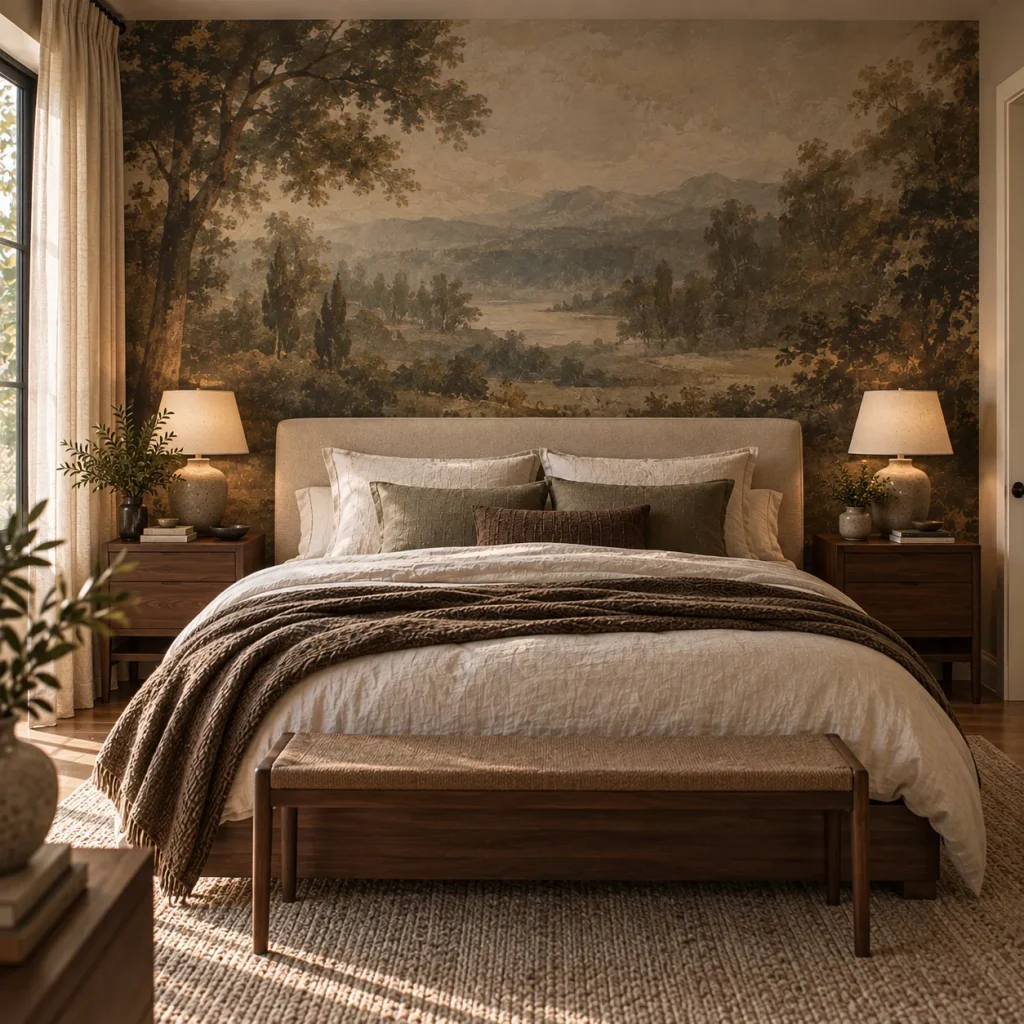
3. Create a scenic mural behind the bed
If wallpaper feels repetitive, consider a mural.
Large landscapes, hazy forests, botanical scenes, abstract washes, and painterly architectural motifs can make the wall feel almost like a window into another environment.
Murals are experiencing a noticeable revival in 2026, particularly scenic designs that bring storytelling and depth back after years of predominantly minimalist blank walls.
Keep the rest of the room quieter if the mural is detailed.
You want one intentional focal point—not a competition between patterned walls, patterned bedding, patterned curtains, and twelve decorative cushions.
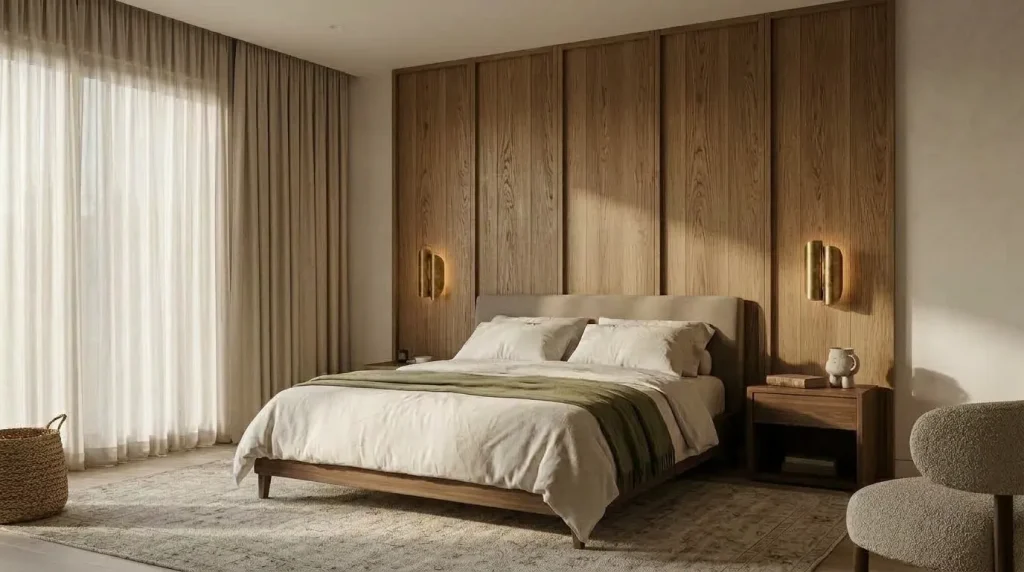
4. Frame the bed with paneling
Wood paneling can bring warmth without adding another color.
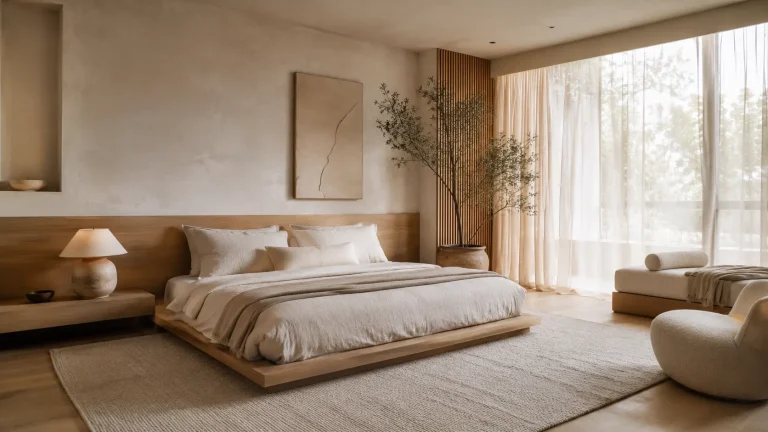
Consider vertical oak battens, traditional molding painted the wall color, tongue-and-groove boards, half-height paneling, or wide wood veneer panels.
This works especially well in bedrooms that feel flat even after furniture and textiles are added.
A contemporary room may benefit from simple vertical timber, while a traditional bedroom could handle picture-frame molding.
For a softer result, paint the molding and wall the same shade. Current bedroom design is increasingly moving beyond ordinary matte-painted surfaces toward paneled, upholstered, tiled, and textured walls precisely because these materials give rooms more depth.
Use Texture Instead of More Objects
5. Hang a textile above the bed
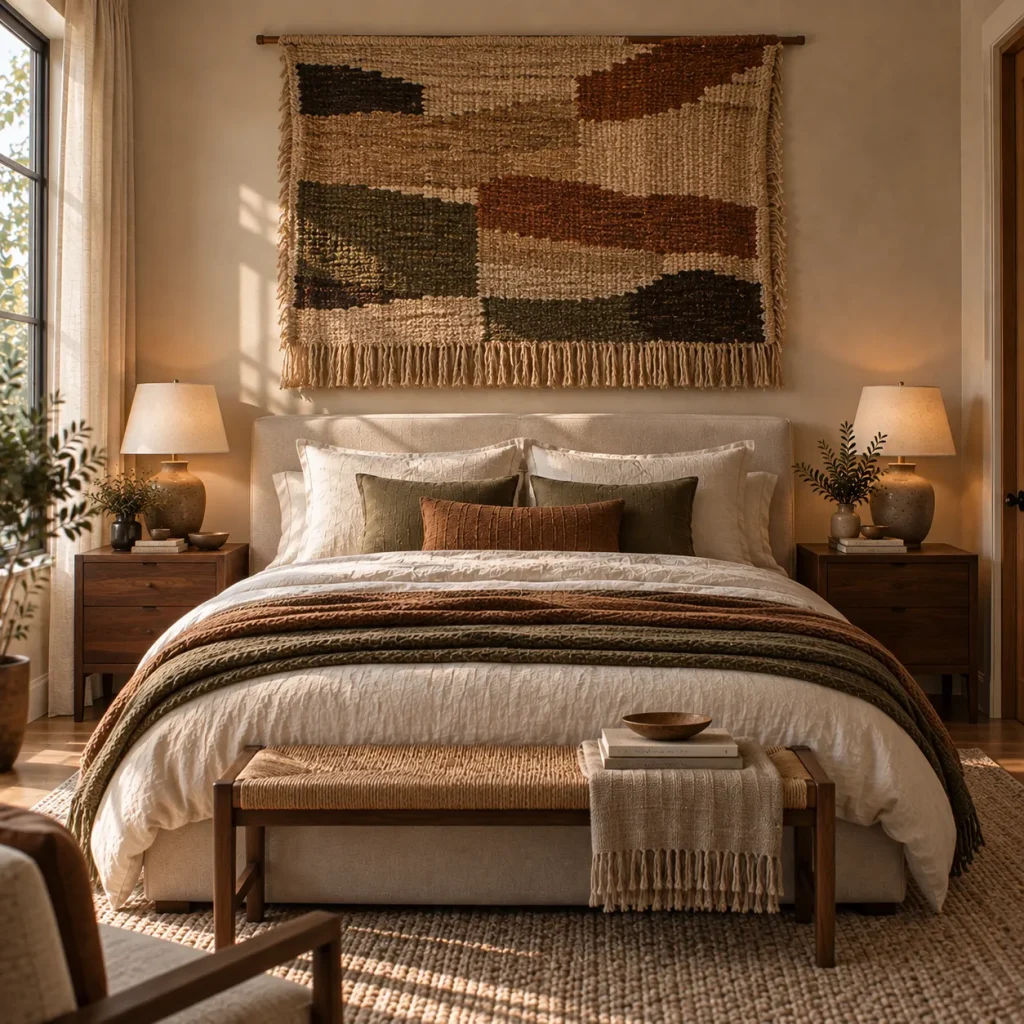
A vintage tapestry, woven panel, embroidered textile, quilt fragment, or handmade fiber artwork can soften a bedroom in a way framed prints cannot.
Textiles absorb some of the visual hardness created by drywall, glass frames, and straight-edged furniture.
They also introduce craftsmanship.
Tapestries have long worked as wall art because they combine imagery with physical texture, and contemporary versions do not need to look historic—abstract woven pieces work beautifully in modern bedrooms too.
Just mount heavy textiles securely and avoid hanging loosely attached objects directly above where you sleep.

6. Upholster part of the wall
If you want something genuinely cocooning, consider padded fabric panels.
They can run from the headboard to the ceiling, cover the lower half of the wall, or form a large rectangle framing the bed.
This is especially effective in large master bedrooms where one small headboard can look lost.
Upholstered surfaces also align with 2026’s move toward cocoon-style bedrooms built around tactile materials, tall headboards, and soft wall treatments.
A lightly textured linen will feel relaxed. Velvet or mohair creates something richer.
I would keep the panel design simple so the texture does the work.
7. Wrap the room in subtle wallpaper
Wallpaper does not have to mean one dramatic floral feature wall.
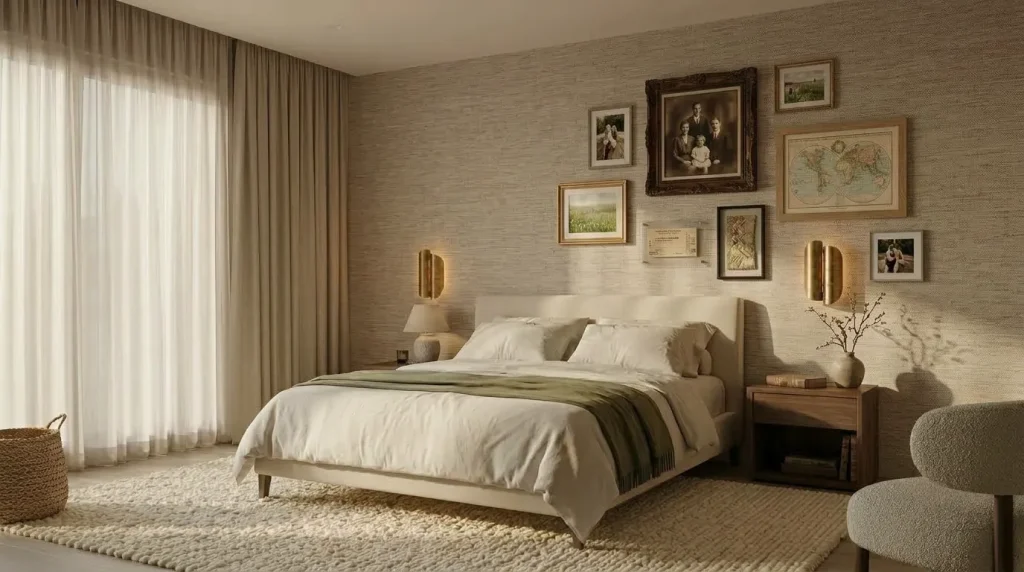
A small-scale print, grasscloth-style texture, soft stripe, plaster-effect paper, or faded heritage motif can cover all four walls and create a remarkably restful room.
Wallpaper trends for 2026 are leaning toward tactile surfaces, hand-painted qualities, and smaller heritage-inspired motifs rather than only crisp graphic patterns.
If the bedroom is small, this approach can actually feel more cohesive than putting one busy wall behind the bed and leaving the other three completely different. Our small bedroom ideas for a bigger feel cover more ways to make compact rooms feel cohesive.
Make Wall Decor More Personal

8. Build a memento wall instead of a perfect gallery wall
Traditional gallery walls often begin with the question: “Which prints look good together?”
Try another question: “What do I actually want to remember?”
Frame a handwritten note, travel postcard, old family photograph, museum ticket, tiny watercolor, fabric swatch, children’s drawing, vintage map, or meaningful photograph.
The resulting composition will naturally be less perfect—and more interesting.
The emerging “memento wall” trend in 2026 reflects exactly this move away from overly coordinated gallery walls toward displays built from memories and collected objects.
This is especially suited to a bedroom because the space is already personal.

9. Use a picture ledge for art you can change
If commitment makes you nervous, mount one long picture ledge above a dresser or on the wall opposite the bed.
Layer framed photographs, small paintings, and objects rather than permanently arranging everything with separate nails.
You can rotate the display seasonally or whenever you find something new.
Keep some overlap between frames so it feels collected, but leave enough negative space that the shelf does not become visual storage.
A ledge is also useful if you are still learning what kind of artwork you enjoy living with.
10. Display something unexpected
Wall decor does not have to come from the wall-art aisle.
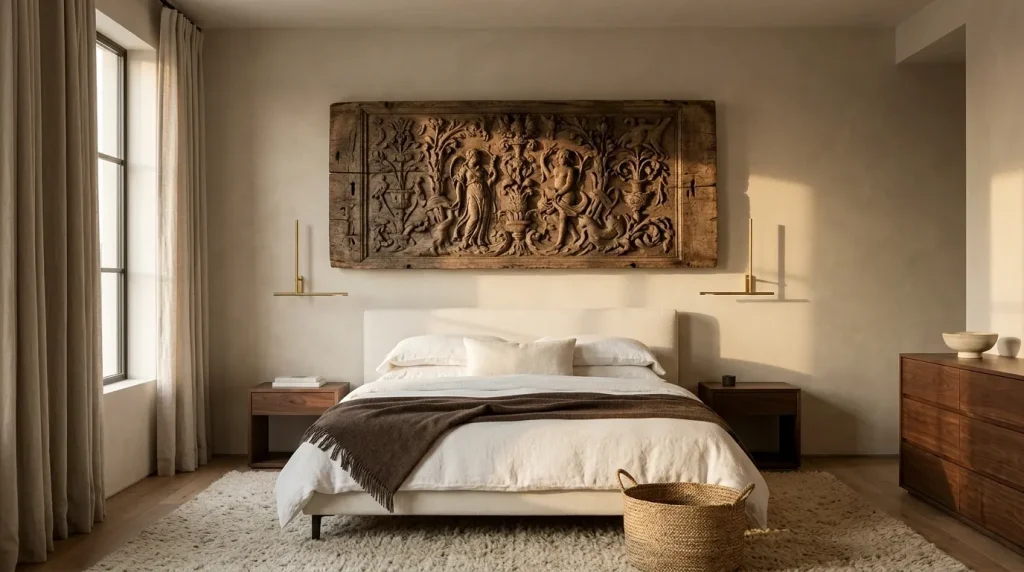
Try a vintage folding screen mounted flat, an antique carved panel, sculptural baskets, a beautiful instrument, framed textile fragments, decorative ceramic plates, a collection of small mirrors, or an architectural salvage piece.
Architectural Digest’s recent wall-decor survey similarly highlights murals, dimensional objects, unconventional installations, and rotating artwork as alternatives to predictable framed prints.
The trick is restraint.
One unexpected object looks curated. Seven unrelated “creative” objects can quickly become clutter.
Let Lighting Become Part of the Wall Design
11. Install sculptural bedside sconces
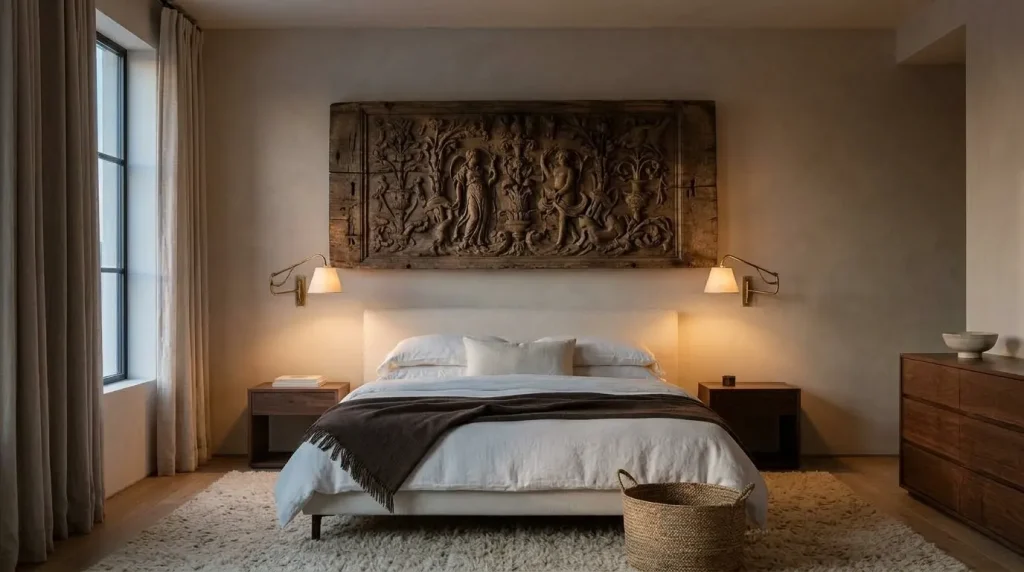
Bedside sconces solve two problems at once: lighting and wall decoration.
They also free your nightstands from large lamp bases.
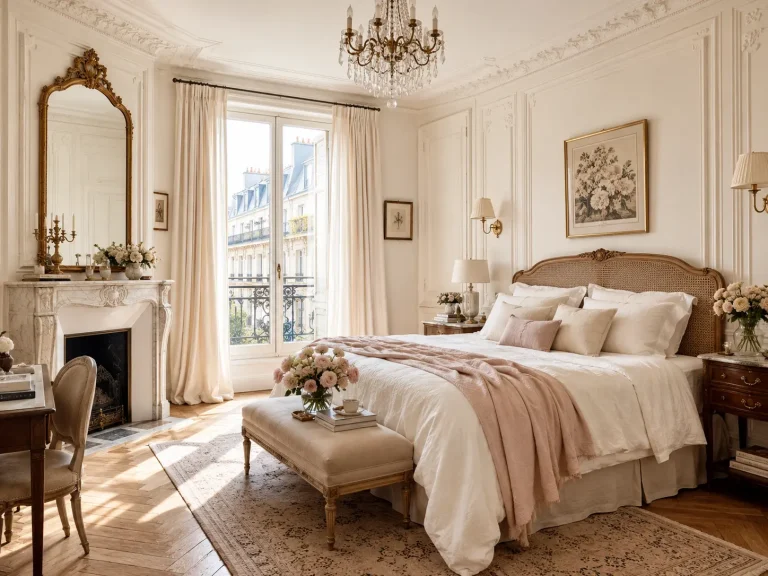
Choose simple plaster sconces for an organic room, aged brass for warmth, pleated shades for a softer traditional look, or articulated metal arms for something more contemporary.
Position them according to how you actually use the bed rather than simply making them symmetrical in a photograph.
If you read at night, the light needs to reach the page comfortably.
A beautiful wall light that does not function well is just expensive sculpture.
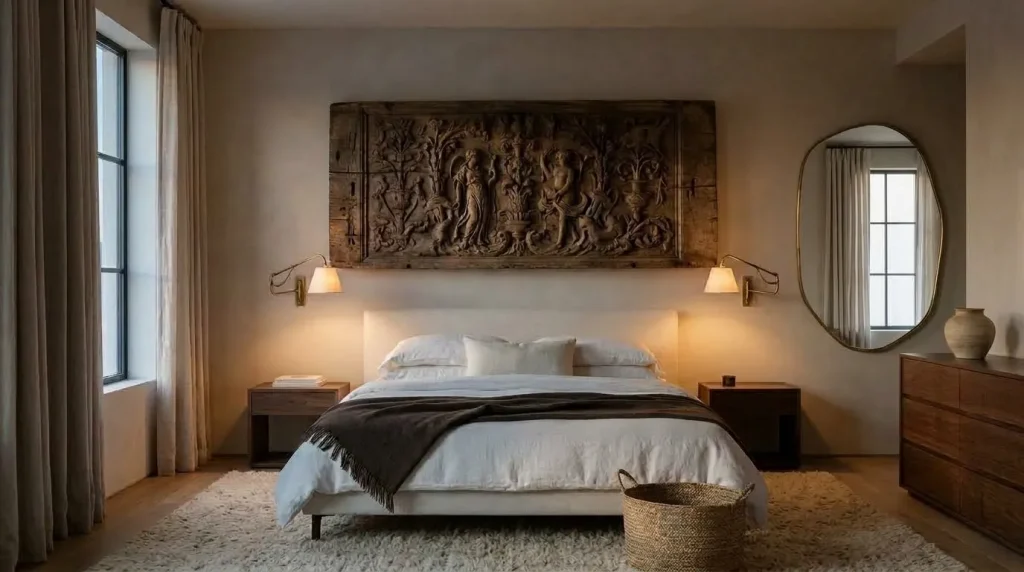
12. Add a decorative wall-mounted mirror
A bedroom mirror does not need to live on a wardrobe door.
Try an irregular organic mirror, tall antiqued mirror, carved wood frame, thin brass design, or oversized round mirror above a dresser.
Mirrors are particularly useful when the wall opposite or beside the window feels dark because they can bounce existing daylight deeper into the room.
But avoid installing one merely because a wall is empty.
Position it where it reflects something attractive—art, a window, curtains, or a beautiful part of the room—rather than an overflowing laundry chair.
Create Architecture Where None Exists
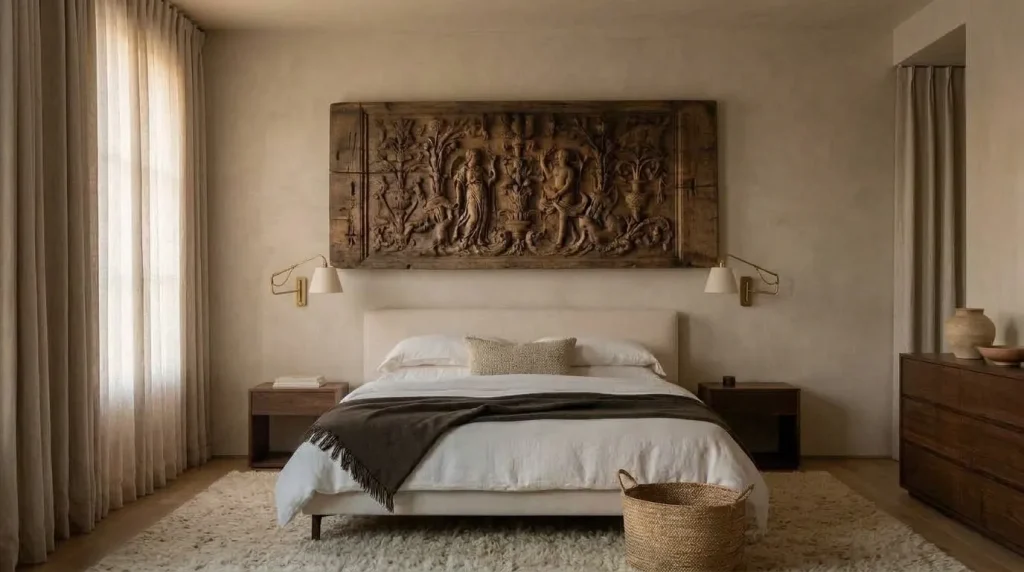
13. Run curtains across an entire wall
This is one of my favorite ideas for a bedroom with an awkwardly small or off-center window.
Instead of hanging curtains only slightly wider than the glass, install a track close to the ceiling and span much more of the wall—or the entire architectural backdrop.
Wall-to-wall pleated curtains are a notable 2026 bedroom direction, with designers using fabric beyond basic window coverage to create more enveloping, intentional rooms.
Imagine a plain bedroom with one narrow window behind the bed. Rather than emphasizing its awkward placement, you cover that wall in warm oatmeal drapery. Suddenly the window disappears into a luxurious backdrop and the entire room feels quieter.
That is wall decor doing actual problem-solving. If you enjoy that earthy, enveloping effect, our terracotta and sage bedroom tips explore a similar warm, layered approach through color.

14. Paint a wall treatment instead of buying decor
You can create visual architecture with paint alone.
Try a wide horizontal band behind the bed, an oversized painted arch, a ceiling-to-floor block of color, or subtle tonal stripes.
For a more immersive result, continue your chosen wall color onto the trim and ceiling.
Color-drenched bedrooms remain important in 2026 because using one enveloping hue across several surfaces can produce a cohesive, cocoon-like atmosphere.
Just avoid creating a random geometric shape because you saw one online.
The painted area should relate to something—the bed width, ceiling architecture, furniture placement, or room proportions.

15. Continue the wall decor onto the ceiling
The ceiling is effectively your bedroom’s fifth wall.
Wallpaper can travel from the headboard wall onto the ceiling. Panel molding can continue upward. A painted border can wrap overhead. Even a canopy-like fabric treatment can visually connect wall and ceiling.
This works particularly well when the bedroom has high ceilings that make the bed feel visually disconnected from the architecture.
It also reflects the larger move toward immersive bedroom surfaces rather than isolated feature walls. Wallpaper, textiles, and wrapped wall treatments are increasingly being used to create rooms that feel enclosed and intentional rather than decorated piece by piece.
You do not need to cover everything.
Sometimes extending a treatment only a few feet onto the ceiling is enough to change the room.
Master Bedroom Wall Decor Mistakes to Skip
The first mistake is hanging artwork too high. Your art should visually connect to the furniture beneath it rather than floating near the ceiling.
The second is buying art only because it matches your colors. Matching is not the same as meaning.
I would also avoid creating a feature wall simply because every bedroom “needs” one. If your upholstered bed, curtains, flooring, and lighting already provide enough visual interest, leaving one wall relatively quiet may actually improve the room.
Be careful with scale too. Several tiny items above a wide king-size bed can look fragmented. Either group them deliberately or choose something larger.
And do not try to use all 15 ideas at once.
A mural, wood paneling, gallery wall, sconces, decorative mirror, ceiling wallpaper, and wall-to-wall curtains can each be beautiful.
Together, they may be exhausting.
Try This If Your Bedroom Is…
| Bedroom challenge | Wall decor solution |
|---|---|
| Large and empty | Oversized art or a wall-to-wall headboard |
| Small | One large artwork or subtle all-over wallpaper |
| Dark | Decorative mirror + warm sconces |
| A rental | Textile hanging, picture ledge, removable mural, or large leaning art |
| Too generic | Memento wall or vintage architectural piece |
| Too cold | Wood paneling, tapestry, or upholstered panels |
| Low ceiling | Vertical paneling or floor-to-ceiling curtains |
| Awkward window | Full-wall curtains to visually correct its proportions |
| Minimalist | One sculptural object rather than many small decorations |
The most successful choice is usually the one that solves something the room already needs.
Frequently Asked Questions
What should I put on the wall above my master bedroom bed?
Oversized art, a textile, mural, decorative panel, wall-to-wall headboard, wallpaper, or a restrained gallery arrangement can all work.
Choose according to scale. A king-size bed needs a stronger visual presence than a narrow bed.
If you live in an earthquake-prone area or have safety concerns, avoid placing heavy glass, mirrors, or inadequately secured objects directly over the sleeping area.
Should every bedroom wall have decor?
No.
Empty space is part of a room’s composition.
If your bed wall is highly decorative, allowing another wall to remain quiet can make the focal point more effective.
Think in terms of the whole room rather than decorating one blank rectangle at a time.
Are gallery walls still in style in 2026?
Yes, but they are becoming more personal.
Perfectly coordinated sets of generic prints feel less interesting than collections combining meaningful photographs, artwork, letters, vintage pieces, and memories. The emerging memento-wall approach is one example of this shift toward more individual displays. For a moodier take on personal display, our dark whimsical bedroom ideas show how collected objects can build atmosphere too.
What to Do Next
Photograph your bedroom from the doorway before purchasing wall decor.
The photograph often reveals scale problems more clearly than standing inside the room.
Then identify one wall that deserves to lead.
For most bedrooms, that will be the wall behind the bed. Decide whether it needs color, texture, architecture, art, or simply more scale.
Choose one major move first.
Maybe that is an enormous painting. Maybe it is a full-width linen headboard. Perhaps your awkward window finally makes sense once you cover the entire wall in softly pleated curtains.
Then stop and reassess before adding anything else.
The best 15 creative master bedroom wall decor ideas are not really about finding more things to hang. They are about turning flat surfaces into an intentional part of the bedroom—sometimes through art, sometimes through material, and sometimes by leaving enough quiet space for the pieces you genuinely love to matter, the same way our cozy bedroom ideas favor a few meaningful touches over endless accessories.