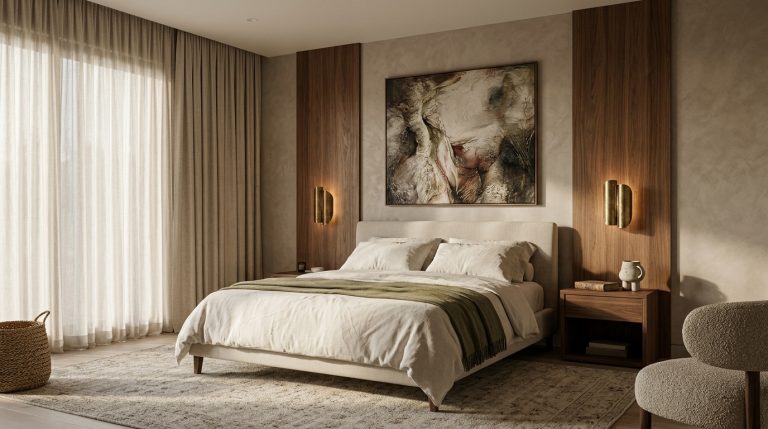

10 Small Bedroom Ideas for Bigger Feel Without Sacrificing Comfort
A small bedroom usually feels cramped for one of two reasons. Either too much furniture has been squeezed into it, or the pieces that are there visually break the room into tiny sections.
That’s why the best 10 Small Bedroom Ideas for Bigger Feel aren’t about buying miniature furniture or painting everything bright white.
Current 2026 small-space design is actually pushing back against several old rules. Designers are using properly scaled beds, darker enveloping colors, full-height curtains, large mirrors, concealed storage, and fewer visual breaks to make compact bedrooms feel more generous. Architectural Digest recently highlighted edited layouts and reduced visual interruptions as two of the most effective ways to change how a small bedroom is perceived.
So before blaming the square footage, look at what your eye encounters when you enter.
A few smart changes can make the same room feel noticeably calmer and larger.
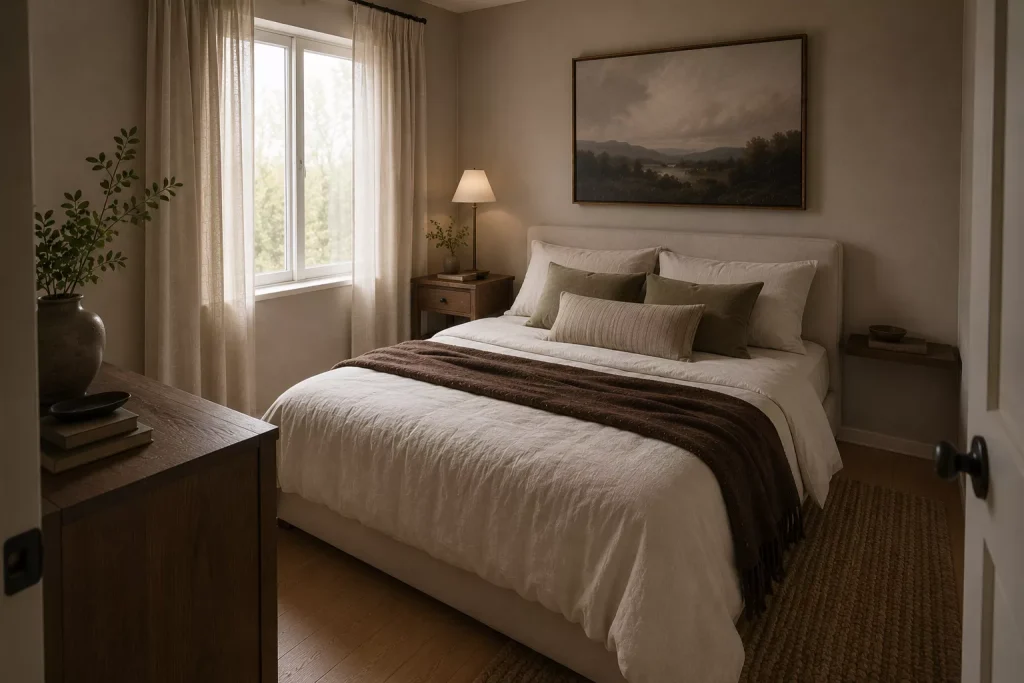
1. Keep the proper bed and remove less important furniture
Idea 1: Don’t automatically buy the smallest bed that fits.
This sounds backwards.
But filling a bedroom with several undersized furniture pieces can make it feel more cluttered than using one substantial bed with fewer supporting pieces.
Professional home stagers are recommending properly scaled main furniture in 2026 rather than shrinking everything. The idea is to let the important piece suit the room’s purpose, then reduce secondary furniture around it.
If you genuinely need a queen bed, use the queen.
Then reconsider the bench, two bulky nightstands, floor-standing mirror, extra chair, and decorative chest.
In a roughly 10-by-10-foot bedroom, you may get a better result from:
A queen bed
One narrow nightstand
One wall-mounted shelf
One dresser
rather than forcing symmetrical furniture onto both sides.
Give the bed breathing room
Try to preserve a comfortable walking route where possible.
You don’t need equal space on both sides of the bed if the room simply can’t provide it.
Pushing one side closer to a wall may allow you to create a much clearer route from the door to the closet.
That matters more than perfect symmetry.
I once tried to make a tiny guest room look “proper” with matching nightstands. Both technically fit. Neither drawer could open fully.
Removing one immediately made the bedroom feel more intentional.
That’s a useful reminder.
Fit is not the same as function.
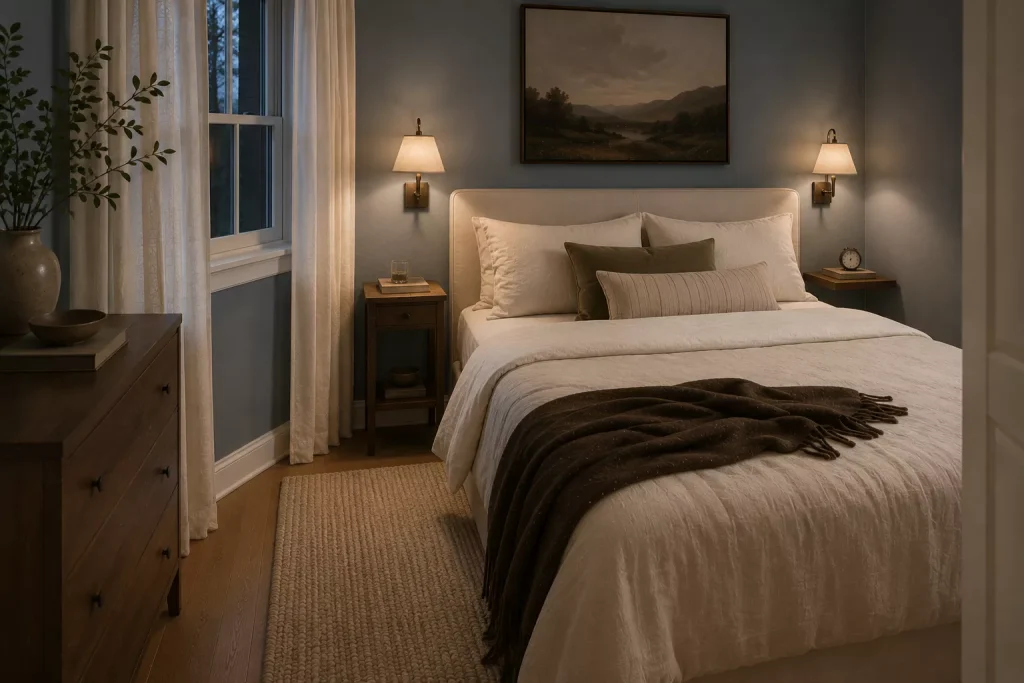
2. Use wall-mounted lighting to free the bedside area
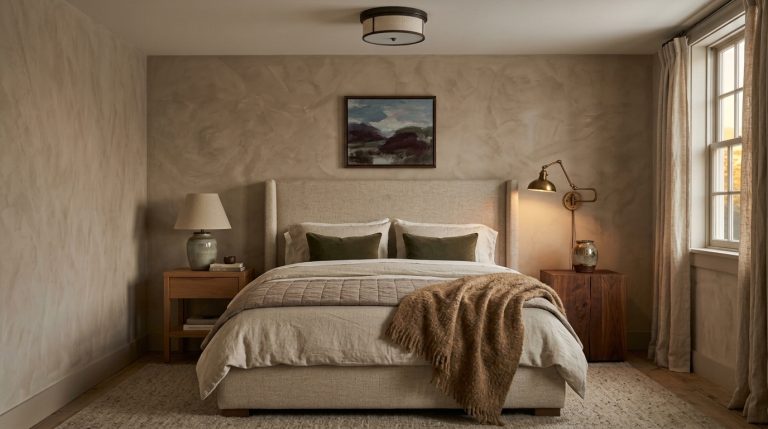
Idea 2: Replace bulky bedside lamps with sconces.
A small nightstand often loses half its surface to a lamp.
Move the light upward instead.
Plug-in wall sconces are especially useful because they can create the look of built-in bedside lighting without electrical work, provided your setup and lease allow them.
Architectural Digest’s 2026 small-bedroom coverage specifically points to sconce lighting as a useful way to maximize space, while current bedroom guidance still favors several lower light sources rather than depending on one ceiling fixture.
Once the lamp disappears, even a 12-to-16-inch-wide nightstand can handle a glass of water, phone, glasses, and book.
For an even tighter bedroom, skip the nightstand entirely.
Try a small floating shelf around 8 to 12 inches deep.
That can provide just enough landing space while leaving the floor visible underneath.
Idea 3: Keep furniture visually lighter near the floor.
Furniture with exposed legs can also help.
Being able to see floor beneath a bedside table or dresser makes the room feel less blocked. Home stagers use this technique specifically to create a greater sense of openness in small rooms.
You don’t need every piece raised.
One or two visually lighter pieces are enough.

3. Make storage disappear instead of adding more storage furniture
Idea 4: Use the bed as your largest storage zone.
A small bedroom can become crowded very quickly once extra drawers, baskets, and shelving units arrive.
Before adding another cabinet, look under the bed.
Storage beds, low rolling containers, and properly fitted under-bed boxes can hold:
- extra bedding
- seasonal clothing
- shoes
- luggage
- less frequently used bags
Architectural Digest’s 2026 small-bedroom storage guidance emphasizes multifunctional furniture and concealed storage because reducing visible possessions creates a greater sense of calm.
That last part is important.
Storage isn’t successful just because everything technically fits somewhere.
The room should look quieter afterward.
Use closed storage for visually messy things
Open shelves photograph beautifully when they contain three books and one ceramic bowl.
Real bedrooms contain chargers, skin care, medication, hair tools, receipts, socks, and other objects that rarely improve a shelf arrangement.
Hide those.
Use drawers, boxes, cabinets, or baskets inside wardrobes.
Keep open shelves for the few things you’re happy seeing every morning.
Current bedroom design continues to treat smart storage as one of the foundations of a successful sleep space, especially in compact rooms.
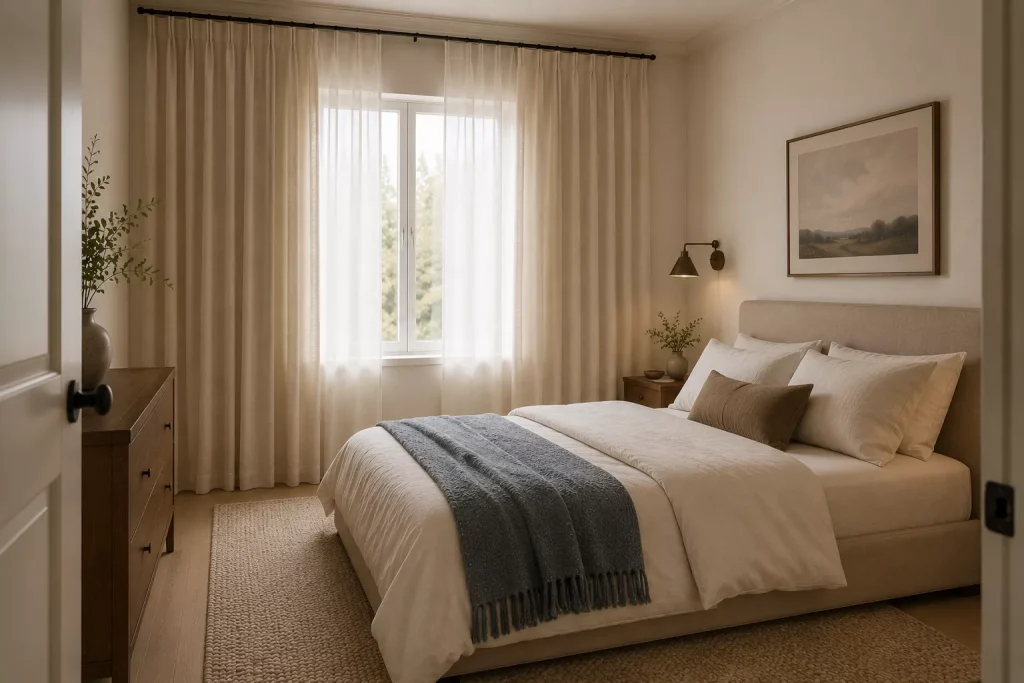
4. Take curtains all the way up
Idea 5: Make the window look taller than it is.
Short curtains can visually cut a wall into sections.
Full-height curtains create a much cleaner vertical line.
Where the architecture allows it, position the curtain rod higher than the window frame and use panels that fall close to the floor.
The eye reads the longer vertical line first.
That can make the wall and ceiling feel taller.
For a room that needs more daylight, use warm white, flax, oatmeal, pale blue, or another light-filtering fabric.
Current 2026 bedroom design is paying much more attention to drapery, including fuller treatments that create softness and a stronger sense of enclosure.
But don’t use so much material that the curtains permanently cover part of the glass.
Extend the rod beyond the window frame where possible so panels stack mostly outside the window when open.
You gain softness without sacrificing useful daylight.
And if your bedroom has a radiator, heater, or ventilation equipment around the window, work with the safety requirements of that setup rather than forcing floor-length fabric where it doesn’t belong.
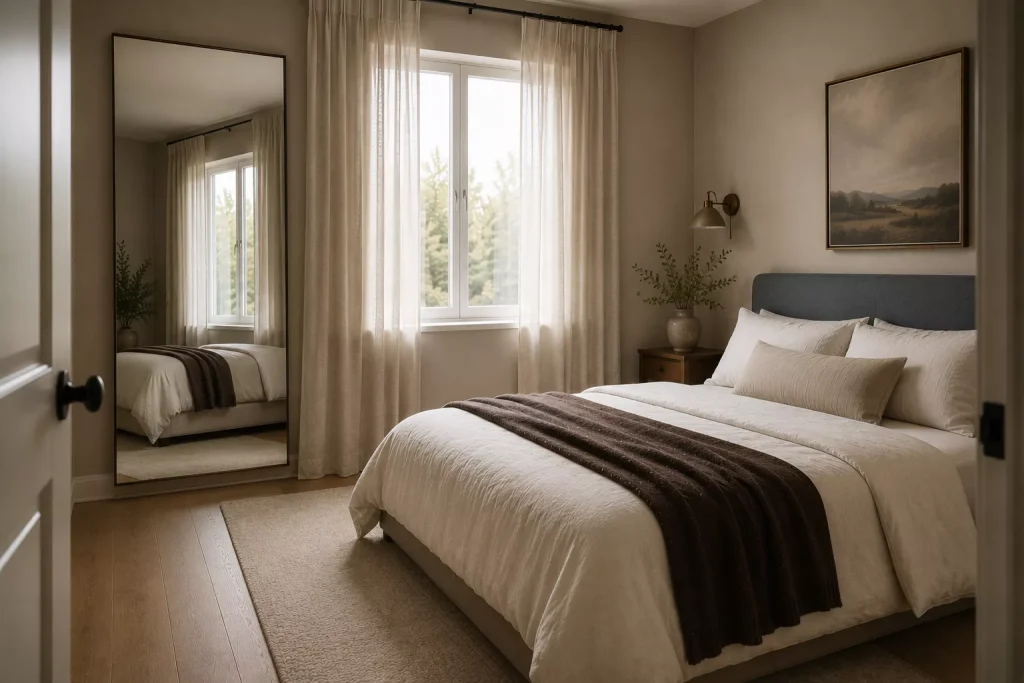
5. Use one large mirror strategically
Idea 6: Treat a mirror as a spatial tool.
A large mirror can do much more than help you get dressed.
Placed where it catches daylight or reflects an open portion of the room, it increases brightness and creates visual depth.
Architectural Digest’s May 2026 advice on making bedrooms appear larger describes mirrors as tools that can amplify light and extend the perception of space.
This is one of the few small-room tricks that genuinely makes a noticeable visual difference.
Try:
A tall wall mirror opposite or beside a window
A large mirror above a low dresser
Mirrored wardrobe panels if you already need new closet doors
If floor area is limited, wall-mount the mirror.
That removes another object from the floor.
Architectural Digest’s small-bedroom storage guidance also recommends wall mirrors for precisely that reason.
Bigger often works better than several tiny mirrors
One 30-by-60-inch mirror usually creates a stronger sense of depth than five little decorative ones.
Small mirrors introduce more frames and more visual interruptions.
And that leads to one of the most useful rules in a compact bedroom.
Reduce the number of edges your eye has to process.
The room begins to feel calmer immediately.

6. Stop assuming a small bedroom has to be white
Idea 7: Use color continuously rather than creating lots of contrast lines.
White can absolutely make a bedroom feel bright.
But it’s not mandatory.
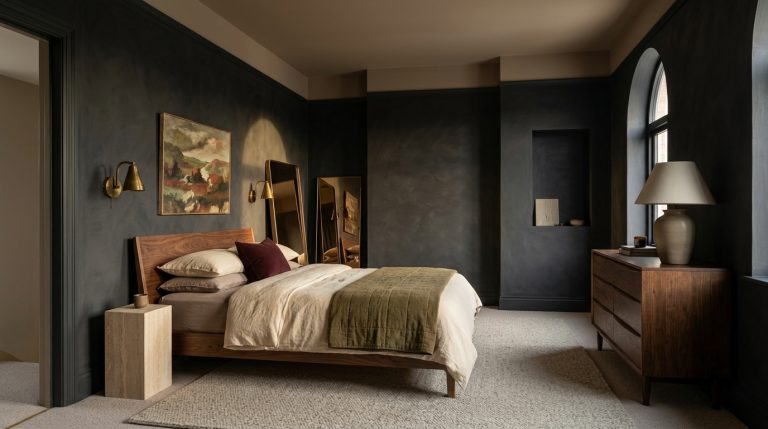
One of the more interesting changes in 2026 small-space thinking is the willingness to use deeper color in compact rooms.
Architectural Digest recently challenged the idea that small spaces must stay pale, while Real Simple’s August 2026 designer advice similarly notes that darker rooms can feel more expansive and immersive when color is handled continuously.
Try warm mushroom.
Dusty blue.
Olive.
Soft burgundy.
Clay pink.
Or an earthy green.
The important part is reducing abrupt breaks.
Paint the trim close to the wall color.
You could even continue the color onto the ceiling for a more enveloping look.
Choose light or dark intentionally
If the room has one small north-facing window and you want brightness, a light warm neutral still makes sense.
If the bedroom is mostly used at night, a deeper cocooning shade may feel far better.
Current bedroom trends include richer burgundy, layered texture, and more enveloping decorating precisely because restfulness no longer has to mean white walls with pale blue bedding.
Everyone says dark paint makes a tiny room feel smaller.
Sometimes it does.
But a tiny bedroom is already tiny.
Trying to disguise that fact isn’t always better than making the room feel beautifully intimate.

7. Choose one large rug instead of several little ones
Idea 8: Connect the bed to the floor visually.
A tiny rug beside the bed can emphasize how little floor space exists.
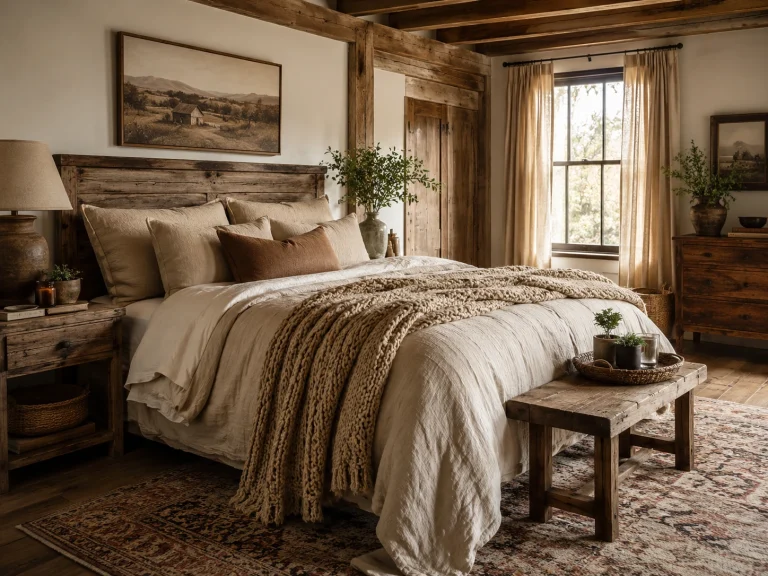
A larger rug creates one continuous base.
For a queen bed, something around 6 by 9 or 8 by 10 feet may work depending on the room and placement.
Measure first.
The rug should extend enough around the bed that you actually see and step onto it.
Professional staging advice for 2026 recommends right-sized rugs because they unite furniture and can make a small space appear more generous rather than visually dividing it.
Here’s how I’d compare common small-bedroom choices:
| Rug choice | Why it works | Main drawback |
|---|---|---|
| Warm solid rug | Visually quiet | Shows marks if very pale |
| Faded vintage pattern | Hides wear and adds depth | Can fight patterned bedding |
| Low-pile wool | Comfortable and substantial | Higher price |
| Washable rug | Practical for everyday life | Often thinner |
| Subtle stripe | Can visually lengthen the room | Direction matters |
Avoid positioning the rug like a tiny island at the foot of the bed.
It should connect to the main furniture rather than decorate leftover floor.
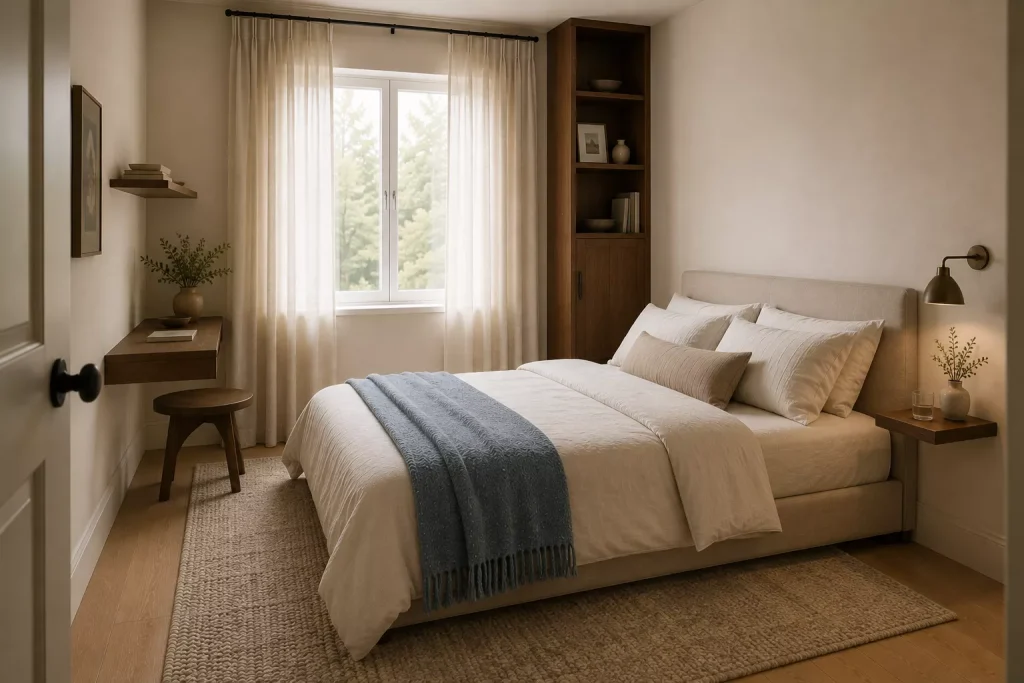
8. Use vertical space instead of consuming more floor
Idea 9: Move storage and visual interest upward.
When floor space is scarce, walls become valuable.
Try a narrow shelving unit that extends higher rather than a wide low cabinet.
Use a floating shelf above a desk.
Take books upward beside the bed.
Mount the television if one genuinely belongs in the room.
House Beautiful’s newest small-bedroom guidance emphasizes multifunctional storage and using limited square footage efficiently rather than treating compact bedrooms like scaled-down large rooms.
Built-in beds are also receiving renewed attention in 2026 because storage, headboards, shelving, and sleeping space can be combined into one architectural zone.
Custom built-ins obviously aren’t realistic for every budget.
But you can borrow the logic.
Instead of:
bed + nightstand + bookcase + headboard
consider:
bed + narrow headboard shelving
Fewer separate furniture pieces means fewer visual boundaries.
That alone can make the room feel larger.
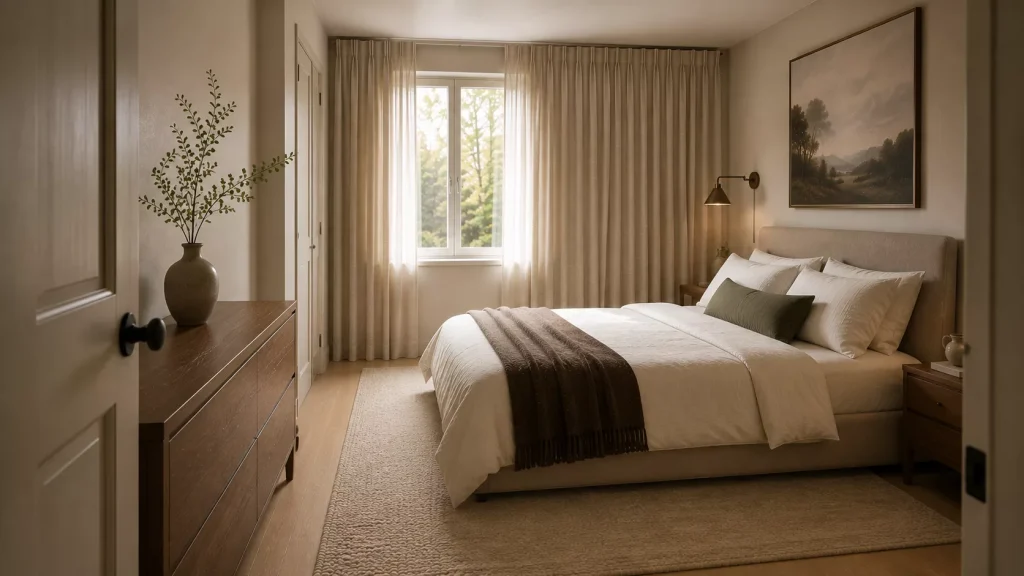
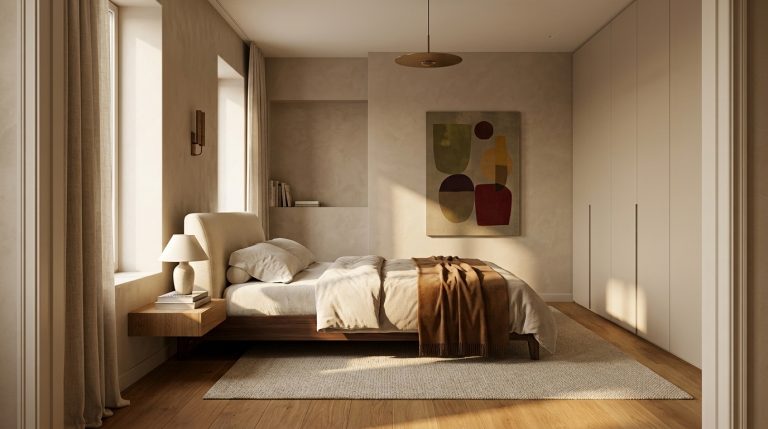
9. Keep the view from the doorway as clean as possible
Idea 10: Design the first sightline, not every corner independently.
Stand in the bedroom doorway.
What do you see first?
Ideally, your eye should reach the bed, window, or another clear focal point without hitting several piles, furniture edges, or storage pieces.
This is where decluttering becomes spatial rather than merely organizational.
Professional stagers recommend thoughtful layouts and fewer visible items because improved traffic flow and reduced clutter make rooms appear larger.
Move the laundry basket into the closet if possible.
Hide charging cords.
Keep the dresser top mostly clear.
Avoid hanging five tiny decorations where one larger artwork would work.
And look at your bedding.
A restrained bed creates a large uninterrupted surface in the middle of the room.
That matters because the bed is usually the biggest thing you see.
You don’t need twelve decorative pillows.
Two sleeping pillows, two larger pillows, and perhaps one lumbar cushion can look complete without creating a nightly storage problem.
What should you skip in a small bedroom?
Skip miniature furniture just because the room is small.
A tiny bed, tiny rug, tiny nightstand, tiny art, and tiny lamp can make the scale of the room more obvious rather than disguising it.
Use fewer properly scaled pieces instead. That matches current 2026 small-space advice from both designers and home stagers.
I’d also skip unnecessary furniture categories.
A bedroom doesn’t automatically need a bench at the end of the bed.
It doesn’t automatically need two nightstands.
And it definitely doesn’t need a decorative chair if that chair spends its life holding clothes.
Avoid excessive visual breaks too.
Contrasting wall colors, many small rugs, several little storage units, and a dense gallery wall can chop the room into sections.
Finally, don’t sacrifice useful storage purely to make the room look minimal.
Hidden clutter is still clutter if you can’t find anything.
The goal is enough storage for your real belongings, combined with fewer visible containers and pieces.
Try this if your bedroom is under 100 square feet
Start with the bed.
Place it where the door and closet can still work comfortably.
Then remove every nonessential furniture piece temporarily.
Live with only:
The bed
Necessary bedside storage
Clothes storage
Lighting
Now add things back only when the room has a specific need.
If you read in bed, add a wall light.
If clothes are overflowing, solve that storage.
If the floor feels cold, add one correctly sized rug.
If the wall feels empty, hang one larger artwork or mirror.
This backwards approach works because you’re no longer decorating around furniture that entered the bedroom years ago for no clear reason.
Small rooms punish unnecessary objects faster than large rooms do.
That can actually be useful.
They force you to decide what deserves the space.
FAQ About Making a Small Bedroom Feel Bigger
What color makes a small bedroom look bigger?
Light colors can reflect more light and create an airy effect, but they aren’t your only option. In 2026, designers are also using color-drenching and deeper shades to reduce visual breaks and create a more continuous, immersive room.
Where should a bed go in a small bedroom?
Choose the position that preserves the clearest route between the door, bed, and storage. Centering the bed is attractive when space allows, but placing one side closer to a wall can be more practical in very tight rooms.
Do mirrors really make a bedroom feel larger?
Strategically placed mirrors can reflect natural light and extend the perceived depth of a room. One larger mirror usually has more impact than several small decorative mirrors.
How can I get more storage without making the room crowded?
Use concealed under-bed storage, taller storage rather than wider furniture, wall-mounted shelves, and pieces that perform more than one job. Closed storage helps reduce visual clutter while still giving everyday belongings a home.
Make the room visually quieter before making it smaller
The most useful 10 Small Bedroom Ideas for Bigger Feel share one principle.
Reduce interruption.
One properly sized bed is calmer than several undersized furniture pieces.
One large mirror creates more depth than a collection of tiny ones.
One continuous wall color can feel more expansive than lots of contrasting edges.
And one concealed storage zone beats five baskets scattered around the room.
Start by standing in the doorway and removing the first object that makes the bedroom look crowded.
Then fix the lighting and storage before buying decor.
You may discover that the room doesn’t need to become physically larger at all.
It just needs fewer things competing to remind you how small it is.