
10 cozy living room ideas without Renovating for a Warmer, More Inviting Home
A living room doesn’t need new floors, built-ins, or a different fireplace to feel dramatically more comfortable.
In fact, some of the most effective 10 cozy living room ideas without Renovating start with things you can change in an afternoon. Moving the sofa six inches, replacing one cold bulb, bringing in a larger rug, or swapping a glass side table for warm wood can change how the whole room feels.
That approach is especially relevant in 2026. Designers are increasingly talking about smaller “micro-makeovers,” where lighting, textiles, furniture placement, and one strong piece create noticeable changes without construction.
So before assuming your living room needs a contractor, look at the softer layers first.
You may already own most of what the room is missing.
1. Rearrange the seating before buying anything
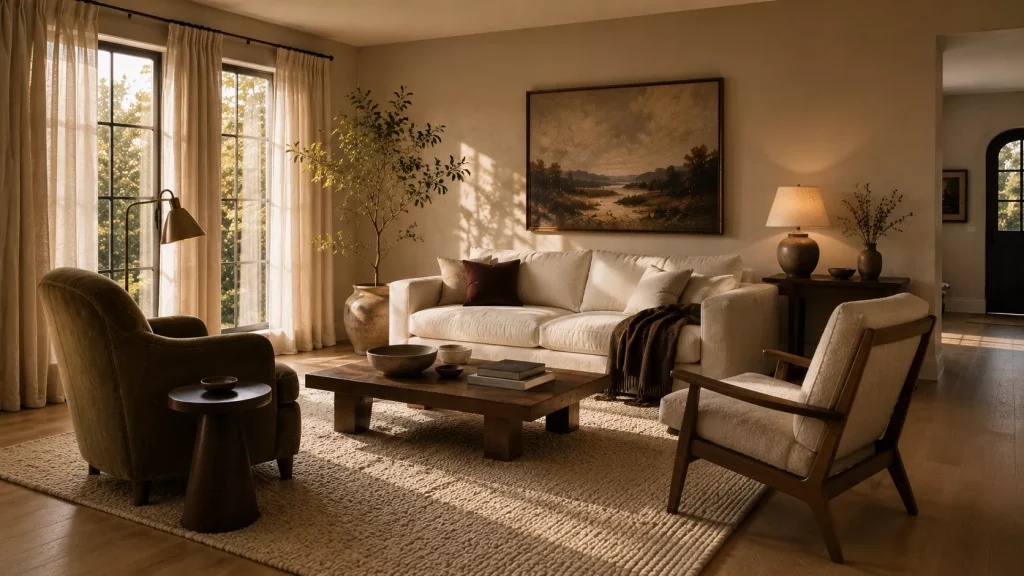
Idea 1: Pull furniture closer together.
A living room often feels cold because the furniture is too far apart.
This happens especially in medium and large rooms where the sofa gets pushed against one wall and the chairs end up against another.
Try pulling everything inward.
Move the sofa away from the wall if there’s room.
Angle one chair slightly toward it.
Bring the coffee table close enough that somebody sitting down can actually reach it.
Current 2026 living room design is moving toward softer, more informal layouts that prioritize conversation and everyday use over perfectly matched, showroom-style arrangements.
Start with the chair nobody uses
Almost every living room has one.
Maybe it faces the television at an awkward angle.
Perhaps it sits too far from a lamp.
Or there’s nowhere beside it to put a drink.
Fix that chair first.
Move it closer to the sofa and add a small side table.
You’ve created a more inviting conversation corner without spending anything.
That’s the kind of decorating change I like most.
The room works better before it simply looks better.
2. Make the rug large enough to connect the room
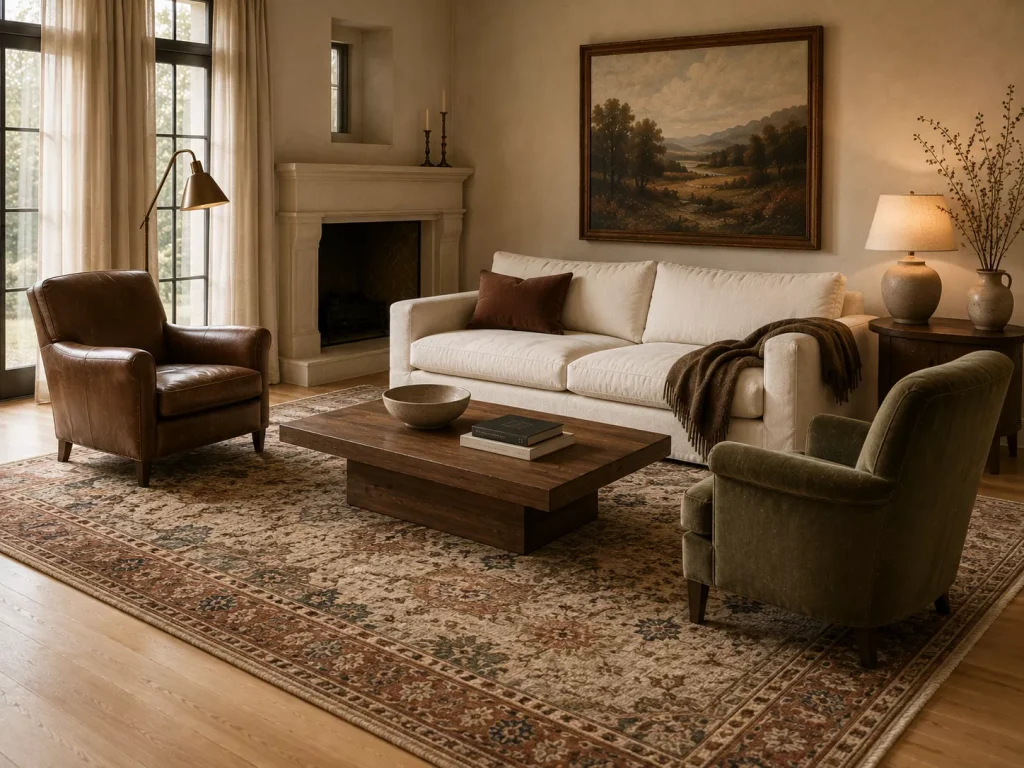
Idea 2: Use one properly scaled rug instead of several tiny ones.
A rug creates an invisible boundary around the seating area.
If it’s too small, the furniture looks like separate islands.
For many average living rooms, an 8-by-10-foot rug is a better starting point than a 5-by-7, although your furniture arrangement should determine the final size.
Try to get at least the front legs of your main sofa and chairs onto the rug.
For coziness, look beyond plain pale gray.
Try:
- faded rust
- oatmeal
- tobacco brown
- olive
- burgundy
- dusty blue
- warm cream
A patterned vintage-style rug is particularly helpful because it can introduce several muted colors without requiring you to change the sofa.
Current designers are also putting more emphasis on texture itself. Wool, woven fibers, wood, velvet, and rougher surfaces are being layered deliberately because a room can feel flat even when its color palette is technically good.
If your existing rug is the right size but looks too pale, don’t automatically replace it.
Add darker furniture or textiles around it first.
Sometimes the rug isn’t the problem.
It just needs more contrast.
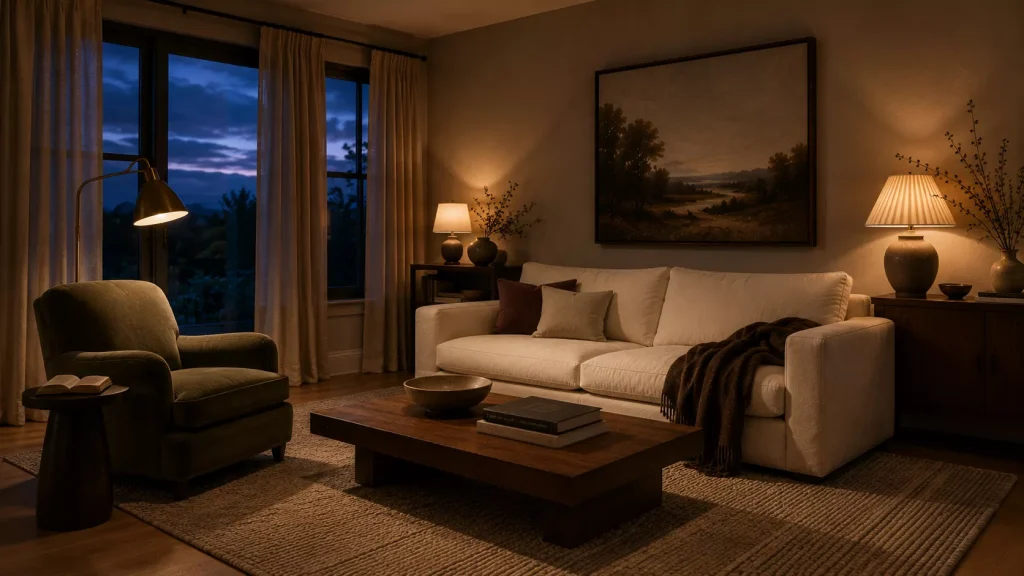
3. Add three lower light sources
Idea 3: Stop relying on the ceiling light.
If there’s one change I’d make to a cold-feeling living room after sunset, it’s this.
Turn off the overhead fixture.
Then look around.
Where does the room disappear into shadow?
That’s where a lamp belongs.
Try using:
- A floor lamp beside the sofa or reading chair.
- A table lamp on a console.
- A smaller lamp on a side table or bookshelf.
You don’t need all three switched on constantly.
The point is flexibility.
Recent 2026 design coverage keeps returning to softer, layered lighting as homes move toward warmer, more personal rooms. Even the current preference for more characterful ceiling fixtures reflects a wider rejection of flat, impersonal illumination.
Change the lampshade before the whole lamp
This is a useful budget trick.
A stark white shade can make a basic lamp feel cooler.
Try cream linen, pleated fabric, warm parchment, or a muted patterned shade.
You may spend $25 to $70 rather than buying a completely new lamp.
And check the bulbs too.
Very cold light can make beige walls look gray and wood look lifeless.
Use warm, comfortable lighting while keeping enough brightness for reading and everyday tasks.
Cozy should never mean stumbling around in darkness.
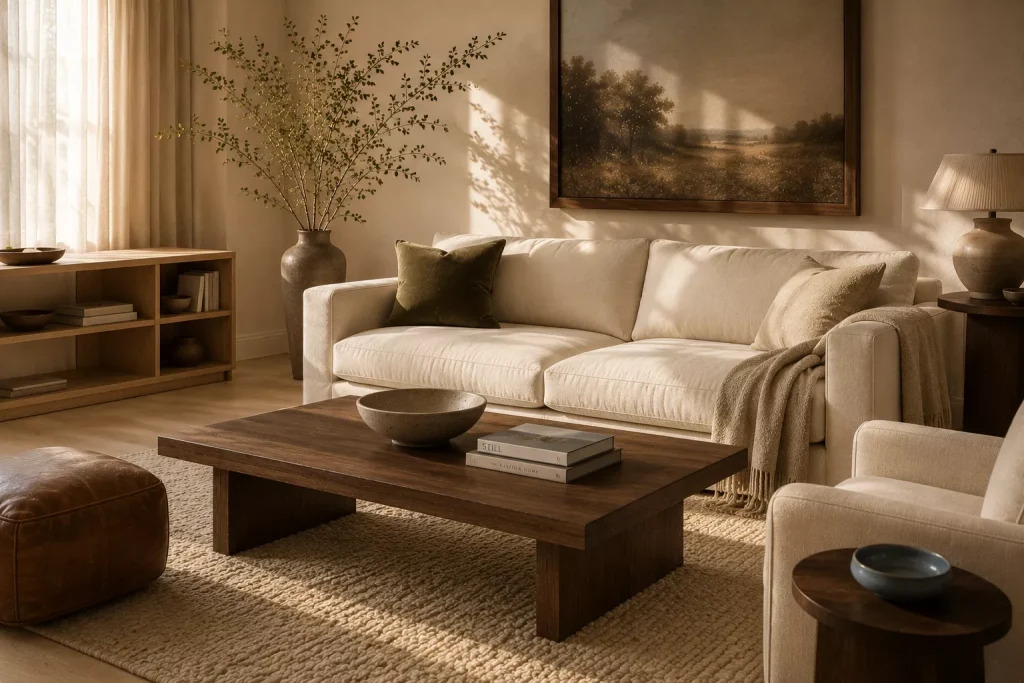
4. Bring in one noticeably warmer wood tone
Idea 4: Add walnut, dark oak, or another medium-to-deep wood.
Pale rooms often need visual weight.
That’s why warm wood is such an effective part of 10 cozy living room ideas without Renovating.
In 2026, designers are leaning back into richer timber because it gives pale and minimal rooms more depth. Recent examples pair warm wood with natural stone, textured upholstery, and subdued colors rather than filling rooms with cool glossy finishes.
You don’t need wood paneling.
A single piece can do the job.
Try a walnut side table beside a cream sofa.
Bring in an old wood stool.
Swap a glass coffee table for a secondhand wood version.
Use deeper wood frames around existing art.
Don’t match every wood finish
Your oak media console can sit beside walnut.
Your walnut coffee table can coexist with a lighter floor.
Repeat the deeper wood once elsewhere and the mixture usually starts feeling intentional.
Matching every piece often makes a room feel newer and flatter.
A little variation gives it history.
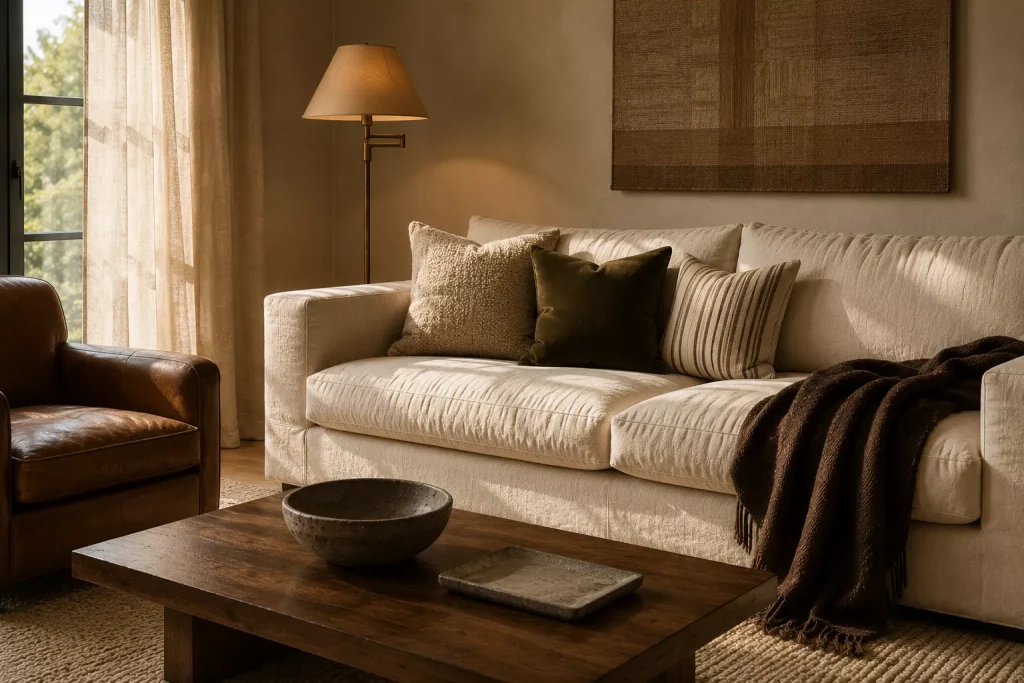
5. Layer texture instead of piling on decorative objects
Idea 5: Combine fabrics that feel different.
Everyone says to add throws and cushions when a living room needs to feel cozy.
That advice isn’t wrong.
It’s just incomplete.
Five smooth beige cushions will still look like five smooth beige cushions.
Instead, vary the texture.
Put a wool pillow beside linen.
Use velvet beside a simple cotton stripe.
Drape a chunky woven throw across one end of the sofa.
Bring in a leather or suede-like detail on a chair or ottoman.
Current 2026 interiors are treating texture almost like a separate design palette, using contrasts between soft, rough, matte, smooth, and tactile materials to make rooms feel deeper.
Here’s a simple way to think about it:
| If you already have | Add |
|---|---|
| Smooth linen sofa | Wool or velvet cushion |
| Flat-weave rug | Chunkier throw |
| Glass coffee table | Wood tray |
| Plain painted walls | Woven or textile artwork |
| Metal lamp | Fabric shade |
| Pale upholstery | Darker leather or wood |
You don’t need all of these.
Pick two areas where the room currently feels one-dimensional.
That’s enough to start.
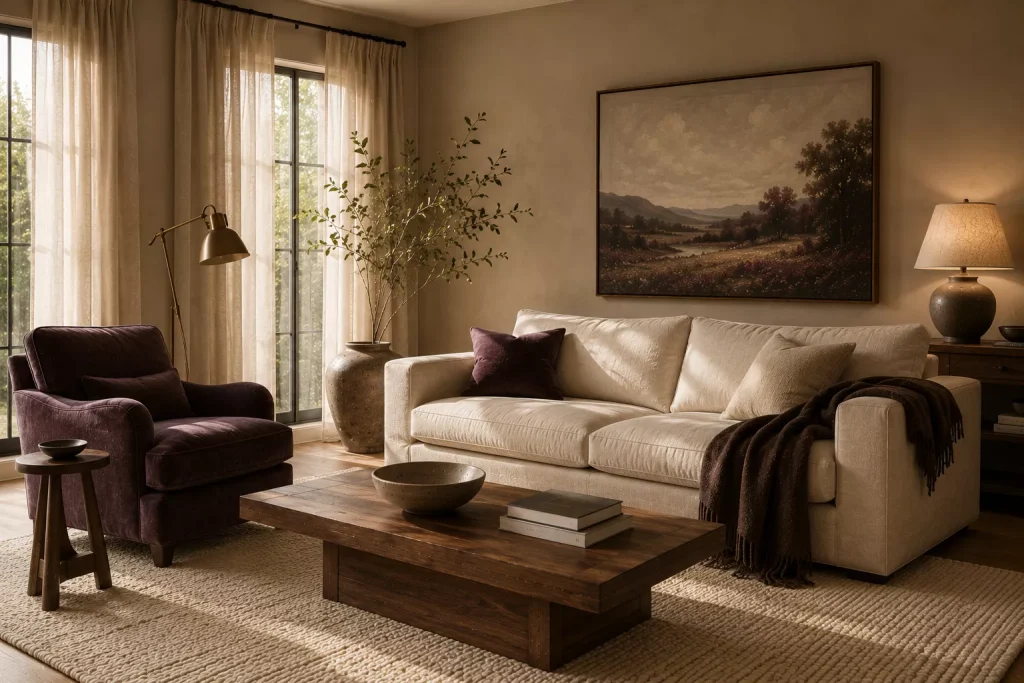
6. Add one deeper color to the neutral palette
Idea 6: Use plum, olive, tobacco, or dusty blue.
A cozy room doesn’t have to be beige.
Actually, neutral rooms often become more comfortable once a deeper color gives your eye somewhere to land.
Try olive green cushions against oatmeal upholstery.
Use a plum throw on a cream sofa.
Bring dusty blue into a brown room.
Add tobacco through one chair or large cushion.
Deep plum is especially current for fall 2026 because it behaves almost like an earthy neutral when paired with camel, olive, wood, or brass.
You don’t need to repaint.
Use the color three times.
For example:
Olive chair
Olive in the rug
Olive detail in artwork
That repetition is enough to make the choice feel deliberate.
Everyone says small rooms should stay pale.
But one darker color can actually make a pale room feel more grounded.
You just don’t need ten dark colors fighting for attention.
7. Replace generic decor with one older piece
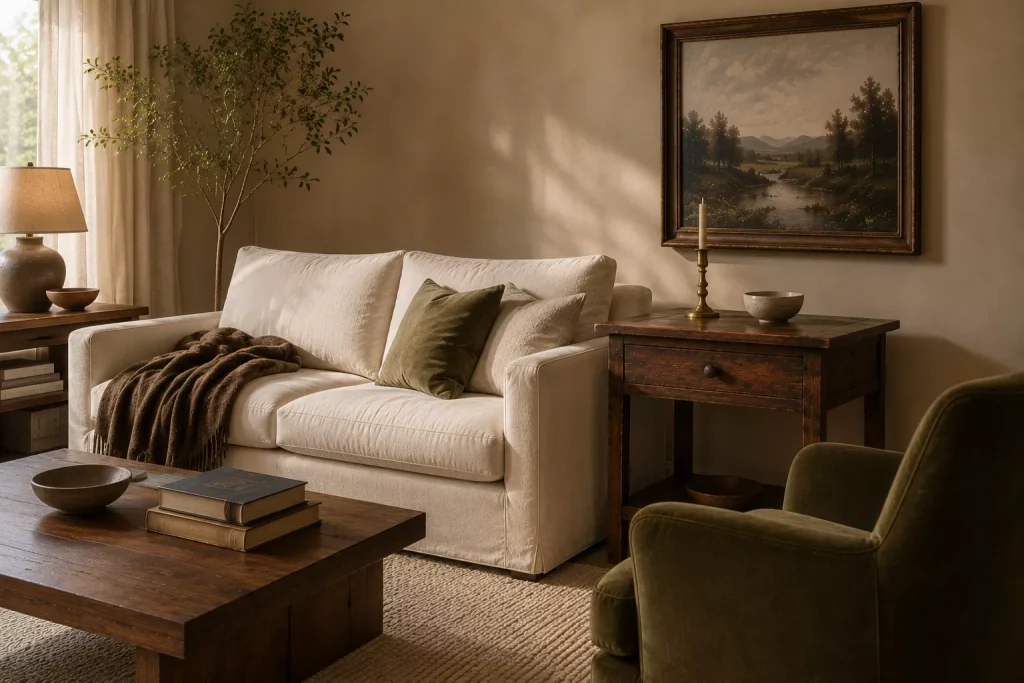
Idea 7: Bring in something that didn’t come from the same shopping trip.
New rooms often feel cold because everything is equally new.
Try adding one object with age.
A secondhand side table.
A vintage landscape.
An old ceramic bowl.
A brass candlestick.
An inherited wooden box.
A worn leather stool.
Vintage and pre-loved pieces are a major part of current 2026 living room design because their patina and irregularity add the kind of depth that brand-new matching furniture can struggle to create.
I’d rather spend $40 on an interesting old landscape than the same amount on four filler accessories.
One has a point of view.
The others mostly occupy space.
Let imperfections stay visible
If a wood table has a few marks, you don’t automatically need to refinish it.
If brass has softened with age, it may look better that way.
Obviously, furniture should still be clean, sturdy, and safe.
But coziness often comes from rooms feeling lived in rather than pristine.
8. Make the curtains look more substantial
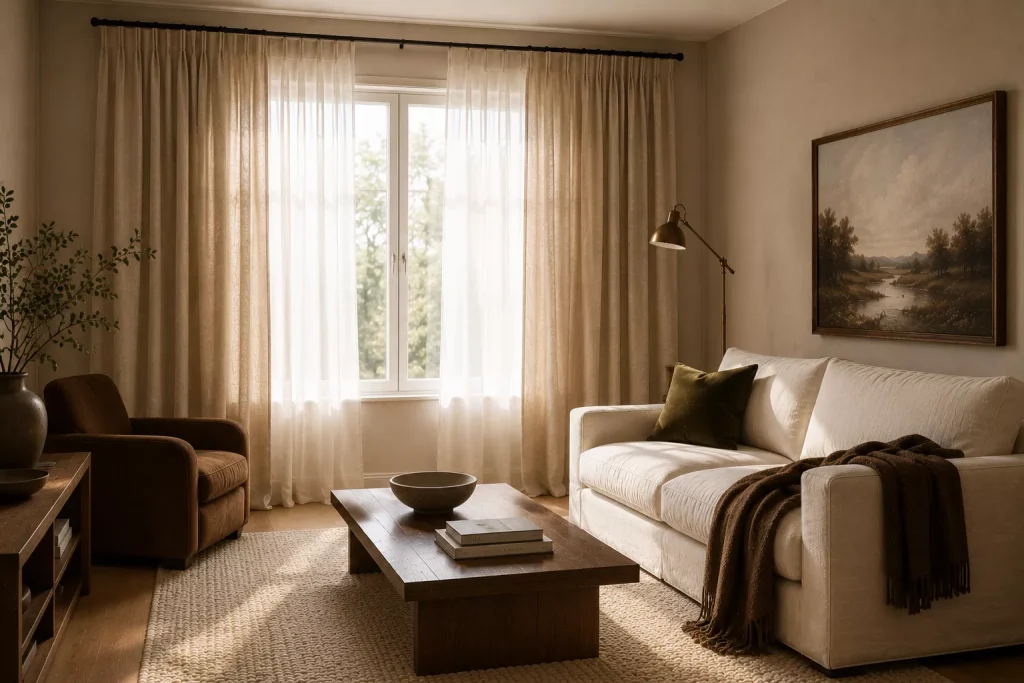
Idea 8: Give the windows more softness.
Bare windows can make a living room feel harder than you realize.
If you already have curtains, check two things.
Are they long enough?
And is there enough fabric?
Thin panels barely covering the glass often look temporary.
Try full-length curtains in warm white, flax, oatmeal, mushroom, olive, or a restrained pattern.
You don’t need heavy velvet unless it suits the room.
A linen-look curtain can soften walls, absorb some visual harshness, and make large windows feel more connected to the furniture.
For renters, curtains are especially useful because they cover a lot of visual area without changing the property itself.
If privacy allows, hang panels so they can sit largely outside the window when open.
That preserves daylight.
The goal is to make the room feel softer without sacrificing the natural light that already works in your favor.
9. Create one corner designed for staying put
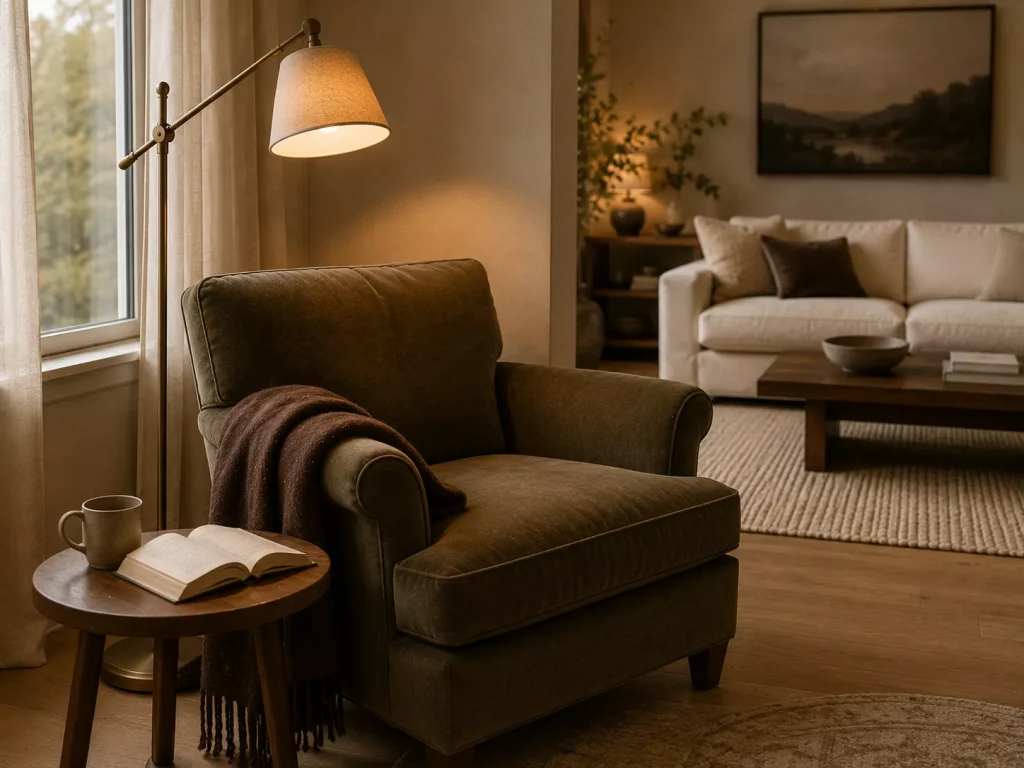
Idea 9: Turn a neglected chair into a real destination.
A cozy room should offer somewhere you genuinely want to sit.
Find the least-used corner.
Then ask why it’s being ignored.
Maybe it needs a lamp.
Perhaps there’s no table.
Maybe the chair faces the wrong direction.
A tiny three-piece setup can change that:
Comfortable chair
Small table
Reading lamp
Add one throw if you’ll use it.
That’s all.
A recent 2026 living room example showed how formal architecture can still feel relaxed when balanced with warm oak, mixed textiles, softened edges, and furniture that encourages actual use.
This is the difference between decorating and furnishing for behavior.
A basket of blankets tells you the room is supposed to be cozy.
A comfortable chair beside a good lamp actually makes it cozy.
I’d choose the second every time.
10. Edit the room before adding the final layer
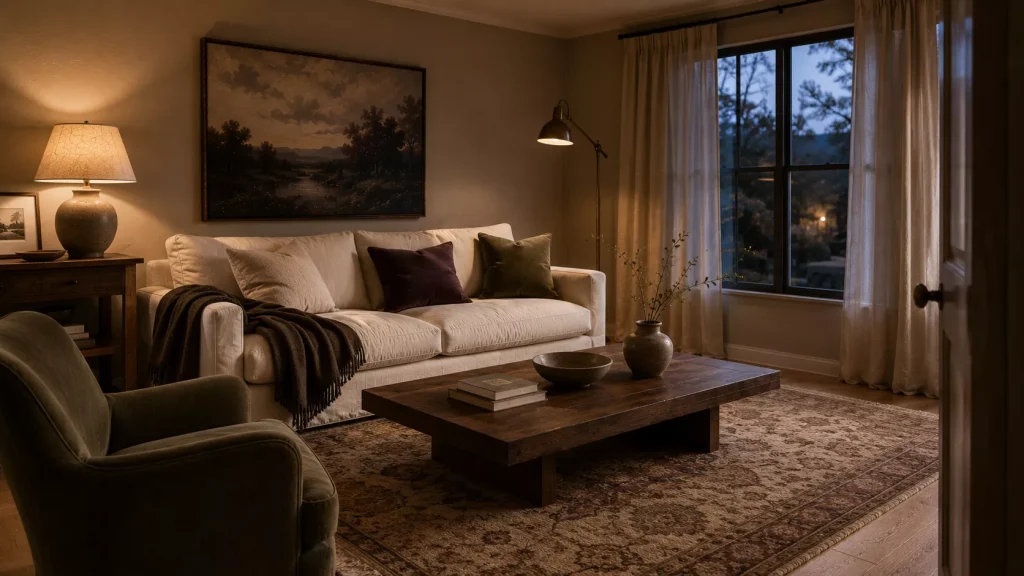
Idea 10: Remove three things.
This is the least glamorous of the 10 cozy living room ideas without Renovating, and it’s one of the most useful.
Cozy does not mean full.
If every table contains a tray, vase, candle, bowl, books, beads, plant, and framed photograph, the room can feel visually restless.
Choose one surface.
Clear it.
Then put back only the things that add function, personality, or useful visual weight.
Perhaps the coffee table keeps:
A stack of two books
One bowl
One small vase
Done.
Current living room design is moving away from sterile minimalism, but it’s also moving away from forced features and overly coordinated rooms. The emphasis is on spaces that feel intentional, personal, and comfortable to use.
That requires editing.
Your eyes need somewhere to rest too.
What should you skip when making a living room cozy?
Skip buying a mountain of decorative cushions.
You still need somewhere to sit.
Three or four good cushions on a standard sofa usually provide plenty of softness.
I’d also skip covering every chair with a throw.
One blanket within reach feels inviting.
Five start to look like laundry.
Avoid matching furniture sets if you’re shopping for something new. A slightly mixed collection often feels warmer and more natural than every table and chair sharing the same finish. Current 2026 living room guidance is specifically moving away from matchy-matchy rooms.
And don’t assume renovation is the answer because the room feels plain.
House Beautiful’s 2026 micro-makeover coverage reflects a much more useful approach, making smaller strategic changes to lighting, textiles, furniture, and individual focal pieces rather than automatically taking on a full project.
Sometimes the bones of the room are fine.
It’s the layers that are missing.
Try this if you only have $200
Don’t spread $200 across ten tiny decorations.
Give it jobs.
Here’s one possible split:
- $60 to $90 for a floor or table lamp
- $30 to $50 for two good cushion covers
- $30 to $60 for a secondhand wood side table
- remaining budget for a throw, artwork, or lampshade
Already have enough lamps?
Put more of the budget toward a rug fund instead.
Already own dark wood furniture?
Spend on curtains or textiles.
The exact shopping list matters less than identifying the room’s biggest weakness.
If everything is pale, buy contrast.
If it feels hard, buy texture.
If it dies after sunset, buy light.
That’s more useful than ordering a generic “cozy living room decor” bundle and hoping it solves the problem.
FAQ About Making a Living Room Cozy Without Renovating
How can I make my living room cozy without spending much?
Start by rearranging the seating and changing the lighting. Then bring in texture through cushions or a throw and add one deeper wood or color. Moving existing furniture costs nothing and may reveal what the room actually needs.
What makes a living room feel cozy?
Comfortable seating distances, soft layered lighting, tactile materials, warm wood, a grounded rug, and personal objects all help. Cozy rooms usually combine physical comfort with visual warmth rather than relying on decorative accessories alone.
How do I make a neutral living room feel less cold?
Add darker wood, chocolate brown, olive, plum, rust, or dusty blue. Then vary the textures through wool, linen, velvet, ceramics, and woven materials. A neutral palette needs contrast to avoid feeling flat.
Can renters use these ideas?
Yes. Rugs, curtains, furniture placement, lamps, cushion covers, art, secondhand furniture, and removable decor can change most of what you see without structural work. Plug-in or wireless lighting can also help where permanent electrical changes aren’t possible.
Make the room comfortable before making it decorative
The best 10 cozy living room ideas without Renovating don’t depend on disguising your existing room.
They make better use of it.
Move the chairs closer.
Put a lamp beside the seat you actually use.
Bring in one warmer wood.
Let the rug connect the furniture.
Add enough texture that cream and beige stop feeling flat.
Then remove the objects that are simply filling space.
You may discover that the living room never needed new floors or a different fireplace.
It needed better light at 8 p.m., a chair facing the right direction, and somewhere comfortable to put your feet.
Start with the thing that affects how you use the room every day.
That change usually matters more than anything a renovation crew could add.