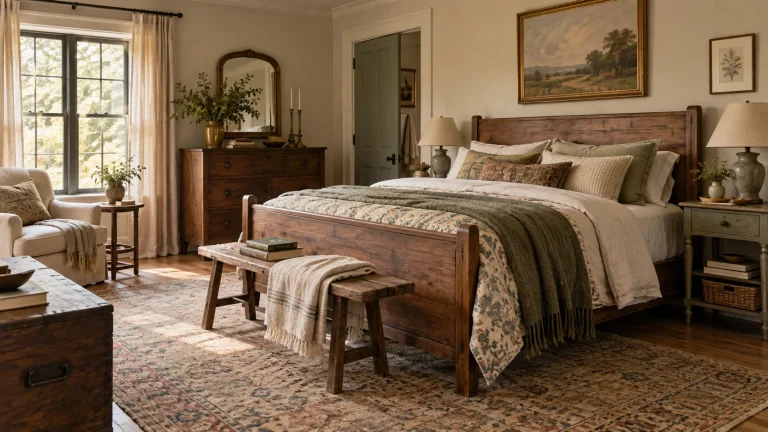
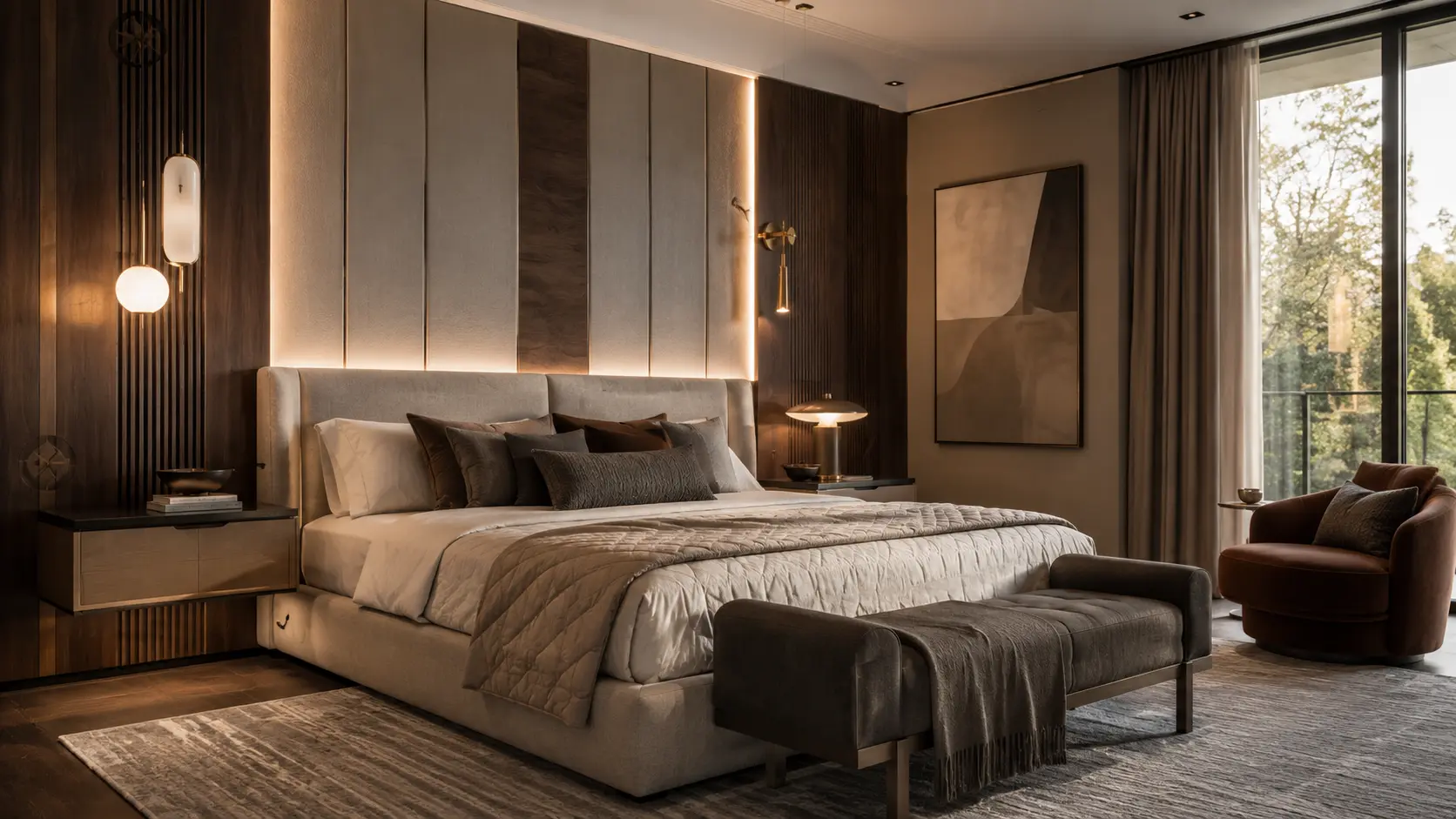
15 Modern Bedroom Ideas That Feel Stylish, Relaxing, and Effortlessly Current
For a long time, “modern” often meant white walls, low furniture, almost no decoration, and enough sharp lines to make a bedroom feel closer to a gallery than somewhere you would actually want to sleep.
That version is becoming much less relevant.
The best modern bedrooms in 2026 are warmer, softer, and more personal. Architectural Digest describes current modern bedroom design around restraint, clean lines, intentional furniture, and strong material choices such as solid wood, natural stone, upholstery, and handwoven textiles. At the same time, broader 2026 design forecasting is moving toward deeper color, texture, vintage pieces, and greater self-expression.
The result is a much more livable kind of modern design.
You can have clean architecture without creating a cold room. You can use color without making the bedroom busy. And you can mix contemporary furniture with something old, handmade, or imperfect without losing the modern feel.
If you are ready to refresh your bedroom, these 15 modern bedroom ideas offer a practical starting point.
1. Begin With a Low, Simple Bed
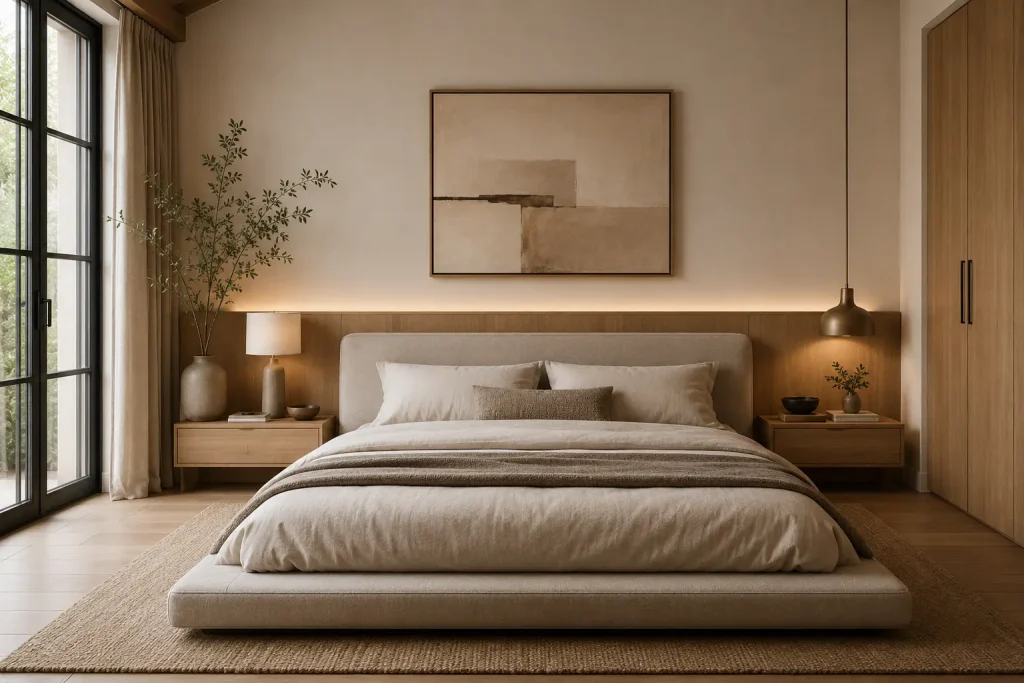
The bed should establish the visual direction of a modern bedroom.
A low-profile frame creates a clean horizontal line and leaves more visual space above the furniture. It works particularly well in rooms where you want the architecture, artwork, or materials behind the bed to remain noticeable.
You might choose:
- a simple upholstered platform bed
- a solid-wood frame
- a low oak bed
- a softly padded frame in linen
- a walnut platform design
Architectural Digest’s 2026 bedroom guidance specifically points to low-profile upholstered platform beds as a natural foundation for modern bedrooms, particularly when combined with clean lines and restrained materials.
Avoid making the bed so low that it becomes uncomfortable to use.
Modern design should still work for your body and everyday routine.
2. Use an Oversized Headboard as Architecture
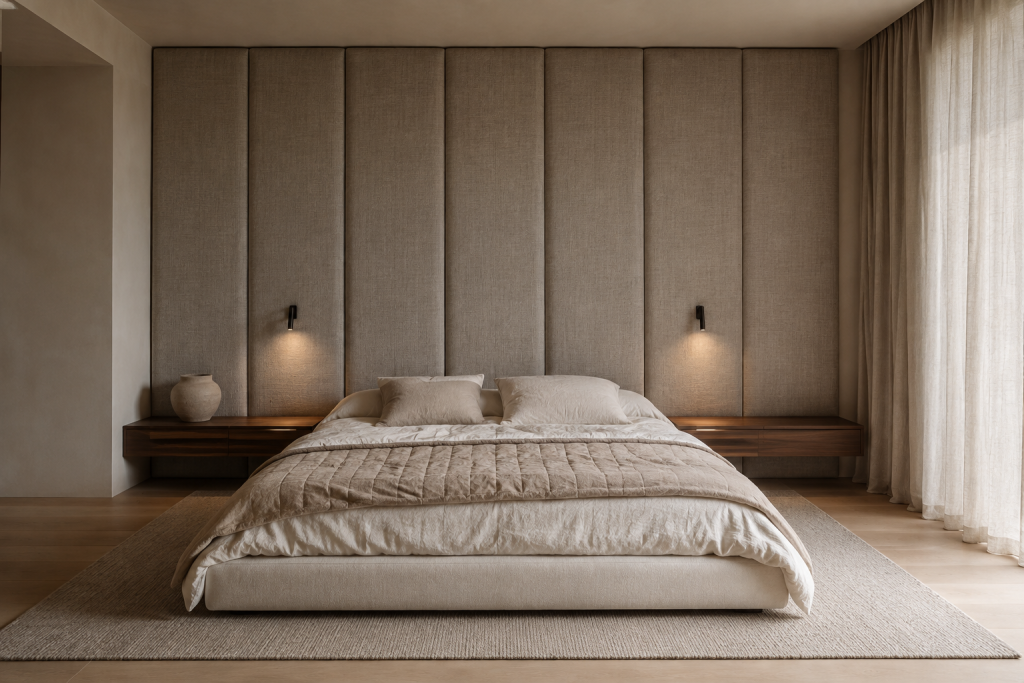
If a simple bed feels too quiet, make the headboard the statement.
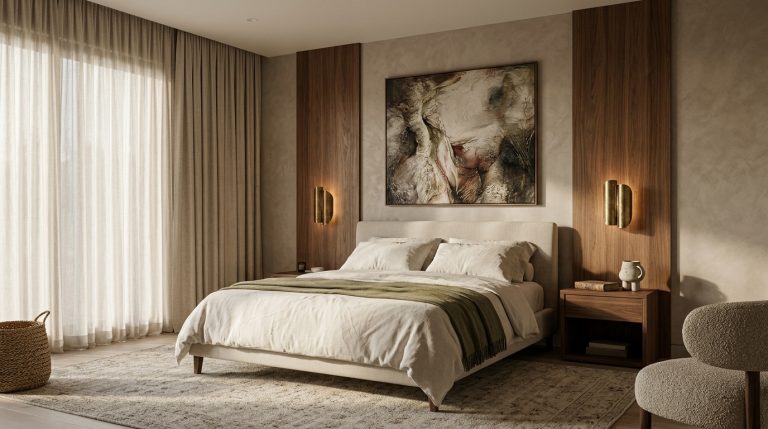
Oversized headboards have become increasingly prominent in current bedroom design, with Architectural Digest reporting in July 2026 that designers are using wider and even wall-to-wall versions to anchor otherwise simple rooms. Some incorporate lighting, bedside surfaces, or other functions directly into the composition.
You do not need a custom installation to use the idea.
Try:
- an extra-wide upholstered headboard
- vertical wood panels behind the bed
- a simple padded wall panel
- a wide timber headboard spanning both nightstands
Keep everything around it relatively restrained.
If the headboard already creates architectural drama, the bedroom does not need multiple competing focal points.
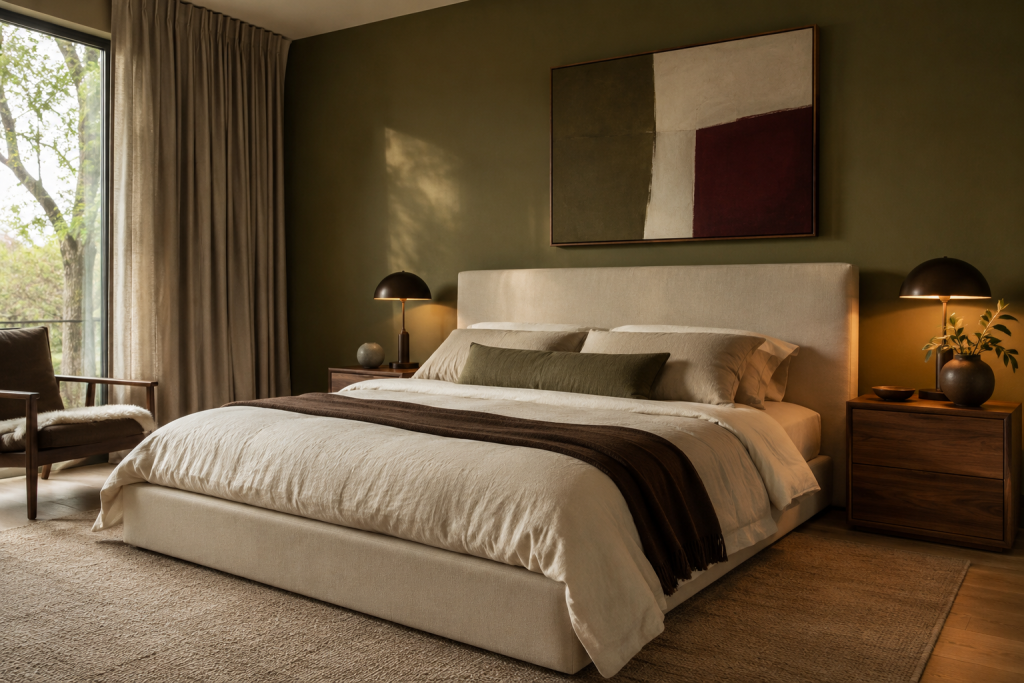
3. Move Beyond the All-White Modern Bedroom
White bedrooms can be beautiful, but modern design no longer requires them.
Current 2026 forecasting is much more confident with color. AD PRO’s forecast points toward saturated shades and stronger self-expression, while the 1stDibs designer survey highlights chocolate brown, burgundy, softer blues, pistachio, and other more expressive hues.
For a modern bedroom, consider:
- mushroom
- warm taupe
- olive
- dusty blue
- chocolate brown
- soft burgundy
- muted terracotta
- warm stone
You can still keep the room calm.
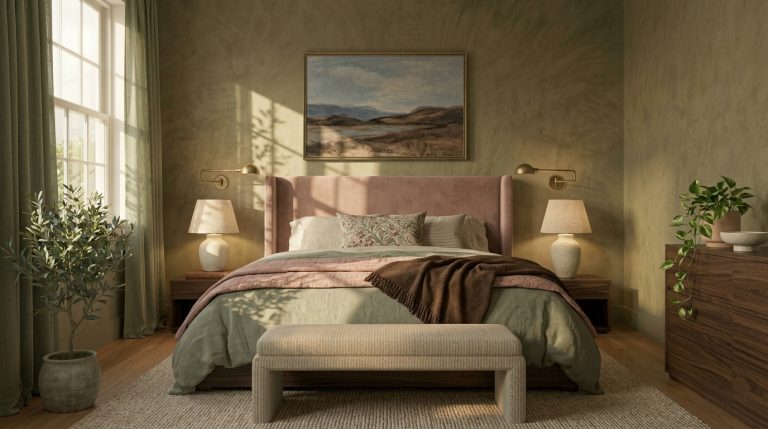
A modern bedroom with olive walls, cream bedding, walnut nightstands, and a bronze lamp can feel just as clean as an all-white space—only much warmer.
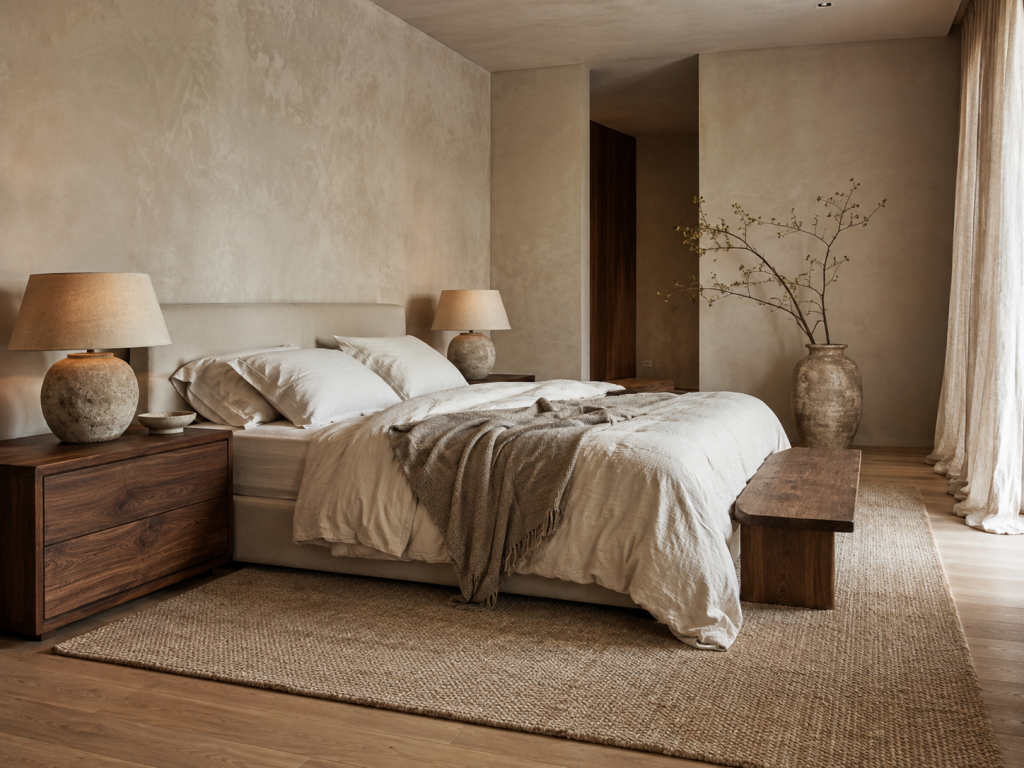
4. Let Natural Materials Create the Luxury
Modern bedrooms look more convincing when materials have visual depth.
Instead of relying heavily on shiny finishes or decorative accessories, introduce materials that already have character.
Think:
- walnut
- oak
- travertine
- marble
- linen
- wool
- cotton
- handmade ceramic
Architectural Digest’s 2026 advice specifically emphasizes materiality and long-lasting natural materials such as solid wood, stone, and handwoven textiles as part of successful modern bedroom design.
A walnut nightstand beside a linen bed and wool rug may need very little additional decoration.
The materials are doing the work.

5. Mix Wood and Upholstery
A room filled entirely with hard furniture can feel severe.
A room filled entirely with upholstery can feel overly soft.
Modern bedrooms benefit from the contrast.
Try pairing:
- linen bed + walnut nightstands
- timber bed + upholstered bench
- wood dresser + soft reading chair
- upholstered headboard + stone side table
Architectural Digest’s August 2026 upholstered-bed coverage highlights linen, cotton, bouclé, velvet, and performance textiles as ways to bring warmth and softness into bedrooms while maintaining contemporary silhouettes.
The combination makes a room feel layered without requiring much decoration.
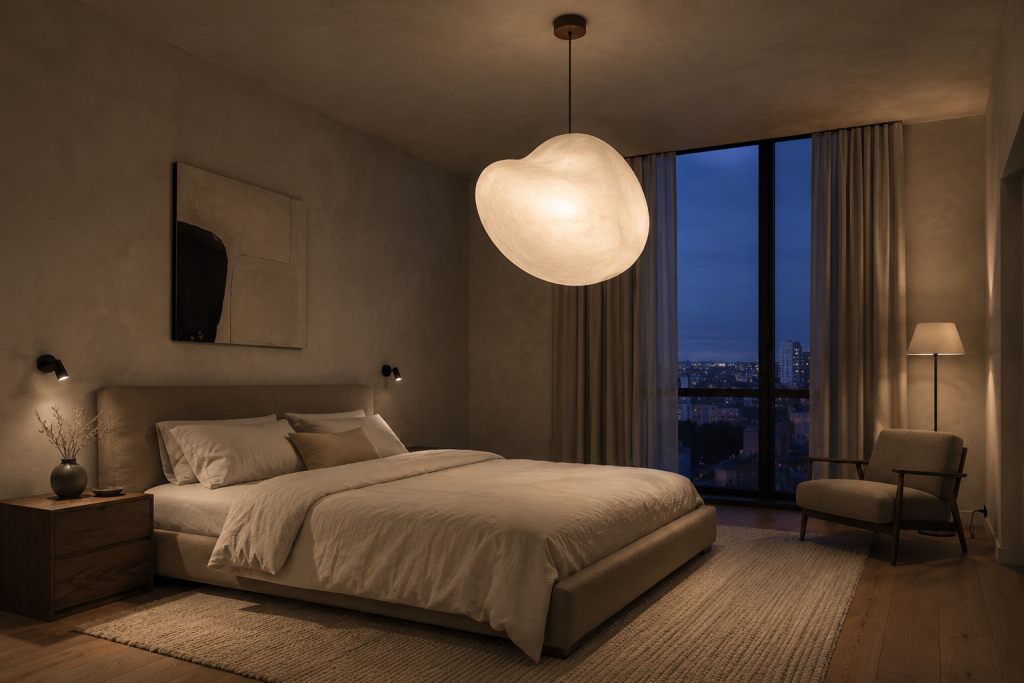
6. Choose One Sculptural Light Fixture
Lighting is a useful place to introduce personality.
If the rest of the room is visually calm, one sculptural pendant, floor lamp, or bedside light can provide enough interest.
Consider:
- paper lantern
- frosted-glass globe
- pleated lamp
- curved metal floor lamp
- simple ceramic lamp
- sculptural pendant
Do not make every light fixture a statement.
Choose one to lead.
The others can be quieter and more functional.
This is part of what keeps modern interiors from feeling chaotic: one strong idea is allowed to stand out rather than five design moments competing with each other.
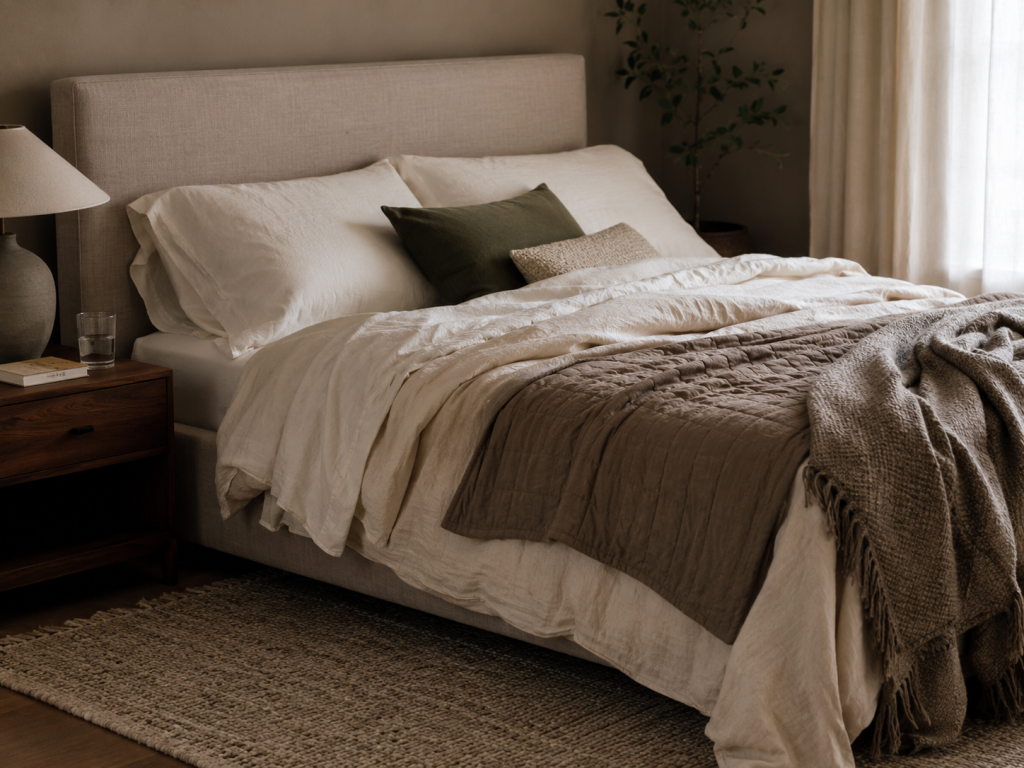
7. Layer the Bed Without Overstyling It
A modern bed should look inviting, not untouchable.
Instead of stacking endless decorative cushions, focus on the texture of the actual bedding.
A simple combination might be:
- cotton sheets
- linen duvet
- lightweight quilt
- one textured throw
- one or two accent cushions
The color palette can remain simple while the fabrics create depth.
Cream sheets, warm-white linen, a taupe quilt, and a deep olive cushion can feel polished without looking overly arranged.
Houzz’s current modern-bedroom guidance also stresses that modern rooms do not need every available area filled; leaving some visual breathing room can itself feel luxurious.
That applies to the bed too.

8. Try Color Drenching for a More Dramatic Modern Look
Modern does not automatically mean pale.
Color drenching can give a bedroom a much stronger identity while preserving visual simplicity.
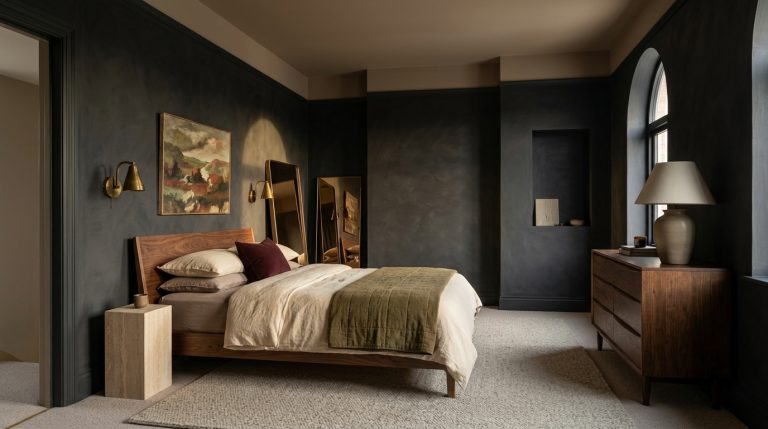
Instead of one colored accent wall surrounded by bright white trim, extend a related color across walls, trim, doors, and sometimes the ceiling.
Try:
- dusty olive
- warm taupe
- smoky blue
- chocolate
- muted burgundy
- clay
The 1stDibs 2026 trend survey identifies color drenching as an important current direction, alongside strong interest in burgundy and chocolate brown.
Because fewer abrupt color changes interrupt the room, the effect can actually feel calmer than using several contrasting shades.
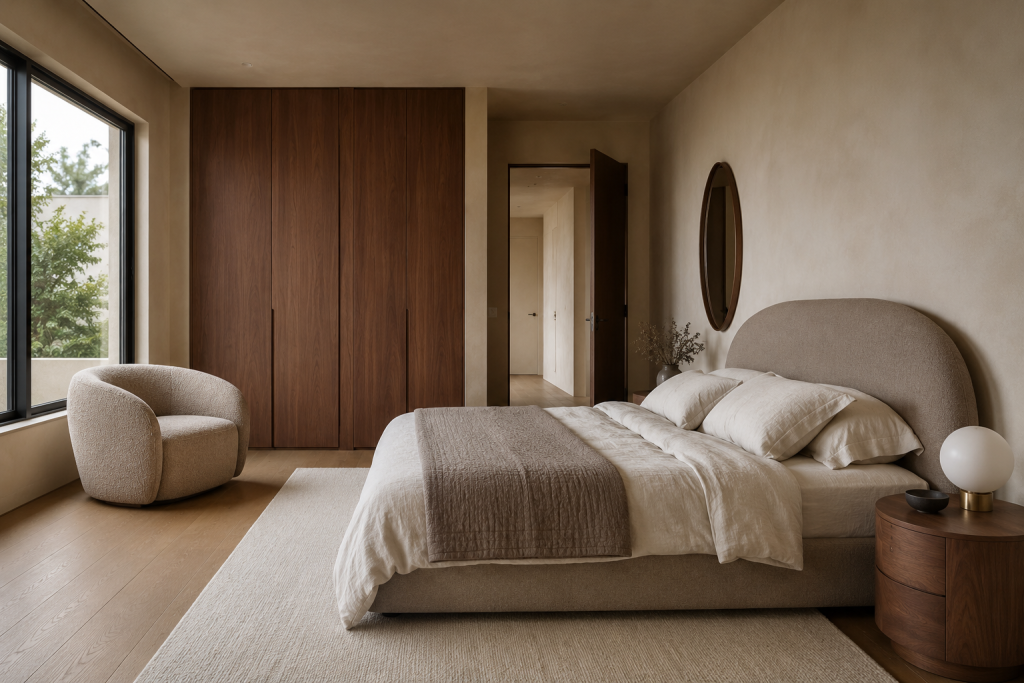
9. Add Curves to Balance Straight Architecture
Bedrooms naturally contain many straight lines.
Walls, doors, wardrobes, windows, bed frames, and rugs are usually rectangular.
One or two curved forms can soften the room.
Houzz’s 2026 home-design coverage points to curves, arches, and scalloped forms as continuing features of contemporary interiors, often alongside earthy shades and stained woods.
Try:
- rounded headboard
- oval mirror
- curved chair
- globe lamp
- round bedside table
- softly arched doorway detail
You do not need to make every object curved.
The contrast between straight architecture and one soft silhouette is what creates the effect.
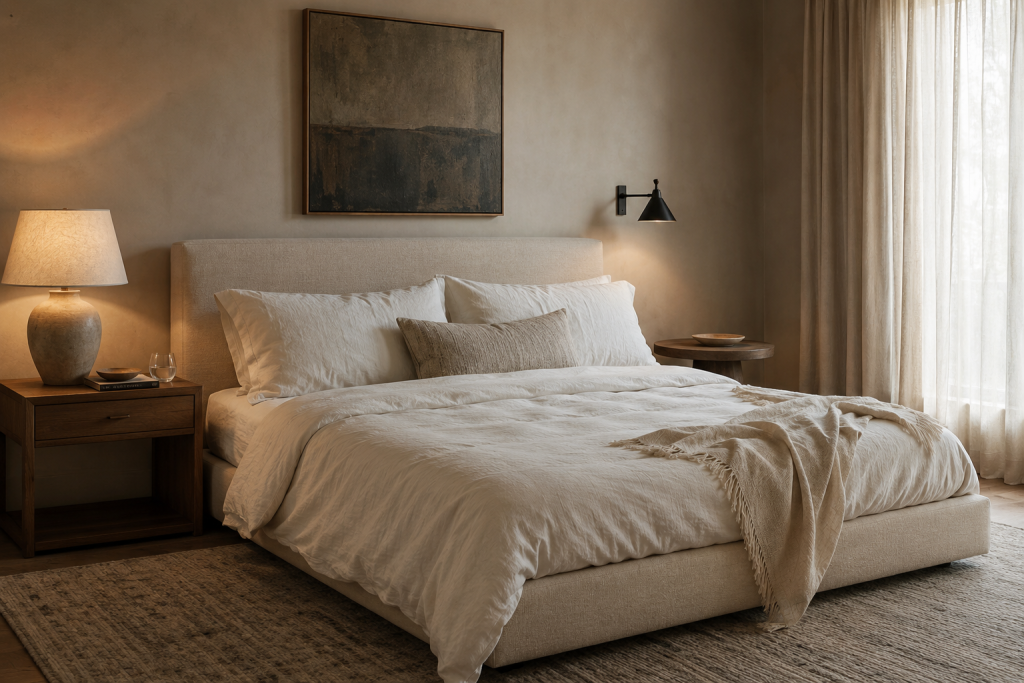
10. Build a Better Bedside Setup
Modern bedrooms benefit from fewer but more functional objects around the bed.
Each side does not necessarily need the traditional formula of matching nightstand, matching lamp, matching artwork.
Instead, ask what you actually need.
Perhaps one side has a drawer nightstand and lamp, while the other uses a simple round table with a wall-mounted sconce.
Keep the surface relatively clear.
A useful bedside arrangement might include:
- lamp
- book
- water
- small tray
- charging point hidden from view
The setup should look calm because it works well—not because nobody is allowed to use it.
11. Bring in One Vintage Piece
Modern furniture becomes more interesting when everything is not equally new.
One vintage dresser, chair, mirror, rug, or small table can prevent a modern bedroom from feeling like a complete furniture package.
The 1stDibs 2026 designer survey found continued strength in vintage sourcing, eclecticism, and organic modernism, suggesting that designers are increasingly comfortable blending eras rather than maintaining one rigid style.
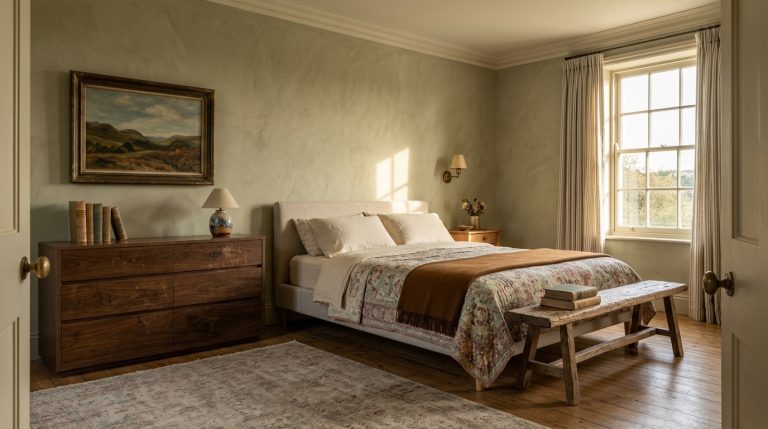
A vintage walnut dresser can work beautifully beside a simple upholstered bed.
An antique mirror can make an otherwise pared-back room more memorable.
The goal is not to create a vintage bedroom.
It is to add one element that gives the modern pieces more context.
12. Create a Soft Wall Behind the Bed
If paint alone feels too simple, use material rather than pattern to create interest behind the bed.
Ideas include:
- limewash
- textured plaster
- timber paneling
- upholstered panels
- subtle wallpaper
- vertical slatted wood
These treatments work particularly well in modern rooms because they introduce depth without requiring clutter.
Houzz’s 2026 trend reporting highlights tactile finishes, including plaster, stone, handmade surfaces, and textured wall treatments, as designers look for warmth and craftsmanship without always relying on bold pattern.
Keep the rest of the wall composition simple.
Texture works best when you can actually see it.
13. Give the Bedroom One Comfortable Chair
If space permits, a modern bedroom can benefit enormously from somewhere to sit that is not the bed.
Choose a chair based on comfort first.
It might be:
- compact lounge chair
- curved upholstered chair
- timber-and-leather chair
- simple armchair
- small bench beneath a window
Houzz’s modern-bedroom guidance notes that leaving unnecessary space open can feel luxurious, so do not force a chair into a room that cannot accommodate one comfortably.
But if you have the space, a chair can make the bedroom feel more complete and give you somewhere to read, put on shoes, or simply sit for a few minutes.
Just avoid turning it into permanent clothing storage.
14. Keep Technology Visually Quiet
A beautiful modern bedroom can quickly lose its sense of calm when charging cables, screens, extension cords, routers, and electronics dominate the surfaces.
Integrate technology instead of displaying it.
Use:
- concealed cable management
- chargers inside drawers where safe and appropriate
- minimal bedside electronics
- discreet television placement
- integrated lighting controls
Recent Architectural Digest reporting on the future of home design notes a broader movement toward technology that is increasingly concealed or seamlessly integrated, allowing tactile materials and calmer human-centered interiors to remain visually dominant.
The room should feel modern because it works intelligently—not because it looks like a technology store.
15. Finish With Something Personal
Modern design becomes forgettable when every decision is made purely in the name of visual cleanliness.
Keep something that could only belong to you.
It may be:
- original artwork
- favorite photograph
- travel object
- handmade ceramic
- vintage lamp
- collection of books
- textile with personal meaning
AD PRO’s 2026 forecast describes a broader move toward greater personality and self-expression in interiors rather than highly restrained, impersonal spaces.
That is particularly useful in a bedroom.
This is the most private room in your home. It should not feel as though it was designed for an imaginary buyer.
Modern does not mean anonymous.
What Makes a Bedroom Look Modern in 2026?
The clearest current version of modern bedroom design combines several ideas:
Clean lines.
Furniture is visually clear rather than overly ornamental.
Strong materials.
Wood, stone, linen, wool, and upholstery bring depth.
Intentional restraint.
The room contains what it needs without every wall and corner being filled.
Warmer color.
Modern bedrooms are moving comfortably beyond cold whites and grays.
Soft forms.
Curves and upholstered pieces balance architectural geometry.
Personal expression.
Art, vintage pieces, and meaningful objects keep the room individual.
Architectural Digest’s March 2026 bedroom guidance describes modern bedrooms through restraint, functionality, clean lines, materiality, and timelessness, while its broader 2026 forecast simultaneously shows contemporary interiors becoming more colorful and expressive.
The two ideas are not contradictory.
Modern design can be restrained without being sterile.
Modern Bedroom Colors Worth Trying
If you want a room that feels current but not excessively trend-driven, build the palette around one grounded shade and one or two supporting colors.
Try:
Cream + walnut + olive
Warm, natural, and easy to live with.
Mushroom + ivory + chocolate
Quiet but sophisticated.
Dusty blue + warm white + oak
Cleaner and slightly cooler without feeling clinical.
Taupe + burgundy + cream
A richer contemporary combination.
Soft clay + walnut + oatmeal
Earthy and relaxed.
Olive + dark bronze + linen
Especially effective with warm natural light.
Current 2026 forecasting supports a wider range of earthy and expressive shades than the narrow neutral palettes associated with recent minimalism.
What Does 2027 Suggest for Modern Bedrooms?
It is too early to treat 2027 forecasts as established design trends, but current color forecasting points toward more freedom rather than one dominant aesthetic.
Sherwin-Williams’ Rewild Colormix Forecast for 2027 includes 48 shades designed to work in many combinations rather than prescribing a fixed palette. Its accompanying designer project emphasizes intuitive, individual color choices over overly structured or algorithmic-looking interiors.
For the bedroom, that supports a useful long-term approach:
Keep the expensive foundation flexible, then personalize through paint, bedding, artwork, upholstery, and smaller furniture.
Your room can evolve without needing a complete redesign.
Modern Bedroom Mistakes to Avoid
Making the bedroom too cold
Clean lines need warmth from wood, fabric, lighting, or color.
Buying an entire matching bedroom set
Modern rooms often feel stronger when furniture coordinates without being identical.
Using too many statement pieces
One large headboard or sculptural light is powerful. Five competing focal points are distracting.
Ignoring bedside function
The bedroom needs practical lighting, charging, storage, and surfaces.
Overloading the bed with cushions
Modern styling should still be convenient to live with.
Making everything beige
Neutral does not automatically mean sophisticated. Use contrast, wood, texture, or controlled color.
Following trends too literally
The most successful modern bedrooms use current ideas selectively instead of recreating a trend report in full.
Frequently Asked Questions
What is modern bedroom style?
Modern bedroom style typically emphasizes clean lines, intentional furniture, uncluttered layouts, practical function, and strong materials. Current 2026 interpretations are also warmer and more expressive, often using wood, upholstery, richer colors, texture, and vintage accents.
What colors are modern for bedrooms in 2026?
Warm neutrals remain useful, but current designer forecasting also favors chocolate brown, burgundy, olive, softer blues, and other more expressive colors.
How can I modernize my bedroom without replacing the furniture?
Start with paint, lighting, bedding, curtain placement, artwork, and reducing unnecessary clutter. You can also replace small details such as lamps, handles, or bedside tables before changing the major furniture.
Are upholstered beds still modern?
Yes. Architectural Digest’s August 2026 guide highlights upholstered beds across minimalist and more expressive contemporary styles, particularly in linen, cotton, bouclé, velvet, and performance fabrics.
Can a modern bedroom include vintage furniture?
Absolutely. Current designer research shows continued interest in vintage pieces, eclecticism, and organic modernism, making old-and-new combinations especially relevant.
Final Thoughts
The best modern bedroom ideas are not about making the room look as new as possible.
They are about making it feel intentional.
Start with a bed that anchors the room. Introduce wood, stone, linen, wool, or upholstery so the space has material depth. Use color confidently but selectively. Let one sculptural object make a statement instead of decorating every surface.
Then soften the design with something personal.
The most interesting shift in modern bedrooms in 2026 is that clean design and character are no longer being treated as opposites. Current professional guidance still values restraint and function, but the wider design conversation is simultaneously embracing richer colors, vintage pieces, tactile materials, oversized headboards, and stronger individual expression.
That creates a much better kind of modern bedroom:
one that looks considered when you first walk in, feels comfortable when you actually live in it, and still has enough personality to feel unmistakably yours.