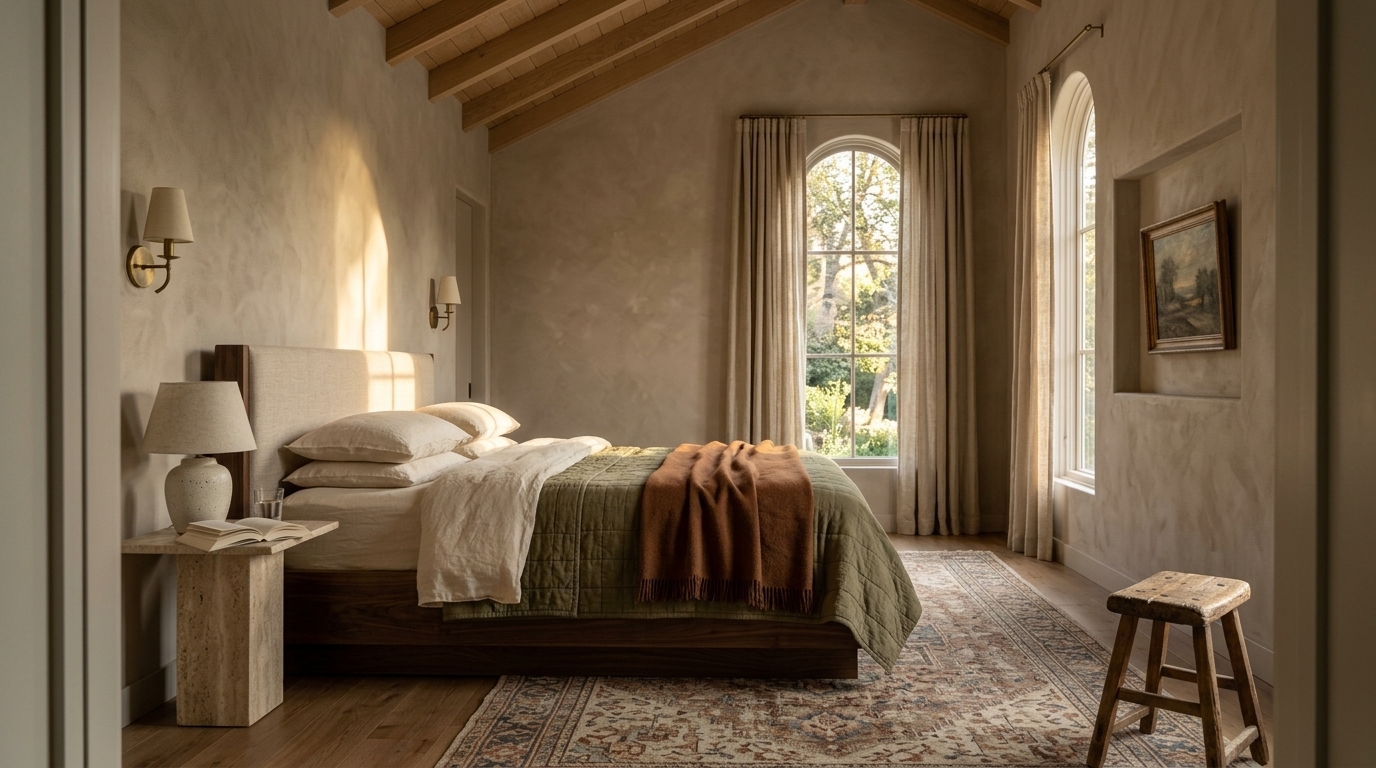
15 Earthy Bedroom Ideas for a Warm, Grounded Retreat
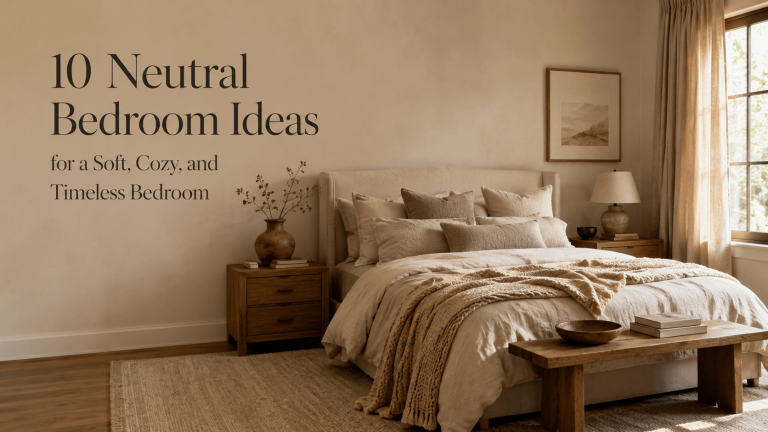
An earthy bedroom can still feel surprisingly cold. The problem usually appears when “earthy” gets translated into beige walls, a jute rug, pale oak furniture, and several cream cushions. Every ingredient sounds natural, yet the room has almost no contrast.
The stronger 15 earthy bedroom ideas for 2026 go further into nature. Think clay, tobacco, olive, mushroom, chocolate, dusty rose, dark wood, linen, wool, ceramic, stone, and finishes that show grain or imperfection, in the same spirit as these neutral bedroom ideas. Current designers are moving beyond flat earth-tone neutrals toward what Homes & Gardens calls “earthy vibrancy,” where richer reds, greens, ochres, and browns give nature-inspired rooms more personality.
The room should feel grounded, but it does not need to disappear into beige.
Build the palette from soil, plants, and stone

Idea 1: Use mushroom instead of basic beige
Mushroom is one of the easiest earthy neutrals to live with because it sits somewhere between brown, taupe, and gray.
Choose a version with enough warmth to relate to wood flooring and natural fibers. Pair it with walnut, olive, warm ivory, and a small amount of rust.
Current 2026 bedroom palettes favor creamy taupes, clay-based beiges, caramel, and chalky off-whites over cooler flat neutrals.
Test paint on a large board first. Mushroom can turn noticeably gray beside cool flooring or unexpectedly pink under warm artificial light.

Idea 2: Bring terracotta onto the walls
Terracotta gives an earthy bedroom more life than beige while remaining connected to natural materials.
Look beyond bright orange. Plaster pink, clay, faded brick, burnt peach, and muted terracotta can all work.
Homes & Gardens reports that richer pink and terracotta undertones are increasingly replacing conventional gray-beige bedroom neutrals in 2026.
A terracotta room works particularly well with cream linen, walnut, dusty blue, and aged brass.
If full walls feel too strong, use clay-colored paneling or paint the wall behind the bed while keeping the remaining surfaces warm ivory.
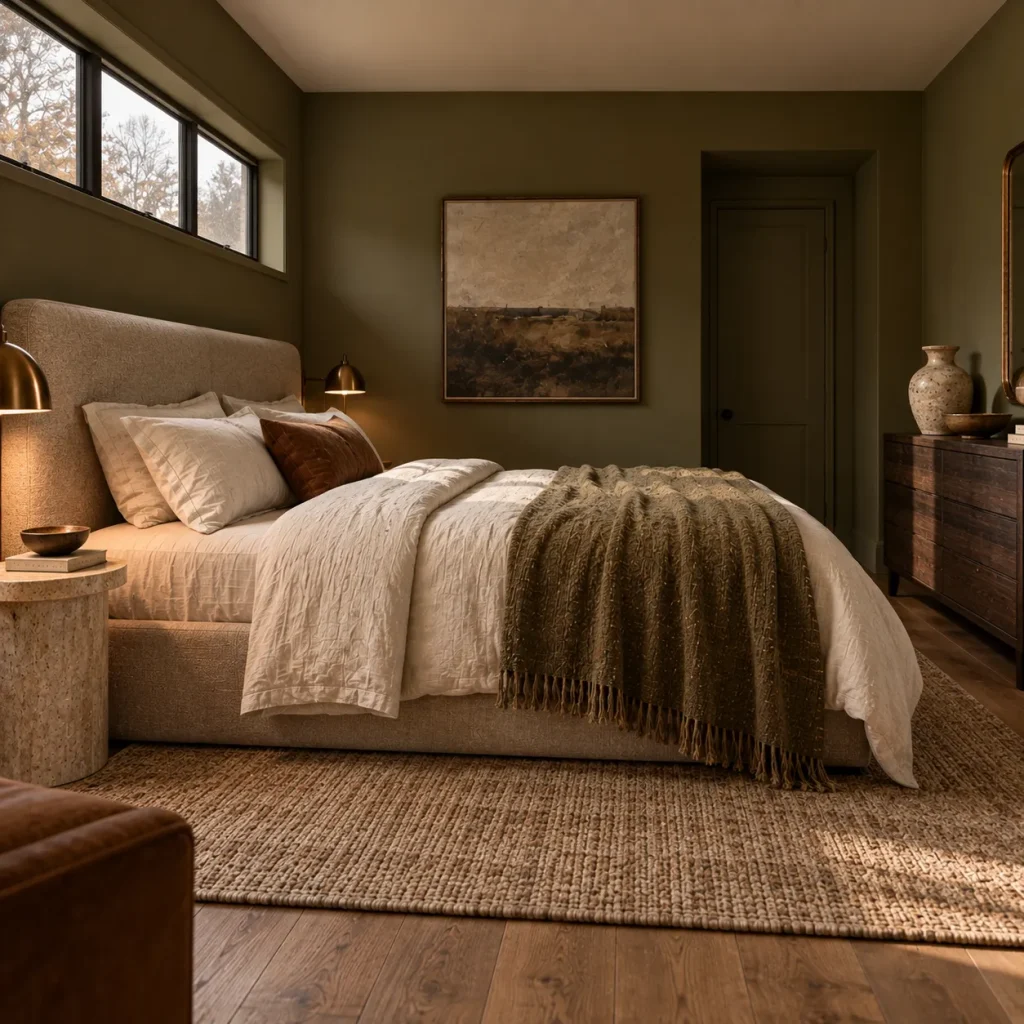
Idea 3: Use olive or moss as an earthy neutral
Green does not have to behave like an accent color.
Muted olive, moss, lichen, and deeper forest tones can function almost like brown in a bedroom. They work naturally beside walnut, oak, tobacco leather, linen, and stone.
For 2026, designers are moving toward deeper earthy greens rather than relying only on pale sage.
Try olive walls with oatmeal bedding and a walnut headboard. Or keep the walls mushroom and introduce moss through curtains, an upholstered bench, or a wool blanket.
Let brown become a real color
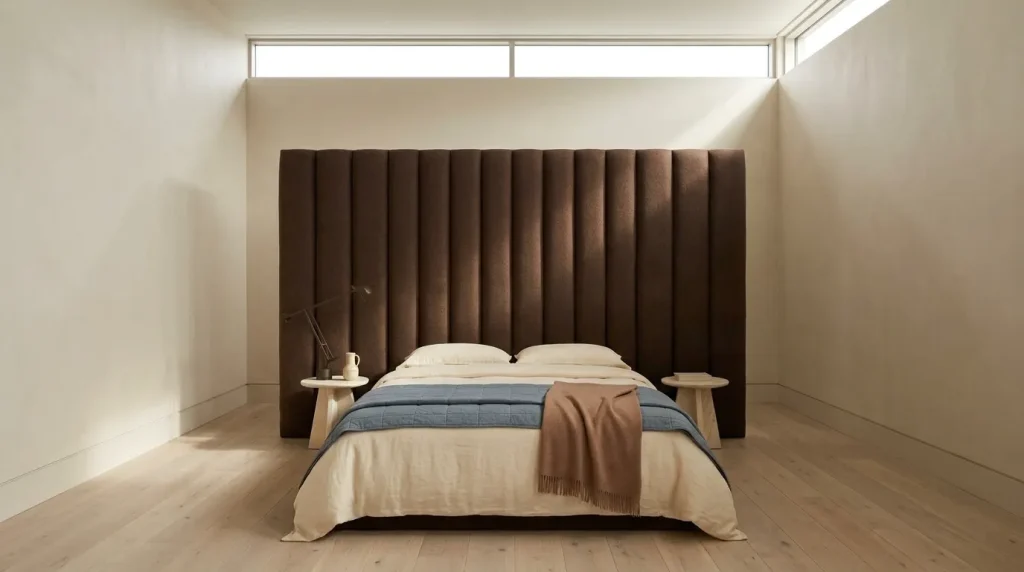
Idea 4: Anchor the room with chocolate brown
Brown is one of the most useful bedroom colors because it can make pale neutrals feel warmer without creating the hardness of black.
Try a chocolate upholstered bed, espresso dresser, brown-painted ceiling, or deep tobacco throw.
The 2026 shift toward richer color includes espresso brown and chocolate paired with shades such as periwinkle, dusty green, and terracotta.
One substantial dark brown element is often enough. If everything is cream, add a chocolate headboard before buying another beige accessory. That single contrast may solve the room.
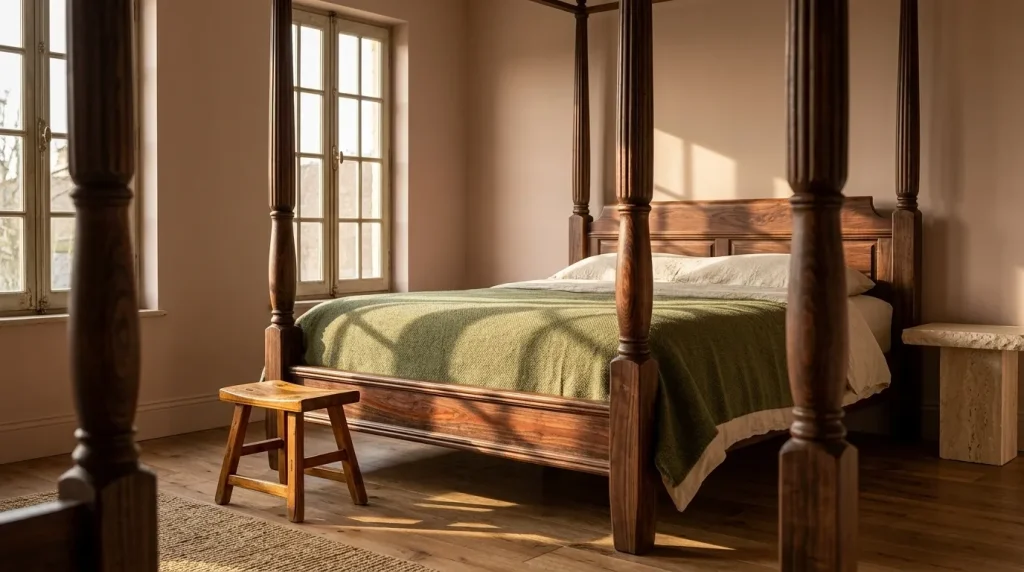
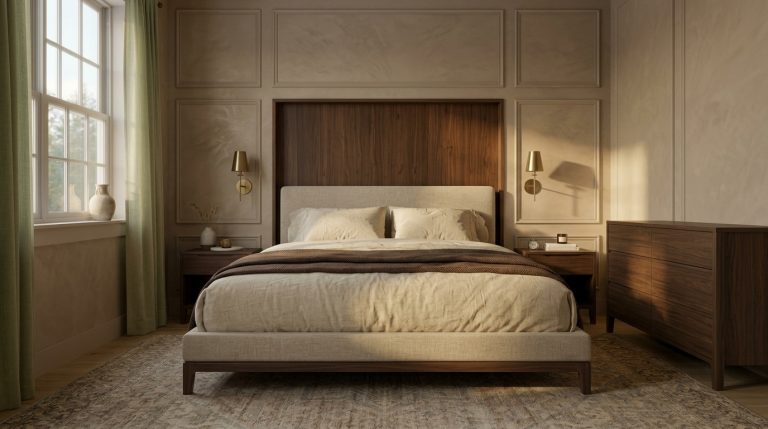
Idea 5: Choose walnut or dark oak instead of all pale wood
Light oak is still useful, but earthy bedrooms do not need to stay blond.
Walnut, smoked oak, dark-stained timber, and espresso oak provide visual weight and bring out the warmth in clay, olive, and mushroom, echoing the same warm-wood direction found in these rustic bedroom ideas.
Dark woods are one of the strongest furniture shifts designers are reporting for 2026, with walnut, ebonized ash, burl, and naturally varied finishes replacing some of the uniform pale oak of recent years.
Do not match the bed, dresser, and nightstands exactly. A walnut bed can sit beside medium oak flooring and an old pine stool if their undertones feel compatible.
Make natural materials noticeably different

Idea 6: Combine linen, wool, cotton, and wood
An earthy bedroom needs tactile variety more than decorative quantity.
Try washed linen curtains, crisp cotton sheets, a wool rug, and a wooden bed. Each material reacts to light differently, so even a quiet palette develops depth.
Architectural Digest’s 2026 bedroom guidance recommends layering natural materials such as cotton, linen, wool, and wood to add warmth without introducing unnecessary clutter.
Avoid making everything nubby. A bouclé bed, shaggy rug, chunky blanket, and fuzzy cushions can actually flatten the material story because all the surfaces behave similarly. Pair rough with smooth. This kind of tactile, uncluttered layering is also central to these organic modern bedroom tips.
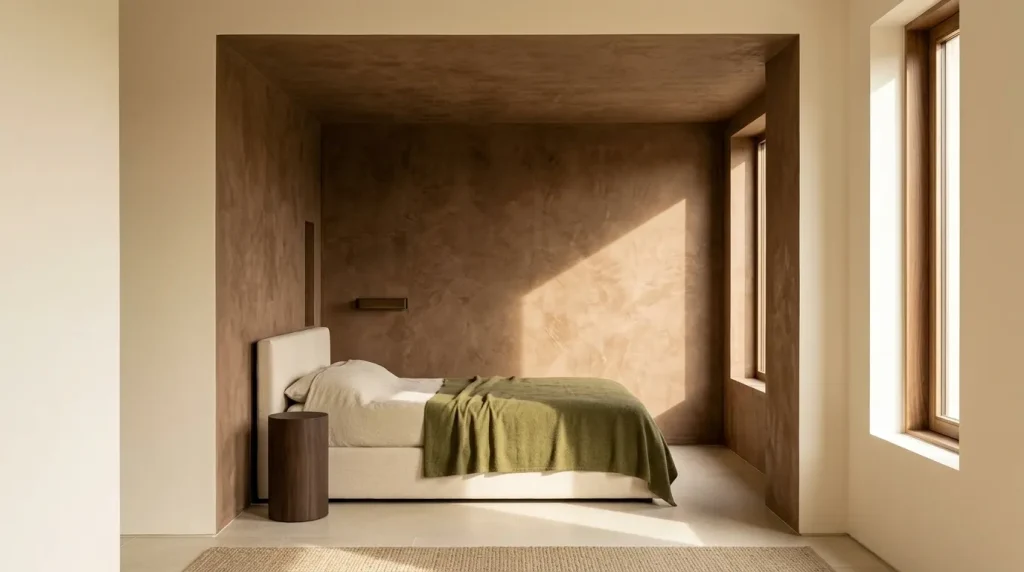
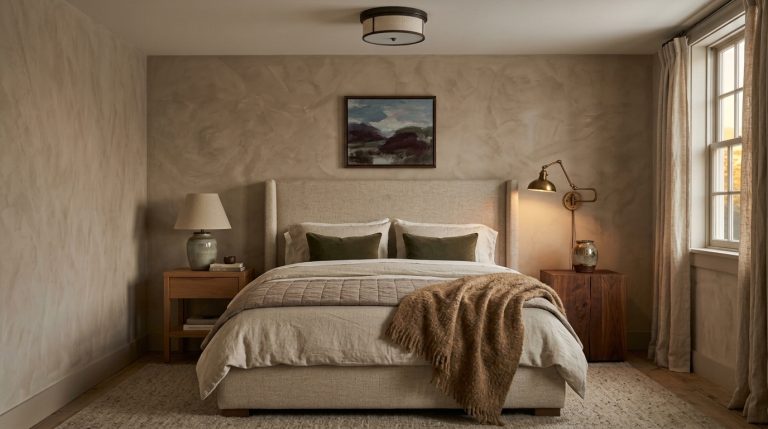
Idea 7: Add clay, plaster, or limewash texture
Earthy style becomes much more convincing when the walls themselves have some mineral character.
Limewash, Roman clay, plaster-style finishes, or subtly uneven matte paint create changing shadows instead of a perfectly flat surface.
A recent Architectural Digest project used waxed clay lime plaster alongside antique furnishings and naturally imperfect materials to create rooms that felt warm and lived-in.
You do not need specialty plaster everywhere. One wall or alcove can be enough, particularly if the rest of the bedroom contains strong wood grain and textiles.
Make the bed feel relaxed rather than overstyled
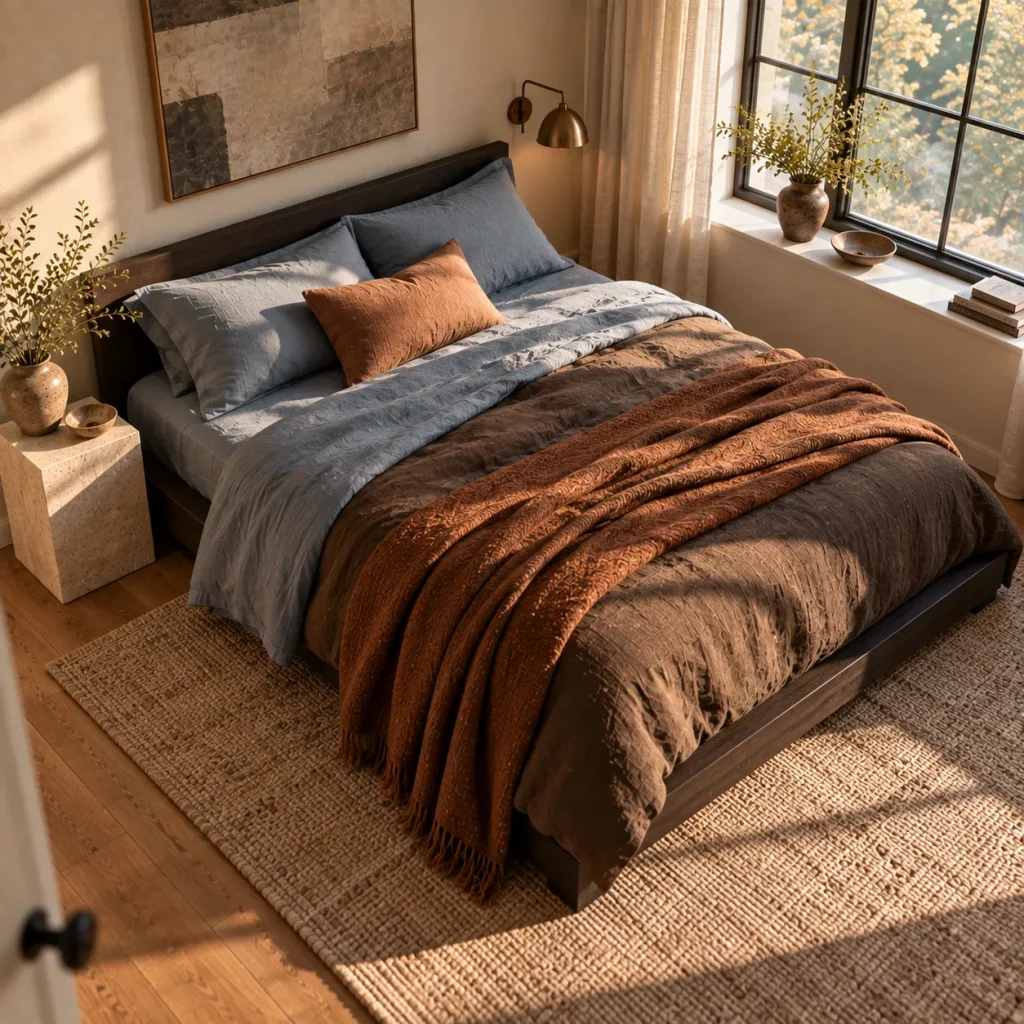
Idea 8: Layer bedding through earthy tones
Instead of buying an entire matching bedding set, build the bed from several related colors.
Try warm ivory sheets with a mushroom duvet and tobacco wool throw. Or clay bedding with an oatmeal quilt and olive cushion. Or dusty blue sheets with a chocolate coverlet and rust blanket.
Keep at least one layer noticeably lighter or darker than the others.
The current bedroom mood is warmer and more expressive, with designers favoring deeper neutrals, tactile bedding, and stronger contrasts over flat pale schemes.
Two or three useful pillows usually look better than an elaborate stack that ends up on the floor.

Idea 9: Choose a substantial natural-fabric headboard
A linen, cotton, wool-blend, or velvet headboard can soften all the harder materials in an earthy room.
Consider oatmeal, tobacco, olive, warm taupe, dusty rose, or deep brown.
If the bedroom is small, choose height over depth. A tall slim headboard gives the bed presence without eating into circulation.
And do not assume an earthy bedroom requires a wooden bed. That is one of the more useful contradictions in this style. An upholstered bed can make the walnut dresser, ceramic lamps, and woven rug around it appear more distinct.
Give the floor more visual weight
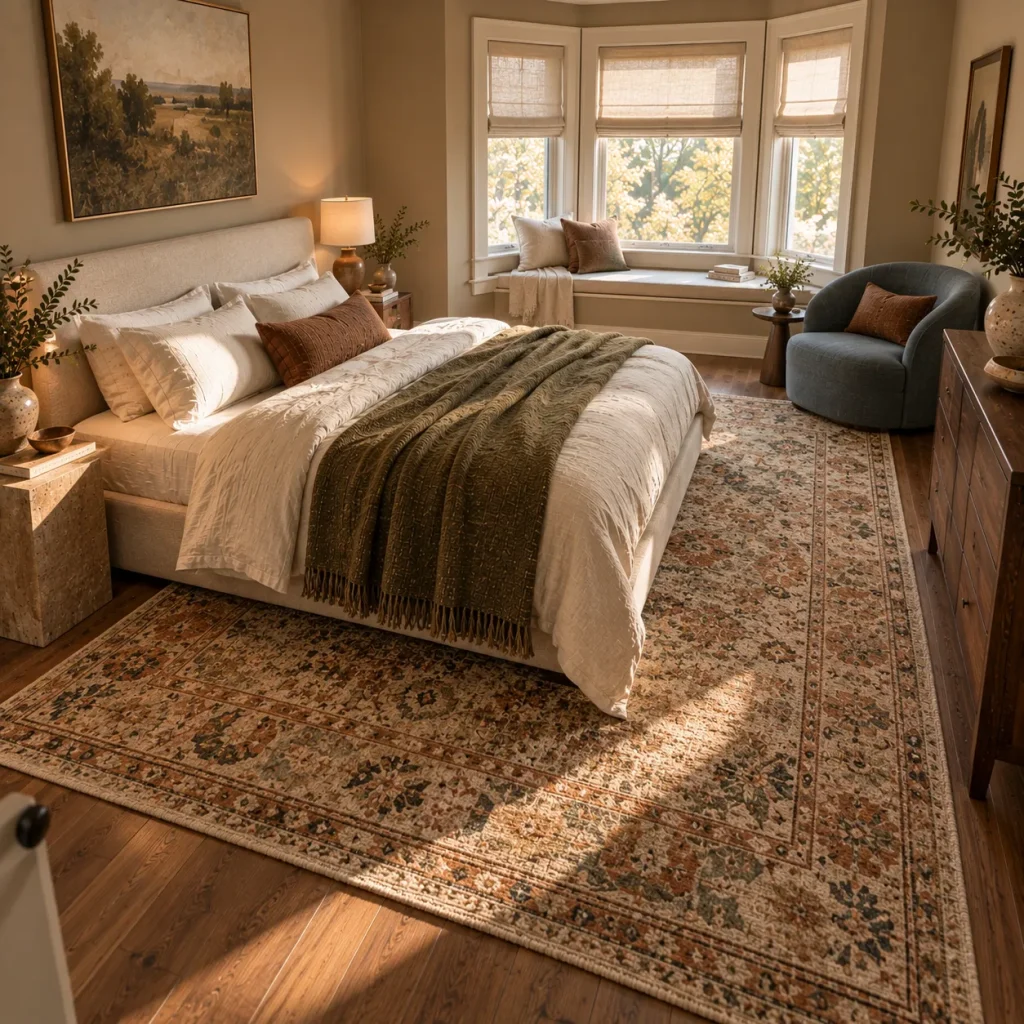
Idea 10: Use a larger wool rug
A tiny jute rug beside the bed rarely makes an earthy room feel more grounded.
Where space permits, use one larger rug that connects the bed and surrounding furniture.
For a queen bed, an 8-by-10-foot rug is often a useful starting point. For a king, 9-by-12 may provide better coverage. Exact dimensions depend on the room.
Wool is particularly useful because it adds warmth without needing a loud pattern. Try tobacco, oatmeal, faded rust, olive, or a vintage-style pattern containing several earth tones.
If the room already contains a lot of brown wood, choose a rug with some cream, dusty blue, or muted red so the floor does not become one brown mass.
Use stone and ceramic to break up all the softness
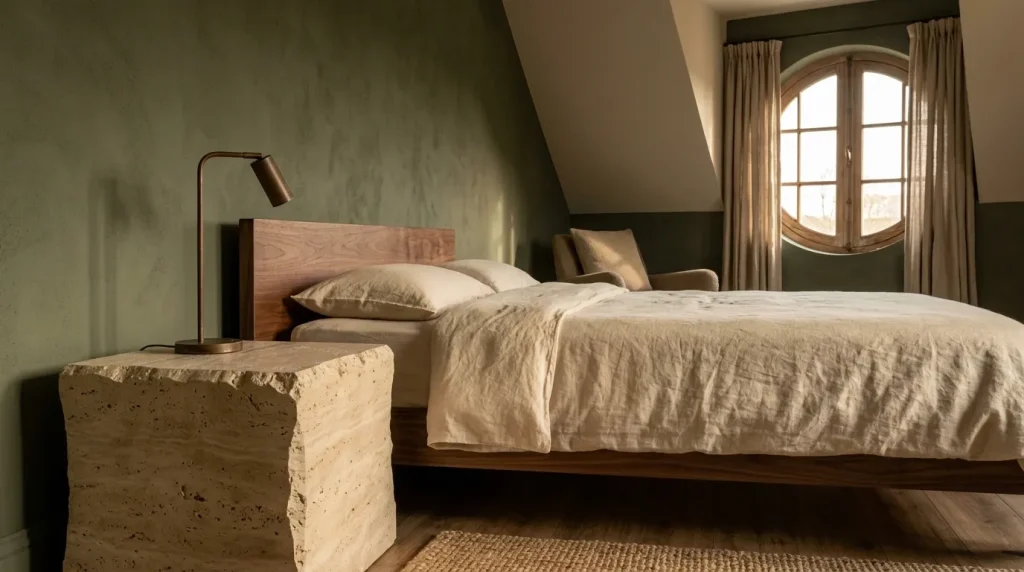
Idea 11: Add one stone surface
Wood and textile are obvious choices, but earthy rooms become richer when you introduce mineral material.
Consider a travertine nightstand, limestone lamp, marble-topped dresser, stone tray, or small side table.
You only need one or two pieces.
Current 2026 interiors are increasingly pairing dark woods with plaster and stone, using contrast between raw and polished surfaces rather than repeating the same material throughout a room.
A rough limestone lamp on a smooth walnut table is often more interesting than another woven basket.
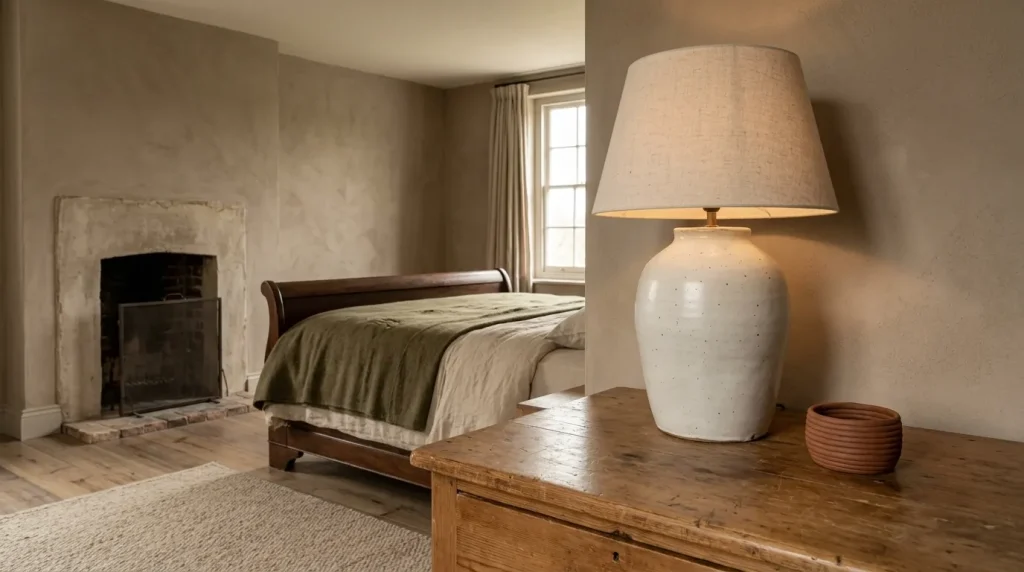
Idea 12: Choose handmade-looking ceramics
Ceramic lamps, vases, bowls, and vessels are natural partners for an earthy palette because subtle irregularity gives the room character.
Look for stoneware, speckled clay, matte glazes, or softly uneven handmade finishes.
You do not need to fill open shelves with pottery. One substantial lamp and one smaller vessel may be enough.
I once worked through an illustrative bedroom filled with woven baskets, jute, rattan, and pale wood because every item was technically “natural.” Replacing several woven pieces with two ceramic objects made the remaining fibers much more noticeable.
Earthy does not mean everything has to be woven.
Use stronger earth colors as accents
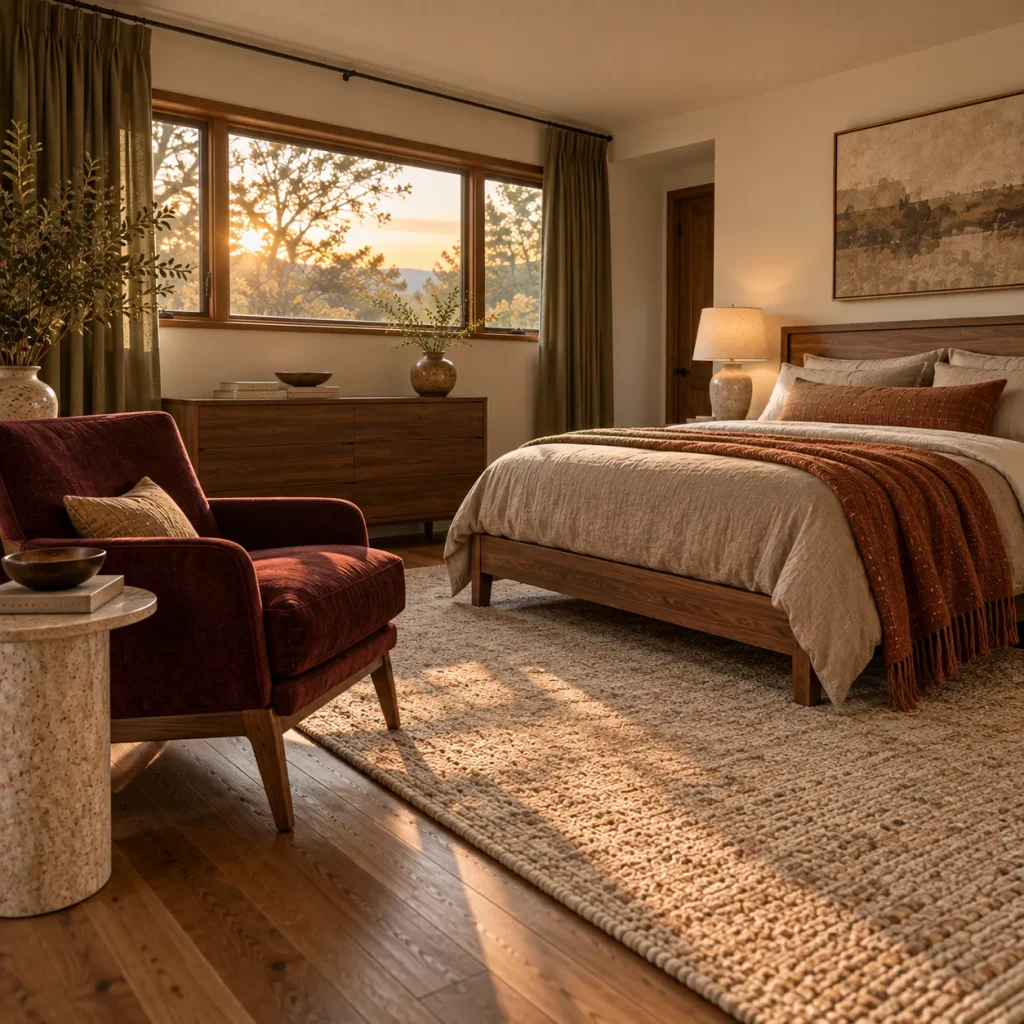
Idea 13: Add oxblood, rust, or dusty rose
Nature is not just beige and green.
Rust, oxblood, clay pink, burgundy, faded red, and dusty rose can keep an earthy bedroom from becoming muddy.
Use these deeper colors in smaller doses. A rust wool blanket over mushroom bedding can be enough. So can an oxblood chair against warm ivory walls.
This richer approach closely matches the 2026 “earthy vibrancy” direction, which combines natural color with greater saturation and personality rather than treating earth tones as muted neutrals only.
Build warmth through evening light
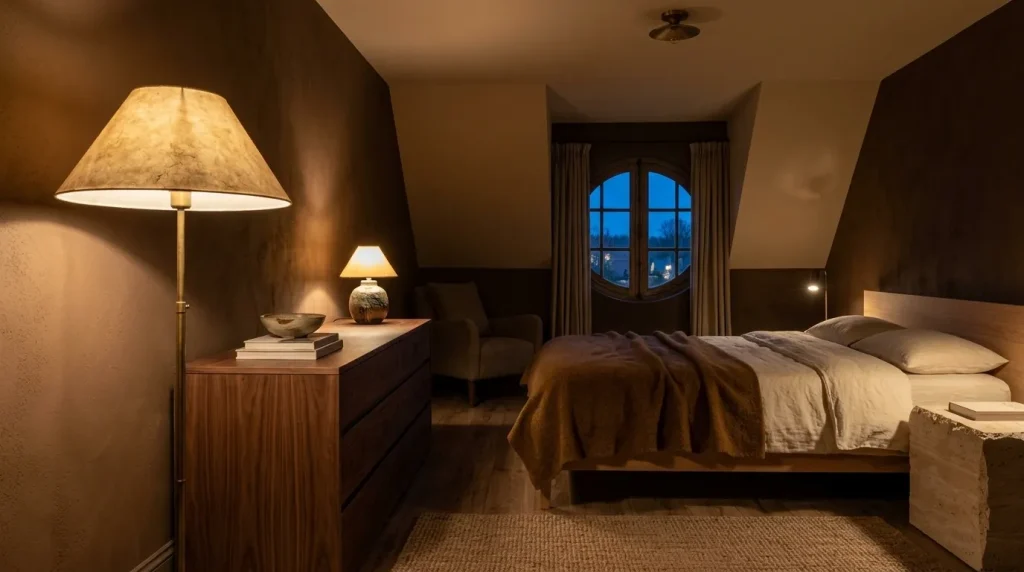
Idea 14: Use several low light sources
Earthy rooms are highly dependent on light because materials such as plaster, walnut, wool, and linen reveal themselves through shadow.
Do not rely on one ceiling light. Use bedside lamps or sconces for reading, a ceiling fixture for general illumination, and perhaps a smaller dresser or floor lamp.
Fabric, parchment, ceramic, or woven shades work particularly well.
Keep the bulb temperatures reasonably consistent. A cold overhead bulb can make clay walls look dull and warm wood strangely orange. One sculptural lamp is enough. Every light fixture does not need to compete for attention.
Add something that did not come from a coordinated collection
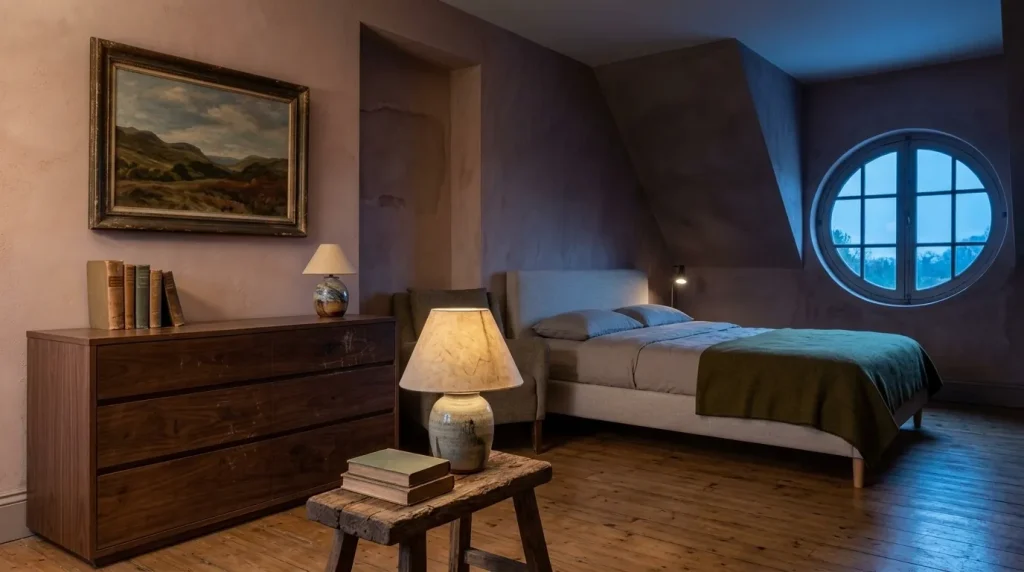
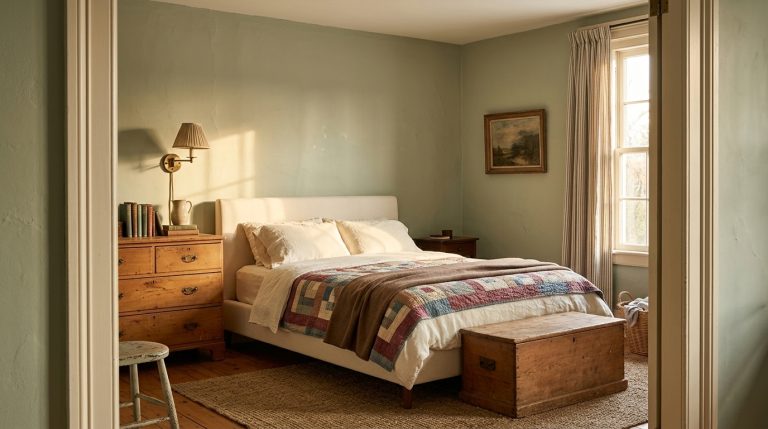
Idea 15: Finish with vintage art or an imperfect object
Earthy bedrooms become far more believable when something has age or visible irregularity.
Try an old wooden stool, vintage landscape, antique chest, handmade ceramic lamp, weathered bowl, old books, or framed textile.
Designed imperfection and visible patina are becoming increasingly important in 2026 interiors as designers move away from rooms that feel overly manufactured or digitally perfect, a quality that also runs through these sage green farmhouse bedroom ideas.
Do not decorate every surface afterward. A dresser with a lamp, a few books, and one ceramic bowl may feel more grounded than a perfectly styled collection of seven neutral accessories.
A practical earthy bedroom palette guide
| Main color | Supporting shade | Best material partner |
|---|---|---|
| Mushroom | Olive | Walnut |
| Terracotta | Warm ivory | Linen |
| Chocolate | Dusty blue | Wool |
| Moss green | Tobacco | Aged oak |
| Clay pink | Burgundy | Dark wood |
| Oatmeal | Rust | Stone |
| Warm taupe | Deep green | Ceramic |
Use these as starting relationships rather than fixed palettes. Your flooring, daylight, and existing furniture should decide which direction works best.
What should you skip in an earthy bedroom?
Beige on every surface. Earthy does not mean monochrome sand. Add brown, green, clay, rust, or dusty blue.
Too much rattan and jute. These materials can work, but using them everywhere quickly turns an earthy bedroom into a generic “natural decor” formula.
Matching pale wood furniture. Mixing walnut, oak, painted finishes, and vintage pieces usually creates more depth.
Fake plants as the main connection to nature. Color, wood, stone, cotton, wool, and daylight can make the room feel grounded without covering it in artificial greenery.
Cold white lighting. It can undermine the warmth you worked to create through paint and materials.
Try this if your bedroom is already beige
Keep the beige if the undertone works.
First, add one darker natural anchor, preferably walnut, chocolate, olive, or tobacco.
Next, replace one synthetic-looking or overly pale textile with linen or wool.
Introduce a mineral surface through a ceramic lamp, stone tray, or plaster-style wall treatment.
Then add one richer accent such as rust, dusty rose, or burgundy.
Finally, remove several small neutral accessories.
A beige room often needs contrast more than it needs another layer of decoration.
FAQ
What colors work best for an earthy bedroom?
Mushroom, terracotta, olive, moss, chocolate brown, tobacco, warm ivory, clay pink, rust, and muted blue all work well. The strongest palettes combine one warm neutral with a deeper natural color and some lighter contrast.
Are earthy bedrooms still popular in 2026?
Yes, but earthy decorating is becoming richer. Current design coverage favors deeper greens, dark woods, terracotta, chocolate, warm neutrals, natural materials, and more vibrant earth-inspired accents rather than flat beige-only rooms.
How do I make an earthy bedroom look expensive?
Focus on material contrast and proportion rather than buying more accessories. A properly scaled wool rug, linen curtains, dark wood, one stone or ceramic element, and good lighting often look more considered than many small decorative objects.
Can an earthy bedroom include blue?
Absolutely. Dusty blue, slate blue, and smoky blue can provide useful contrast to terracotta, walnut, rust, and warm beige. Natural landscapes contain cool colors as well as warm ones.
Make earth tones feel alive
The best 15 earthy bedroom ideas are not about making everything brown, green, and beige.
Start with one grounded color, then build contrast through materials. Put smooth walnut beside rough linen. Let terracotta meet dusty blue. Pair olive with warm ivory. Add stone or ceramic where the room has too much fabric.
If you make one change first, identify the flattest area of the bedroom. It may be an all-beige bed, matching pale furniture, or a wall with no depth.
Change that one surface rather than adding more accessories.
An earthy bedroom should feel connected to nature because the colors, textures, and materials have variation. Real landscapes are never one shade of beige, and your bedroom does not need to be either.