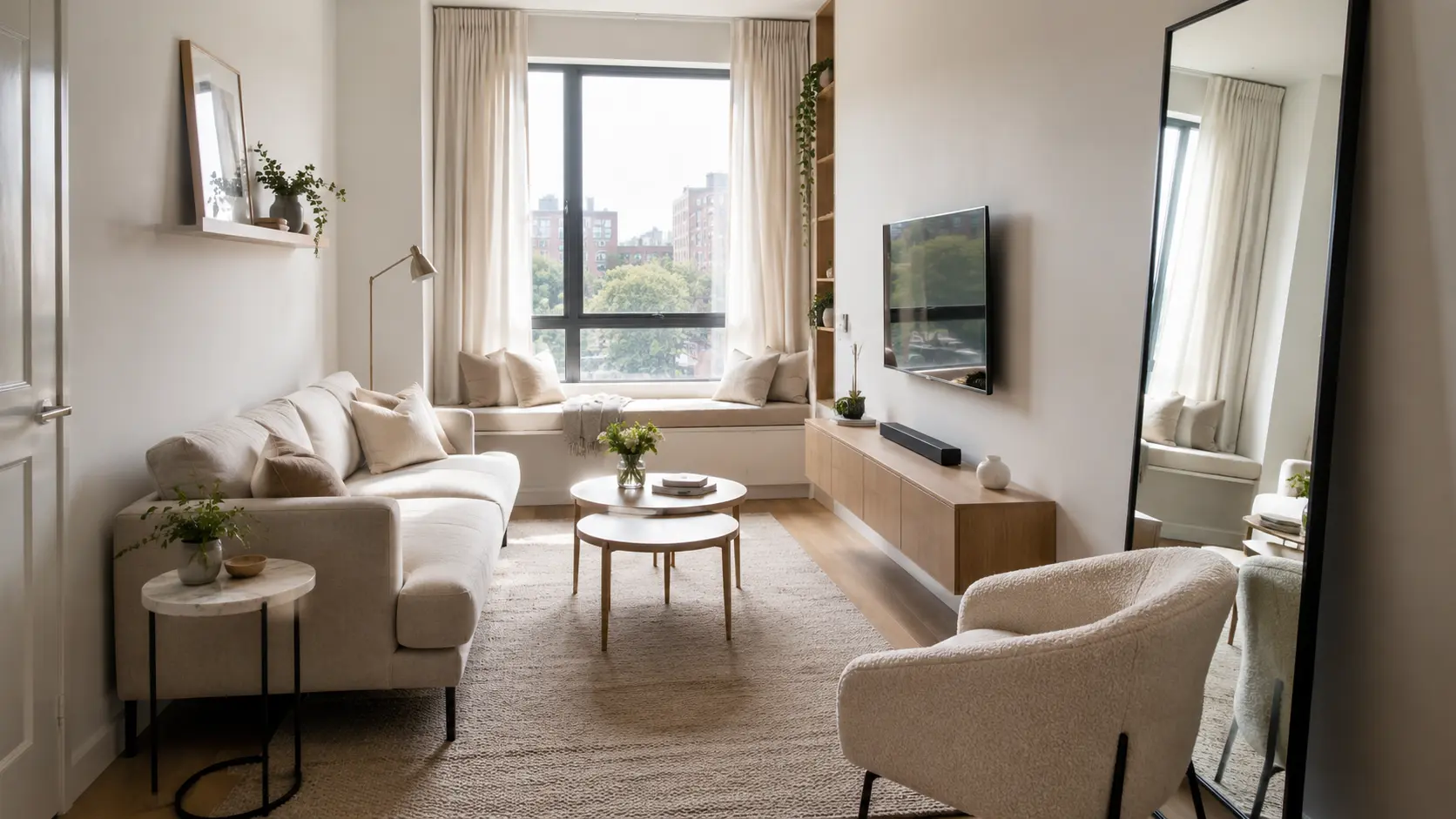
17 Small Living Room Ideas That Make Any Space Look Bigger, Brighter, and More Beautiful
A small living room does not need to feel cramped.
In fact, compact rooms can be some of the most inviting spaces in a home because they encourage more thoughtful choices. When the furniture fits properly, the lighting is layered, storage is controlled, and the eye can move easily around the room, even a modest living area can feel surprisingly open.
The biggest mistake is assuming that making a small living room look bigger requires filling it with tiny furniture and painting everything bright white. Current designer advice is much more nuanced. Architectural Digest recommends strategies such as appropriately scaled furniture, mirrors, vertical elements, integrated storage, and consistent color to visually expand compact rooms. Houzz similarly emphasizes storage, restrained decorating, and making the most of existing architectural features.
The goal is not to disguise the fact that your living room is small.
It is to make every inch feel intentional.
Here are 17 small living room ideas that can help your space look bigger while remaining warm, comfortable, and practical.
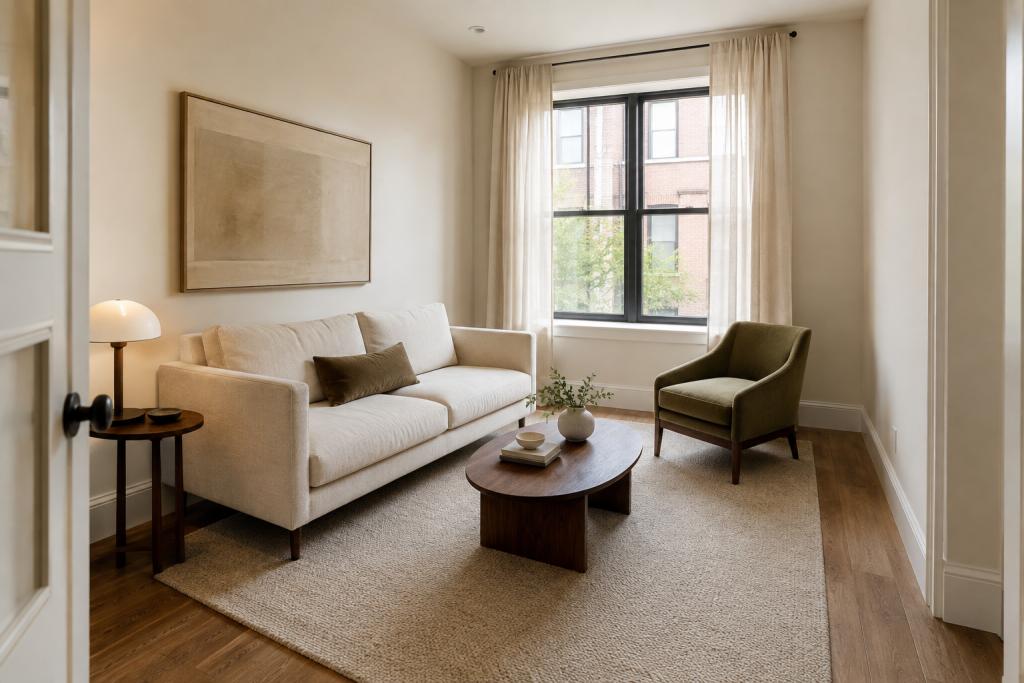
1. Start With the Right Furniture Scale
Small room does not automatically mean tiny furniture.
Several undersized pieces can actually make a living room feel more crowded because they create additional legs, edges, and gaps for the eye to process.
Instead, choose fewer pieces with proportions that suit the room.
A properly sized sofa, one comfortable chair, a coffee table, and a useful side table may work better than a miniature sofa surrounded by several small chairs and tables.
Measure before buying.
Mark the sofa dimensions on the floor with removable tape and check:
- walking routes
- door clearance
- window access
- distance from the coffee table
- relationship with the rug
- whether drawers and cabinets can open
A small living room feels larger when the furniture appears to belong there rather than being squeezed into it.
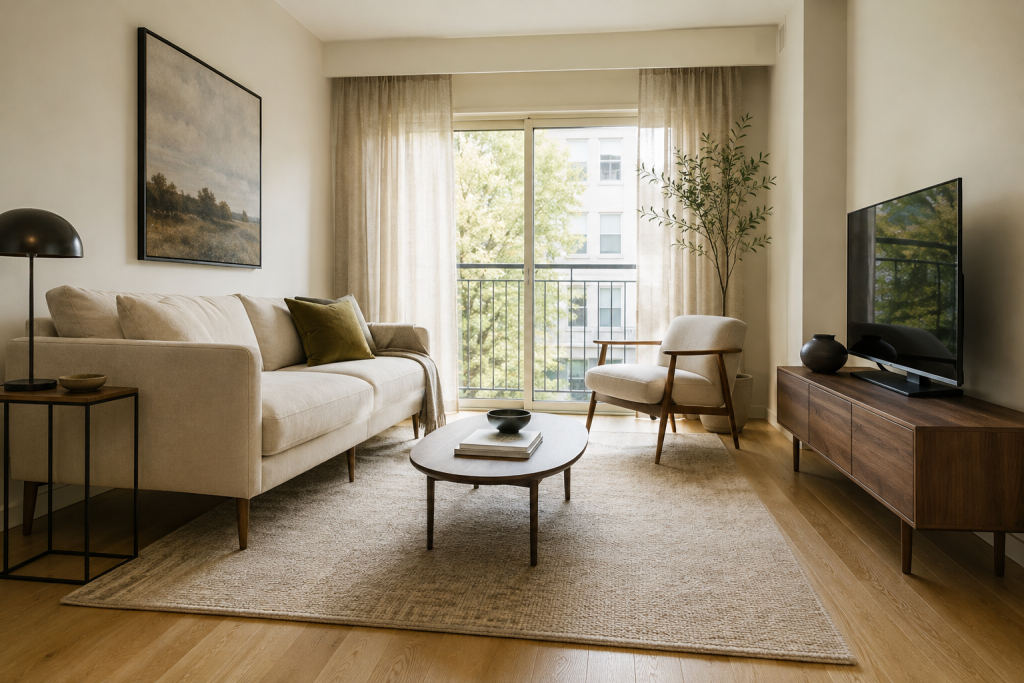
2. Choose Furniture With Visible Legs
One of the most useful 2026 designer tricks for compact rooms is surprisingly simple: let more of the floor remain visible.
Architectural Digest recently highlighted furniture raised slightly on legs as a way to make small interiors feel more expansive. When a sofa, chair, or cabinet is lifted from the floor, light and sightlines continue underneath it rather than stopping at a solid block of furniture.
Consider:
- sofas with exposed legs
- slim-legged armchairs
- raised media cabinets
- side tables with open bases
- benches rather than bulky storage cubes
You do not need every piece to float above the floor.
One or two visually lighter pieces can be enough to make the room feel less heavy.
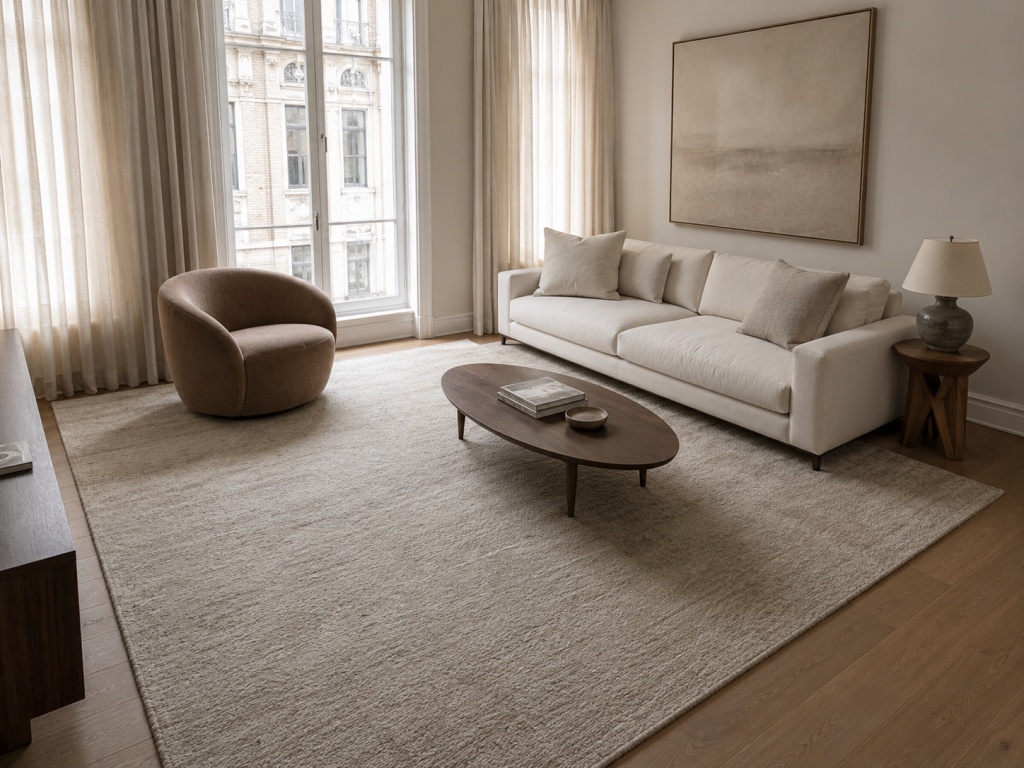
3. Use One Large Rug Instead of a Tiny One
A small rug can visually shrink a room because it creates another small rectangle inside an already compact space.
A larger rug helps connect the furniture and creates one continuous seating area.
Ideally, the front legs of the sofa and chairs should sit on the rug. This makes the arrangement feel like one composition rather than several separate pieces.
Choose something with:
- subtle texture
- low-contrast pattern
- soft tonal variation
- a palette related to the flooring
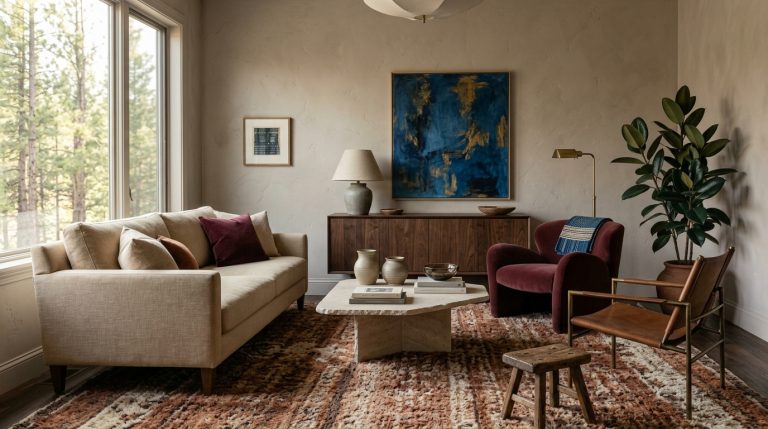
A pale rug is not mandatory. Vintage-inspired patterns and deeper colors can work beautifully if they relate to the rest of the room.
What matters most is scale.

4. Hang Curtains Close to the Ceiling
When floor space is limited, use the height of the room.
Architectural Digest’s 2026 designer guidance on vertical design recommends mounting drapery higher to visually lengthen windows and emphasize ceiling height.
Instead of placing the curtain rod immediately above the window frame, take it closer to the ceiling where practical.
Allow the curtains to reach the floor.
Also consider extending the rod beyond the sides of the window so the fabric can sit beside the glass when open. This allows more daylight into the room and makes the window appear broader.
Full-height curtains create strong vertical lines—and those lines encourage the eye to travel upward rather than focus only on limited floor area.
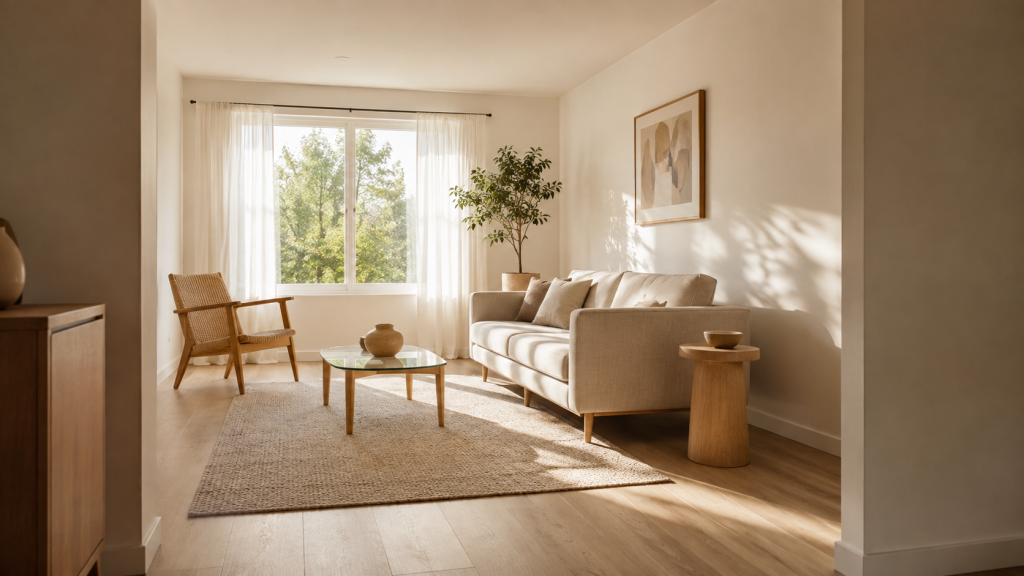
5. Let Natural Light Travel Through the Room
Natural light can make boundaries feel less oppressive.
Avoid placing unnecessarily bulky furniture directly in front of windows, and choose window treatments that can be opened fully during the day.
If privacy is important, consider:
- sheer curtains
- light-filtering blinds
- layered sheer and opaque curtains
Pay attention to furniture finishes as well.
A very dark, bulky cabinet positioned opposite the main window can visually absorb light, while wood, soft neutral upholstery, glass, or lighter-toned surfaces often allow the room to feel more open.
You do not need a completely pale interior.
You simply want daylight to reach as much of the room as possible.
6. Use Mirrors Strategically
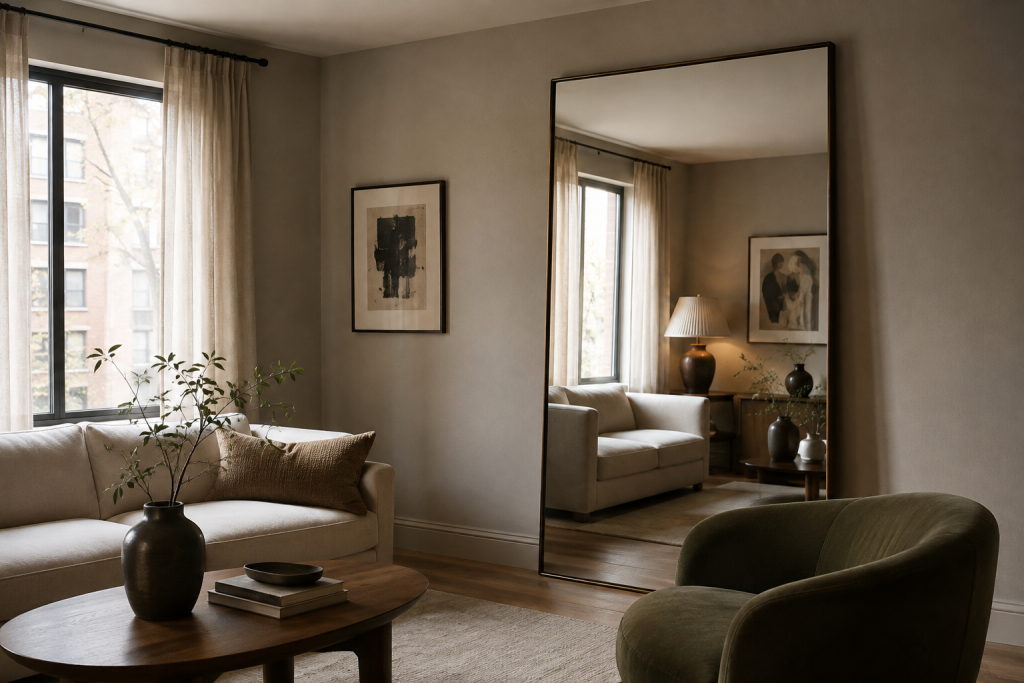
Mirrors are most effective when they have something worthwhile to reflect.
Architectural Digest’s current small-space design advice uses mirrors as architectural tools to reflect light and visually soften boundaries.
Place a mirror:
- opposite or near a window
- above a console
- behind a lamp
- where it reflects an attractive part of the room
A larger mirror often has more impact than several tiny decorative ones.
An oversized leaning mirror can create a strong sense of depth, while a simple wall-mounted mirror can increase reflected light without taking up floor space.
Before hanging one, stand where the mirror will go and look at what it will reflect.
A beautiful window, artwork, or lamp is useful.
A cluttered hallway is less so.
7. Keep the Main Color Palette Connected
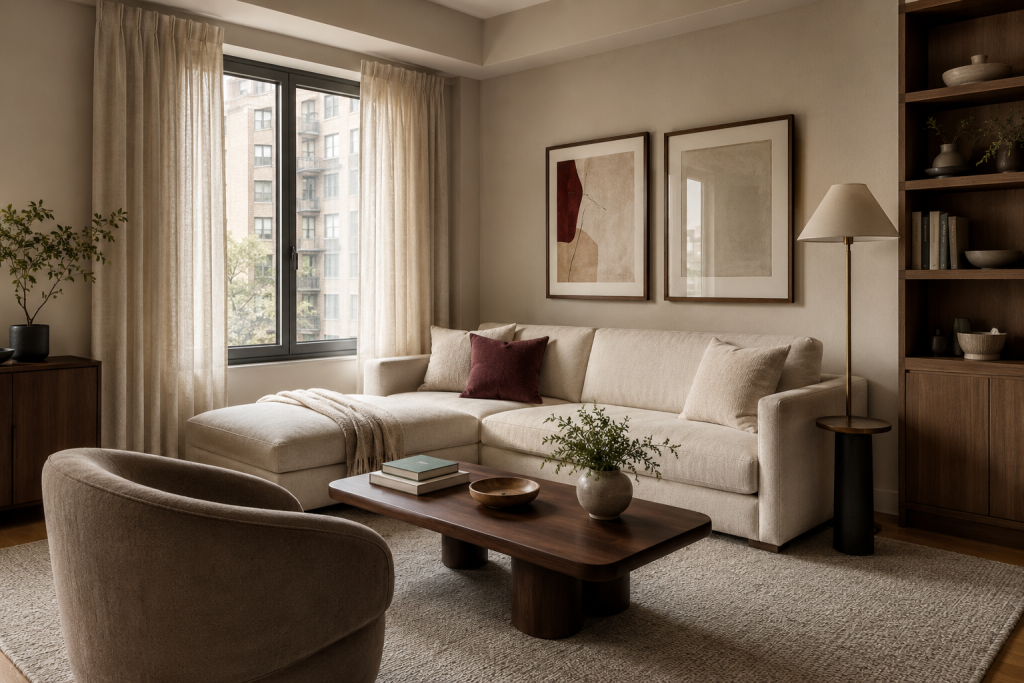
Too many abrupt color changes can break a compact room into smaller visual sections.
A more connected palette allows the eye to travel around the room smoothly.
You might combine:
- warm white walls
- cream sofa
- natural oak
- mushroom rug
- olive accents
Or:
- pale taupe
- walnut
- ivory
- muted burgundy
This does not mean everything has to match.
A small living room can absolutely use color. Architectural Digest’s small-space guidance makes clear that compact rooms do not need to rely exclusively on white; consistent or immersive color can also soften boundaries and change the perception of space.
The important thing is reducing unnecessary visual interruption.
8. Draw the Eye Up With Vertical Storage
If you need more storage, look upward before adding another piece of floor furniture.
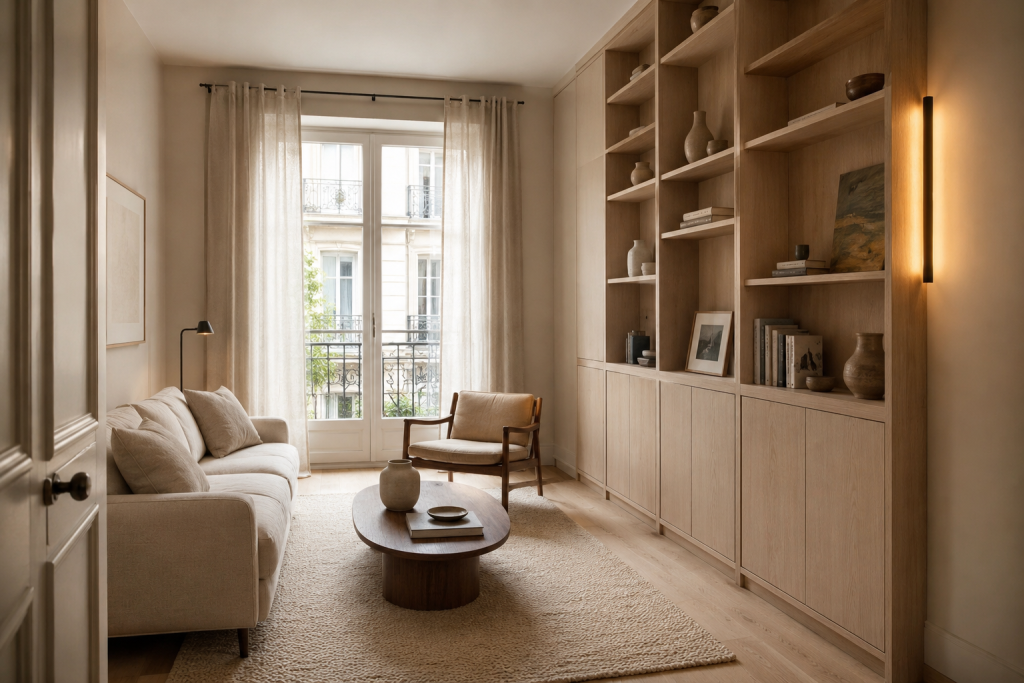
Tall bookcases and shelving make better use of limited square footage while emphasizing the room’s height.
Architectural Digest’s vertical-design guidance recommends taking storage upward and using the full wall rather than concentrating everything at eye level.
Try:
- full-height shelving
- tall narrow cabinets
- vertical picture ledges
- storage around a doorway
- built-ins that reach toward the ceiling
Use closed sections for unattractive essentials and open sections for books or objects you enjoy seeing.
Do not fill every shelf.
A little empty space prevents tall storage from becoming visually overwhelming.
9. Choose Multifunctional Furniture
Every piece of furniture in a very small living room should earn its footprint.
Look for items that solve more than one problem:
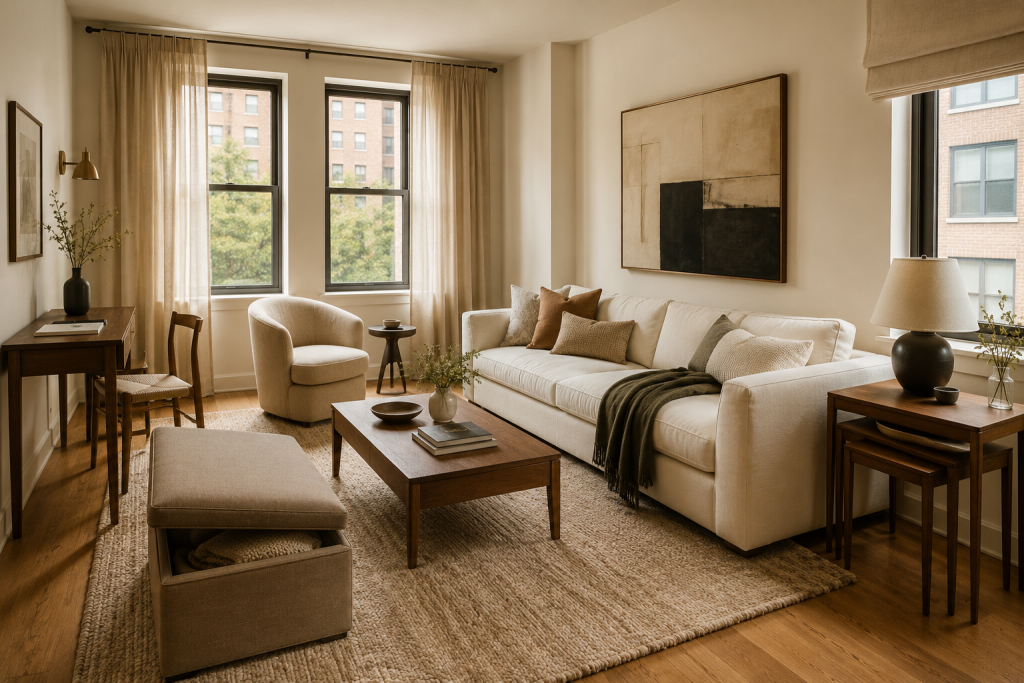
- storage ottoman
- coffee table with drawers
- nesting tables
- bench with storage
- console that becomes a desk
- sleeper sofa
- side table with shelving
The goal is not to buy complicated transforming furniture simply because it seems clever.
Choose functions you will actually use.
A storage ottoman can hold blankets and provide extra seating. Nesting tables can expand when guests arrive and tuck together afterward.
Multifunctional furniture is most successful when the secondary function does not compromise the primary one.
10. Float Furniture When the Layout Allows It
Pushing every piece against the walls does not always make a room look bigger.
Sometimes it emphasizes the perimeter and leaves an awkward empty area in the middle.
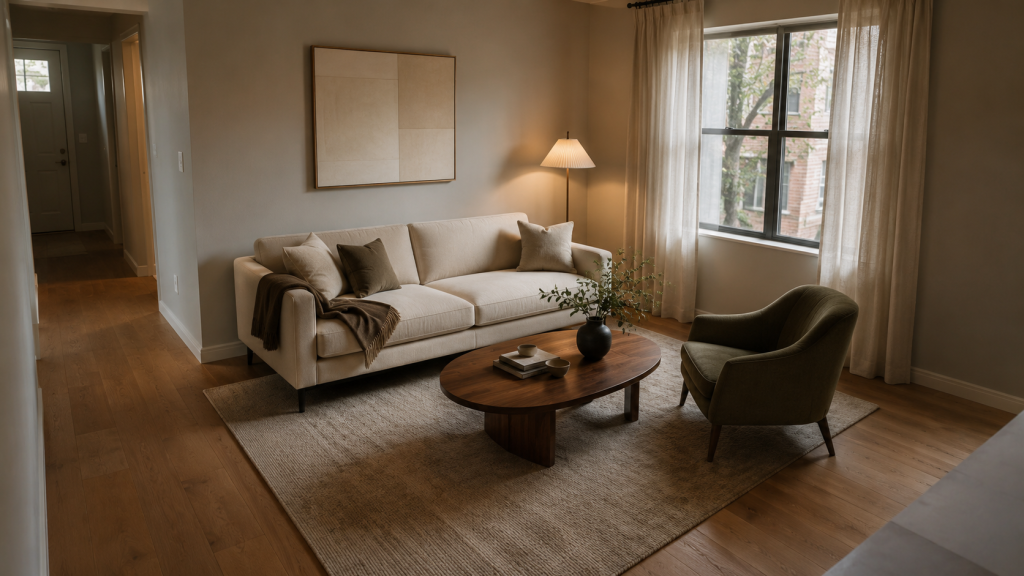
Try moving the sofa slightly away from the wall, or placing a chair at an angle rather than lining everything around the edges.
Even a few inches can create depth.
The correct arrangement depends on the room, but the goal is to form a natural conversation area while preserving clear walking routes.
Think about relationships between furniture, not simply the amount of visible floor.
A room that functions well tends to feel more spacious because movement through it is easy.
11. Keep the Coffee Table Visually Light
The coffee table occupies valuable central space, so its visual weight matters.
Consider:
- glass
- slim wood
- oval forms
- nesting tables
- open-frame designs
- small round tables
A transparent glass table allows the rug and floor to remain visible, while an oval table removes sharp corners from busy circulation routes.
If storage is essential, a closed coffee table can still work—just make sure its size does not overwhelm the sofa.
Leave enough space around it for comfortable movement.
A beautiful coffee table is not useful if you have to turn sideways every time you walk through the room.
12. Use Curves to Improve Flow
Small rooms often contain many rigid rectangles: windows, doors, sofas, cabinets, screens, rugs, and walls.
Introducing one or two rounded pieces can make the layout feel softer and easier to navigate.
Current Houzz living-room coverage continues to feature curved seating and rounded furniture as part of contemporary interiors.
Consider:
- round side table
- oval coffee table
- curved armchair
- circular mirror
- rounded lamp
- softly curved sofa arm
Curves are particularly helpful where people move around furniture because they remove projecting corners.
You do not need to make everything curved.
One or two rounded elements are usually enough.
13. Replace Many Small Decorations With One Strong Focal Point
Visual clutter makes a compact room feel even smaller.
Instead of filling every wall and surface with small objects, choose one stronger focal point.
Houzz’s small-living-room guidance specifically suggests using a single artwork, mirror, or colorful rug to give a compact room focus without overdecorating it.
That focal point might be:
- large artwork
- sculptural lamp
- beautiful rug
- statement mirror
- vintage cabinet
- fireplace
Then keep nearby decoration quieter.
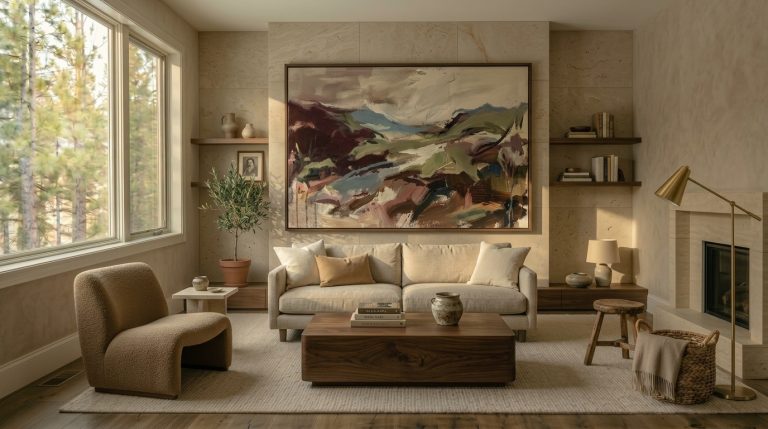
One substantial artwork above the sofa often makes the wall feel larger than a scattered arrangement of several undersized frames.
14. Layer Lighting Around the Room
A single overhead light can flatten a small room and leave the corners feeling dark.
Use several light sources instead.
A recent Architectural Digest feature on common living-room mistakes identifies relying only on ceiling lighting as a mistake, reinforcing the value of layered illumination.
Try combining:
- floor lamp
- table lamp
- wall sconce
- ceiling fixture
- small accent lamp
Lighting the corners can make the room’s full dimensions more visible after sunset.
Wall-mounted sconces are particularly useful in compact spaces because they provide lighting without occupying a table or floor area.
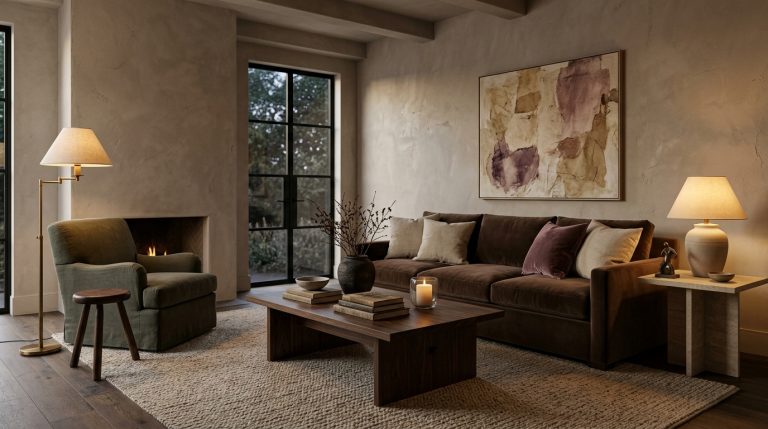
Choose warm evening light to make the room feel comfortable rather than harsh.
15. Hide Clutter Behind Closed Doors
A small room does not necessarily need fewer possessions.
It needs better control over what remains visible.
Houzz recommends shelves, cabinets, and drawers when living areas are tight on space, because effective storage is critical when one room serves several purposes.
Give ordinary objects a home:
- remote controls
- cables
- paperwork
- toys
- chargers
- games
- extra blankets
- cleaning items
Use attractive open shelves for things you want to display and closed cabinets for the rest.
This distinction matters.
A room can contain plenty of storage and still feel calm if most of it visually disappears into the architecture.
16. Keep the Floor as Continuous as Possible
The more uninterrupted floor you can see, the easier it is to understand the room as one complete space.
Avoid breaking the floor into many visual sections with several small rugs, baskets, stools, plant stands, and storage boxes.
Choose fewer floor-standing accessories.
Where possible, use:
- wall-mounted lighting
- floating shelves
- raised furniture
- one main rug
- wall-mounted media storage
This does not mean the floor needs to be bare.
It means every item placed on it should justify interrupting that visual continuity.
This idea works particularly well alongside the 2026 designer preference for slightly elevated furniture, which allows more flooring to remain visible beneath major pieces.
17. Edit the Room Before You Buy Anything New
The most effective small-living-room improvement may cost nothing.
Remove unnecessary furniture and accessories temporarily.
Then look at the room again.
Ask:
- Is there a table nobody uses?
- Are there too many cushions?
- Does that extra chair block circulation?
- Are decorative baskets occupying useful floor space?
- Is the shelving overloaded?
- Is furniture positioned according to habit rather than function?
Small rooms amplify every object.
Removing one unnecessary chair or side table can sometimes improve the room more than adding several new pieces.
This does not mean stripping the room of personality.
Keep the books, artwork, ceramics, photographs, and objects that matter to you.
Just give them enough breathing room to be noticed.
Should You Paint a Small Living Room White?
Not necessarily.
White can be effective when you have good natural light and want a bright, airy atmosphere, but it is not a universal solution.
Designers increasingly use richer colors even in small rooms. The key is often continuity rather than absolute lightness.
Painting walls and architectural details in closely related shades can reduce strong visual boundaries. A warm taupe, pale olive, muted blue, mushroom, or soft clay can make a compact living room feel cohesive and intentional.
If you prefer pale colors, use texture to keep the room from becoming flat.
Combine warm-white walls with:
- linen
- wool
- natural wood
- ceramics
- woven fibers
- soft stone
Looking ahead, Sherwin-Williams’ 2027 Rewild forecast includes 48 colors and ten Continuity Colors rather than prescribing one narrow palette, reflecting a broader move toward adaptable and individual combinations.
Use forecasts as inspiration, not as instructions.
Small Living Room Mistakes That Make a Space Feel Smaller
Buying furniture without measuring
An oversized sofa can dominate circulation even if it technically fits.
Choosing everything in miniature
Too many tiny pieces create visual clutter. Fewer properly scaled pieces often feel calmer.
Using a tiny rug
A larger rug usually creates a more unified seating area.
Blocking windows
Preserve as much natural light as possible.
Ignoring vertical space
High curtains and tall storage can shift attention upward.
Overloading open shelves
Closed storage is often better for everyday clutter.
Relying only on overhead lighting
Dark corners visually contract the room.
Decorating every wall
Some empty wall space helps the room breathe.
Prioritizing appearance over movement
A small living room must be comfortable to walk through. Clear circulation is more valuable than squeezing in one extra decorative chair.
Frequently Asked Questions
How do I make a small living room look bigger?
Use appropriately scaled furniture, preserve visible floor space, take curtains higher, improve storage, layer lighting, use mirrors strategically, and keep the palette visually connected. Current designer guidance also emphasizes vertical design and furniture raised slightly off the floor.
What color makes a small living room look bigger?
There is no single required color. Light shades can reflect daylight, but designers also successfully use monochromatic or richer schemes to reduce visual boundaries. The relationship between walls, furniture, flooring, and light matters more than simply choosing white.
Should a small living room have a large sofa?
It can. One appropriately scaled sofa may work better than several undersized seating pieces. Measure the room carefully and preserve comfortable circulation.
Are mirrors good for small living rooms?
Yes, particularly when they reflect daylight or an attractive view within the room. Designers use mirrors to increase reflected light and visually soften boundaries in compact interiors.
How can I make a small living room cozy without clutter?
Use texture rather than large quantities of accessories. A wool rug, linen curtains, warm lighting, wood, a comfortable sofa, and a few meaningful objects can create warmth without filling every surface.
Final Thoughts
Making a small living room look bigger is not really about fooling the eye.
It is about removing unnecessary obstacles.
Let the furniture breathe. Keep circulation clear. Show more of the floor where possible. Use the walls for storage. Take the curtains upward. Reflect natural light. Illuminate the corners at night. Choose one strong focal point instead of many competing decorations.
Most importantly, stop treating a small room as though it needs to apologize for its size.
Current 2026 design thinking is increasingly focused on adaptive living, wellness, and spaces that work intelligently for the people using them—an especially useful perspective when square footage is limited.
A compact living room can still have generous furniture, beautiful materials, rich color, artwork, books, and personality.
It simply needs them in the right amounts.
When every piece has a purpose and the room is easy to move through, even a very small living room can feel brighter, calmer, and far more spacious than its measurements suggest.