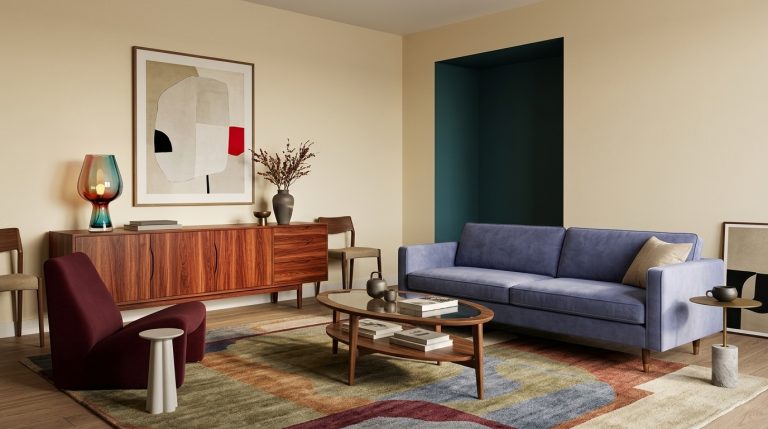
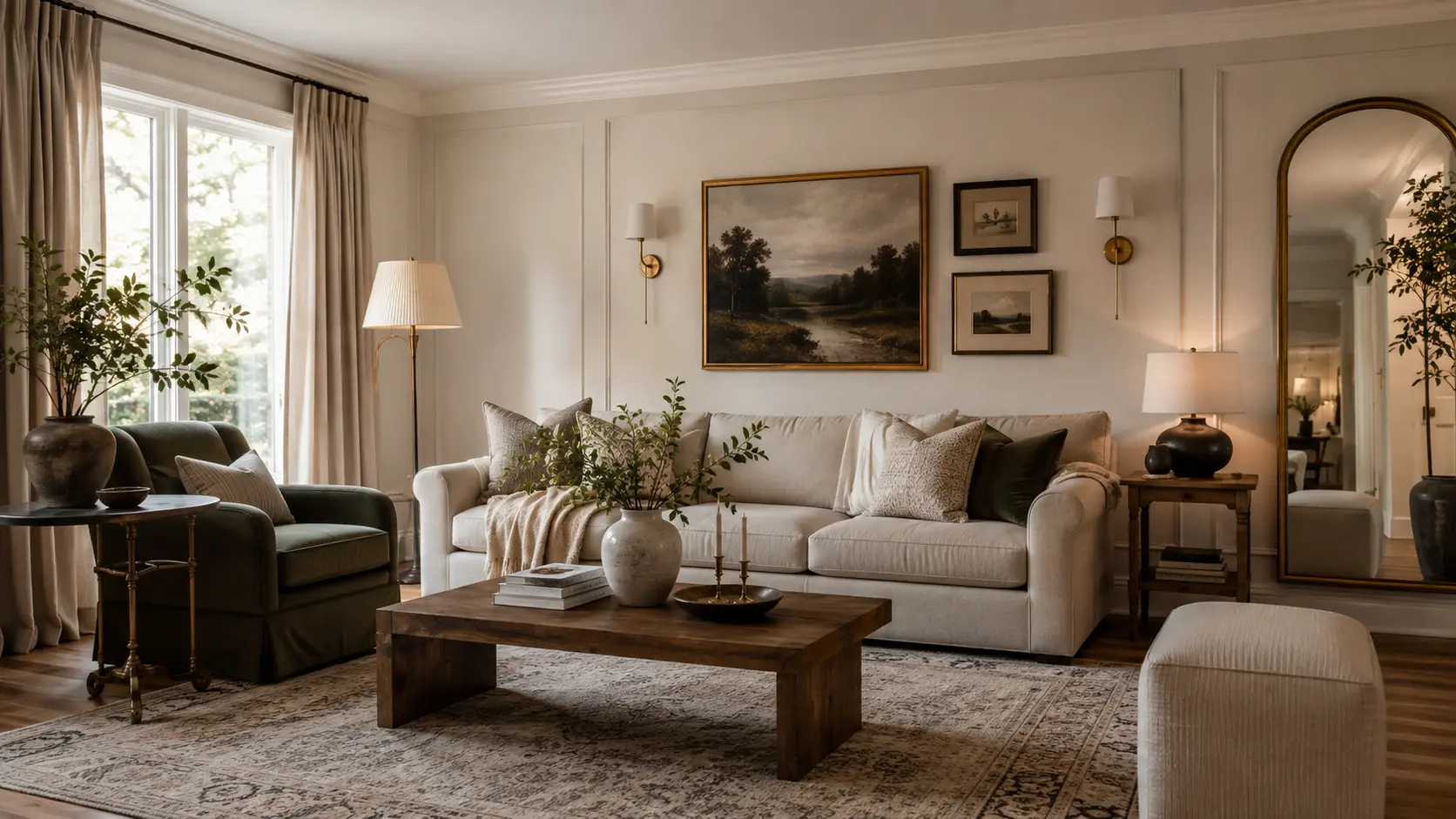
15 Luxury Living Room Ideas on a Budget That Look Far More Expensive
A luxurious living room is not necessarily one filled with designer furniture, expensive marble, or custom-made pieces. More often, it is a room where the proportions feel right, the lighting is flattering, the materials work together, and every object appears to have been chosen deliberately.
That distinction matters if you are decorating on a realistic budget.
Current interior design is also making luxury easier to interpret this way. Architectural Digest’s 2026 trend coverage points toward livable luxury, dark wood, warmth, vintage pieces, richer color, and rooms with greater personality rather than sterile, perfectly coordinated interiors. Houzz similarly reports growing interest in tactile materials and spaces that feel warmer and more layered. (architecturaldigest.com) (houzz.com)
That is good news because many of the details that make a living room look expensive do not require a complete renovation.
A better paint color, properly hung curtains, one vintage table, warmer lighting, a larger rug, or simply removing unnecessary furniture can completely change the way a room feels.
Here are 15 luxury living room ideas on a budget that can help you create a space that looks polished, sophisticated, and genuinely comfortable.
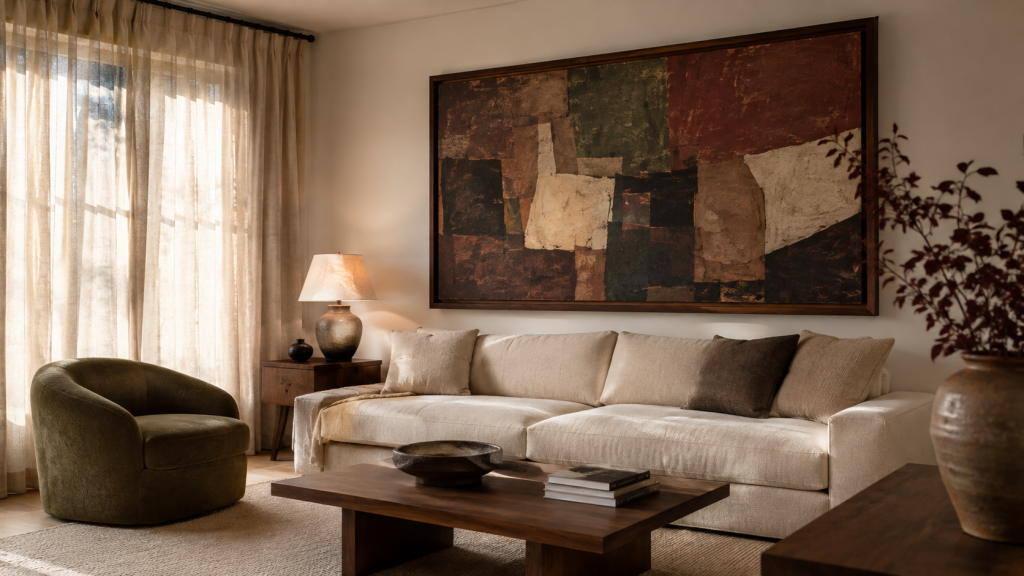
1. Spend More on One Focal Point, Not Everything
One of the easiest ways to overspend is to assume every piece in the living room needs to look expensive.
It does not.
Instead, decide what you want the eye to notice first.
That could be:
- A beautiful sofa
- A large artwork
- An antique cabinet
- A statement rug
- A sculptural coffee table
- An elegant light fixture
Then allow simpler pieces to support it.
A room containing one memorable vintage table and an affordable neutral sofa can look more sophisticated than a room filled with expensive but visually competing furniture.
This high-low approach also gives you time to build the room gradually rather than purchasing an entire furniture set at once.
Luxury often comes from editing. If everything is demanding attention, nothing feels special.
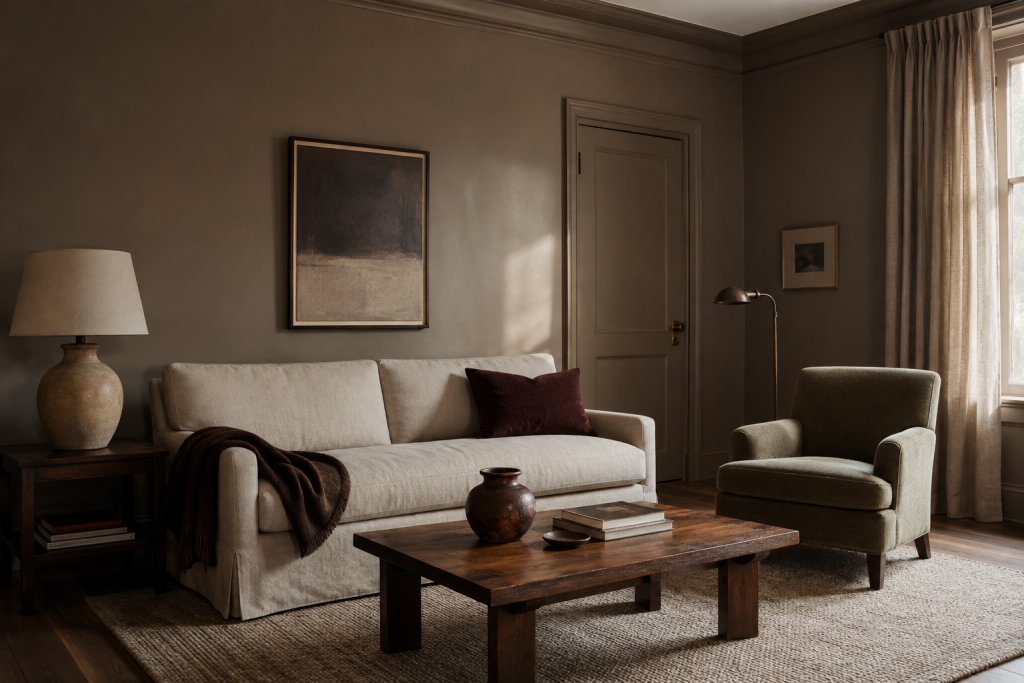
2. Use Paint to Create a Richer Background
Paint remains one of the highest-impact changes you can make without replacing furniture.
Instead of automatically choosing brilliant white, consider a color that gives the room more depth.
Current 2026 palettes are moving toward earthier, richer shades. The 1stDibs designer survey found strong enthusiasm for chocolate brown, deep greens, burgundy, and other grounded colors, while Architectural Digest continues to highlight moodier palettes and color drenching as important current directions. (1stdibs.com) (architecturaldigest.com)
For an expensive-looking living room, try:
- Mushroom
- Warm taupe
- Soft olive
- Muted clay
- Chocolate brown
- Deep burgundy
- Warm greige
- Creamy ivory
You do not have to use a dark color on every wall.
A warm neutral throughout the room can make ordinary furniture look more considered simply because the background feels intentional.
For a more enveloping effect, paint the walls, trim, and doors in related shades rather than creating sharp white borders around everything.
Always test large paint samples in your actual room before deciding. The same neutral can appear completely different beside warm wood, gray flooring, or strong daylight.
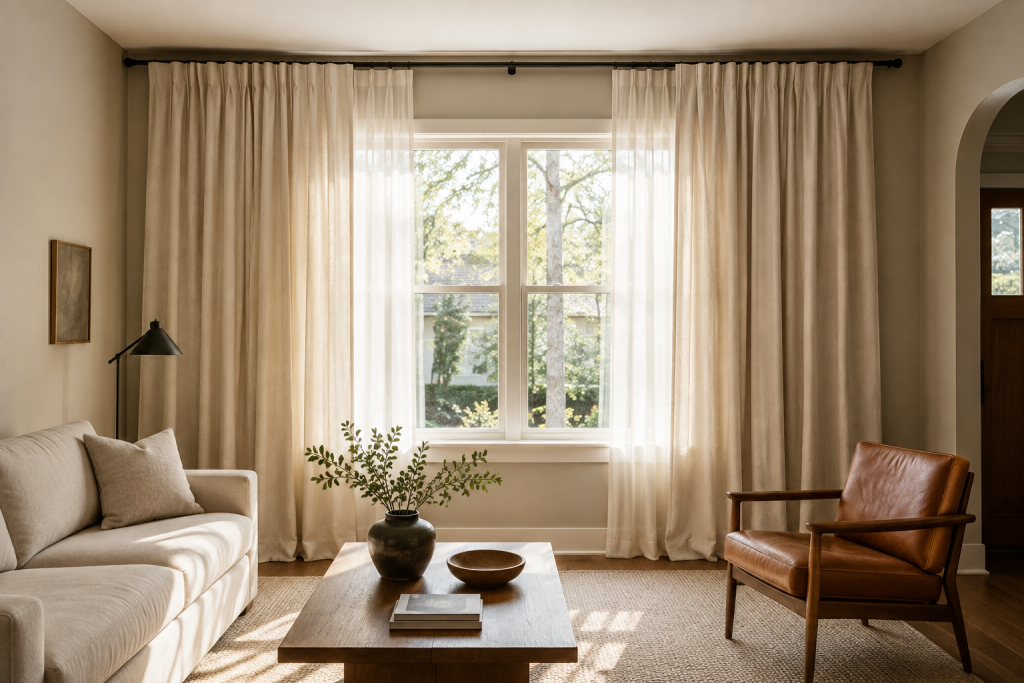
3. Hang Curtains Higher and Wider
Poorly hung curtains can make even expensive furniture look less polished.
A common mistake is mounting the curtain rod immediately above the window and using panels that barely cover the opening.
For a more luxurious effect, take the curtains closer to the ceiling and extend the rod or track beyond the window where possible.
This makes the window feel larger and allows more glass to remain visible when the curtains are open.
Choose panels generous enough to create real folds rather than hanging almost flat.
You do not need expensive custom drapery. Affordable ready-made curtains can look considerably better when:
- They reach the floor
- They have enough width
- They are properly steamed
- Their color relates to the walls
- The rod and rings are simple and substantial
Linen-look fabrics, cotton blends, velvet, and heavier woven materials can all work depending on the room.
A simple cream curtain against a mushroom or taupe wall can look remarkably refined.
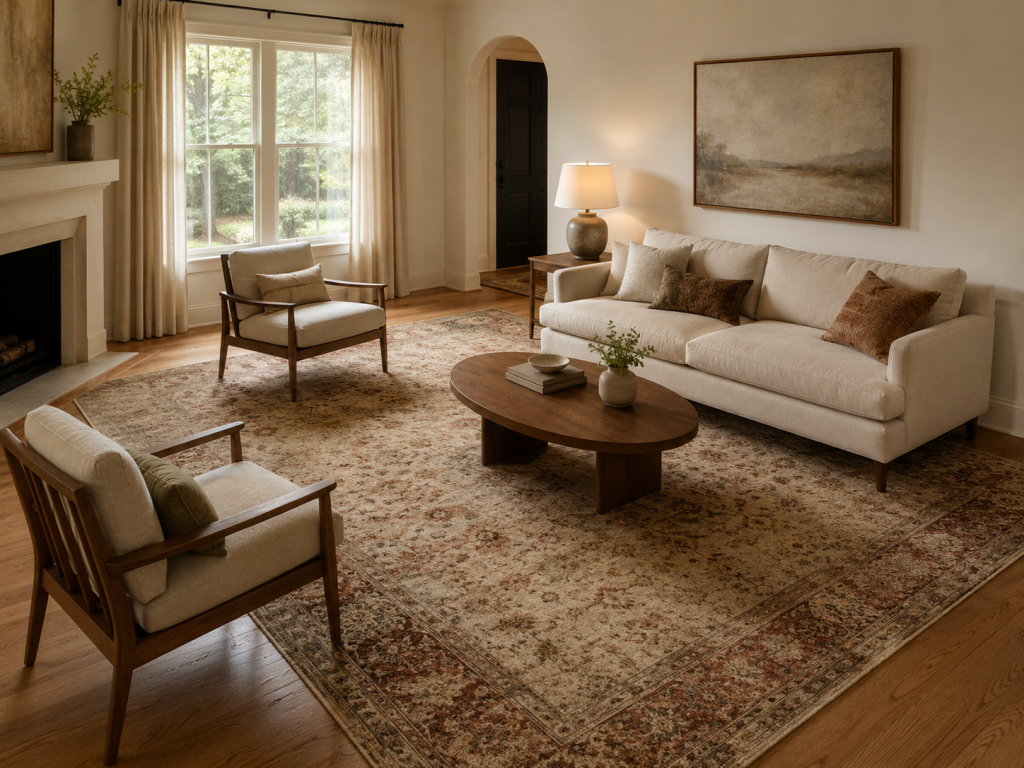
4. Choose a Rug Large Enough for the Furniture
An undersized rug is one of the quickest ways to make a living room arrangement feel disconnected.
The rug should help visually hold the seating group together.
When possible, position at least the front legs of the sofa and major chairs on the rug. In larger rooms, placing all seating fully on the rug can create an even more substantial effect.
Do not assume that a luxurious-looking rug needs to be new.
Consider:
- Vintage rugs
- Flat-weave wool
- Faded Persian-inspired patterns
- Natural wool
- Subtle geometric designs
- Secondhand rugs in good condition
Architectural Digest’s decorating guidance frequently uses rugs as a way to unify living areas and introduce color, texture, and personality without changing the architecture. (architecturaldigest.com)
Measure before buying. A less expensive rug in the correct size usually looks better than a premium rug that is obviously too small.
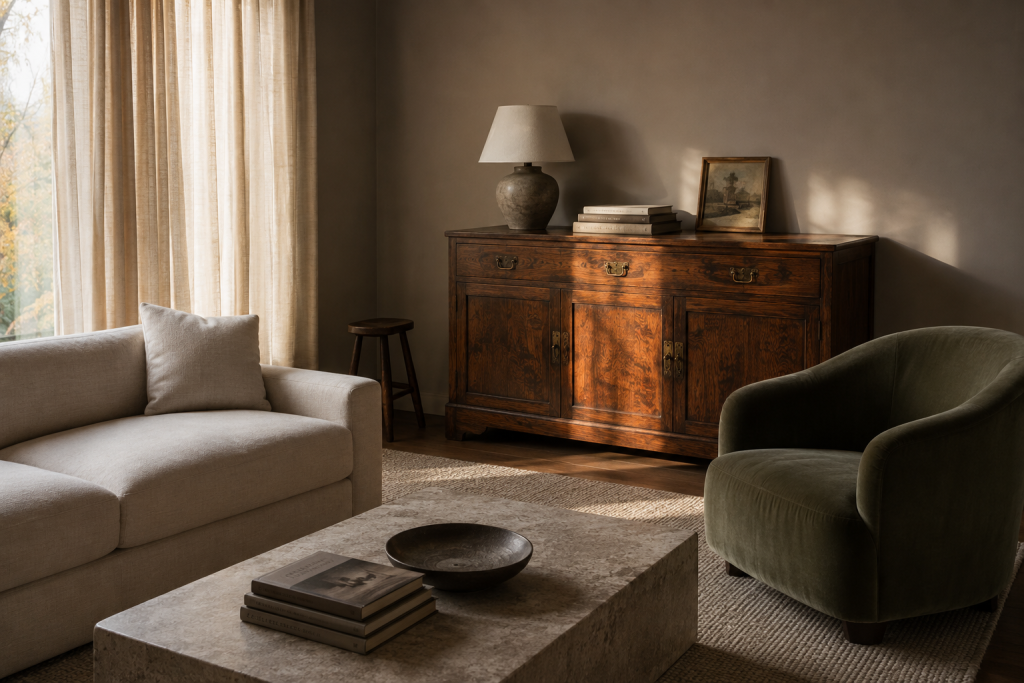
5. Mix Vintage Furniture With Affordable New Pieces
Rooms that look expensive rarely look as though everything arrived from the same warehouse.
One of the best budget strategies is therefore to mix new essentials with secondhand furniture.
Vintage and antique pieces remain highly relevant in 2026. The 1stDibs designer survey found that vintage sourcing remains widespread among professional designers, reflecting a larger movement toward more individual, collected interiors. (1stdibs.com)
Look for:
- Solid wood side tables
- Vintage coffee tables
- Small cabinets
- Framed mirrors
- Ceramic lamps
- Wooden stools
- Occasional chairs
- Decorative boxes
- Art
A scratched but beautifully proportioned solid-wood table may have more character than a brand-new inexpensive piece covered in imitation wood veneer.
Estate sales, local marketplaces, thrift stores, flea markets, and secondhand furniture shops can all be useful.
You do not need a room full of antiques.
One older piece with real texture and character can make newer furniture feel more intentional.
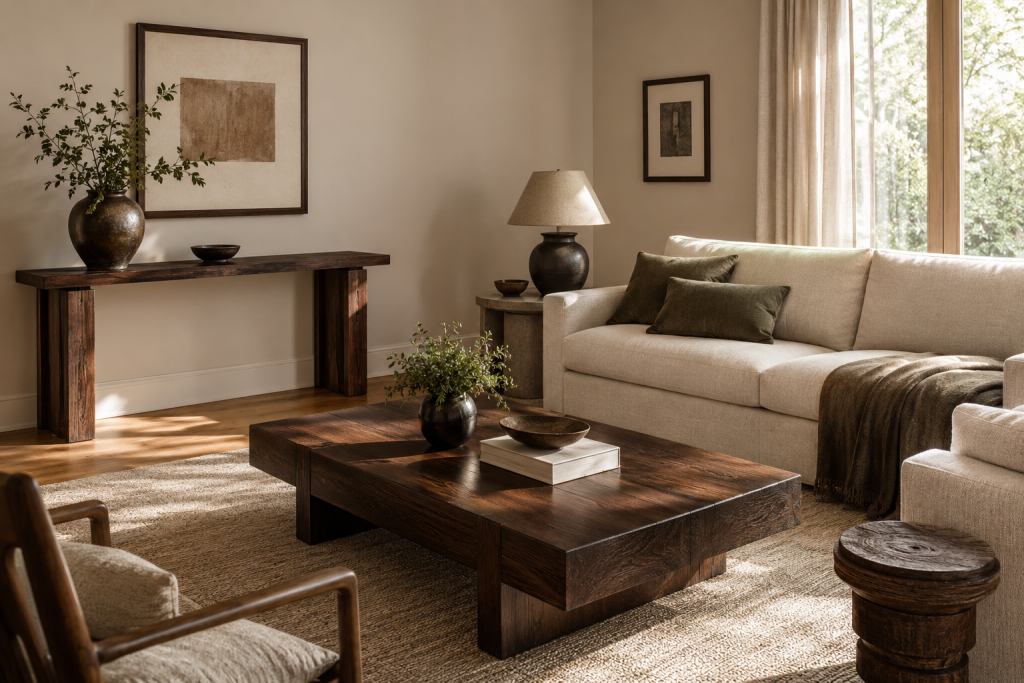
6. Bring in Darker Wood for Instant Depth
Pale wood has dominated many interiors for years, but deeper timber can make a living room feel significantly richer.
Architectural Digest lists dark wood and warmth among the interior directions continuing into 2026, while the broader designer preference for brown is also reflected in the latest 1stDibs research. (architecturaldigest.com) (investors.1stdibs.com)
You do not need to replace your sofa or flooring.
Introduce walnut, mahogany tones, dark oak, or medium brown through:
- A side table
- Coffee table
- Picture frames
- Console
- Cabinet
- Lamp base
- Decorative tray
Dark wood works particularly well against cream upholstery, warm-white walls, olive textiles, brass, and stone.
Avoid trying to match every timber perfectly. Several compatible wood tones often look more natural than a completely identical furniture set.
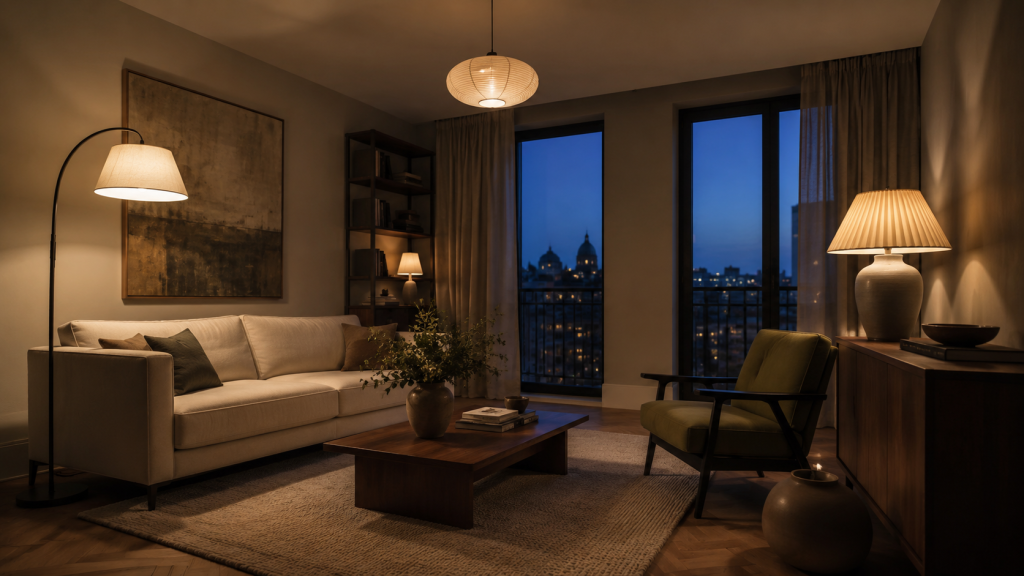
7. Layer Lighting Instead of Relying on the Ceiling
Nothing exposes inexpensive finishes faster than harsh overhead lighting.
A sophisticated living room usually looks different depending on the time of day because several light sources allow the atmosphere to change.
Use a mixture of:
- Floor lamps
- Table lamps
- Wall sconces
- Ceiling fixtures
- Small accent lamps
- Picture lights
Place light at different heights.
A table lamp on a console produces a different effect from a floor lamp beside the sofa. Together they create depth and make corners feel intentional.
Architectural Digest’s budget living-room guidance specifically points to lighting, drapery, texture, and focused decorative interventions as high-impact ways to transform an ordinary room without rebuilding it. (architecturaldigest.com)
Choose warm bulbs for living areas and avoid unnecessarily bright, cold-white lighting in the evening.
Even inexpensive lamps can look more refined with a well-proportioned fabric, paper, or pleated shade.
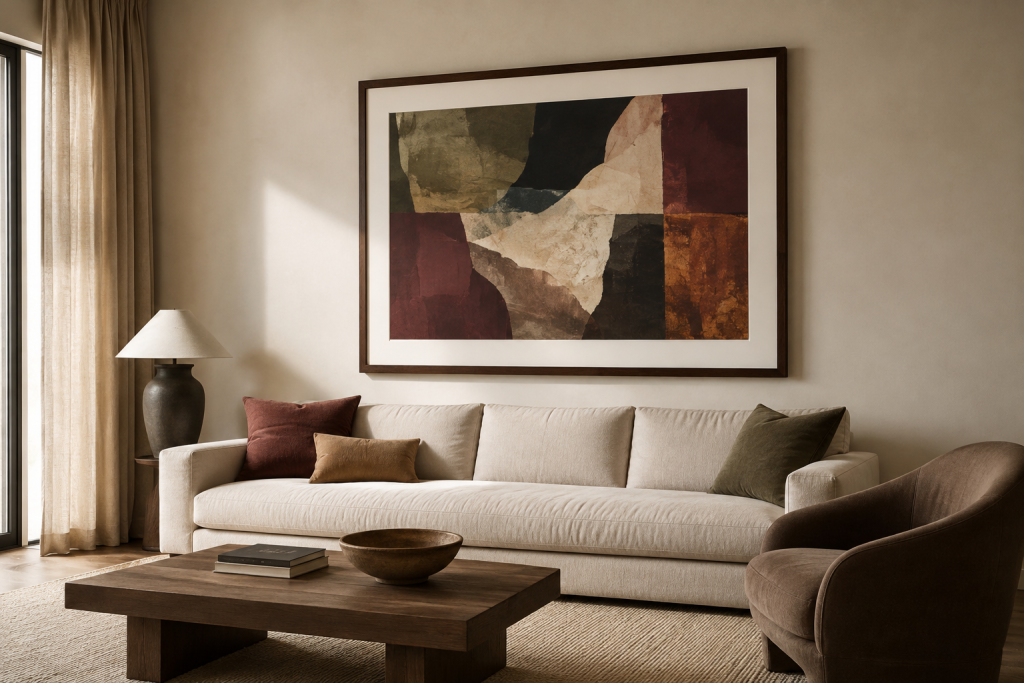
8. Use One Large Piece of Art
You do not need a valuable original painting to make the wall above your sofa look impressive.
Scale often matters more than price.
A single substantial artwork can make a stronger statement than several undersized prints floating across a large wall.
Affordable options include:
- Art prints
- Photography
- Vintage posters
- Textile art
- Large framed drawings
- Secondhand paintings
- Your own photography
- Public-domain artwork printed professionally
Architectural Digest’s affordable-art guidance notes that large-format prints can provide substantial impact, and inexpensive reproductions or prints can become far more convincing when they are thoughtfully framed. (architecturaldigest.com)
Do not ignore the frame.
A simple wood, black, or aged-metal frame with a generous mat can elevate inexpensive artwork dramatically.
The artwork should relate to the room without matching every cushion.
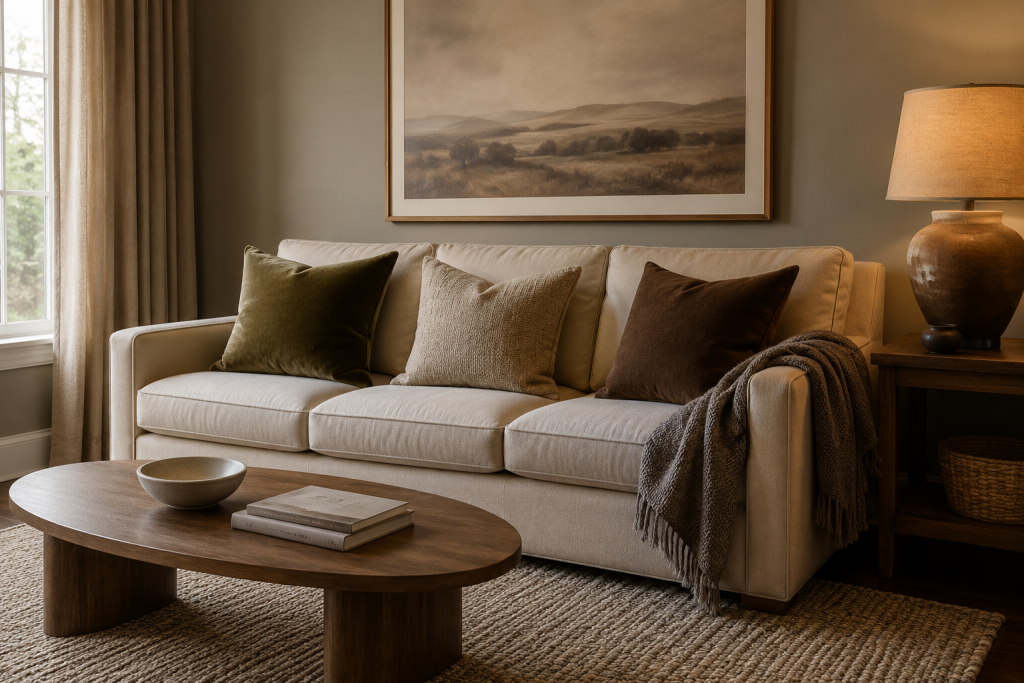
9. Make Your Existing Sofa Look Better
Replacing the sofa can consume most of a decorating budget.
Before doing that, determine whether the problem is actually the sofa or everything surrounding it.
A plain neutral sofa can look considerably more elevated with:
- Better cushion inserts
- Two or three substantial pillows
- A textured throw
- A larger rug beneath it
- Improved lighting
- A side table with stronger proportions
- Art properly scaled to the wall
Avoid covering the sofa with ten different cushions.
Choose two or three fabrics with a visible difference in texture—perhaps linen, velvet, wool, or woven cotton—and repeat colors already present elsewhere in the room.
If the sofa itself is tired but structurally sound, professional cleaning, replacement cushion inserts, new legs, or a well-fitted slipcover may cost considerably less than buying a new piece.
Luxury is often about making what you already own look deliberate.
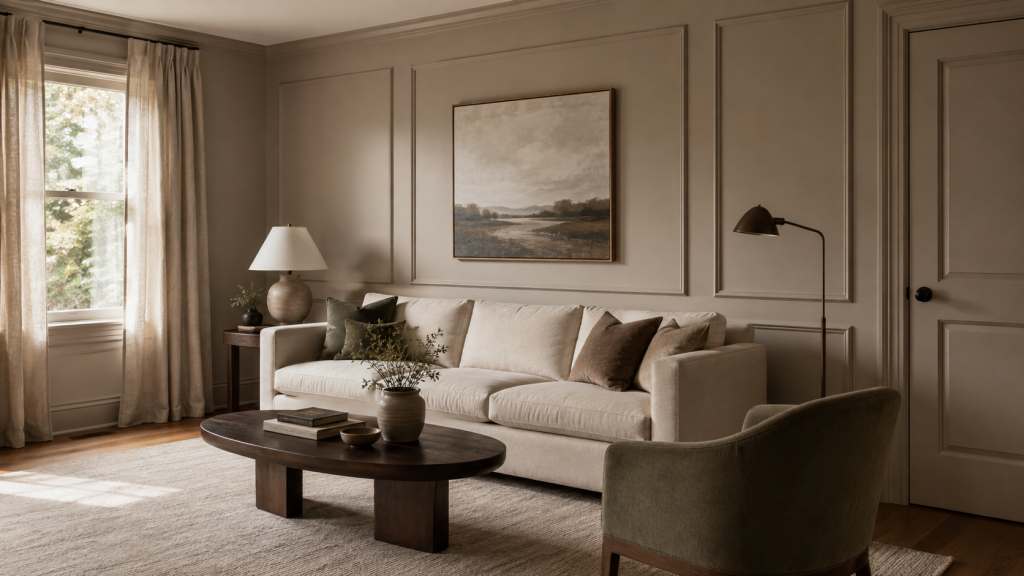
10. Add Architectural Detail Without a Major Renovation
Expensive rooms often benefit from architectural depth: molding, paneling, built-ins, or interesting wall surfaces.
Some of that character can be recreated at a relatively modest cost.
Depending on your home and skill level, consider:
- Simple picture-frame molding
- Painted wall paneling
- A picture rail
- Decorative trim
- Removable molding for rentals
- Paint applied in architectural blocks
- Full-height shelving
Keep the treatment proportionate to the room.
Too many narrow moldings or decorative strips can make a simple living room look busier rather than more expensive.
Another affordable approach is to paint the wall, trim, doors, and radiator in one related color. The uninterrupted palette can create visual sophistication without adding any construction.
11. Hide Everyday Clutter Behind Closed Storage
Luxury interiors rarely appear calm because their owners have no possessions.
They appear calm because ordinary possessions have somewhere to go.
Closed storage is therefore one of the least glamorous but most effective upgrades you can make.
Use:
- Sideboards
- Media cabinets
- Baskets with lids
- Storage ottomans
- Cabinets
- Boxes inside shelving
- Coffee tables with concealed storage
Keep frequently used objects accessible but remove unnecessary visual noise.
Remote controls, charging cables, mail, children’s toys, game controllers, paperwork, and miscellaneous electronics can quickly undermine a carefully designed room.
One attractive cabinet may improve the room more than five new decorative accessories.
12. Mix Materials to Create a Layered Look
A luxury room rarely relies on one material.
Imagine a living room containing only smooth painted walls, polyester upholstery, laminate furniture, and glass.
Even if everything is new, the space may still feel flat.
Now introduce:
- Linen
- Wool
- Natural wood
- Stone
- Aged metal
- Ceramic
- Glass
- Leather
- Woven fibers
The color palette can remain restrained while the different surfaces create richness.
Current 2026 design reporting from Houzz and Architectural Digest places considerable emphasis on tactile craftsmanship, layered surfaces, and interiors that feel warmer and less sterile. (houzz.com) (architecturaldigest.com)
You do not need genuine marble everywhere.
A ceramic lamp, wool cushion, wooden table, linen curtain, and stone bowl can create enough material variation to make a simple living room feel considerably more sophisticated.
13. Style the Coffee Table With Restraint
A luxury coffee table should still be usable.
Avoid covering the entire surface with small decorative objects.
Instead, create one controlled arrangement.
For example:
- Two large books
- A ceramic bowl
- One sculptural object
- A small vase or branch
Use different heights but keep enough clear surface for a drink or tray.
Books are particularly useful because they add color, scale, and personality without looking like purely decorative purchases.
A tray can also visually group smaller objects and make the arrangement easier to move.
Do not feel obligated to reproduce the traditional combination of books, beads, candle, vase, and decorative chain simply because it appears frequently on social media.
Your coffee table should reflect the rest of your room.
14. Rearrange the Furniture Before Buying Anything
Sometimes the most expensive-looking upgrade costs nothing.
Furniture placement has an enormous effect on whether a living room feels intentional.
Start by identifying the room’s focal point. It may be:
- A fireplace
- Window
- Artwork
- Television
- View
- Main conversation area
Then arrange seating around that focal point instead of simply pushing every piece against the perimeter.
Create a conversational distance between the sofa and chairs.
Leave clear walking paths.
Move an accent chair out of a forgotten corner and connect it to the seating group. Pull the sofa slightly away from the wall if space allows. Center the rug beneath the arrangement rather than beneath the room itself.
The goal is to make the furniture relate to one another.
A modest room with a strong layout nearly always feels more polished than an expensive room with awkward circulation.
15. Decorate Slowly and Let the Room Become Personal
A luxury living room should not look like a display apartment that could belong to anyone.
The most convincing interiors contain objects accumulated over time.
House Beautiful’s recent designer guidance on “slow decorating” emphasizes living with a space, making thoughtful purchases, and allowing distinctive or meaningful pieces to arrive gradually rather than racing to finish every room immediately. (housebeautiful.com)
That philosophy is especially useful when you have a limited budget.
Instead of purchasing ten inexpensive accessories this weekend, save the money and wait for:
- The vintage lamp you really like
- Artwork that means something
- A better side table
- A handmade ceramic piece
- A beautiful textile
- A book you actually want to keep
- An object collected while traveling
A room built gradually often develops more character than one completed in a single shopping trip.
And because you are buying less, you can sometimes afford better quality when the right piece appears.
Where to Save and Where to Spend
A limited budget becomes easier to manage when you decide which things deserve more money.
Worth spending more on
The sofa:
Comfort, construction, and upholstery matter when a piece is used every day.
The main rug:
Correct scale and durable material have a large visual impact.
Frequently used lighting:
A good reading lamp needs to perform properly, not simply look attractive.
Window treatments:
Especially if privacy, insulation, or light control matters.
Good places to save
Side tables:
Secondhand markets often have excellent solid-wood options.
Art:
Prints, vintage pieces, photography, and properly framed inexpensive art can look excellent.
Decorative cushions:
You do not need designer labels to find good fabric and color.
Accessories:
Books, ceramics, bowls, baskets, and found objects do not need high price tags.
Mirrors:
Vintage and secondhand mirrors can provide excellent scale for relatively little money.
The smartest room usually combines both categories rather than trying to save on absolutely everything.
Luxury Living Room Colors for 2026 and Beyond
If you want your living room to feel current without becoming dated quickly, start with a grounded base and use stronger trend colors in smaller amounts.
For 2026, designer research continues to favor warmer and more expressive colors, including chocolate brown, dark green, burgundy, earthy neutrals, and selected softer pastels. (investors.1stdibs.com)
Early 2027 forecasting suggests even greater flexibility. Sherwin-Williams’ Rewild Colormix forecast contains 48 colors rather than prescribing a few fixed combinations, with groups spanning blues and greens, reds and purples, deeper shades, and delicate tints. (sherwin-williams.com)
That makes a practical strategy simple:
Keep expensive or difficult-to-change pieces relatively versatile, then experiment through:
- Paint
- Cushions
- Art
- Throws
- Lampshades
- Rugs
- Smaller furniture
Your living room can evolve without being redecorated from scratch every year.
Common Budget Decorating Mistakes That Make a Living Room Look Cheaper
Buying complete matching furniture sets
A room generally feels more sophisticated when different pieces relate without matching perfectly.
Buying everything at once
This often leads to compromises and too many generic accessories.
Using a rug that is too small
Correct scale is usually more important than an expensive label.
Choosing trendy decor instead of fixing the layout
No accessory can compensate for furniture that blocks circulation or feels disconnected.
Hanging curtains too short
Floor-length curtains usually create a more considered finish.
Using only one ceiling light
Multiple light sources make the room more comfortable and visually layered.
Filling every shelf
Empty space allows the objects you love to have more impact.
Mistaking gold finishes for luxury
Gold-colored objects do not automatically make a room luxurious. Material quality, proportion, restraint, and context matter much more.
Buying imitation luxury
A simple honest material usually looks better than a poorly executed imitation of marble, crystal, or precious metal.
Frequently Asked Questions
How can I make my living room look luxurious on a small budget?
Prioritize the changes with the greatest visual impact: paint, lighting, curtain placement, rug size, furniture layout, art, and clutter control. Then introduce one or two vintage or characterful pieces instead of buying many decorative accessories.
What makes a living room look expensive?
Good proportions, layered lighting, properly sized furniture, substantial textiles, natural-looking materials, controlled color, and thoughtful editing often create a more expensive appearance than obvious luxury branding.
What colors make a living room look luxurious?
Warm neutrals, chocolate brown, olive, burgundy, mushroom, charcoal, cream, muted blue, and deep green can all create sophisticated interiors. The correct choice depends on the room’s daylight, flooring, and furniture.
How do I make a cheap sofa look expensive?
Improve the area around it. Use a larger rug, better lighting, a few substantial cushions, a textured throw, correctly scaled artwork, and stronger side tables. If necessary, clean the upholstery or replace flattened cushion inserts.
Can secondhand furniture make a room look luxurious?
Absolutely. Vintage furniture is frequently used by professional designers precisely because age, craftsmanship, wood grain, patina, and unusual proportions can give a room individuality that new mass-produced furniture sometimes lacks. (1stdibs.com)
Final Thoughts
Creating a luxurious living room on a budget is not really about finding cheap versions of expensive things.
It is about understanding what makes a well-designed room feel valuable in the first place.
Scale matters. Lighting matters. Texture matters. Furniture placement matters. The relationship between old and new matters. And perhaps most importantly, restraint matters.
Start with the room you already have.
Move the furniture before replacing it. Remove what does not contribute. Improve the lighting. Hang the curtains properly. Choose a rug large enough to anchor the seating. Add one piece of art with presence. Look for solid vintage furniture instead of filling the room with inexpensive matching pieces.
Then allow the space to develop over time.
Current 2026 design is moving toward livable luxury, warmth, craftsmanship, vintage character, richer color, and more personal interiors, which means an expensive-looking living room increasingly has less to do with showing how much money was spent and more to do with showing how thoughtfully the room was put together. (architecturaldigest.com)
That is ultimately the best budget strategy of all:
Buy less, choose better, and make every decision count.