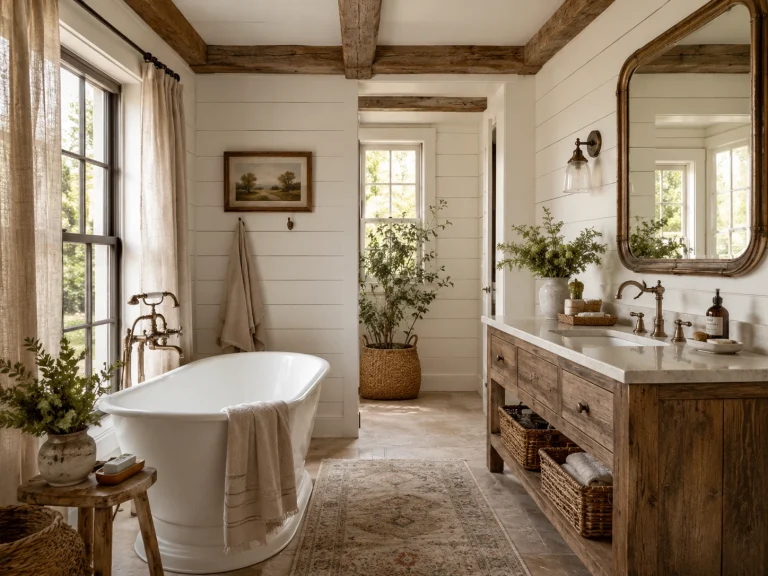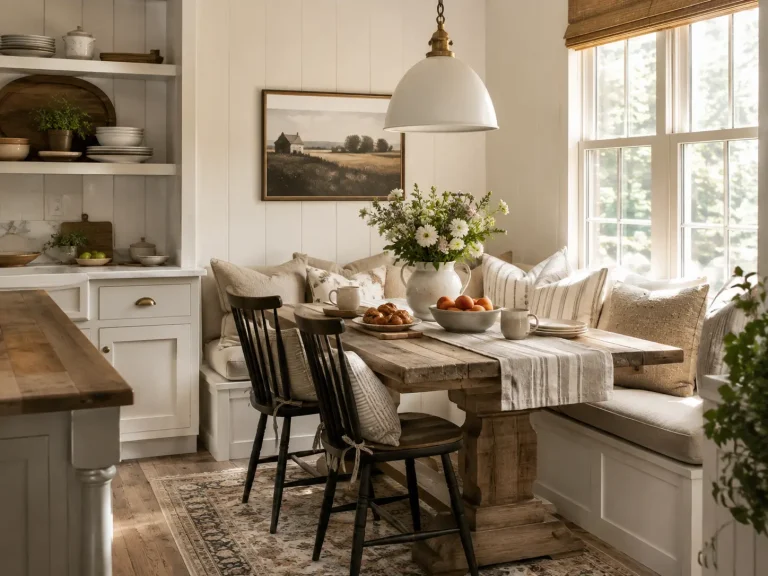
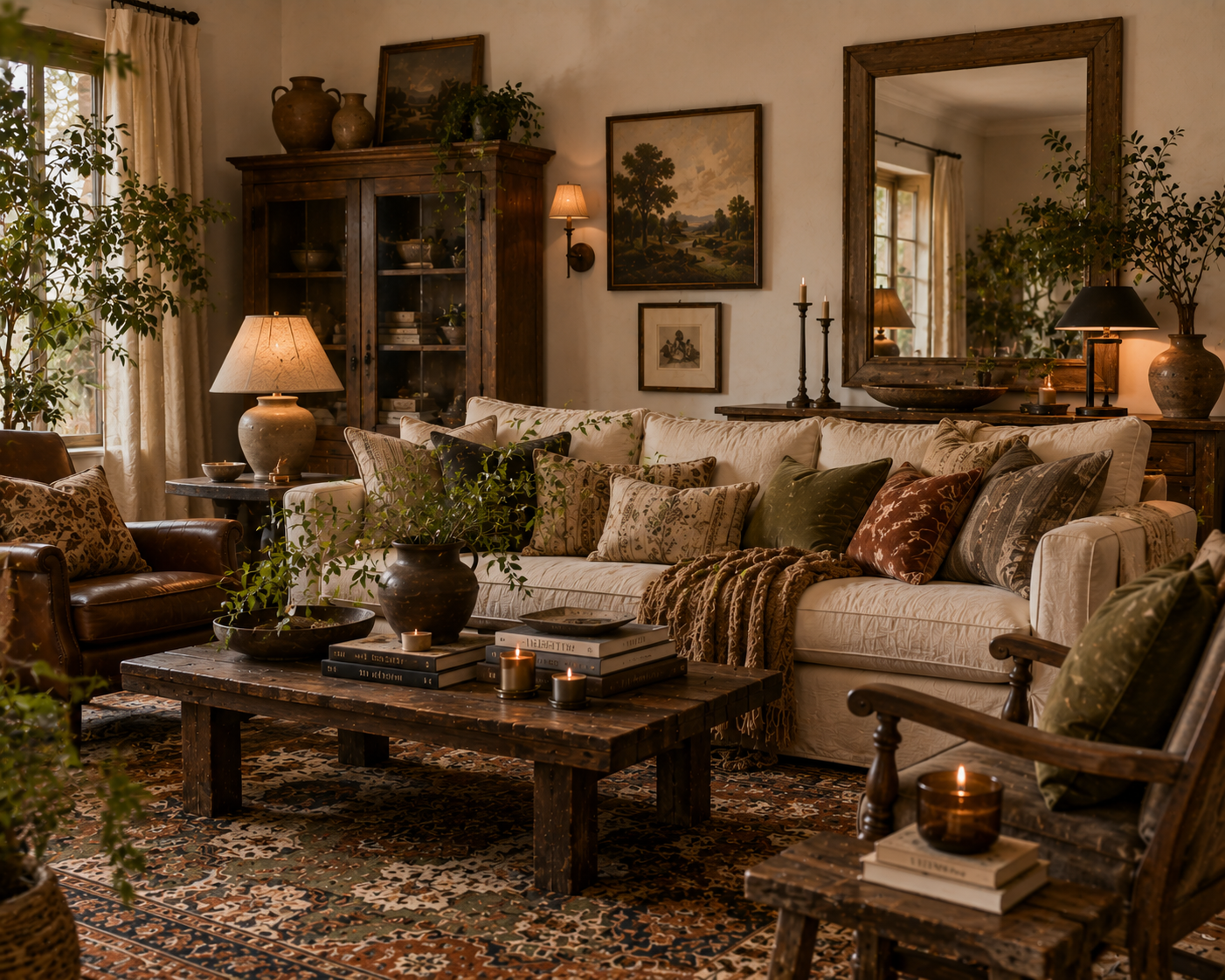
15 Farmhouse Living Room Tips for a Warm, Collected Home
Farmhouse style has a strange problem. Many people love its warmth, natural materials, and relaxed character, yet they hesitate because they picture white shiplap, gray sofas, distressed signs, and a wagon-wheel chandelier.
That formula is exactly what makes some farmhouse rooms feel stuck in the 2010s. These 15 farmhouse living room tips take a more current approach. In 2026, the style works best when it feels collected rather than themed, with warm wood, vintage pieces, natural textiles, aged finishes, useful furniture, and a little more color. Recent designer coverage is pointing toward the same broader shift, with personality, vintage furniture, patina, and material richness replacing overly coordinated rooms.
Start with warmth instead of farmhouse clichés
Tip 1: Replace stark white with a softer wall color
White can still work beautifully, but bright builder white is rarely the only answer.
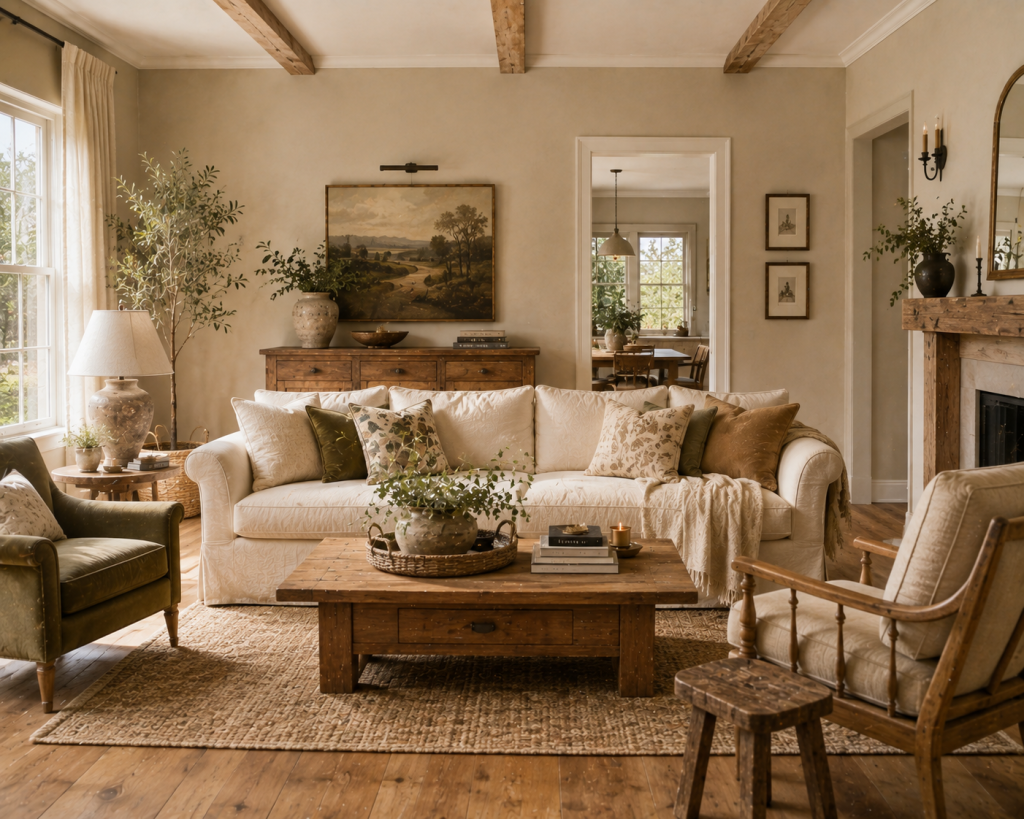
Warm ivory, putty, mushroom, parchment, soft taupe, or a pale clay tone often works better with oak floors and rustic furniture. These colors soften the transition between walls and natural wood instead of creating a sharp contrast.
If your living room has little daylight, sample several warm neutrals before painting. A cream that looks gentle in a south-facing room can become noticeably yellow under warm artificial light.
Tip 2: Let real wood carry more of the room
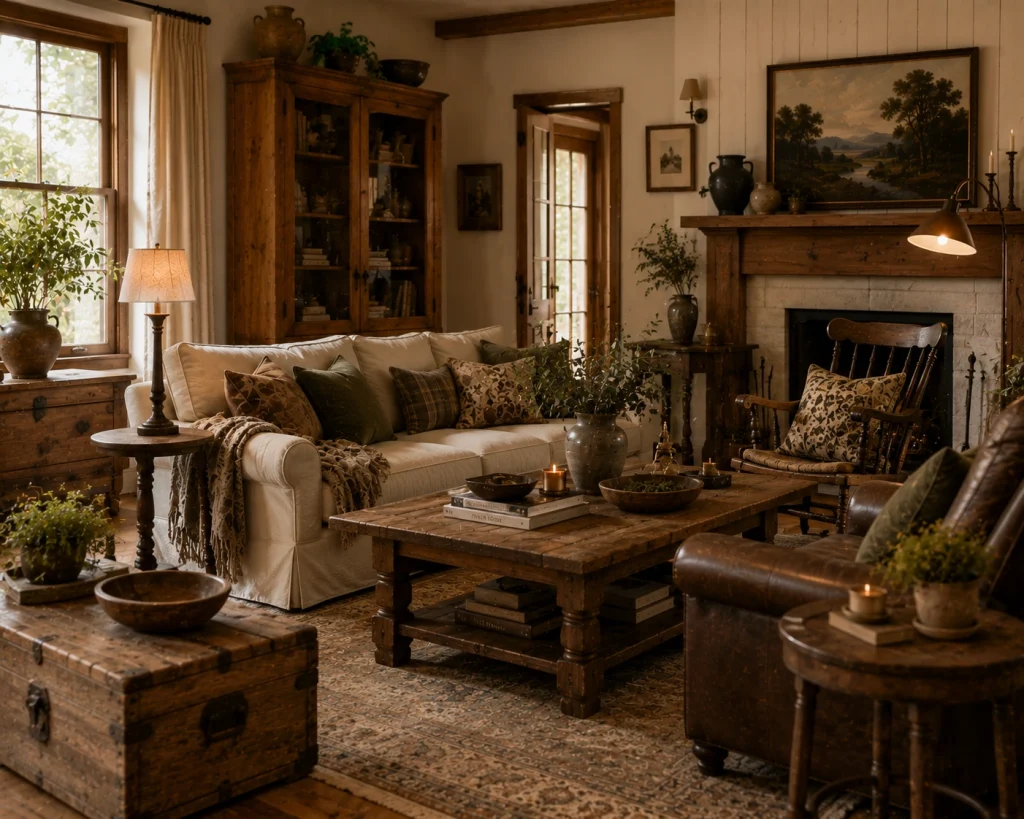
Wood is fundamental to farmhouse interiors, but the finish matters.
Skip the heavily distressed gray wood that became closely associated with earlier modern farmhouse. Medium oak, old pine, walnut, reclaimed timber, and darker stained finishes feel richer and more convincing.
Dark woods are also gaining strength across 2026 interiors, with walnut and espresso-toned oak appearing as alternatives to years of very pale timber.
You don’t need matching species. An old pine chest can sit beside a walnut side table if the undertones feel warm and intentional.
Tip 3: Mix polished pieces with imperfect ones
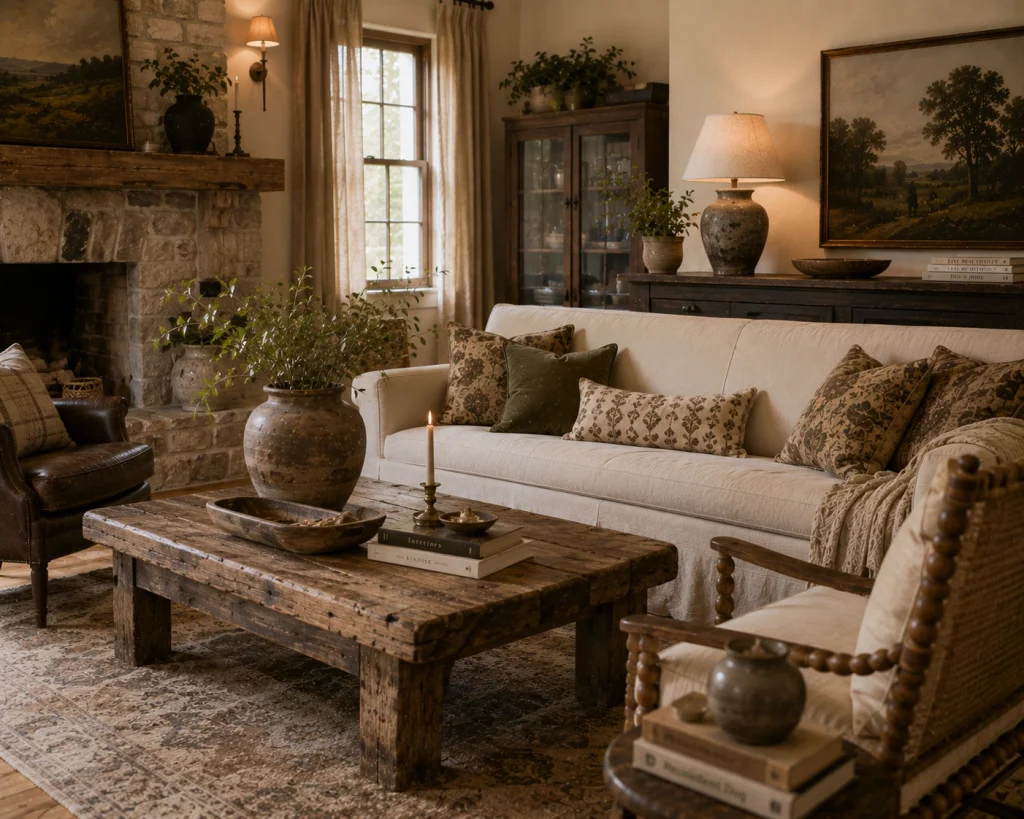
Farmhouse style becomes interesting through contrast.
Pair a clean-lined upholstered sofa with a weathered wooden table. Put an aged ceramic lamp on a relatively crisp cabinet. Let rough stone sit beside soft linen.
Current design thinking is embracing this type of material tension and designed imperfection rather than rooms where every finish looks new and flawless.
And this is one place where an inexpensive secondhand piece can do more than another brand-new accessory.
Choose furniture that feels gathered over time

Tip 4: Avoid the complete matching living room set
A matching sofa, loveseat, chair, coffee table, and side tables may be convenient, but it removes the variation farmhouse rooms need.
Start with one comfortable sofa, then add seating with a different shape or material. A linen sofa might sit with a leather club chair or an upholstered wooden armchair. Combine a substantial wood coffee table with a smaller aged-brass or ceramic side table.
Better Homes & Gardens recently highlighted matching furniture sets among the choices that can make interiors feel dated.
The room should coordinate without looking purchased in one afternoon.
Tip 5: Use one vintage piece with enough presence
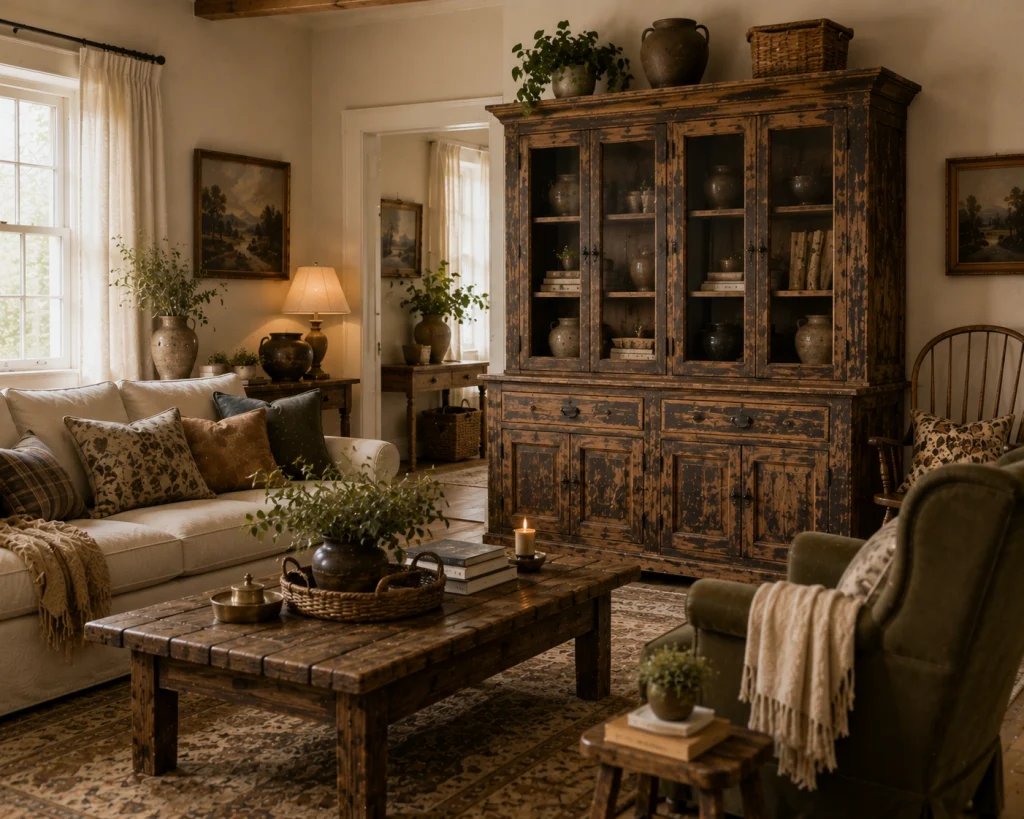
A tiny vintage jug on a shelf will not give a new room much history. A substantial old piece will.
Consider an antique chest, farmhouse table used as a console, vintage wooden cabinet, old Windsor chair, or weathered bench.
Vintage furniture is becoming even more relevant in 2026 living rooms as designers favor individual, collected interiors.
I once saw a perfectly pleasant neutral room where almost everything was new. The one piece everyone noticed was an old pine chest with uneven drawers. Its imperfections gave the rest of the room context.
Tip 6: Buy a sofa for comfort before style
Farmhouse living rooms should feel usable.
A sofa with a seat depth around 22 to 24 inches often gives comfortable lounging without becoming excessively bulky, although body height and room size matter. In a compact living room, a sofa around 72 to 84 inches wide may provide better circulation than a deep sectional.
Linen-look upholstery, cotton blends, brushed fabrics, and softly textured performance materials fit the style well.
And no, the sofa does not need rolled arms simply because the room is farmhouse.
Layer textiles without turning everything beige
Tip 7: Start with a generous rug
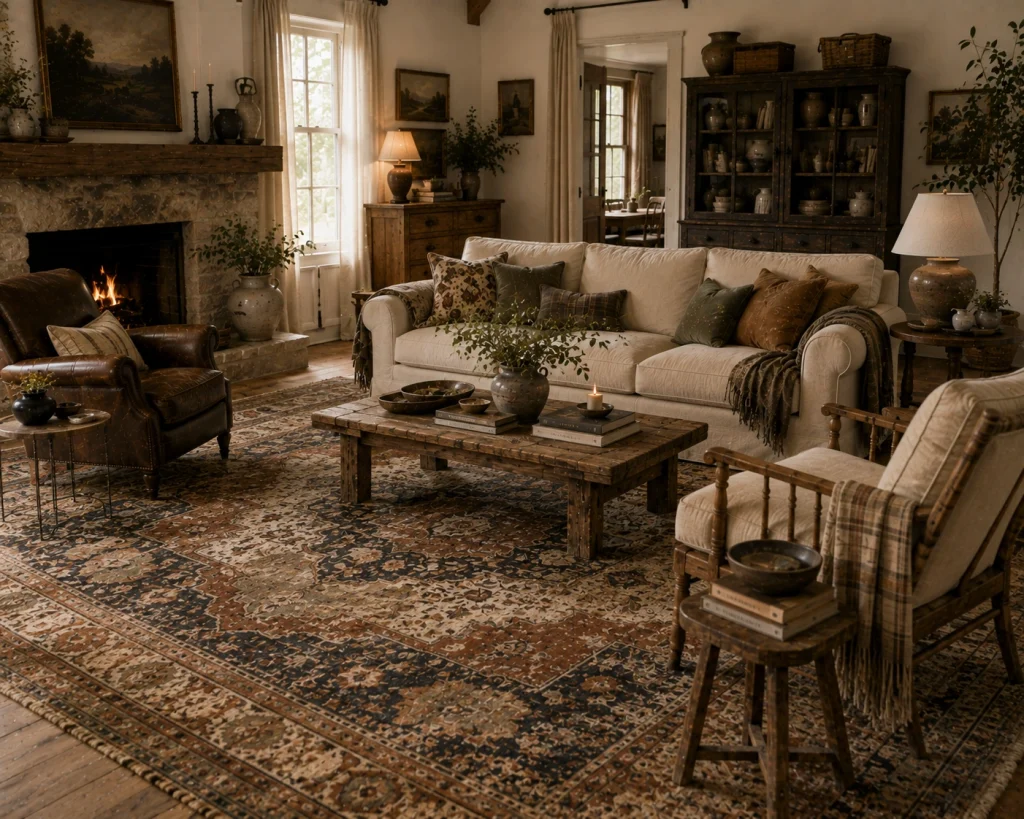
One of the quickest ways to make a farmhouse living room look unfinished is using a rug that is too small.
Where the layout permits, at least the front legs of the main sofa and chairs should sit on the rug. An 8-by-10-foot rug often works better than a 5-by-7 in an average seating area.
Look beyond plain jute. Faded Persian-style patterns, muted stripes, checked wool, understated florals, and woven rugs containing rust, olive, tobacco, navy, or warm cream can bring more depth.
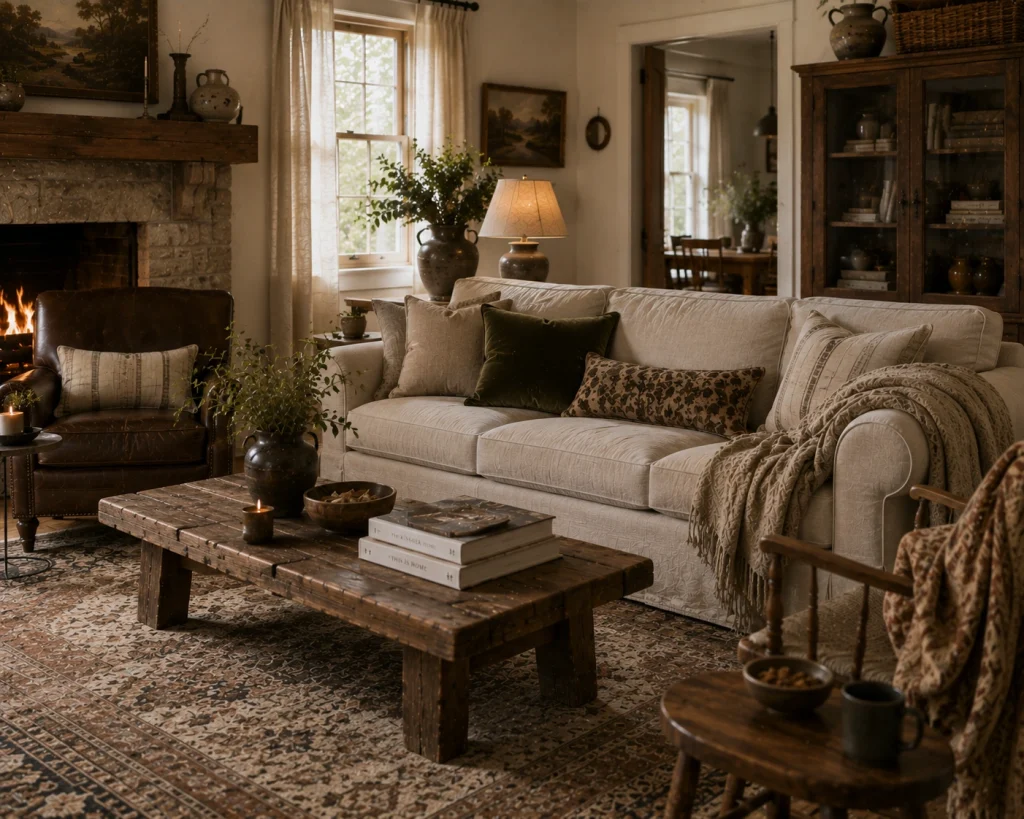
Tip 8: Mix linen, wool, cotton, and leather
Texture should come from materials rather than dozens of decorative objects.
Try a linen or cotton sofa, wool rug, leather chair, woven throw, and perhaps one velvet cushion. The finishes should feel related but not identical.
Modern farmhouse has become more refined partly because it now mixes organic, rougher materials with smoother and softer ones rather than relying on rustic texture everywhere. Designers have long used that rough-versus-soft balance to keep farmhouse rooms comfortable rather than costume-like.

Tip 9: Bring pattern back into the room
Farmhouse does not have to mean plain cream upholstery.
Small florals, ticking stripes, gingham, windowpane checks, and quiet botanical motifs can prevent a neutral room from feeling lifeless. The trick is controlling scale.
For example, pair a larger floral cushion with a narrow striped one and a solid rust or olive pillow. Repeating one or two colors across different patterns creates connection without requiring identical prints.
A 2026 Iowa living room by Oho Interiors demonstrates how mixed patterns, warm oak, built-ins, and softer furnishings can give a structured room an easy country-house quality.
Give the architecture farmhouse character carefully
Tip 10: Use paneling where it makes architectural sense
Shiplap is not banned. Covering every wall with it is the problem.
In a newer home, consider paneling the lower third of the wall, adding simple tongue-and-groove around a fireplace, or using restrained vertical boards in an alcove. Traditional wall molding can sometimes give a room more longevity than obvious farmhouse paneling.
If the house already contains exposed brick, original beams, timber trim, or stone, let those materials lead before adding another rustic surface.
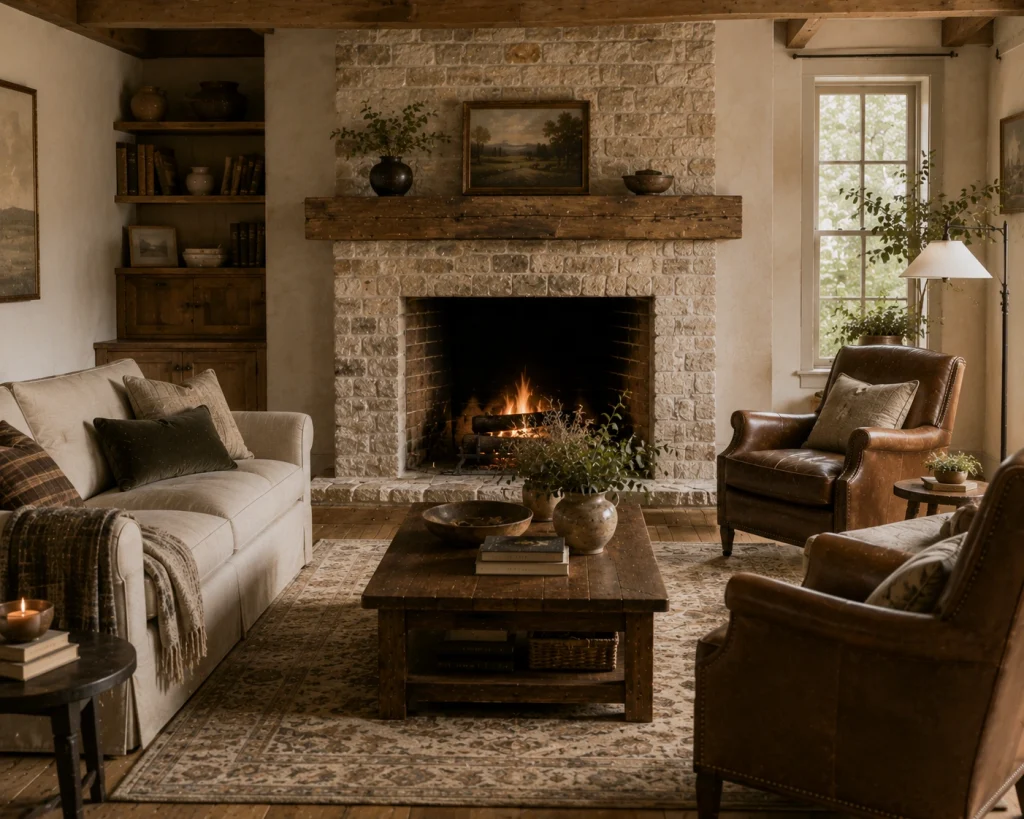
Tip 11: Make the fireplace feel substantial, not decorated
A farmhouse fireplace works best when the materials do most of the talking.
Limestone, brick, fieldstone, plaster, or a simple timber mantel can provide enough texture without filling the mantel with signs, garlands, lanterns, and identical candlesticks.
If you’re working with an ordinary drywall fireplace, paint can help. A warm putty or plaster-like finish around the surround often feels quieter than introducing faux stone purely to chase the farmhouse look.
Natural stone, exposed brick, reclaimed wood, and simple contemporary furniture remain a strong combination in well-designed farmhouse rooms.
Use color with more confidence
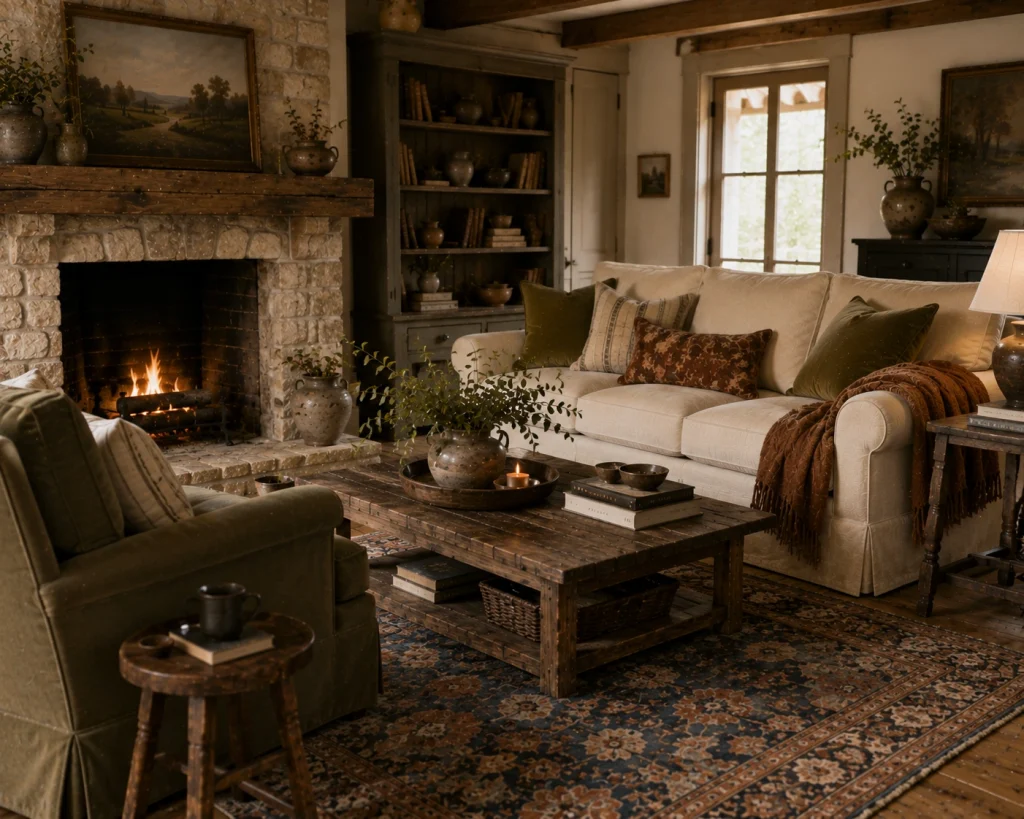
Tip 12: Add olive, tobacco, rust, or muted blue
Farmhouse palettes do not need to stop at white, cream, gray, and black.
Muted olive works beautifully beside oak. Tobacco leather gives a pale sofa more weight. Faded rust warms stone and brick. Dusty blue or an inky navy can cool a room containing lots of yellow-toned timber.
Use color on something meaningful, such as an armchair, rug, curtains, painted cabinet, or large artwork. See more living room color combination ideas for pairing options. Six tiny accent objects rarely have the same effect.
One contrarian rule is worth remembering here: a neutral farmhouse living room often needs less beige decor, not more.
Tip 13: Let black become an accent rather than the entire contrast plan
Black window frames, black hardware, black lights, black tables, and black curtain rods became a recognizable modern-farmhouse formula.
Keep one or two blackened-metal details if they suit the architecture, but consider aged brass, bronze, iron, or dark wood elsewhere. For more restrained ways to use dark tones, see these black accent living room ideas.
The result has more tonal variation and feels less tied to a specific decorating era.
Finish with objects that have a reason to be there
Tip 14: Use art, books, pottery, and useful objects
Farmhouse rooms feel most convincing when the accessories could plausibly have accumulated over time.
Try landscape paintings, botanical studies, framed drawings, old books, handmade stoneware, wooden boxes, baskets used for blankets, and one or two pieces of vintage glass.
Avoid buying twenty objects simply because the product description contains “farmhouse.”
A shelf containing six meaningful pieces usually feels richer than one containing twenty-five coordinated decorations.
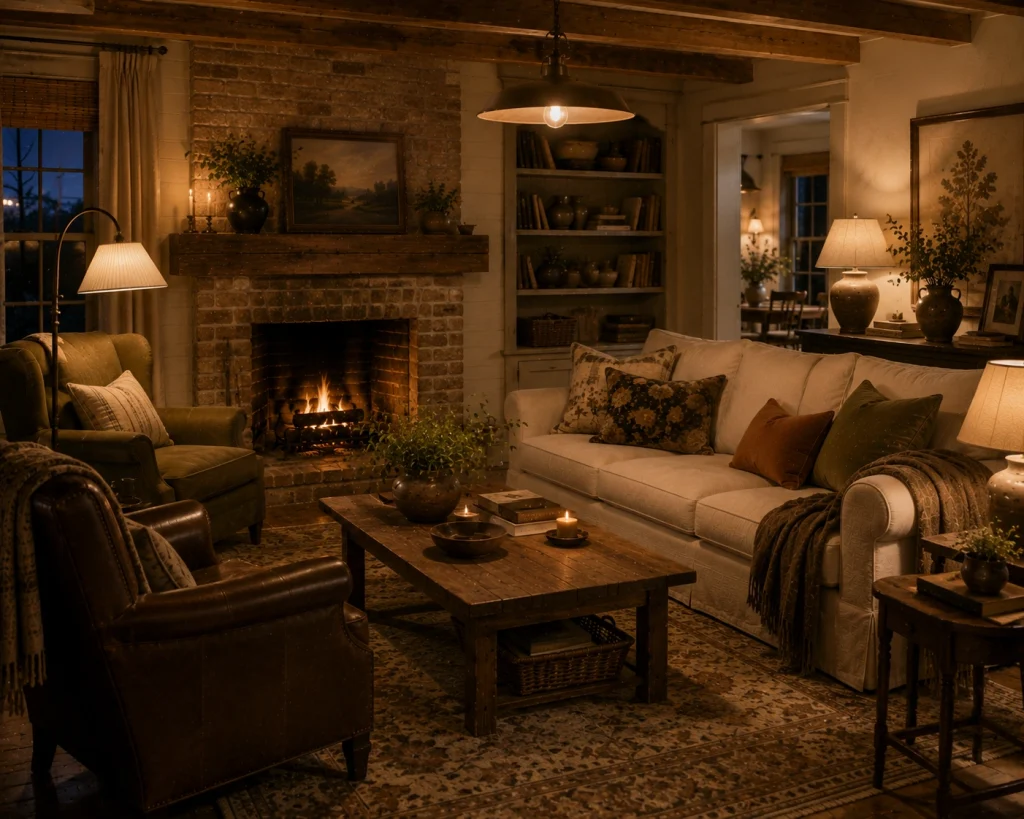
Tip 15: Layer the lighting instead of relying on one chandelier
The oversized black wagon-wheel chandelier became such a strong farmhouse symbol that it can make an otherwise updated room feel predictable.
Consider aged brass, linen shades, ceramic lamps, iron picture lights, or a simpler sculptural pendant instead.
Use several light sources. A floor lamp beside a reading chair, table lamp on a console, and overhead fixture give the room more flexibility than one bright central light.
Keep bulbs on the warmer side where comfortable, particularly around wood, linen, brick, and stone.
A simple farmhouse living room formula
| Element | More current approach | Be cautious with |
|---|---|---|
| Walls | Warm ivory, putty, clay, mushroom | Stark white everywhere |
| Wood | Oak, pine, walnut, reclaimed timber | Gray distressed finishes |
| Furniture | Mixed old and new pieces | Matching sets |
| Textiles | Linen, wool, leather, pattern | All-beige layering |
| Metal | Brass, bronze, iron, selective black | Black on every fixture |
| Decor | Art, books, pottery, useful baskets | Farmhouse-themed signs |
What should you skip in a farmhouse living room?
Mass-produced word signs. A room does not need to announce “HOME,” “FAMILY,” or “FARMHOUSE.” Art, photography, landscapes, and textiles communicate far more personality.
Artificial distressing everywhere. One genuinely old table has more credibility than five new pieces deliberately scraped to appear old.
Gray wood with cool gray upholstery. This combination defined an earlier period of modern farmhouse and can make a room feel cold. Warmer timber and nuanced neutrals are easier to live with.
Too much black contrast. Black can sharpen a pale room, but repeating it on every frame, fixture, table, and handle creates a rigid formula.
Decorating every surface. Farmhouse warmth comes from materials and lived-in objects, not filling every shelf.
Try this if your living room already looks dated farmhouse
Do not replace everything.
First, remove obvious themed decor and leave the surfaces partially empty. Then identify the coolest gray element in the room. If possible, replace or soften it with warm wood, olive, tobacco, rust, mushroom, or parchment.
Keep your good neutral sofa. Add a vintage wood table rather than another matching piece. Replace two decorative cushions with patterned or textured covers. Finally, change one strongly dated fixture, such as an oversized black chandelier.
Those few edits can change the direction of the room without turning it into an expensive renovation.
FAQ
Is farmhouse living room decor still popular in 2026?
Yes, although the rigid modern-farmhouse formula has lost some of its appeal. Current versions feel warmer and more individual, mixing natural materials, vintage furniture, comfortable upholstery, pattern, and personal objects rather than relying on white walls and black accents.
What colors make a farmhouse living room feel current?
Warm ivory, mushroom, putty, olive, muted blue, tobacco brown, rust, and deeper wood tones work particularly well. Choose colors based on your flooring, daylight, and existing upholstery rather than following one fixed farmhouse palette.
Can farmhouse style work in a small living room?
Yes. Use fewer substantial pieces rather than many small rustic objects. A properly sized rug, compact sofa, one vintage table, closed storage, and layered lighting can communicate the style without crowding the room.
Can I mix farmhouse decor with modern furniture?
You should. The contrast between clean contemporary furniture and older wood, stone, linen, or vintage pieces keeps farmhouse interiors from becoming themed. The strongest rooms usually contain enough old and new elements to make neither side dominate completely.
Build the room around what already has character
The most useful lesson behind these 15 farmhouse living room tips is that farmhouse style works better as a feeling than a shopping category.
You do not need shiplap, a barn door, matching distressed furniture, or a collection of rustic accessories. Start with something that already has substance. That might be the oak floor, stone fireplace, old cabinet, linen sofa, or vintage landscape you own.
Then add materials and colors that support it.
If you make one change first, remove the most obviously themed object in the room and replace it with something you would still love without the farmhouse label. That is usually the point where the room starts feeling more personal and less like a trend.