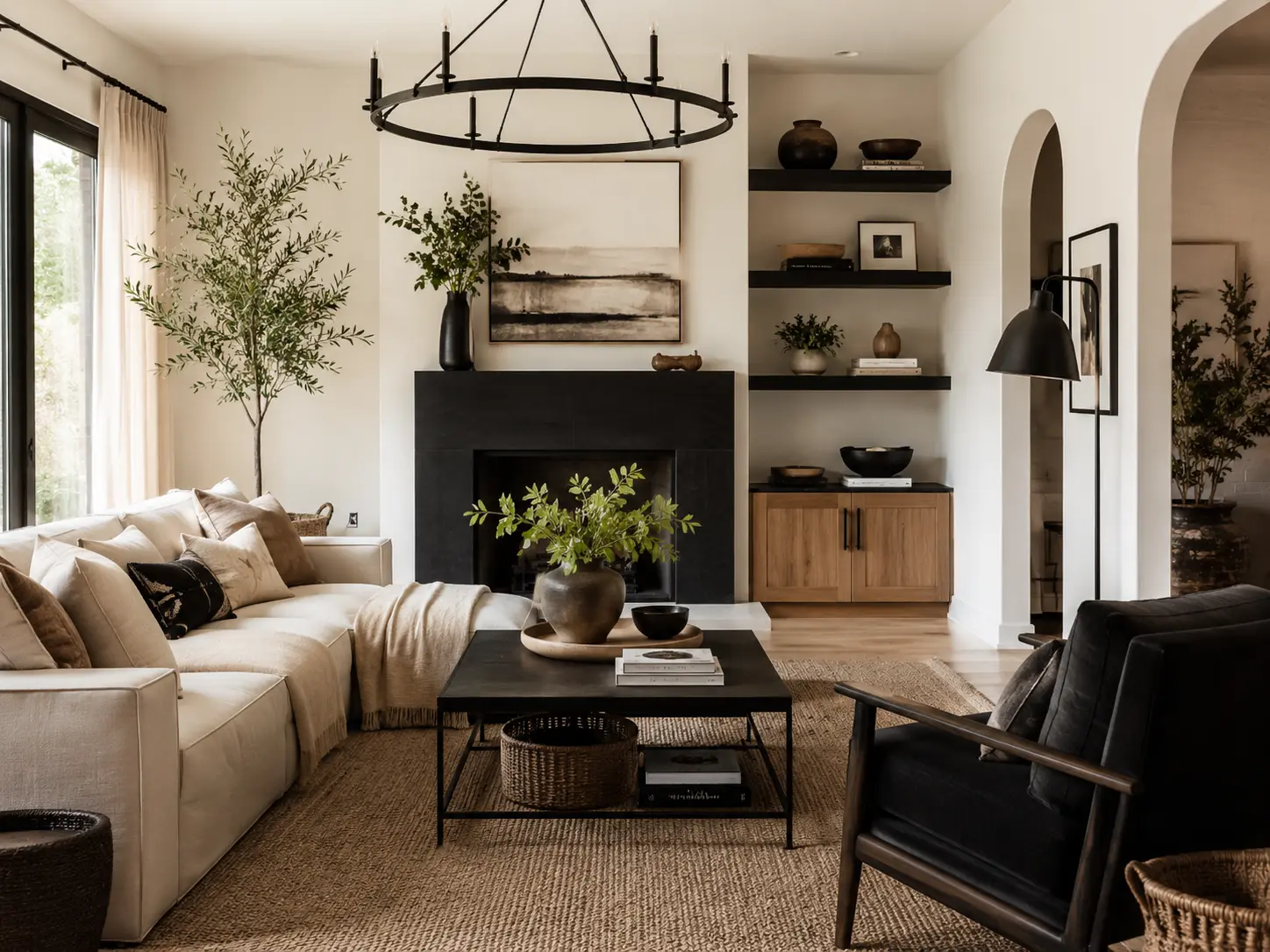
10 Black Accent Living Room Ideas for a More Grounded, Polished Space
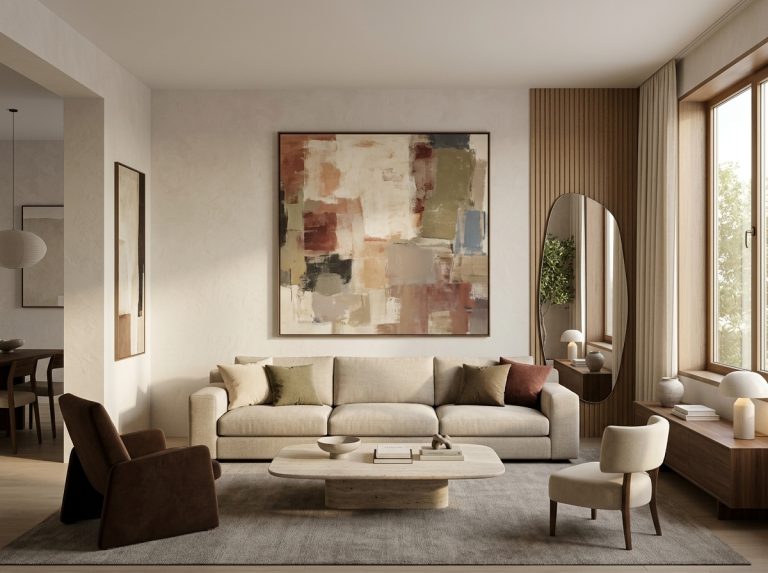
A pale living room can have beautiful furniture and still feel as though something is missing.
The cream sofa blends into the rug. The oak table blends into the floor. The artwork looks pleasant, but nothing gives your eye a strong place to land.
That’s where these 10 Black Accent Living Room Ideas become useful.
Black can behave almost like punctuation in a room. You don’t need much of it, but a few carefully repeated dark elements can sharpen lighter colors, define furniture, and give a neutral palette more visual weight. Designers continue to recommend small amounts of black for exactly that reason, while 2026 interiors are also favoring richer contrast, patinated metals, natural materials, and rooms with more personality. (homesandgardens.com)
The trick is not adding black everywhere.
It’s knowing where the room actually needs an anchor.

1. Frame the room with black windows, doors, or trim
Idea 1: Use black on architectural lines rather than an entire wall.
If you have white, cream, mushroom, or pale greige walls, black trim can make the room’s architecture much more noticeable.
Try painting:
- a window frame
- one interior door
- built-in shelving trim
- fireplace detailing
- baseboards in a selected zone
Homes & Gardens has long recommended black woodwork as a way to frame lighter walls and create definition without committing to a completely dark room. (homesandgardens.com)
This works particularly well in rooms that otherwise contain very soft colors.
Imagine warm-white walls, a camel sofa, oak floors, and linen curtains. A black window frame suddenly gives all those gentle surfaces a boundary.
Start smaller than you think
You don’t need every door and baseboard in the house to become black.
Paint one architectural element first.
A fireplace surround can be enough.
So can the trim around a large window.
If you like the result, repeat the black elsewhere through lighting or furniture rather than automatically painting more architecture.
Black is strongest when the eye notices the relationship between several separate elements.
2. Use black lighting and frames as the easiest entry point
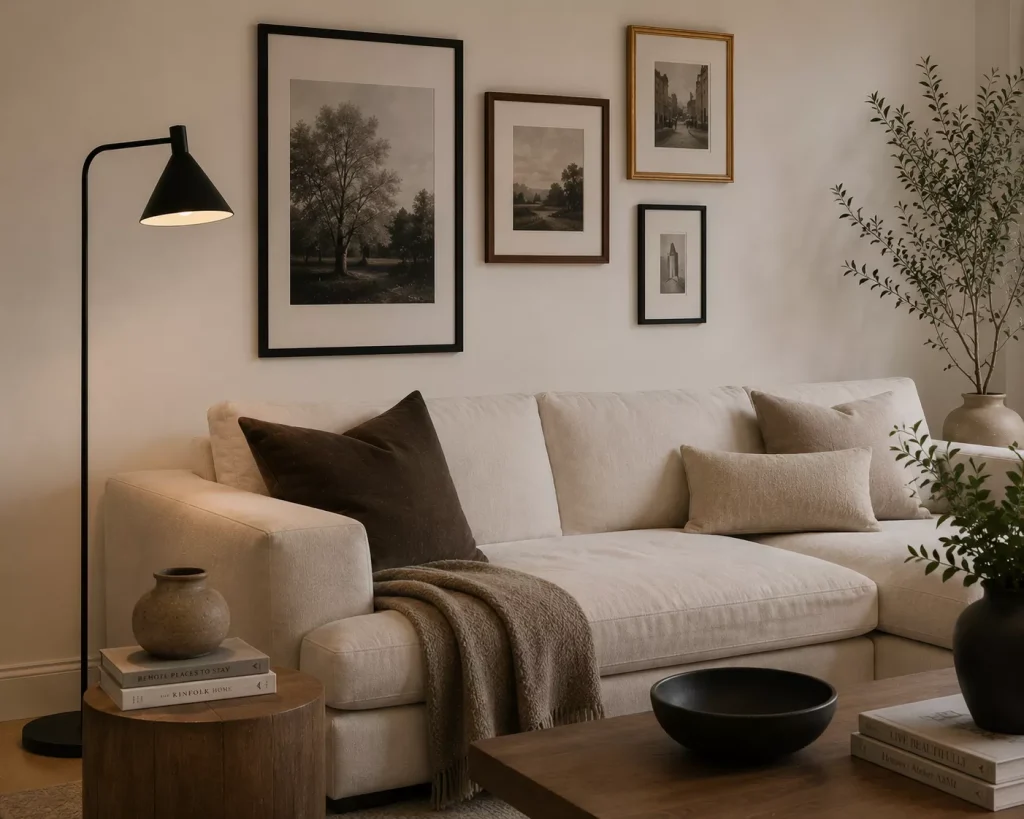
Idea 2: Introduce black through lighting.
This may be the simplest black accent to add because most living rooms already need lamps.
Try a blackened metal floor lamp beside a pale sofa.
Use a matte-black table lamp with a cream fabric shade.
Hang a dark metal pendant or lantern-style ceiling light if you’re already replacing an existing fixture.
Architectural Digest has highlighted blackened iron and steel in lighting as an effective way to add a strong visual base note without overpowering softer furnishings. (architecturaldigest.com)
A black lamp also creates a clean silhouette against a pale wall.
That means it can add impact even when the fixture itself is fairly simple.
Idea 3: Repeat black through picture frames.
If the lamp is black, echo it somewhere else.
Artwork is an easy place.
Use one substantial black frame above the sofa or mix two or three black frames into a gallery wall.
Avoid turning every photograph and painting into a matching black rectangle.
A mixture of walnut, brass, and black often feels more collected.
For example:
Large black frame
Small walnut frame
Aged brass frame
Another narrow black frame
The black pieces connect the composition without making it rigid.
This is particularly useful in renter-friendly rooms because you can introduce contrast without touching the paint.

3. Let one black furniture piece carry real visual weight
Idea 4: Add a black accent chair rather than a complete black sofa set.
One black chair can be surprisingly effective.
Place it beside a cream, camel, olive, or rust sofa.
Try black leather for a stronger graphic look.
For something softer, choose black linen, velvet, bouclé, or a dark charcoal-black fabric with visible texture.
The texture matters because completely flat black surfaces can absorb light and lose detail.
A woven or softly textured fabric keeps the piece visually interesting.
Black furniture also works best when lighter flooring, walls, or textiles give it room to stand out. Designer commentary around black living-room furniture consistently recommends balancing its visual weight with softer neutrals and layered texture. (homesandgardens.com)
Keep the chair shape interesting
If the color is simple, let the silhouette contribute something.
Try a curved barrel chair.
A black wood-frame chair with woven seating.
A sculptural lounge chair.
Or a traditional chair with a dark-painted frame and lighter upholstery.
Idea 5: Try a black bench or stool when a chair is too bulky.
Small living rooms can still use black furniture.
A narrow black bench beneath a window provides contrast without blocking much visual space.
A black wood stool can become a side table.
Two dark upholstered ottomans can tuck beneath a console and come out when guests need extra seating.
This is often more useful than adding another substantial armchair.
4. Ground the center of the room with a black table or cabinet
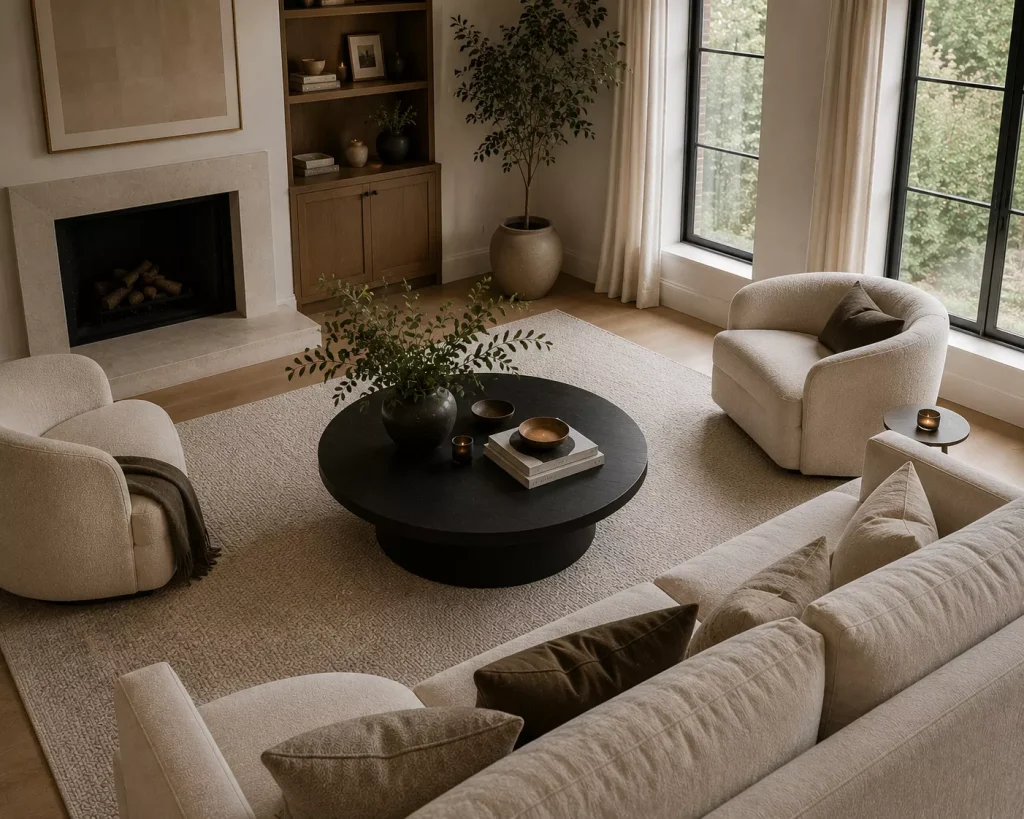
Idea 6: Use a black coffee table to anchor pale seating.
If your living room has a cream or light-gray sofa with a pale rug, a black coffee table can immediately organize the center of the seating group.
It doesn’t need to be a heavy rectangular block.
Try:
A round black wood table
Blackened metal with glass
A sculptural matte table
A dark stone table
A black pedestal design
For a softer look, I’d choose a table with rounded corners or an organic silhouette.
That prevents the dark color from feeling too severe.
Black is particularly good here because a coffee table naturally sits at the visual center of the furniture arrangement.
You get substantial contrast from one object rather than scattering dozens of tiny black accessories around the room.
Idea 7: Use black on closed storage.
A black credenza, media cabinet, or bookcase can create a strong horizontal anchor.
This works especially well against warm-white walls.
For a 70 to 80-inch television, a media console around 70 to 90 inches wide often feels more proportional than a small unit directly beneath the screen, although your wall and layout should guide the final size.
Look for detail that keeps black from appearing flat.
Fluted doors.
Cane panels.
Visible wood grain beneath a dark stain.
Rounded corners.
Antique-style hardware.
A black storage piece should still feel like furniture rather than a featureless box.
5. Bring black into softer layers rather than only hard finishes
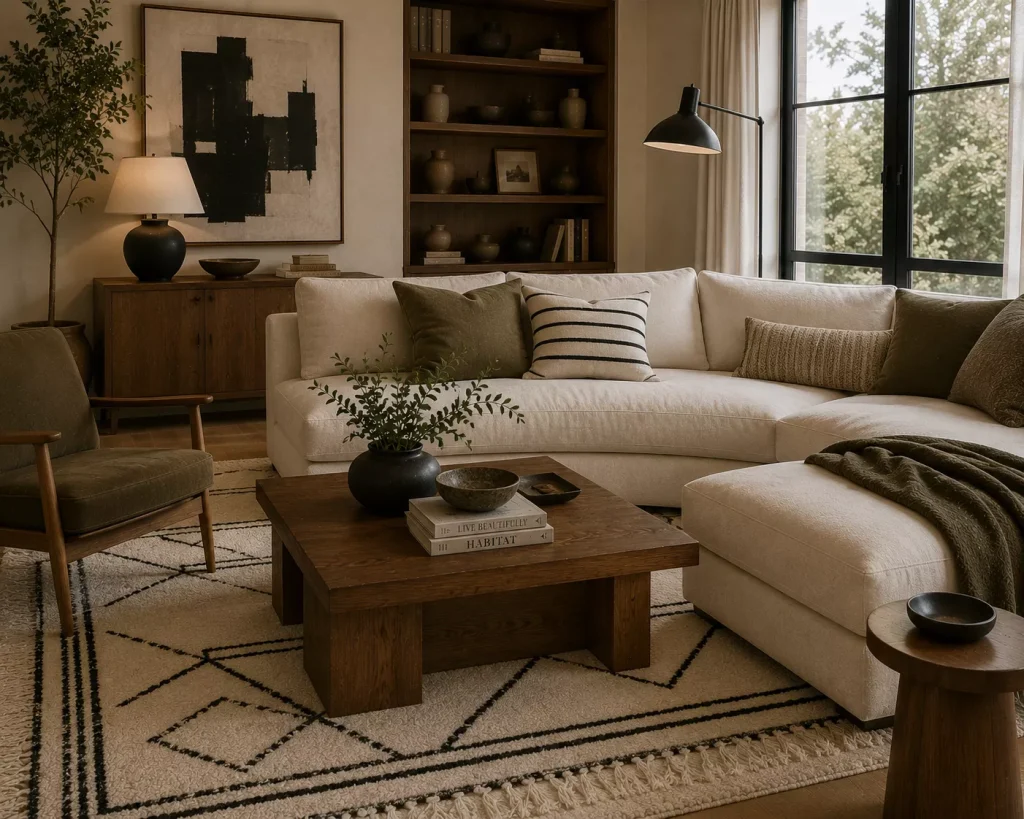
Idea 8: Use black in a rug, stripe, or textile pattern.
You don’t have to place solid black objects everywhere.
Sometimes pattern gives you enough contrast.
Try an ivory rug with a thin black geometric line.
Use cream-and-black striped cushions.
Add a small-scale black floral to an armchair.
Bring in a checked throw containing black, brown, and warm white.
This is one of my preferred approaches in earthy living rooms because pure solid black can occasionally feel disconnected from all the natural browns and greens.
Pattern blends it in.
A cream rug with thin black details can connect a black lamp, dark window frame, and walnut coffee table without making the floor itself dark.
Idea 9: Use black in artwork rather than decorative filler.
A large charcoal drawing can provide substantial dark value.
So can black-and-white photography.
Try one oversized abstract piece with black marks across a cream background.
Or use a landscape containing deep shadows rather than adding another black vase purely because the room “needs black.”
Architectural Digest has described black as a color that can clarify surrounding colors and make lighter or more delicate palettes appear crisper. (architecturaldigest.com)
Artwork is a good way to get that effect while also giving the wall some personality.
And choose art because you like it.
The black should support the art, not be the only reason you bought it.
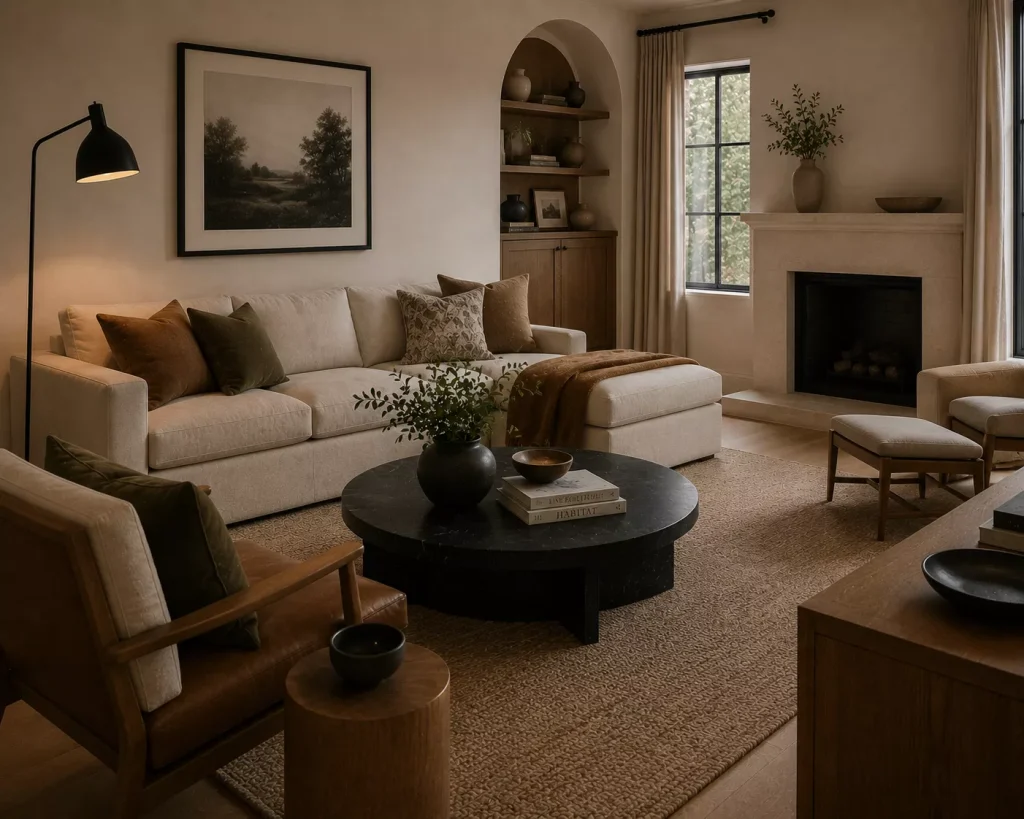
6. Repeat black in three places, then warm it up
Idea 10: Create a visual triangle of black accents.
One isolated black object can look accidental.
Ten can dominate the room.
Three is often a useful starting point.
For example:
Black floor lamp
Black picture frame
Black coffee table
They sit at different heights and areas of the room, so your eye moves between them.
Or try:
Black curtain rod
Black chair legs
Black ceramic bowl
The pieces don’t need to match.
They simply need to repeat enough dark value to create connection.
Designers discussing black accents often describe the color as grounding lighter schemes, especially when repeated subtly through lighting, furniture, hardware, or frames. (homesandgardens.com)
Then bring warmth around those black elements.
Here’s how several combinations behave:
| Black paired with | Overall feeling | Useful materials |
|---|---|---|
| Cream | Crisp but soft | Linen, wool |
| Walnut | Warm and grounded | Wood, leather |
| Camel | Relaxed and tailored | Leather, woven fabrics |
| Olive | Earthy and sophisticated | Velvet, linen |
| Terracotta | Warm and expressive | Pottery, wool |
| Dusty blue | Calm with stronger contrast | Cotton, ceramics |
My favorite is black with walnut and cream.
The black gives structure, walnut softens it, and cream keeps the room bright.
Use natural materials to prevent harshness
This part matters.
A room containing black metal, glass, bright white walls, and glossy tile can feel much harder than one containing the exact same amount of black beside oak, linen, wool, and ceramic.
Natural materials are receiving renewed attention in 2026, alongside patinated metals and authentic wood and stone, precisely because they bring warmth and character to highly designed rooms. (bhg.com)
So when you add black, add texture too.
What should you skip with black living room accents?
Skip the automatic black metal furniture set.
Black coffee table, black side tables, black console, black lamp, black curtain rod, black shelf brackets.
The repetition becomes too obvious.
Choose different materials.
Perhaps the coffee table is walnut, the lamp is black metal, and the console is painted olive.
Black doesn’t need to own every structural element.
I’d also avoid turning every neutral room into strict black and white.
Pure black with bright white can look beautiful, but cream, mushroom, camel, dusty blue, terracotta, olive, and brown usually create a softer result.
And be cautious with tiny black accessories.
A room doesn’t become more sophisticated because you added a black candle, black beads, black decorative chain, black bowl, black vase, and three black books.
Use black where it has visual purpose.
A substantial lamp provides more structure than six filler objects.
Finally, don’t assume black automatically makes a room feel smaller.
Strategically placed dark elements can create depth and definition. The bigger issue is balance, lighting, and how much dark surface you introduce. (bhg.com)

Try this if your living room feels too beige
Don’t repaint immediately.
First, remove a few of the smallest beige accessories.
Then introduce black in this order:
- Add one black lamp.
- Use one or two black artwork frames.
- Bring in a black or very dark brown table.
- Repeat black once through a small functional object.
- Add walnut, warm metal, or terracotta beside it.
Live with that for a week.
You may discover your beige walls and sofa weren’t the problem.
They simply lacked enough contrast.
This is where 10 Black Accent Living Room Ideas can save you from a much larger project.
A $60 lamp and a secondhand black table may create the structure you thought required new paint and furniture.
If the room still feels flat afterward, then look at the rug, curtains, and wall color.
But give contrast a chance first.
FAQ About Black Accents in Living Rooms
How much black should you use in a living room?
There’s no fixed percentage. Start with two or three noticeable black elements at different heights, then assess the room. Black should create definition without becoming the first thing you notice everywhere.
What colors work best with black living room accents?
Cream, warm white, walnut brown, camel, olive, terracotta, burgundy, sage, and dusty blue all work well. Natural wood and warm textiles are particularly useful if you want black to feel softer.
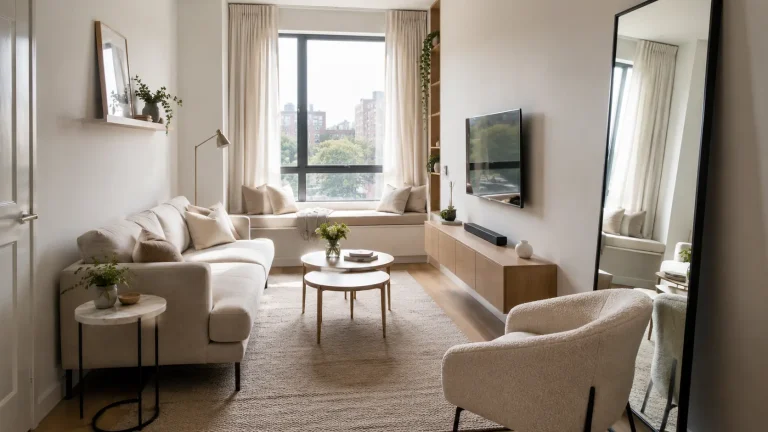
Can black accents work in a small living room?
Yes. Try black through narrow elements such as frames, lamp bases, chair legs, curtain rods, and one compact table. You can get strong definition without giving up much visual or physical space.
Are matte black accents still in style?
Black itself remains extremely flexible, but the fresher approach is less about matching matte-black hardware everywhere and more about mixing black with natural wood, aged metal, ceramics, color, and texture. Current interiors are becoming more layered and less dependent on perfectly coordinated finishes.
Use black like punctuation, not the whole sentence
The strongest 10 Black Accent Living Room Ideas have one thing in common.
They don’t ask black to decorate the entire room.
They use it to sharpen what is already there.
A black frame makes pale artwork more noticeable.
A black lamp gives a cream wall structure.
A dark table grounds a soft sofa.
A narrow black window frame makes the view outside feel almost like artwork.
Start with one medium-sized black piece rather than a collection of tiny accessories.
Then repeat the color twice somewhere else and bring warm wood or tactile fabric beside it.
That may be all your living room needs.
Black works best when it gives every softer color around it a little more confidence.