12 Curved Furniture Ideas for Living Room That Feel Soft, Sculptural, and Current
Living rooms contain an extraordinary number of rectangles.
The sofa, rug, television, windows, console, artwork, and coffee table often repeat the same straight lines until the room starts feeling more like a floor plan than somewhere you want to relax.
That’s where these 12 Curved Furniture Ideas for Living Room become useful.
Curved furniture is still a major 2026 direction. Designers are using rounded sofas, sculptural chairs, circular tables, and organic silhouettes to soften rooms and improve flow. But there’s an important shift happening too. Some designers are already pushing back against rooms where everything curves, arguing that the strongest interiors create tension between soft shapes and straighter pieces.
I agree.
One beautiful curve can change an entire living room.
Twelve competing curves can make it look like nothing owns a ruler.
Here’s how I’d use the idea in a real home.
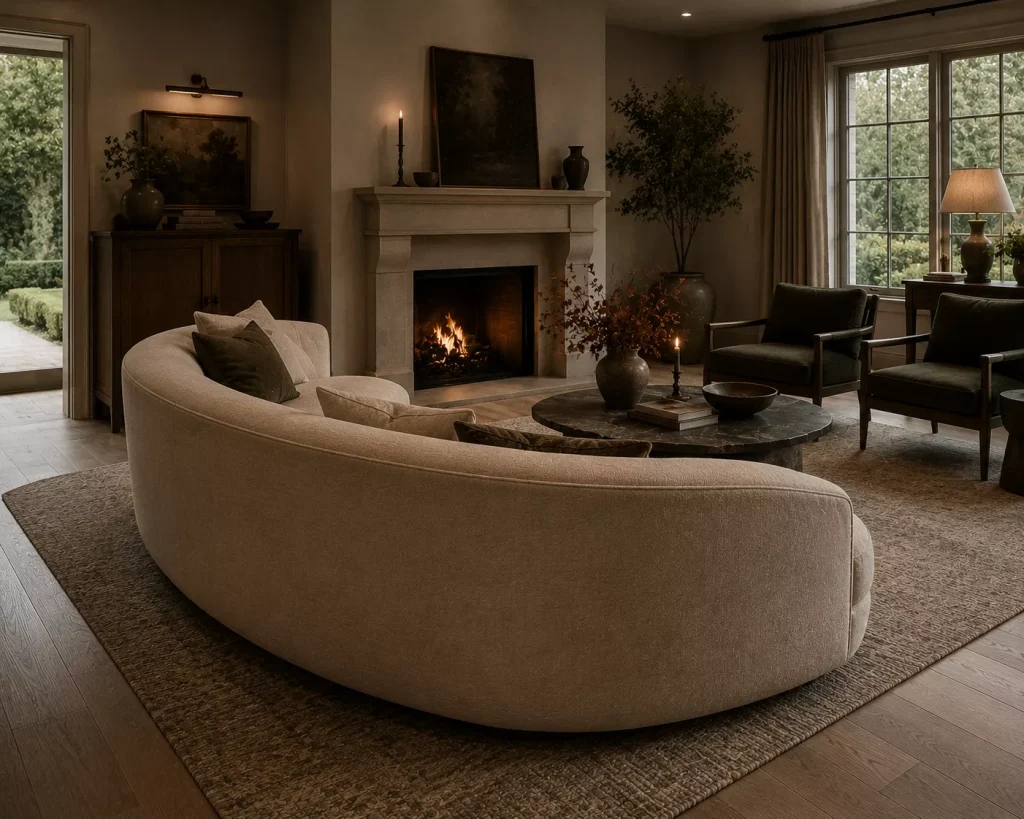
1. Make one curved sofa the room’s main statement
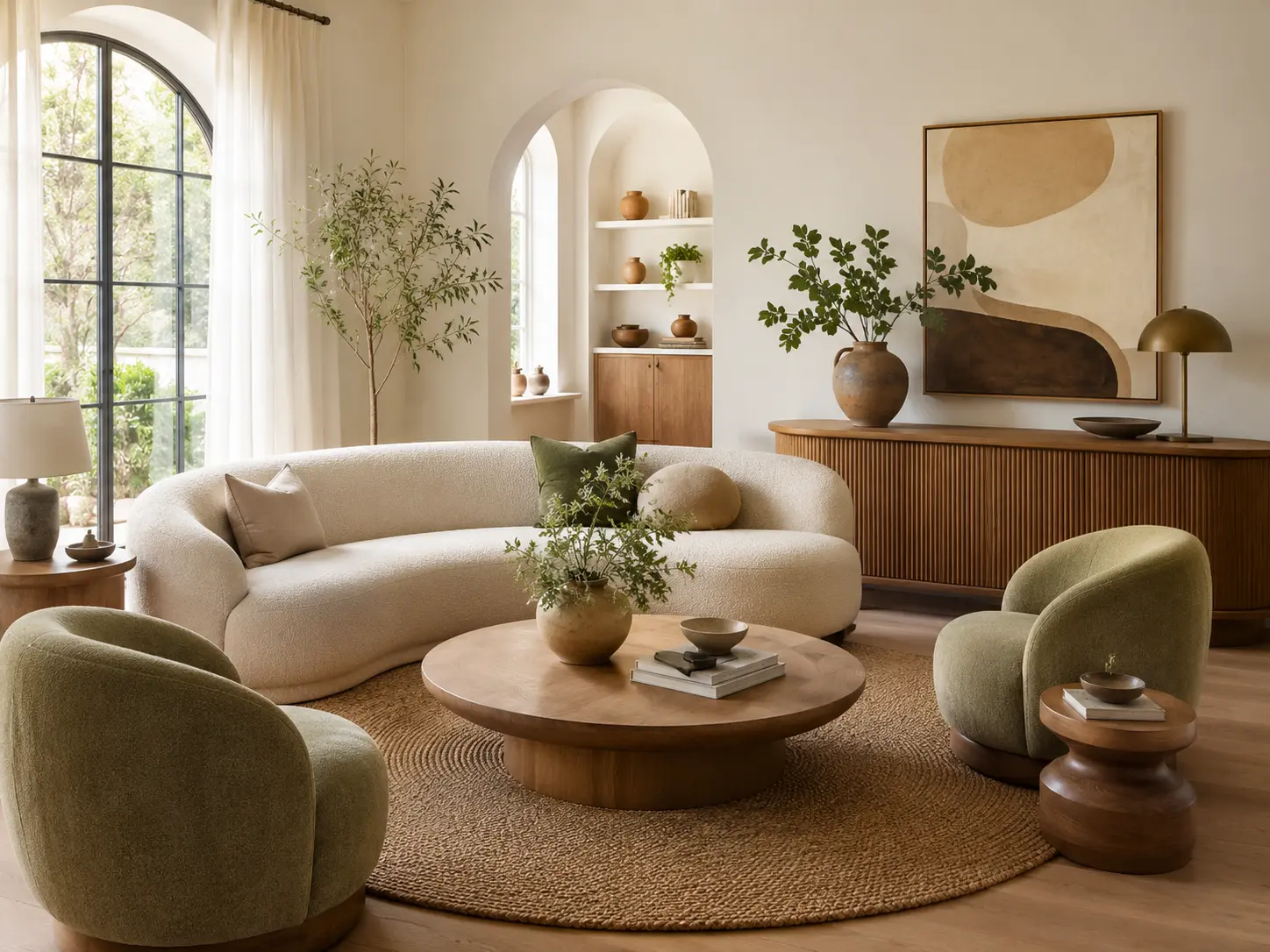
Idea 1: Use a gently bowed sofa instead of an exaggerated semicircle.
A curved sofa can immediately soften a living room because it changes the silhouette of the largest piece in the space.
And despite looking very current, curved sofas aren’t new. Vladimir Kagan’s famous Serpentine sofa dates to the early 1950s, which is a useful reminder that this shape has much deeper design roots than a passing social-media trend.
For most homes, I’d choose a gentle curve rather than something dramatically crescent-shaped.
A sofa around 80 to 95 inches wide with slightly rounded arms or a shallow bowed back is much easier to place than a huge sculptural piece.
Curved sofas work particularly well:
- floating within a larger room
- facing a fireplace
- centered around a round or irregular coffee table
- in a bay-window or rounded architectural space
- as part of a conversation-focused layout
Leave some space around it
A sculptural sofa needs enough floor around it for the curve to register.
If you squeeze it tightly against two walls, much of the effect disappears.
This is why I wouldn’t automatically recommend one for a very narrow living room.
A conventional sofa with rounded arms may give you the softness without consuming valuable circulation space.
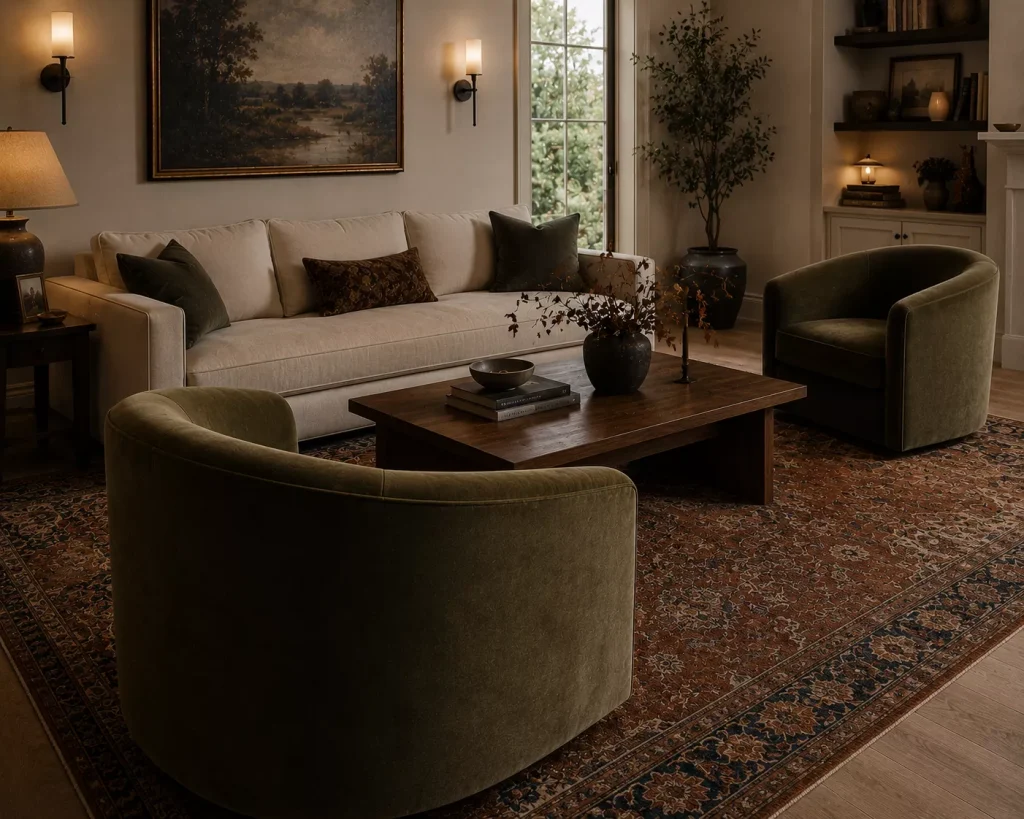
2. Use two barrel chairs to soften a straight sofa
Idea 2: Keep the sofa linear and curve the secondary seating.
This is probably the easiest way to try curved furniture.
Use your existing rectangular sofa, then place two rounded barrel chairs opposite or slightly angled toward it.
Current living room guidance supports a one-sofa-plus-two-chair arrangement because it creates a clear conversation zone without requiring a matching furniture set.
The curved backs break up the sofa’s straight line.
And because chairs are smaller than sofas, you can introduce a stronger shape without letting it dominate the room.
Try:
Cream sofa
Two olive barrel chairs
Walnut coffee table
Rust and blue patterned rug
Or:
Chocolate sofa
Two oatmeal curved chairs
Round stone coffee table
Brass floor lamp
I’d avoid pairing a heavily curved sofa with two equally dramatic rounded chairs unless the room is large enough to support all three.
House Beautiful’s 2026 living-room coverage is leaning toward mixed shapes, scales, and fabrics rather than coordinated sets.
That contrast is what makes the curved pieces interesting.

3. Add a curved swivel chair in a multifunctional room
Idea 3: Let movement make the furniture more useful.
A curved swivel chair is especially good in a living room with more than one focal point.
Perhaps the television sits on one wall while the fireplace is somewhere else.
Or maybe the living room opens toward the kitchen and conversation regularly moves between both spaces.
A swivel chair lets you turn without dragging furniture across the floor.
And the rounded back naturally suits the mechanism.
Curved swivel seating is getting plenty of attention in 2026 because it combines softer silhouettes with flexibility. One recent example highlighted a rounded 360-degree swivel chair specifically for its ability to move between different conversations in a social room.
For a smaller space, measure the turning radius carefully.
A chair may physically fit but still bump the wall every time it rotates.
Leave a little clearance around it.
I’d use one swivel chair rather than a pair if the room is tight.
Then balance it with a simpler chair or side table elsewhere.
Function should justify the shape.
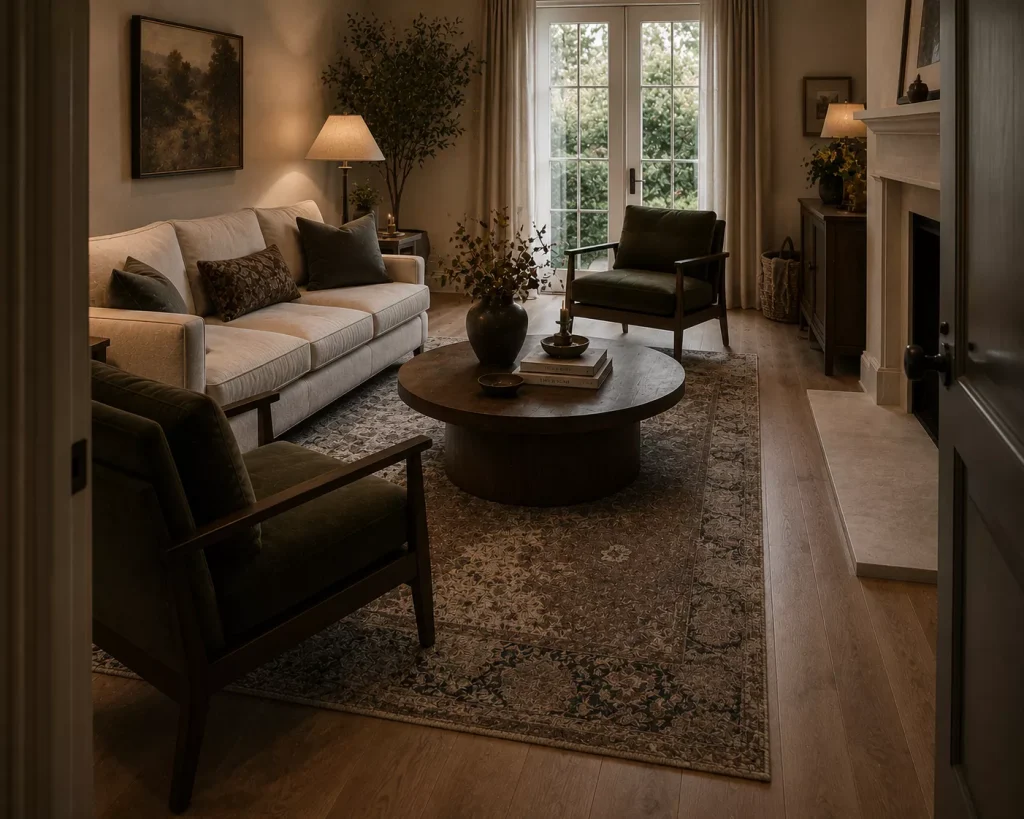
4. Replace a rectangular coffee table with a round one
Idea 4: Use a circle where people actually walk.
This is one of the most practical curved furniture changes you can make.
Coffee tables sit directly in the circulation zone between seating pieces.
Rounded corners remove the sharp projections that people constantly walk around.
That makes a round table particularly useful in:
Small living rooms
Homes with children
Rooms with several chairs
Tight sectional layouts
Spaces where people cross between sofa and television
Architectural Digest’s 2026 coffee-table coverage shows how curved and organic tables can unify living rooms while playing against straighter furniture and rug lines.
For many standard sofas, something around 32 to 40 inches in diameter works well, depending on the seating arrangement.
Try to preserve around 14 to 18 inches between the table and sofa where possible.
Idea 5: Try an irregular organic table instead of a perfect circle.
Kidney, pebble, and softly triangular shapes give you the same visual softness with more personality.
2026 furniture forecasts are especially interested in irregular and organic shapes, not only perfect circles.
This works beautifully if the rest of your room is quite tailored.
A boxy sofa beside a freeform stone or wood table creates exactly the kind of shape tension that keeps curved furniture from feeling gimmicky.

5. Use a round ottoman when you need flexibility
Idea 6: Let one soft piece work as table, footrest, and extra seat.
A rounded ottoman is useful because it introduces curves without adding another hard furniture piece.
Choose something firm enough to hold a tray.
Then it can serve as:
Coffee table
Footrest
Occasional seating
Soft play-friendly surface
Current 2026 living room furniture trends are placing more emphasis on ottomans, laid-back seating, and flexible furniture rather than rigid formal arrangements.
For a neutral living room, try chocolate velvet, olive chenille, caramel leather, or a patterned woven fabric.
A patterned ottoman can be particularly effective because its rounded form prevents the print from feeling overly formal.
One caution.
Very soft ottomans may look wonderful but become annoying as tables.
If you regularly place drinks there, use a rigid tray around 16 to 22 inches wide, depending on the ottoman.
And don’t put a giant round ottoman in front of a giant curved sectional simply because both are fashionable.
One of them should visually lead.
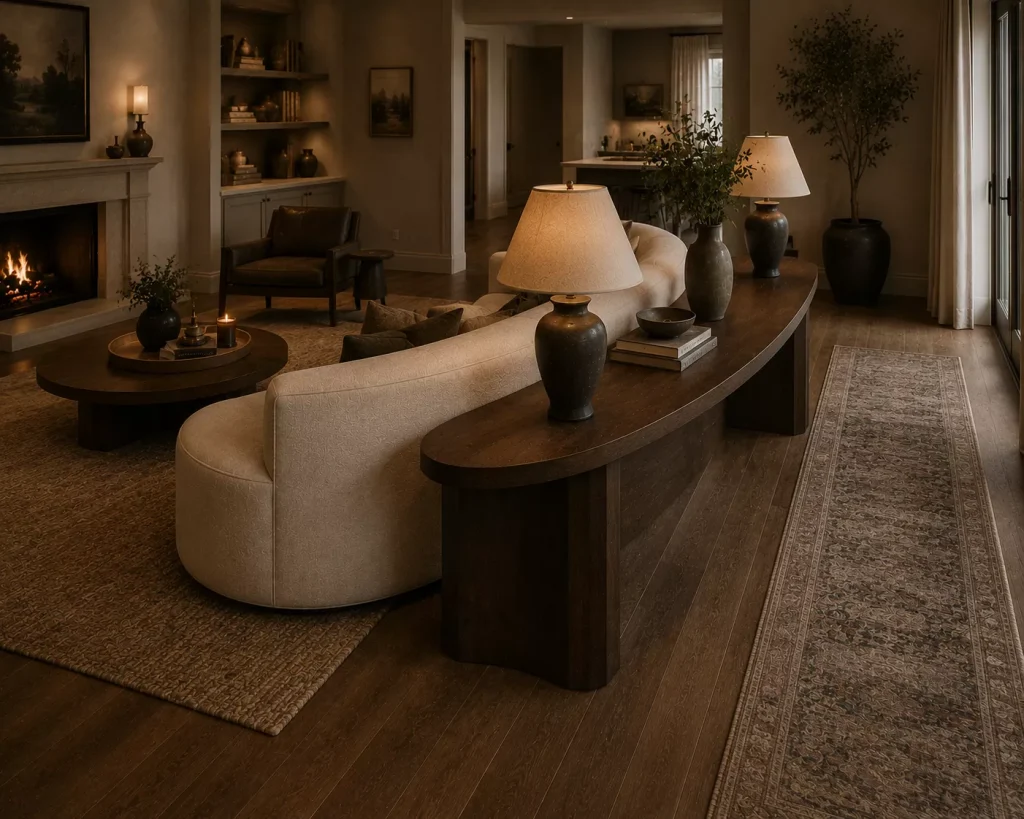
6. Put a curved console behind a floating sofa
Idea 7: Echo the sofa shape without copying it exactly.
This is one of the less obvious ideas, and it can look fantastic in a larger room.
If you float a sofa away from the wall, a straight console behind a deeply curved back can sometimes leave awkward gaps.
A gently bowed console solves that.
You get:
A useful surface
A stronger furniture composition
A place for lamps
A subtle repetition of the sofa shape
But keep the curve gentle.
The goal is to respond to the sofa, not trace it exactly.
A curved console in dark walnut behind a cream sofa is particularly good because the deeper wood creates visual weight beneath the softer upholstery.
Current 2026 furniture direction includes stronger sculptural storage pieces too, with designers treating storage furniture as an anchor rather than an afterthought.
This idea is best in rooms with enough width behind the sofa for circulation.
If your sofa already sits against a wall, skip it.
There’s no reason to force every curved furniture idea into every room.
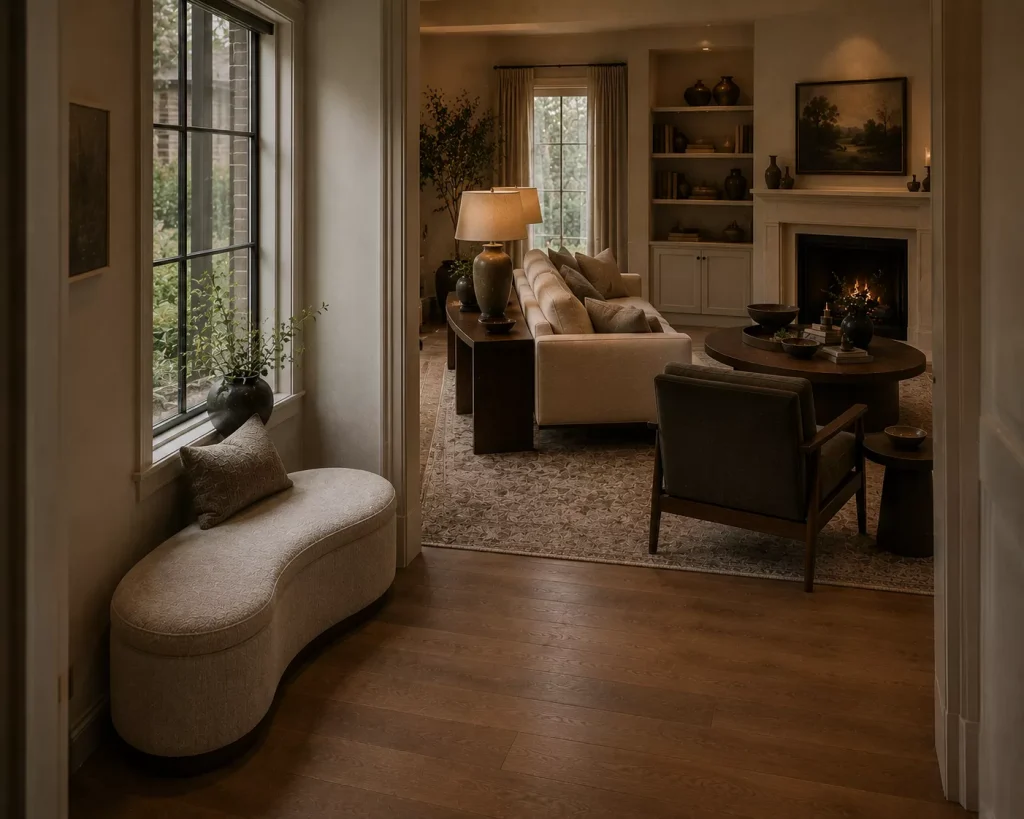
7. Try a crescent bench where another chair would feel bulky
Idea 8: Use a backless curve to keep sightlines open.
A curved bench can be surprisingly useful near a fireplace, window, or the edge of a conversation area.
Because it has no high back, it provides occasional seating without creating another visual wall.
Look for:
Crescent benches
Curved upholstered stools
Low sculptural benches
Half-moon seats
A curved bench can also sit beneath a large window where an armchair would block too much light.
For a hallway-facing living room, use it near the edge of the seating arrangement so the room stays visually open from the doorway.
I’d avoid treating a bench as someone’s main evening seat unless it provides proper back support.
This is occasional furniture.
Think guest seating, pulling on shoes, or somewhere to sit during a crowded gathering.
The broader 2026 move toward relaxed, sculptural seating makes pieces like this easier to integrate into living rooms that don’t follow traditional matching-suite formulas.
And because the bench is already unusual in shape, keep the fabric relatively quiet unless you want it to become the room’s focal point.
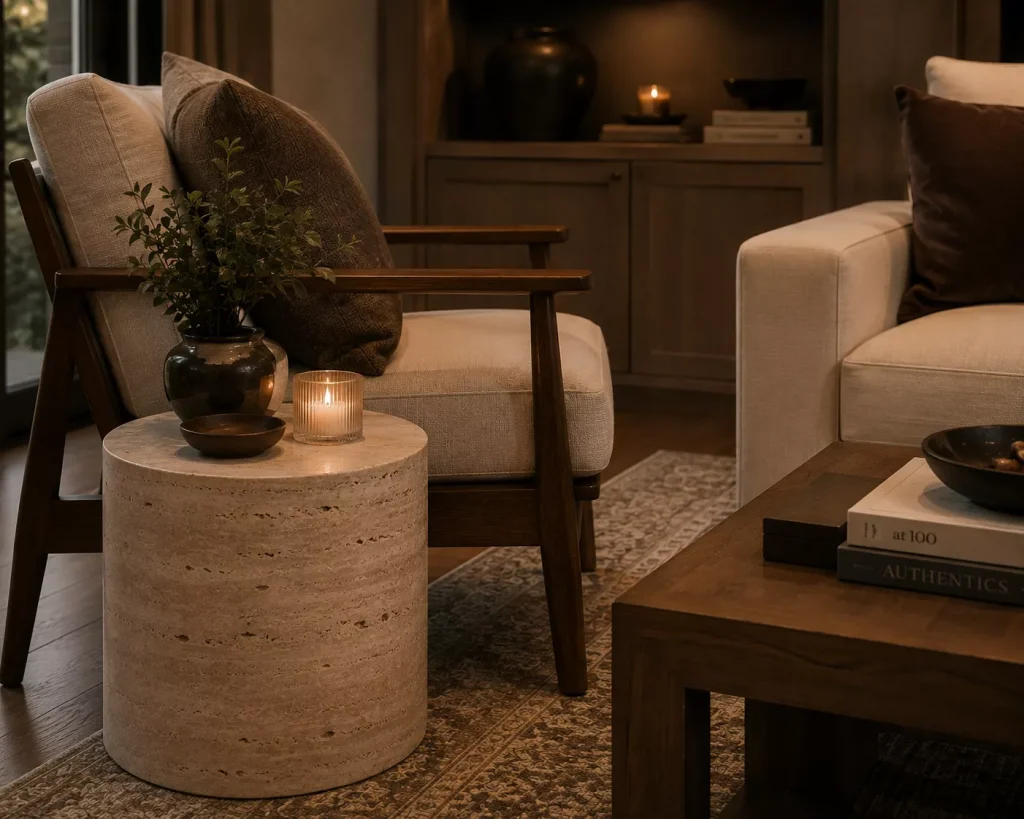
8. Bring curves into side tables at different heights
Idea 9: Use round side tables to interrupt square furniture.
If replacing a sofa feels excessive, side tables are an easier entry point.
A cylindrical pedestal table beside a squared-off sofa immediately softens that corner.
Try one around 18 to 24 inches wide, depending on the available space.
Materials matter.
A round travertine table feels substantial and architectural.
Dark wood makes the curve warmer.
Glass keeps it visually light.
Plaster or ceramic creates a more sculptural effect.
I particularly like a round side table beside a chair with straight wooden arms.
The contrast makes both pieces more noticeable.
Don’t make every table circular
This is where the current backlash against excessive curves becomes useful.
Some designers are already tired of rooms where the curved sofa, curved chairs, round coffee table, wavy mirror, and circular accessories all repeat the same idea. Their advice is to pair curved furniture with cleaner linear pieces so the room retains tension and structure.
I’d follow that.
If your coffee table is organic, use a square side table.
If your sofa is straight, round tables can do more work.
Curves need straight lines to look curved.
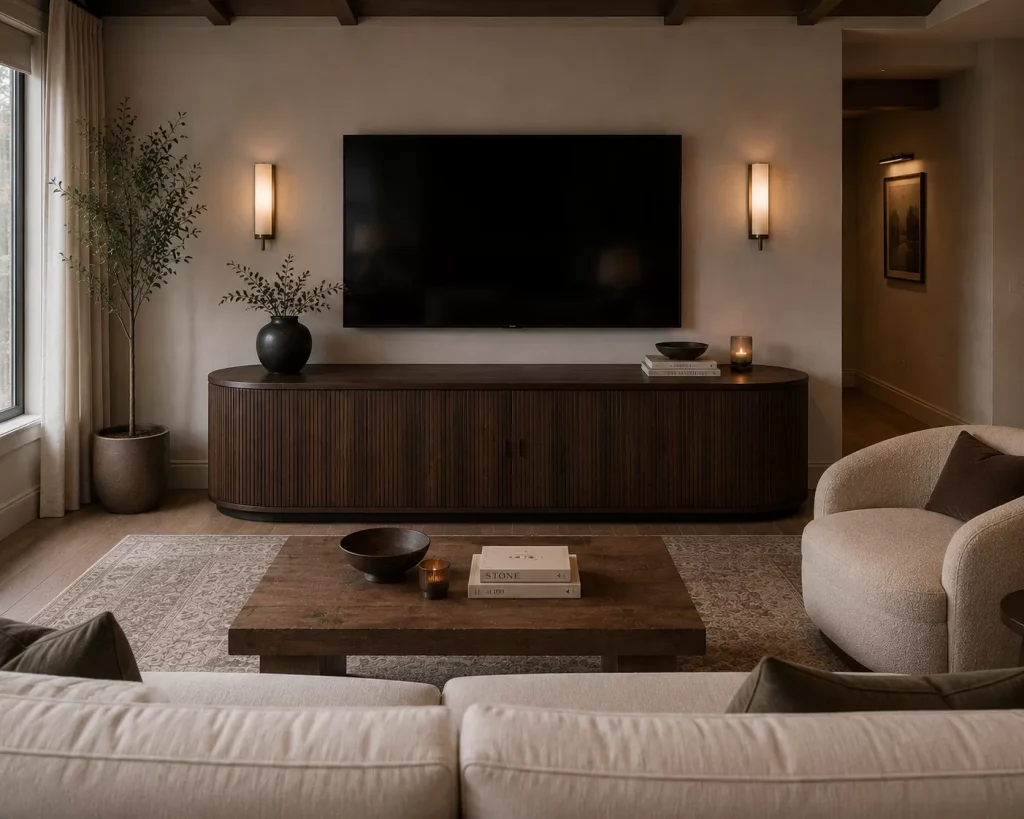
9. Use a rounded media cabinet instead of sharp box cabinetry
Idea 10: Soften storage at the corners rather than making it decorative.
Living-room storage tends to be extremely rectangular.
Media cabinets, bookcases, credenzas, and consoles often repeat the architecture so closely that everything becomes a grid.
A cabinet with rounded front corners changes that without sacrificing storage.
Look for:
Tambour-front credenzas
Half-round cabinet ends
Rounded doors
Bowed fronts
Oval freestanding storage
This is a smart place to use curves because the furniture still earns its floor space.
You’re not adding an object purely for shape.
You’re gaining closed storage.
Current 2026 furniture forecasts specifically mention sculptural storage pieces as substantial anchors within rooms.
I’d pair a rounded dark-wood media unit with a straight cream sofa and perhaps one curved chair.
That gives you three clearly different silhouettes.
Avoid adding a scalloped bookcase, wavy shelving, and round cabinet beside it.
The room doesn’t need a geometry theme.
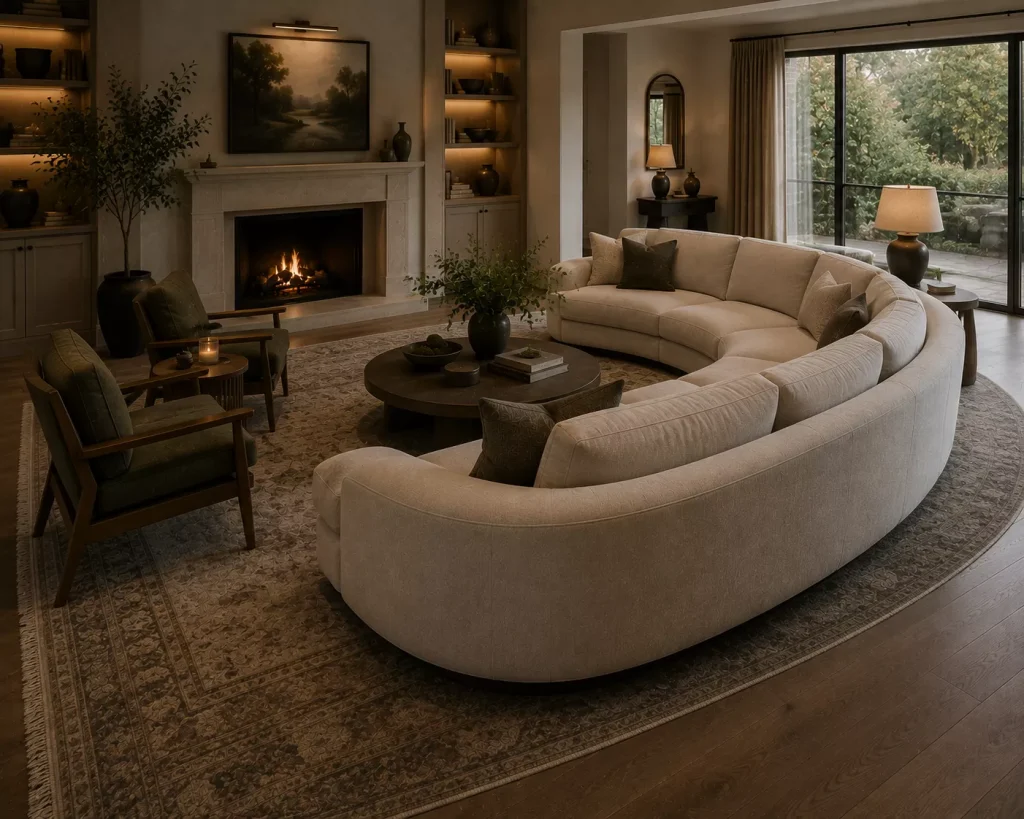
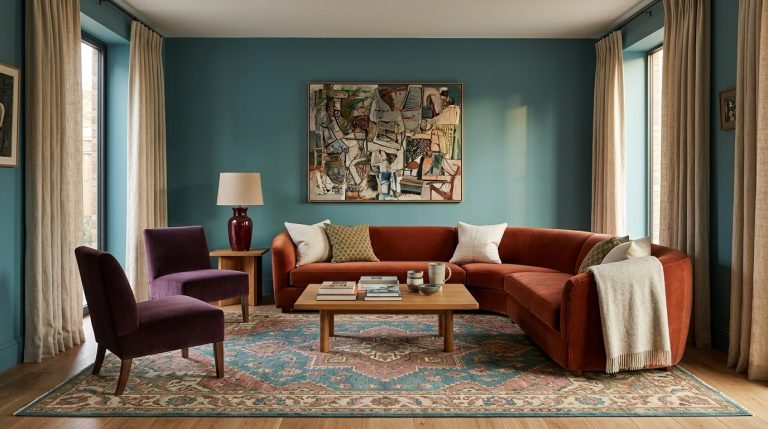
10. Use a curved sectional to improve conversation flow
Idea 11: Choose a curve because it changes how people face one another.
This is where curved furniture becomes more than visual styling.
A straight sectional tends to place people in lines or right angles.
A gently curved sectional turns seats slightly inward.
That naturally encourages conversation.
Design experts discussing 2026 furniture trends specifically point out that curved sofas and rounded tables can improve room flow and encourage social interaction.
This works particularly well in a living room where the television isn’t the only focus.
Try a curved sectional facing:
A fireplace
A large window
A round table
Two movable chairs
The curve can make a large room feel more intimate without requiring additional walls or partitions.
But check the footprint carefully.
Curved sectionals often occupy more depth than photographs suggest.
Use painter’s tape on the floor before ordering.
Mark the outer curve.
Then walk around it for a day.
If you keep stepping over the tape, the sofa is too large.
That test is free.
Returning a 12-foot sectional is not.

11. Add a rounded chaise or daybed near a window
Idea 12: Use one sculptural lounging piece instead of another conventional chair.
A rounded chaise can work beautifully at the edge of a larger living room.
It creates a different sitting posture and gives the room a softer, more relaxed quality.
Place it near:
A large window
A bookcase
A fireplace
The transition into another room
Choose a chaise with a low back so it doesn’t block sightlines.
For a more flexible alternative, try a low daybed with rounded bolsters.
This works particularly well in 2026 because living rooms are becoming less formal and more varied in how people sit. Designers are mixing low seating, ottomans, banquettes, and sculptural forms instead of relying on conventional sofa-and-chair sets.
The downside is obvious.
A beautiful chaise consumes real floor space.
Don’t buy one if the room still lacks enough everyday seating or storage.
This is the final layer, not the first purchase.
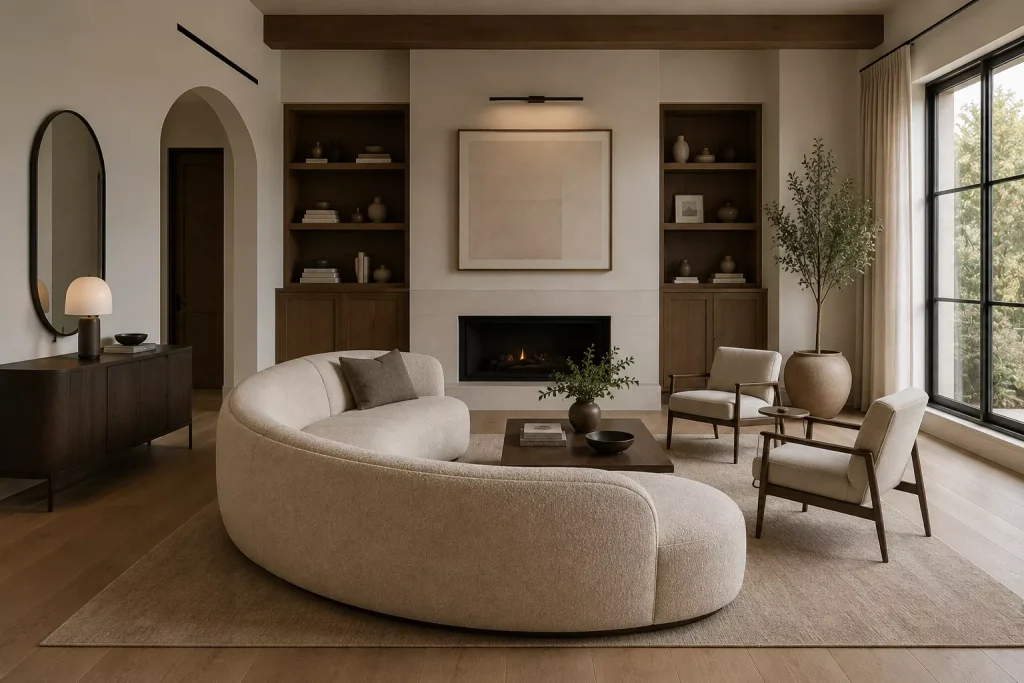
12. Repeat the curve once outside the furniture
Once you have one or two curved furniture pieces, repeat the shape subtly.
Not with another sofa.
Use a smaller architectural or decorative echo.
A round planter.
An arched mirror.
A spherical lamp.
An oval artwork.
Cameron Diaz’s former living room is a useful example. Its curved sofa and armchairs are supported by rounded planters and lighting, which helps the shapes feel related without turning the room into a collection of identical furniture silhouettes.
That’s the balance I’d aim for.
If the curved sofa is the dominant shape, repeat a circle or arch two more times in much smaller doses.
Then stop.
A useful rough approach is:
70% straighter or quieter forms
30% obvious curves and organic shapes
That isn’t a strict formula. It’s simply a reminder to leave enough structure around the softness.
One 2026 analysis of Aubrey Plaza’s living room makes a similar case for using curves as a controlled proportion within a broader room rather than making every single element rounded.
What should you skip with curved furniture?
Skip buying an entire curved furniture set.
That’s the biggest mistake.
A curved sofa plus barrel chairs plus round coffee table plus circular ottomans plus wavy cabinet can make every individual piece less special.
Designers who are pushing back against the curve trend in 2026 aren’t necessarily rejecting curves themselves. They’re rejecting curves everywhere. The more useful recommendation is to create contrast between rounded and linear pieces.
I’d also skip extremely dramatic shapes when circulation is tight.
A sculptural sofa with a deep outer arc can consume far more floor than a straight model with the same seat count.
Measure the entire footprint.
Not just the seat width.
And be cautious with very trendy upholstery.
Curved furniture already has a strong silhouette.
You don’t necessarily need boucle, bright orange, and an exaggerated kidney shape all on the same chair.
Choose where the personality comes from.
Shape.
Color.
Texture.
Usually two are enough.
Try this if you already own a completely straight furniture set
Don’t replace everything.
Choose the room’s most obvious rectangle and soften something beside it.
If you have a straight sofa, add one rounded chair.
If the sofa and chairs are all linear, replace the square coffee table with an oval or organic one.
If you already love the tables, bring in a round ottoman.
Then look at lighting.
A globe lamp or curved floor lamp can reinforce the new shape without another major furniture purchase.
I’d start with this sequence:
- Keep the sofa.
- Add one rounded chair.
- Introduce one circular or organic table.
- Repeat the curve once through lighting or a mirror.
- Leave the remaining furniture straight.
That’s enough to change the room.
And it prevents you from replacing useful furniture purely because the current trend favors another silhouette.
FAQ About Curved Furniture in Living Rooms
Is curved furniture still in style in 2026?
Yes. Curved sofas, chairs, ottomans, and irregular tables remain prominent in 2026, with designers valuing their softer appearance and ability to improve flow. However, there’s also growing emphasis on balancing curves with straighter forms rather than using them everywhere.
Does curved furniture work in a small living room?
It can. Round coffee tables, curved-back chairs, and compact ottomans are particularly useful because they soften tight circulation areas. Large curved sofas need more caution because their overall footprint can be deeper than a straight sofa.
What furniture looks good with a curved sofa?
Linear side tables, rectangular rugs, straight floor lamps, angular wood chairs, and simple storage pieces can all work well. The contrast between soft and straight shapes usually makes the curved sofa look more intentional.
Are curved sofas practical?
They can be, especially in conversation-focused rooms. A gentle curve encourages people to face inward, but strongly curved sofas may be harder to place against walls and can use more floor area. Measure the full outer dimensions before buying.
Let one curve change the room
The best 12 Curved Furniture Ideas for Living Room aren’t really about filling a house with rounded objects.
They’re about breaking up rigidity.
One curved sofa can soften a room full of straight architecture.
Two barrel chairs can make a boxy sofa arrangement feel more conversational.
A round coffee table can improve circulation while changing the room’s entire silhouette.
And one cylindrical side table can sometimes be enough.
Start with the piece that solves a real problem.
If people keep walking into the coffee-table corners, go round.
If the room feels too formal, try curved seating.
If the furniture looks like it’s lined up on a grid, introduce one organic shape.
Then keep some straight lines.
Curved furniture looks best when the room gives it something to push against.