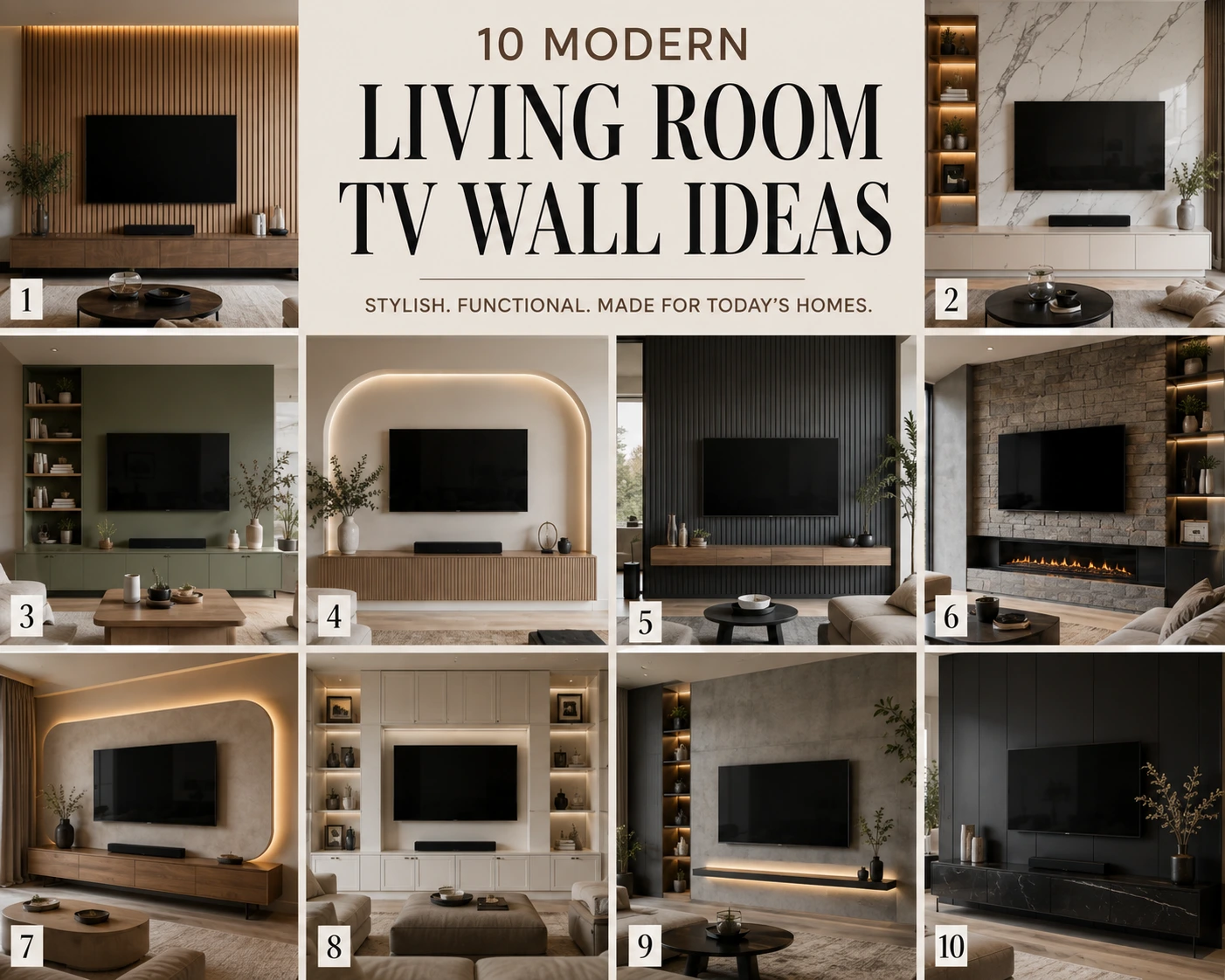
10 Modern Living Room TV Wall Ideas That Look Designed, Not Tech-Heavy
A television creates an awkward decorating problem because it’s usually one of the largest objects in the living room, yet few people actually want a giant black rectangle to define the entire space.
That’s why the best 10 Modern Living Room TV Wall Ideas don’t simply add decorative panels behind the screen. They consider viewing height, storage, cables, furniture proportions, architecture, and what the wall looks like when the TV is switched off.
That thinking feels particularly relevant in 2026. Designers are moving away from oversized televisions treated as the room’s primary focal point. Instead, screens are being integrated into cabinetry, positioned lower, placed off-center, or visually balanced with books, art, and architectural finishes.
Here are ten approaches I’d actually consider in a real living room.

1. Build the TV into full-width cabinetry
Idea 1: Make the television one element of a larger wall.
This is probably the most successful modern TV-wall solution if you need storage too.
Instead of hanging the screen alone, build shelving and closed cabinets around it.
A practical arrangement might include:
- low closed cabinets for electronics
- the television centered or slightly off-center
- open shelves for books and ceramics
- taller storage at one or both ends
- hidden channels for wiring
The reason this works is visual scale.
A 65-inch television looks enormous on an otherwise empty 12-foot wall. Put that same screen into a 10-foot-wide composition of cabinetry and shelving, and suddenly it becomes only one part of the architecture.
Architectural Digest recently showed a similar approach where a television disappears into a large bookcase rather than floating independently on the wall.
Keep some of the storage closed
This is important.
A TV wall containing twenty-four open shelves creates another problem. Now you need twenty-four shelves worth of objects.
I’d make the lower third mostly closed.
Hide:
Routers
Game controllers
Remotes
Cables
Board games
Spare chargers
Then let the upper shelving hold the pieces you actually want to see.
The wall feels calmer because practical clutter has somewhere to go.

2. Use warm wood instead of another gray feature wall
Idea 2: Create a wood-backed media wall.
Vertical wood slats became so common that they’re starting to feel predictable when installed as a narrow decorative rectangle behind the TV.
I’d take the material further.
Cover a larger section of the wall in oak, walnut, or another warm wood finish so it reads as architecture rather than an applied TV backdrop.
Walnut works beautifully with:
Cream upholstery
Warm white walls
Olive green
Dusty blue
Travertine
Blackened metal
Light or medium oak suits smaller rooms where very dark wood might feel heavy.
And you don’t necessarily need narrow slats.
Wide wood panels, veneer cabinetry, or simple flat-front joinery can look quieter and more expensive.
Current 2026 living rooms are putting renewed emphasis on warm timber, built-ins, books, and character rather than formulaic feature treatments.
Idea 3: Mix wood with plaster rather than covering everything.
Try a plaster-finish central TV panel with wood cabinetry below.
Or place the television on a wood wall while adjacent niches stay softly plastered.
That material contrast usually looks more considered than repeating identical slats across the entire room.
3. Float the console and leave the floor visible
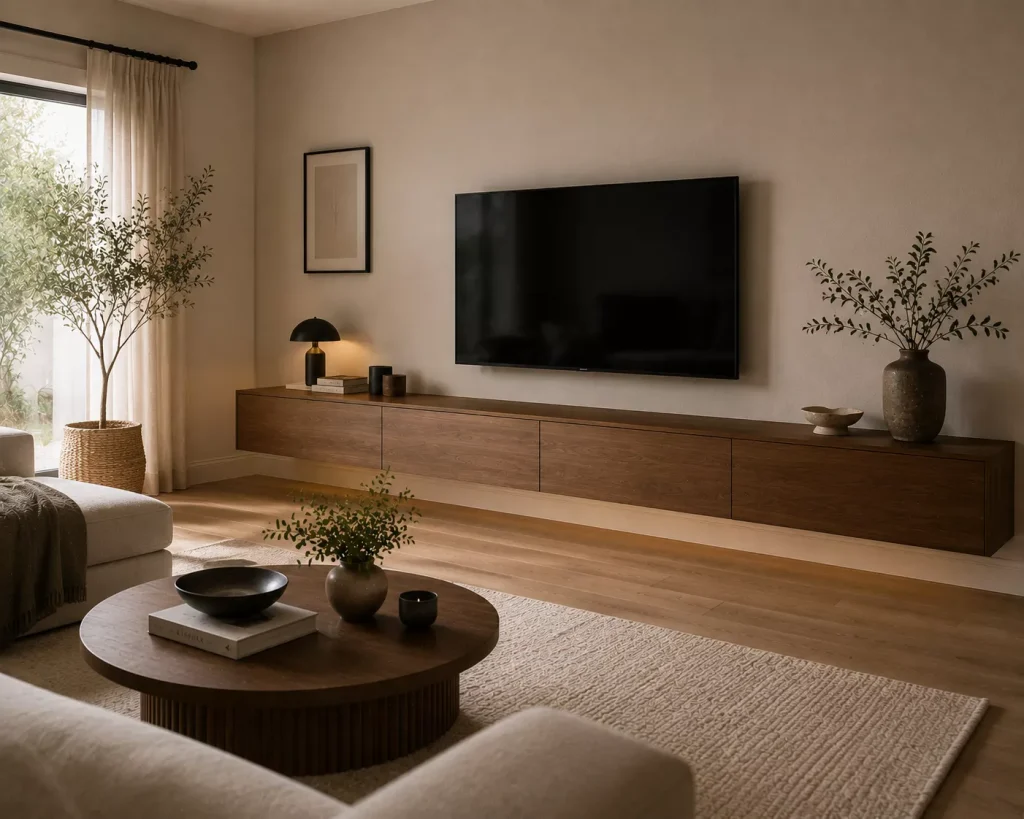
Idea 4: Pair a wall-mounted television with a long floating cabinet.
This is one of my favorite ideas for a smaller modern living room.
Mount the television.
Then install a low floating console below it.
The exposed floor underneath makes the furniture visually lighter while still providing useful closed storage.
I’d usually make the console noticeably wider than the television.
For example, beneath a TV roughly 57 inches wide, a console around 72 to 90 inches can create a much better proportion than a cabinet that ends exactly at the edges of the screen.
The television should look anchored.
Not balanced precariously above a tiny box.
Use wood for warmth or paint the cabinet the same color as the wall for a quieter effect.
Current designer advice for reducing TV dominance also favors positioning screens lower rather than mounting them unnecessarily high.
Hide every cable you reasonably can
Nothing undermines a carefully designed TV wall faster than two black cables hanging toward the outlet.
If you’re renovating, plan concealed power and cable management before finishing the wall.
Without construction, use a paintable cable raceway or route cables behind the media cabinet.
Keep ventilation requirements for electronics in mind.
Hidden doesn’t mean sealed inside a hot compartment with no airflow.
4. Use stone as one strong material, not a luxury cliché
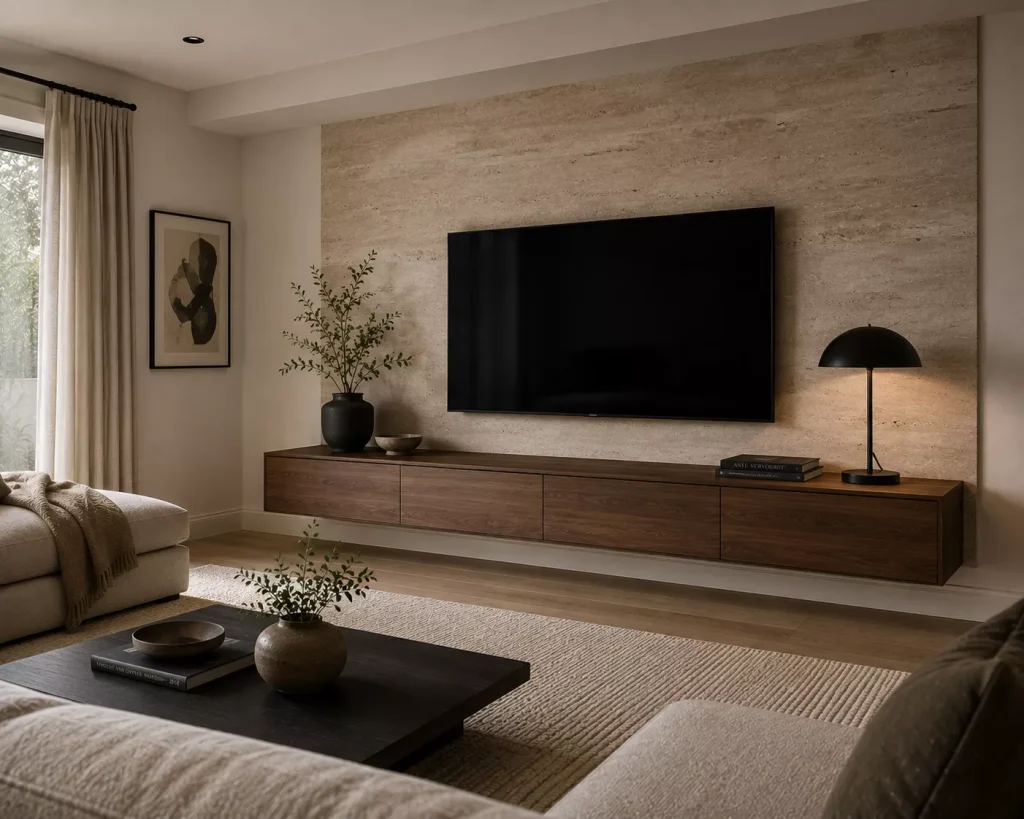
Idea 5: Put the screen against large-format stone or stone-look porcelain.
Stone can make a modern TV wall feel substantial, but I’d avoid automatically creating the familiar combination of glossy marble, gold strips, and a linear electric fireplace.
That formula has been repeated enough.
A quieter approach feels fresher.
Try honed travertine.
Soft limestone.
Veined soapstone.
Warm gray porcelain.
Or a matte stone-effect slab.
Keep the surrounding cabinetry simple.
A wall might look like this:
Warm limestone TV panel
Walnut floating console
Off-white walls
Black metal lamp
Textured cream sofa
Only one material needs to be dramatic.
Livingetc has highlighted TV walls where stronger finishes and architectural materials draw attention to the overall composition rather than simply disguising the black screen.
For a smaller budget, large-format porcelain can create a similar uninterrupted appearance without the cost or weight of many natural stones.
Just make sure the installation method suits the wall and material.
5. Make the TV disappear into a dark painted wall
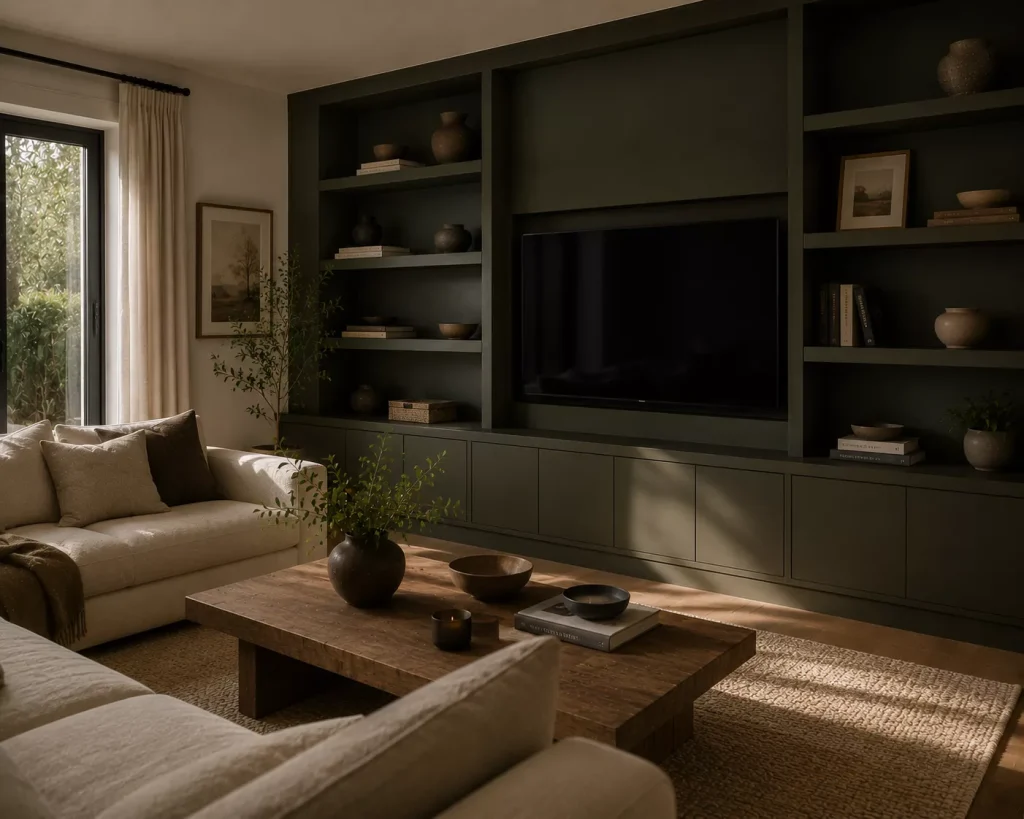
Idea 6: Use charcoal, deep brown, navy, or muddy green behind the screen.
You don’t actually have to hide the television.
Sometimes you just need to reduce the contrast around it.
A black screen on a white wall is impossible to ignore.
Put that same TV against chocolate brown or charcoal and it recedes immediately.
This can be especially effective with built-ins.
Imagine deep olive cabinetry covering the full wall, with the television sitting inside one open section.
Books, artwork, and ceramics become part of the same composition.
A recent Livingetc example recommends integrating the television into a media unit and even painting cabinetry a strong color so the screen becomes one piece of a more purposeful wall.
I’d consider:
Chocolate + walnut
Olive + cream
Navy + oak
Charcoal + camel
Deep teal + warm white
Don’t make the room dark purely to camouflage the television.
Use the deeper wall color if it already suits the light and furniture.
The TV disappearing is a bonus.
6. Use asymmetry instead of forcing the TV into the center
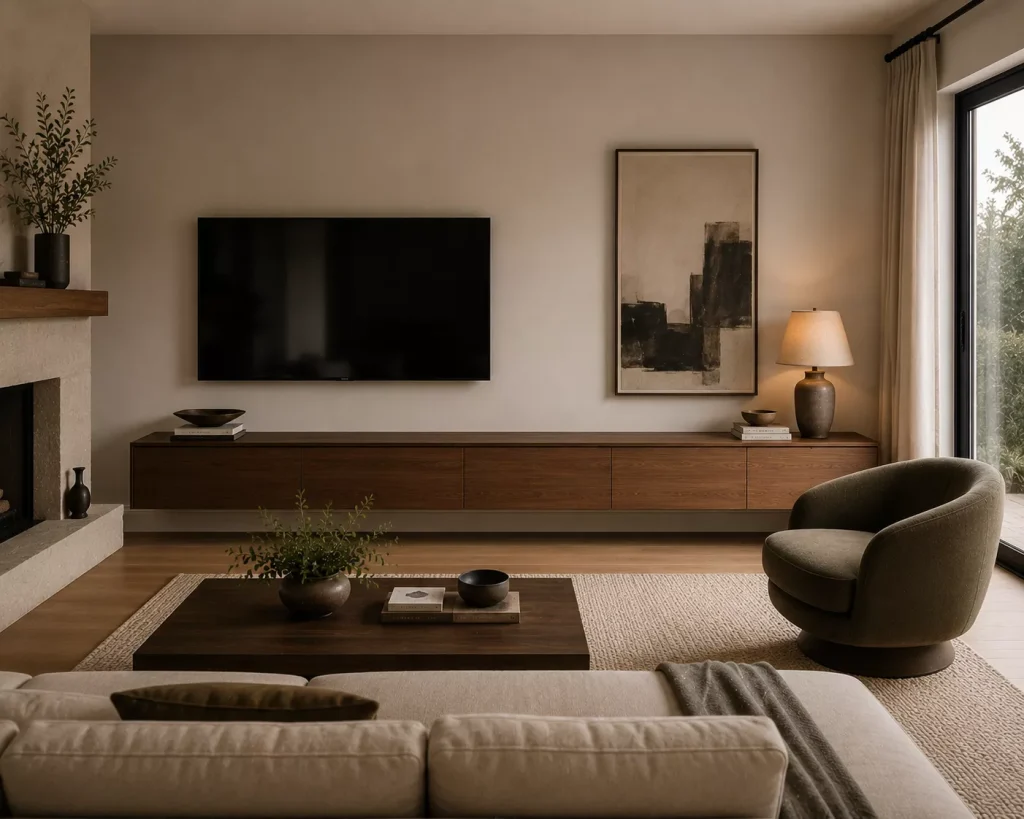
Idea 7: Position the television to one side of the composition.
Modern doesn’t have to mean perfectly symmetrical.
In fact, an off-center TV can make the living room feel less dominated by the screen.
Homes & Gardens specifically identifies off-center positioning as one method designers use to keep televisions from controlling the room visually.
Try a wall with:
TV on the left
Tall artwork on the right
Long cabinet underneath both
One table lamp or sculpture creating balance
Or:
Open bookshelf on one side
Television beside it
Closed storage stretching below the full composition
You’re balancing visual weight rather than mirroring objects.
This works particularly well if an existing doorway, fireplace, or window already prevents perfect symmetry.
Instead of fighting awkward architecture, use it.
Don’t center the sofa automatically either
If the television sits slightly off-center, your seating doesn’t necessarily need to line up with it like a cinema.
A swivel chair can face the TV when needed.
The sofa can relate to a fireplace, window, or coffee table too.
That produces a living room that supports television viewing without making every piece of furniture worship the screen.

7. Hide the TV behind art or cabinetry
Idea 8: Conceal it when you genuinely don’t want to see it.
This isn’t necessary for everyone.
If your family watches television every evening, hiding and revealing it several times a day may become irritating.
But in a formal sitting room or open-plan space, concealment can work beautifully.
Options include:
Sliding panels
Pocket doors
Art panels
Cabinet doors
Motorized screens
Art-style televisions
House Beautiful’s 2026 roundup of designer solutions shows just how many current interiors are using cabinetry, artwork, and concealed mechanisms to prevent screens from permanently dominating living spaces.
Livingetc has also featured sliding panels that can reveal shelving or close completely over the television.
If you choose doors, make sure they have somewhere sensible to go when open.
Two giant cabinet doors sticking into the room every movie night aren’t a clever solution.
Sliding or pocket systems are cleaner where construction and budget allow.
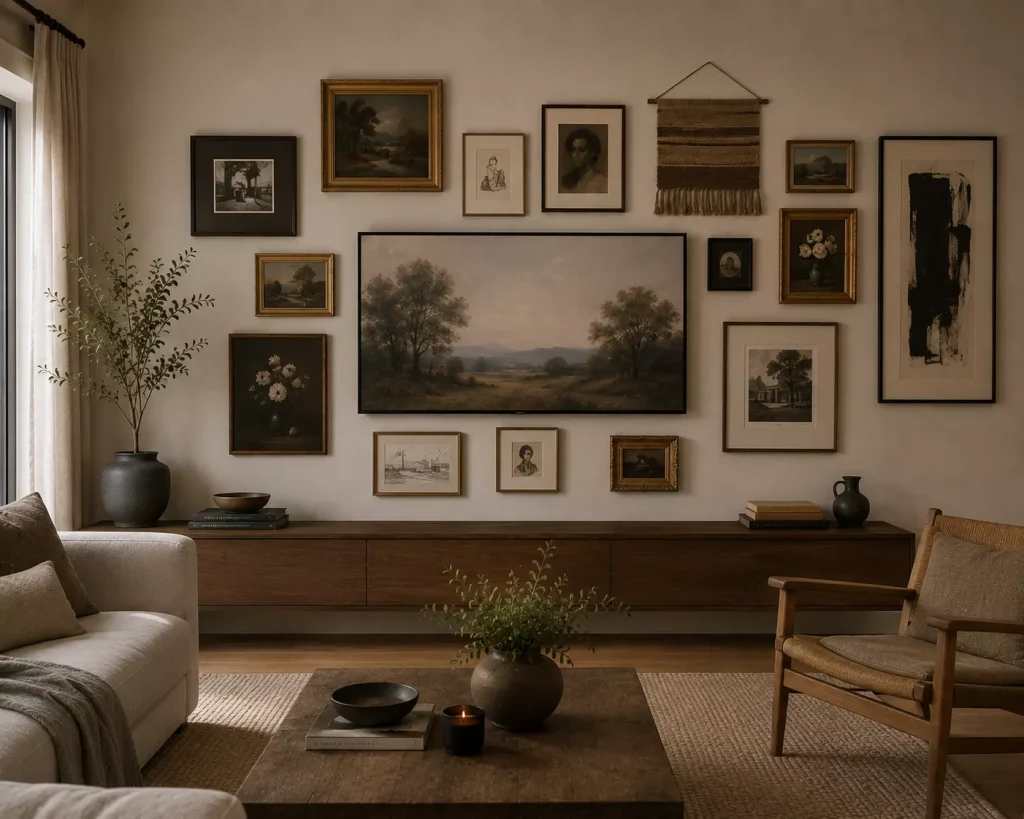
8. Turn the screen into part of a gallery wall
Idea 9: Surround an art-style TV with real artwork.
This works best if you already enjoy collected art.
Don’t build an entire gallery wall simply to disguise a television.
Use the screen as one large rectangle within a group containing genuinely meaningful pieces.
Livingetc recently highlighted a successful example in which an art-style television was integrated with differently scaled artwork so the black box no longer became the sole visual focus.
Mix:
Photography
Small oil paintings
Drawings
Textiles
Vintage prints
Personal artwork
Keep spacing relatively consistent, but avoid making the arrangement too perfect.
And please don’t fill the wall with twelve generic downloadable beige abstracts because they coordinate with the TV frame.
The whole advantage of a gallery wall is personality.
Use objects you’d keep even if the television disappeared tomorrow.

9. Combine the TV, fireplace, and storage carefully
Idea 10: Treat all three as one architectural composition.
A media wall containing a television, fireplace, and storage can be very useful.
It can also become extremely busy.
Livingetc has featured successful built-ins where the TV, fireplace, shelving, and storage are treated as one cohesive architectural unit rather than several unrelated features stacked together.
The key is hierarchy.
Decide what matters most.
If the fireplace is visually strong, keep the TV treatment quiet.
If the television is large, use understated shelving.
If the stone is heavily veined, don’t add another loud finish beside it.
And think carefully before putting the TV directly above the fireplace.
Better Homes & Gardens reported in August 2026 that designers remain cautious about this arrangement because it can make the wall visually top-heavy and place the screen uncomfortably high.
Sometimes it’s the only logical location.
If so, keep the fireplace low and check the viewing height before construction begins.
But if the room allows the TV to sit beside the fireplace instead, I’d seriously test that layout.
Two neighboring focal points can look more relaxed than one enormous vertical stack.
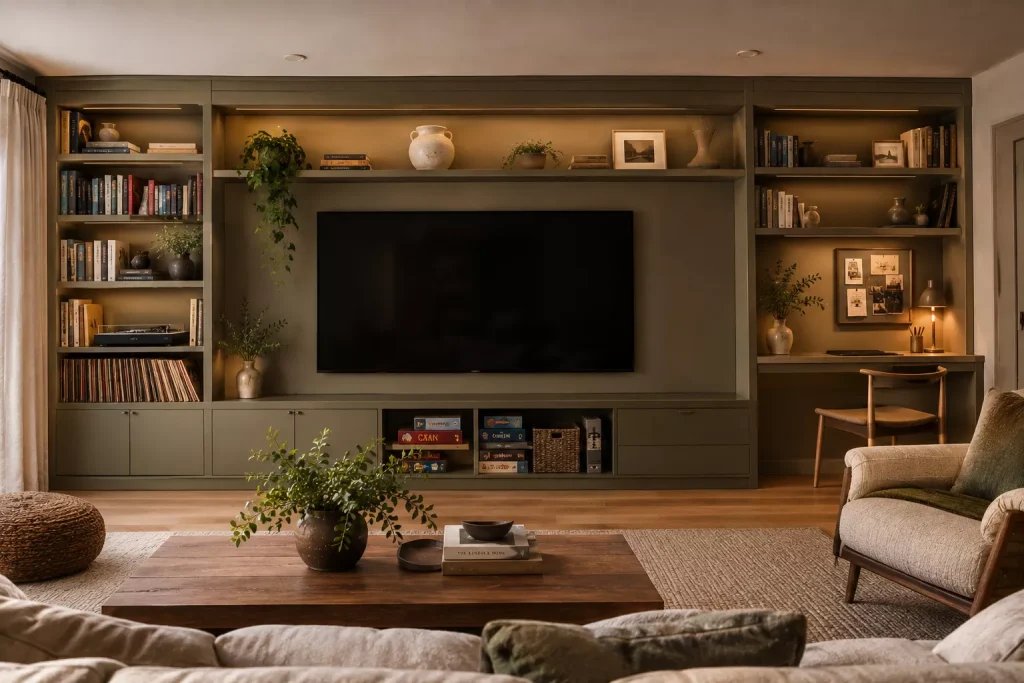
10. Let the TV wall do more than hold a television
The biggest shift I’d make in a modern media wall is conceptual.
Stop designing a wall for a television.
Design a useful wall that happens to contain one.
That could mean adding:
Bookshelves
Closed toy storage
A reading niche
Display space
A small desk
Record storage
Game storage
Livingetc has highlighted open media walls for exactly this reason. Shelves filled with books, collected objects, flowers, and personal pieces can keep the installation evolving rather than becoming a static technology feature.
This approach also protects you from one practical problem.
Televisions change.
A built-in designed to fit one exact 55-inch screen can become annoying when you replace it with a 65-inch model five years later.
Leave some flexibility around the screen.
If you’re investing in custom joinery, think about the next television too.
Modern design should make everyday life easier, not turn a future electronics purchase into a carpentry project.
What should you skip on a modern TV wall?
First, I’d skip decorative wall treatments that exist only inside a rectangle slightly larger than the TV.
A small patch of slatted wood behind the screen often makes the television more obvious because you’ve effectively drawn a frame around it.
Either let the material occupy a meaningful architectural area or keep the wall simpler.
I’d also avoid mounting the screen unnecessarily high.
Your neck should not have to angle upward for an entire movie.
And skip placing tiny floating shelves randomly around the television.
They rarely disguise the screen. They usually create several smaller visual distractions around it.
Another 2026 shift worth paying attention to is the move away from XXL televisions as the automatic center of a living room. Designers interviewed by Homes & Gardens are increasingly prioritizing art, conversation, and the architecture of the home instead.
That doesn’t mean buying a tiny TV.
It means choosing one appropriate to your viewing distance and then designing a room around more than screen size.
Try this if you’re renting
You can improve a TV wall without custom cabinetry.
Start with a long freestanding media console.
Hide the visible cables with a removable raceway.
Then add one large artwork beside the screen rather than several tiny shelves.
If your lease allows painting, a deeper wall color can help the television recede.
If not, use the console to bring in wood or color.
Try:
Warm-white wall
Walnut media cabinet
Black TV
Large artwork containing olive and rust
Tall floor lamp at one end
That already feels far more deliberate than a television mounted above a tiny black stand.
A renter-friendly TV wall doesn’t need to pretend it’s custom millwork.
Good proportions can do most of the work.
FAQ About Modern Living Room TV Walls
What is the best wall treatment behind a TV?
Wood, warm paint, plaster, stone, and built-in cabinetry can all work. Choose a material that belongs with the rest of the room instead of installing a decorative finish solely because it’s a “TV wall” material.
Should the TV wall be darker than the other walls?
It can be. Charcoal, chocolate, navy, olive, and other deeper colors reduce the contrast around a black screen, helping it visually recede. A darker wall isn’t required if cabinetry, art, or another architectural element already balances the television.
Is a TV above the fireplace still a good idea?
Sometimes it’s the most practical solution, but designers remain cautious about mounting televisions too high or making the fireplace wall visually top-heavy. Test the viewing height and consider placing the screen beside the fireplace if the layout allows it.
How do I make a large TV look less obvious?
Integrate it into wider cabinetry, put it against a deeper wall color, surround it with art or shelving, position it lower, or use an art-style screen. Current designers are also using off-center layouts and alternative focal points so the television doesn’t control the entire room.
Design the wall for the hours when the TV is off too
The most successful 10 Modern Living Room TV Wall Ideas don’t ask you to pretend the television doesn’t exist.
They simply stop giving it all the power.
Put it inside a wall of useful cabinetry.
Pair it with walnut.
Let it recede into olive or chocolate paint.
Move it slightly off-center.
Hide it behind panels if you genuinely prefer a screen-free room.
Or surround an art-style TV with pieces you actually care about.
Then switch the television off and look at the wall again.
If the room still has books, texture, useful storage, art, and something interesting to look at, the design is probably working.
That’s a much better test than asking whether the TV wall looks impressive in a photograph.