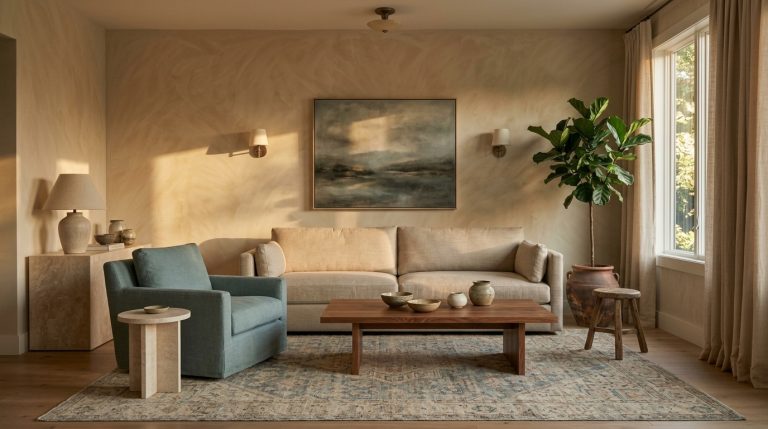
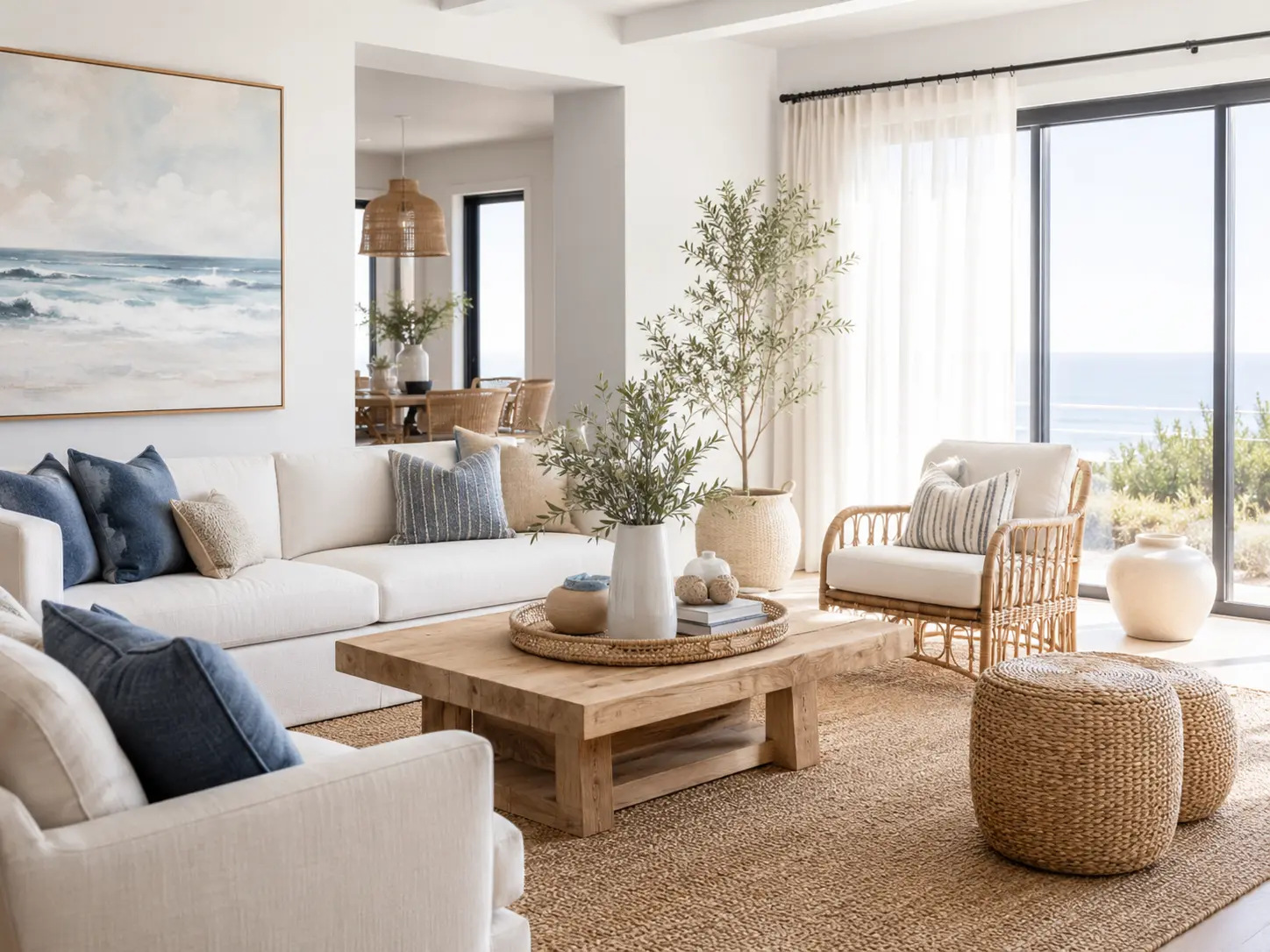
10 modern coastal decor ideas for a Fresh, Relaxed Home
There’s a big difference between a room that feels coastal and a room that looks decorated for a beach-themed Airbnb.
One uses warm wood, washed linen, textured stone, soft blue, and plenty of breathing room. The other has an anchor on the wall and a bowl of shells that nobody is allowed to touch.
The best modern coastal decor ideas are moving firmly toward the first approach. Current 2026 design coverage favors coastal rooms with natural materials, richer texture, warmer colors, and fewer literal seaside references.
I once helped simplify a living room that had navy stripes, rope accessories, driftwood signs, and several wicker pieces. We removed most of the obvious coastal decorations but kept the colors and natural textures.
Strangely enough, it looked more coastal afterward.
Here’s how to create that quieter, fresher version at home.
1. Replace stark white with warmer coastal neutrals
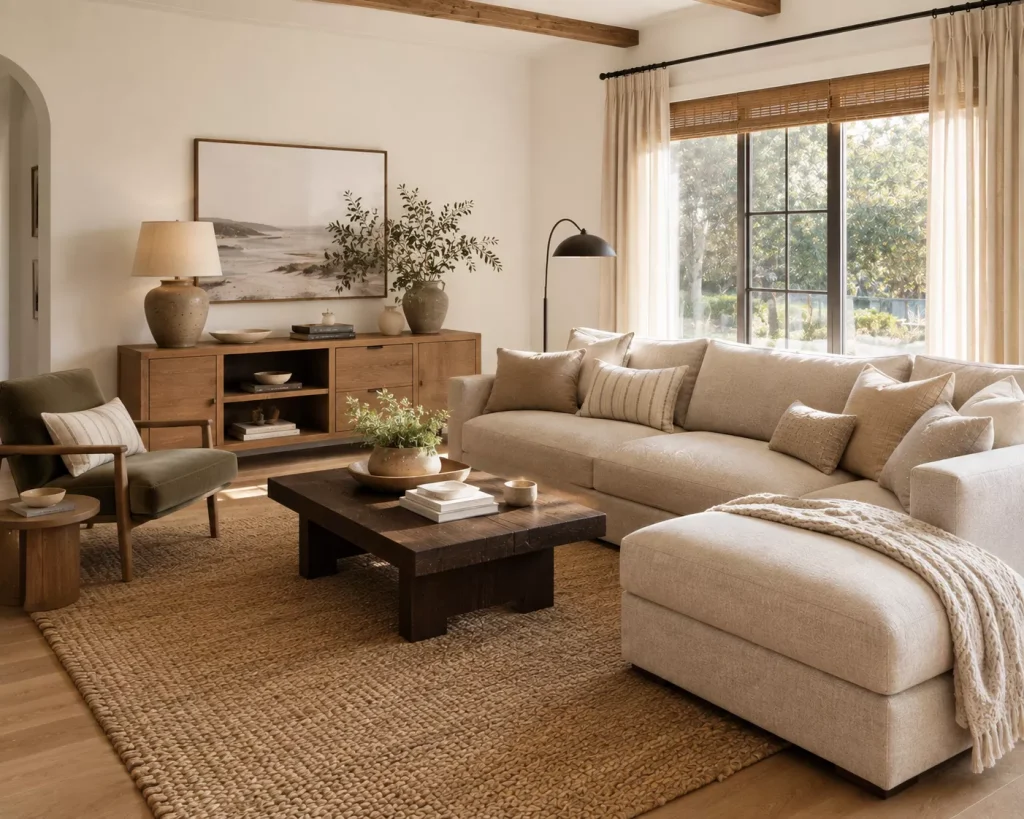
Idea 1: Build the room around sand, cream, flax, and warm white.
Modern coastal decorating still benefits from a light foundation, but pure white everywhere can feel flat.
Try creamy off-white, pale mushroom, light taupe, warm greige, or sandy beige instead.
A living room could have warm white walls, a flax-colored sofa, medium-oak furniture, and muted blue cushions. In a bedroom, try pale sand walls with white bedding and a walnut nightstand.
That small amount of warmth makes woven materials and wood look far richer.
Current interpretations of coastal interiors still use light palettes, but designers are increasingly mixing them with natural materials, organic textures, and more nuanced color rather than relying on crisp blue and white alone.
And don’t worry about making everything pale.
A dark brown coffee table, olive chair, or charcoal lamp can give the room some necessary weight.
Here’s what nobody tells you about airy interiors. They still need contrast.
Without it, your beautiful cream sofa can start looking like it’s floating in a bowl of oatmeal.
2. Use blue in quieter, less predictable ways
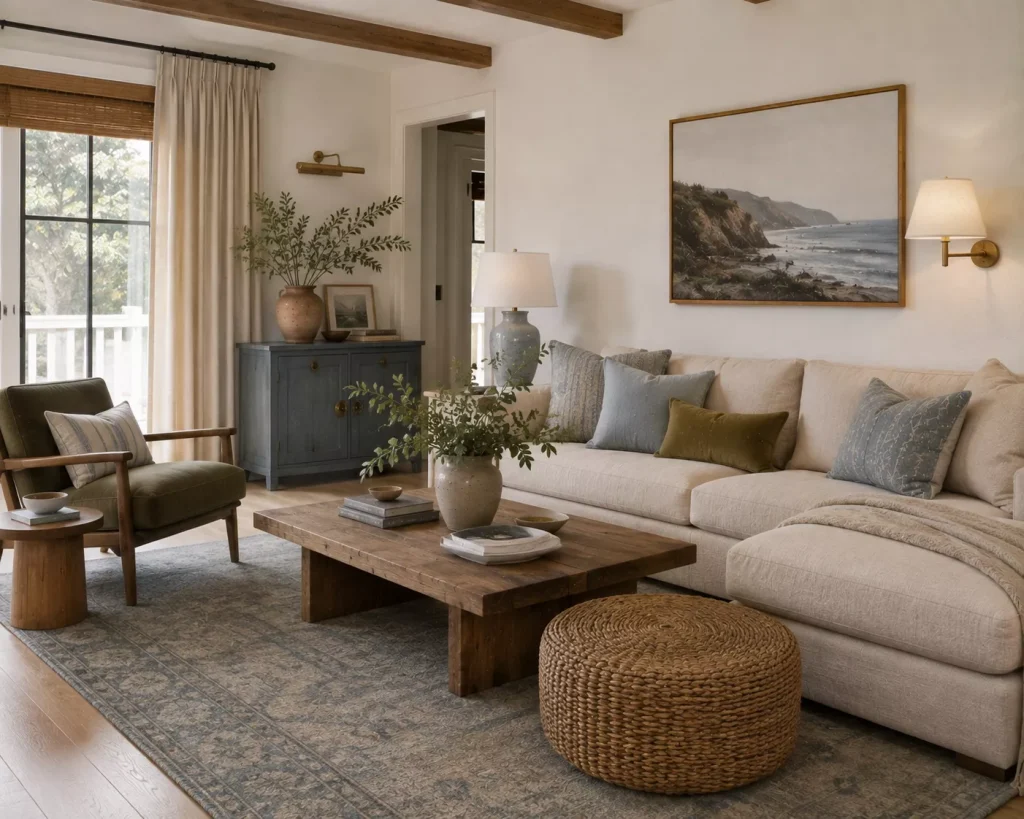
Idea 2: Swap nautical navy for faded and mineral-inspired blues.
Blue still makes sense in coastal interior design. It just doesn’t need to appear as navy stripes on every cushion.
Look at dusty denim, muted slate blue, pale aqua, sea-glass blue, soft blue-gray, and deeper stormy shades.
Try a faded blue rug beneath a cream sofa. Add a pair of blue-gray lamps beside the bed. Paint a small cabinet a muted ocean tone instead of covering an entire room.
Current 2026 design coverage continues to show blue prominently, while newer coastal interpretations are becoming more layered and less dependent on traditional nautical combinations.
Pair blue with warmer colors
Blue becomes more interesting beside colors you wouldn’t immediately associate with a beach house.
Try:
- dusty blue with tobacco brown
- pale aqua with warm oak
- navy with clay terracotta
- blue-gray with olive
- faded denim with aged brass
Those combinations keep the room grounded.
And if you don’t particularly like blue, leave it out.
Soft green, sand, clay, warm brown, and off-white can still create a convincing coastal atmosphere.
Style should never require living with a color you secretly dislike.
3. Let natural materials create most of the coastal feeling
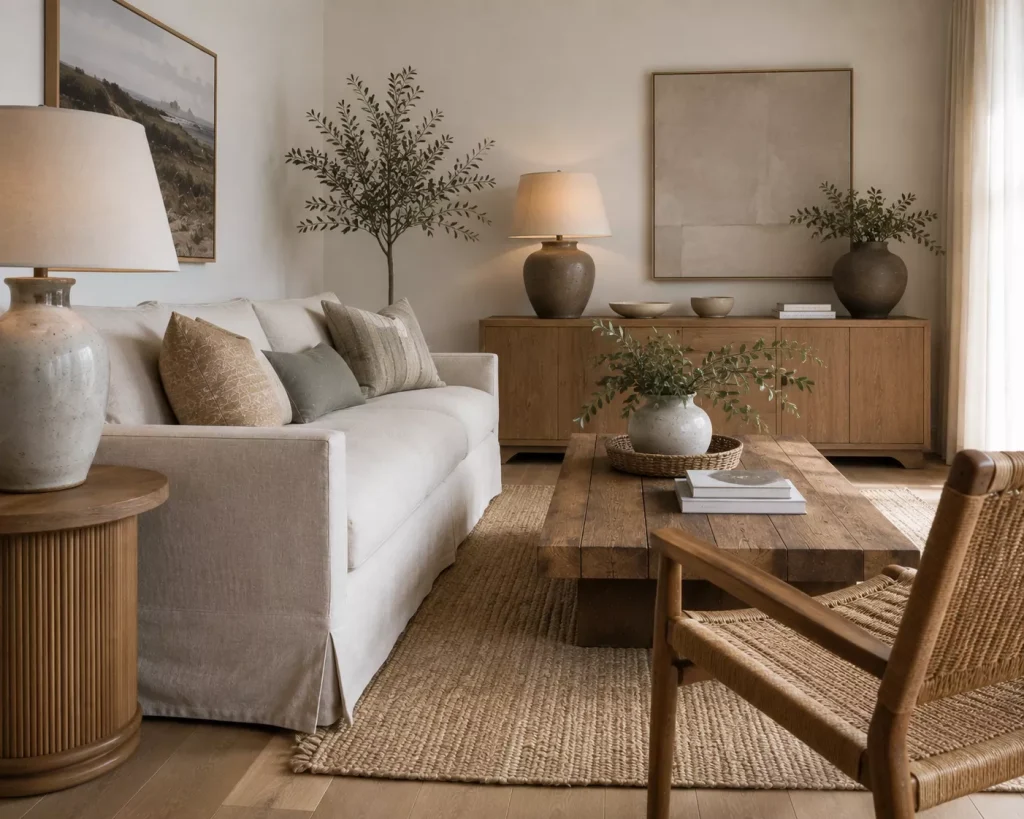
Idea 3: Use texture instead of obvious beach decorations.
Wood, linen, jute, stone, plaster, cane, seagrass, and rattan do far more for modern coastal decor than seashell motifs.
Architectural Digest identifies wood, washed linen, plaster, jute, and rattan among the natural materials commonly associated with coastal interiors.
The trick is mixing them instead of repeating one.
Put a smooth stoneware lamp on a warm oak console. Pair a linen sofa with a woven chair. Add a wool rug beneath a wood coffee table.
Those small contrasts make a room feel layered.
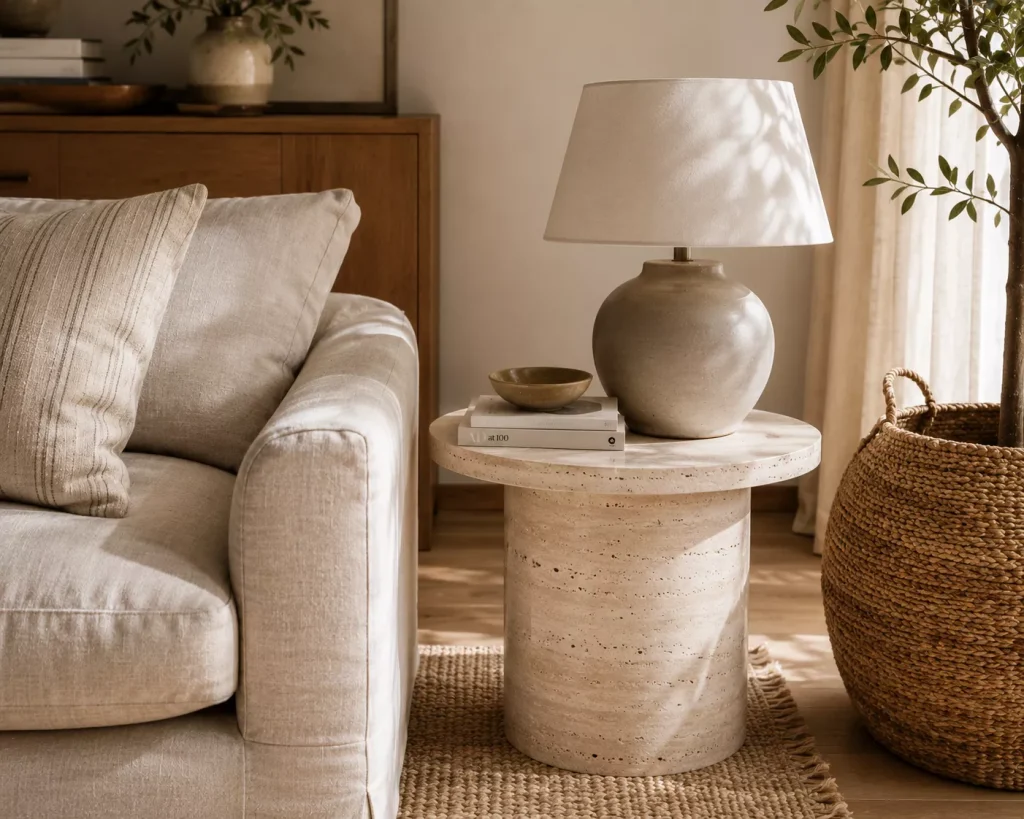
Idea 4: Bring in stone or ceramic for a cleaner modern edge.
Travertine side tables, pale marble, handmade-looking pottery, and matte ceramic lamps can keep all that woven texture from becoming overly rustic.
You don’t need genuine stone everywhere either.
One substantial ceramic lamp or stone tray can create the effect for $40 to $150 instead of committing to expensive furniture.
Recent coastal homes are also using materials such as marble, warm woods, and aged metals alongside traditional lighter coastal finishes, which gives the style more depth.
Think coast, not cabana.
4. Choose woven furniture carefully instead of using it everywhere
Rattan is probably the fastest shortcut to coastal style.
It’s also one of the easiest materials to overuse.
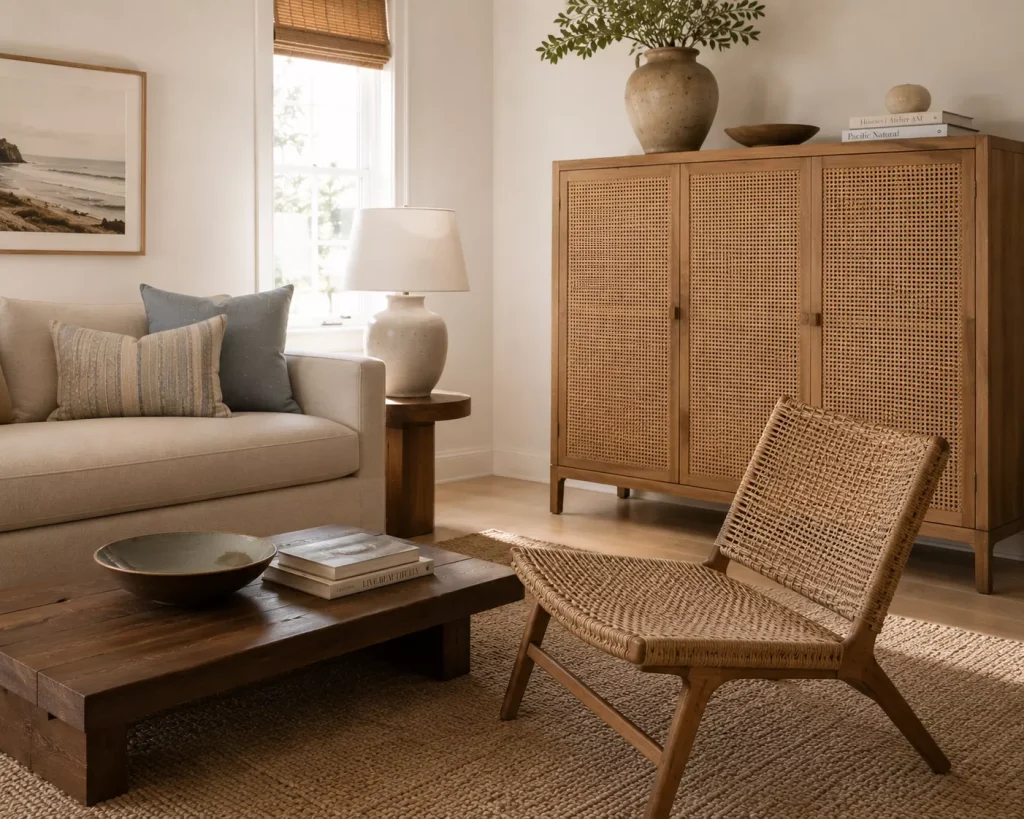
Idea 5: Choose one substantial woven piece and let it stand out.
That might be a cane-front cabinet, woven lounge chair, rattan pendant, or seagrass bench.
Then stop.
If your room already has a cane chair, you probably don’t need a rattan coffee table, rattan console, rattan mirror, and matching woven baskets.
Current 2026 coastal collections are still leaning into woven materials, but the look is being broadened with ceramics, richer colors, upholstery, and other tactile finishes.
I prefer mixing a woven accent with something more solid.
A cane chair beside a chunky walnut side table feels more interesting than an entire matching woven furniture family.
And remember the practical side.
Woven furniture collects dust in all those little gaps. Anyone who owns a cane headboard has eventually met the tiny brush attachment on their vacuum cleaner.
Beautiful materials still require maintenance.
That doesn’t make them bad choices. It just makes them real choices.
5. Keep furniture simple, substantial, and comfortable
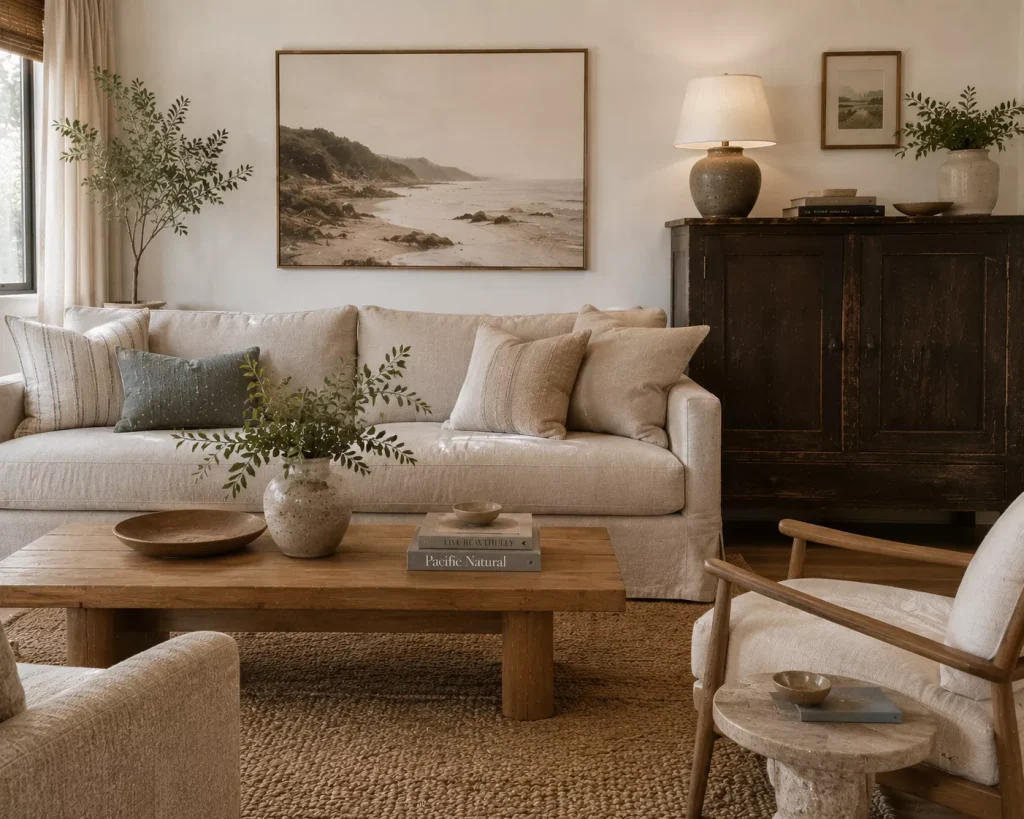
Idea 6: Choose clean-lined furniture with enough softness to feel relaxed.
Modern coastal doesn’t mean ultra-minimal.
A sharp white box of a sofa may look clean, but it can make the room feel colder than you intended.
Look for slightly relaxed silhouettes.
A sofa with soft cushions, slim arms, and a linen-look fabric works well. Pair it with a simple oak coffee table or a slightly rounded stone table.
California coastal style in particular is being described in 2026 design coverage as combining a casual atmosphere with natural textures, wood, linen, leather, rattan, and subdued greens and blues.
Avoid matching furniture sets.
Instead, repeat one or two materials around the room.
You might use medium oak on the coffee table, then repeat it in picture frames or a small stool.
A dark vintage cabinet can sit beside those lighter woods and actually make the room look more collected.
That contrast is valuable.
Modern doesn’t require everything to be new.
In fact, one slightly worn piece often keeps a coastal room from feeling suspiciously perfect.
6. Layer textiles without creating a sea of stripes
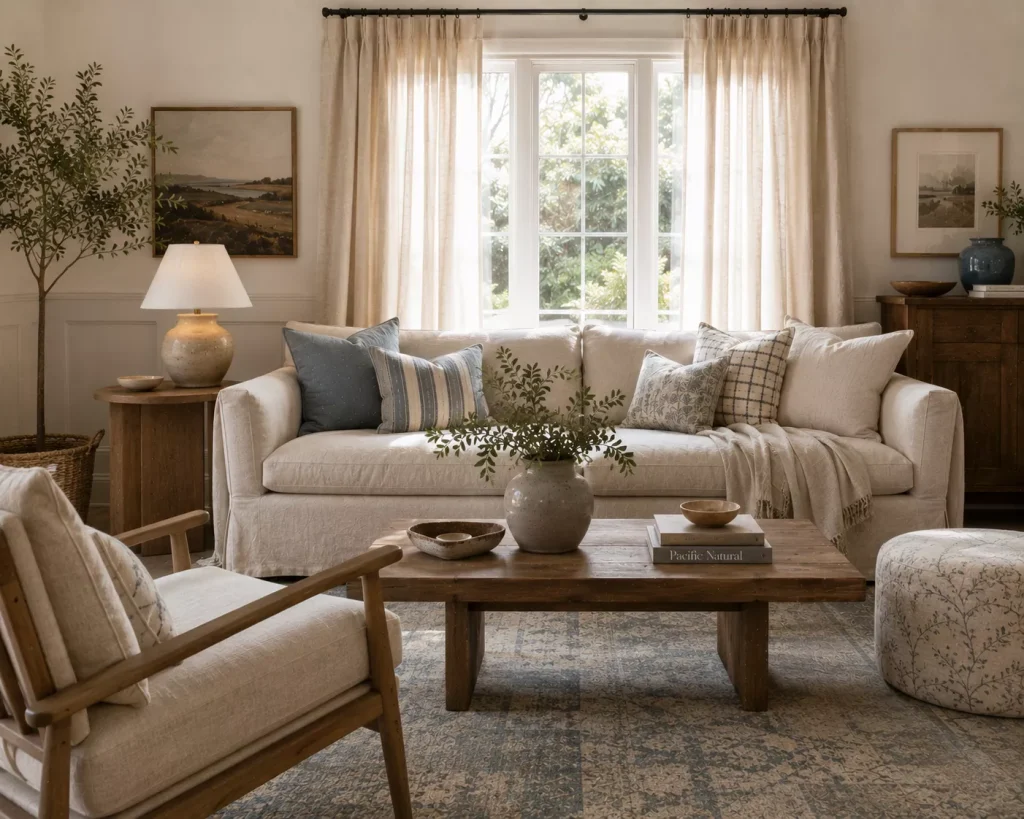
Idea 7: Use linen, cotton, wool, and relaxed patterns for softness.
Textiles are where you can make a modern coastal room comfortable rather than merely attractive.
Start with one large soft surface.
That might be linen-blend curtains, a wool rug, an upholstered bed, or a comfortable sofa.
Then layer smaller textures around it.
A useful living-room combination could be:
| Textile | Good coastal choice | What to avoid |
|---|---|---|
| Curtains | Flax or warm-white linen blend | Shiny synthetic fabric |
| Rug | Faded blue, cream, or sandy wool | Tiny nautical motif rug |
| Cushions | Washed cotton and subtle stripes | Five matching anchor prints |
| Throw | Lightweight cotton or wool | Excessive tassels |
| Bedding | White, oatmeal, or muted blue | Overly coordinated theme sets |
Natural-fiber rugs and woven textures continue to feature strongly in current coastal decorating examples.
Let one pattern lead
You can absolutely use stripes.
Just don’t make every textile striped.
Try one blue-and-cream striped cushion beside two plain cushions. Or use subtle ticking stripes on curtains while keeping the rug quieter.
Checks, faded botanical patterns, block prints, and loose geometrics can also work.
The best modern coastal decor ideas hint at the style rather than repeating the same visual clue.
7. Make lighting feel sculptural during the day and soft at night
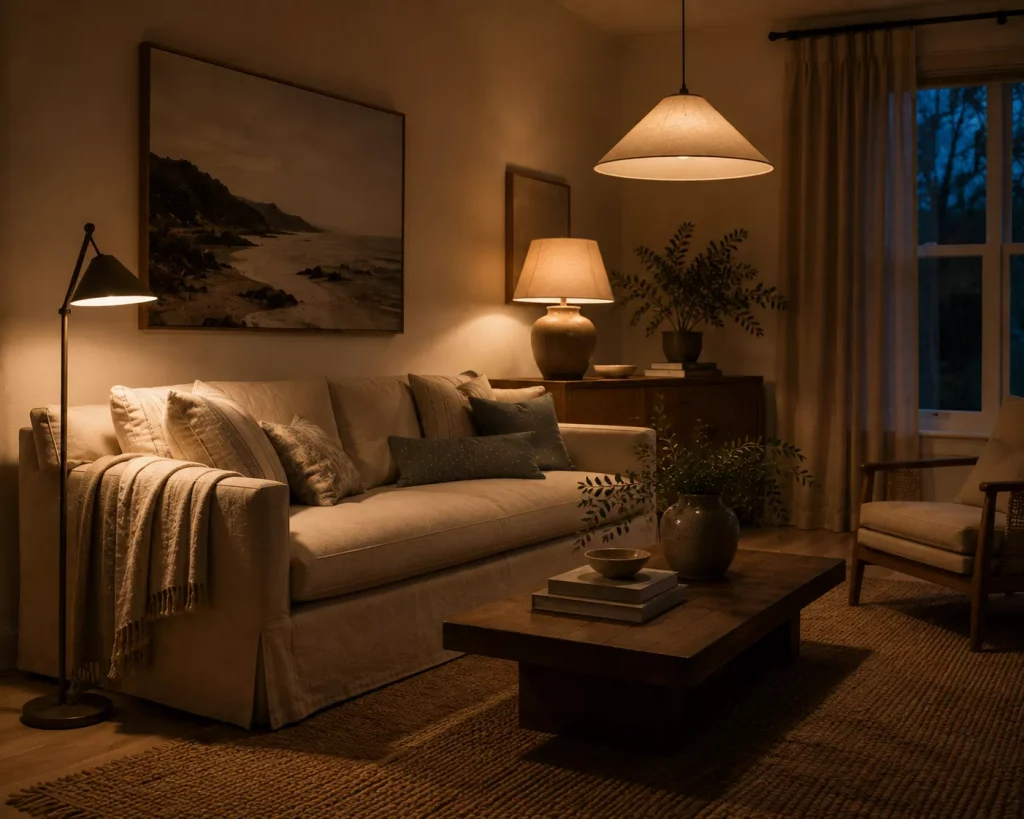
Idea 8: Treat lighting as decor, not just illumination.
Modern coastal rooms need warmth after sunset.
One overhead light rarely provides it.
Use at least two levels of light in frequently used rooms.
A ceramic table lamp on a console can provide a soft pool of light. A slim floor lamp beside the sofa handles reading. A pendant can give the ceiling some character.
Materials such as ceramic, paper, woven fiber, aged brass, and wood fit particularly well.
Choose warm bulbs around 2700K for living rooms and bedrooms if you like a softer evening feel.
Recent broader 2026 decorating advice is also favoring layered lighting and sculptural lamps over reliance on a single harsh overhead source.
Just be careful with oversized woven pendants.
They’ve become so strongly associated with coastal interiors that an enormous one can dominate a small room.
A pendant should support the architecture.
It shouldn’t look like a straw hat descending from the ceiling.
For renters, plug-in sconces and rechargeable table lamps are useful ways to build these lighting layers without rewiring anything.
8. Use art and accessories that suggest nature without becoming nautical
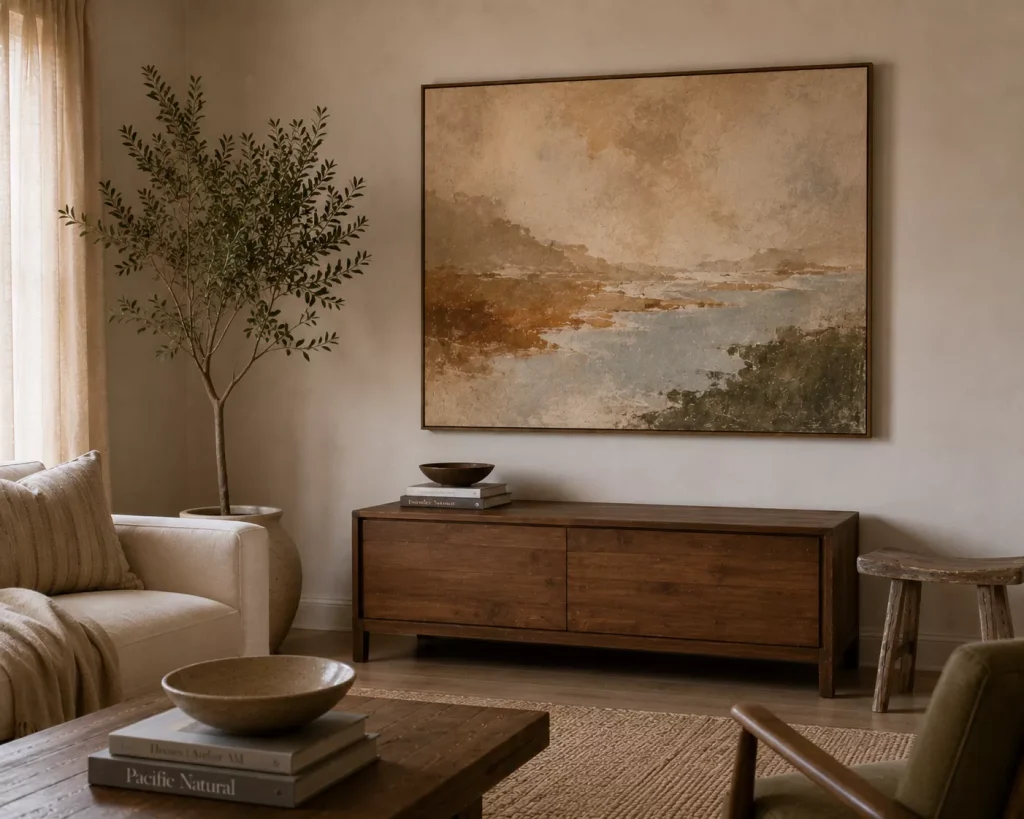
Idea 9: Choose coastal art by mood, not subject matter.
You don’t need a photograph of a lighthouse.
Try abstract art in sand, rust, pale blue, and olive. Look for atmospheric landscapes, botanical prints, or simple black-and-white photography.
One large piece usually looks stronger than several tiny themed prints.
If you do love coastal photography, choose something personal.
A photograph from a beach you actually visited has more meaning than a generic print chosen because it matches the sofa.
Current designers are actively pushing coastal interiors away from overdone anchors, signage, seashell displays, rope details, and aggressively themed blue-and-white rooms.
Architectural Digest’s recent coastal shopping coverage similarly emphasizes antiques, heirloom-style objects, organic materials, and layered pieces over obvious seaside kitsch.
That’s a much better direction.
Put an old ceramic bowl on the coffee table.
Frame a sketch you found while traveling.
Use one weathered wood stool because you genuinely like it.
Objects with some history create more personality than a tray filled with decorative starfish ever will.
9. Bring in deeper color so modern coastal doesn’t feel washed out
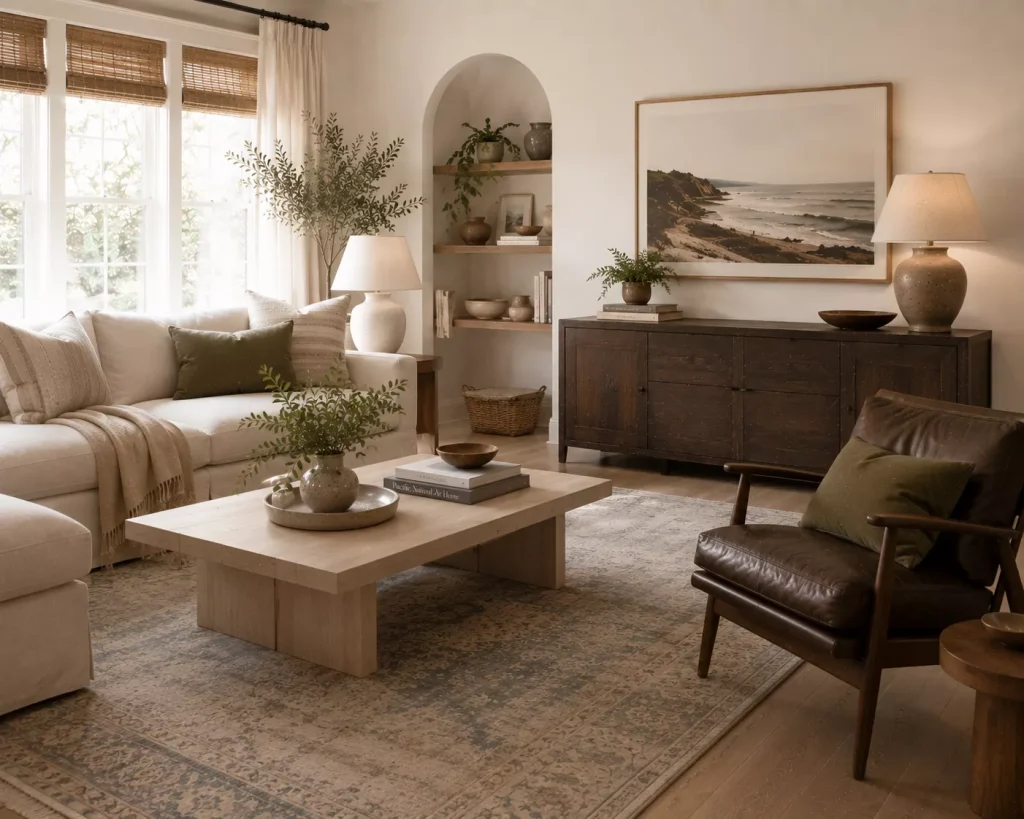
Idea 10: Add one darker or earthier note to the room.
This is one of my favorite newer directions for coastal interiors.
Instead of stopping at white, pale blue, and light wood, introduce olive, chocolate brown, brick red, burgundy, deep blue, or black.
The 2026 version of coastal decorating is increasingly being shown with richer tones and tactile materials rather than relying entirely on summery pale colors.
Try a chocolate-brown leather chair beside a pale sofa.
Add olive-green cushions to an oatmeal bed.
Use a dark wood console underneath airy artwork.
These darker notes give your eye somewhere to land.
They also make lighter materials feel brighter by comparison.
You only need a little.
For a living room, perhaps 70 percent of the palette stays light, 20 percent comes from natural wood and medium tones, and the final 10 percent carries the darker accent.
Don’t obsess over the exact percentages.
The point is contrast.
Rooms usually become more convincing when every object isn’t trying to feel breezy.
What should you skip in modern coastal decor?
Start with literal nautical decorations.
Anchors, fishing nets, “Beach House” signs, artificial coral, rope-wrapped everything, and huge collections of shells can make the room feel themed rather than relaxed. Designers interviewed in 2026 are specifically moving away from many of these coastal clichés.
I’d also avoid intentionally distressed furniture throughout the room.
One genuinely aged table has character.
A new dresser factory-painted to look battered can feel forced, especially beside cleaner modern pieces.
Then there’s the all-white problem.
White sofa. White rug. White curtains. White walls. White accessories.
It photographs nicely until somebody drinks coffee.
Real homes need a little forgiveness.
Pattern, warm wood, and mid-tone fabrics are far easier to live with.
And don’t buy every woven accessory you see.
Modern coastal style gets stronger when natural materials contrast with something smoother, darker, older, or more polished.
The whole room should never look like it was woven from one very ambitious basket.
FAQ About Modern Coastal Decor
What is modern coastal decor?
Modern coastal decor combines the relaxed colors and natural materials associated with coastal interiors with cleaner furniture, quieter patterns, and fewer nautical motifs. Current interpretations lean heavily on wood, linen, stone, ceramics, woven texture, and layered color.
What colors work best with modern coastal style?
Warm white, sand, flax, muted blue, olive, soft gray-blue, brown, and clay all work well. Deeper green, navy, burgundy, or chocolate can add useful contrast without losing the relaxed atmosphere.
Can modern coastal decor work in an apartment?
Yes. Focus on textiles and removable pieces such as curtains, rugs, lamps, art, cushions, and a woven chair or basket. You don’t need shiplap walls or architectural changes to create the look.
How do I keep coastal decor from looking cheesy?
Remove the literal references first. Use natural materials, landscape-inspired colors, personal art, and one or two woven accents instead of building the room around shells, signs, anchors, and rope.
The coastal living room I mentioned at the beginning improved when we stopped trying to prove it was coastal.
The navy stayed. So did one wicker chair. But the rope accessories disappeared, a walnut table introduced warmth, and a large abstract print replaced several beach signs.
That’s how I’d use these 10 modern coastal decor ideas in your own home.
Start by removing one literal beach-themed object. Then bring in one material that feels naturally connected to the coast, perhaps linen, pale wood, stoneware, or woven fiber.
You don’t need your home to look like it sits twenty feet from the ocean.
A convincing coastal room is really about the feeling people go to the coast for in the first place, more light, less visual noise, natural materials, and enough breathing room to slow down.