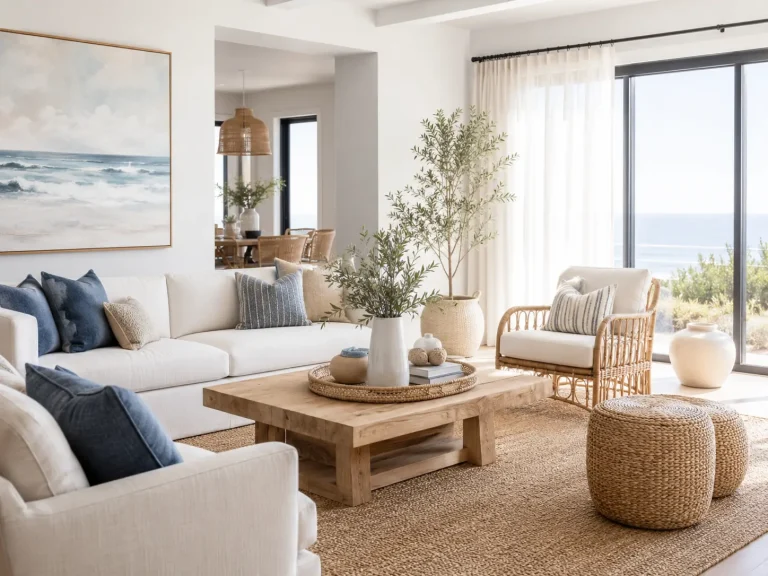
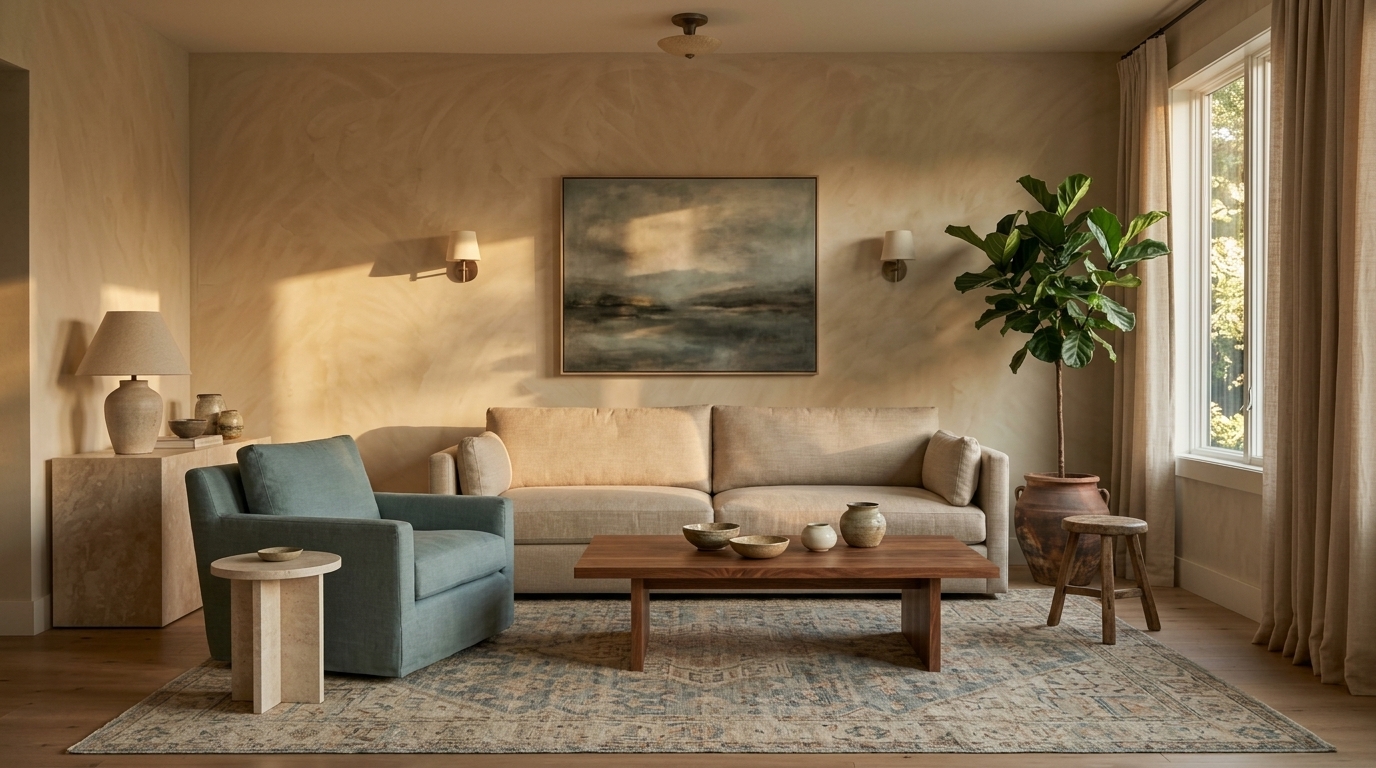
15 Coastal Living Room Ideas for a Relaxed, Collected Home
A coastal living room does not need an anchor on the wall or a bowl filled with shells. In fact, the rooms that feel most convincing now often contain very few obvious seaside references.
These 15 coastal living room Ideas take their cues from the coast through light, color, natural materials, comfortable furniture, and an easy connection to outdoors. That direction is especially relevant in 2026. Designers are moving coastal interiors away from literal nautical motifs and toward warmer woods, textured walls, honed stone, linen, vintage furniture, and more personal art. Elle Decor describes the current shift as increasingly architectural and less theme-driven.
The result still feels breezy, but it works just as well in an apartment as it does beside the ocean.
Start with a coastal palette that goes beyond blue and white

Idea 1: Build the room around warm white, sand, and wood
White still belongs in coastal interiors, but stark white everywhere can leave a living room feeling more clinical than relaxed.
Choose warm ivory, oyster, parchment, sandy beige, or a pale mushroom instead. Then add medium oak, walnut, woven fiber, and natural linen so the palette contains visible shifts in tone.
Current coastal designers are using warmer whites, sand, cream, walnut, and more pronounced wood grain instead of relying only on bleached finishes.
If your flooring already has honey or golden undertones, test wall colors beside it before painting. A cool gray-white can make warm timber appear unexpectedly orange.

Idea 2: Use blue in a quieter, more complicated way
Coastal blue does not have to mean bright navy stripes.
Try storm blue, faded denim, dusty blue, sea-glass blue, muted teal, or a gray-blue that changes as daylight moves through the room.
Use the strongest blue on one meaningful surface. That could be a pair of chairs, painted cabinetry, a large rug, or linen curtains.
A room with sandy walls, walnut furniture, and a dusty blue sofa can feel more sophisticated than one built entirely around blue-and-white accessories, the same layered thinking behind these coastal bedroom ideas.
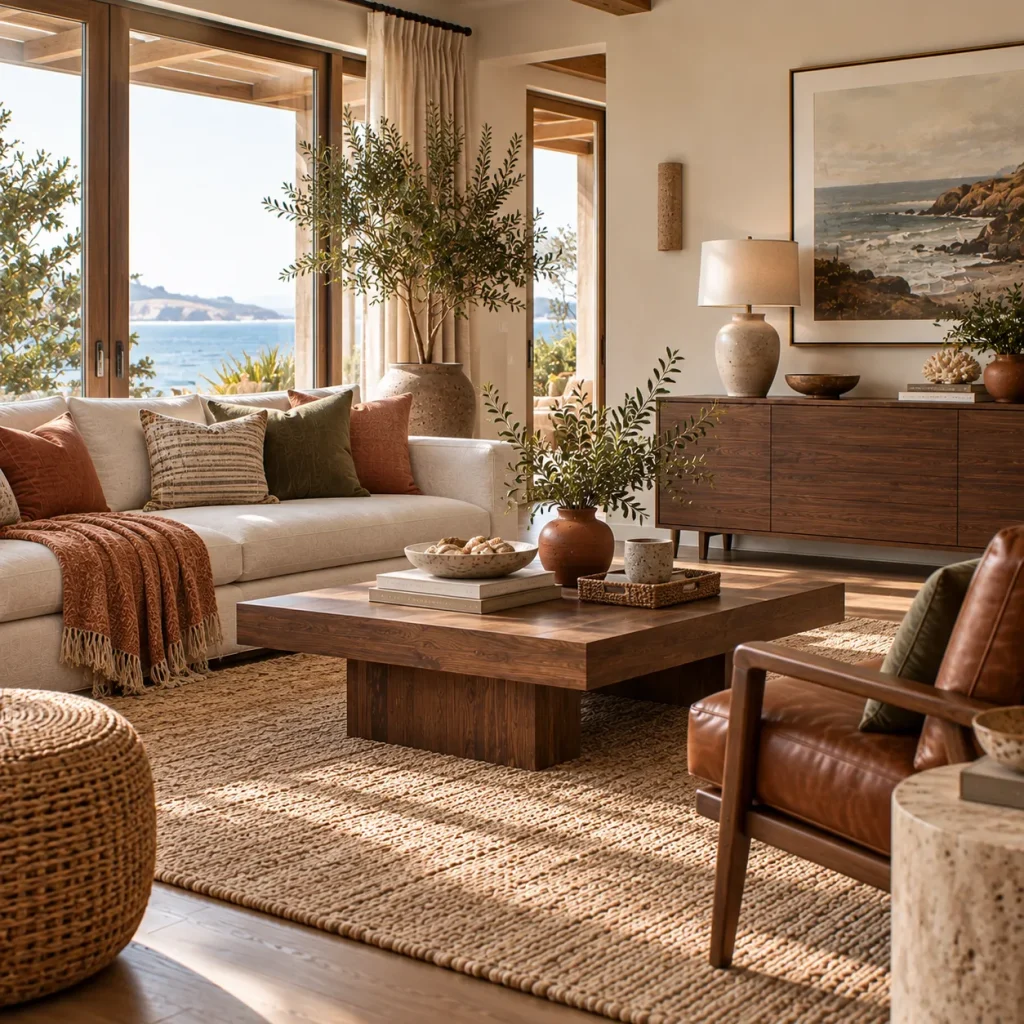
Idea 3: Bring in earthy coastal colors
The shoreline contains far more than blue.
Terracotta, seaweed green, driftwood brown, weathered gray, shell pink, tobacco, and muted coral all belong naturally within a coastal palette.
A recent California-focused coastal interior featured warm timber, colorful furnishings, white oak paneling, vintage lighting, and a relaxed 1970s surf influence rather than conventional nautical decoration.
So do not assume a coastal living room must look cool. A little terracotta or tobacco can keep pale blues and creams from feeling washed out, an approach explored further in these modern coastal decor ideas.
Let materials create the coastal feeling
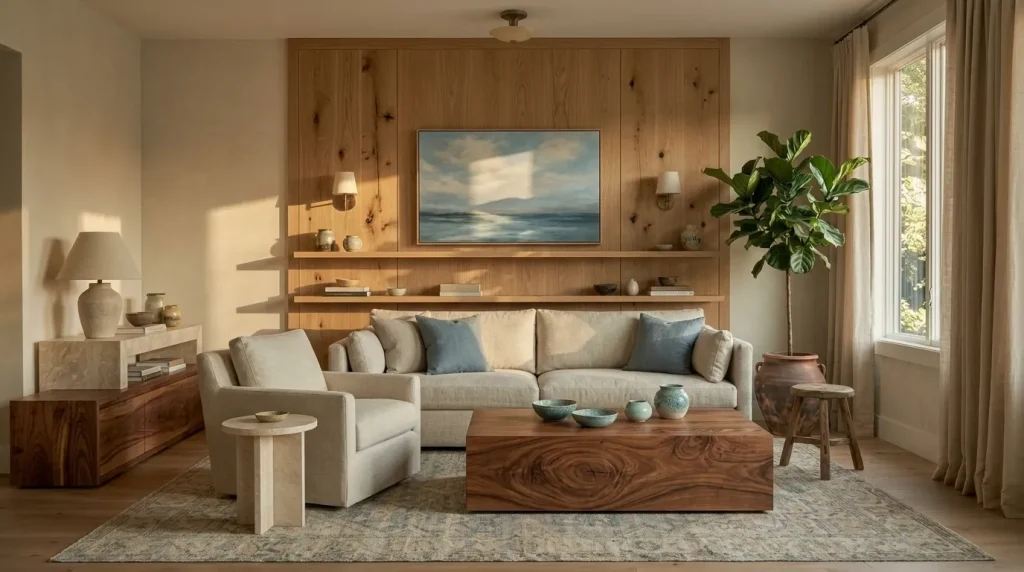
Idea 4: Choose wood with visible grain
Wood paneling is becoming one of the more interesting coastal directions in 2026, particularly when it uses cleaner detailing and warmer wood rather than heavily whitewashed planks.
You do not need to panel an entire room.
Try white oak behind built-in shelving, timber on one architectural wall, a substantial wood coffee table, or a warm wood media cabinet.
And this is where I would skip the old assumption that every coastal wood should look bleached by the sun. Medium oak and walnut can make linen and pale upholstery look much richer.

Idea 5: Add honed stone instead of more woven decor
Coastal rooms often contain rattan, jute, wicker, and baskets. All of those can work, but too many woven surfaces start repeating the same texture.
Bring in something harder. A honed limestone side table, travertine coffee table, marble lamp base, ceramic stool, or stone fireplace surround introduces the mineral side of the landscape.
Current coastal designers are layering honed stone with linen, plaster, white oak, deeper stained woods, and woven textures.
That material contrast feels much more considered than buying another seagrass basket.
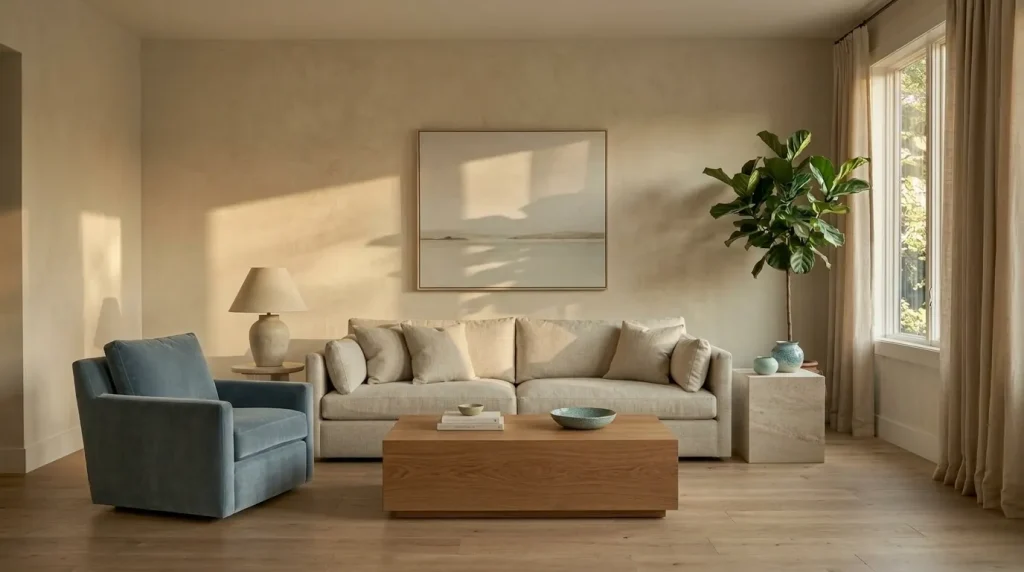
Idea 6: Use plaster or limewash for quiet movement
Flat white paint is not the only way to create a light coastal background.
Plaster, limewash-style finishes, Roman clay, and subtly textured wallpapers can give the walls movement without adding pattern. They are particularly useful in rooms with simple architecture.
Soft texture catches changing daylight, which suits a style inspired by outdoor environments.
If a specialty wall finish is outside the budget, choose a matte paint with a warm undertone and let artwork, timber, and textiles provide the rest of the variation.
Choose furniture for actual coastal living
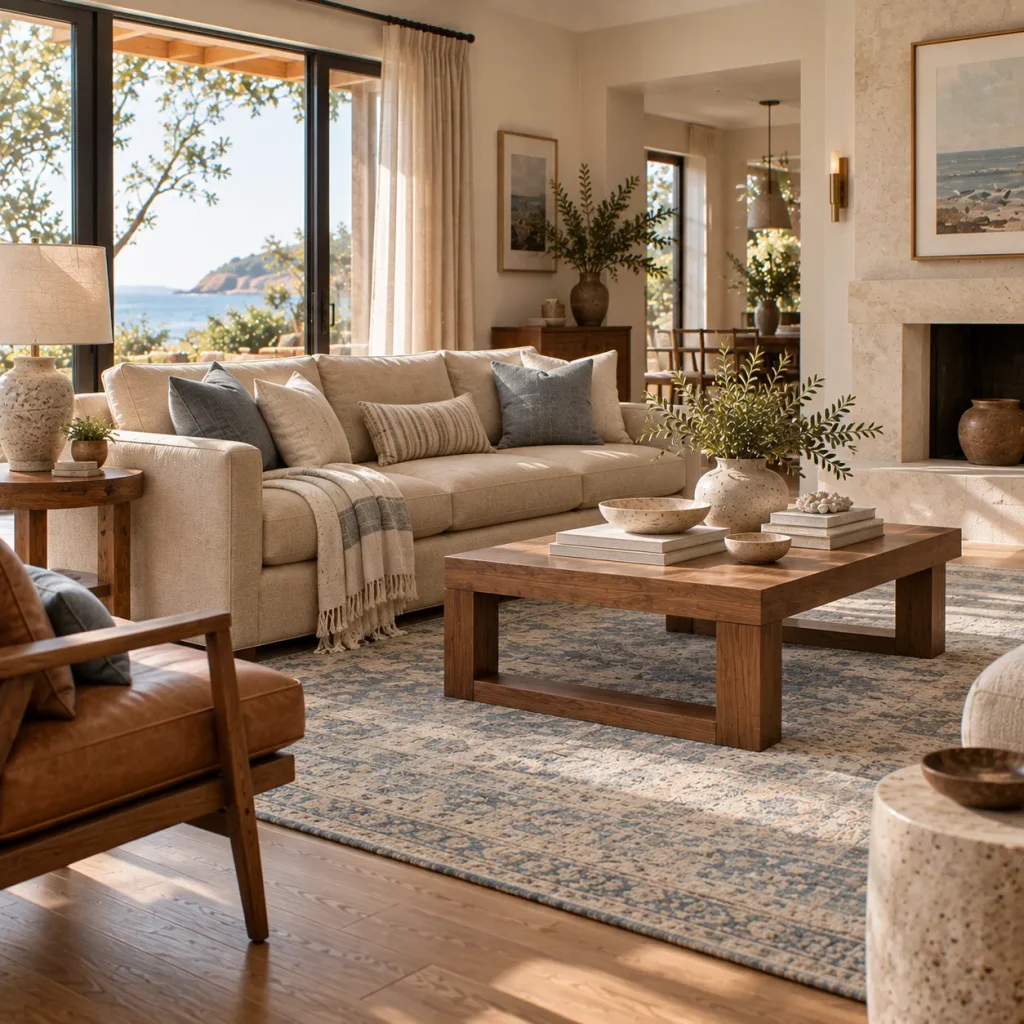
Idea 7: Use a sofa that looks relaxed but still has structure
A coastal sofa should invite people to sit down, but it does not have to be an enormous white slipcovered sectional.
A linen-look sofa in oatmeal, warm ivory, pale blue-gray, or sand can provide the right softness. Performance upholstery is worth considering in homes with children, pets, or frequent entertaining.
For many moderate living rooms, a sofa around 78 to 90 inches wide offers generous seating without dominating the room. A seat depth around 22 to 24 inches is a useful starting point for comfortable everyday seating.
And white upholstery is optional. A faded blue or moss-green sofa can still read as coastal when the surrounding materials are light and natural.
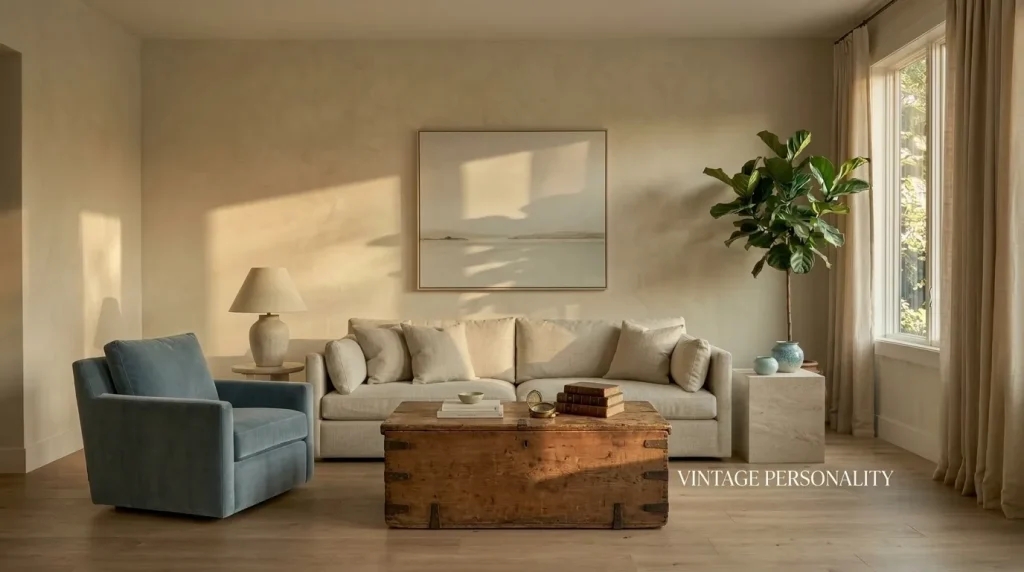
Idea 8: Mix one vintage piece into cleaner furniture
Contemporary coastal style benefits enormously from something that does not look newly purchased.
Try an old pine chest, vintage bamboo side table, weathered cabinet, antique stool, or aged wooden chair.
I once worked through a coastal room concept where every object was pale, new, and beautifully coordinated. It still felt strangely anonymous. Replacing one perfect side table with a worn wooden chest immediately gave the room more credibility.
Current coastal design is increasingly layered and individual rather than built as a matching furniture package.
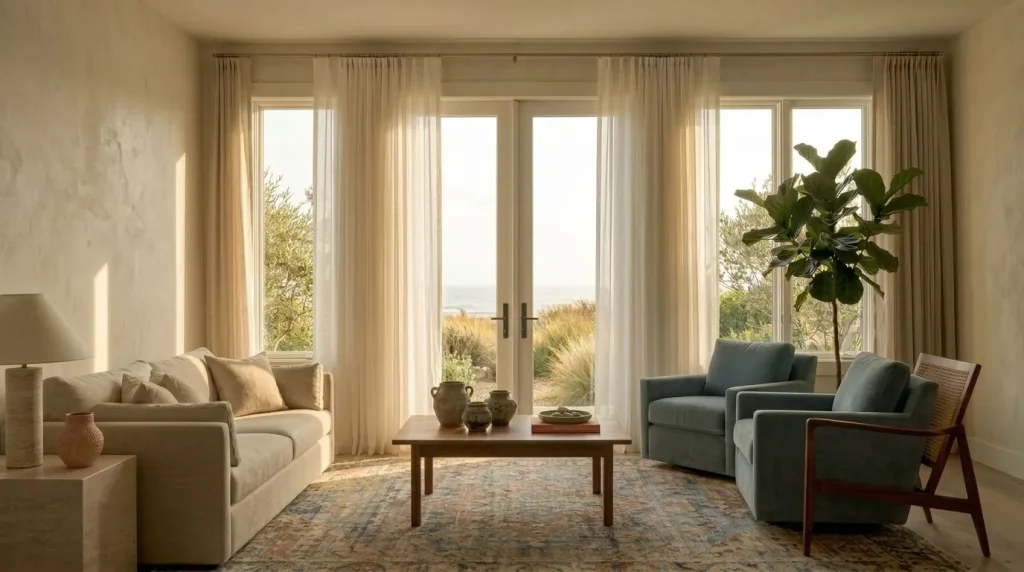
Idea 9: Arrange seating for conversation, not just the television
Relaxed coastal living is as much about layout as decoration.
If space permits, bring an occasional chair closer to the sofa instead of lining every seat against a wall. A pair of swivel chairs can be particularly useful in rooms that connect to a garden, terrace, or view.
Keep roughly 14 to 18 inches between the sofa and coffee table where comfortable.
And resist overfurnishing. Coastal rooms usually benefit from visible floor space and clear movement more than they benefit from another side table, a principle covered in more detail in these small living room layout ideas.
Layer pattern without turning nautical
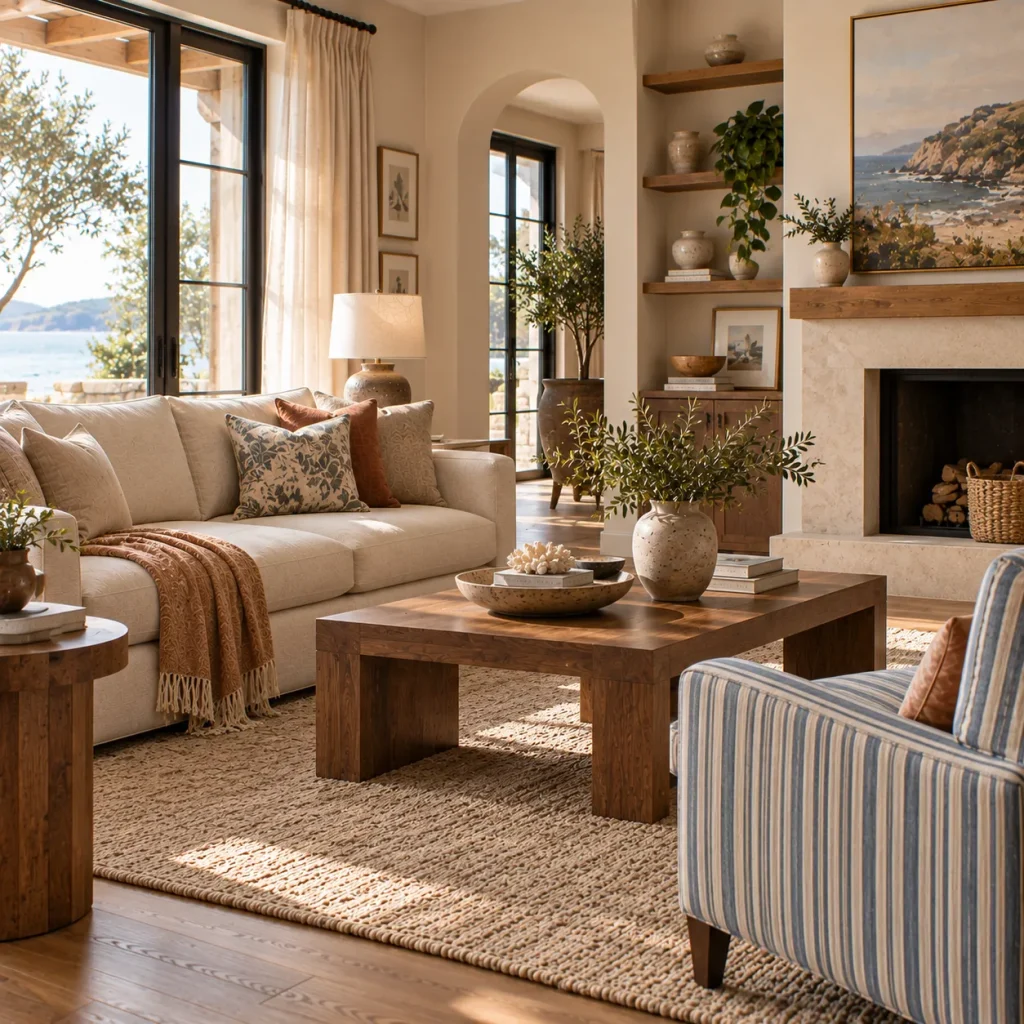
Idea 10: Use stripes once
Stripes make sense in coastal rooms, but they do not need to appear on the rug, cushions, curtains, and chairs simultaneously.
Try one striped armchair, a ticking-stripe cushion, or wide linen curtains with a subtle banded pattern.
Then combine the stripe with solids, a small botanical, or an abstract textile.
One good stripe quietly references maritime design. Six striped surfaces make the room look themed.
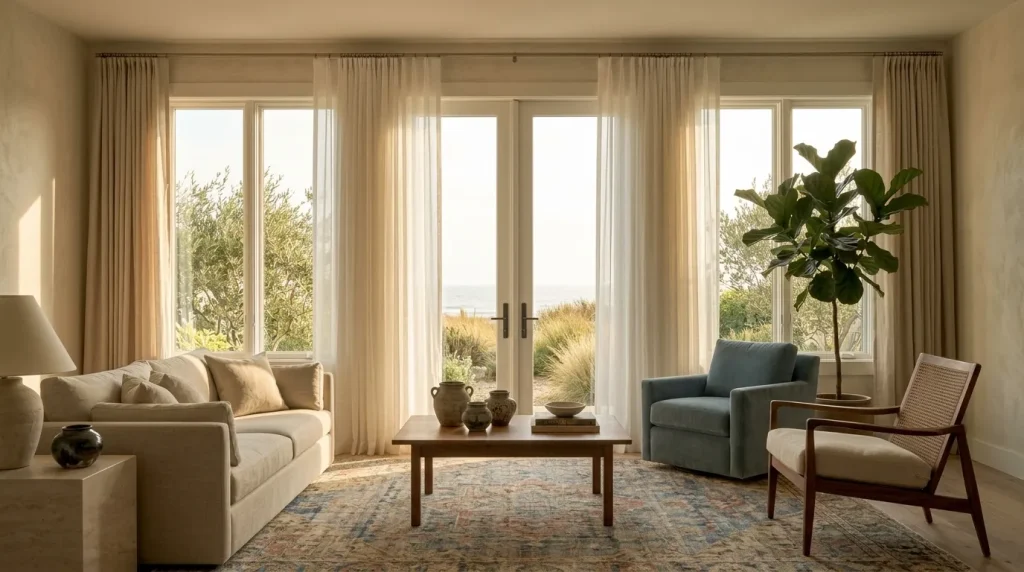
Idea 11: Let a patterned rug carry more color
A pale jute rug is an obvious coastal choice, but it is not always the most useful one.
If your room already contains cream upholstery and light walls, choose a faded patterned rug with dusty blue, rust, sand, olive, or soft coral. It will connect the seating and give the palette more depth.
An 8-by-10-foot rug is often a better starting size for a medium living room than a 5-by-7 because it can reach beneath the front legs of the major seating.
The goal is to make the furniture look connected, not to leave a decorative island beneath the coffee table, the same connective approach used in these living room color combinations for a fresh feel.
Make the room feel connected to nature
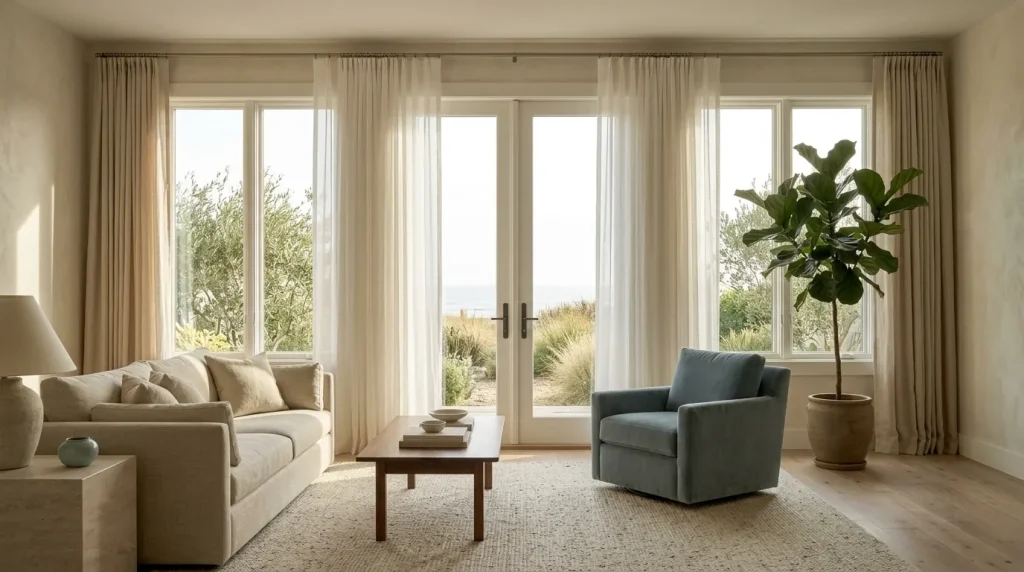
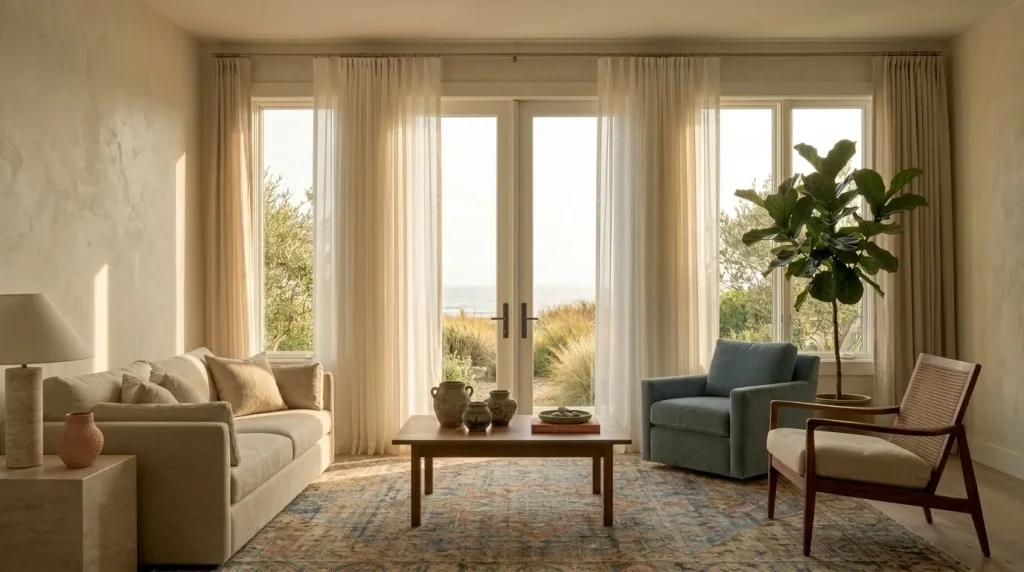
Idea 12: Frame the daylight rather than blocking it
The coastal feeling depends heavily on light.
Mount curtain rods above the window and extend them beyond the frame where possible so the fabric stacks mostly beside the glass when open. Linen or linen-look curtains soften light without visually closing the room.
If privacy is important, layer sheer panels with fuller curtains rather than using heavy drapery alone.
Even away from the coast, this stronger relationship between interior and exterior can create much of the ease people associate with beach houses. Current design coverage continues to emphasize indoor-outdoor continuity through natural materials and relaxed layouts.
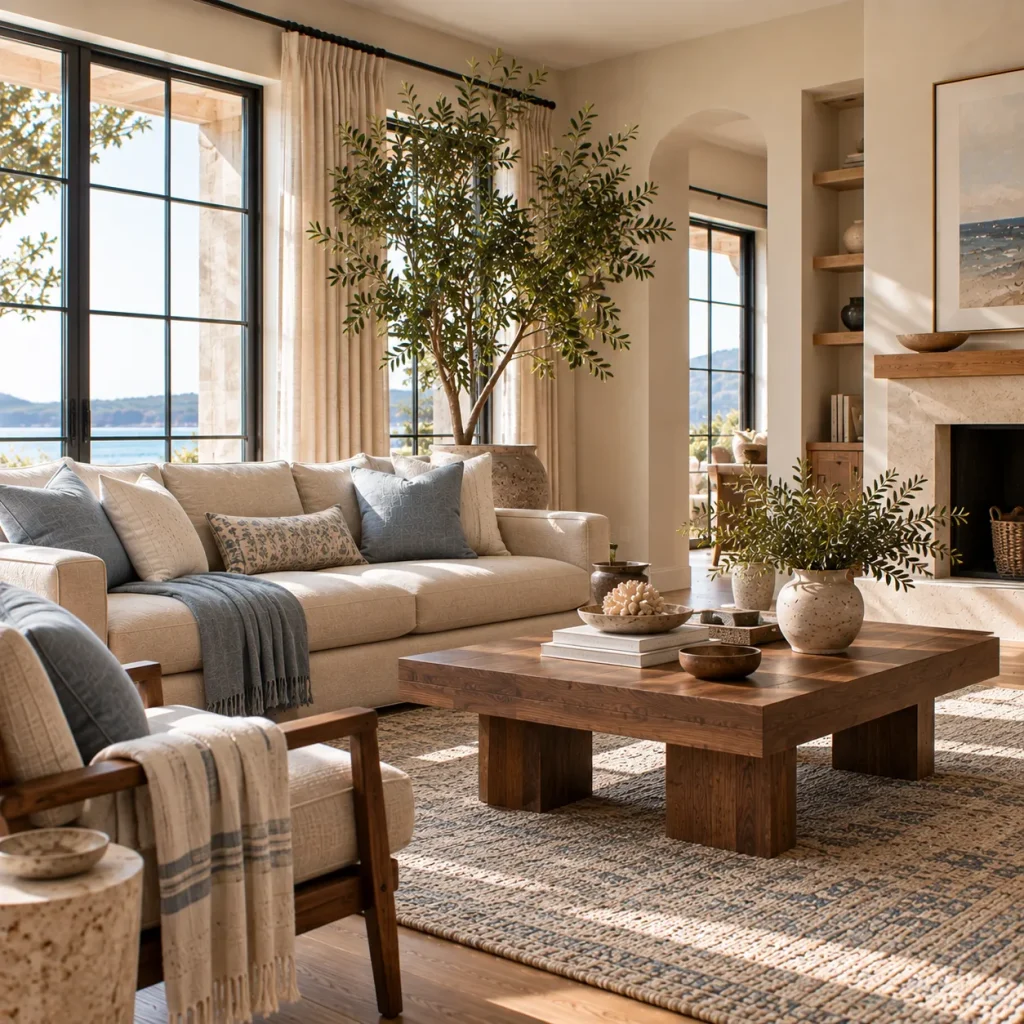
Idea 13: Bring in greenery that suits your actual light
Do not automatically put a faux palm in the corner because the room is coastal.
Choose plants according to conditions. A kentia palm, ficus, olive, or large leafy plant can add useful height where the daylight supports it.
In darker rooms, a few substantial branches in a large ceramic vessel may look better than struggling plants.
One large green element is usually stronger than a dozen tiny pots scattered across tables and shelves.
Add personality without beach-house clichés
Idea 14: Use art that suggests place without spelling it out
Coastal art does not have to show a sailboat.
Consider abstract work in sea-glass colors, atmospheric landscape photography, vintage botanical prints, coastal topography, gestural paintings, or something completely unrelated that shares the room’s palette.
Artwork can even establish the entire color scheme. Homes & Gardens has highlighted designer examples where coastal living-room palettes were developed from existing art rather than from standard nautical colors.
For art above a sofa, a piece or grouped arrangement around two-thirds the sofa’s width is a useful starting point.

Idea 15: Use one shell-inspired detail with restraint
Shells are actually having a renewed design moment in 2026, but the treatment is more sculptural than souvenir-like. Current examples include shell forms interpreted in plaster, metal, and more refined decorative objects.
That means one shell-shaped plaster bowl, scalloped lamp, or sculptural object can work beautifully.
A shelf containing starfish, coral replicas, rope knots, miniature boats, and five shells is another story.
The reference should feel like an observation, not a costume.
A simple formula for a current coastal living room
| Element | Stronger 2026 approach | What can feel dated |
|---|---|---|
| Walls | Warm white, plaster, sand, muted blue | Cold white everywhere |
| Wood | White oak, walnut, visible grain | Heavily bleached finishes only |
| Upholstery | Linen, cotton, relaxed performance fabric | All-white slipcovers by default |
| Color | Dusty blue, terracotta, moss, tobacco | Strict navy and white |
| Texture | Stone, wood, linen, wool, woven fiber | Rattan on every surface |
| Decor | Art, pottery, books, one coastal reference | Anchors, ropes, signs, themed collections |
What should you skip in a coastal living room?
Literal nautical decor. Anchors, fishing nets, rope-covered objects, and repeated boat motifs usually make the style feel staged. Designers in 2026 are explicitly moving coastal spaces toward subtler references.
Too much white. Coastal lightness comes from space, materials, and daylight. It does not require every object to be white.
Matching rattan furniture. One woven chair or cabinet can be beautiful. A complete woven furniture suite quickly becomes repetitive.
Tiny seaside accessories. Pebbles, shells, miniature boats, and blue bottles scattered everywhere create clutter rather than atmosphere.
Overfurnishing the room. Leave enough open floor area for easy movement. A coastal room should feel relaxed before it looks decorated.
Try this if your living room is already beige
Do not repaint immediately.
Add dusty blue or muted teal through a substantial element, such as curtains, a rug, or an upholstered chair. Next, introduce medium or darker wood so the pale palette gains weight.
Replace one generic woven accessory with ceramic or stone. Add a large piece of art containing two or three colors you can repeat elsewhere.
Finally, remove a few small beige objects.
That last step matters. Sometimes a neutral room needs stronger contrast rather than another layer of neutral decor.
FAQ
Is coastal living room decor still popular in 2026?
Yes, but it has become less literal. Current coastal design favors warm woods, plaster, stone, natural textiles, layered interiors, and personal art instead of obvious beach motifs.
What colors work best in a coastal living room?
Warm white, sand, dusty blue, muted teal, sea-glass green, terracotta, tobacco, soft coral, and deeper navy can all work. Build the palette around the actual light and flooring rather than using blue and white automatically.
Can coastal style work if I do not live near the beach?
Absolutely. Focus on natural materials, comfortable seating, daylight, earthy coastal colors, and a relaxed layout rather than literal seaside objects. The room can reference a landscape without pretending to be a beach house.
What wood tones work with coastal decor?
White oak and light woods remain useful, but medium oak, walnut, and warmer visible-grain woods feel particularly current in 2026. Mixing light and darker wood can also stop a pale coastal room from looking flat.
Create the feeling of the coast, not a theme
The most successful 15 coastal living room Ideas have surprisingly little to do with decorating a room with beach objects.
Start with light, comfortable furniture, honest materials, and colors that could plausibly come from the landscape. Then add contrast through wood, stone, art, and one or two pieces with age.
If you make one change first, remove the most obvious coastal-themed accessory and look at what remains. A strong coastal room should still feel relaxed without an anchor or seashell telling you what style it is.
That is the more interesting direction for 2026. Let the coast influence the atmosphere, while your furniture, art, and personal objects make the room your own.