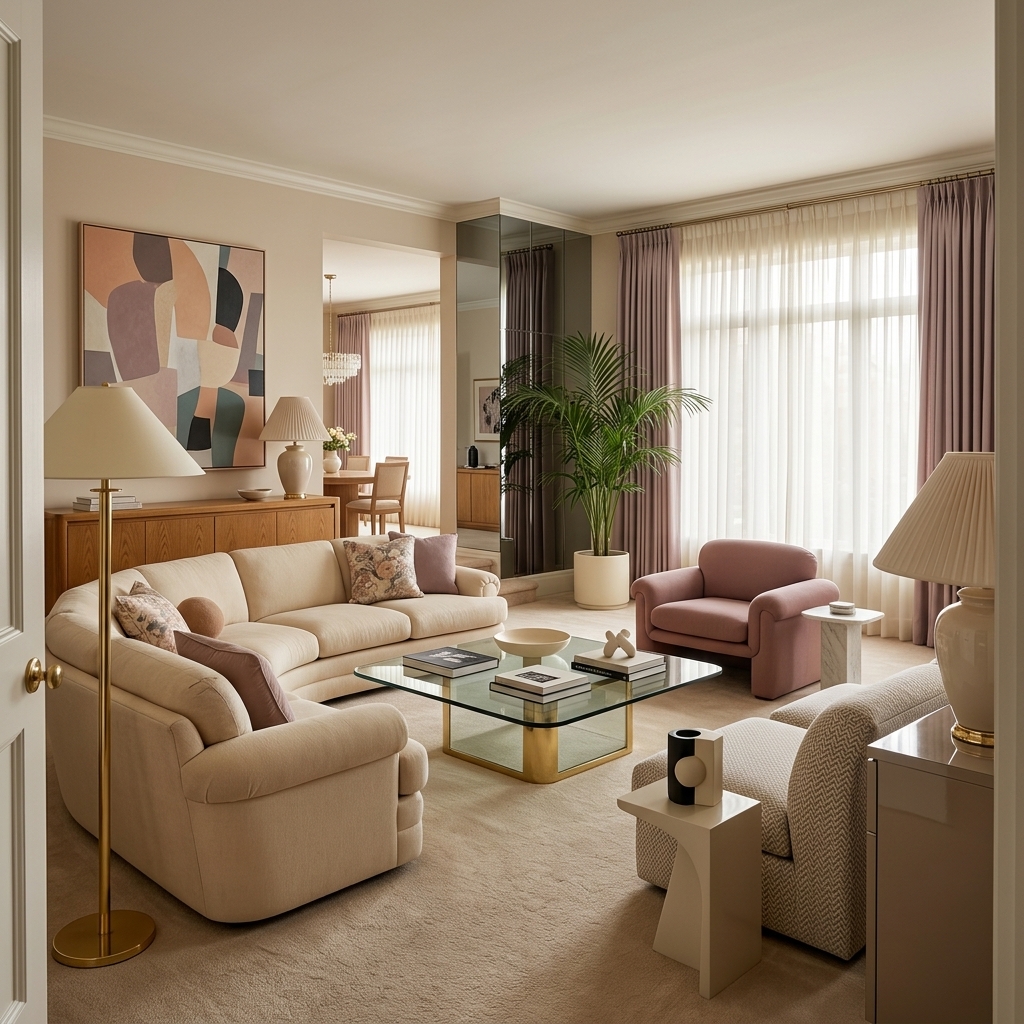
35 1980s Living Room Decor Ideas From Cozy Suburban Style to Miami Glam
The easiest way to get an 1980s living room wrong is to assume the decade looked like one long music video filled with neon, Memphis squiggles, and black-and-white checkerboard patterns.
Real 1980s homes were far more varied.
One suburban living room might have beige wall-to-wall carpet, a deep floral sofa, brass lamps, oak furniture, and heavy window treatments. Across the country, a Miami apartment could look almost futuristic with crisp white walls, glass tables, chrome, palms, pastel upholstery, and glossy surfaces. Wealthier interiors added marble, lacquer, mirrors, brass, oversized art, and furniture with theatrical proportions.
Memphis and other postmodern movements absolutely mattered. The Memphis group was founded in 1981 and became one of the decade’s most recognizable design movements, challenging conventional modernism through unusual combinations of color, geometry, laminate, terrazzo, glass, and playful forms. But museums and design historians make clear that it was one distinctive branch of a much wider 1980s design landscape.
That wider landscape is precisely why 1980s Living Room Decor Ideas feel interesting again. House Beautiful reported in August 2026 that designers are revisiting elements of the decade, particularly layered pattern, bold character, and expressive decorating, without necessarily reproducing an entire period room. Architectural Digest is simultaneously documenting renewed interest in lacquer, chrome, curved furniture, glossy finishes, and cinematic 1980s opulence.
So the goal here is not to turn your living room into a movie set.
It is to understand what actually made different kinds of 1980s rooms recognizable, then decide how far you want to take the reference.
First, decide which version of the 1980s you actually want
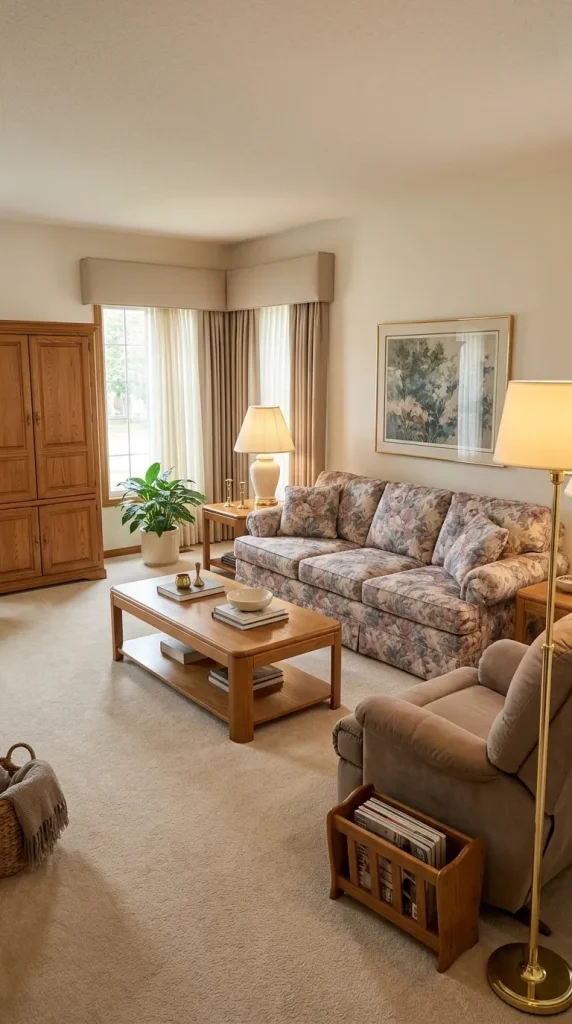
1. Choose your 1980s living room personality before buying anything
The decade is broad enough that simply saying “80s decor” is not very useful.
Choose a direction first.
Suburban 80s: beige, taupe, oak, floral upholstery, brass, comfortable sofas.
Miami 80s: white, peach, pale blue, teal, chrome, glass, palms.
Luxury 80s: marble, lacquer, mirrors, brass, plush seating, dramatic art.
Postmodern 80s: geometric shapes, contrasting color, sculptural furniture, playful form.
Modern 80s revival: curved seating, glass, chrome, white walls, one strong color, much more negative space.
Once that decision is made, shopping becomes easier.
A large oak cabinet may look perfect in a suburban nostalgic room and completely wrong beside a sleek white Miami sectional. A Memphis-inspired side table can energize a modern interpretation but may feel unrelated in a soft traditional family room.
The decade becomes much more convincing when you commit to a specific visual language instead of collecting random “retro” objects.
Build the palette before adding retro accessories

2. Use white walls as the backdrop for a late-80s modern look
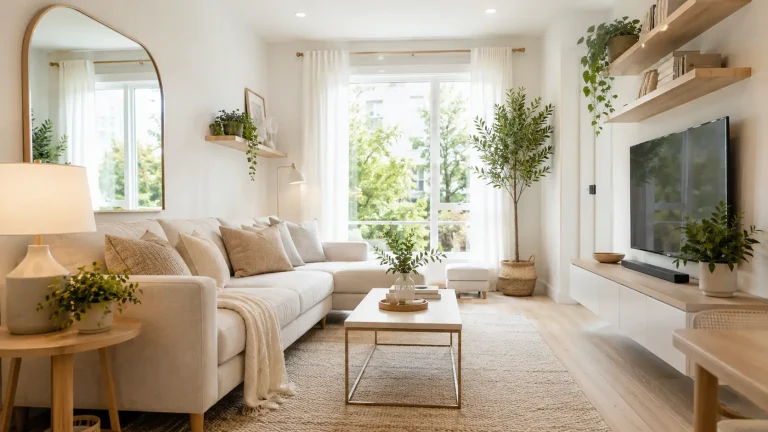
White walls can be one of the easiest routes into the decade.
They are particularly effective for Miami-inspired and more contemporary 1980s schemes because they allow chrome, glass, black lacquer, pastel upholstery, and colorful art to register clearly.
Try warm or relatively clean white walls with:
A pale blush or powder-blue sofa.
A smoked-glass table.
Chrome lighting.
One large abstract print.
A black lacquer side table.
The white acts as visual relief between reflective and colorful objects.
This is also one of the best ways to create a modern 80s aesthetic living room because the room retains contemporary simplicity while the silhouettes and finishes carry the historic reference.
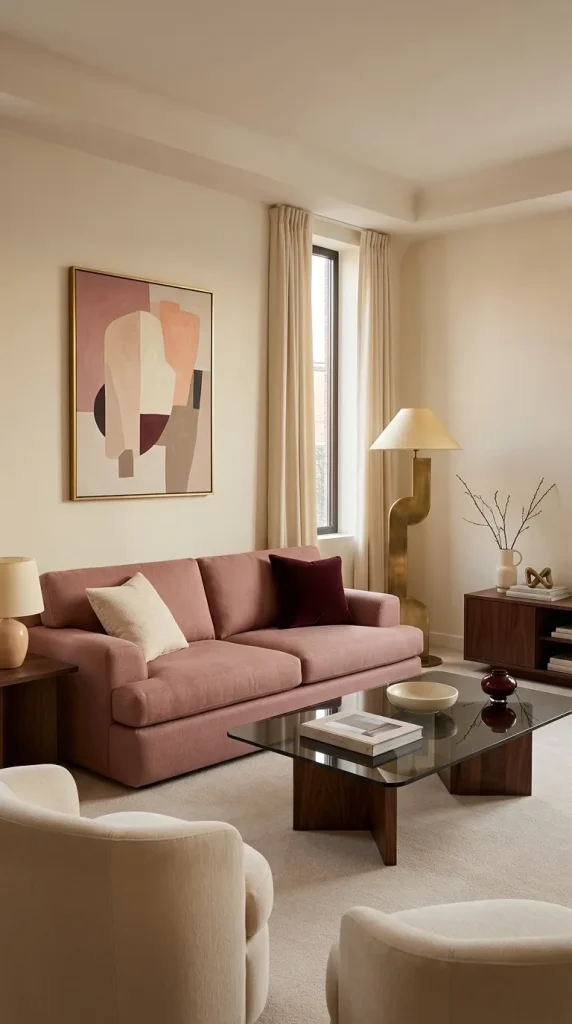
3. Combine peach, dusty rose, and cream for a softer 80s palette
Not every 1980s palette was high contrast.
Peach, dusty rose, warm cream, and pale beige can create the softer side of the decade, particularly when paired with plush upholstery and warm lighting.
The important part is preventing the colors from becoming too sugary.
Ground them with something darker:
Walnut.
Smoked glass.
Black.
Deep burgundy.
Aged brass.
A dusty-rose sofa against cream walls can look surprisingly current when paired with a dark glass coffee table and sculptural lamp.
Skip the matching peach curtains, peach cushions, peach rug, and peach lampshade unless historical reproduction is genuinely the goal.

4. Try teal, mauve, and gray for unmistakable 1980s color
Teal and mauve can instantly move a room toward the decade, but they need careful control today.
Use one as the dominant accent and the other in smaller quantities.
For example:
Soft gray sofa.
Muted teal rug.
One or two mauve cushions.
Chrome or black coffee table.
Large abstract artwork containing both colors.
The gray gives the stronger colors somewhere to rest.
For a more authentic version, increase the amount of mauve and introduce gray carpet.
For a contemporary interpretation, keep walls quieter and concentrate teal and mauve in art, upholstery, and textiles.
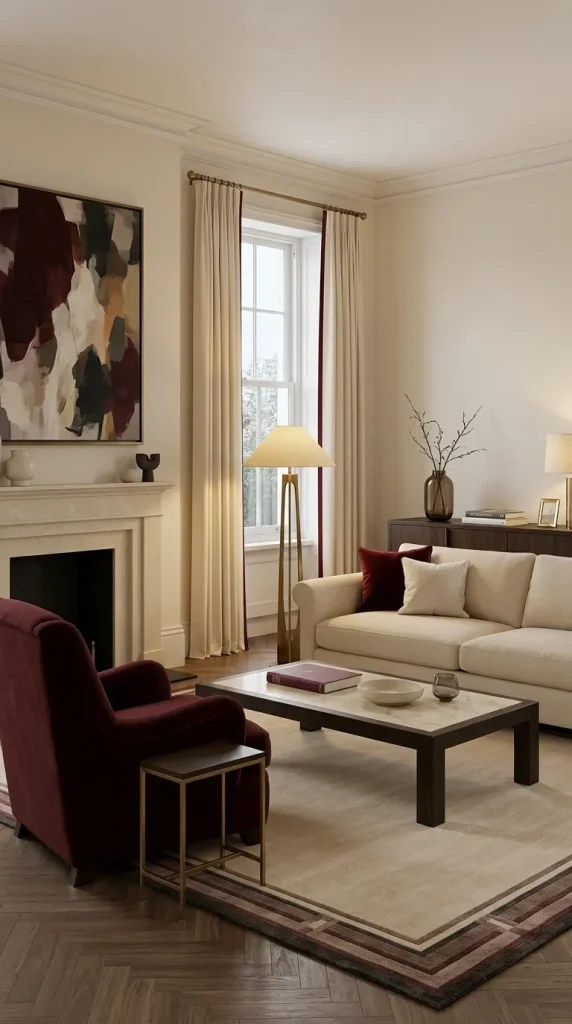
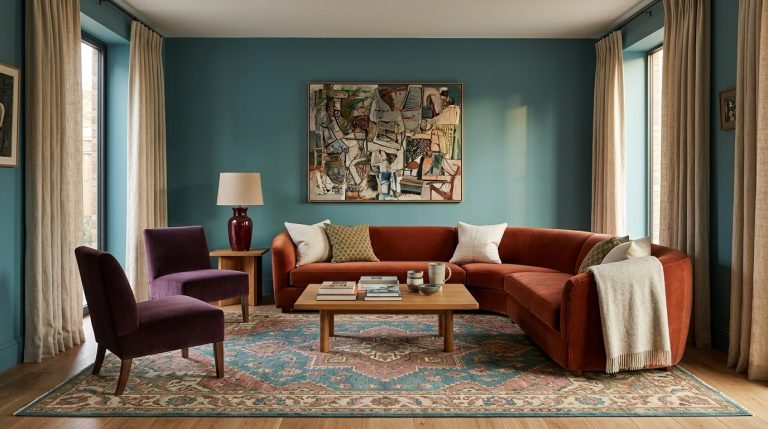
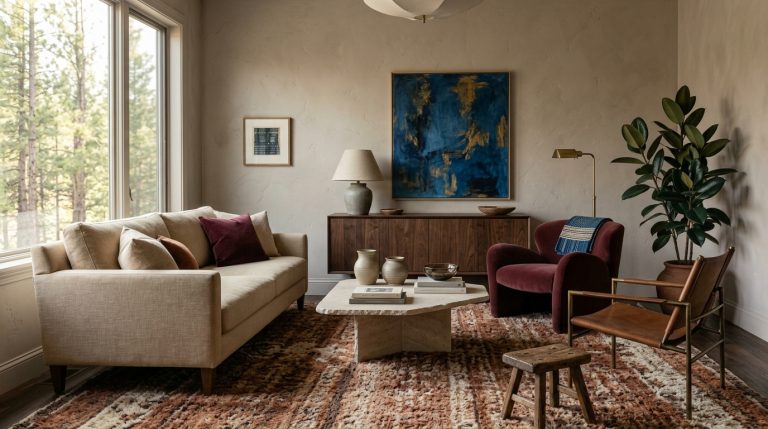
5. Pair burgundy with brass and cream for grown-up 80s glamour
Burgundy was not just a 1990s color.
Used with cream, brass, dark timber, marble, and plush upholstery, it can create a sophisticated late-20th-century living room.
Start with a cream or warm ivory foundation.
Add burgundy through:
One chair.
A rug.
Curtains.
Artwork.
A deep sofa.
Then introduce brass in lighting or a side table.
The metal should remain an accent rather than appearing on every available surface.
This palette suits traditional architecture particularly well because it lets you reference the decade without making the room look overtly retro.

6. Use black, white, and red for the graphic side of the decade
For something bolder, work with black and white first, then add red as a deliberate interruption.
A useful hierarchy might be:
White walls.
Black lacquer console.
Black-and-white geometric rug.
Chrome table.
One red sofa or chair.
The red should feel like the focal point.
If you repeat saturated red on the rug, walls, lamps, cushions, curtains, and accessories, the composition can slide quickly into party-theme territory.
One powerful red furniture piece usually does more.
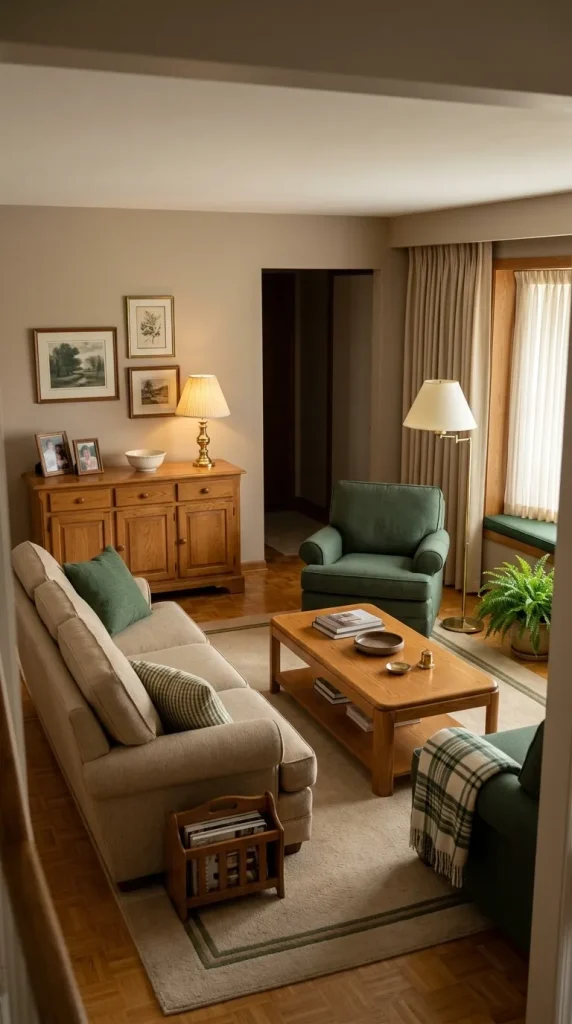
7. Combine beige, forest green, and oak for suburban 80s nostalgia
The family-oriented side of the decade looked very different from glossy penthouses.
Start with warm beige or taupe.
Add honeyed or medium oak.
Then introduce forest green through upholstery, curtains, cushions, or artwork.
Brass lamps work naturally here.
So do framed prints and deeper upholstered seating.
This is especially useful if you are decorating around inherited furniture rather than starting from scratch.
Instead of fighting an oak cabinet or beige sofa because it looks “dated,” use it as part of a deliberate nostalgic palette.
Let furniture silhouette carry the decade
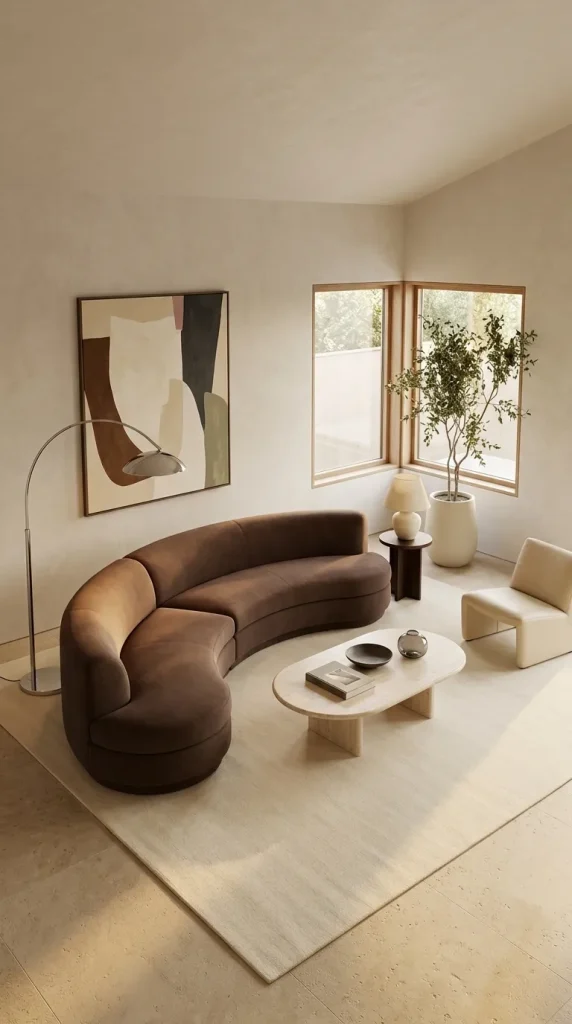
8. Start with one curved sofa
Furniture shape can communicate the 1980s even when the colors are restrained.
A curved sofa immediately brings softness and theatricality into a living room.
Keep enough clear floor area around it so the curve can actually be seen.
Pushing a sculptural sofa tightly against several pieces of bulky furniture removes the quality that made you choose it.
For a current interpretation, try cream, dusty rose, pale gray, tobacco, or deep green upholstery.
Curved and organic furniture remains relevant in contemporary design, which makes this one of the easiest 80s references to integrate without making the room feel like a reproduction. Architectural Digest’s 2026 coverage of 80s-inspired furniture similarly highlights curves, lacquer, chrome, and dramatic silhouettes as part of the decade’s renewed appeal.
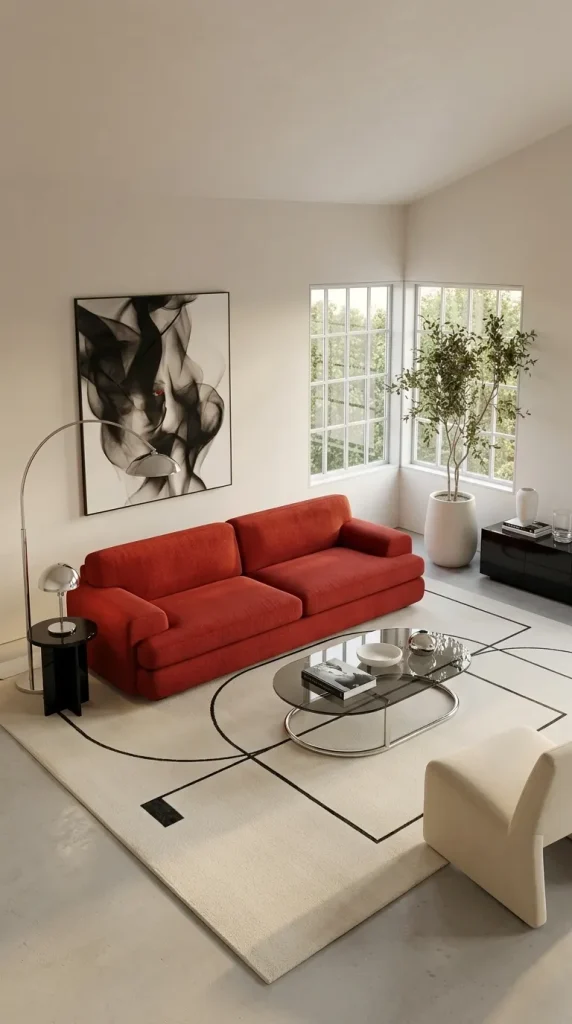
9. Make a red retro couch the room’s dominant object
A red sofa can deliver more 80s character than dozens of small accessories.
Choose the surrounding room carefully.
Red works particularly well beside:
White walls.
Chrome.
Black lacquer.
Smoked glass.
Black-and-white rugs.
Large graphic art.
The reason is contrast.
The room becomes a controlled composition built around one strong color rather than a collection of retro references.
If the sofa is already visually heavy, keep surrounding chairs quieter.
You do not need every seat to compete.
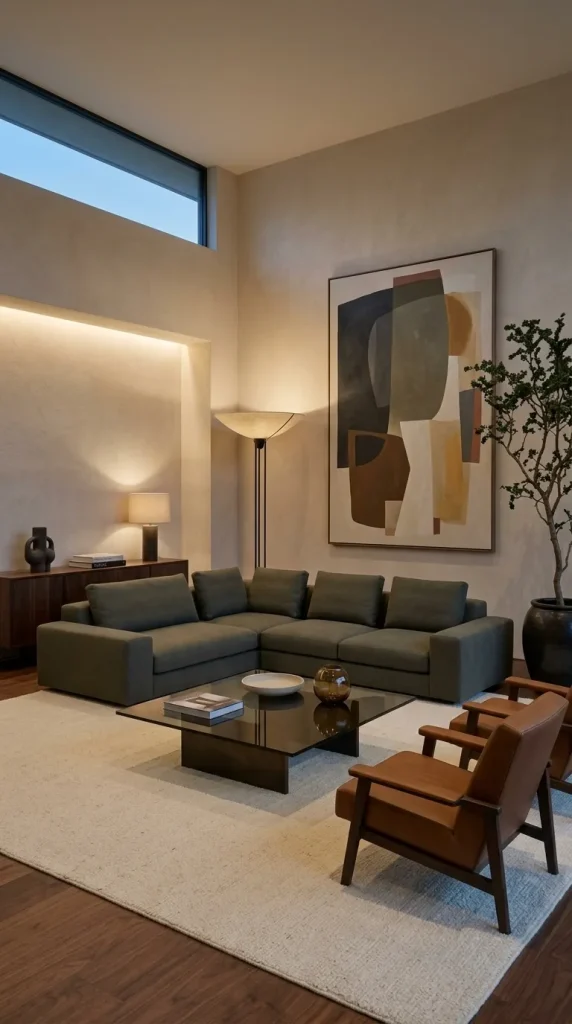
10. Bring in low-profile lounge seating
Low sofas and lounge chairs create the relaxed, almost conversation-pit atmosphere associated with some late-modern and 1980s interiors.
This works especially well in a room with:
A generous rug.
A low glass table.
Soft indirect lighting.
Large-scale art.
But proportion matters.
Very low furniture can look stranded in a room with extremely high ceilings unless artwork, lighting, or another tall element reconnects the seating to the vertical architecture.
Use a tall floor lamp or large artwork to bridge the difference.
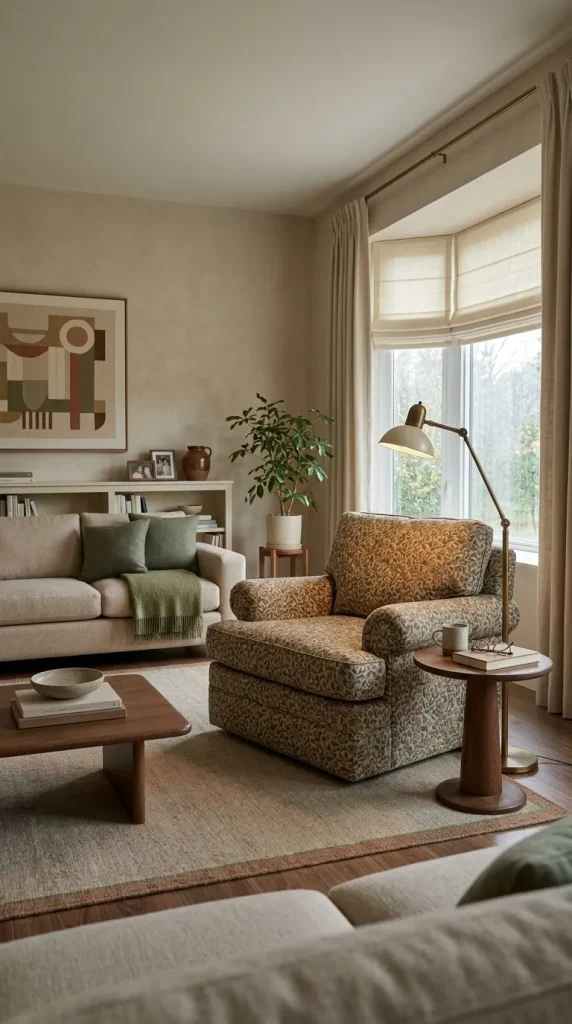
11. Add one oversized upholstered armchair
Suburban 1980s rooms often valued comfort as much as style.
A deep, substantial armchair can help recreate that generous family-room feeling.
Look for:
Rounded arms.
Plush upholstery.
A substantial seat.
Pattern or texture.
Pair the chair with a simple side table and dedicated reading lamp so it looks useful rather than merely oversized.
For a modern version, skip the full matching suite.
Let the chair differ from the sofa while repeating one color or material elsewhere in the room.
That produces a more collected result.
Use reflective materials to create 80s polish
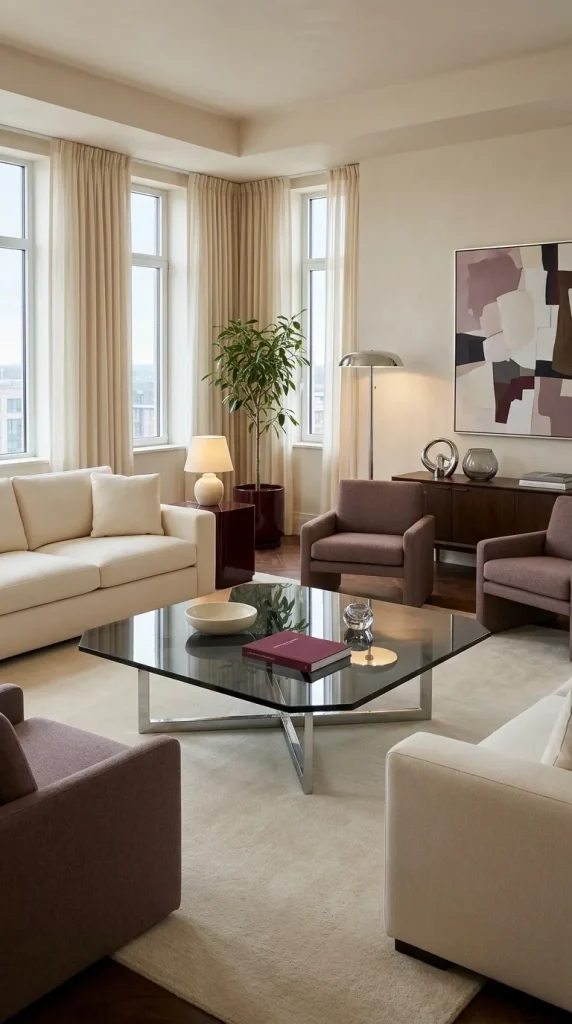
12. Make smoked glass the coffee-table material
Smoked glass is one of the most effective ways to bring the decade into a contemporary room.
It has the sleekness of clear glass but carries more visual weight.
Pair it with:
Chrome.
Dark lacquer.
Burgundy.
Cream upholstery.
Mauve.
Walnut.
Smoked glass is particularly useful if the sofa and chairs are bulky because the transparency keeps the middle of the room from becoming visually dense.
House & Garden has specifically identified glassy materials, chrome, marble, and other shiny surfaces as important 1980s references now being reconsidered in current interiors.
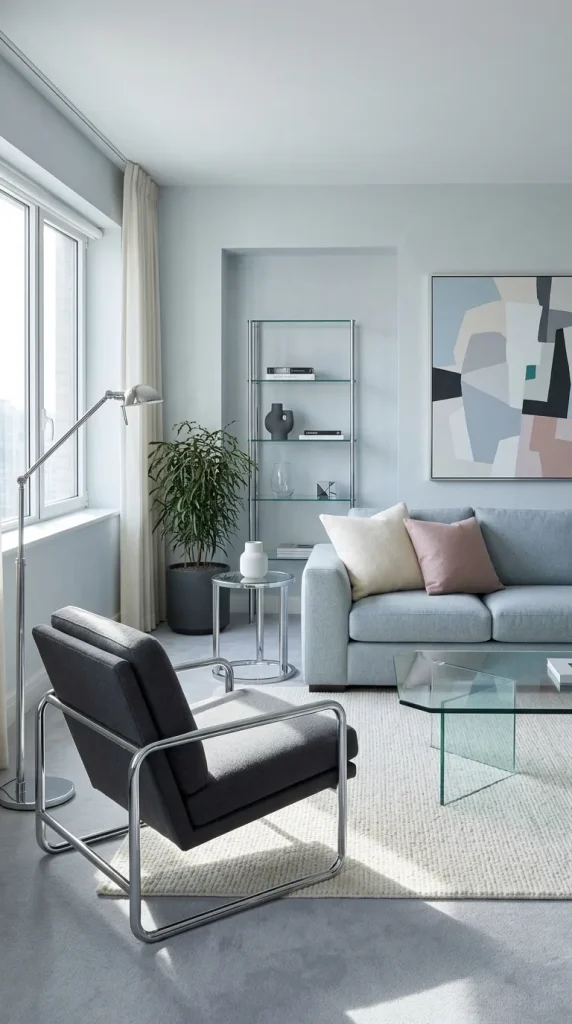
13. Use chrome for the cooler, high-tech side of the 80s
Chrome communicates a different mood from brass.
It feels cooler, sharper, more futuristic.
Use it for:
Coffee-table bases.
Floor lamps.
Side tables.
Shelving.
Chair frames.
Small decorative objects.
Chrome looks particularly strong against white, black, gray, pale blue, pink, and teal.
For a modern room, use it where light can catch it, then balance it with softer materials such as wool, upholstery, carpet, or plaster-like walls.
The contrast matters.
An entire room of shiny surfaces becomes visually hard.
A chrome table beside a soft wool sofa creates much more tension.
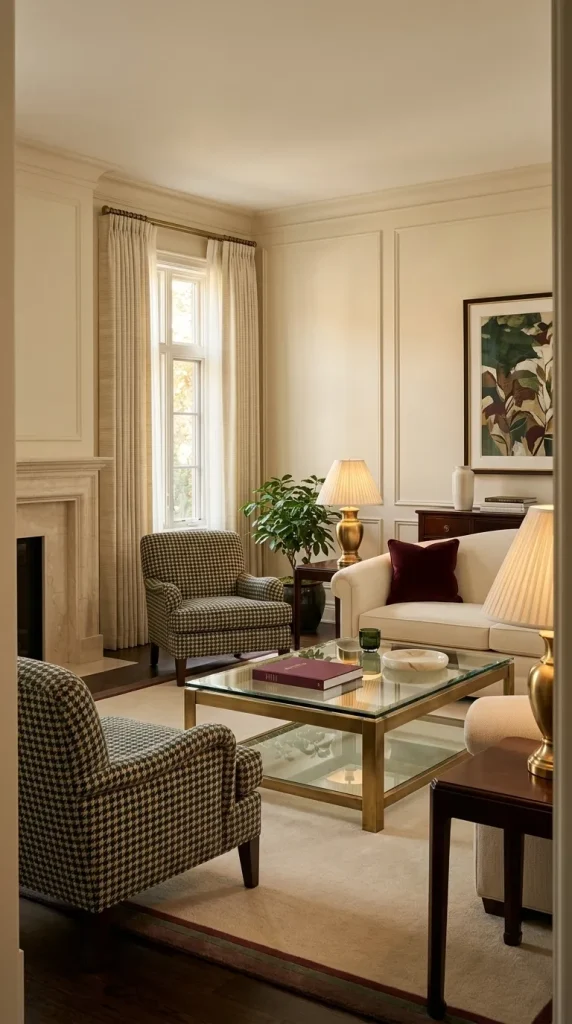
14. Use brass for the glamorous or traditional side of the decade
Brass belongs to another branch of 1980s decorating.
Rather than futuristic, it can feel luxurious and warm.
Use it alongside:
Cream.
Burgundy.
Forest green.
Dark wood.
Marble.
Patterned upholstery.
A pair of brass table lamps can be enough.
Or choose a brass-framed glass table.
Avoid assuming chrome and brass are interchangeable. They create different temperatures and different references.
Chrome generally works better for Miami, high-tech, and more postmodern looks.
Brass suits luxury, traditional, and suburban interpretations.
15. Introduce black lacquer as one strong glossy surface
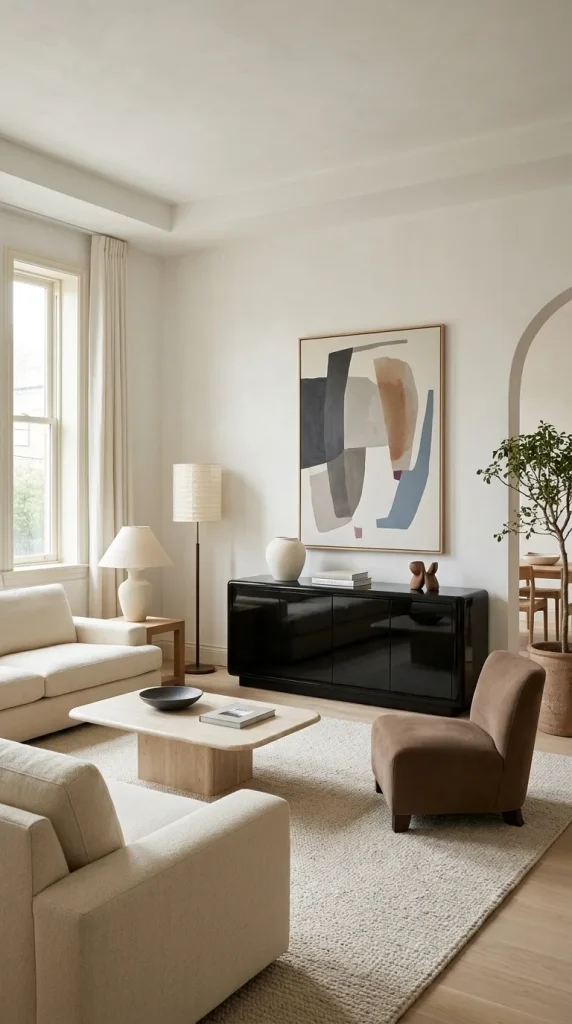
Glossy black is one of the most recognizable material cues from the decade.
But a little goes a long way.
Try:
One black lacquer console.
A side table.
A low media cabinet.
A pair of nesting tables.
Against white walls and pale upholstery, the gloss creates crisp contrast.
Against burgundy or darker upholstery, it creates a more dramatic, nightclub-like quality.
Lacquer itself is also experiencing renewed design attention in 2026, although contemporary interiors tend to balance high-gloss surfaces with matte walls, fabric, or natural material rather than making everything reflective.
16. Keep warm oak for the suburban side of 1980s design
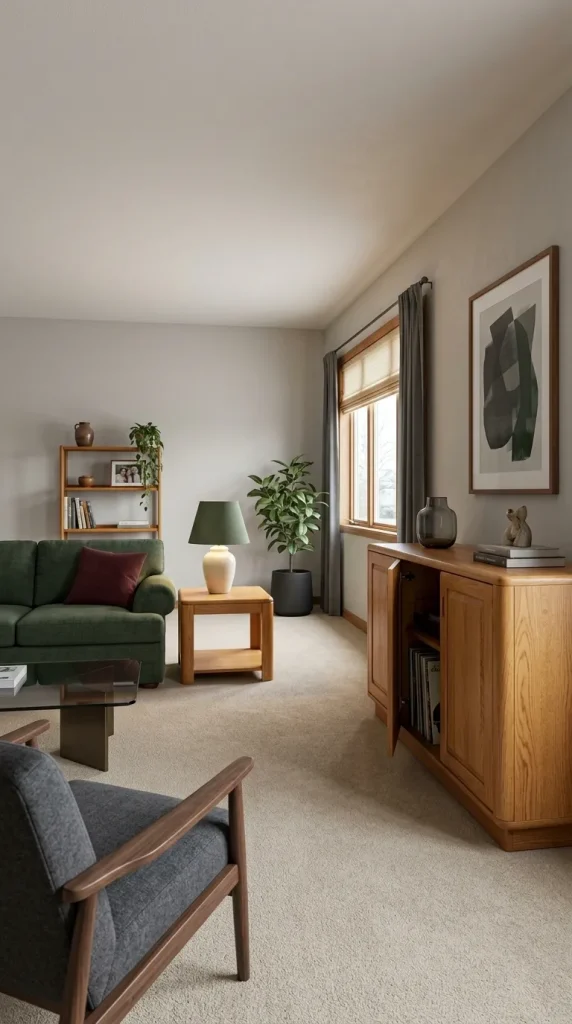
Not every 80s living room contained chrome and lacquer.
Oak furniture was extremely important to the everyday domestic version of the decade.
You can reference it today without rebuilding a giant wall of cabinetry.
Try:
An oak console.
A substantial side table.
Vintage shelving.
A record cabinet.
A low media unit.
If the wood has an orange or honey undertone, balance it with cooler or deeper elements such as forest green, charcoal, burgundy, or smoked glass.
Do not try to make every wood finish match exactly.
That often makes a modern room feel more artificial, not more authentic.

17. Add marble for an upscale mansion or penthouse mood
For luxury 80s interiors, marble can provide immediate visual weight.
Use it on one meaningful surface:
Coffee table.
Console top.
Fireplace surround.
Side table.
The marble can then sit beside brass, black lacquer, glass, or plush upholstery.
Avoid scattering marble-patterned accessories everywhere.
A substantial real or convincing stone surface creates much more authority than several small decorative objects printed to resemble marble.
Give walls more presence
18. Use one large mirror instead of covering every wall with mirror
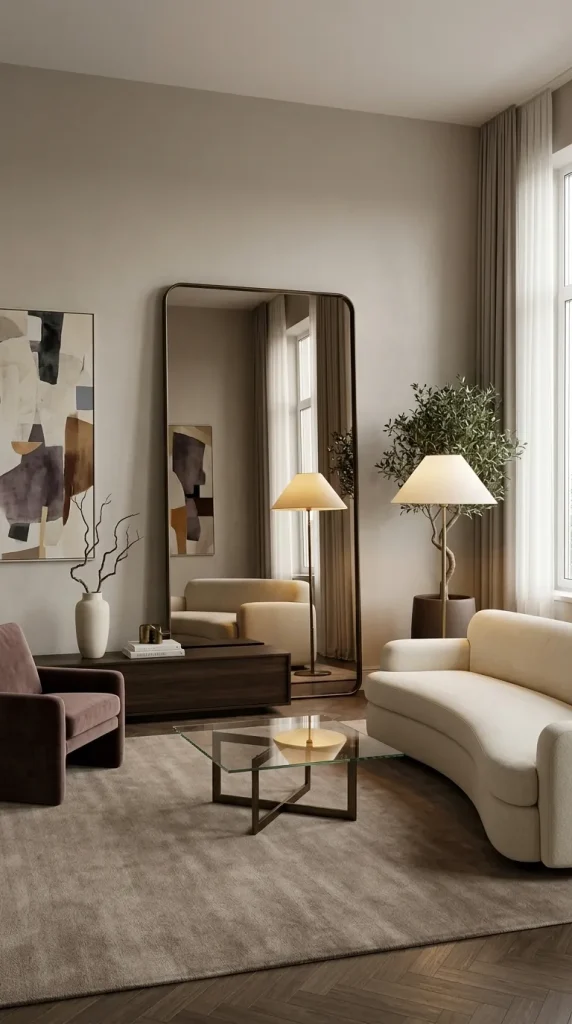
Mirrored walls were one of the more theatrical features of upscale late-20th-century interiors.
They enlarged rooms visually and amplified shiny surfaces and lighting.
You do not need to reproduce an entire mirrored wall to capture the idea.
A modern version might use:
One oversized floor mirror.
A large smoked mirror.
Mirrored panels behind a console.
A mirrored side table.
The best placement usually reflects something worth seeing.
A mirror facing clutter does not magically create glamour. It duplicates the clutter.
19. Hang oversized abstract art
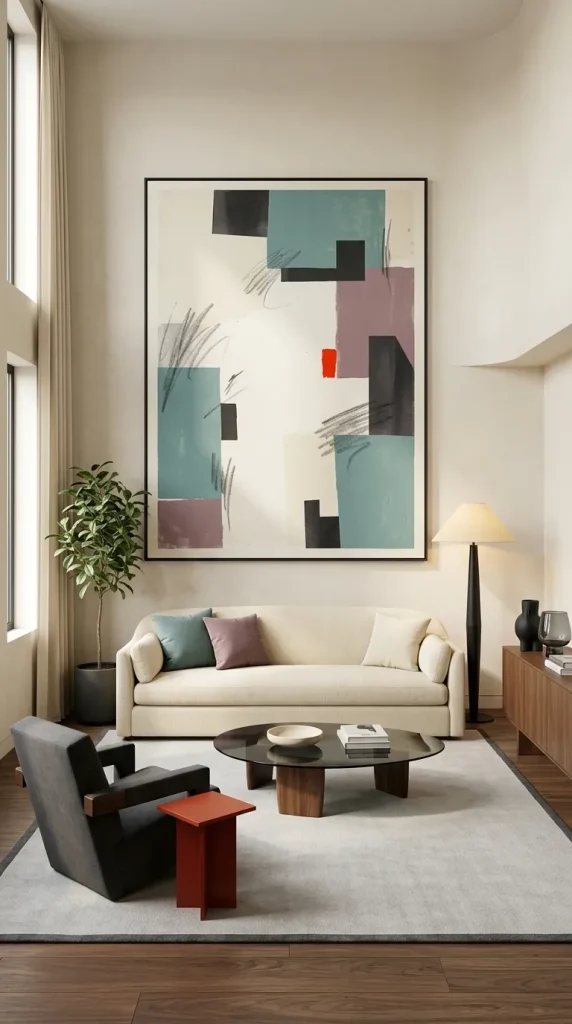
Large-scale art fits the proportions of 1980s interiors better than a dense collection of tiny frames.
Look for work with:
Geometric forms.
Broad color fields.
Gestural abstraction.
Pastel blocks.
Black-and-white graphics.
Strong primary accents.
Hang one substantial piece above the sofa or console.
The art can also establish the room’s color palette.
If an abstract print contains teal, mauve, black, and cream, those colors can repeat elsewhere in smaller doses.
This gives the room cohesion without requiring a coordinated furniture set.

20. Use geometric wall art without turning the room into a Memphis set
Memphis is one of the most identifiable design movements associated with the decade. The collective’s 1981 debut rejected conventional modernist restraint through bold colors, playful geometry, laminate, terrazzo, and deliberately unconventional combinations.
That does not mean the whole room needs squiggles.
Try one geometric artwork or sculptural object.
Then surround it with quieter furniture.
This makes the postmodern reference visible without overwhelming everyday function.
It is also closer to the way many contemporary designers borrow from the period today, using one or two expressive ideas instead of recreating an entire Memphis showroom.
Use flooring and textiles to change the atmosphere
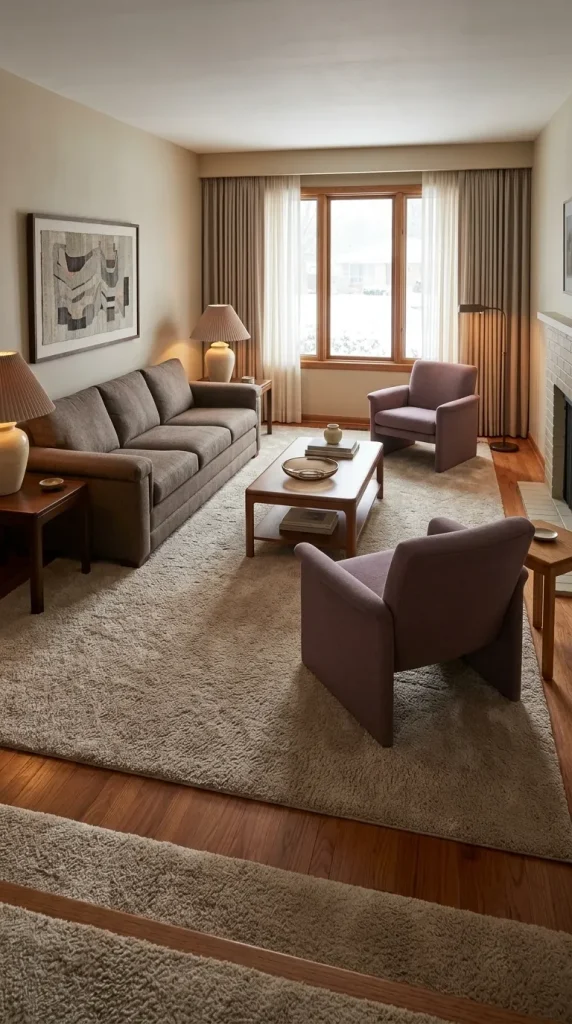
21. Recreate wall-to-wall carpet with a large plush rug
Wall-to-wall carpet was common in comfortable suburban homes, often in beige, gray, taupe, or mauve.
You do not need to replace hardwood flooring to recreate that softness.
Use a large plush rug instead.
Let it extend beneath the sofa and chairs enough to connect the seating group.
Choose:
Warm beige.
Mushroom.
Soft gray.
Dusty mauve.
Muted geometric pattern.
A large rug creates the visual softness of carpeting while remaining much easier to change later.
Recent coverage of genuinely restrained 1980s interiors also provides a useful reminder that beige carpet and softer domestic materials were as much a part of the decade as louder postmodern design.
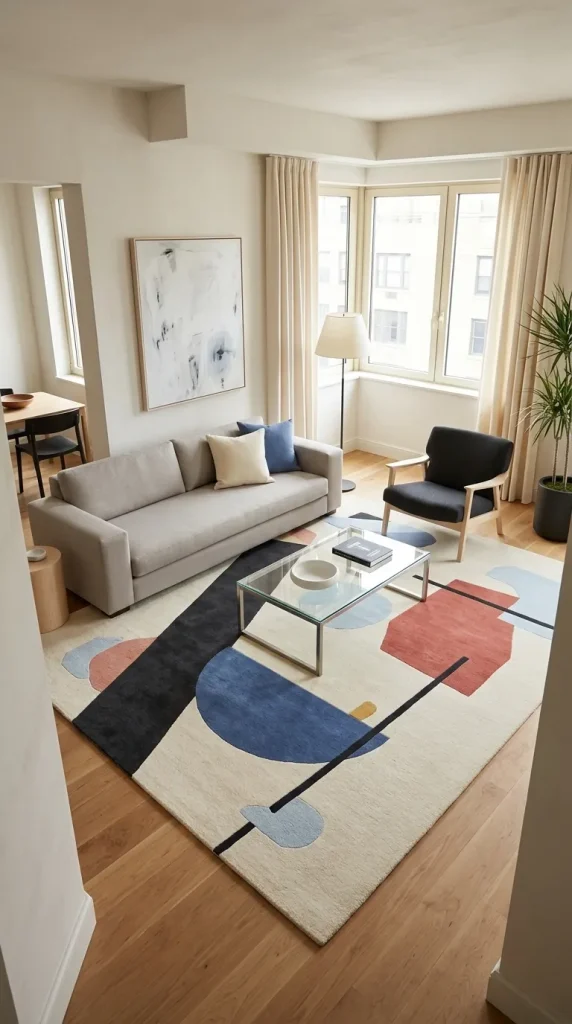
22. Bring in one bold geometric rug
For a more graphic interpretation, let the rug carry the retro pattern.
Think:
Black-and-white grid.
Large abstract shapes.
Pastel geometry.
Red, blue, and black accents.
Irregular postmodern forms.
Keep the sofa comparatively quiet if the rug is extremely expressive.
Pattern needs visual hierarchy just like furniture.
When the rug, sofa, curtains, cushions, and artwork all use bold geometry at the same scale, the room becomes difficult to read.
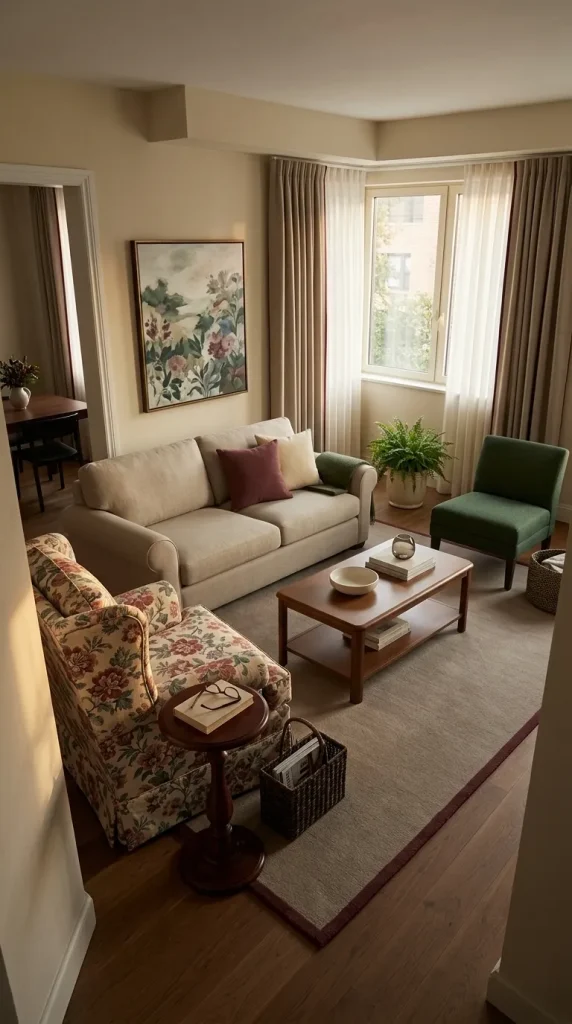
23. Use floral upholstery for cozy suburban nostalgia
Floral upholstery was another important part of domestic 1980s interiors, especially away from the high-gloss editorial image of the decade.
A floral chair can immediately soften an 80s-inspired room.
Choose one piece rather than purchasing a full floral suite.
Then pull one color from the fabric into:
A cushion.
A lamp.
A rug.
Artwork.
House Beautiful’s 2026 reporting on the revival of 1980s decorating specifically points to the decade’s love of layered pattern, trim, and richly decorated rooms rather than reducing the period to postmodern graphics.
For a more current look, let surrounding furniture remain solid.
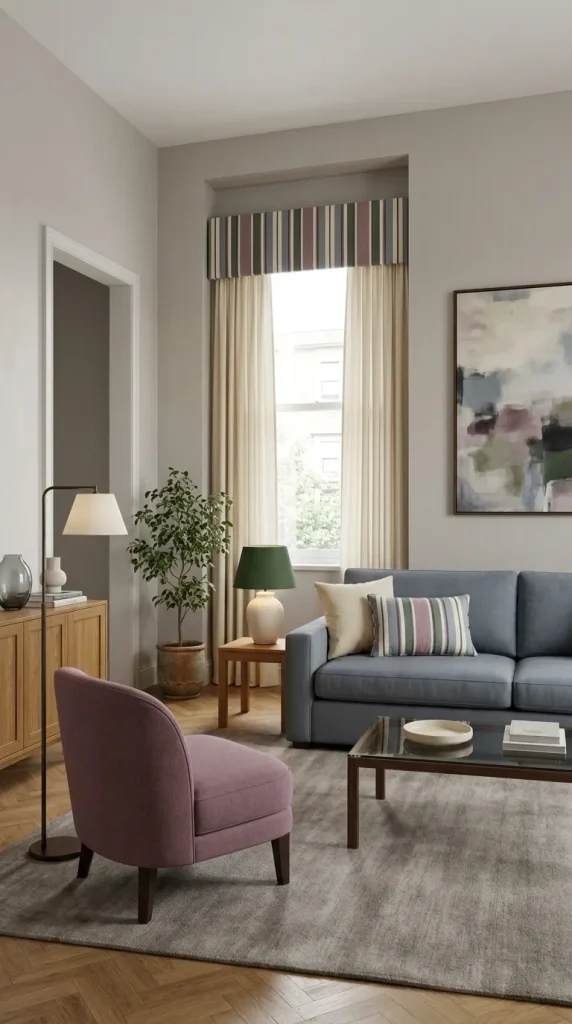
24. Use coordinated textiles selectively
Historically, some 1980s rooms embraced substantial coordination.
Curtains might relate directly to upholstery.
Cushions repeated sofa fabrics.
Valances picked up colors from wallpaper.
That can create wonderful nostalgia, but a complete recreation can feel heavy in a modern home.
Instead, repeat one pattern twice.
Perhaps a floral armchair shares a fabric tone with the curtains.
Or a striped cushion repeats colors from an abstract rug.
Two repetitions suggest coordination.
Five can start to resemble a showroom set.
Let window treatments contribute to the period look

25. Decide whether you want vertical blinds or softer valances
Window treatments can move a room surprisingly far toward the decade.
For a sharper apartment or Miami direction, vertical blinds can provide an immediate late-20th-century cue.
For a suburban or traditional room, fuller curtains and valances create a softer nostalgic reference.
If you are modernizing the look, simplify the treatment.
Use generous curtains without elaborate swags.
Or choose clean vertical blinds but pair them with current furniture.
The goal is to borrow the proportion and mood rather than reproduce every historical layer.
Use lighting as one of the strongest 80s signals
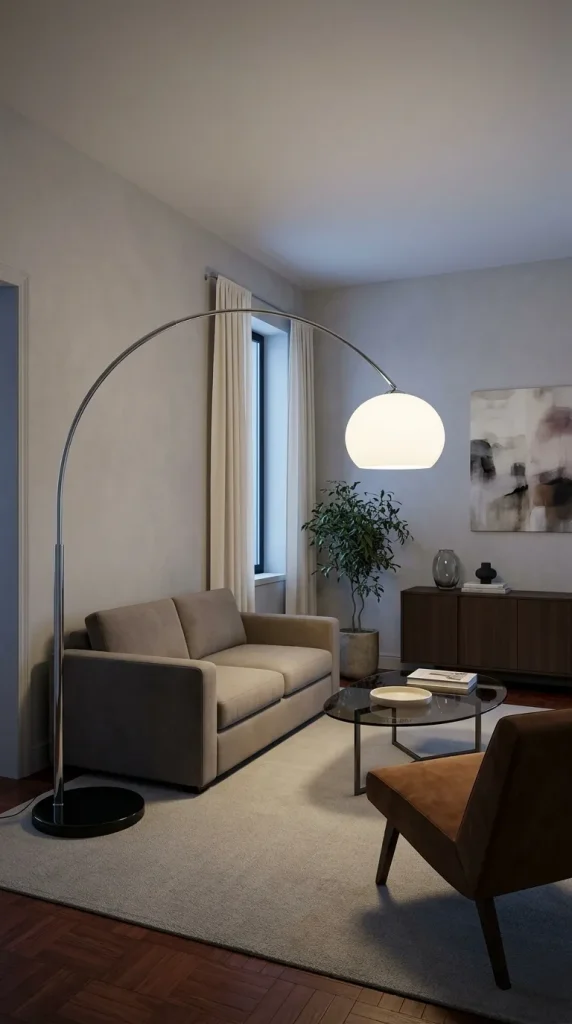
26. Add a sculptural floor lamp
Lighting is one of the easiest ways to change the era of an otherwise neutral living room.
Look for a lamp with:
A chrome frame.
A curved arm.
An oversized shade.
A dramatic globe.
A black lacquer base.
A geometric form.
Place it where its silhouette can be seen rather than hiding it behind a large chair.
This is especially effective in small living rooms where you may not have space for another piece of retro furniture.
A lamp delivers shape, material, and evening atmosphere without taking over the room.
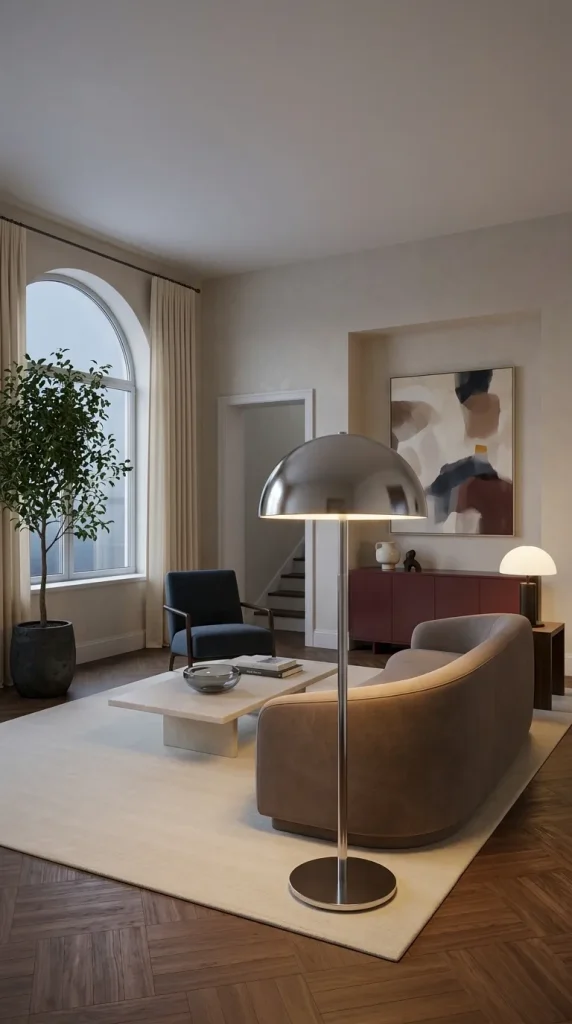
27. Try torchiere, globe, or mushroom-style lighting
The decade had a strong appetite for expressive lighting.
A torchiere can send light upward and create the softer indirect glow associated with late-modern interiors.
Globe lamps bring geometry.
Mushroom forms introduce the rounded silhouette that works well beside curved seating.
Choose one family and repeat it subtly.
For example, a chrome floor lamp could relate to a smaller metal table lamp without matching exactly.
Current interest in sculptural lighting and reflective finishes makes this another retro element that can sit comfortably inside a contemporary room.
Bring back the media-centered living room
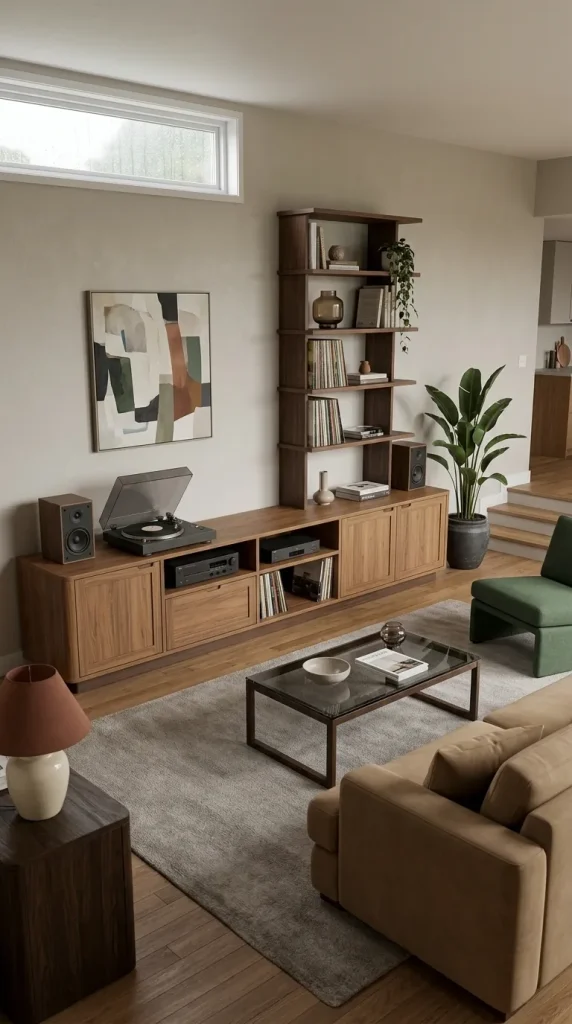
28. Reference the giant entertainment center without recreating all its bulk
The entertainment center was a defining object in many family living rooms.
Television.
VHS tapes.
Stereo equipment.
Speakers.
Albums.
Books.
Decorative objects.
Everything could be housed in one substantial cabinet system.
A modern version can capture the same media-centered feeling with a long warm-wood console and open shelving.
Add a record player or vintage-style stereo if you actually use one.
Leave enough closed storage to prevent the media area from turning into a display of cables and electronics.
The best update preserves the importance of the media zone while reducing the visual weight.
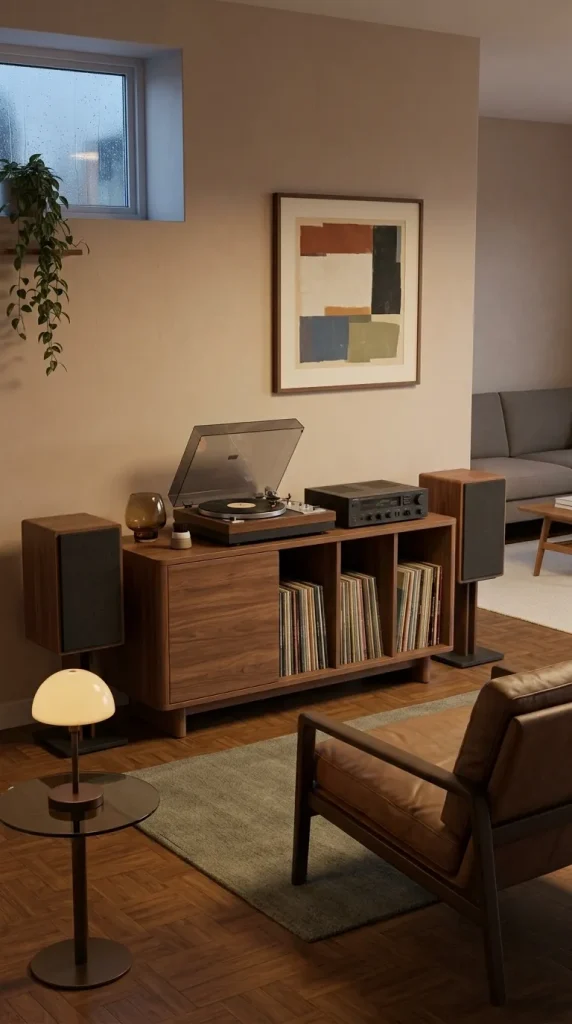
29. Build a vinyl and stereo corner
The music-room and record-store side of retro design can contribute character when treated as a residential feature rather than retail decor.
Use:
Turntable.
Vintage or vintage-inspired speakers.
Low record storage.
A framed album cover.
Small lamp.
Comfortable chair.
Do not plaster every wall with albums unless that is genuinely your aesthetic.
One thoughtful music zone makes the room feel inhabited and personal.
It also captures something important about living rooms before every form of entertainment disappeared into one thin screen.
Bring in the Miami side of the decade
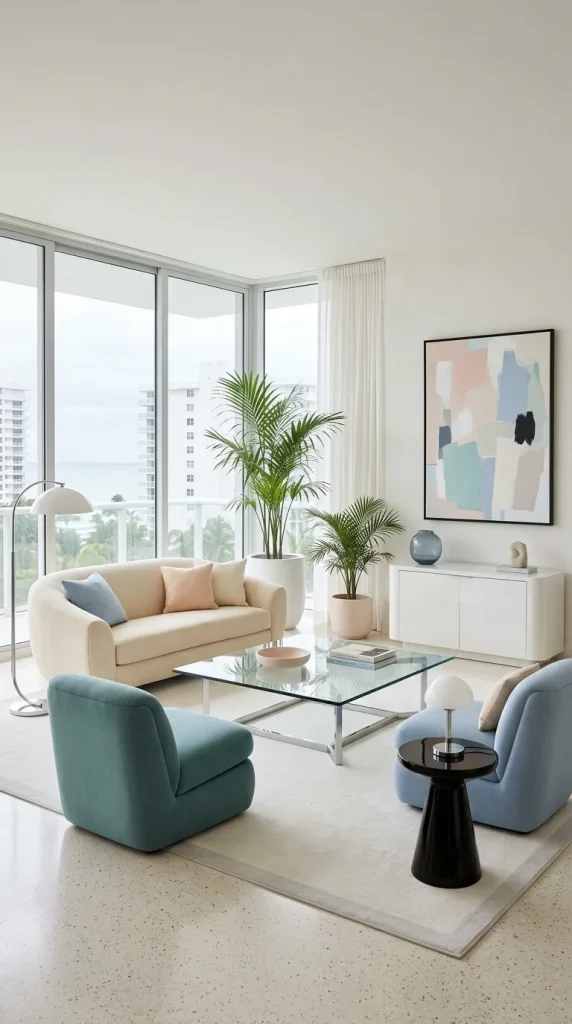
30. Create an 80s Miami living room with white, glass, chrome, and pastel
For a clear 80s Miami apartment aesthetic, start lighter.
Use:
White walls.
Pale sofa.
Glass coffee table.
Chrome or polished metal.
Peach.
Powder blue.
Soft teal.
Blush.
Indoor palms.
Sculptural lighting.
The trick is gloss without visual heaviness.
Glass allows the room to remain airy while pastel upholstery provides enough color to prevent it from feeling clinical.
Add black sparingly for definition.
A single black side table or artwork frame may be enough.
Avoid filling the room with neon signs and flamingo graphics. The palette, polished materials, palms, and furniture shapes can establish Miami far more convincingly.
Recreate the theatrical luxury of an 80s penthouse

31. Mix marble, mirrors, lacquer, and brass with oversized furniture
An 80s mansion or penthouse was an opportunity for scale.
Furniture became larger.
Artwork became larger.
Materials became more reflective.
To reference that mood, choose perhaps three luxurious materials rather than all of them at once.
For example:
Cream curved sofa.
Marble table.
Brass floor lamp.
Large mirror.
Or:
Burgundy seating.
Black lacquer console.
Glass table.
Oversized abstract painting.
Architectural Digest’s 2026 interest in glossy “Neo Deco” interiors and an 80s-opulence furniture collection shows how lacquer, chrome, gilded accents, dramatic curves, and high-contrast materials are being reconsidered today.
Scale is what keeps this from becoming a collection of shiny accessories.
Use fewer objects with stronger silhouettes.
Bring back the comfortable American suburban family room
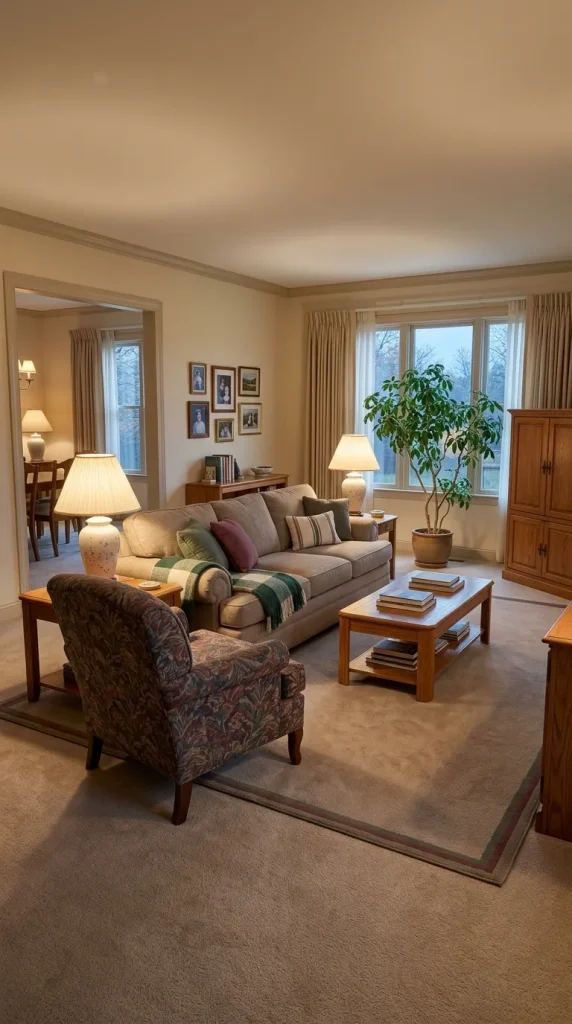
32. Create a cozy 80s living room with soft upholstery and warm lamps
For many people, 1980s nostalgia is not Miami Vice glamour.
It is a family sofa, television cabinet, soft carpet, framed pictures, table lamps, plants, and wood furniture.
Lean into that familiarity.
Use:
Deep comfortable sofa.
Patterned chair.
Large warm rug.
Oak side table.
Brass or ceramic lamps.
Books.
Family photographs.
Curtains.
One substantial plant.
The lighting should be especially warm and layered.
Use table lamps rather than relying entirely on bright ceiling light.
This is the version of the decade that should feel comfortable first and nostalgic second.
Use Memphis as an accent, not a stereotype
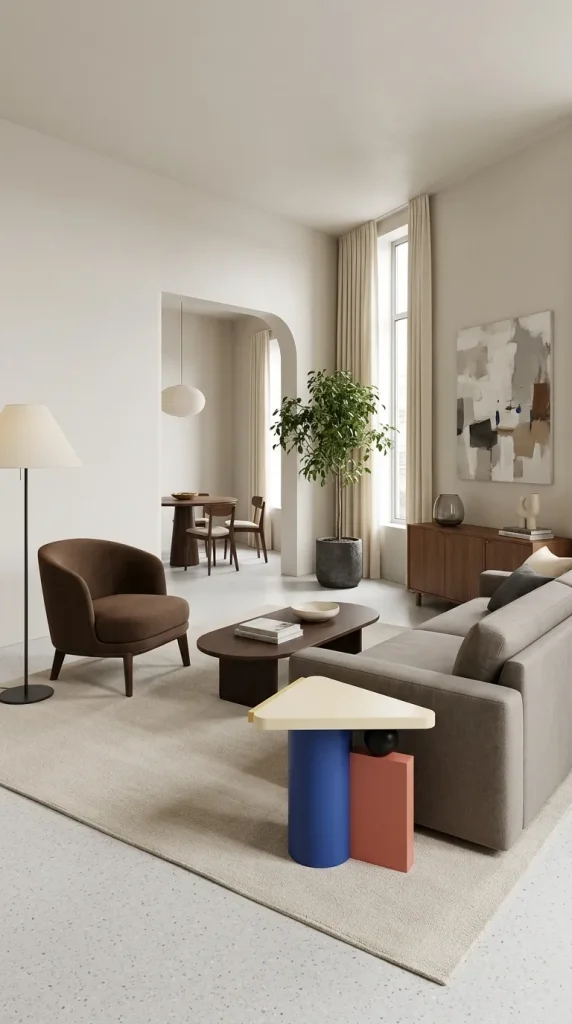
33. Introduce one true postmodern shape or Memphis-inspired object
If you love the more radical 80s, let one object carry that story.
Choose:
Geometric side table.
Unusual lamp.
Bright patterned chair.
Sculptural shelving.
Color-blocked artwork.
Terrazzo accent.
Memphis was genuinely revolutionary and highly influential, but it was also intentionally provocative rather than representative of every ordinary living room. The Met describes the movement as a radical reinterpretation of function, form, material, surface, and color, while House & Garden notes its continued influence on contemporary interiors.
One strong postmodern piece can make a quiet room feel unmistakably 80s.
Ten may make it feel like an exhibition.
Adapt the look to smaller and multi-use rooms

34. Use four strong 80s cues in a small family room
A small living room does not need mini versions of every 1980s trend.
Choose four cues.
For example:
Curved sofa.
Glass table.
Large abstract print.
Chrome lamp.
That is enough to establish the reference.
Another version might use:
Oak media console.
Plush rug.
Patterned chair.
Brass lamp.
The key is avoiding competing furniture footprints.
Glass is particularly useful in compact rooms because it provides the correct period material without adding the visual mass of a solid table.
And one large artwork usually works better than filling a small wall with many retro accessories.
Finish with a modern 80s interpretation
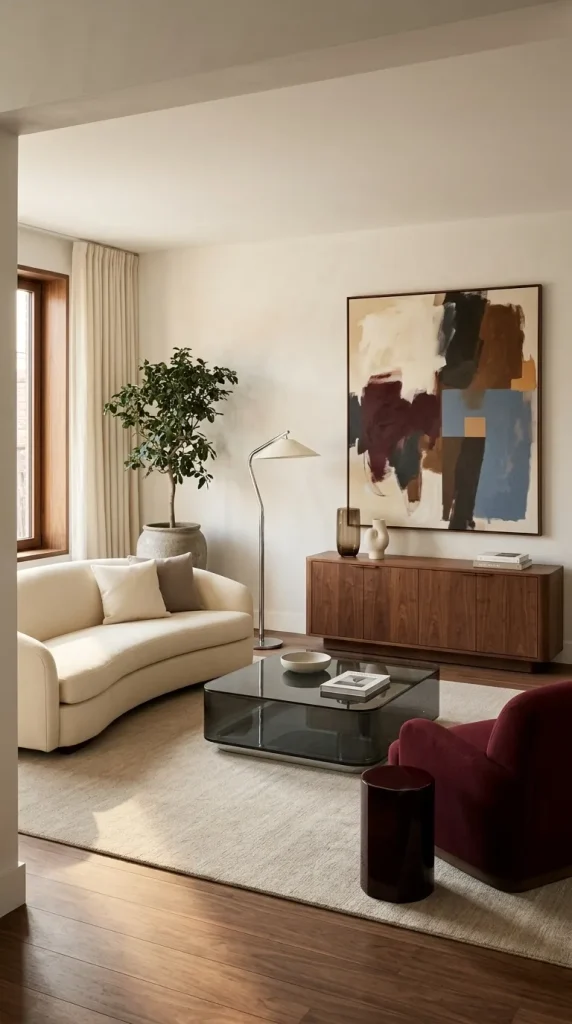
35. Borrow the decade’s shapes and materials, then edit the clutter
For most homes today, this is the most practical way to use 1980s Living Room Decor Ideas.
Keep the strongest ingredients:
Curves.
Glass.
Chrome or brass.
Lacquer.
Warm wood.
Large art.
Bold upholstery.
Geometric forms.
Sculptural lighting.
Then reduce the quantity.
A modern 80s living room might contain:
Warm white walls.
One curved cream sofa.
Smoked-glass coffee table.
Chrome floor lamp.
Walnut console.
Large abstract artwork.
A deep burgundy chair.
Nothing in that list is a novelty object.
Yet together, the shapes, finishes, proportions, and colors create a clear late-20th-century reference.
That selective approach also reflects the current revival. House Beautiful’s 2026 reporting specifically describes designers returning to the decade’s exuberance and personality without going fully into retro kitsch.
This is the difference between designing with the 1980s and decorating for an 1980s party.
Seven 1980s palettes worth trying
| 80s direction | Main colors | Best materials |
|---|---|---|
| Miami glam | White, peach, teal, powder blue | Glass, chrome, gloss |
| Suburban cozy | Beige, forest green, cream | Oak, brass, plush textile |
| Graphic retro | Black, white, red | Lacquer, chrome, glass |
| Soft pastel | Dusty rose, mauve, cream, gray | Upholstery, glass, brushed metal |
| Luxury penthouse | Burgundy, cream, black | Marble, brass, mirrors |
| Postmodern | Primary accents, pastel, black | Laminate, terrazzo, metal |
| Modern 80s | Warm white, burgundy, walnut, chrome | Glass, wood, lacquer, wool |
The palette should follow the version of the decade you are creating.
A burgundy-and-brass room and a peach-and-chrome Miami apartment can both be completely valid 1980s references while looking almost nothing alike.
Authentic 1980s versus modern 80s-inspired design
If historical accuracy is your priority, you can go considerably further.
An authentic 1980s room might include:
Wall-to-wall carpet.
Vertical blinds.
Large oak entertainment unit.
Matching upholstered furniture.
Floral fabric.
Mirrored surfaces.
Heavy window treatments.
Brass table lamps.
Substantial television and stereo equipment.
A modern 80s-inspired room might instead use:
Large wool rug.
Simpler warm-wood media console.
One patterned chair.
Curved sofa.
Smoked-glass table.
Chrome floor lamp.
One large mirror.
Oversized abstract artwork.
The second room uses the decade’s visual vocabulary while removing the elements that would interfere with contemporary function or make the room feel overly themed.
Neither approach is inherently better.
They serve different intentions.
What made 1985 different from the stereotype?
The middle of the decade is useful because it demonstrates how much overlap existed.
Traditional decorating had not disappeared.
Soft color, floral fabric, carpet, and substantial wood furniture still occupied many homes, while postmodern forms, glossy finishes, new technologies, and more theatrical color were becoming increasingly visible elsewhere.
House & Garden’s examination of 1980s interiors captures exactly this variety, moving between radical Memphis design, extravagant textiles, glass, chrome, marble, and the high-tech futurism that also defined part of the period.
So an “authentic” 1985 room does not have to look radical.
It depends on whose home you are recreating.
1980s versus 1990s living rooms
These decades overlap enough that they are often blended together.
A simple distinction can help.
1980s interiors frequently leaned toward:
Gloss.
Chrome.
Brass.
Pastel.
Mauve.
Mirrors.
Glass.
Geometric graphics.
Coordinated schemes.
Postmodern shapes.
More theatrical styling.
1990s interiors generally moved further toward:
Earthier neutrals.
Casual upholstered furniture.
Darker or medium woods.
Sage and muted green.
Less gloss.
Simpler traditional furniture.
More relaxed family-room styling.
These are broad tendencies, not rigid rules.
But if your goal is a clearly 1980s room, reflective surfaces and stronger silhouettes often help keep the scheme from drifting into 1990s nostalgia.
The 1980s details worth skipping unless you genuinely love them
Not everything needs revival.
Avoid adding novelty objects simply because they scream “80s.”
A Rubik’s Cube on the coffee table does not compensate for furniture that otherwise has no relationship to the decade.
Neither does covering the room with cassette tapes, neon signs, arcade graphics, and random geometric accessories.
Those objects can be fun if they have personal meaning.
But they create a theme faster than they create an interior.
The more convincing route is:
Furniture silhouette first.
Color second.
Materials third.
Lighting and art fourth.
Accessories last.
If those first four layers are right, the room can read as 1980s before a single novelty object appears.
Try this if your 80s living room looks like a costume set
Remove every explicitly retro accessory.
Take away the novelty signs.
The cassettes.
The themed ornaments.
The decorative references that literally say “80s.”
Now look at the room.
Do you still see the decade?
If not, strengthen the actual design language.
Perhaps the sofa needs a more sculptural shape.
The table needs glass or lacquer.
The lighting could become larger and more expressive.
The art might need stronger scale.
The palette may need clearer direction.
Restore only the accessories that add personality rather than carrying the entire theme.
A convincing period-inspired interior should survive without labels.
Frequently Asked Questions
What defines 1980s living room decor?
There was no single 1980s living-room style. Common elements included curved or substantial seating, glass tables, chrome and brass, black lacquer, oak furniture, mirrors, large art, plush carpet, patterned upholstery, pastel or high-contrast color schemes, dramatic lighting, and increasingly prominent media equipment. Postmodern and Memphis design represented one especially influential branch of the decade rather than the whole period.
What colors were popular in 1980s living rooms?
Recognizable combinations include peach and cream, teal and mauve, black and white with red accents, burgundy with brass and cream, beige with forest green, pastel blue and pink, and brighter postmodern combinations. The correct palette depends on whether you are referencing suburban, Miami, luxury, or postmodern 80s interiors.
How can I make a modern living room look 80s without making it dated?
Concentrate on silhouettes and materials rather than novelty decor. Use a curved sofa, smoked-glass table, chrome or brass lighting, one lacquered piece, large abstract art, and a controlled retro palette. Current 2026 design coverage shows designers taking a similarly selective approach to the decade’s return.
How do I create an 80s Miami living room?
Begin with white or very pale walls, then add glass, chrome, sculptural furniture, soft pastel blue, peach, blush, or teal, plus a large indoor palm. Keep the room relatively open and bright. Use black sparingly for definition rather than filling the room with dark furniture.
Can 1980s living room decor feel cozy?
Absolutely. Focus on the suburban and traditional side of the decade rather than the glossy postmodern side. Plush seating, warm oak, beige or taupe rugs, floral upholstery, brass lamps, books, curtains, plants, and layered table lighting can create a deeply nostalgic and comfortable 80s family-room atmosphere.
Bring back the 1980s, not the stereotype
The most useful lesson from these 1980s Living Room Decor Ideas is that there was never one definitive 80s room.
The decade could be glossy and theatrical.
It could also be beige, floral, carpeted, and deeply comfortable.
A Miami apartment might combine white walls, glass, chrome, pastel seating, and palms. A suburban family room could revolve around an oak entertainment unit, plush upholstery, brass lamps, and patterned textiles. A wealthy penthouse might layer lacquer, marble, mirrors, huge artwork, and sculptural furniture. And a radical postmodern room could treat geometry, color, and material almost like visual provocation.
That variety gives you far more freedom today.
You do not need neon.
You do not need a wall of cassette tapes.
And you definitely do not need to recreate every trend from the decade in one room.
Choose the version of the 1980s you actually love. Establish it through furniture shape, material, palette, lighting, and art. Then decide whether you want an authentic reproduction or a cleaner contemporary interpretation.
The best result should make someone recognize the decade before they can point to the reason why.