33 Living Room Wall Decor Ideas That Make Blank Walls Feel Designed, Not Filled
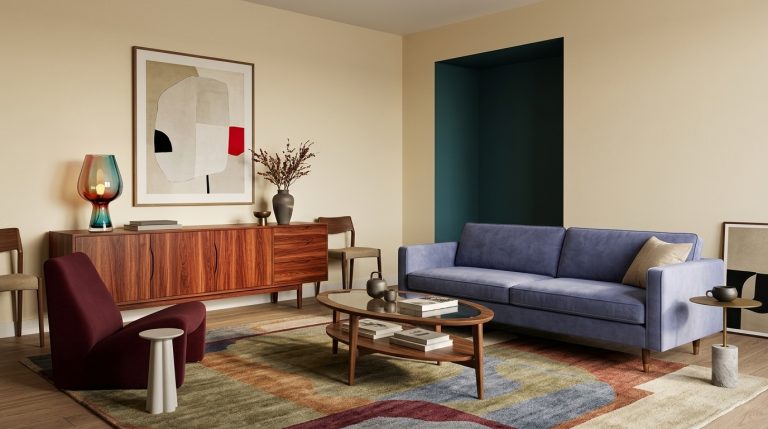
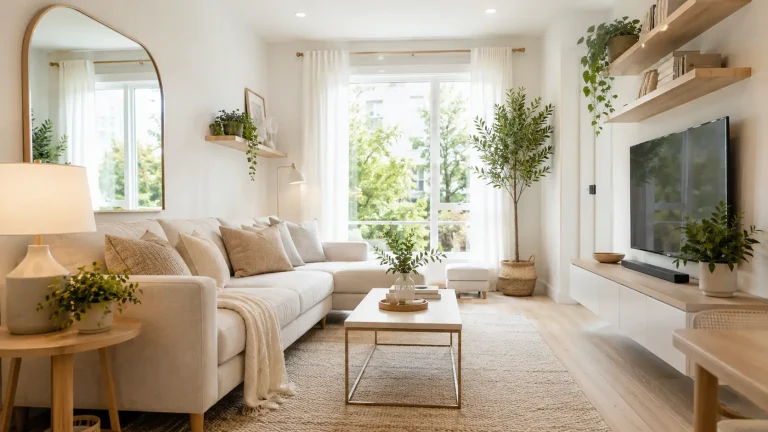
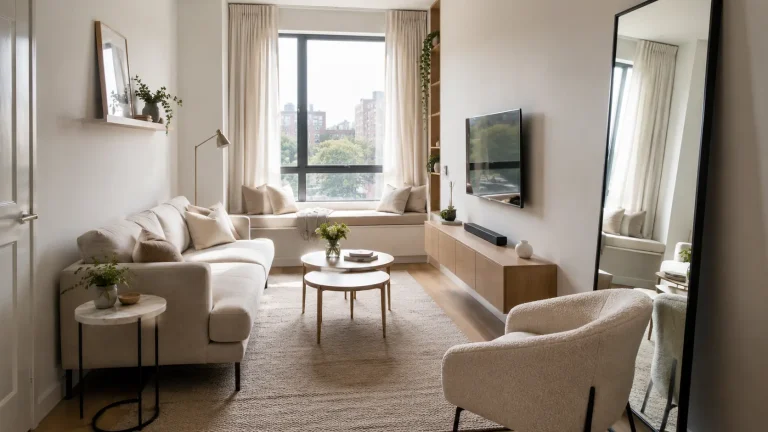
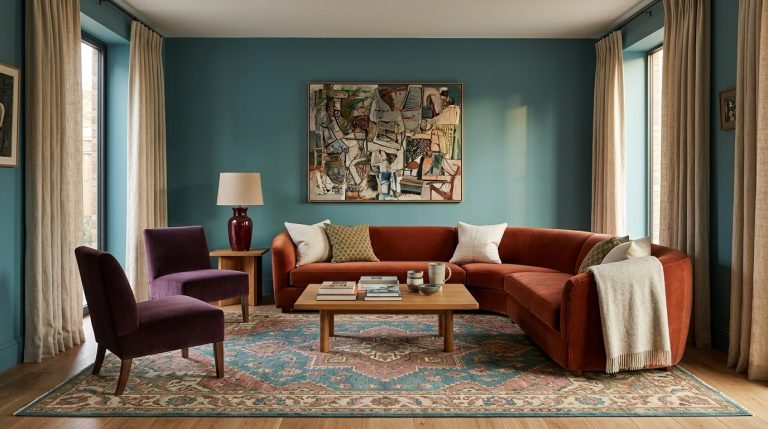
A blank living room wall can make an otherwise furnished room feel unfinished, but filling it simply because it is empty is rarely the answer. The better question is what role that wall plays in the room. The wall behind the sofa may need enough visual weight to balance a large piece of furniture, while a narrow wall beside a doorway might need only one vertical artwork. A 12-foot wall can handle scale that would overwhelm a compact apartment living room.
That distinction matters because Living Room Wall Decor Ideas now extend far beyond framed prints. Artwork, mirrors, family photography, picture ledges, shelving, wallpaper, murals, wood paneling, plaster, textiles, metalwork, dimensional pieces, clocks, and architectural salvage can all work, but not on every wall and not in the same proportions.
Current 2026 design coverage is also moving toward walls with more material presence. Architectural Digest reports growing interest in sculptural plaster, textured wallpaper, tile, wood paneling, and other three-dimensional surfaces, while designers are pushing back against underscaled art and overly cluttered wall arrangements.
The goal, then, is not to make every wall interesting. It is to make the important walls feel intentional.
Start with the wall above the sofa
The sofa wall is usually one of the strongest visual zones in a living room because the furniture below it already has substantial width and visual weight. Whatever you hang above it should relate to that furniture rather than floating independently on the wall.

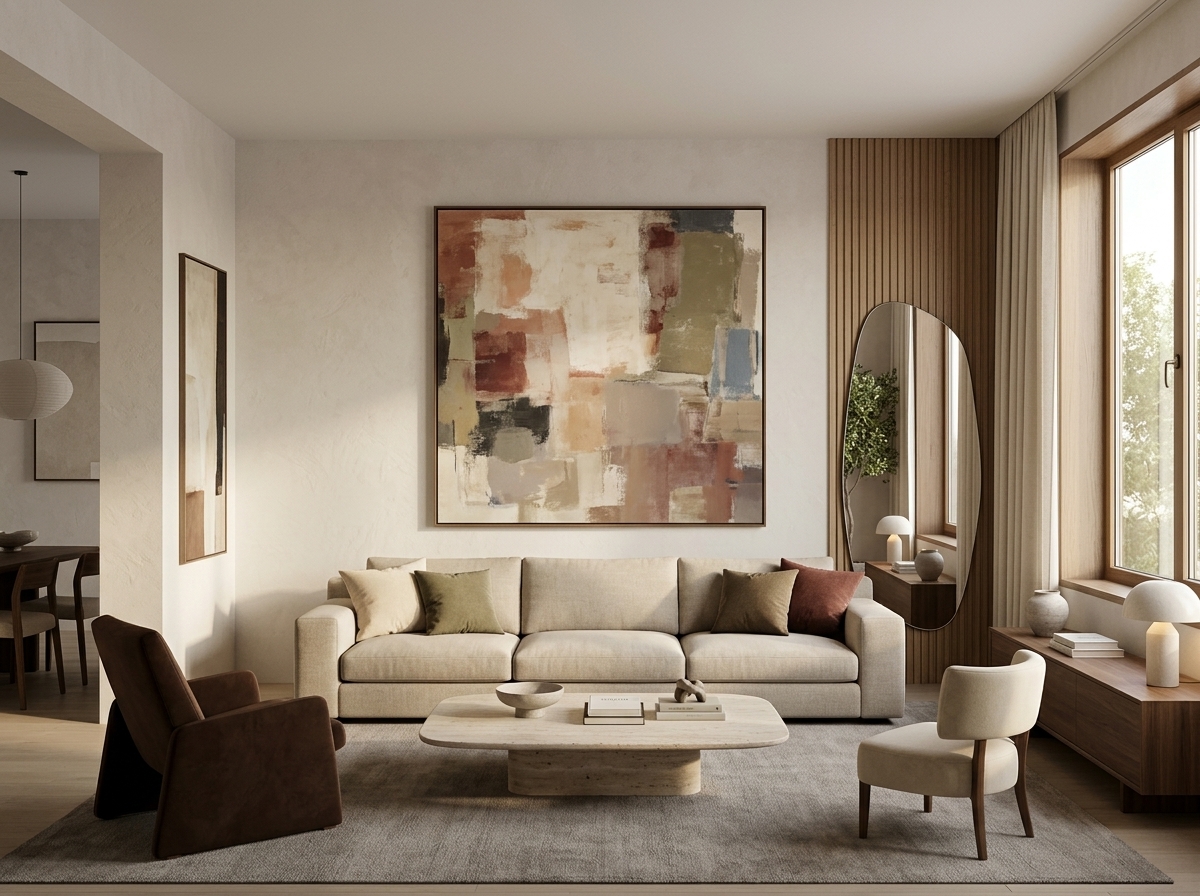
1. Hang one oversized artwork above the sofa
A single large painting or print is often the cleanest solution for the wall behind a couch. It works particularly well when the sofa is already surrounded by side tables, lamps, cushions, and other visual activity because the wall gets one calm, readable gesture instead of another collection of small objects.
As a useful starting point, artwork around two-thirds the width of the sofa can often feel proportionate, although the correct size depends on the wall, frame, sofa shape, and surrounding furniture. The more important test is visual weight. A deep sectional generally needs something more substantial above it than a narrow two-seat sofa.
Keep the artwork close enough to the sofa that the two read as one composition. Art hung very high can make the sofa appear disconnected from the wall, while an oversized piece placed too close may feel compressed. Livingetc’s current guidance on above-sofa decor similarly treats this area as a balancing problem between furniture and wall rather than simply an empty space to fill.
2. Use a pair of large artworks instead of one canvas
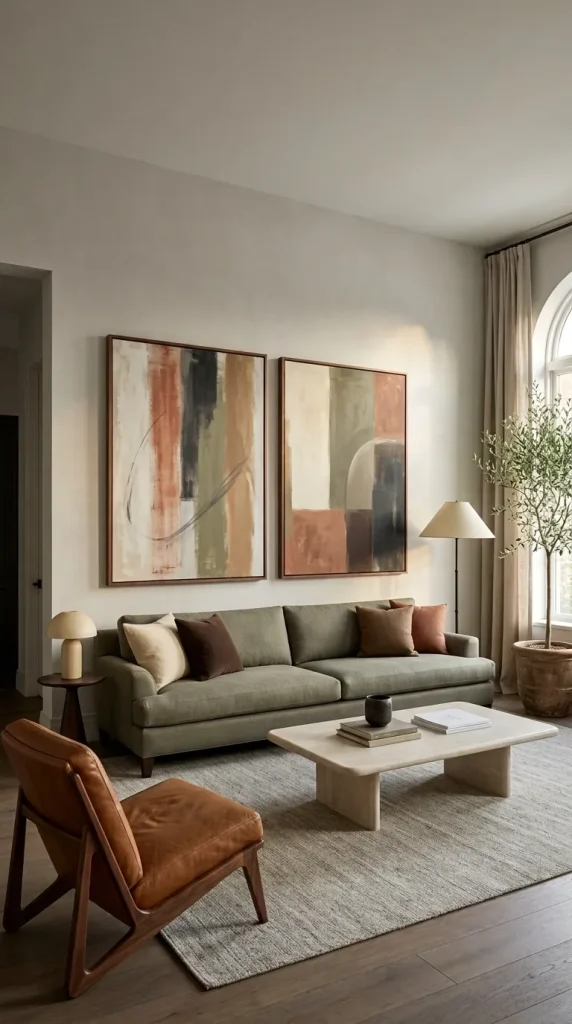
Two related pieces can work beautifully when one enormous artwork feels too dominant. The pair can be identical in size but does not need to contain matching imagery. The connection can come through frame finish, palette, subject, or medium.
A pair is particularly useful over longer sofas because the small gap between the frames introduces rhythm without fragmenting the wall. Keep the spacing tight enough that the two pieces still read together. If they drift too far apart, each artwork begins competing for its own territory.
For a contemporary room, try two large abstract works with simple framing. Traditional and transitional rooms can use landscapes, botanical works, or vintage-style paintings. The structure stays the same even when the visual language changes.
3. Build a triptych across a long sofa
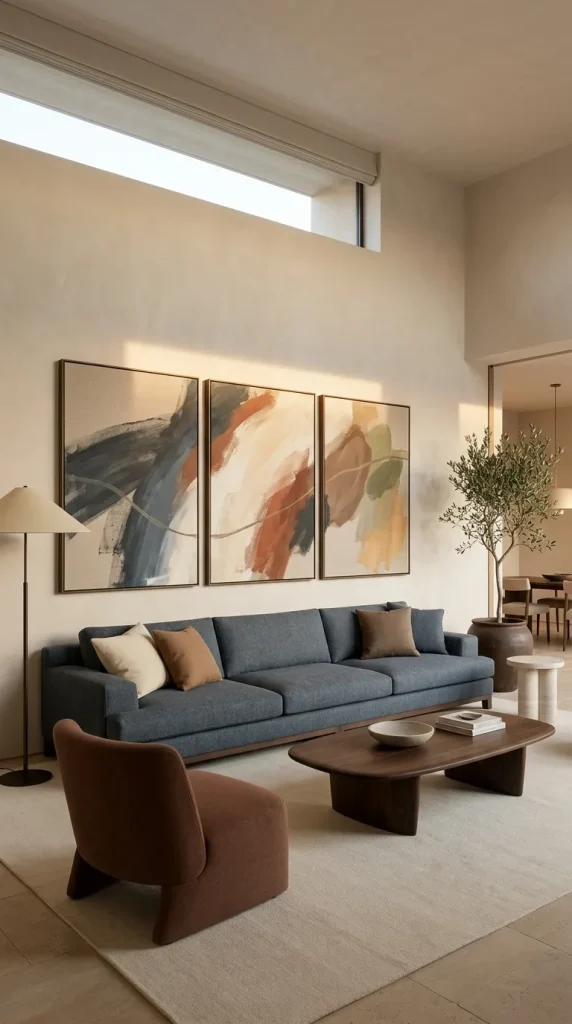
A triptych gives a long sofa or sectional a stronger horizontal rhythm. Three panels naturally echo the width of the furniture below and are especially effective when the room needs more movement than a single rectangular artwork would provide.
The strongest triptychs usually behave like one larger piece. That may mean one image divided across three canvases, or three works with clearly related colors and scale. Avoid combining three unrelated pictures simply because they fit the available width.
This idea also suits modern living rooms with broad, low furniture because the horizontal composition reinforces the room’s proportions rather than fighting them.
4. Create a sofa gallery wall with one clear anchor
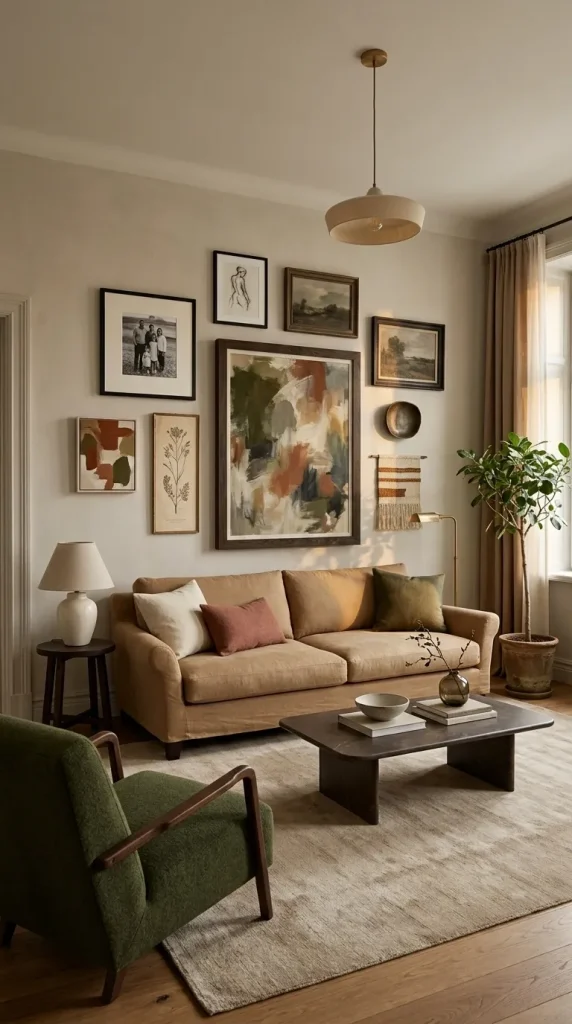
A gallery wall can be more personal than one large artwork, but it needs hierarchy. Start with one larger piece and build outward instead of arranging ten similarly sized frames with equal importance.
Family photos, paintings, sketches, mirrors, textiles, or small sculptural objects can coexist if something visually ties them together. That connection might be mostly black frames, similar matting, a repeated color, or a shared subject.
Current 2026 gallery-wall guidance from House Beautiful emphasizes exactly this kind of intentional curation, including varied formats, negative space, and a unifying element rather than simply filling the wall with frames.
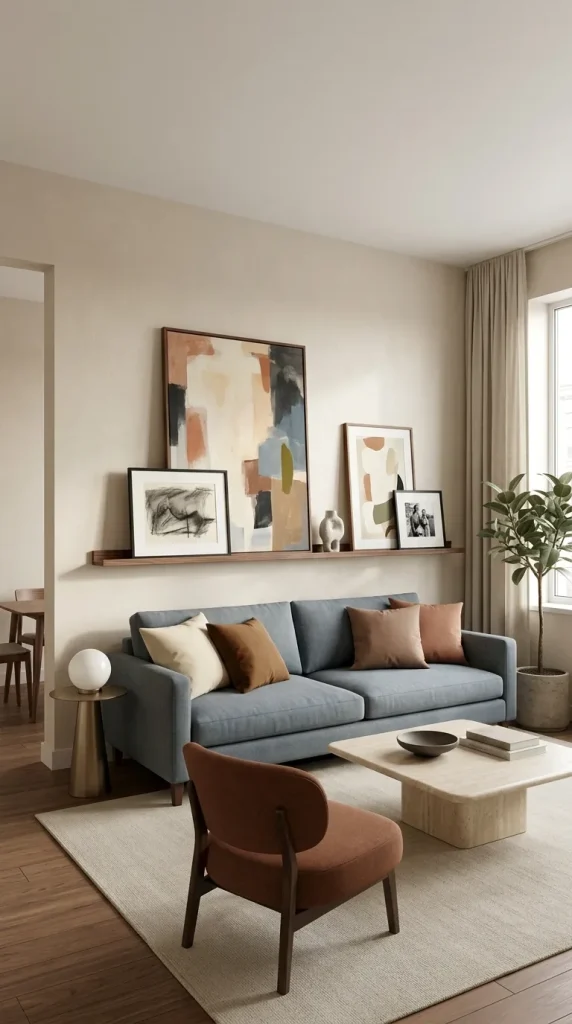
5. Install one long picture ledge above the couch
A picture ledge is useful if you enjoy changing art or family photographs without creating new holes every time. One long ledge usually looks more cohesive over a sofa than several short floating ledges placed at different heights.
Layer frames rather than lining them up like books on a store shelf. A larger artwork can sit toward the back, with one or two smaller pieces overlapping slightly in front. Add perhaps one small ceramic or sculptural object if the ledge is deep enough, but leave open space.
The ledge should still feel lighter than the sofa below. If it becomes crowded with tiny frames, candles, signs, plants, and ornaments, the wall begins to resemble storage rather than composition.
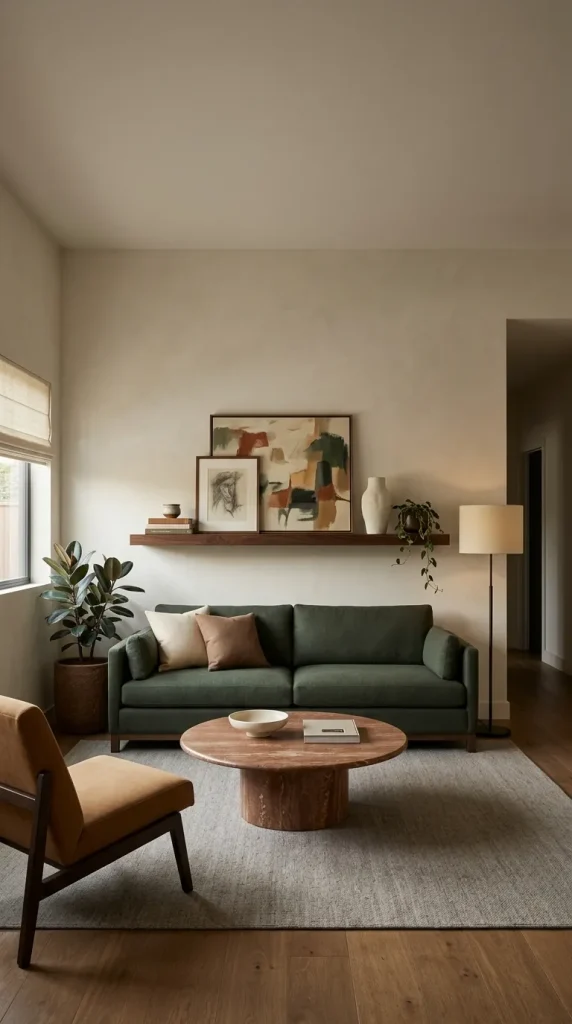
6. Float a shelf above the sofa, but make it substantial
A shelf above a couch can introduce depth that flat artwork cannot, but it needs enough length and visual weight to relate to the sofa. Several tiny shelves scattered above a large sectional often look nervous and disconnected.
Choose one substantial shelf and style it with a mix of framed art, books, pottery, and perhaps trailing greenery. Vary heights while keeping the number of objects controlled.
Mounting over seating deserves extra care. Use hardware and installation methods suitable for the shelf, wall type, and expected load. The visual styling is secondary to secure installation.
Use scale properly on large and tall walls
Large living room walls rarely need more things. They need larger gestures. A huge wall covered in tiny objects often feels emptier because the contrast between wall scale and decoration becomes more obvious.

7. Let one enormous canvas occupy the wall
Oversized art can make a tall or wide living room feel calmer rather than busier. The artwork gives the eye somewhere obvious to land and eliminates the need to coordinate many smaller pieces.
This works especially well in modern, minimalist, elegant, and contemporary rooms. A large abstract canvas can introduce the main accent colors for the entire living room, while a landscape or painterly work can create a quieter atmosphere.
The art does not need to match the sofa exactly. In fact, repeating only one or two colors from the room usually feels more sophisticated than selecting a painting whose entire palette mirrors the furniture.
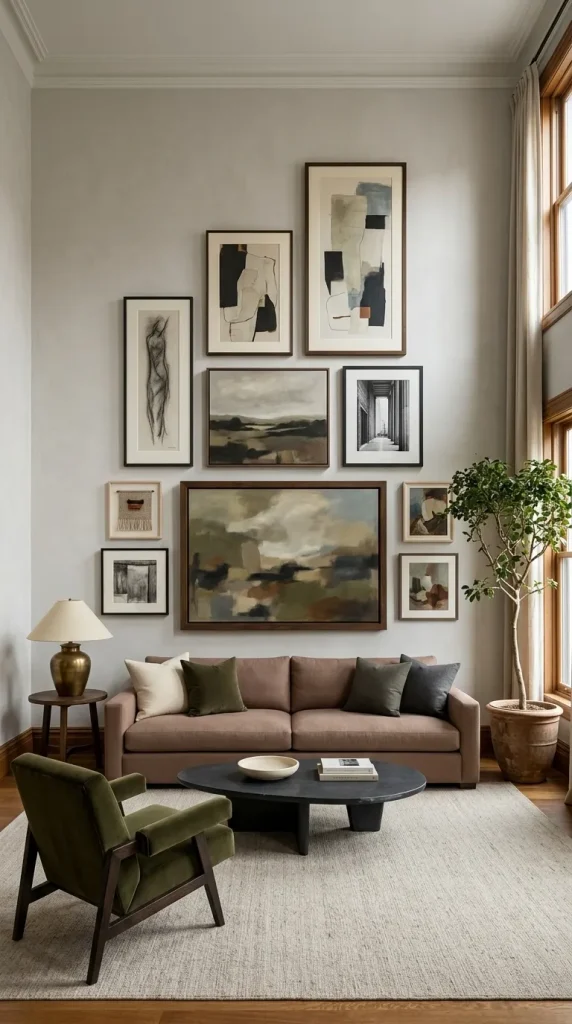
8. Take a gallery wall higher in a room with tall ceilings
A room with 12-foot ceilings can make a standard gallery wall look unexpectedly small. Instead of decorating only a narrow strip immediately above the furniture, allow the composition to use more vertical space.
The lower works should still connect visually to the furniture, while selected pieces can extend upward. Mixing portrait formats with larger horizontal pieces helps the arrangement climb the wall naturally.
Do not assume you need to reach the ceiling. The objective is simply to acknowledge the full wall volume. Leave enough untouched wall around the composition that it still has boundaries.
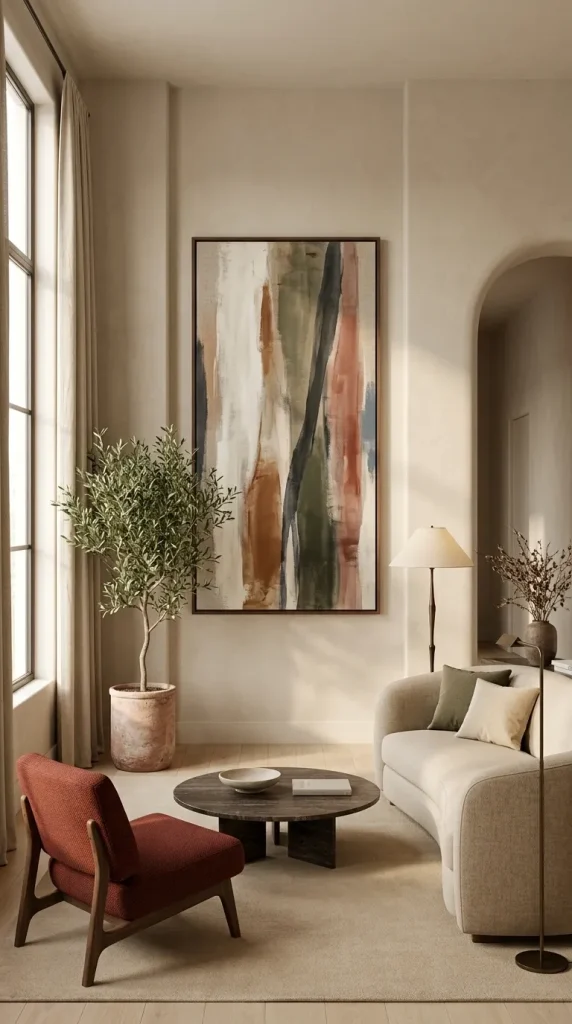
9. Use one tall vertical artwork on a narrow, high wall
A narrow wall between windows, beside a doorway, or near the end of a long room often needs a different solution from a broad sofa wall. One vertical piece can emphasize height without requiring a complicated grouping.
This is a good place for a portrait, botanical study, textile panel, tall abstract work, or narrow mirror. Keep the width appropriate to the wall so the object feels intentionally contained rather than squeezed into the space.
Small walls do not automatically need small art. They need art with the right proportions.
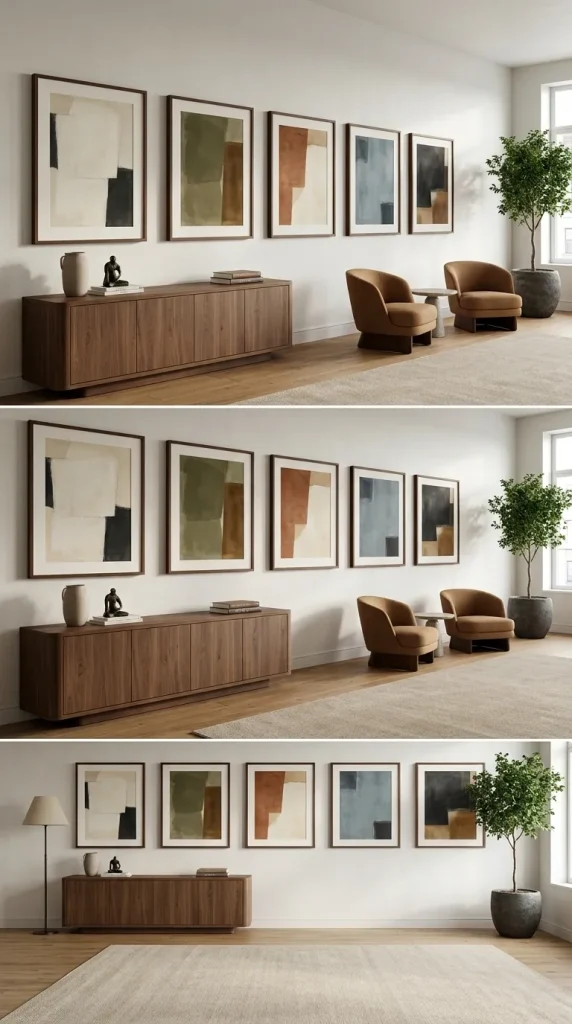
10. Create horizontal rhythm across a long blank wall
A long wall often feels awkward because one medium-size picture leaves too much unused space on either side. A wide triptych, row of related artwork, extended shelving composition, or panoramic photograph can respond more naturally to the wall’s proportions.
Furniture can help divide the wall as well. A console, bench, or pair of chairs underneath part of the composition gives the wall more structure.
Think of the wall as a sequence instead of one central spot. Repeating frame sizes or colors across the length creates rhythm without requiring a single enormous feature.
Use family photos without making the room feel like a hallway
Family photographs can absolutely belong in a living room. The difference between a polished display and a random collection is usually scale, editing, and consistency.
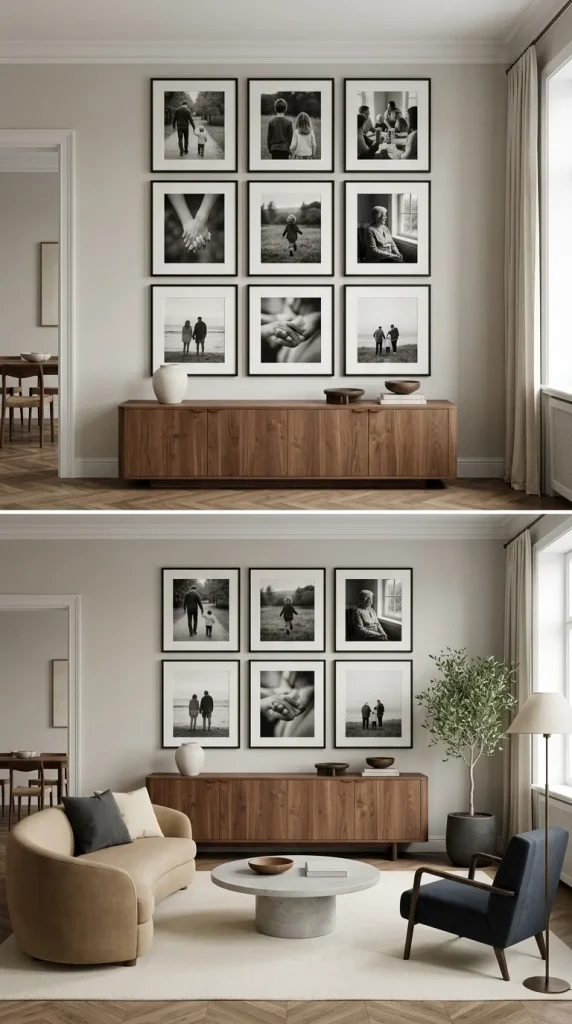
11. Turn family photos into a clean black-and-white grid
A grid of family photographs can look more like an art installation when the images share a similar treatment. Black-and-white photography is particularly effective because different locations, clothing colors, and lighting conditions become visually quieter.
Use consistent frames and generous matting. Larger photographs generally feel more appropriate in a living room than dozens of small snapshots.
The grid itself creates formality, so the photos can remain personal without the room feeling like a corridor of family portraits.
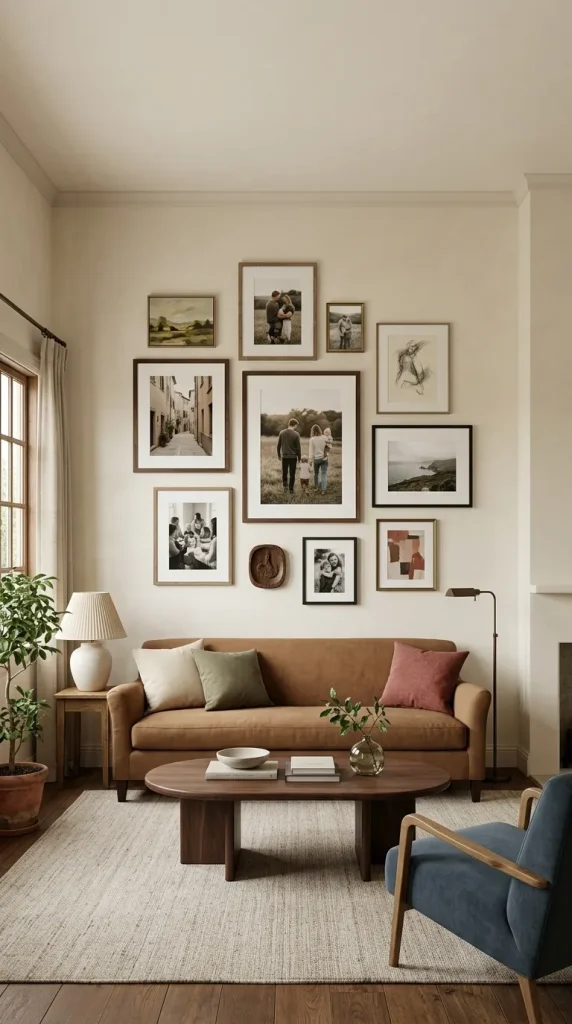
12. Build a relaxed family-photo gallery
If a perfect grid feels too formal, mix family photographs with art, travel images, sketches, and meaningful objects. This allows the wall to tell a broader story about the household.
Keep one element consistent. Perhaps all frames are dark wood, or every image contains a warm neutral palette. Another approach is to mix frame finishes but use identical white mats.
The goal is connection, not matching. A gallery wall should feel accumulated but still edited.
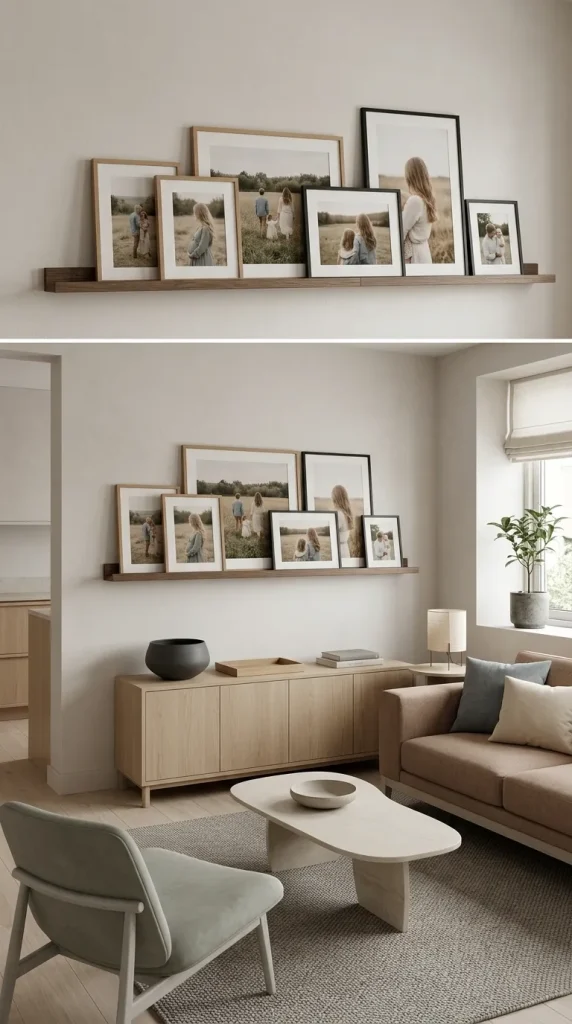
13. Use a photo ledge for pictures that change often
A photo ledge is particularly useful for families because photographs evolve. New trips, children, celebrations, and milestones can be introduced without rebuilding the entire wall.
Keep the display selective. Rotate images rather than continually adding more.
A few larger photographs often create more impact than many small ones. Layering different frame heights also gives the arrangement depth while the consistent ledge keeps everything visually contained.
Let mirrors do more than fill empty space
Mirrors can alter both light and perceived depth, but placement matters. A mirror is most successful when it reflects something worth repeating.
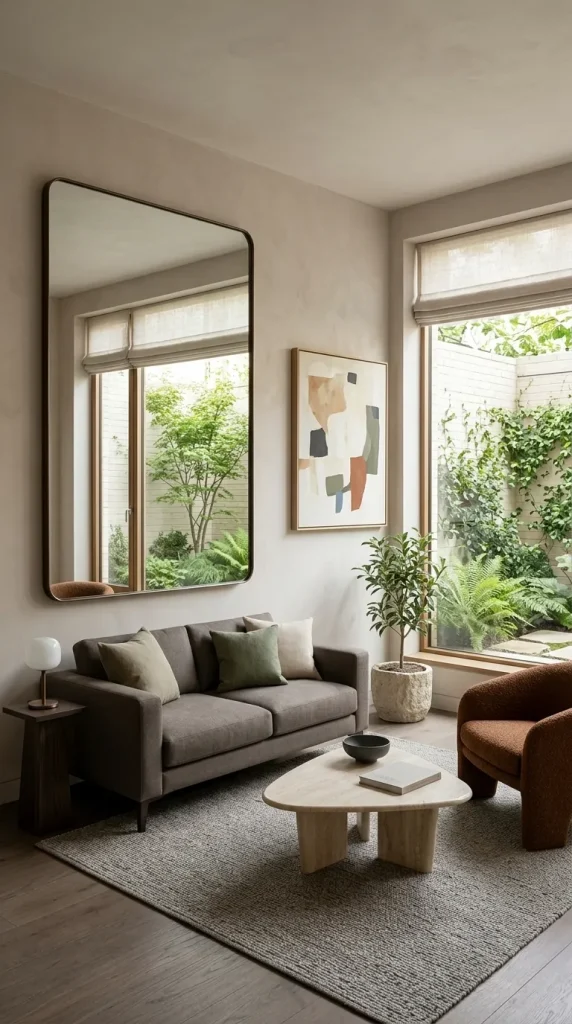
14. Hang one oversized mirror opposite a useful view
A large mirror can make a compact or darker living room feel more open, especially when it reflects daylight, artwork, greenery, or an attractive part of the room.
Think carefully about the reflection before choosing the location. A mirror opposite clutter, a television, or an awkward doorway simply doubles that view.
For a contemporary room, a clean oversized mirror may be enough. Traditional and eclectic spaces can support antique, carved, gilded, or darker timber frames.

15. Use an architectural mirror as the artwork
Some mirrors are strong enough to function more like sculpture than utility. An arched mirror, carved antique frame, irregular organic shape, or strong geometric design can fill a wall without additional pictures around it.
This works especially well over a console or between two windows, where the mirror already has an architectural relationship to its surroundings.
Give an expressive mirror negative space. Crowding smaller objects tightly around it can weaken the shape that made it interesting.
Use wallpaper and murals when art alone is not enough
Sometimes the problem is not that a wall lacks an object. The wall itself lacks character. Wallpaper can add pattern, color, texture, or even an entire visual scene.
Wallpaper is particularly relevant in 2026, with House Beautiful reporting stronger interest in expressive pattern and texture rather than treating wallcoverings as background decoration only.

16. Cover one wall with a large-scale wallpaper pattern
A living room feature wall can work beautifully when the pattern scale relates to the room. A large botanical or abstract design may suit a generous living room, while a tighter motif can work better in a smaller space.
Treat the wallpaper as the primary artwork. If the pattern is visually active, the sofa wall may need only one restrained picture or perhaps no additional framed art.
A common mistake is installing dramatic wallpaper and then decorating over it exactly as if the wall were plain. Allow the pattern to do some of the work.
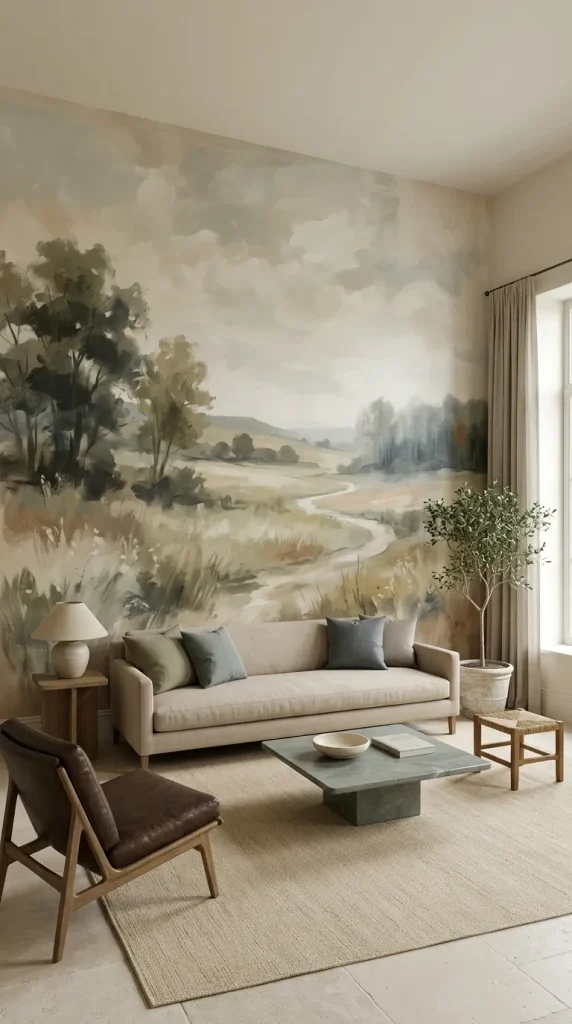
17. Use a mural as one giant piece of art
A mural creates a more immersive effect than framed art because it ignores the normal boundary of a picture frame.
Botanical scenes, landscapes, painterly abstractions, and architectural motifs can all work. House Beautiful’s 2026 coverage notes that mural wallpapers are increasingly being used almost like oversized tapestries or custom art installations.
Keep furniture in front of an elaborate mural relatively controlled. The wall should remain readable rather than disappearing behind high-backed furniture and multiple decorative objects.
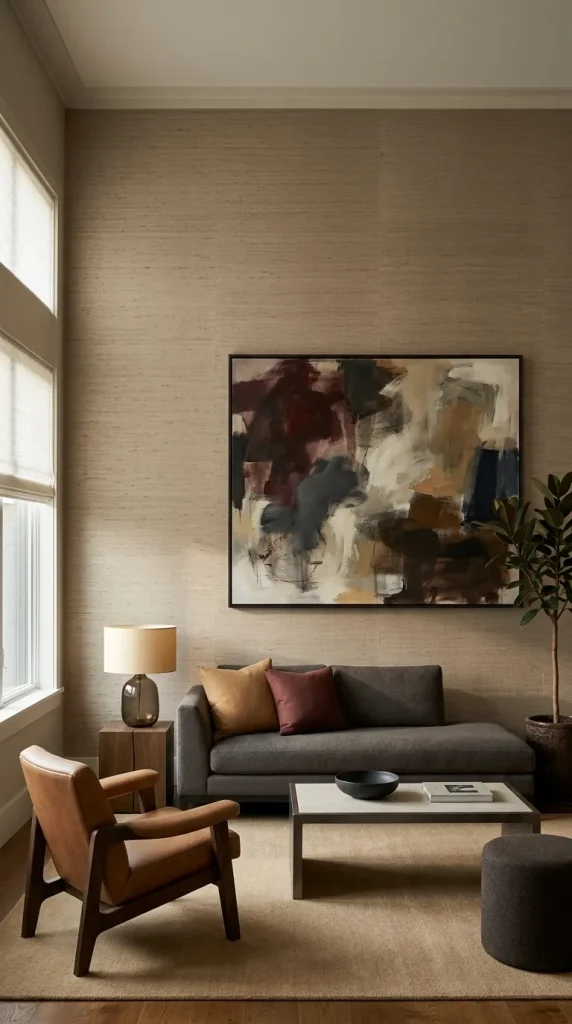
18. Try textured wallpaper when the room needs depth, not pattern
Grasscloth, woven-look wallcoverings, subtle plaster effects, and other tactile papers can change how a living room feels without introducing obvious imagery.
This is particularly useful when the room already contains strong artwork. Texture can make the wall richer while allowing the art to remain dominant.
Architectural Digest’s current wall-decor coverage points to grasscloth and textured surfaces as part of the move toward walls that feel more material and tactile.
Let paint become wall decor
Paint does not have to stop at choosing one wall color. Used deliberately, it can create architecture, frame artwork, or change a wall’s apparent proportions.

19. Paint a darker wall behind the sofa
A darker sofa wall can make artwork, pale upholstery, or metallic finishes stand out more clearly. Deep olive, chocolate, burgundy, smoky blue, charcoal, or aubergine can all work depending on the room.
Dark color does not automatically make a living room feel smaller. If the wall has good lighting and the palette around it contains enough tonal variation, the deeper backdrop can actually make the room feel more dimensional.
Consider the sofa color before painting. A dark brown sofa against an almost identical chocolate wall may lose its silhouette unless lighter textiles, art, or lighting restore contrast.

20. Use painted color blocking to frame furniture or art
A large rectangle or arch of paint can act almost like an oversized frame around a console, art composition, or reading corner.
This approach is useful for renters only when painting is permitted and for homeowners who want impact without wallpaper.
Keep the geometry connected to something in the room. Random painted shapes floating in the middle of an empty wall can feel decorative for decoration’s sake. Framing a sofa zone or art arrangement gives the color block a reason to exist.
Bring architecture and wood onto the wall
Architectural wall treatments can make a living room feel finished before any pictures are hung. Current 2026 design coverage is particularly interested in wood and dimensional surfaces as alternatives to generic feature-wall treatments.
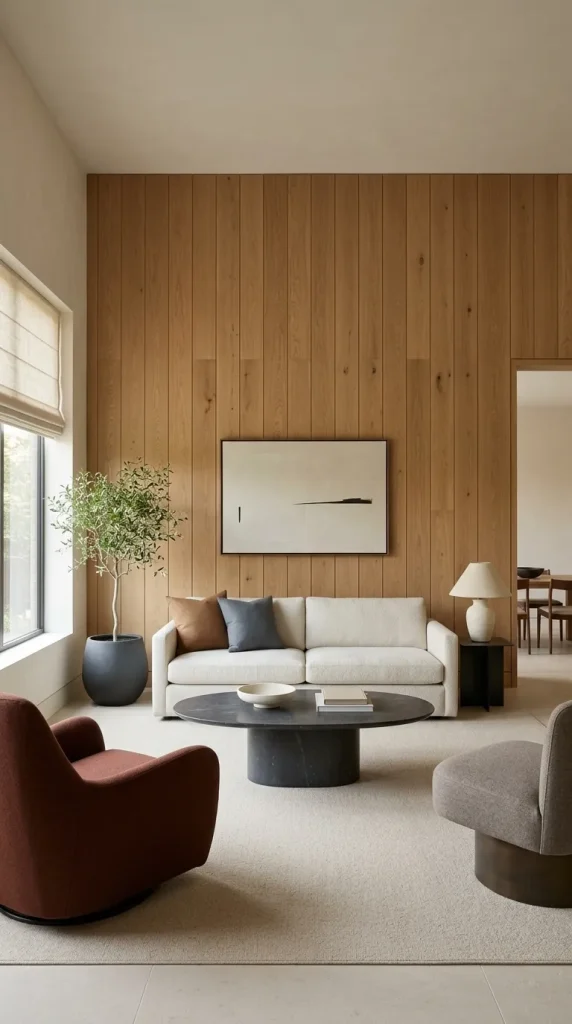
21. Use refined wood paneling instead of a heavily rustic pallet wall
Wood paneling can suit modern, mid-century, rustic, coastal, and traditional rooms depending on species, stain, panel width, and orientation.
Dark oak creates depth and formality. Pale vertical slats can feel more contemporary. Medium oak brings warmth without dominating the room.
If you like reclaimed or pallet-inspired walls, use the idea selectively. A more refined arrangement of reclaimed boards often ages better than covering an entire living room wall with obviously rough shipping-pallet timber.
Always consider the floor and furniture. Three unrelated orange-toned woods in one view can make the room feel visually muddy.
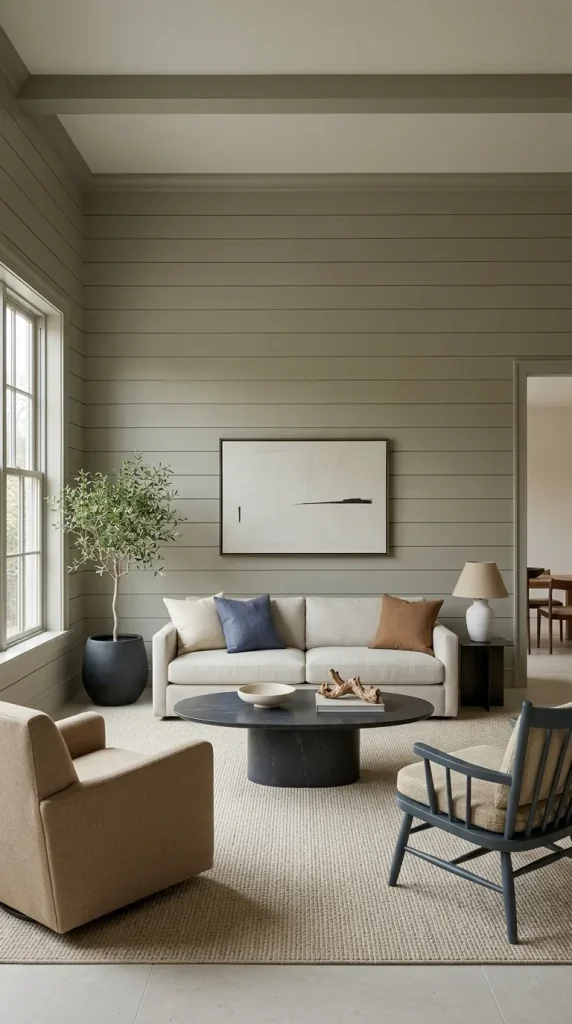
22. Add shiplap where the architecture supports it
Shiplap can work in farmhouse, coastal, cottage, and transitional interiors, particularly when it reinforces the home’s architectural character.
It does not always need to be bright white. Mushroom, sage, warm gray, deep green, or natural wood can make shiplap feel less formulaic.
Use the boards as texture first. If the wall already has visible horizontal lines, avoid loading it with too many small framed pieces that create additional visual noise.

23. Add panel molding for a quieter architectural wall
Panel molding is useful when you want the wall itself to feel finished but do not want a strong rustic texture or busy wallpaper.
Paint the molding and wall the same color for a subtle effect, or use a slightly contrasting tone for more definition.
Artwork can then sit within the panel proportions rather than floating independently. This approach works particularly well in traditional, transitional, elegant, and Parisian-inspired interiors.
Add dimension instead of another framed picture
Rooms containing mostly flat surfaces can benefit from objects that project from the wall and create shadow throughout the day.
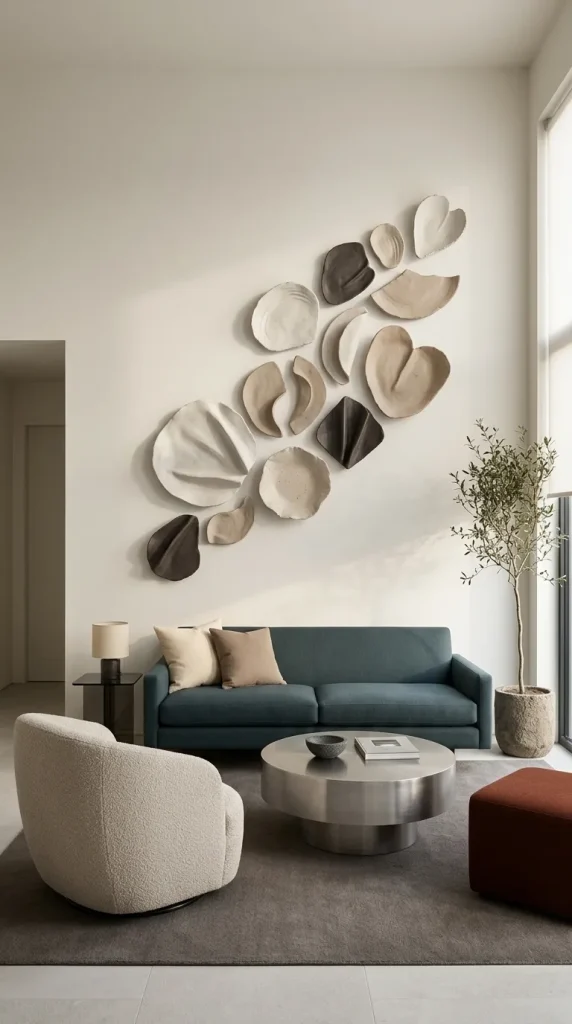
24. Hang a sculptural wall piece
Metal sculpture, carved wood, ceramic relief, plaster forms, woven objects, and abstract dimensional compositions can all replace conventional framed art.
Sculpture is particularly effective on a wall already surrounded by rectangular architecture. The irregular shape breaks the repetition of windows, doors, television screens, and picture frames.
Choose a material that contributes something missing from the room. A space full of soft textiles might benefit from metal or ceramic. A sleek modern room may need the warmth of carved timber or woven fiber.
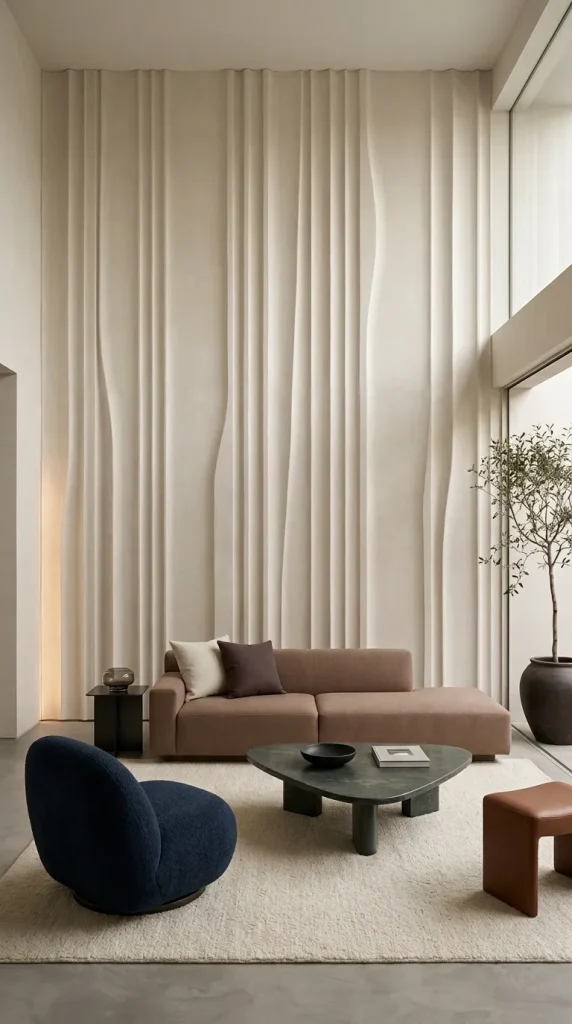
25. Try three-dimensional wall panels
Textured panels can turn a wall into a large relief surface. Fluted plaster, geometric panels, dimensional tiles, or sculpted surfaces work best when the room needs architecture more than additional imagery.
Lighting matters here because shadow creates much of the effect. A wall-washing lamp or nearby daylight can reveal the relief far better than flat frontal lighting.
Keep other wall decor limited. The surface itself is already the feature.
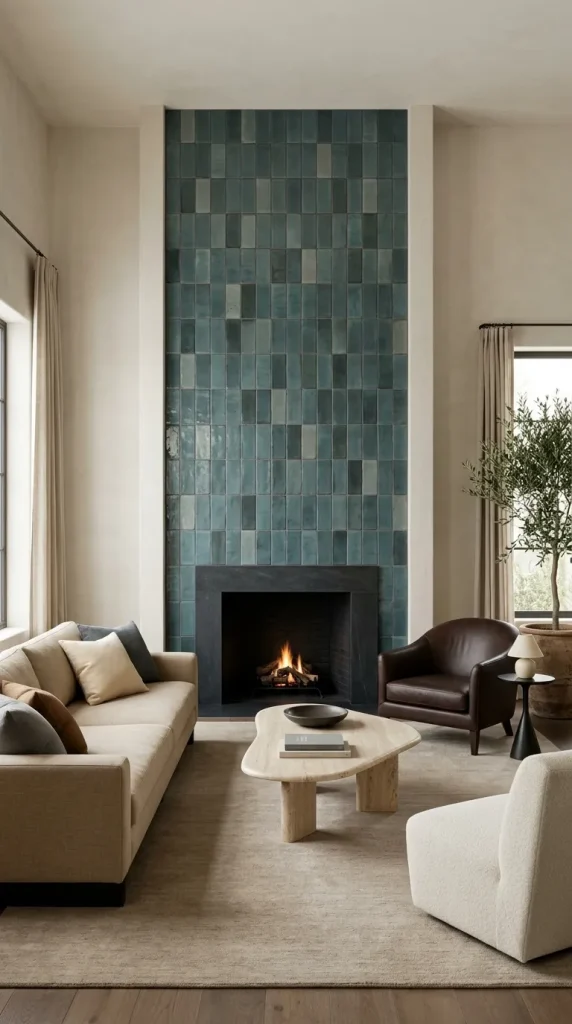
26. Use decorative tile as living room wall art
Tile is usually associated with kitchens and bathrooms, which is precisely why it can feel unexpected in a living room.
Handmade ceramic tile, glazed relief tile, geometric compositions, or a tiled fireplace wall can introduce color and craftsmanship.
Architectural Digest includes allover tile among current living room wall treatments, reflecting a broader interest in treating traditionally functional materials as decorative surfaces.
Because tile is permanent and visually strong, use it where it relates naturally to architecture, such as a fireplace, alcove, or defined feature wall.
Use textile art to soften hard rooms
Not every living room needs more glass, frames, or hard wall objects. Textile art can add softness both visually and materially.
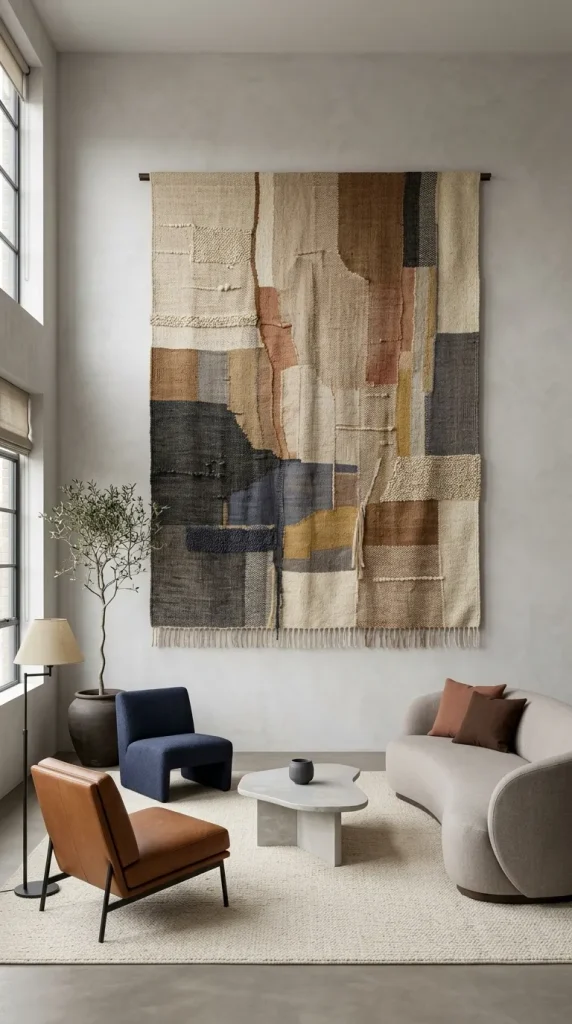
27. Hang a tapestry or large textile panel
A tapestry can occupy the same wall area as an oversized painting but creates a completely different mood. The edges are softer, the surface absorbs light, and the material can make a room with hard floors and minimal upholstery feel warmer.
Vintage textiles work well in eclectic and traditional rooms, while abstract woven pieces can suit contemporary spaces.
Allow the textile to hang cleanly rather than surrounding it with multiple small frames. The material already brings considerable detail.
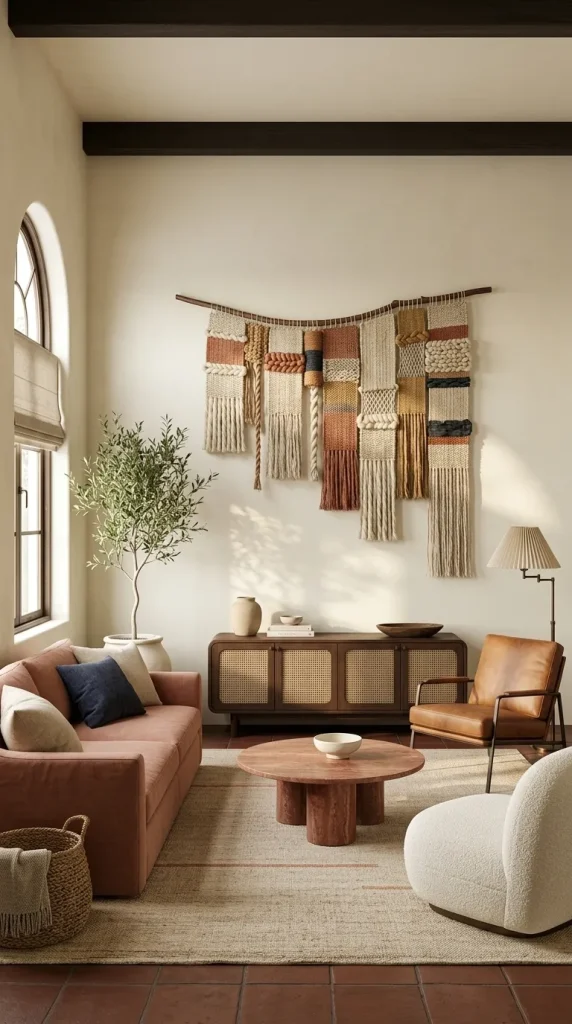
28. Use woven or fiber art in a bohemian living room
Macramé, woven panels, yarn art, and basket-like wall pieces suit bohemian and handmade-focused interiors, but the strongest rooms use them intentionally rather than covering every wall in fiber.
Choose one substantial piece or a carefully related group.
Repeat perhaps one fiber or color elsewhere through a rug, cushion, or basket. That small repetition connects the wall treatment to the rest of the room without turning every surface into the same texture.
Use specific statement pieces where the style calls for them
Some wall-decor formats are more style-specific. They can be extremely effective when they belong to the room and awkward when added only because the wall is empty.
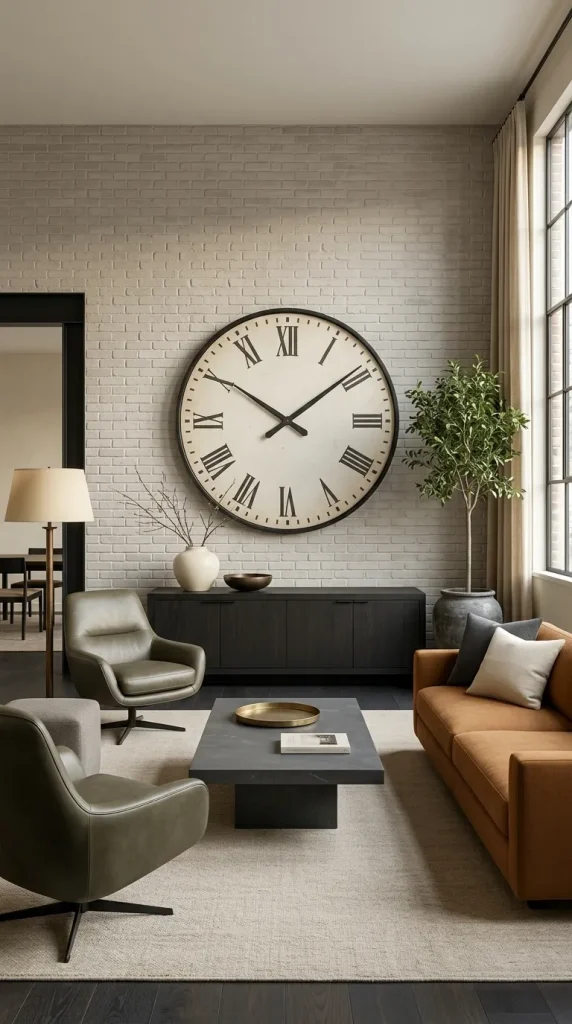
29. Make an oversized wall clock the focal point
A large clock can work particularly well in farmhouse, industrial, rustic, transitional, or open-plan rooms.
Scale is the deciding factor. An oversized clock needs enough clear wall around it to read as one graphic object.
Avoid surrounding a large clock with many tiny signs and frames. If the clock already occupies the focal position, allow it to remain dominant.

30. Hang an architectural salvage piece
An antique shutter, carved wooden panel, ceiling fragment, vintage door section, old ironwork, or other architectural piece can give a blank wall depth and history.
These objects work particularly well in collected, farmhouse, Mediterranean, traditional, rustic, and eclectic rooms.
Pay attention to weight and secure mounting. Large salvage pieces may be substantially heavier than standard wall art.
The best example should feel like an object you genuinely value, not a random old fragment purchased simply to imitate age.
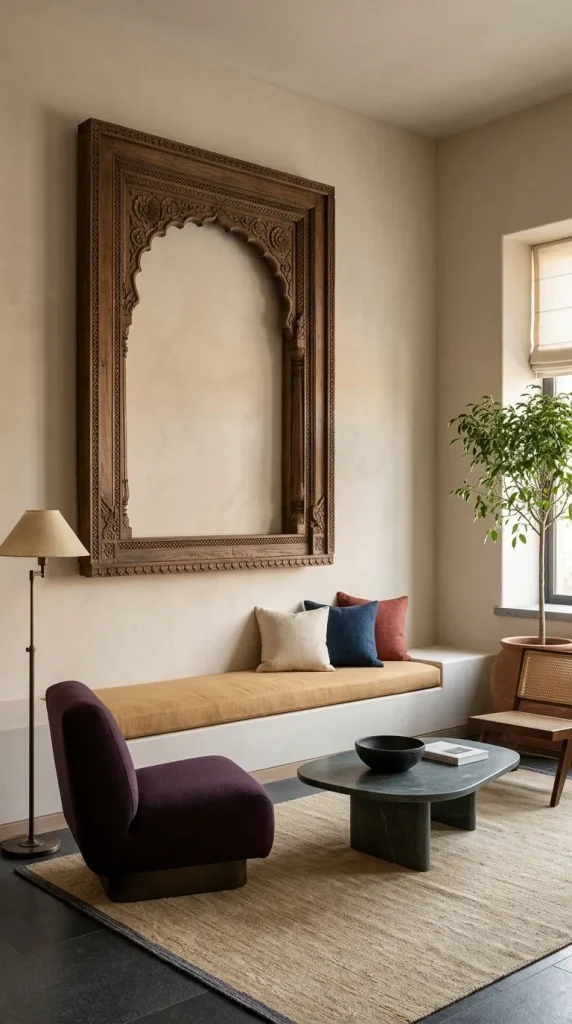
31. Use a carved jharokha or decorative iron panel as one focal object
A carved Indian jharokha-style frame can become a striking wall feature in an Indian-inspired, eclectic, bohemian, or globally influenced room. Its architectural depth and carving already provide substantial ornament, so it usually needs little around it.
Wrought-iron panels can play a similar role in Mediterranean, rustic, or traditional rooms. The openness of the metal allows the wall color to remain visible behind the design, which makes a large piece feel less visually heavy than a solid painting of the same dimensions.
Treat cultural architectural pieces with respect and context rather than using them merely as generic “exotic” accents.
Use affordable art more intelligently
Budget has less impact on a wall than scale, framing, and composition. An inexpensive print can look convincing when it is properly presented, while costly art can look lost when it is too small for the wall.

32. Frame posters, prints, botanicals, or your own DIY art at a larger scale
Posters, travel prints, botanical illustrations, photography, vintage advertisements, and downloadable artwork can provide large-scale wall decor without the cost of original paintings.
Frames and mats matter. A modest print in a generous frame with appropriate matting often has far more presence than the same print pinned directly to the wall.
Botanical sets work particularly well in traditional, cottage, farmhouse, and transitional living rooms because repeated frames create structure. Graphic posters can suit modern, Y2K, eclectic, and contemporary interiors.
You can also create simple DIY abstract work using a limited palette already present in the living room. The objective is not to imitate an expensive artist. It is to create scale and color intentionally.
Make flexible solutions work for apartments and changing homes
Renters and people who move frequently need wall decor that can evolve without requiring expensive permanent work.
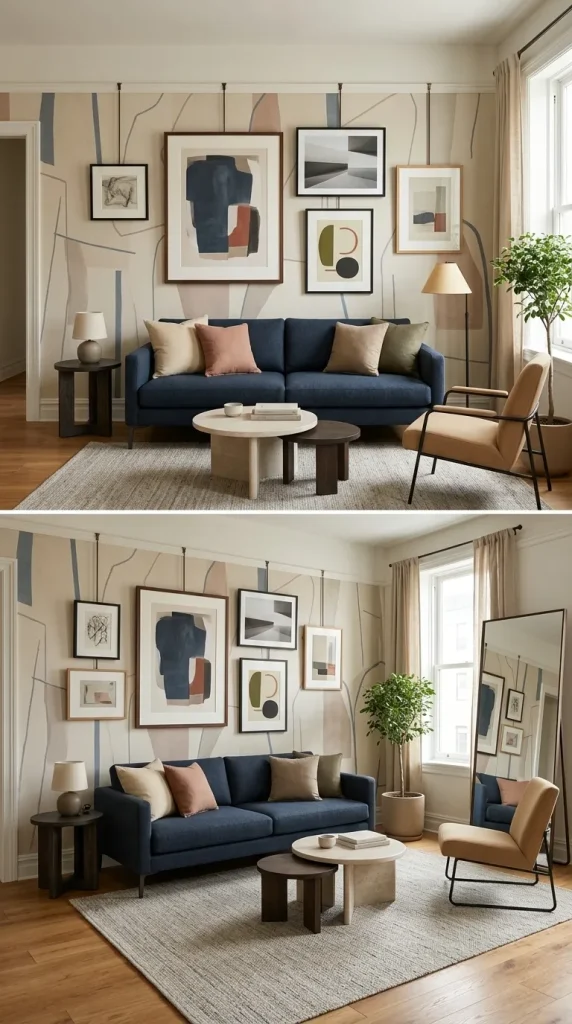
33. Create a flexible wall with picture rails, removable treatments, and movable art
A picture rail is especially useful when you want art to change over time. Livingetc reports renewed designer interest in hanging artwork from rails because the system allows pieces to be rearranged while reducing repeated wall damage and adding its own architectural detail.
Where permitted and appropriate for the surface, removable wallpaper or peel-and-stick murals can introduce color or pattern without committing to a permanent treatment. Large leaning mirrors, lightweight framed prints, tapestries, and removable hanging systems can also give renters more flexibility.
The key is not to make a rented living room feel temporary. Choose art and objects you would happily carry into another home. A flexible installation can still look permanent and considered.
How to decorate two living room walls without making them compete
Adjacent walls should relate to one another, but they should not usually have equal visual strength.
Choose the primary wall first. This might be the sofa wall, fireplace wall, or whichever surface is visible when someone enters the room. Give that wall the larger artwork, gallery, wallpaper, or architectural treatment.
The secondary wall can then become quieter. If the main wall uses large colorful art, the adjacent one might hold a restrained mirror or smaller picture grouping. If one wall has patterned wallpaper, the other might need simple framed work.
Repeat a detail between them. The same frame finish, a shared color, similar timber, or related subject matter can connect the two walls without making them identical.
Sight lines matter. If both walls are visible simultaneously, two equally dramatic focal treatments can pull the eye in opposite directions.
What should go above a radiator?
A radiator wall can still be decorated, but heat and clearance need consideration.
Wall-mounted artwork or a mirror is usually easier to manage than textiles or objects resting directly above the heat source. Keep decor out of the radiator’s functional area and follow the radiator or heating-system manufacturer’s clearance and safety requirements.
Visually, treat the radiator as part of the lower composition. A frame that is far narrower than the radiator may feel disconnected, while artwork related to its width can create a more deliberate arrangement.
If a radiator cover or console is appropriate and safely designed for the system, it may create a stronger visual base for the wall, but function should come before styling.
How to choose between one large piece and a gallery wall
Use one large piece when the room already contains pattern, shelving, books, strong furniture, or other visual activity. Large art creates calm and gives the eye one obvious destination.
Choose a gallery wall when you have several pieces with personal or artistic value that deserve to be seen together. It works especially well in eclectic, traditional, bohemian, and collected interiors.
The decision should come from the room, not from what is currently popular.
A minimalist room can sometimes benefit from an expressive gallery wall precisely because the surrounding space is quiet. An already busy maximalist room may actually need one large calming artwork.
A quick wall-decor guide by wall type
| Wall condition | Strong starting point |
|---|---|
| Above a sofa | Oversized art, pair, triptych, ledge |
| Huge blank wall | Large canvas, mural, gallery, paneling |
| 12-foot ceiling | Vertical art, taller gallery, large sculpture |
| Narrow wall | One vertical piece or slim mirror |
| Long wall | Horizontal gallery, triptych, long ledge |
| Small apartment wall | Large print, tapestry, removable treatment |
| Texturally flat room | Fiber art, wood, plaster, sculpture |
| Visually busy room | One large quiet artwork |
| Two adjacent walls | One focal wall + one supporting treatment |
These are starting points rather than rigid rules. Architecture, furniture, ceiling height, windows, and circulation should still determine the final decision.
Common living room wall decor mistakes
One of the most common mistakes is choosing art that is simply too small. A tiny frame above a broad sofa makes both the frame and the wall look smaller. When in doubt, test larger dimensions with painter’s tape or paper before buying.
Another mistake is hanging everything too high. Wall decor should usually relate to the furniture beneath it rather than drifting toward the ceiling. High ceilings do not mean every picture needs to move upward. Instead, use larger or taller compositions that still begin in a meaningful relationship with the furniture.
Gallery walls often go wrong through inconsistent spacing. Eclectic content can still have disciplined placement. Repeating the approximate gaps between pieces helps the arrangement read as one group rather than many unrelated frames.
Avoid assuming every blank wall needs decoration. Architectural Digest’s 2026 guidance is notably moving toward fewer, more intentional wall gestures rather than cluttered galleries and underscaled mass-produced pieces. Sometimes the strongest decision is to leave a secondary wall largely empty so the focal wall has more authority.
And avoid choosing wall decor without looking at the room underneath it. Artwork is not floating in isolation. The sofa, tables, lamps, rug, windows, and architecture all participate in the same composition.
Try this if your living room wall still looks wrong
Take everything off the wall and look at the furniture first.
Ask what the wall is balancing. Is there a long sofa underneath it? A low console? Nothing at all? Is the wall tall, narrow, wide, dark, textured, or interrupted by windows?
Next, identify what the room is missing. If it already contains lots of color and pattern, the wall may need one calm artwork. If everything is smooth and neutral, texture may be more useful than another framed print. If the room feels low and horizontal, a taller arrangement may improve the proportions.
Then mock up the dimensions before hanging anything. Painter’s tape or paper templates can show whether a picture, mirror, or gallery composition has enough scale.
Only after the large relationships work should you think about small decorative pieces.
A living room wall usually looks wrong because of scale, spacing, hierarchy, or material, not because it needs another object.
Frequently Asked Questions
What should I put on the wall above my living room sofa?
A single oversized artwork, pair of large pictures, triptych, gallery wall, picture ledge, shelf, tapestry, mirror, or sculptural piece can all work. Choose something with enough width and visual weight to relate to the sofa rather than a small object that appears to float above it.
How do I decorate a very large living room wall?
Start with scale. Oversized art, murals, wallpaper, tall gallery walls, broad shelving compositions, paneling, and large mirrors generally work better than many tiny objects. In rooms with high ceilings, use more vertical space while keeping the lower part of the composition connected to the furniture.
Are gallery walls still in style?
Yes, but current 2026 designer guidance favors gallery walls that feel personal and intentionally edited rather than crowded with interchangeable prints. Varied formats, consistent spacing, meaningful art, and negative space help the arrangement feel more sophisticated.
How can I decorate living room walls on a budget?
Use framed posters, downloadable art, secondhand frames, thrifted mirrors, botanical prints, family photography, simple DIY canvases, framed textiles, or removable wallpaper. Spend attention on scale and presentation rather than assuming expensive art is required.
Should every living room wall have decor?
No. Some walls should function as visual rest. Focus on the walls with a clear role, such as the sofa wall, fireplace wall, media wall, or main wall visible from the entrance. Leaving secondary walls quieter can make the important displays feel stronger.
Make the wall belong to the room
The strongest Living Room Wall Decor Ideas do not begin with the wall.
They begin with the room in front of it.
A broad sofa needs a wall treatment with enough scale to support it. High ceilings need vertical thinking. A sleek room full of glass and polished surfaces may benefit from wood, plaster, or textile art. A richly layered living room might need one large quiet canvas rather than another gallery.
That is why decorating a wall is less about finding attractive objects and more about composition.
Decide what the wall is supposed to do. Choose one focal idea. Match its scale to the architecture and furniture. Introduce texture or color only where the room actually needs it, and leave enough negative space for the chosen elements to register.
A finished living room does not have something hanging on every wall.
It has the right things on the right walls.