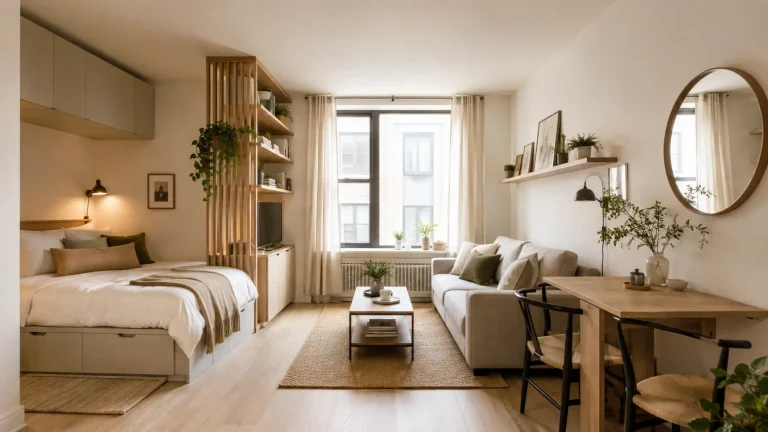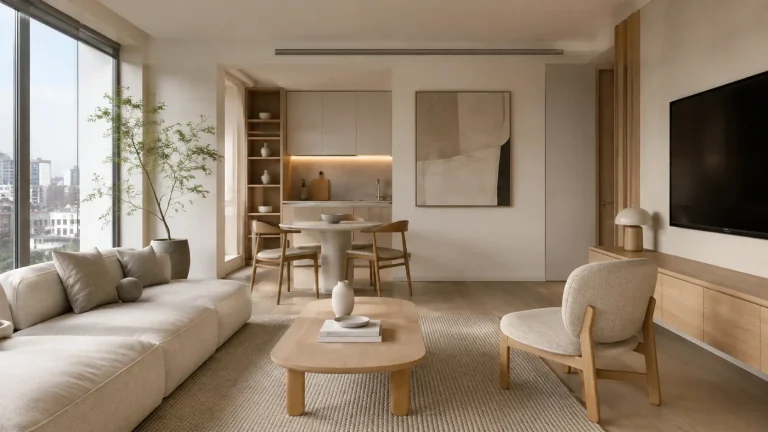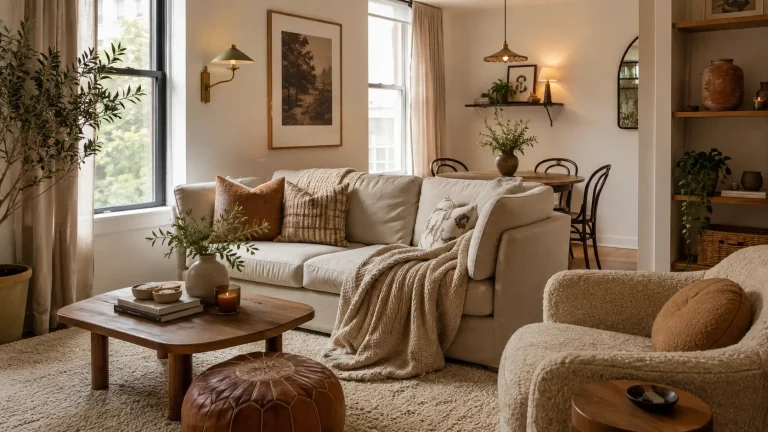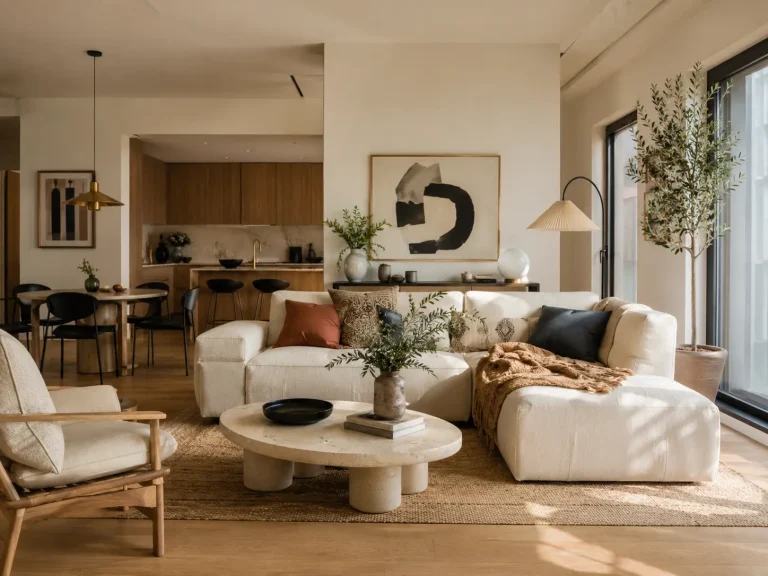

17 Studio Apartment Decor Ideas That Make a Small Space Feel Layered, Calm, and Personal
A studio apartment can go from cozy to chaotic with three innocent purchases. One extra chair, a decorative ladder, and a cute little side table can somehow consume half the room.
That’s why the best studio apartment decor ideas aren’t really about adding more decor. They’re about making the things you choose work harder visually.
I still think about a roughly 380-square-foot studio where the owner had good furniture, beautiful art, and plenty of natural light. Yet the room felt cramped. The problem wasn’t size. Nearly every surface had something sitting on it, and every wall was asking for attention.
We removed very little. We simply grouped objects, repeated a few colors, raised the curtains, and gave several areas some breathing room.
The apartment finally felt like a home instead of one very enthusiastic decorating project.
Here’s how to get that balance right.
1. Pick one clear visual direction before buying more decor
Small rooms show inconsistency quickly.
In a large house, a vintage side table can live several rooms away from a glossy modern console. In a studio, they may sit six feet apart. Every material, color, and shape is visible at once.
Start with a loose visual direction rather than a rigid theme.
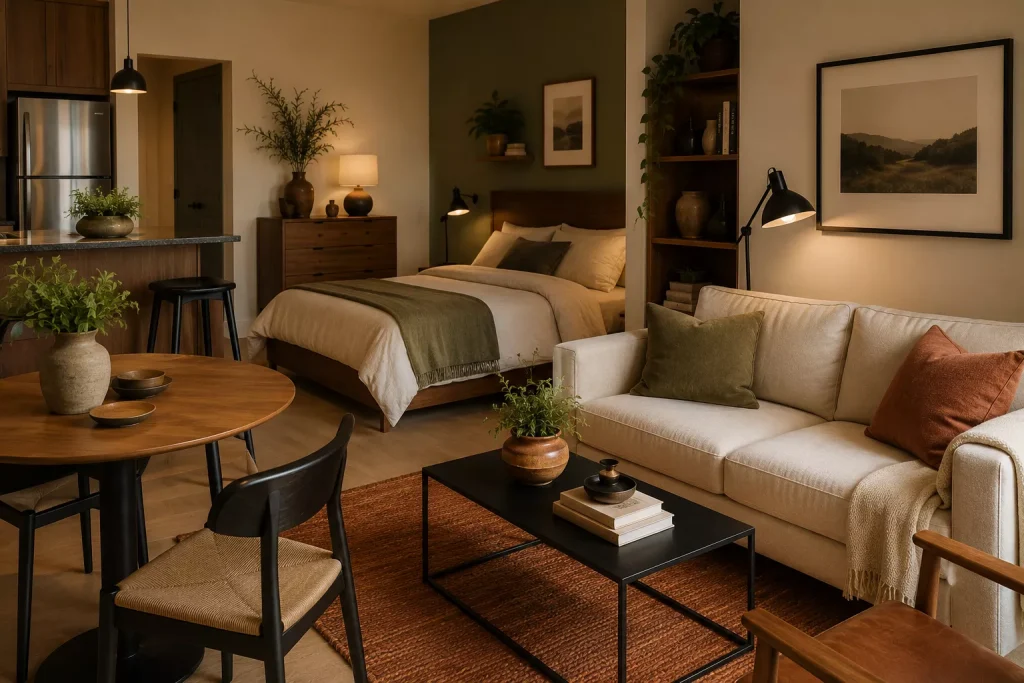
You might choose warm modern with walnut, cream upholstery, black metal, and muted olive. Another studio could lean softer with pale oak, dusty blue, oatmeal linen, and aged brass.
You don’t need every item to match.
Actually, I’d avoid that.
Matching furniture sets often make small apartments feel like rental showrooms. A little variation creates personality.
The trick is repetition. If your coffee table has black metal legs, repeat black in a lamp or picture frame. If your rug includes clay terracotta, bring that shade back through one cushion or ceramic pot.
Limit yourself to roughly three main materials and a small supporting color palette.
That simple discipline makes even affordable decor look more considered.
And it prevents the classic studio problem, fifteen individually nice things that somehow dislike each other.
2. Use a large rug instead of several tiny ones
One of the most common small-space mistakes is buying a tiny rug because the room itself is tiny.
It sounds logical. Visually, it often backfires.
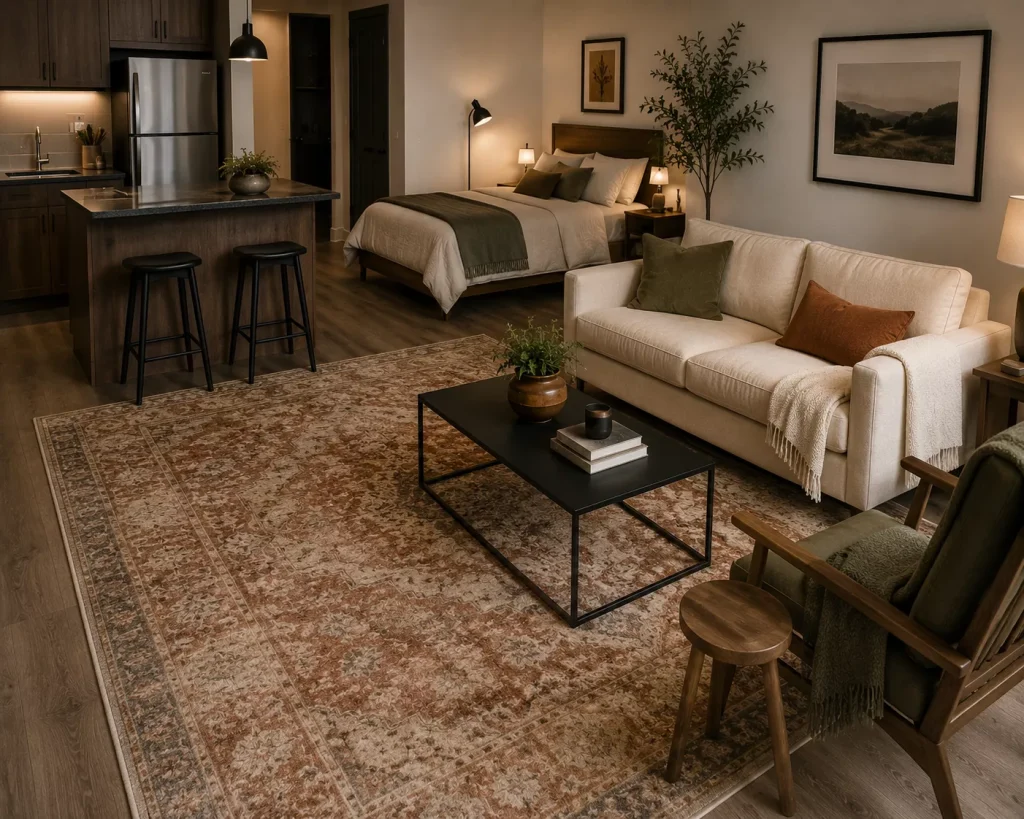
A 4-by-6-foot rug floating underneath a coffee table can make the seating area look miniature. A larger 6-by-9 or 8-by-10 rug may actually make the room feel broader because it connects the furniture.
For most studio living areas, try to get at least the front legs of the sofa and chairs onto the rug.
Studio apartment decor idea 2 is simple: use one generous rug to create the main living zone.
Choose low-pile wool, washable synthetic fiber, or flatwoven cotton if the rug sits near the kitchen. High-pile ivory rugs look beautiful in photographs but are far less charming after a week of crumbs, coffee, and everyday foot traffic.
For color, I like subtle patterns over solid beige.
Think faded rust and cream, muted olive with tan, or soft charcoal mixed with warm greige. Gentle pattern hides everyday wear and adds depth without dominating the room.
A good rug should anchor the furniture, not look like a postage stamp beneath it.

3. Make your bed look intentional, because everyone can see it
There’s no hiding the bed in most studios.
So stop treating it like the part of the room guests aren’t supposed to notice.
Studio apartment decor idea 3 is to style the bed like a major piece of furniture.
Start with a proper headboard if your layout allows one. Upholstered linen, cane, light oak, or a simple painted wood design instantly gives the sleeping area more structure.
Then keep the bedding relatively controlled.
I’d rather see crisp white sheets, a warm mushroom duvet, and one rust lumbar cushion than seven decorative pillows that have to be relocated every evening.
A throw folded casually across the lower third of the bed can bring in texture. Look at waffle cotton, brushed wool blends, chunky knits, or linen.
Use the wall behind the bed
One large artwork often works better than a collection of tiny frames.
For a full or queen bed, art around 30 to 40 inches wide usually has enough presence. Hang it roughly 6 to 10 inches above the headboard.
If you rent and can’t make many holes, removable hooks, lightweight textile art, or peel-and-stick wall treatments can still create a strong focal point.
Your bed takes up too much visual space to be an afterthought.
4. Hang curtains higher than the window frame
Few decorating tricks give you this much visual return for such little effort.
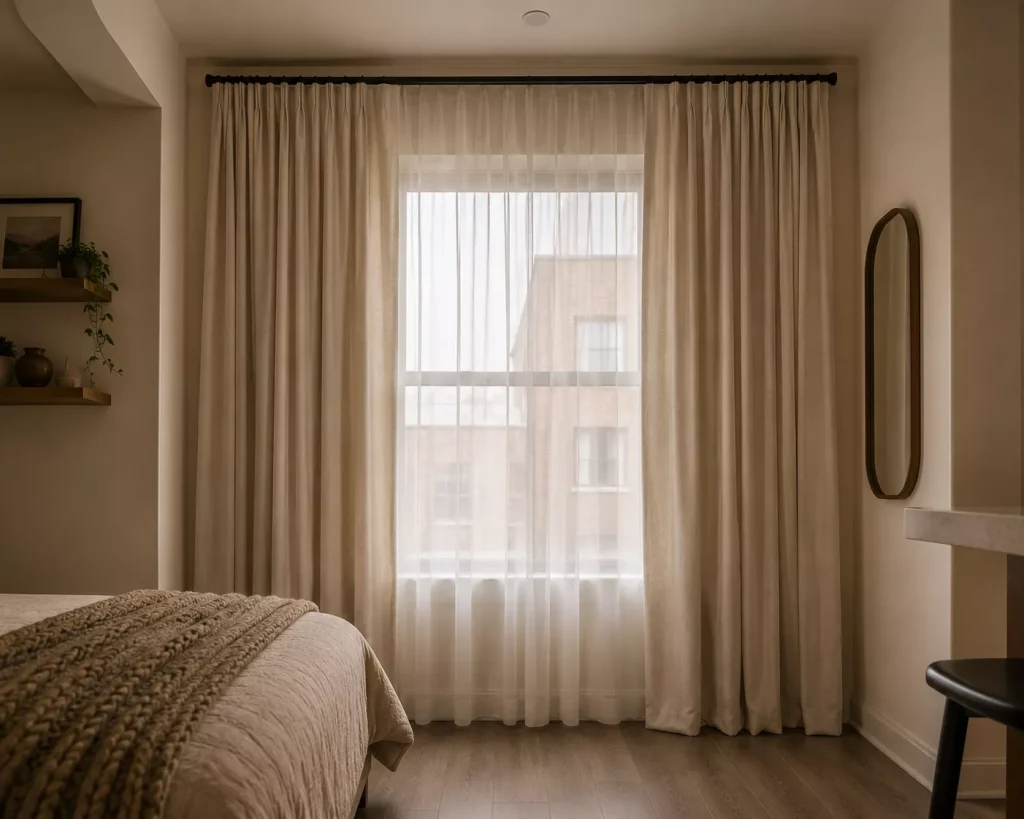
Mount your curtain rod several inches above the top of the window, or closer to the ceiling where proportions allow.
Then let the fabric reach the floor.
This stretches the eye upward and gives the wall more height.
For a studio, I usually prefer curtains that are about 1.5 to 2 times the width of the window once gathered. Panels that barely cover the glass can look thin and unfinished.
Choose warm white, flax, soft taupe, pale stone, or another shade close to the wall color if you want the room to feel calm.
Heavy dark curtains can work, but they carry more visual weight. In a north-facing studio with limited daylight, I’d be cautious.
Layering is useful too.
A sheer panel gives daytime privacy while preserving light. Add a blackout layer if the bed sits near the window and streetlights interfere with sleep.
Expect basic panels and hardware to start around $50 to $100 for a small window setup. Linen blends and custom sizes can climb much higher.
It’s one upgrade where even inexpensive fabric can look surprisingly good if the length is right.

5. Decorate upward so your floor stays open
Floor space is precious. Wall space is usually sitting there unemployed.
That makes vertical decorating one of the most useful studio apartment decor ideas.
Instead of adding another console table, use floating shelves. Replace a floor-standing bookcase with wall-mounted storage where installation allows. Hang plants from the ceiling rather than putting three pots on stands.
The goal isn’t to cover every wall.
You still need blank space.
A useful approach is to concentrate vertical decor in one or two areas. Perhaps the wall above your desk gets two oak shelves, while the opposite wall remains mostly clear except for one large print.
That contrast makes the decorated areas feel deliberate.
I’ve seen small apartments become visually exhausting because every wall had a gallery, mirror, shelf, hanging plant, or decorative object.
Small-space decorating doesn’t reward maximum effort.
It rewards editing.
Keep the highest shelves for attractive objects you don’t need daily. Books, pottery, a sculptural vase, or a woven box work well.
Frequently used clutter belongs somewhere easier to reach.
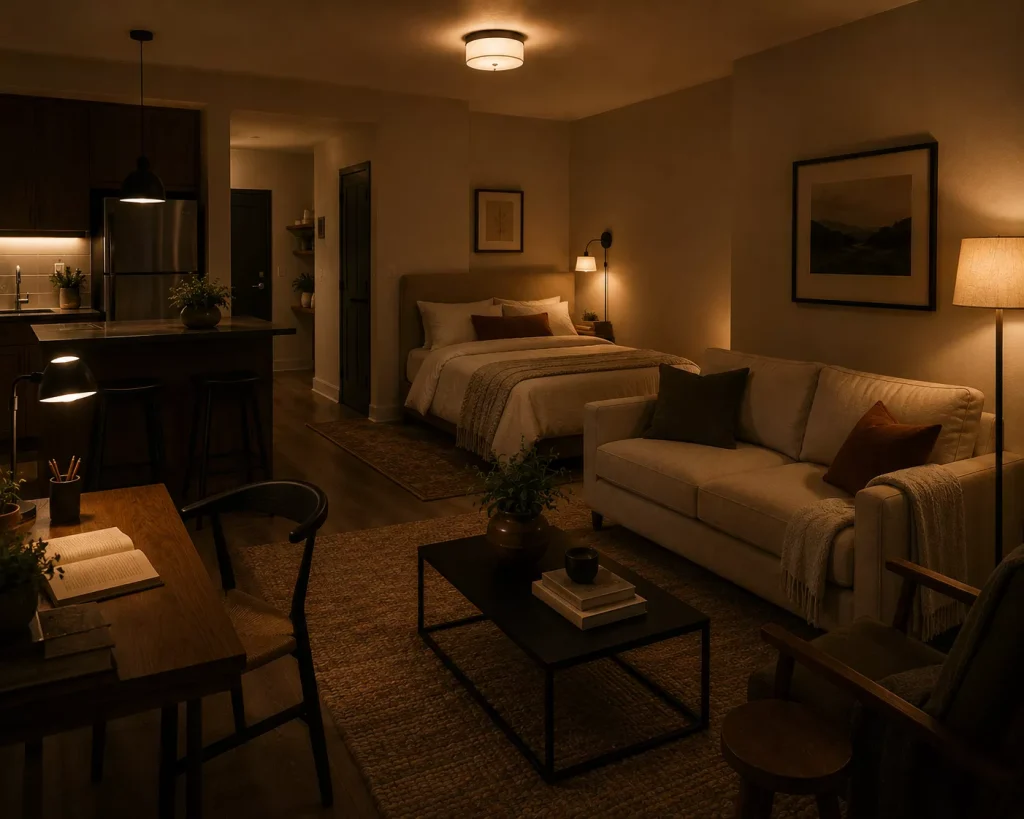
6. Let lighting do more than one ceiling fixture
A single ceiling light can flatten a studio instantly.
Good small-space lighting works in layers.
You want light at different heights, serving different jobs.
Build three layers of light
Ambient light: Your main ceiling fixture or broad room lighting.
Task light: A desk lamp, reading lamp, or under-cabinet kitchen light.
Accent light: A small table lamp, wall sconce, or warm glow near artwork.
You don’t need all three running constantly. Their value is flexibility.
A slim plug-in wall sconce beside the bed can replace a bedside lamp and free up the nightstand. A floor lamp with a narrow base can tuck behind the sofa. A rechargeable lamp can move between the dining table, kitchen counter, and bookshelf.
For bulbs, warm white light around 2700K usually creates a relaxed residential feel.
Avoid filling a cozy studio with icy blue-white light unless you genuinely prefer it.
And skip oversized lampshades that consume half a table.
In small rooms, lighting should add atmosphere without creating another obstacle course.
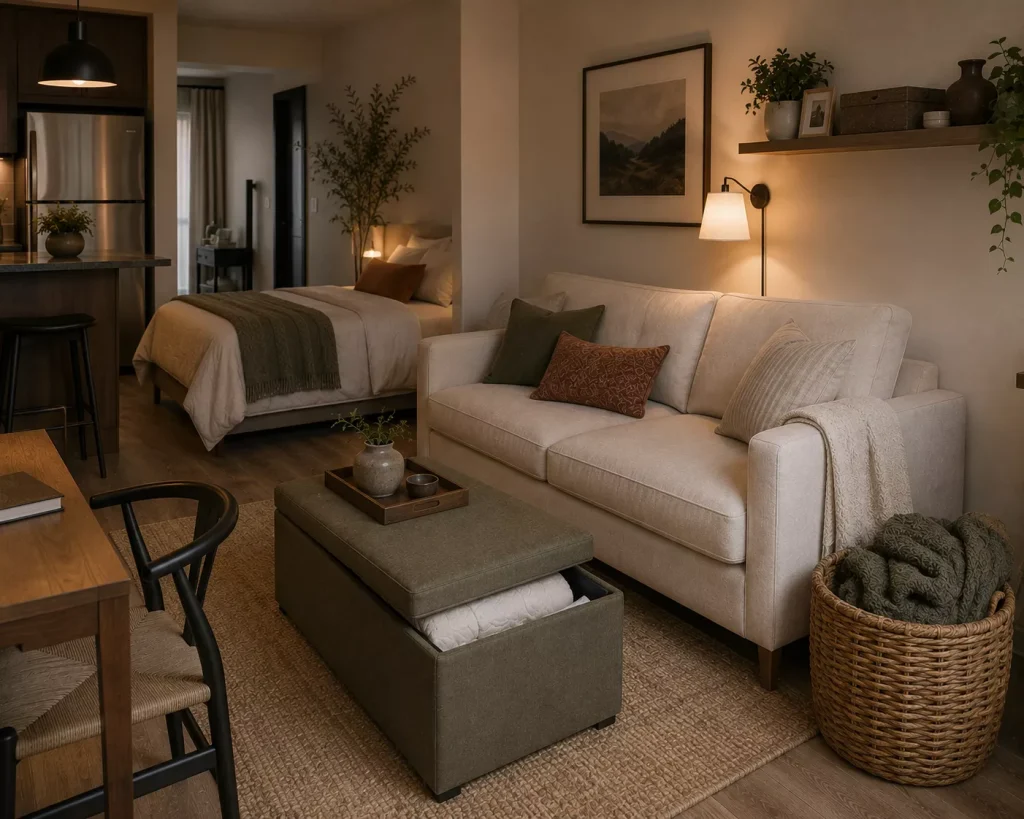
7. Choose decor that doubles as useful storage
Decorative storage is where aesthetics and real life finally cooperate.
A woven basket beside the sofa can hold blankets. A lidded box on a shelf can hide cables, batteries, and random household bits. An upholstered storage ottoman can conceal extra bedding while working as a coffee table.
This is far better than displaying every practical object openly.
But there’s a catch.
Too many baskets can make the room look like a storage aisle.
Mix storage types instead.
Here’s a simple comparison:
| Decor choice | What it does well | Watch out for |
|---|---|---|
| Woven basket | Adds warmth and hides soft items | Open tops can still look messy |
| Storage ottoman | Seating, table, and hidden storage | Can feel bulky in narrow rooms |
| Decorative boxes | Great for small clutter | Too many look repetitive |
| Wall hooks | Uses vertical space | Visible items become part of the decor |
| Lidded bench | Stores larger items | Needs substantial floor space |
| Floating cabinet | Keeps the floor visually open | Installation may not suit renters |
The best decorative storage disappears into the room rather than announcing, “I have nowhere else to put this.”
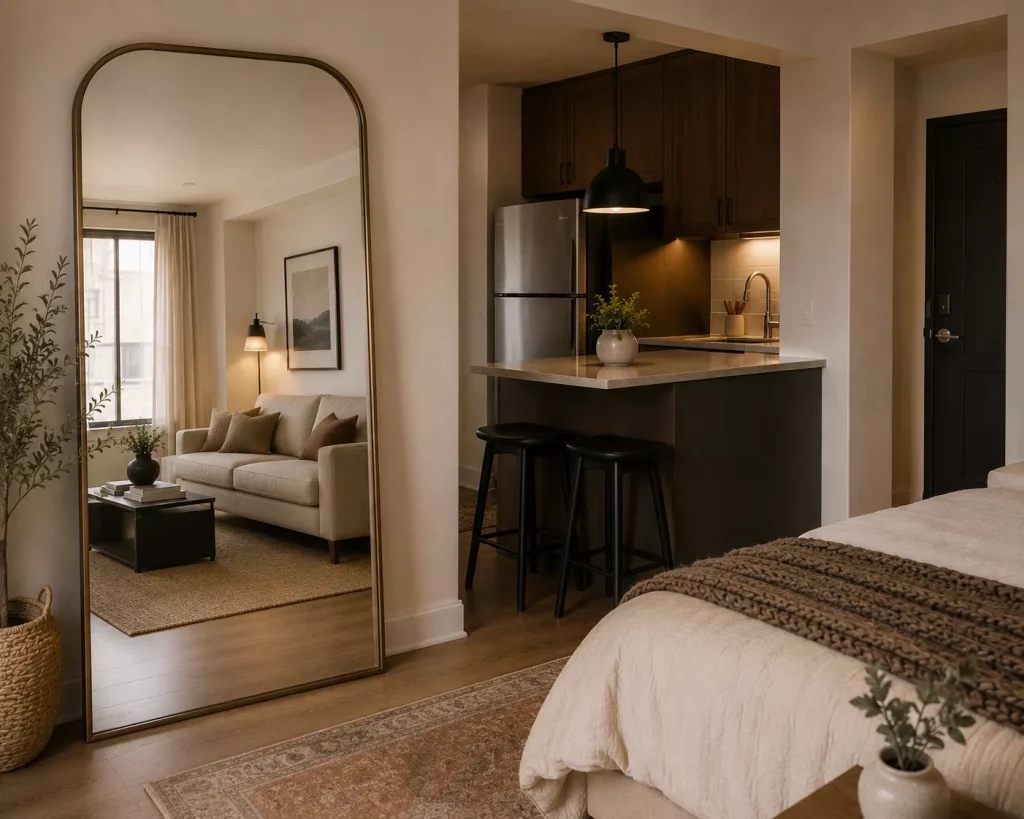
8. Use mirrors strategically, not everywhere
Mirrors are practically mandatory in small-apartment advice, but people often use them badly.
A mirror doesn’t magically enlarge a room.
It reflects whatever sits opposite it.
If that happens to be a pile of laundry, congratulations, you now have two piles of laundry.
Place a large mirror where it can reflect daylight, an attractive view, artwork, or an uncluttered portion of the room.
A floor mirror around 60 to 72 inches tall can work beautifully near a window. For safer positioning in small spaces, anchor leaning mirrors where appropriate.
Over a dresser or narrow console, a round mirror between 24 and 36 inches wide can soften all the straight lines common in studio apartments.
I’d choose one substantial mirror over a cluster of small decorative ones.
Small mirrored objects also tend to feel dated quickly.
If you like a warmer look, try frames in walnut, antique brass, blackened metal, or pale oak rather than bright chrome.
This is a good example of less doing more.
One well-positioned mirror can become architecture. Five little mirrors become accessories.

9. Give your walls personality without shrinking the room
White walls aren’t the only safe choice for a studio.
In fact, endless landlord white can sometimes make a small apartment feel flatter rather than larger.
Color gives walls depth.
Soft olive, dusty blue, warm greige, muted clay, creamy beige, and pale mushroom can all work beautifully in a compact home.
Renters can get similar effects with removable wallpaper, peel-and-stick panels, or large-scale artwork.
My preference is usually one confident treatment rather than multiple accent walls.
For example, use muted olive behind the bed, then keep the remaining walls warm white. Or add a soft botanical wallpaper to a sleeping alcove while leaving the main living area quieter.
There’s also nothing wrong with darker color.
Deep navy, chocolate brown, or charcoal can make a small sleeping nook feel rich and cocooning.
The trade-off is obvious. Dark walls absorb more light and show dust in certain finishes.
So consider where your windows sit before committing.
Great studio apartment decor ideas should work with the apartment’s natural light, not fight it.
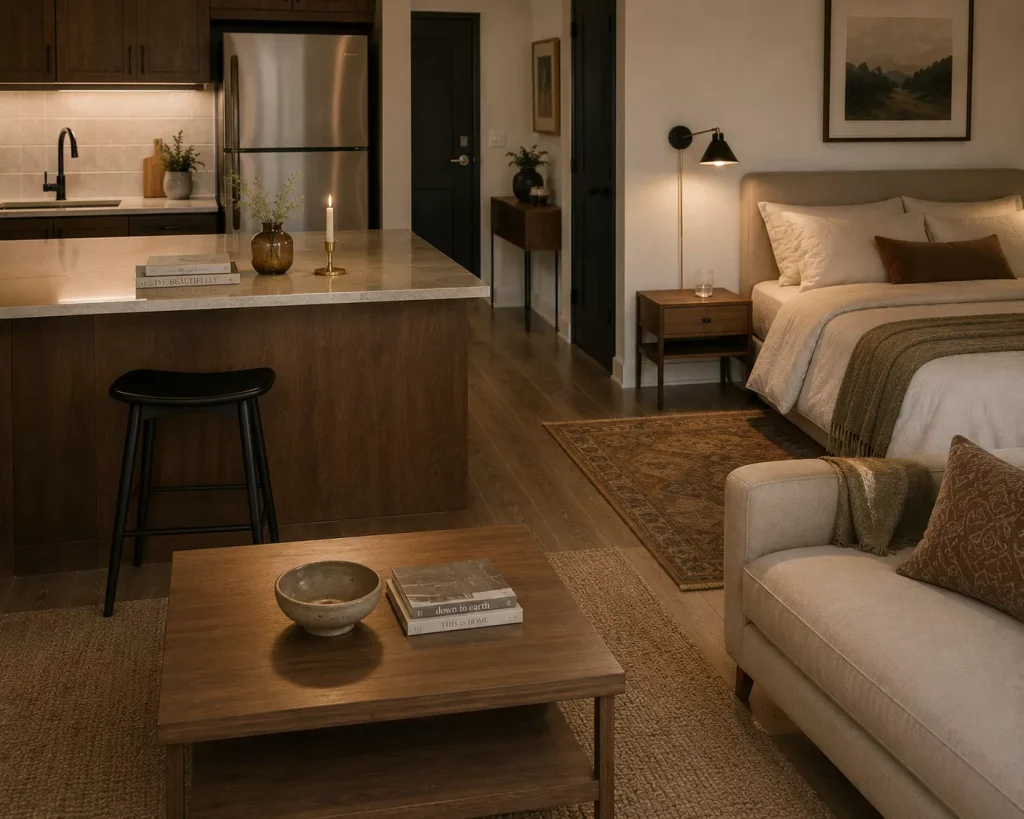
10. Keep surfaces styled, but leave some of them empty
The fastest way to make a studio feel cluttered is to decorate every available horizontal surface.
Coffee table.
Nightstand.
Kitchen counter.
Desk.
Window ledge.
Dresser.
Suddenly you have no place to put down a glass.
I follow a simple rule in small homes. At least part of every hardworking surface should stay empty.
On a coffee table, that might mean one ceramic bowl and two books instead of a full decorative arrangement.
A nightstand needs room for your phone and a glass of water.
The kitchen counter should prioritize cooking.
Try grouping decor into small clusters rather than spreading objects evenly. Three related pieces often feel calmer than seven isolated ones.
You could pair a smoked-glass vase, one small book stack, and a brass candle holder. Vary the heights slightly.
And don’t forget texture.
Wood, stoneware, linen, glass, woven fibers, and aged metal create depth more effectively than piles of decorative objects.
Your studio should have places where your eyes can stop working.
Empty space does that.
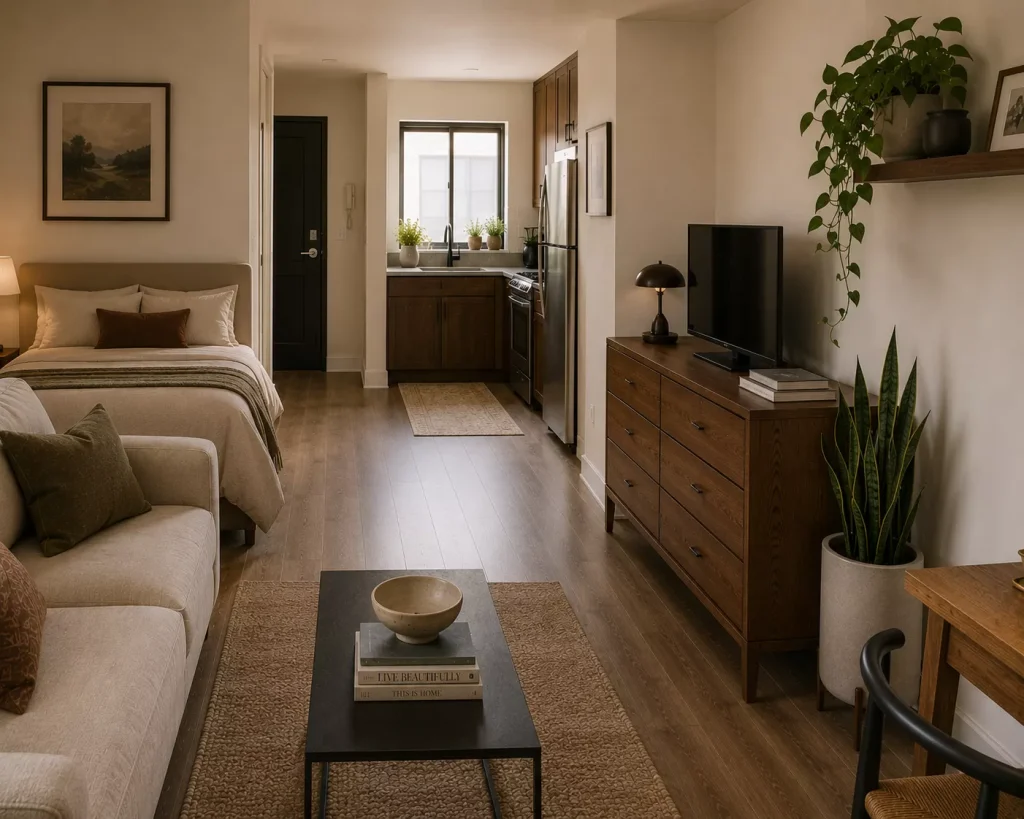
11. Add plants where they won’t steal useful floor area
Plants bring life to a studio, but floor-standing planters can become surprisingly demanding roommates.
Use them selectively.
A pothos trailing from a high shelf adds softness without using floor space. A narrow snake plant can fit beside a dresser. Small herbs look great on a kitchen windowsill if the light works.
Avoid scattering tiny pots everywhere.
They create another category of visual clutter and somehow require constant watering.
One medium or large plant usually has more impact than six tiny ones.
If natural light is limited, choose plants suited to lower-light conditions rather than buying whatever looks best at the garden center.
And fake plants aren’t automatically terrible.
A high-quality faux branch in a matte ceramic vase can look far better than a struggling real plant dropping leaves across your desk.
I’d rather see one believable artificial olive branch than a sad fiddle-leaf fig living through its third near-death experience.
Decor should make the apartment easier to enjoy, not create another weekly obligation.
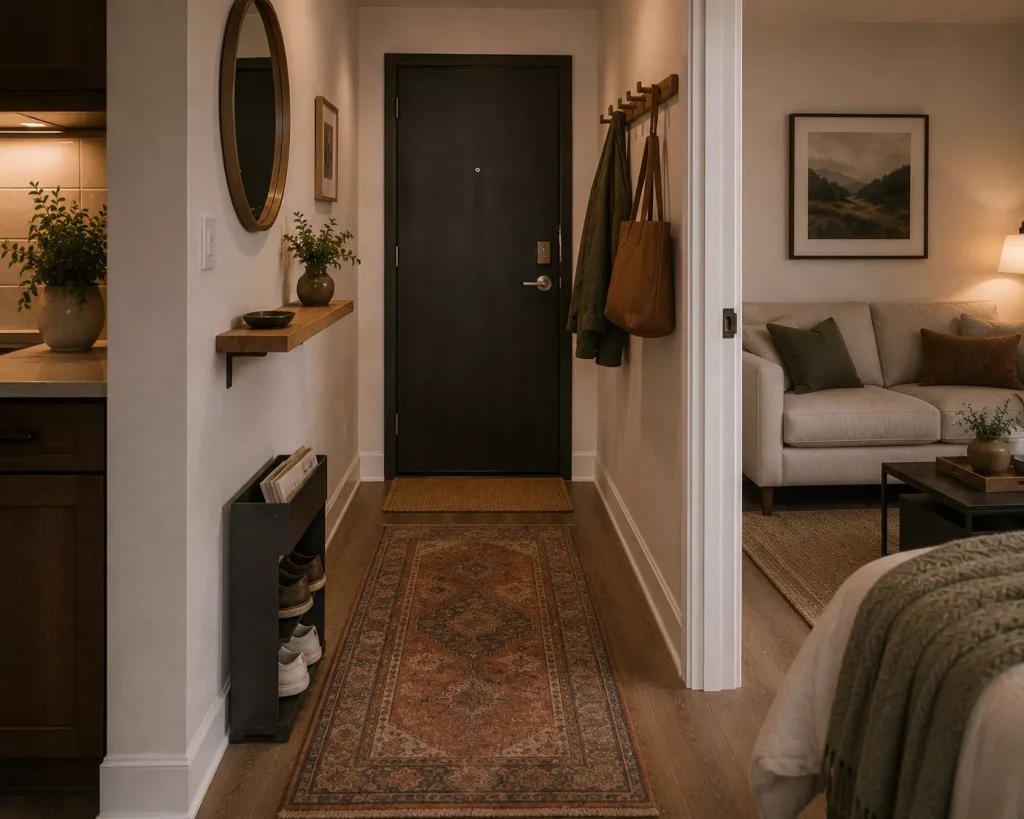
12. Make the entry feel like part of the room
Studios rarely have a proper foyer.
You open the front door and there’s the kitchen, sofa, bed, or all three.
That makes the entry worth defining.
A narrow shelf around 8 to 12 inches deep can hold keys without blocking the walkway. Add a small mirror above it and a hook rail nearby for bags or jackets.
If you have almost no wall space, use a decorative tray on the kitchen counter as an intentional landing spot.
A washable runner can also create a subtle entry zone.
Choose something patterned in rust, faded navy, olive, charcoal, or taupe so dirt isn’t instantly obvious.
The key is containment.
Shoes need one clear home. Mail needs one home. Keys need one home.
Once entry clutter spreads into the living area, the entire studio feels messy.
Small apartments expose habits quickly.
That can be annoying, but it’s also useful. A good entry setup solves the problem before clutter travels farther into the room.
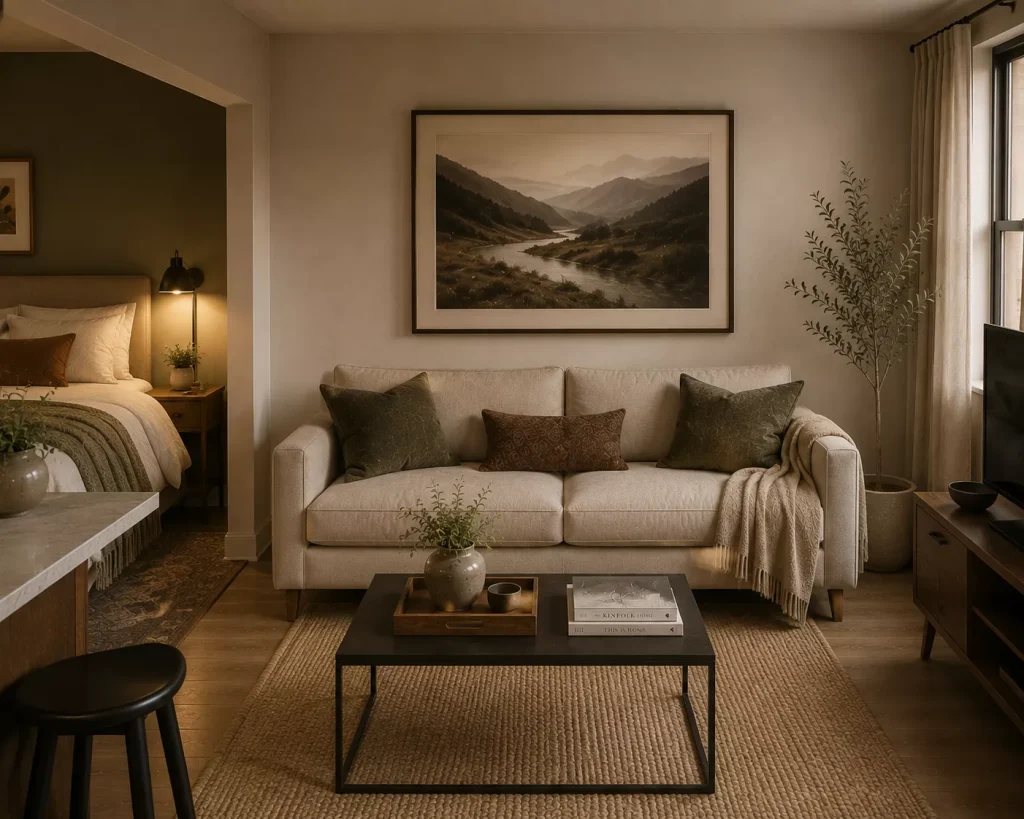
13. Use art at a scale that matches your furniture
Tiny art isn’t automatically appropriate for a tiny home.
In fact, several little pieces can make the walls feel fragmented.
Over a sofa, try one larger artwork or a tightly organized pair. A piece around two-thirds the width of the furniture below it often feels balanced.
Gallery walls can still work.
Just treat the whole grouping as one large composition.
Keep spacing consistent, usually around 2 to 3 inches between frames, and repeat one element such as frame color or mat style.
I’m particularly fond of oversized photography in studios because it creates a sense of depth.
Landscapes, architectural images, botanical photography, and abstract pieces all work well.
You don’t need expensive originals.
Printable art, vintage market finds, personal photography, textile pieces, and framed pages can look excellent with thoughtful framing.
Spend more attention on scale than price.
A $25 print in a correctly sized frame can look far better than expensive art floating awkwardly in the middle of a huge wall.
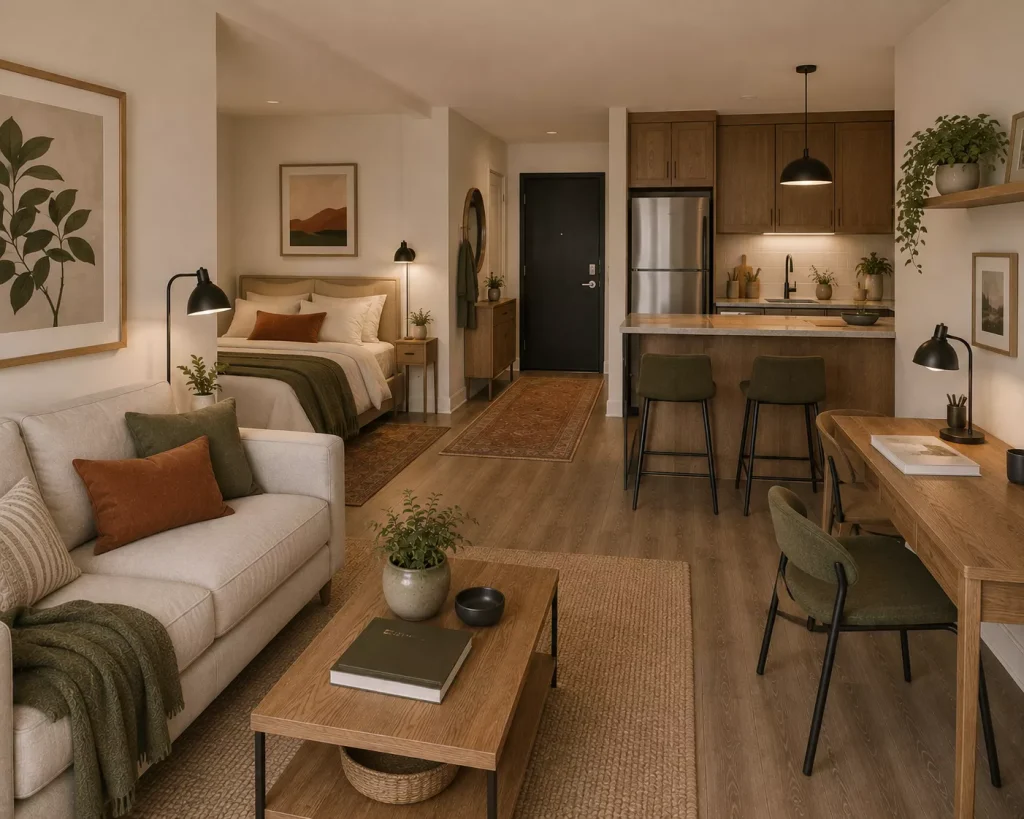
14. Repeat colors across zones to make the studio feel connected
A studio still needs visual separation, but each zone shouldn’t look like a different apartment.
Repeat colors gently across the space.
Suppose your living area has a warm rust cushion. You might echo that color in a small kitchen runner or artwork near the bed.
Your pale oak desk could connect with oak frames and a wooden bedside shelf.
This creates continuity without matching everything.
I usually recommend one main neutral, one supporting wood tone, and two or three accent colors.
For example:
Warm white walls
Medium oak
Olive green
Rust
Matte black
That’s enough variety to feel interesting while keeping the whole apartment visually connected.
Small homes benefit from repetition because your eye can see almost everything at once.
Treat the studio as one composition with several functions, rather than several tiny rooms competing for attention.
That shift alone improves most small apartment decorating schemes.
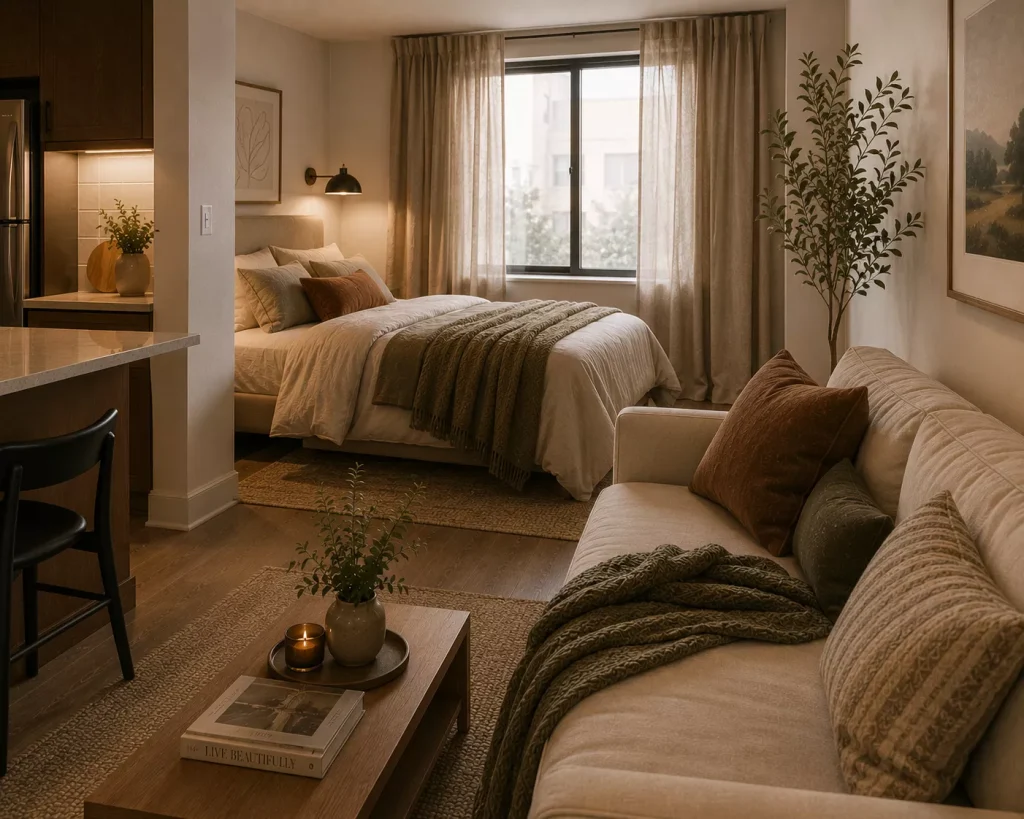
15. Introduce softness through textiles instead of extra furniture
You don’t need another chair to make a studio feel cozy.
Often you need better textiles.
A substantial throw, linen curtains, an upholstered headboard, soft bedding, and a textured rug can completely change how a hard-edged rental feels.
Mix textures rather than piling on patterns.
Try washed linen beside boucle, cotton beside wool, or smooth velvet against woven jute.
Keep the palette reasonably connected.
A cream boucle cushion on a caramel leather chair feels layered. Six cushions in unrelated prints can feel like a clearance bin.
For budget decorating, textiles offer plenty of flexibility.
Cushion covers can cost roughly $10 to $40 each. Throws often fall around $25 to $100 depending on material. Curtains vary widely, but ready-made panels keep costs manageable.
Just remember that high-texture fabrics collect dust and pet hair more easily.
Boucle deserves a special warning here. It looks lovely. It also seems personally determined to collect every crumb in the apartment.
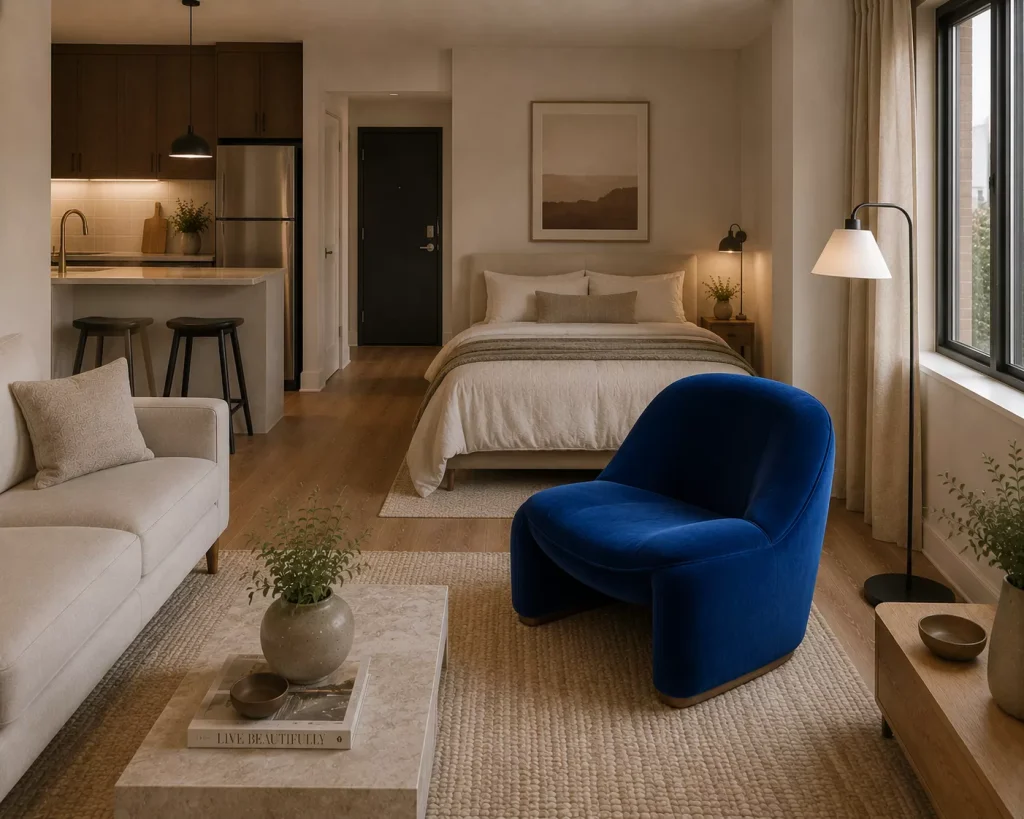
16. Let one or two pieces be genuinely bold
Small apartments don’t need small personalities.
One bold object can actually simplify the decor because it gives the room a clear focal point.
Try a cobalt blue lounge chair, an oversized striped rug, a deep burgundy headboard, or a sculptural paper pendant light.
Then let quieter pieces support it.
This works better than distributing ten small “statement” objects around the room.
One of my favorite combinations is a mostly warm-neutral studio with a single dark green velvet chair near the window. It gives the entire room enough character without demanding matching green decor everywhere.
Bold pieces also help inexpensive furniture look more intentional.
A basic white dresser feels less generic beside a striking framed print or sculptural lamp.
The mistake is confusing bold with busy.
You want one clear moment, maybe two.
If the rug, sofa, bedding, curtains, wallpaper, and artwork are all competing to be memorable, none of them wins.
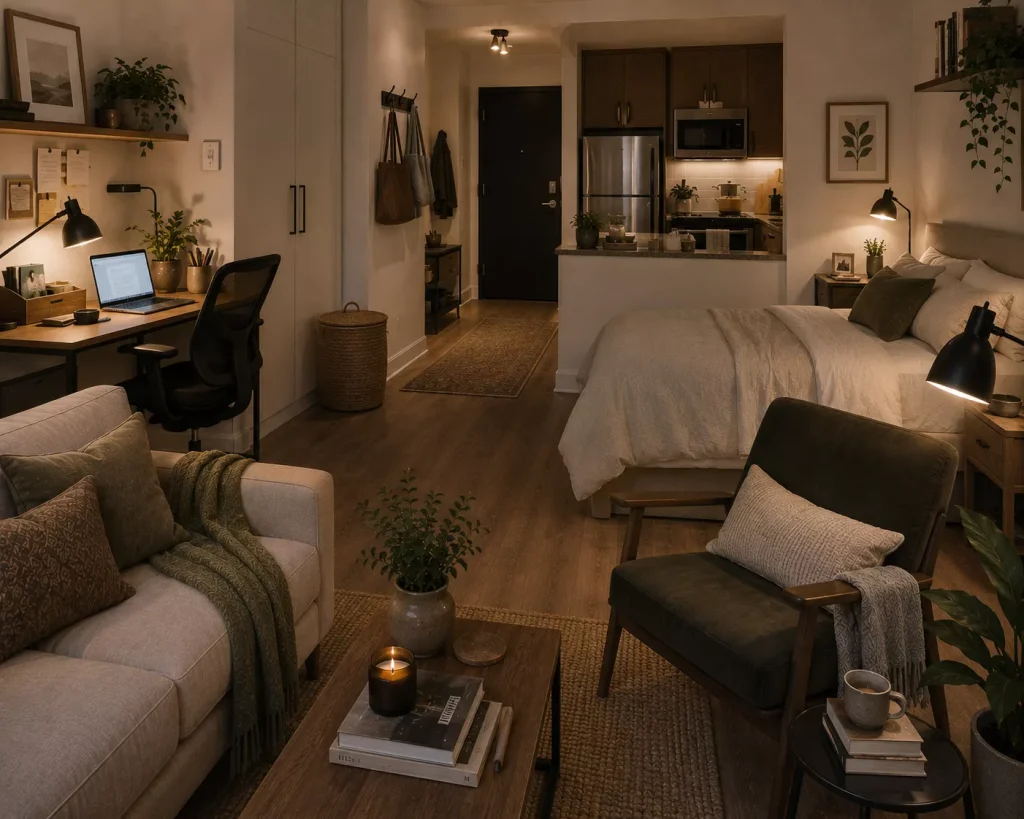
17. Decorate for the life you actually live there
This may be the least glamorous rule, but it matters most.
Your apartment shouldn’t be designed around a photograph.
If you work from home five days a week, the desk deserves more attention than a decorative bar cart.
If you cook constantly, keep kitchen storage easy to reach.
If friends visit often, flexible seating matters.
If you read every evening, give yourself a genuinely comfortable chair and good lamp.
Some of the most useful studio apartment decor ideas are surprisingly ordinary because real homes have charging cables, laundry hampers, pet supplies, work bags, and groceries.
Design around those realities.
A beautiful woven hamper can live beside the wardrobe. A decorative box can hide charging cords. Attractive wall hooks can hold everyday bags.
That’s good decorating because it supports good habits.
A studio that looks slightly less perfect but works every day will always beat a beautifully styled room that becomes annoying by Tuesday.
FAQ About Studio Apartment Decor
How do I decorate a studio apartment without making it cluttered?
Use fewer, larger decorative pieces and repeat a limited palette. Keep some surfaces deliberately empty and concentrate wall decor rather than spreading it across every available area.
What colors make a studio apartment look bigger?
Warm whites, pale greige, light mushroom, soft blue, and muted green can keep the room feeling open. But darker colors can work too, especially in a sleeping nook or on one controlled feature wall.
How can renters decorate a studio without damaging walls?
Try removable wallpaper, tension rods, leaning mirrors, freestanding shelving, command-style hooks, and lightweight artwork. Always check the lease before mounting heavier pieces.
How much decor should a small studio apartment have?
There’s no perfect number. Focus on leaving breathing room around furniture and keeping everyday surfaces functional. One larger plant, one substantial artwork, and a few well-chosen objects can do more than dozens of small accessories.
Make one corner feel finished first
Remember that 380-square-foot studio from the beginning? The biggest improvement didn’t come from buying anything new.
We cleared the crowded dresser, moved one lamp, raised the curtains, and grouped the artwork more intentionally. Suddenly, the pieces that had been there all along started looking better.
That’s where I’d begin in your apartment.
Choose one visible corner and finish it properly. Maybe it’s the bed, the sofa wall, or the little area beside the window. Remove what doesn’t help, add only what’s missing, and repeat those choices elsewhere.
The smartest studio apartment decor ideas aren’t about filling every square foot beautifully.
They’re about knowing which square feet need decorating at all.