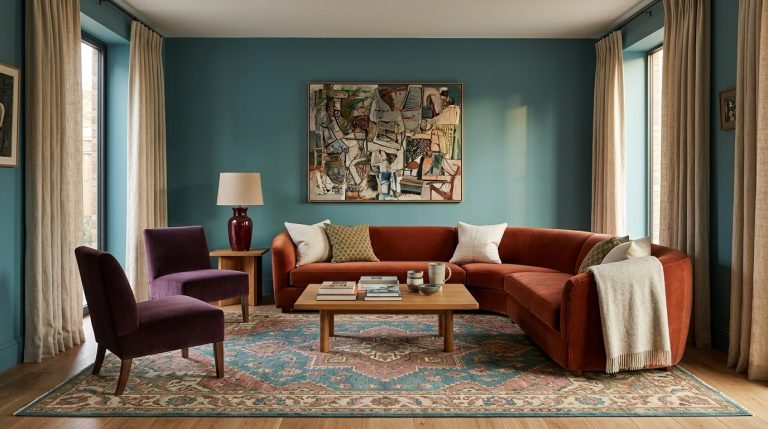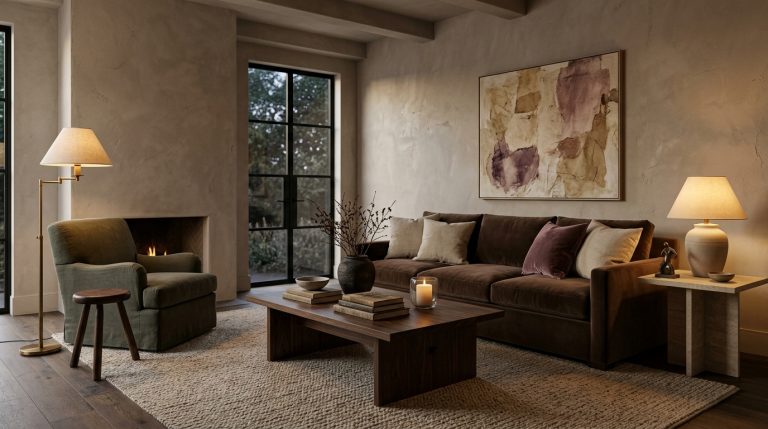
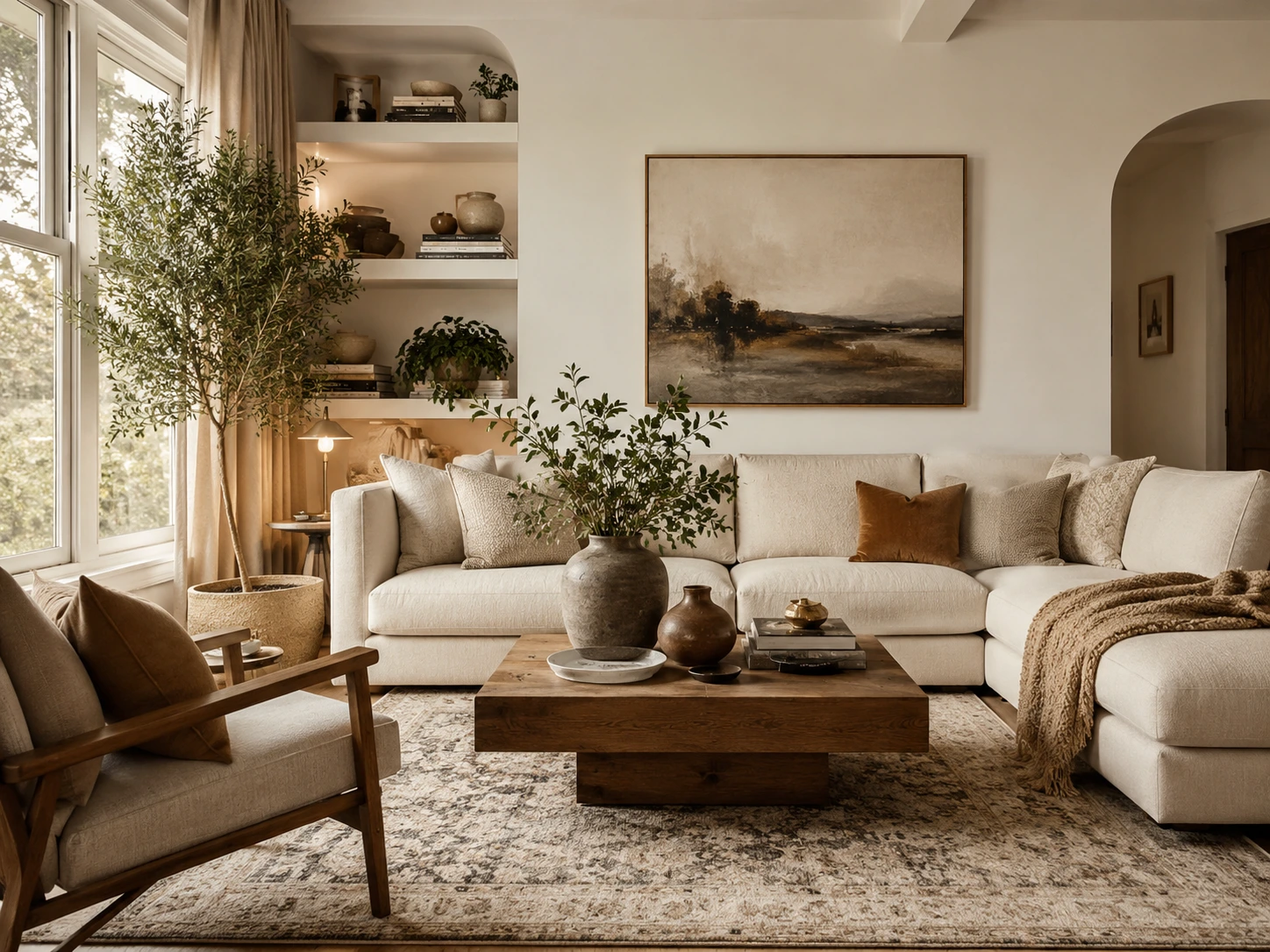
10 living room inspo ideas for a More Collected, Comfortable Home
A living room can have a good sofa, a decent rug, and perfectly nice furniture yet still feel oddly unfinished.
Usually, the problem isn’t that the room needs more decor. It needs stronger relationships between the things already there. The chairs need to encourage conversation. The rug needs to connect the seating. Lighting needs to work after sunset. And at least a few objects should say something about the people who actually live there.
That’s the thinking behind these 10 living room inspo ideas.
Living rooms in 2026 are moving away from rigid matching sets and anonymous neutral rooms. Designers are favoring softer seating, informal layouts, richer color, antiques, mixed furniture, personal collections, and spaces built around how people spend time together.
You don’t need to copy every trend.
Use the ideas that solve something your room is currently missing.
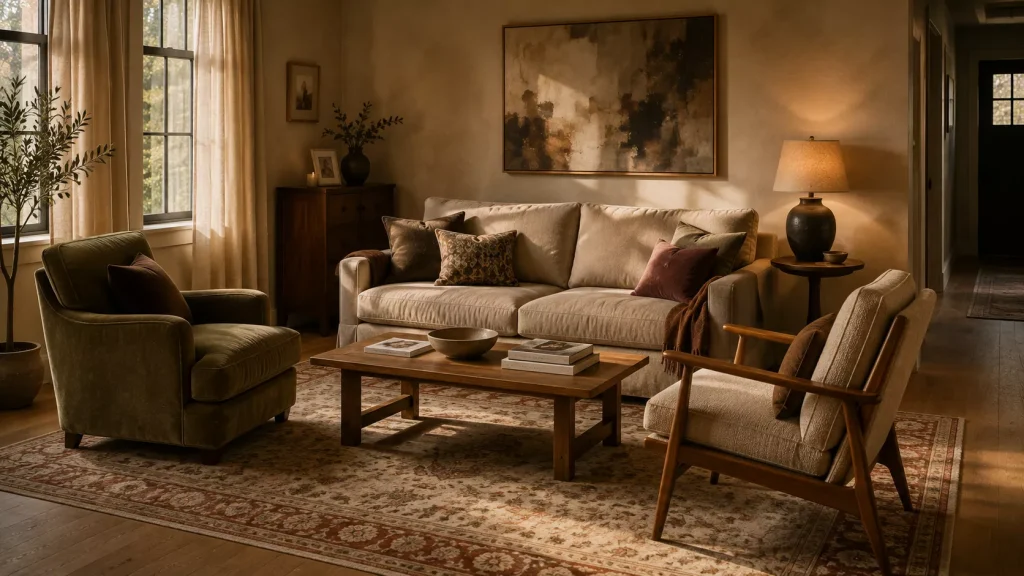
1. Pull the furniture inward and create a real conversation zone
Idea 1: Stop automatically pushing every seat against a wall.
This is the first thing I’d test in almost any living room.
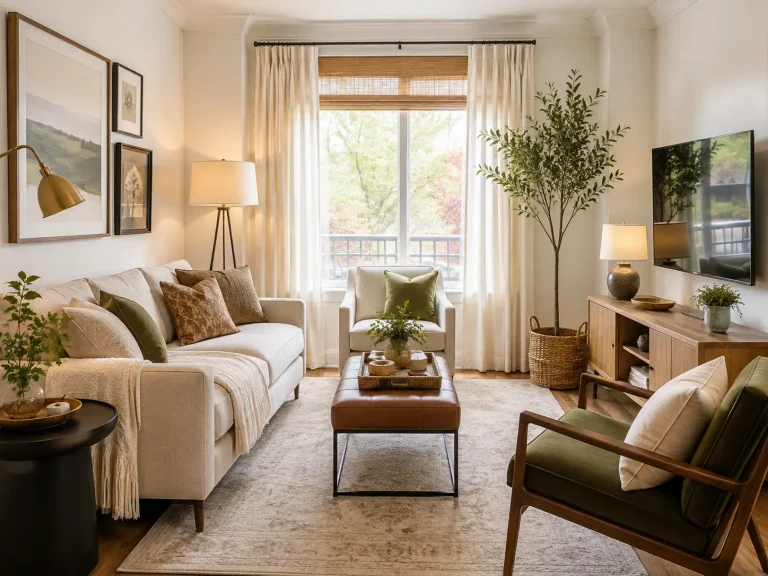
Take a typical 12-by-14-foot room. If the sofa sits against one wall and two chairs are pushed against the opposite corners, people may technically have seating, but the arrangement doesn’t feel connected.
Move the chairs closer.
Angle them slightly toward the sofa.
Give the coffee table a clear relationship with all three seats.
Current living room design is becoming noticeably less formal, with designers prioritizing relaxed furniture arrangements and conversation rather than rigid layouts. House Beautiful recently highlighted a simple one-sofa-and-two-chair arrangement as a reliable way to create balance and encourage conversation.
You don’t need matching chairs either.
One upholstered chair can sit beside a lighter wood-frame chair if they share something, perhaps similar height, color, or fabric warmth.
Check the walking route before deciding
The room still needs an obvious path.
Aim to leave roughly 30 to 36 inches where people regularly walk if the room allows it. Around 16 to 18 inches between the sofa and coffee table often feels comfortable for reaching a drink without squeezing through.
Those aren’t rigid design laws.
Your actual room wins.
The point is to make furniture relate to people first, walls second.
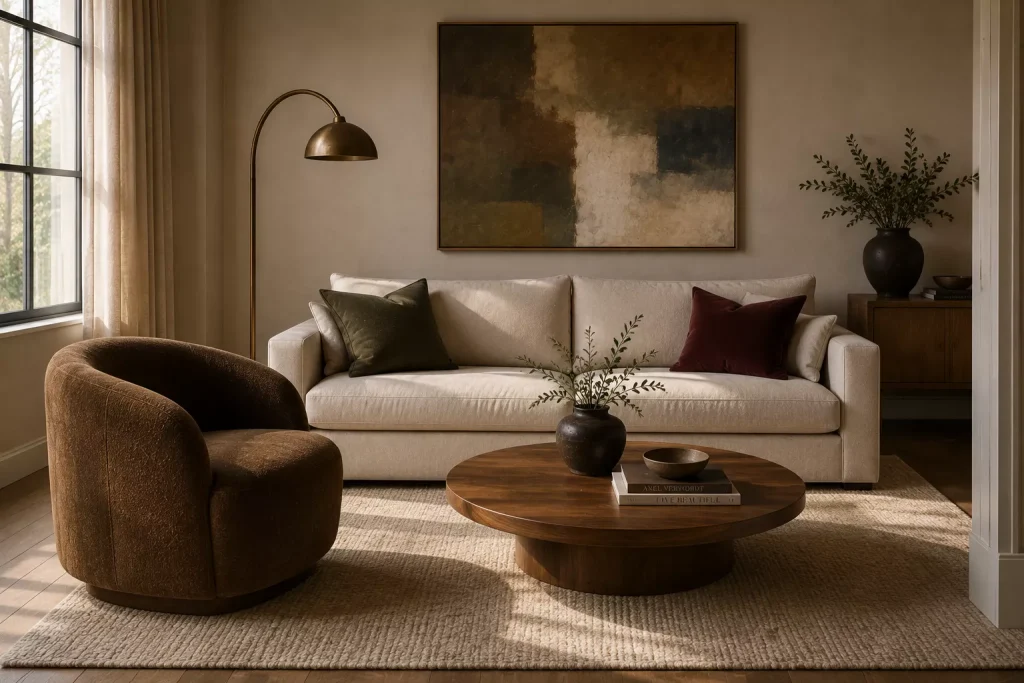
2. Add curves where the room feels too boxy
Idea 2: Introduce one rounded or sculptural shape.
Most living rooms contain rectangles everywhere.
Sofa.
Rug.
Television.
Windows.
Coffee table.
Bookcase.
That’s why one curved piece can change the entire room.
Rounded sofas, overstuffed cushions, organic silhouettes, and sculptural seating remain strong in 2026 because they soften rooms and put comfort ahead of severe straight lines.
You don’t need an expensive curved sofa.
Try a round coffee table.
Choose a barrel chair.
Use an oval mirror.
Add a softly curved floor lamp or scalloped side table.
If you’re shopping for furniture anyway, this is where I’d spend rather than buying several little decorative accessories.
A $200 secondhand rounded chair can alter the silhouette of the whole room.
Six $35 decorative objects rarely can.
And don’t force curves into everything.
One or two softened shapes work because the room still has straight lines to contrast with them.
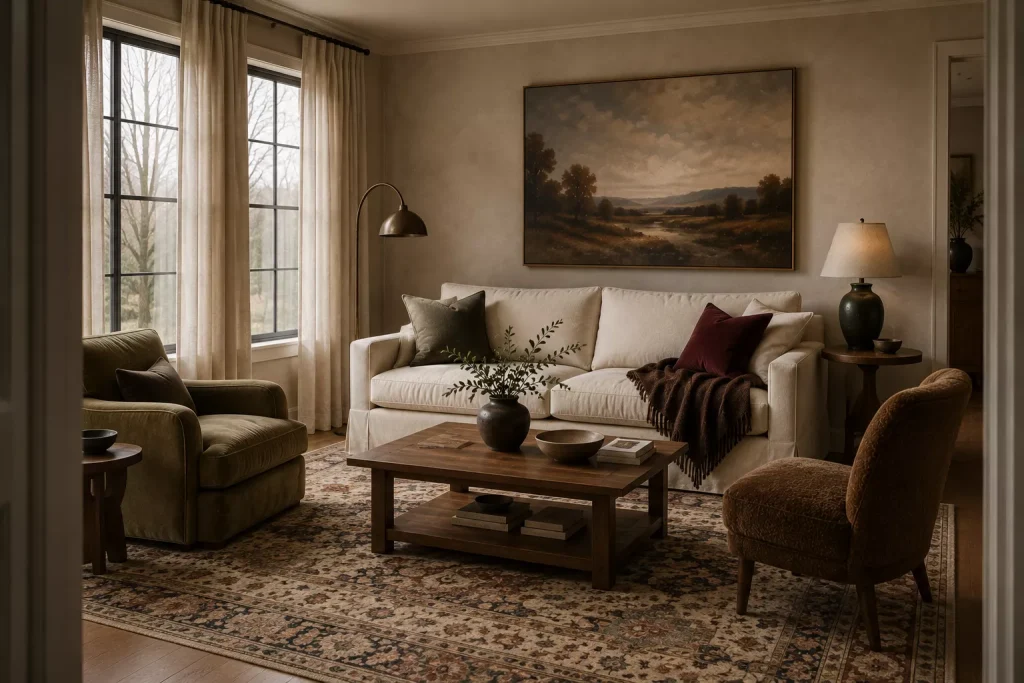
3. Replace cold gray with a warmer, more complicated neutral
Idea 3: Let your neutral have an undertone.
The flat cool-gray living room has lost much of its momentum.
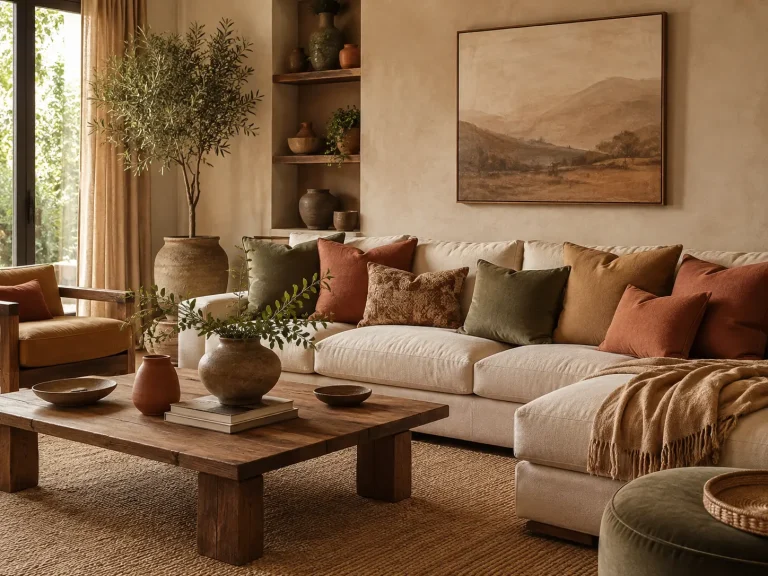
Designers in 2026 are shifting toward warmer earth tones, honeyed neutrals, muted greens, deeper blues, terracotta, and colors that behave like neutrals without feeling sterile.
That doesn’t mean beige everything.
Try mushroom instead of gray.
Use tobacco brown beside cream.
Choose putty walls with olive upholstery.
Pair dusty blue with walnut and burgundy.
Even a mostly white room can work if the white feels soft and the materials provide enough texture. Recent interiors show that pale rooms can remain calm without feeling empty when brick, timber, linen, ceramics, and tactile fabrics add depth.
Try this if repainting isn’t realistic
Renters can make the same shift through larger movable surfaces.
Change two cushion covers.
Bring in a warm rug.
Add walnut or medium-oak furniture.
Use a tobacco-colored throw.
Replace a cool silver lamp with dark ceramic or aged metal.
Your wall color is only one part of the palette.
I’d rather see a gray rental with thoughtful brown, olive, and cream layers than gray walls covered with temporary decor trying to hide them.
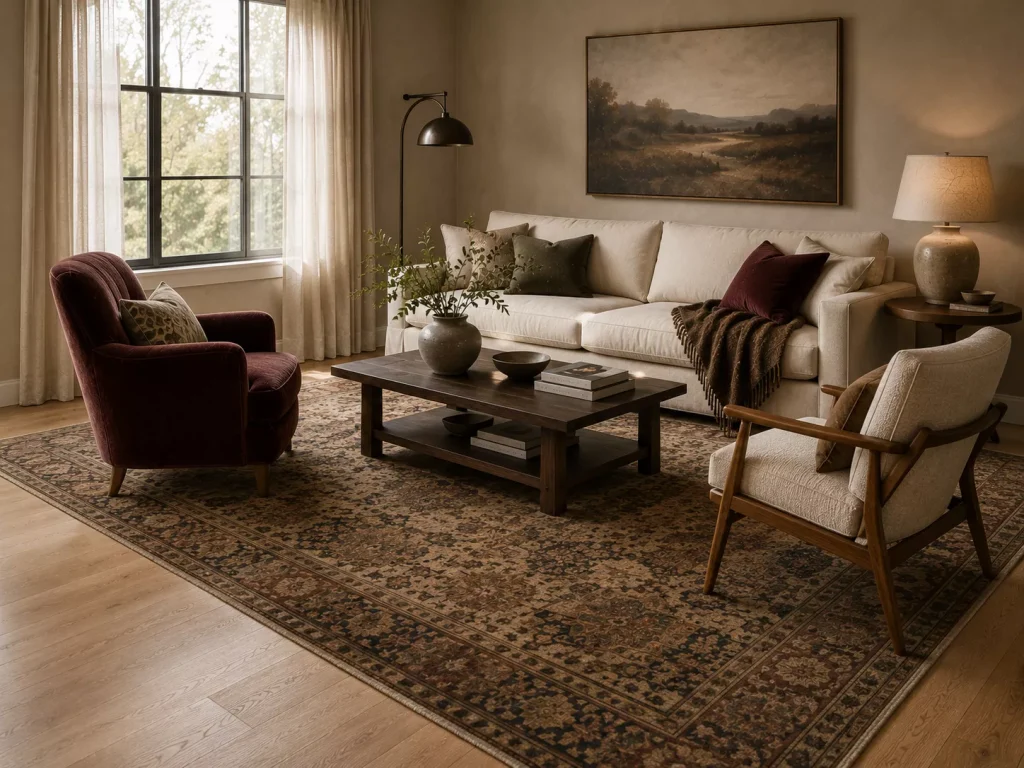
4. Make the rug large enough to organize the furniture
Idea 4: Treat the rug as the foundation, not an accessory.
A rug that floats beneath only the coffee table can make an otherwise generous room feel chopped into pieces.
For many medium living rooms, an 8-by-10-foot rug works far better than a 5-by-7 because the front legs of the sofa and chairs can actually sit on it.
Larger rooms may need 9 by 12 feet or more.
Measure before shopping.
The right size depends on furniture placement, not the dimensions printed on a generic rug chart.
For color, faded rust, brown, olive, tobacco, deep blue, burgundy, and warm cream are easy to work with.
A vintage-style rug is especially useful if the rest of the furniture is simple.
Here’s how I’d choose:
| Rug style | What it adds | Watch out for |
|---|---|---|
| Faded vintage pattern | Color and collected character | Can fight busy upholstery |
| Warm solid wool | Texture and visual calm | Usually costs more |
| Washable low pile | Easier with children or pets | Often feels thinner |
| Geometric flat weave | Structure for soft furniture | Needs a good rug pad |
| Natural fiber | Warm texture | Can feel rough underfoot |
One properly sized rug can make mismatched furniture suddenly feel like one room.
That’s why I’d fix the floor before adding more objects to the shelves.
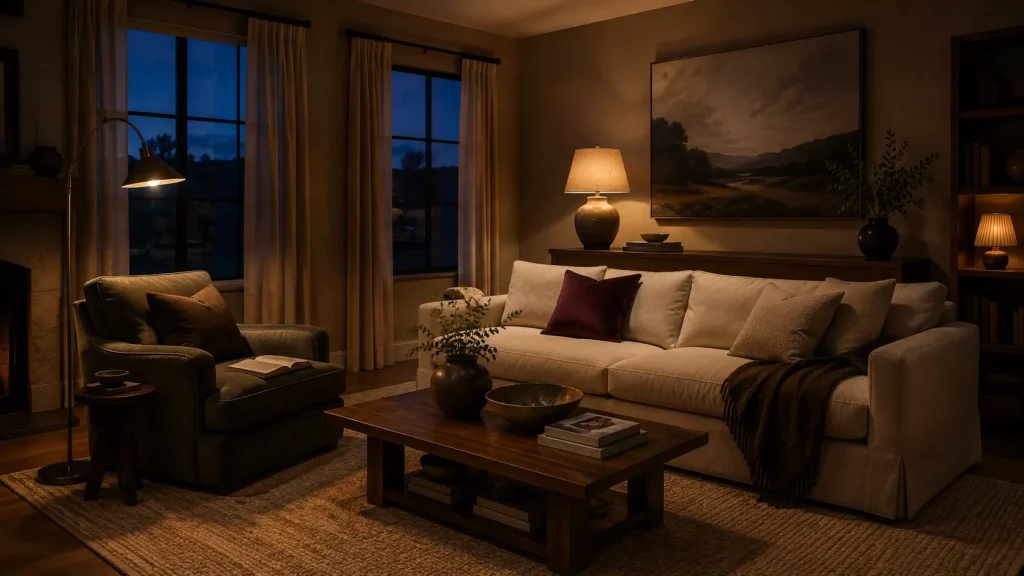
5. Use lighting to make the room work after sunset
Idea 5: Build several small pools of light.
Overhead lighting is useful.
It just shouldn’t have to do everything.
Current design advice continues moving toward layered ambient light and sculptural lamps because softer sources make living rooms feel more welcoming and dimensional.
Try a floor lamp beside the sofa.
Put a smaller table lamp on a console.
Add another near the reading chair.
Three modest lights usually create more atmosphere than one intensely bright ceiling fixture.
And vary their heights.
If every lamp sits at exactly 24 inches, the room can still feel visually flat.
A floor lamp brings height. A table lamp creates a middle layer. A tiny bookcase lamp can warm a dark corner.
One of my pet peeves is a beautiful living room where nobody can comfortably read.
Atmosphere shouldn’t make the room less functional.
Choose enough light for the activities that actually happen there.
6. Mix furniture instead of buying another matching set
Idea 6: Let the room look assembled over time.
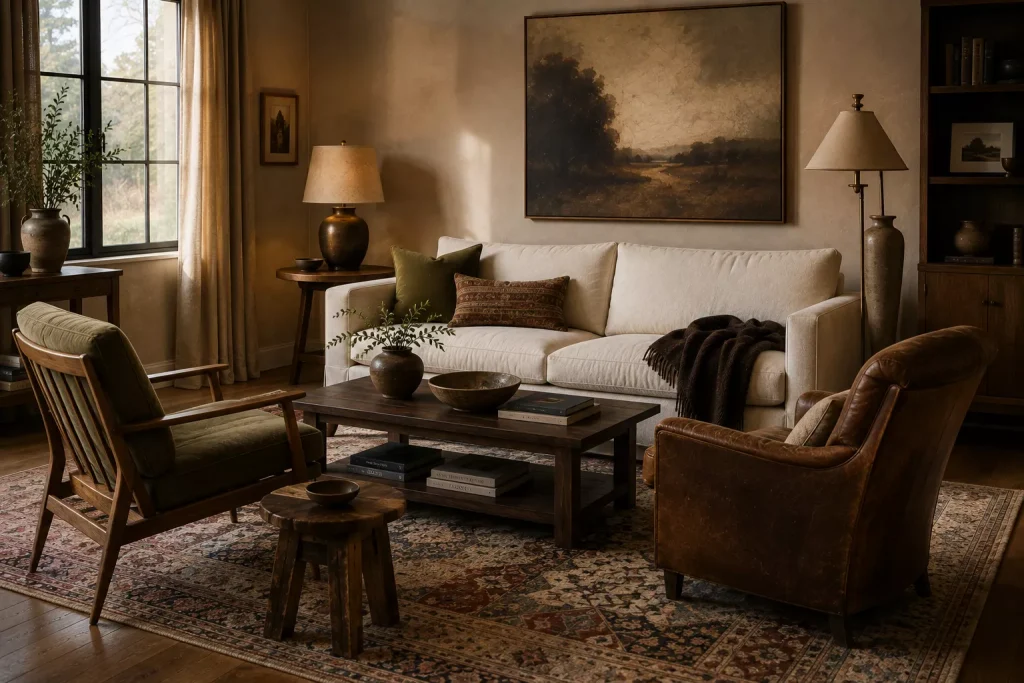
One of the clearest directions in 2026 living rooms is movement away from perfectly matched furniture toward mixed pieces, layered antiques, and more individual combinations.
That’s good news if you’re decorating gradually.
Your coffee table doesn’t have to match the side tables.
Your armchairs don’t have to come from the sofa collection.
Your media cabinet can be older than everything else.
The trick is finding connections.
Perhaps two pieces share walnut tones.
Maybe the sofa and chair repeat a dusty red.
Perhaps several furniture legs have similar visual weight.
This is also where secondhand shopping becomes useful.
A vintage wood side table may cost less than a new mass-market piece and bring much more character.
Current design coverage also points toward renewed interest in vintage, handcrafted, and mid-century pieces, with natural wood and expressive shapes being folded into contemporary rooms rather than treated as complete period styles.
That last part matters.
You’re not building a museum.
You’re mixing enough periods to make the room feel personal.
7. Turn storage into part of the architecture
Idea 7: Use bookshelves for more than displaying objects.
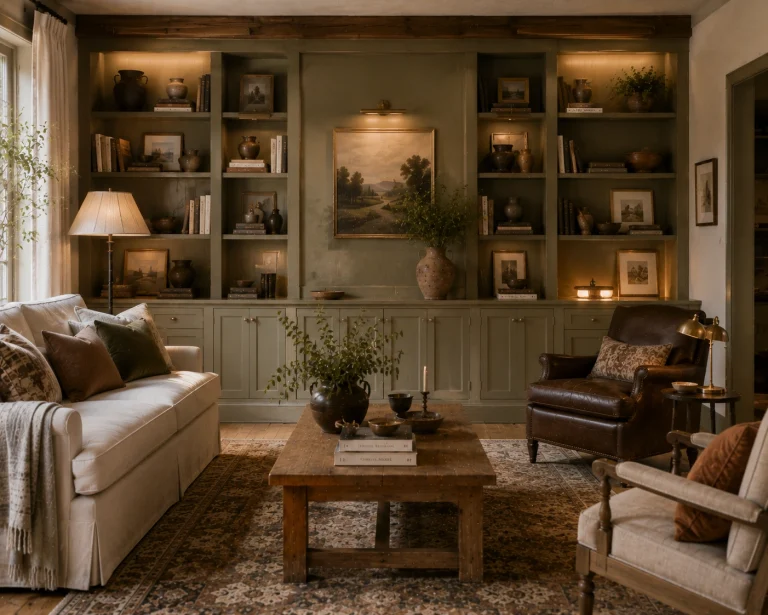
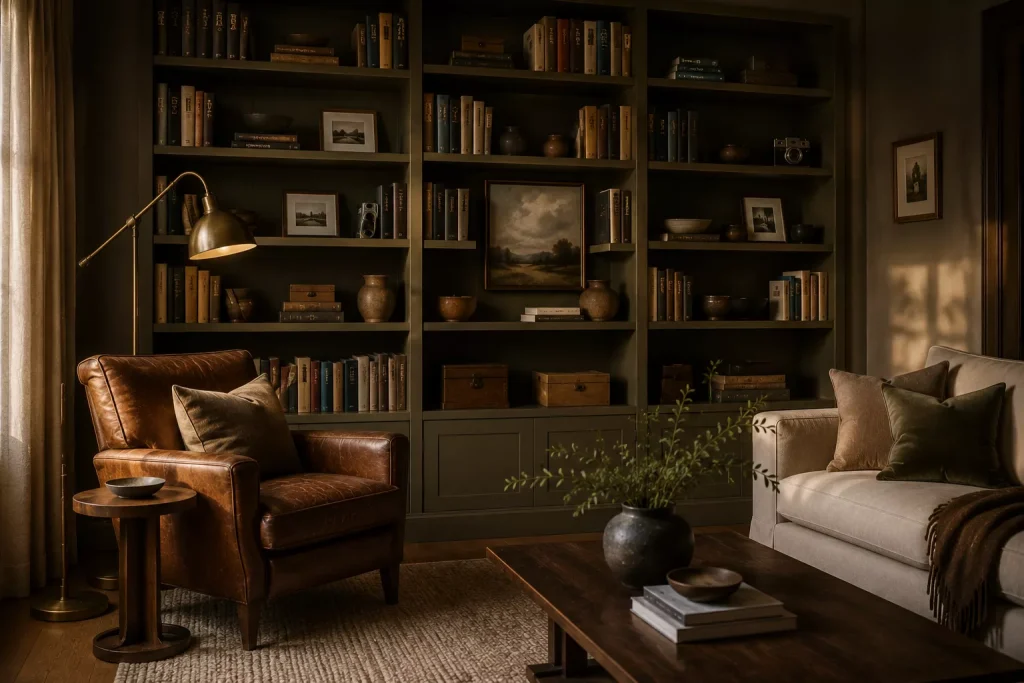
One interesting 2026 living-room direction is what designers are calling “book drenching,” using substantial shelving around a room so books become both storage and visual texture.
You don’t need floor-to-ceiling custom cabinetry.
A pair of tall bookcases can create a similar effect.
Paint existing shelving the wall color for a built-in feeling.
Or go the opposite direction and paint cabinetry in aubergine, deep green, dusty blue, or brown.
Then put real books on it.
Not books selected because their spines match the rug.
Add framed photographs, ceramics, small paintings, boxes, and objects connected to actual interests.
2026 interiors are leaning strongly toward personal storytelling and away from generic decor that could belong to anybody.
And leave some shelves partially empty.
Bookcases need rhythm.
A shelf filled edge to edge with tiny objects becomes visual static remarkably fast.
8. Make one seating area useful for something besides television
Idea 8: Give the living room a second reason to exist.
Living rooms are becoming more activity-focused.
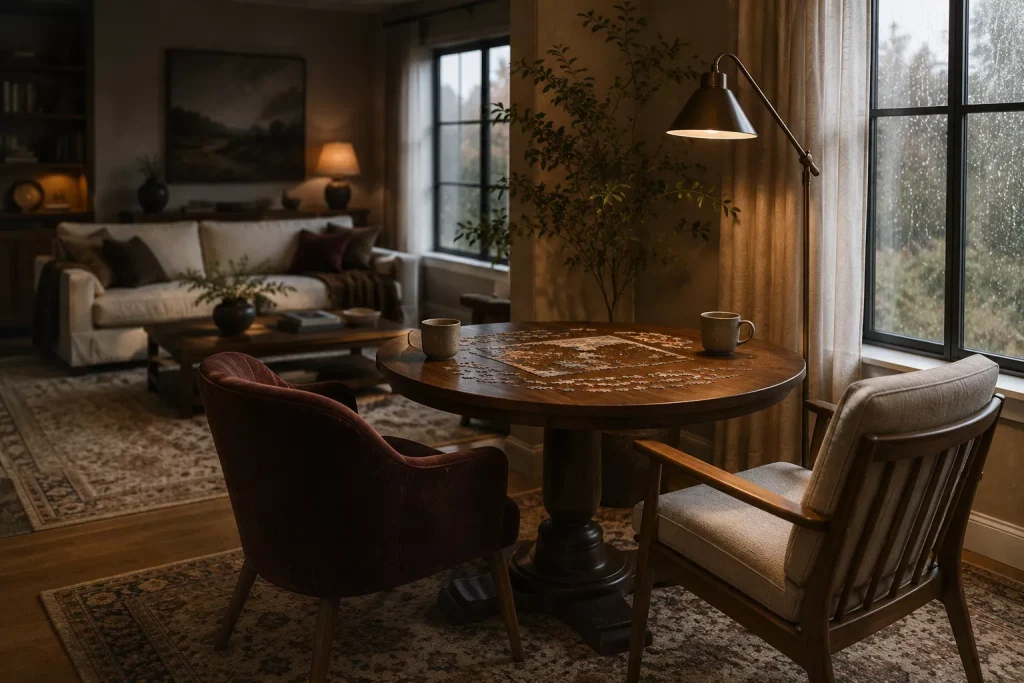
Game tables, reading areas, daybeds, and flexible seating are appearing because people want these rooms to support actual shared activities rather than functioning purely as a television-facing setup.
If you have an unused corner, ask what would make you spend time there.
Maybe it needs a reading chair and lamp.
Perhaps a 30-inch round table could become a puzzle or card table.
A daybed might work under a window in a long room.
Even two chairs turned slightly toward one another can create a place for conversation that doesn’t involve the screen.
This is one of those “everyone says buy more decor, but actually change the room’s job” moments.
A useful zone gives a room personality because people leave traces of real life there.
A book.
A deck of cards.
A half-finished puzzle.
That usually looks more convincing than a carefully styled tray nobody touches.
9. Put personal art ahead of generic wall decor
Idea 9: Let the walls tell a specific story.
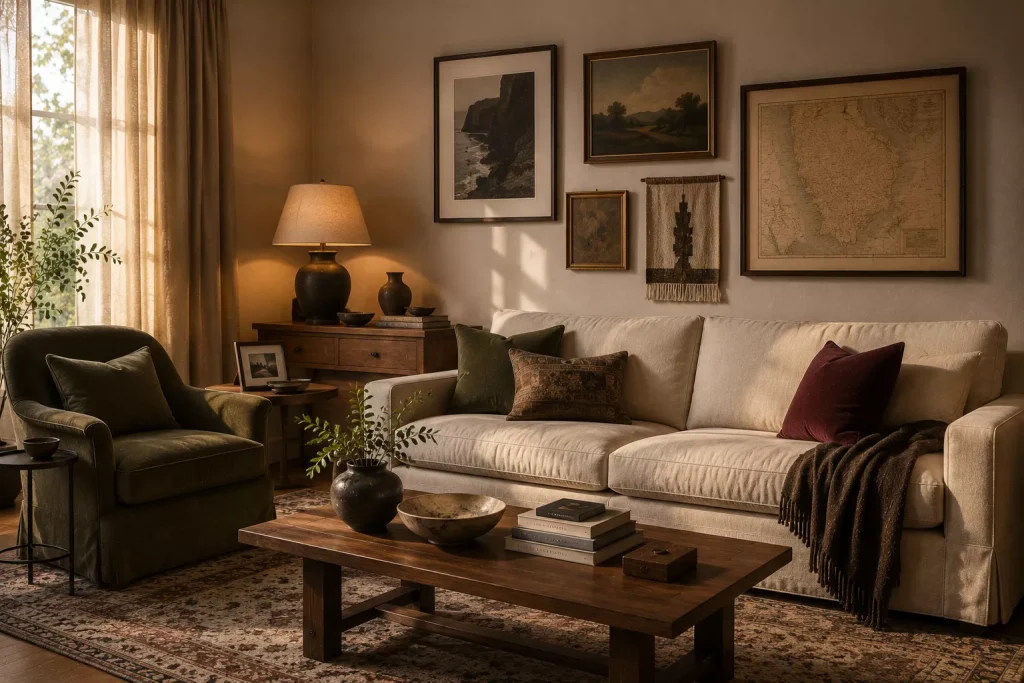
Mass-produced word art and anonymous decorative sets are increasingly being pushed aside in favor of family photographs, personal artwork, vintage maps, travel finds, and pieces with some connection to the owner.
This doesn’t mean your walls need expensive original paintings.
Frame a photograph you took.
Find an old map of a city that matters to you.
Use a child’s drawing in a surprisingly good wood frame.
Hang a textile.
Buy a secondhand landscape because you genuinely like it.
For a gallery wall, mix sizes but establish one common element, perhaps dark wood frames, cream mats, or several pieces with warm colors.
For a quieter room, one oversized artwork may be enough.
A common mistake is hanging artwork too high.
Use the furniture as your reference.
Over a sofa, leaving roughly 6 to 10 inches between the top of the sofa and the bottom of the artwork often helps the two feel connected.
The wall shouldn’t look like it’s floating away from the room.
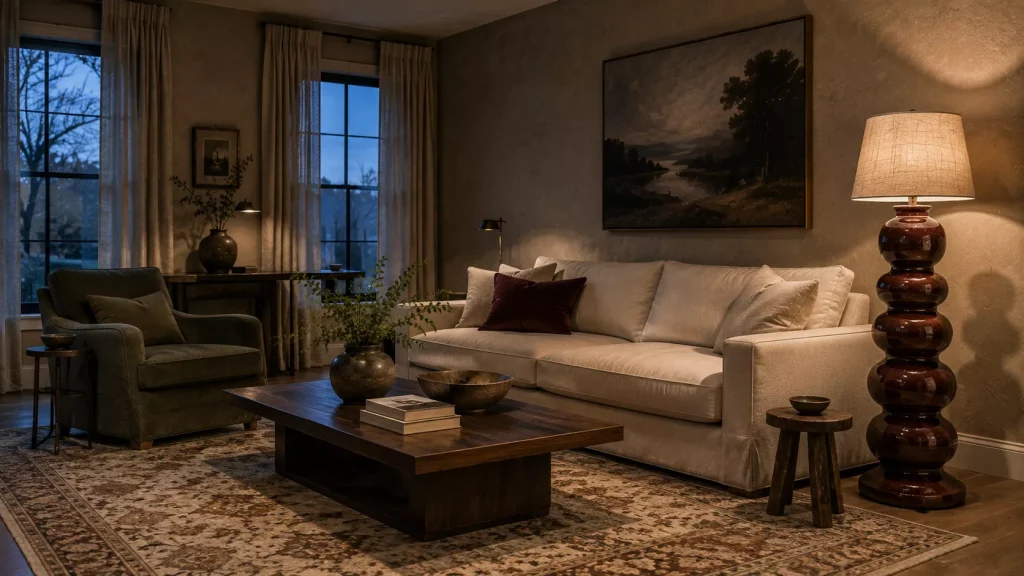
10. Add one thing that is slightly strange
Idea 10: Give the room an object people remember.
This is the part most generic living-room advice misses.
A polished room can still be forgettable.
2026 design is becoming more expressive, with sculptural forms, craftsmanship, ornament, rich material, and personal eccentricity replacing some of the blank restraint of recent years.
So add one piece that doesn’t feel entirely predictable.
A ceramic lamp shaped almost like sculpture.
A burgundy chair in a pale room.
An oversized painted screen.
A strange vintage portrait.
A tiled coffee table, another emerging living-room detail for 2026.
Or a rattan chair beside otherwise tailored furniture.
The object should still earn its space.
Interesting isn’t the same as impractical.
If you live in 700 square feet, an enormous sculptural chair nobody enjoys sitting in isn’t personality.
It’s an obstacle.
Choose something useful enough to stay and unusual enough that you’d miss it if it disappeared.
What should you skip when refreshing a living room?
Skip matching furniture sets first.
They solve the problem of coordination, but they can also remove the contrast that makes a room feel collected. Current designers are leaning away from showroom-style matching toward individual combinations of old, new, patterned, and sculptural pieces.
I’d also skip generic word signs, fake decorative books, filler bead strands, and artificial greenery bought simply because a shelf looked empty. Designers have specifically called out those kinds of impersonal filler objects as overdone in 2026.
Don’t rush to replace every cool-gray item either.
A gray sofa can still work.
Warm the room around it with brown wood, rust, olive, cream, artwork, and better light.
Finally, skip decorating before fixing the layout.
A badly placed sofa with beautiful cushions is still badly placed.
Solve where people sit, walk, read, talk, and put down a drink first.
Then decorate.
FAQ About Living Room Inspiration
What living room styles are popular in 2026?
The strongest direction is less about one fixed style and more about personality. Designers are using richer color, curved seating, antiques, mismatched furniture, tactile fabrics, personal collections, and more informal layouts.
How can I make my living room look better without buying new furniture?
Rework the layout first. Pull seating closer together, improve the lighting, reposition art, remove filler accessories, and make sure your rug connects the main furniture. These changes can alter the room without replacing its expensive pieces.
How do I make a small living room feel more interesting?
Use fewer pieces with stronger shapes. One curved chair, a properly scaled rug, one large artwork, and layered lighting can give a small room more character than many little decorations.
How can I make a living room feel more personal?
Display objects connected to your life rather than buying decor purely to fill shelves. Books you read, photographs, collected ceramics, travel finds, inherited furniture, and art you genuinely like create a room that cannot be easily copied.
Make the room work before making it impressive
The most useful 10 living room inspo ideas don’t start with shopping.
They start with noticing.
Where does everyone naturally sit?
Which chair never gets used?
Does the room feel flat after sunset?
Is the rug connecting the furniture or floating beneath it?
Does anything in the room actually tell a visitor who lives there?
Answer those questions before adding another decorative object.
Move the chairs closer. Add one lamp. Bring in a deeper wood piece. Hang art you care about. Then choose one unexpected object that makes the room a little less predictable.
A good living room doesn’t need to look like anybody else’s inspiration photo.
Eventually, it should become the room someone else wants to save as inspiration.