40 Front Porch Halloween Ideas for a Spooky, Stylish and Unforgettable Entrance
The best Halloween porches are not necessarily the ones with the most decorations. They are the ones where you understand the mood before you have counted a single pumpkin, skeleton, or spider.
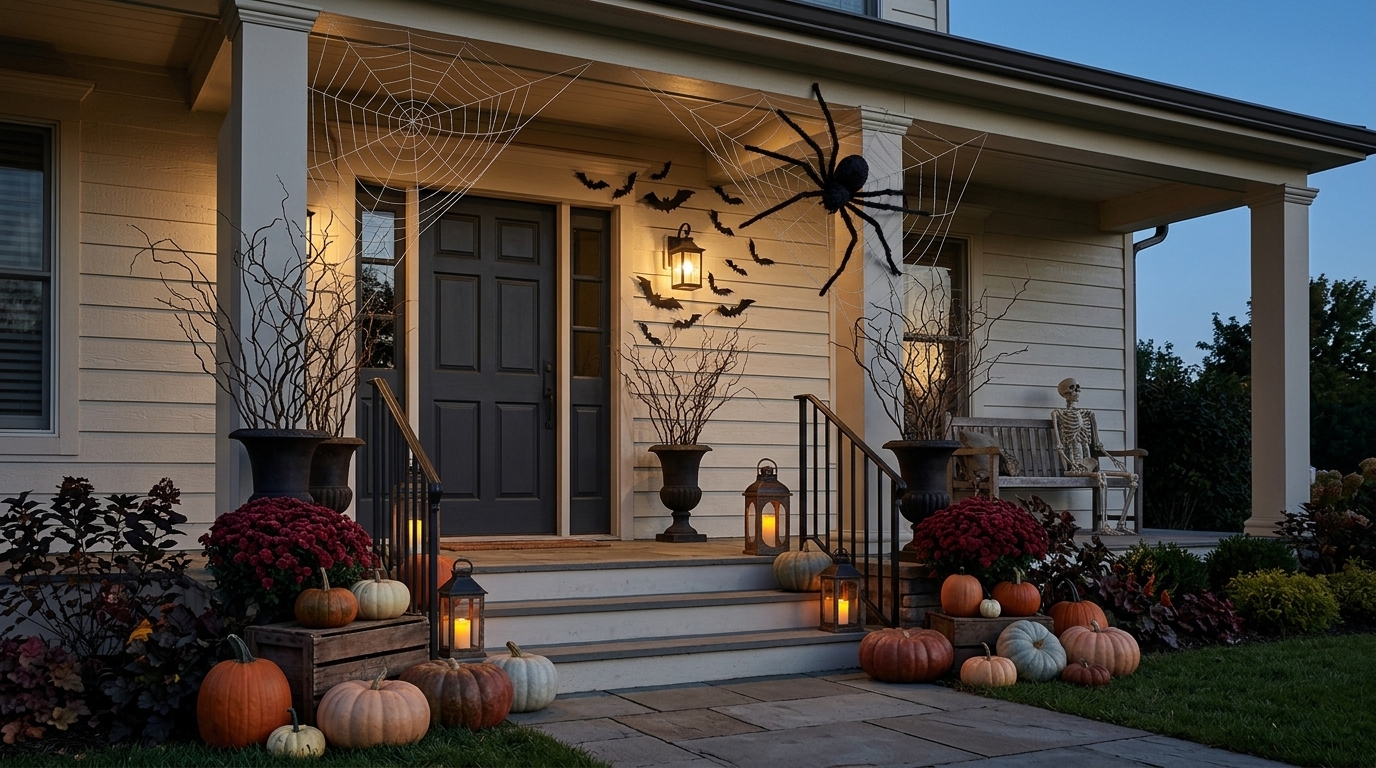
A dark Victorian-inspired entrance might rely on blackened branches, burgundy foliage, aged lanterns, and one enormous spider. A playful family porch can use friendly ghosts, smiling jack-o’-lanterns, colorful witch hats, and warm lights. A modern home may need little more than sculptural pumpkins, a sweep of black bats, and carefully placed lighting.
That range is important. Current 2026 Halloween coverage is moving in several directions at once, from sophisticated outdoor styling to dramatic Gothic doorscaping, oversized arachnids, enchanted themes, skeleton scenes, and accessible DIY decorations.
These front porch Halloween ideas are therefore not just a list of objects. They are organized around composition, mood, architecture, how the porch will look good after dark, and how to create impact without making the front entrance difficult to use.
Start with the composition, not the decorations
1. Build a fall foundation that Halloween can borrow
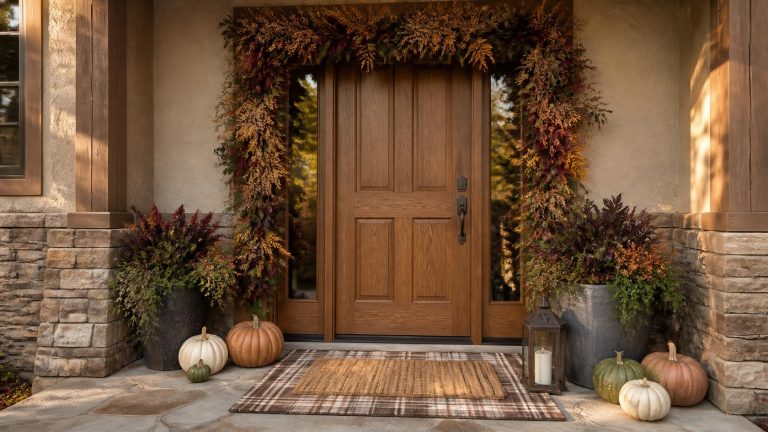
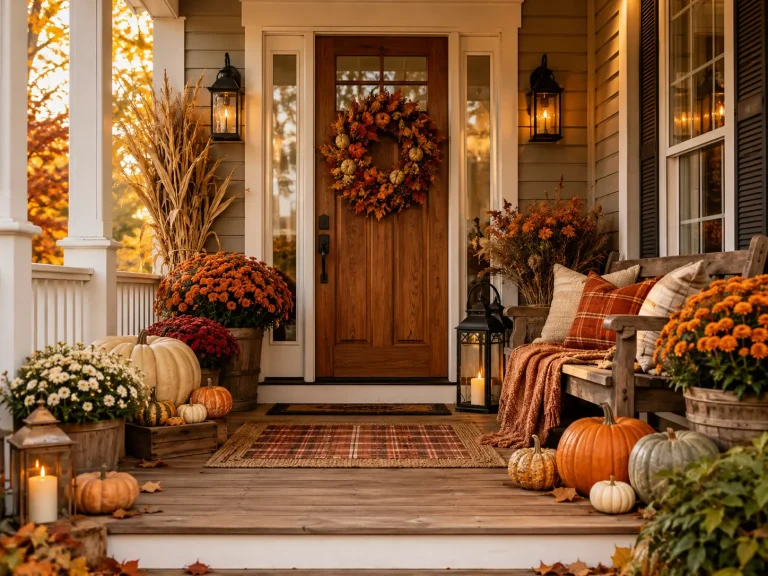
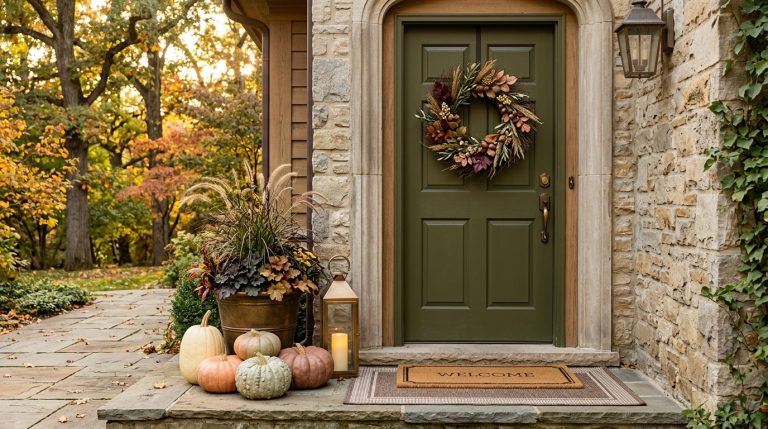
One of the smartest approaches is to decorate for autumn first.
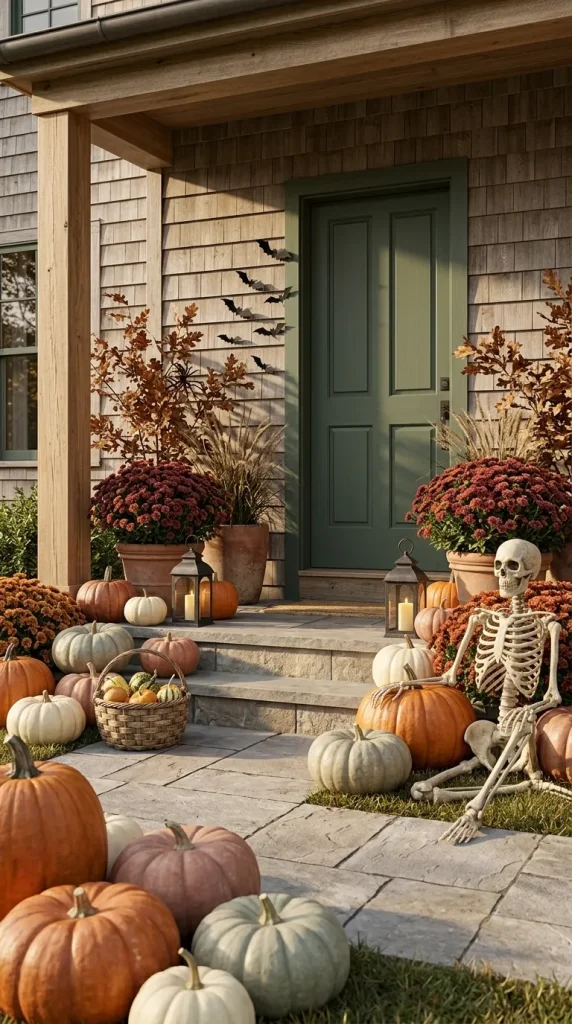
Start with whole pumpkins, planters, mums or seasonal foliage, baskets, lanterns, dried branches, and other pieces that can remain outside for several weeks. Then introduce Halloween through smaller, removable layers such as bats, skeletons, spiders, witch hats, ghosts, or black accents.
The advantage is not only financial. A fall base gives the Halloween decorations something natural to sit against. A skeleton beside a mums and pumpkins grouping looks more integrated than the same skeleton standing alone on an empty porch.
It also makes the transition after October 31 much easier. Current 2026 fall coverage increasingly emphasizes seasonal planting and natural materials that survive beyond one short holiday display.

2. Decide how scary you actually want the porch to be
“Spooky” is not one aesthetic.
A mildly eerie porch might use bare branches, low amber lighting, black lanterns, dark foliage, and silhouettes.
A stronger version could introduce ravens, webs, skeletons, ghost figures, or an oversized spider.
A theatrical haunted-house entrance might use a doorway installation, multiple skeletons, dramatic uplighting, oversized webs, dense branches, and a much darker palette.
Choose the level first. Otherwise, it is easy to start with an elegant black-and-cream entrance and gradually cover it with so many unrelated props that the original concept disappears.
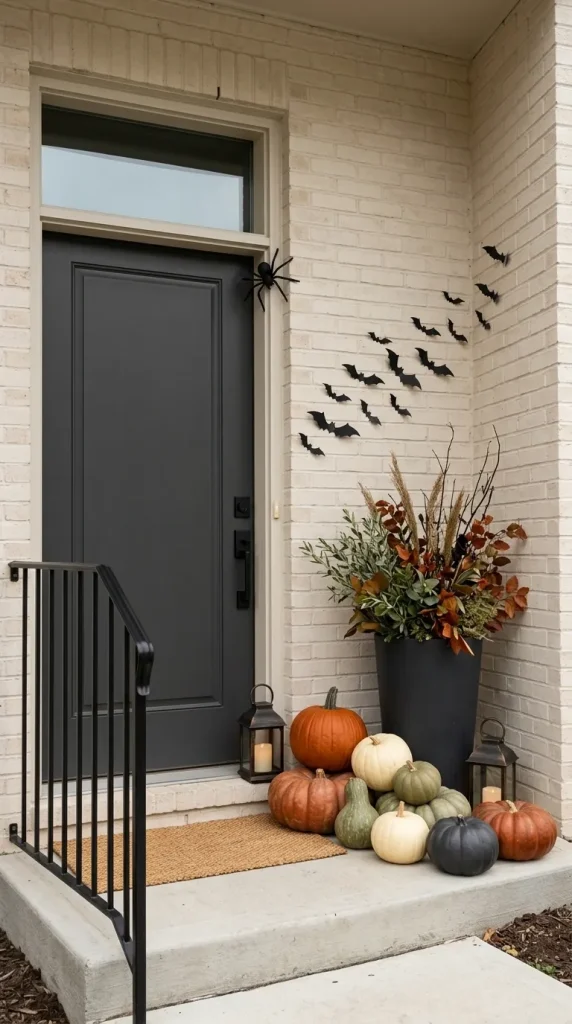
3. Choose a controlled Halloween color palette
Color is one of the fastest ways to make inexpensive decorations look more deliberate.
You do not have to use every traditional Halloween shade.
Try one of these directions:
| Mood | Useful palette |
|---|---|
| Classic Halloween | Orange, black, warm cream |
| Elegant | Black, ivory, muted orange, purple, green, cream |
| Subtle fall-Halloween | Rust, cream, olive, charcoal |
The principle is similar to designing an interior. Repetition gives unrelated objects a visual relationship.
If your black spider, black lantern, black bats, and black planter appear in separate parts of the porch, that repeated dark note links them together.

4. Give the porch one unmistakable focal point
Halloween decor becomes chaotic when every object asks for equal attention.
Choose the feature that should register first from the sidewalk. It could be:
- A giant spider
- A doorway arch
- A seated skeleton
- An illuminated ghost
- A dense pumpkin arrangement
- A dramatic wreath
- A swarm of bats
Everything else should reinforce that feature rather than compete with it.
If the giant spider is the star, the pumpkins and lanterns can remain comparatively quiet. If you have built an elaborate doorway arch, a second equally elaborate installation on the porch railing will usually weaken the composition rather than strengthen it.
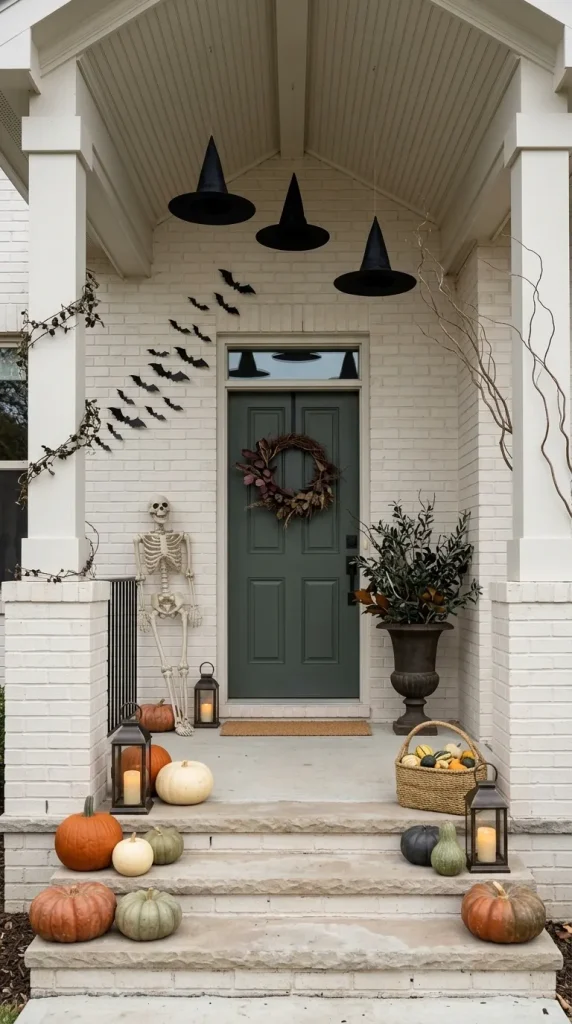
5. Use a high-middle-low layering system
Give the porch visual layers instead of one flat row of objects.
Upper level: garland, hanging hats, bats, branches.
Middle level: wreath, planters, skeleton, column decoration.
Ground level: pumpkins, lanterns, baskets, low props.
This high-middle-low hierarchy is especially useful on porches where many objects otherwise end up clustered around people’s feet.
It also keeps the front door visually important. The decorations should pull your eye toward the entrance rather than form an unrelated pile beside it.
Create a porch that feels genuinely spooky
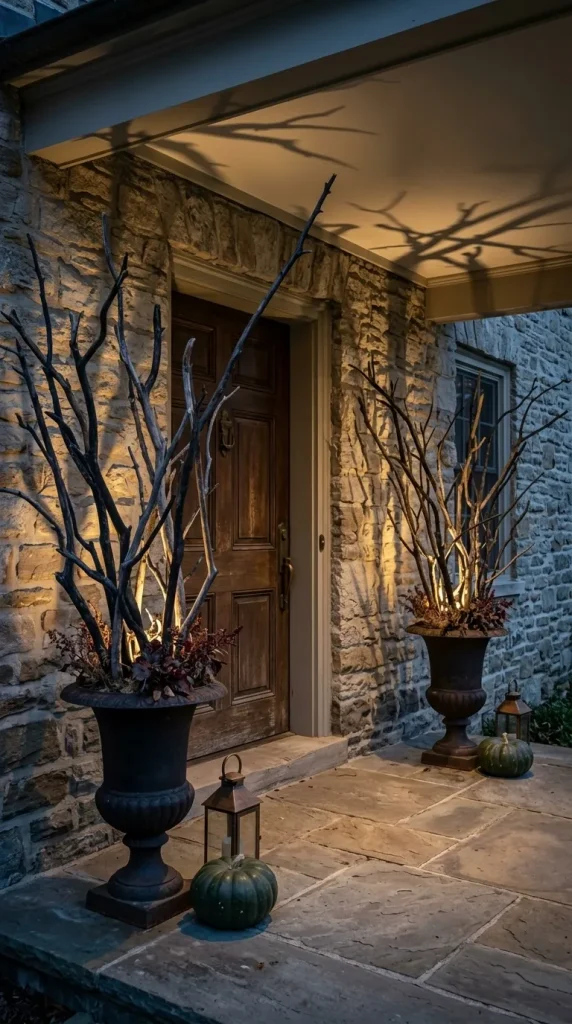
6. Use bare branches and shadows for a quieter scare
You do not need monsters to make an entrance unsettling.
Fill a pair of tall urns with bare or nearly bare branches. Add subtle uplighting from below so their shadows fall across the wall or ceiling.
During the day, the arrangement reads as sculptural fall decor. At night, the exaggerated branch shadows create the eerie part.
Black, very dark brown, or naturally weathered branches work well. Avoid adding too many small ornaments. The silhouette is the decoration.
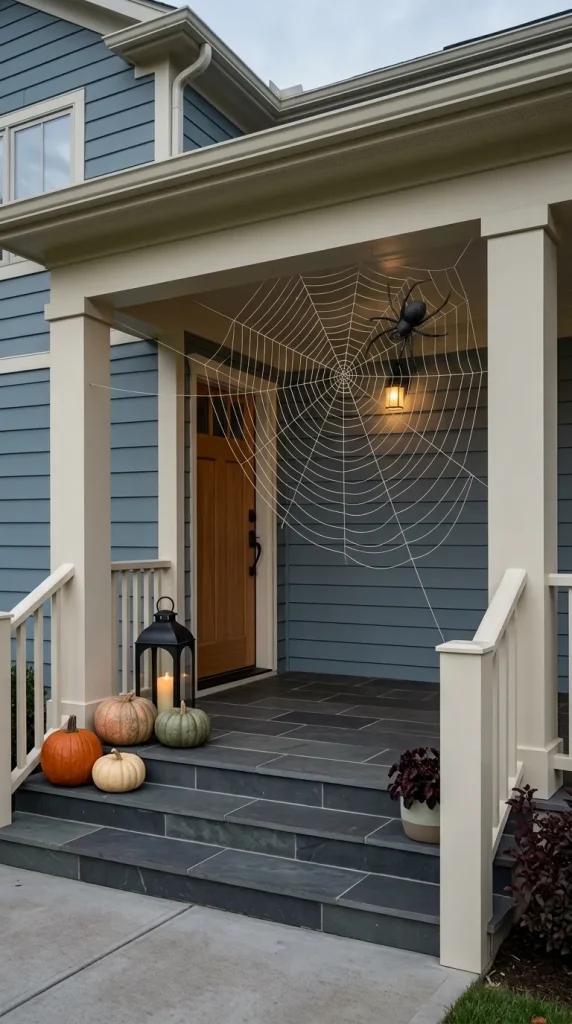
7. Stretch a spiderweb across an architectural feature
Spider webbing becomes much more convincing when it has a believable place to span.
Use porch columns, the corner of a covered entry, a railing, or the space above a door as the framework.
Rather than pulling wispy webbing over every shrub and planter, create one large composition.
Scale changes the effect. One broad web stretched between two substantial porch columns reads as a deliberate installation. Dozens of tiny strands scattered across unrelated surfaces often read as clutter.
Keep handrails, door hardware, and walking routes free.
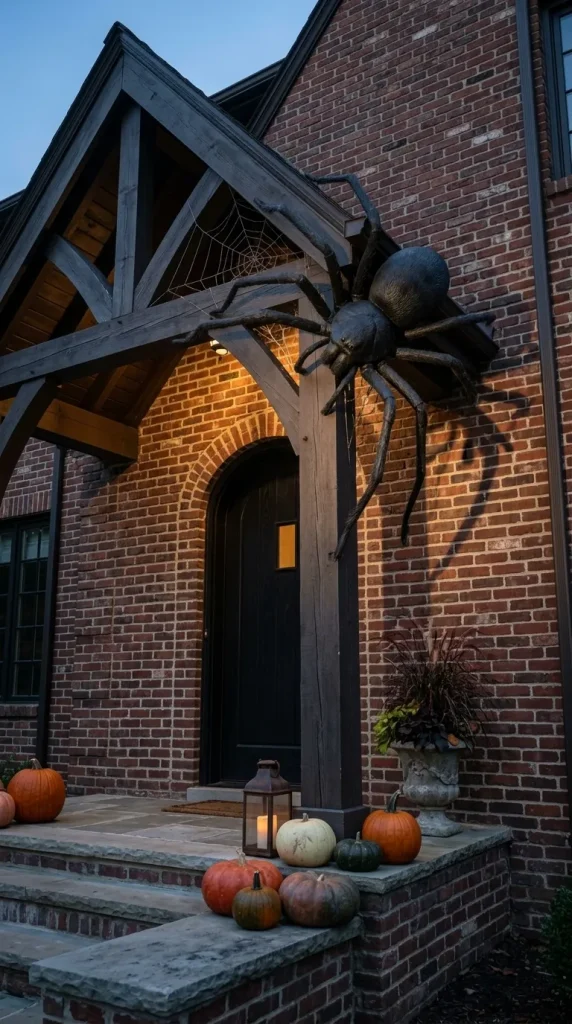
8. Let one giant spider dominate the scene
If you are buying or making an oversized Halloween piece, a giant spider is one of the strongest options because its shape can respond to the architecture.
Place it over a doorway, crawl it down a column, or position it where a large web meets the porch roof.
Current 2026 Halloween coverage continues to feature giant arachnids as part of theatrical outdoor schemes, including highly visible focal installations.
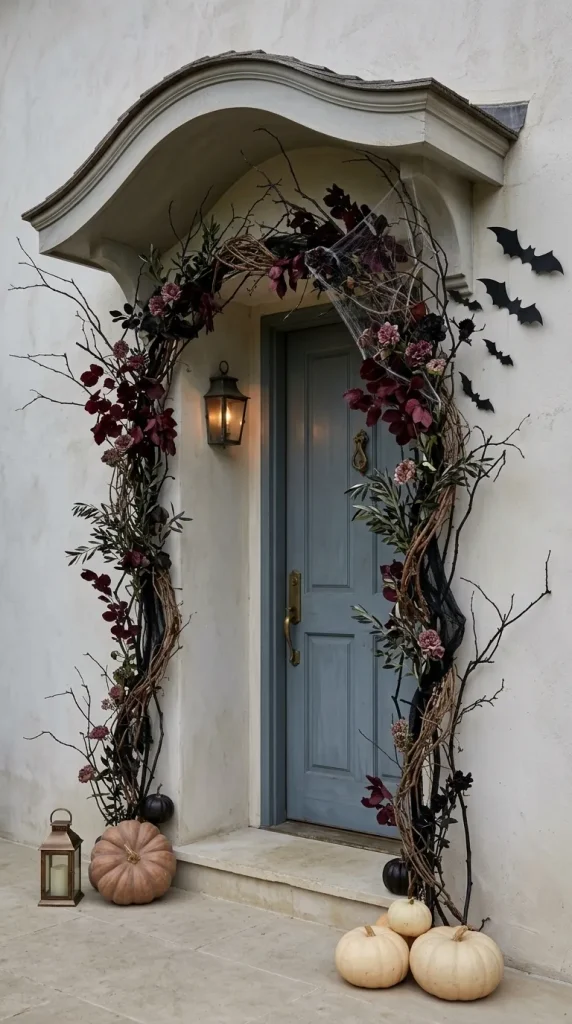
9. Frame the door with a Halloween arch
An arch can completely change an entrance because it outlines the architectural opening itself.
Possible materials include:
- Black branches
- Dark faux vines
- Grapevine
- Muted foliage
- Bats
- Pumpkins
- Webbing
- Black fabric
- Weather-resistant artificial flowers
For a sophisticated version, keep the arch relatively narrow and irregular, using branches and deep burgundy foliage.
For a haunted-house version, let the material become denser around the top corners and add webs or creatures.
Avoid making the installation so thick that it narrows the actual doorway or catches on people entering the house.
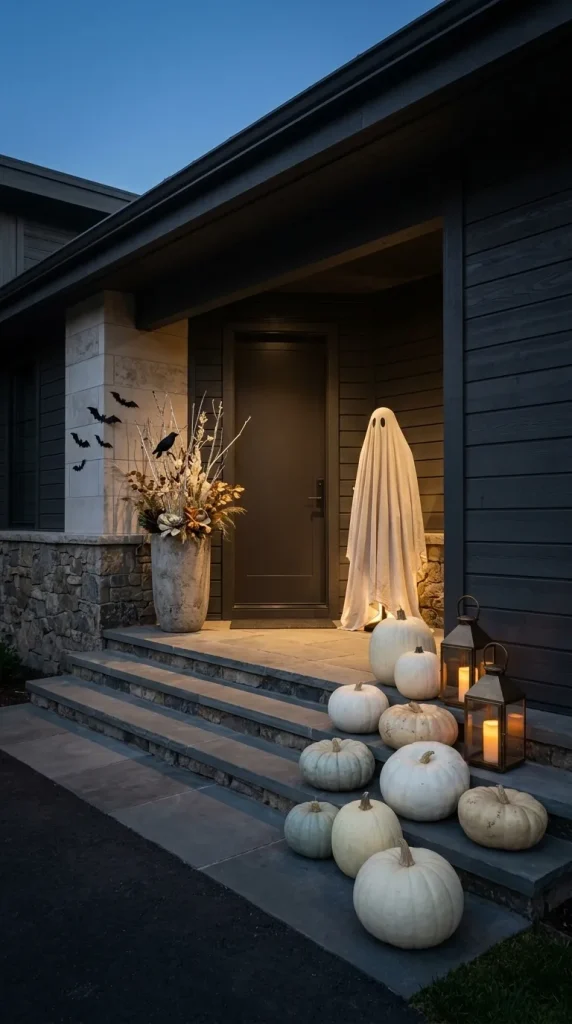
10. Use darkness selectively instead of making everything black
A dark Halloween porch needs contrast.
If the door, siding, props, planters, and furniture are all black, individual shapes disappear after sunset.
Against a dark background, introduce pale pumpkins, white ghosts, parchment-toned branches, or amber light.
Against pale siding, black becomes far more effective on its own.
Turn skeletons into a real scene
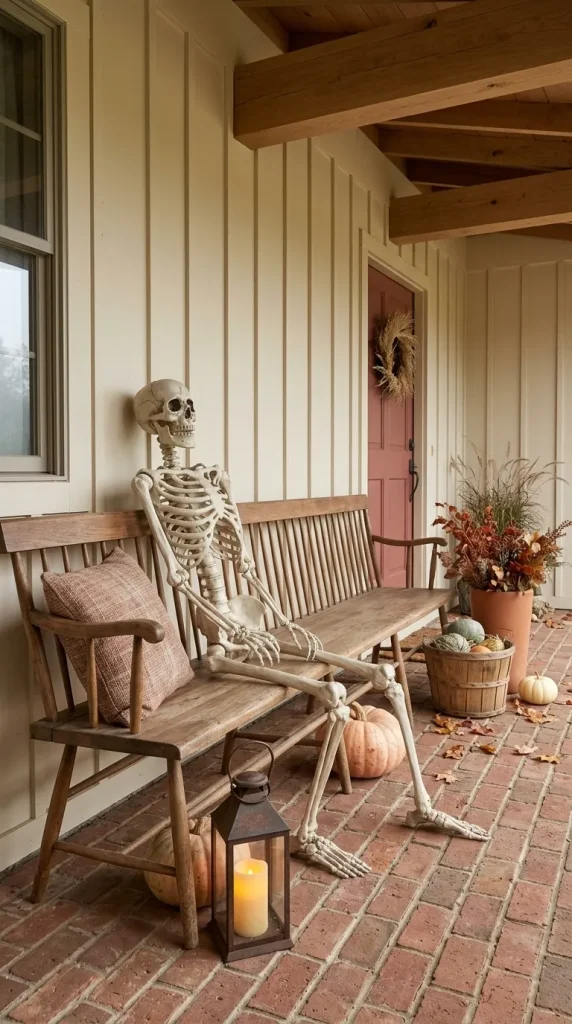
11. Seat a skeleton on an existing porch bench
A bench gives you one of the easiest skeleton arrangements because the furniture already establishes scale.
Sit the skeleton as though it belongs there. Then build the composition around it using perhaps:
- One lantern near the foot
- A pumpkin beneath the bench
- A basket or planter on the opposite side
- One seasonal cushion if the seating is protected from weather
Do not cover the entire bench if it is still used regularly.
A slightly relaxed pose is often more memorable than putting the skeleton perfectly upright in the center.

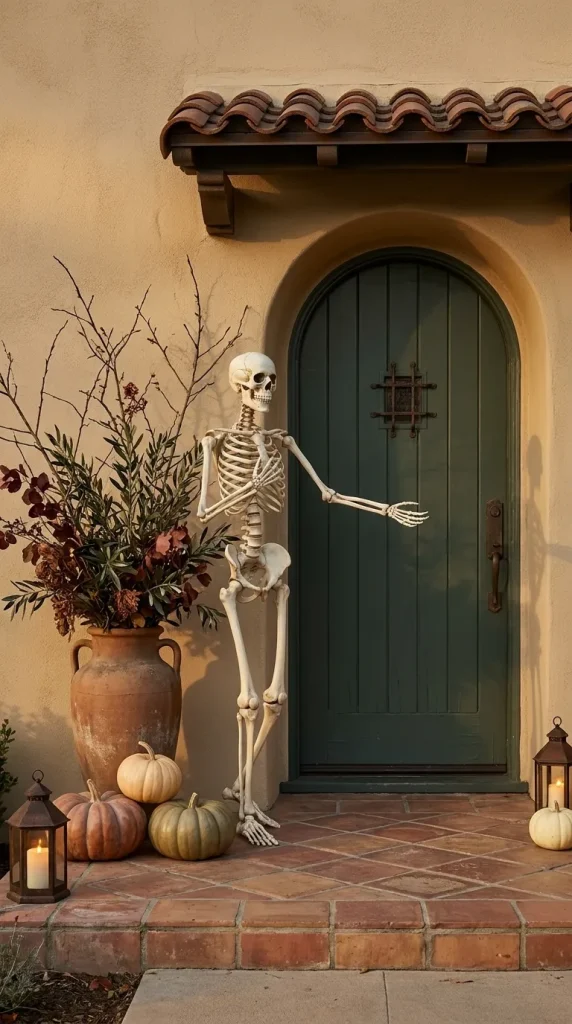
12. Turn a skeleton into the host at the front door
A standing skeleton beside the entrance can become the clear focal character.
Give it enough breathing room.
A skeleton flanked by five signs, twelve pumpkins, fake tombstones, a witch, and three ghosts loses much of its presence.
Instead, place it beside a tall planter or branch arrangement and repeat one or two elements at ground level.

13. Let a skeleton climb a column
A skeleton can interact with the architecture rather than simply standing on the floor.
Secure the figure carefully so it appears to be climbing upward or wrapping around the column.
Then let the viewer’s eye follow the movement toward a bat swarm, web, or hanging decoration overhead.
The effect works because the composition becomes directional.
Keep the main structural and hand-contact areas unobstructed, particularly near railings and stair posts.
14. Create a small skeleton scene instead of adding more figures
Multiple skeletons work best when they appear to be doing something together.
Two skeletons can sit on opposite porch chairs.
One might be reaching toward a pumpkin arrangement.
A small skeleton can appear inside an oversized planter.
A group can gather around a low table on a very large porch.
The difference between theatrical decorating and random prop placement is often narrative. Give the figures a relationship to each other and to the furniture.
Use witches, ghosts and bats with intention
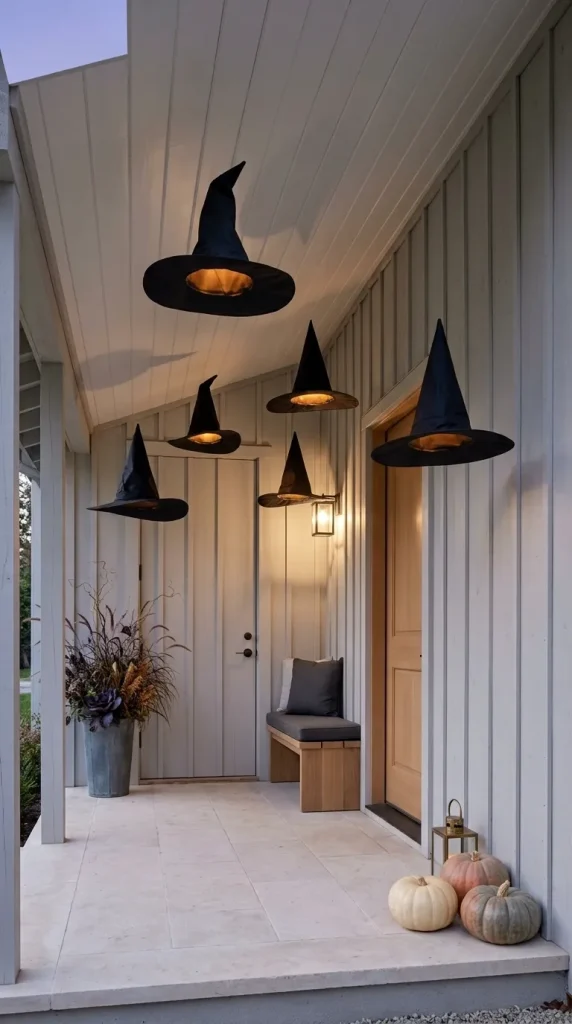
15. Hang witch hats overhead instead of only placing them on the ground
Suspend witch hats rather than lining them up mechanically.
Black hats create the strongest silhouette, particularly against a pale porch ceiling.
On a large porch, several can establish a canopy over a seating area.
On a small porch, two or three near the doorway may be enough.
Illuminated versions have also appeared in current 2026 Halloween coverage as a way of combining witch imagery with evening atmosphere.
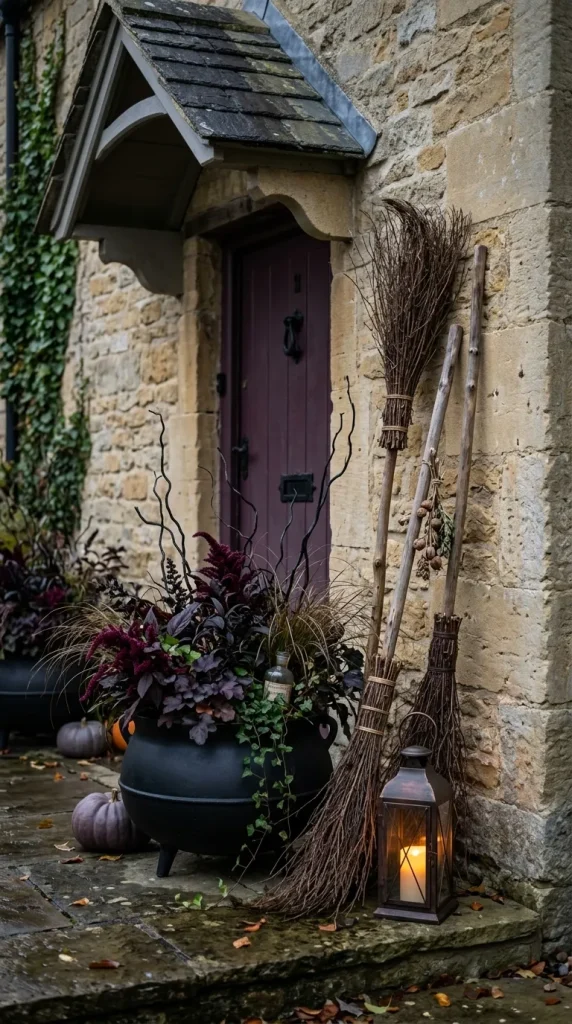
16. Build a witch vignette from brooms and cauldron-style planters
A witch theme can feel sophisticated if you suggest the character instead of reproducing every cliché.
Lean two or three natural-looking brooms against the wall.
Use a dark rounded planter as a cauldron.
Fill it with burgundy foliage, blackened branches, grasses, or seasonal plants rather than plastic body parts.
Add one lantern. That may be enough.
This is also an area where a vague magical or wizard-inspired direction can work without turning the article or porch into franchise-specific decor.

17. Group ghosts in a family of sizes
Use ghosts of different heights: one full-height figure and one smaller one. The variation creates the sense of a group rather than identical decorations placed side by side.
Keep the forms relatively simple. Too many facial details can move the design from atmospheric toward craft-project territory.
Secure lightweight figures well if the porch is windy.
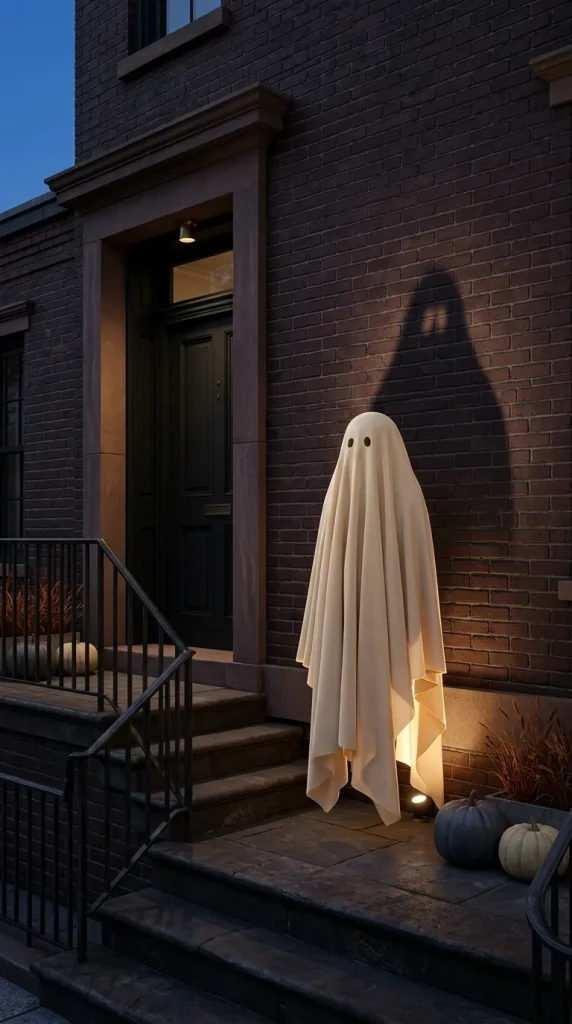
18. Backlight a ghost instead of flooding it from the front
White ghost decorations can look flat under bright porch lighting.
A low light placed behind or slightly to the side creates a soft outline and shadow.
This is especially effective against brick, dark siding, stone, or a shaded porch wall.
The same ghost can look fairly innocent during the day and much more theatrical after sunset.
Use outdoor-appropriate lighting and keep cords away from the walking route.
Use bats as part of the composition
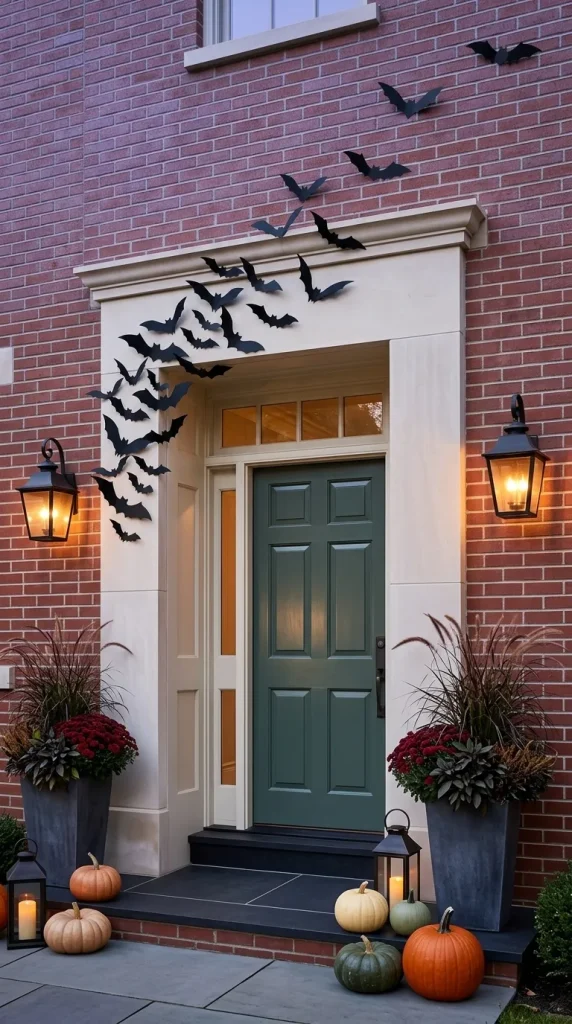
19. Make a bat swarm move upward from the doorway
Bats work best as a group with direction.
Start with denser spacing near the door or one side of the entrance. Gradually thin the pattern as it spreads upward or outward.
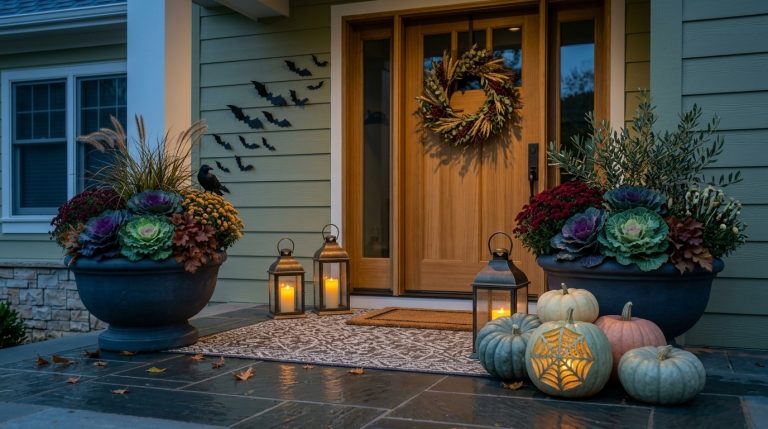
HGTV has documented an effective general strategy to turn a plain porch into a Halloween entrance while combining the bats with dark lanterns, pumpkins, and fall plants.
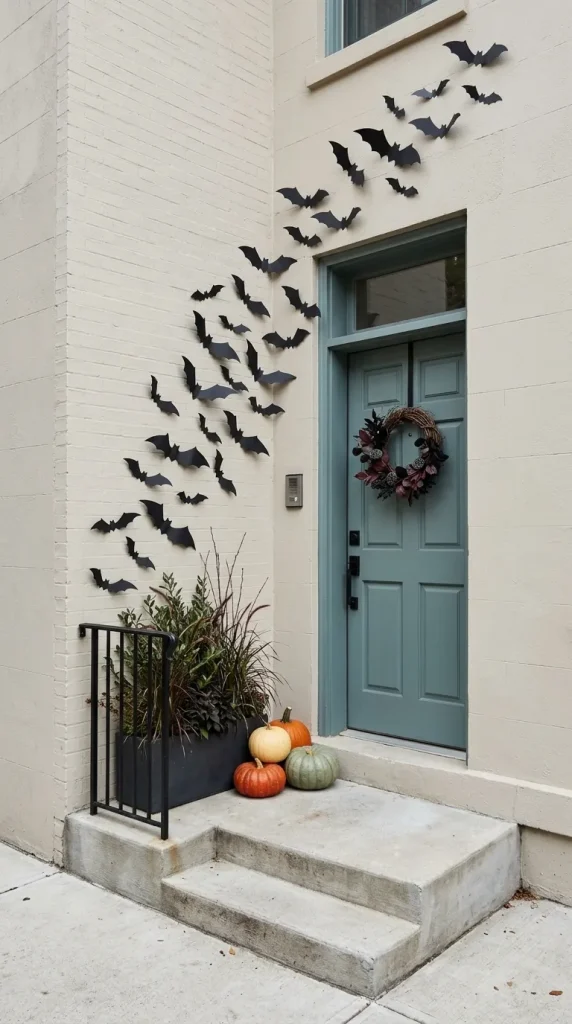
20. Use bats when a small porch cannot sacrifice floor space
For a compact stoop or apartment-style entrance, bats solve a practical problem.
They decorate the wall rather than the walkway.
Pair a bat arrangement with one wreath, a narrow planter, and perhaps three pumpkins rather than trying to fit full-size figures beside the door.
This is one case where small front porch Halloween ideas should not simply mean miniature versions of large-porch displays.
Use the vertical surfaces more aggressively and keep the floor calmer.
Make pumpkins do more of the work
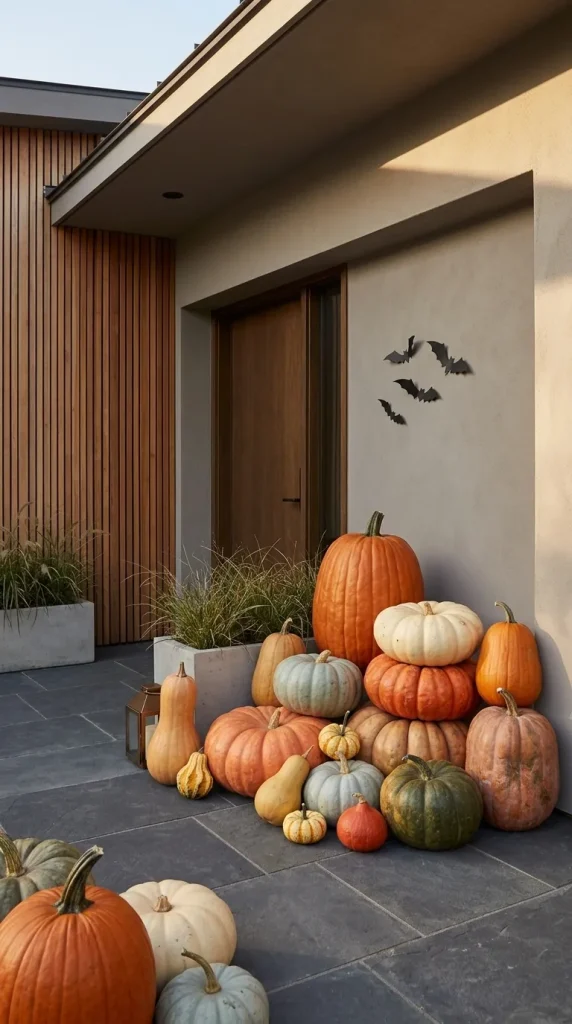
21. Build a pumpkin display from different shapes, not just different colors
Pumpkin variety is most convincing when silhouettes change.
Mix:
- Tall pumpkins
- Wide squat pumpkins
- Flat pumpkins
- Small gourds
- Traditional round pumpkins
- Heirloom varieties
Then vary color within that shape mix rather than treating color as the only variable.

22. Carve a few pumpkins and keep the rest whole
A mixture of carved and uncarved pumpkins is both more useful and visually stronger.
Whole pumpkins create mass. Carved pumpkins create faces and light.
Use the carved ones where they will actually be noticed, such as near the doorway or at the center of a larger cluster.
Leave the remainder intact so the porch still has a strong autumn foundation later.
NFPA and CPSC both recommend battery-powered lighting as the safer option around jack-o’-lanterns and seasonal decorations, especially where children will be approaching the entrance.
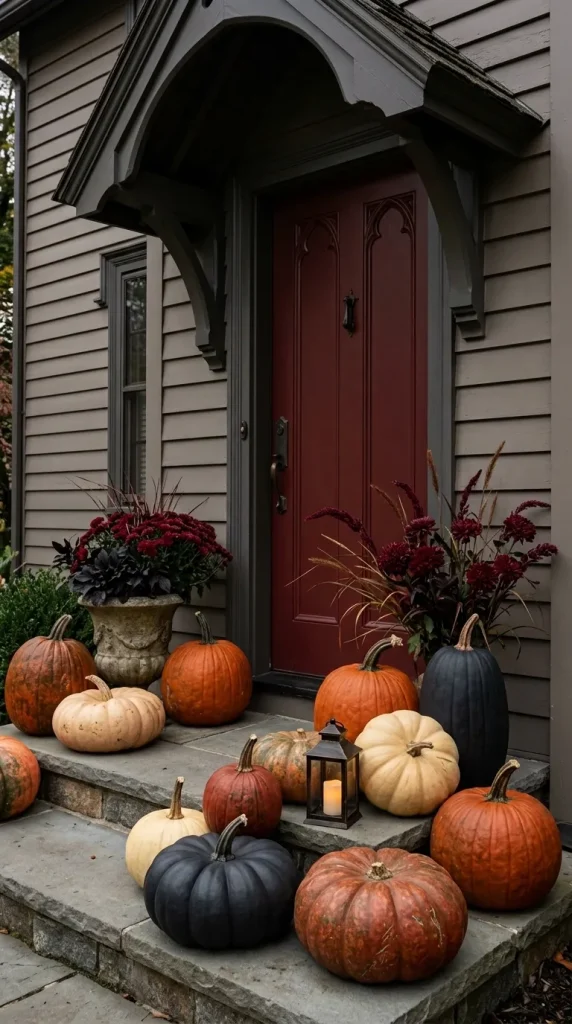
23. Paint a few pumpkins to support the porch palette
Painted pumpkins are useful when natural orange fights with the rest of the exterior.
A modern porch might use matte black, cream, and natural pumpkins.
A Gothic arrangement could mix black pumpkins with deep natural orange and burgundy foliage.
A vintage scheme can use slightly faded cream, muted orange, and black.
Do not paint every pumpkin automatically.
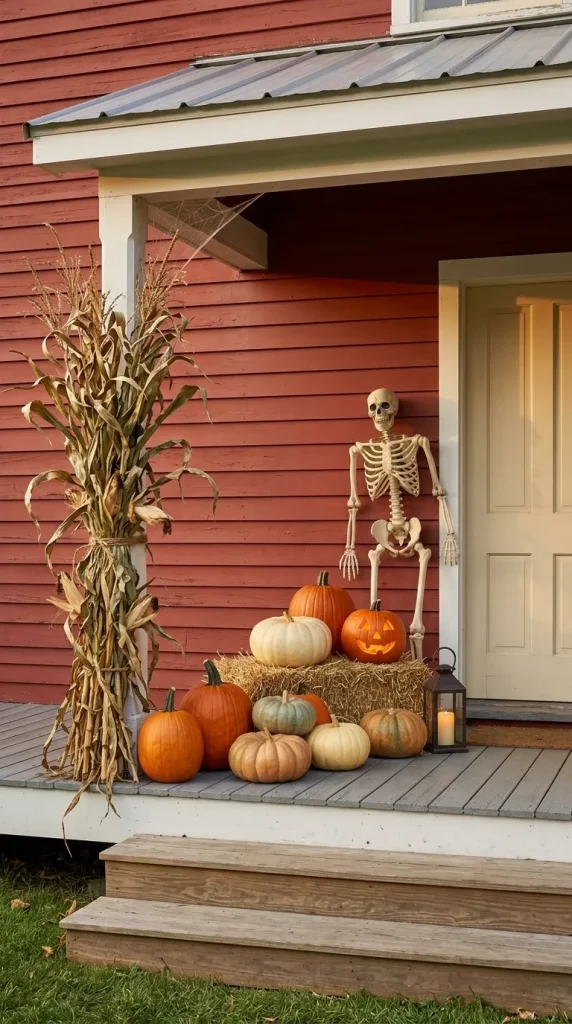
24. Add hay bales and cornstalks for the more traditional Halloween porches
A small bale can raise a pumpkin grouping.
Cornstalks can add height beside a doorway or porch post.
Then introduce the Halloween layer through a skeleton, jack-o’-lantern, dark lantern, or web.
Avoid filling the porch with agricultural material simply because it is fall.
NFPA warns that dried cornstalks, dried flowers, and similar seasonal materials ignite readily and should be kept away from open flames and other heat sources.
Create a classy or elegant Halloween porch

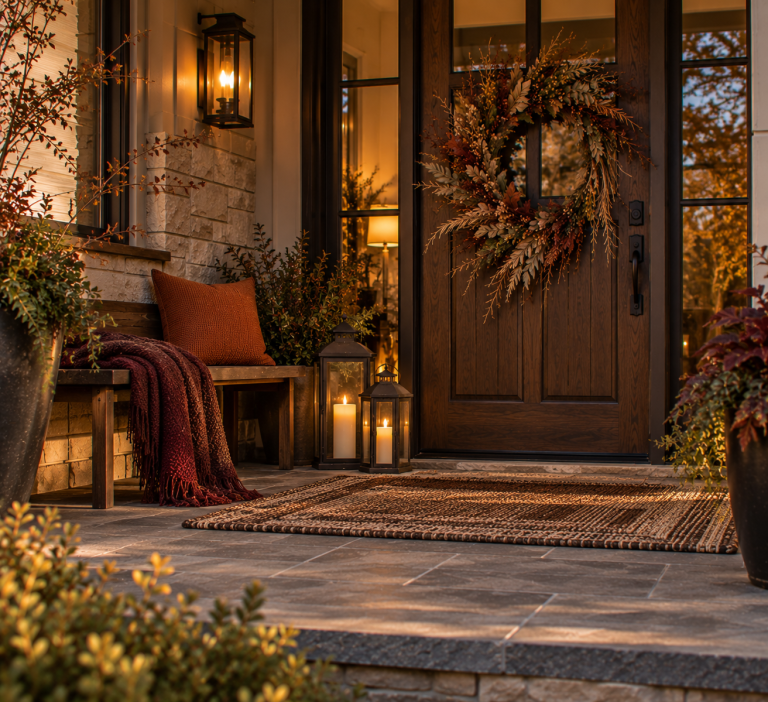
25. Use black, ivory, burgundy, and bronze for a more sophisticated palette
If orange-and-black feels too obvious for your house, shift the balance. Try:
- Ivory pumpkins
- Black lanterns
- Burgundy mums or foliage
- Dark green leaves
- Bronze or aged-brass details
The palette still reads as October, but the color transitions are softer.
This restrained direction fits the more sophisticated Halloween styling being emphasized in current 2026 design coverage.
The key is value contrast rather than saturated novelty color.
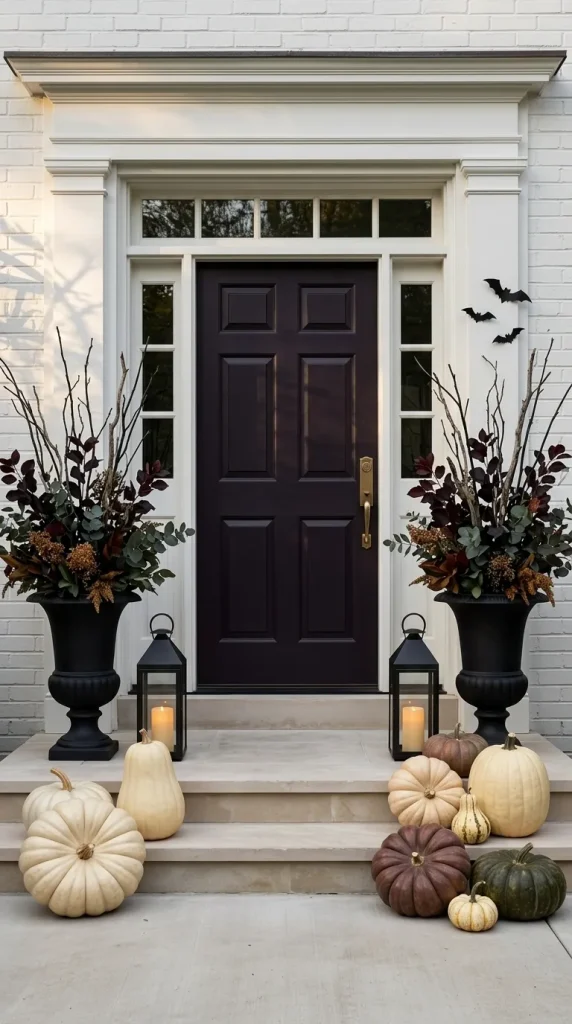
26. Use symmetry for a more formal entrance
Try matching black urns on either side of the door.
Add similar branch arrangements. Use a pair of lanterns below them.
Then break the symmetry slightly with an irregular pumpkin cluster so the porch does not feel rigid.
This works especially well on Georgian, Colonial, traditional, and symmetrical facades where the architecture already provides a strong central axis.
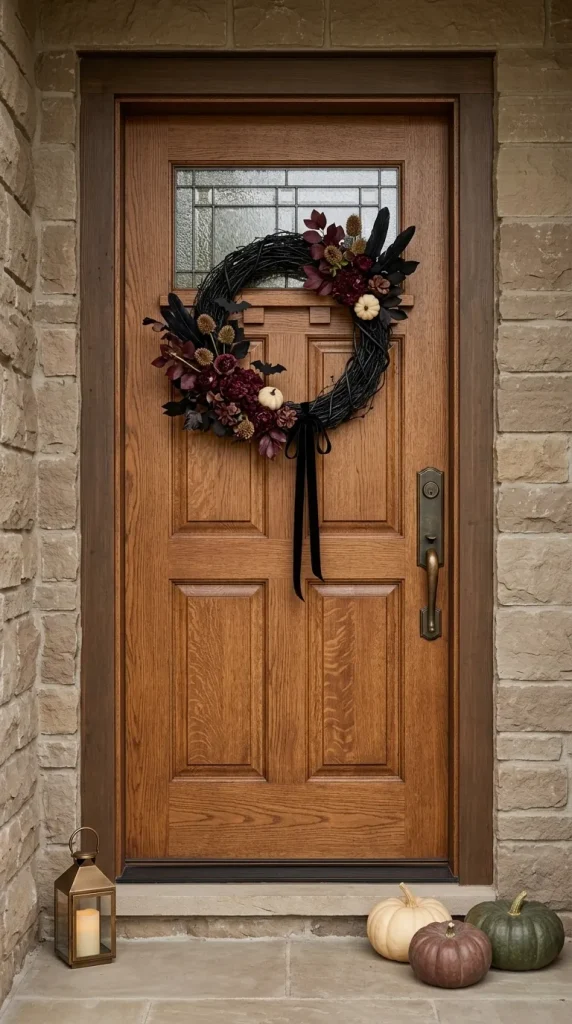
27. Choose one elegant Halloween wreath instead of decorating the whole door
A wreath can provide enough Halloween character for readers who prefer a restrained entrance.
Useful materials include:
- Black grapevine
- Dark dried foliage
- Burgundy flowers
- Black feathers used sparingly
- Small bats
- Muted miniature pumpkins
- Black velvet ribbon
Let plenty of the door remain visible.
If your front door already has beautiful paneling, glass, or hardware, covering most of it with a giant decoration can actually reduce the quality of the composition.
Give Gothic Halloween its own identity

28. Build a romantic Gothic entrance from branches, urns, and dark florals
Start with black urns.
Add tall twisting branches and dark foliage.
Introduce antique-looking lanterns, a raven, a skull, or one large web.
If you have a bench or old chair, dark flowers and textured fabric can make it part of the composition. HGTV has demonstrated a Gothic porch seating vignette built around an old chair, black flowers, feathers, a web, and skull details.
Current 2026 coverage has also identified highly theatrical Gothic doorscaping as a notable Halloween direction.
What makes the style work is the mixture of romance and menace, not the quantity of props.
Keep modern and minimalist porches controlled
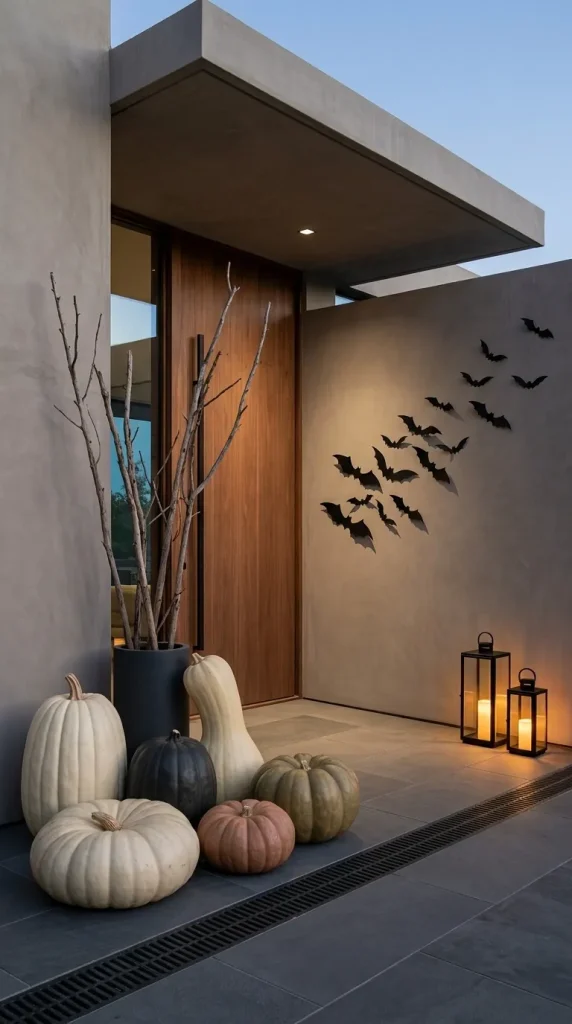
29. Use fewer Halloween objects, but make them larger
Modern and minimalist porches benefit from negative space. Try a simple formula:
- One group of sculptural pumpkins
- One tall branch arrangement
- One bat composition
- One pair of lanterns
Stop there.
Avoid replacing clutter with dozens of tiny black objects.
Minimalism works through scale and spacing, and pairs especially well with a modern minimalist approach to the rest of the porch.
Bring in vintage Halloween character

30. Build a vintage porch around faded color and old-looking objects
Vintage Halloween should feel nostalgic rather than simply old.
Use faded orange, cream, black, parchment, and dark green. Add:
- Vintage-style jack-o’-lantern faces
- Old metal buckets
- Weathered crates
- Aged lanterns
- Wooden stools
- Retro-inspired Halloween imagery
- Secondhand containers
The trick is to combine the nostalgic Halloween pieces with genuinely aged-looking materials so the display does not resemble a brand-new “vintage collection” purchased all at once.
One real old stool or weathered lantern can give newer accessories more credibility, an approach that shares a lot with a vintage porch.
Let rustic and country porches stay natural
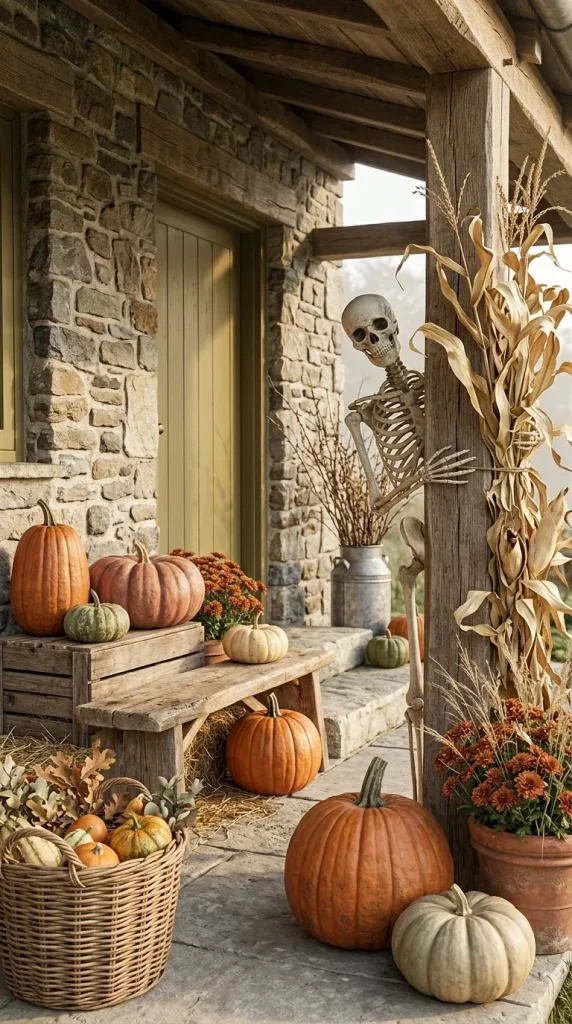
31. Mix pumpkins, rough wood, baskets, cornstalks, and one spooky element
Rustic Halloween does not require dozens of signs saying “Boo.”
Start with natural texture.
Use weathered timber, baskets, terracotta, galvanized metal, pumpkins, branches, hay, or cornstalks.
Then add one clearly spooky element, since contrast between natural material and one eerie object usually creates more tension than covering everything with Halloween graphics.
Give traditional Halloween its classic orange-and-black moment
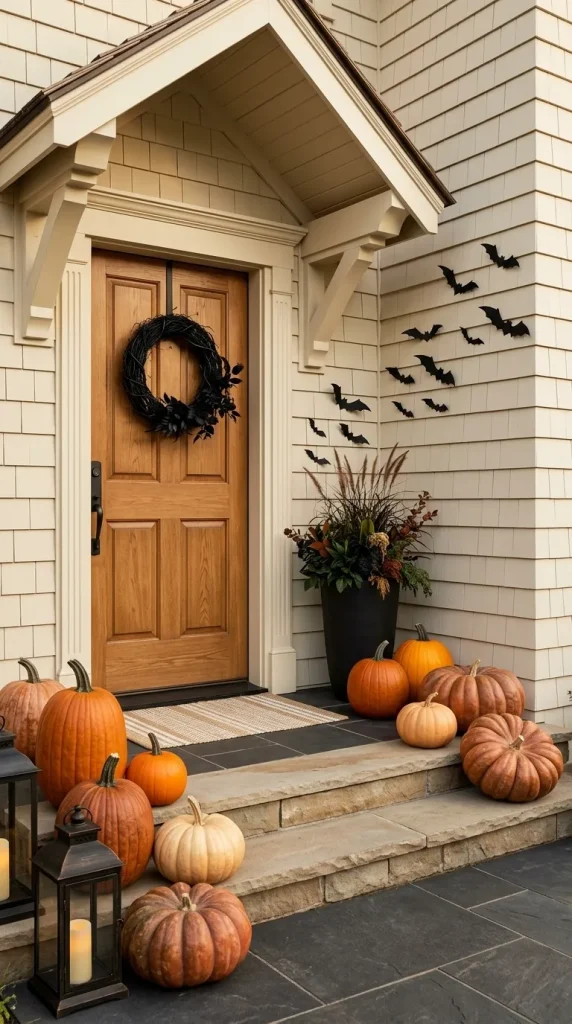
32. Use orange and black deliberately rather than apologizing for it
Traditional Halloween colors can look excellent when the quantities are controlled.
Let orange come mostly from real pumpkins.
Use black through lanterns, bats, a wreath, and perhaps one planter.
Warm cream from siding, stone, pumpkins, or a doormat can act as the relief color.
This avoids the harsher effect created when every item alternates between synthetic bright orange and solid black.
A porch can look classic without looking childish.
Make whimsical Halloween cheerful rather than scary
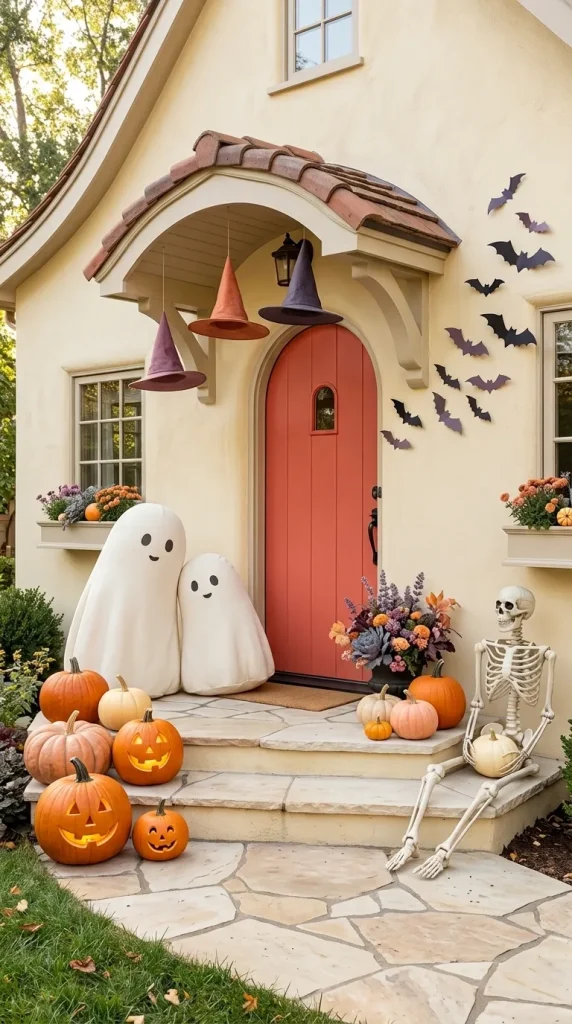
33. Use friendly ghosts, smiling pumpkins, and playful movement
Not every house needs to terrify the neighborhood. A whimsical porch can use:
- Smiling jack-o’-lanterns
- Rounded white ghosts
- Colorful witch hats
- Funny skeleton poses
- Candy-inspired colors
- Purple and orange accents
Playful arrangements sit comfortably alongside darker ones, which reflects how broad the category has become.
Make the porch genuinely kid-friendly
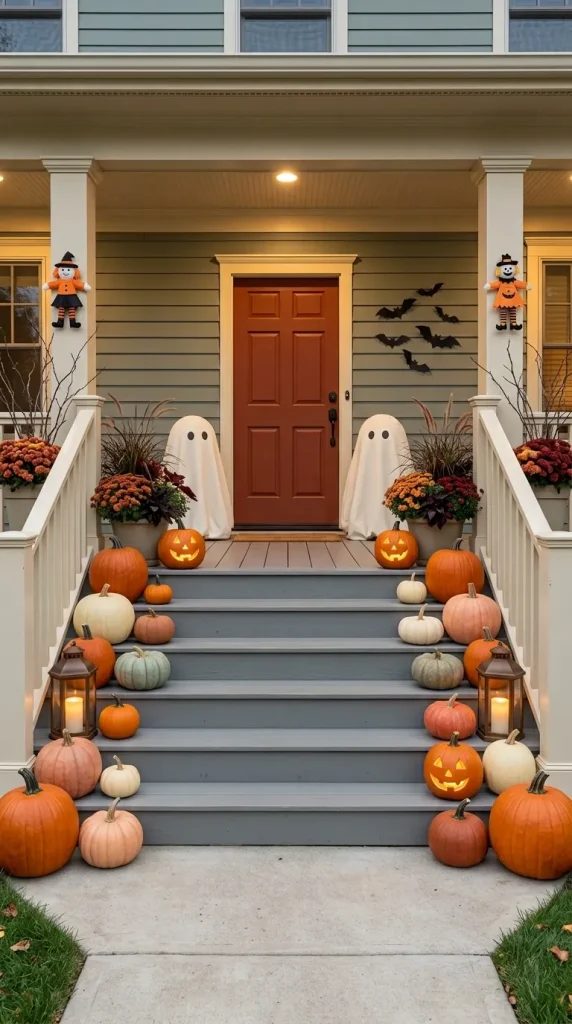
34. Keep the path obvious even when the porch is heavily decorated
For trick-or-treat night, the walkway is part of the design.
Keep steps visible.
Do not allow fabric ghosts to blow across the walking route.
Move pumpkins away from the center of stair treads.
Secure lightweight props. Keep cords out of the path.
Use friendly figures at child eye level without creating objects children need to squeeze around.
CPSC specifically recommends removing obstacles from lawns, steps, and porches when expecting trick-or-treaters. NFPA also advises keeping exits clear of decorations.
A safe route does not make the display less impressive. It gives the decorations clean edges instead of letting them spread everywhere.
Treat lighting as part of the design
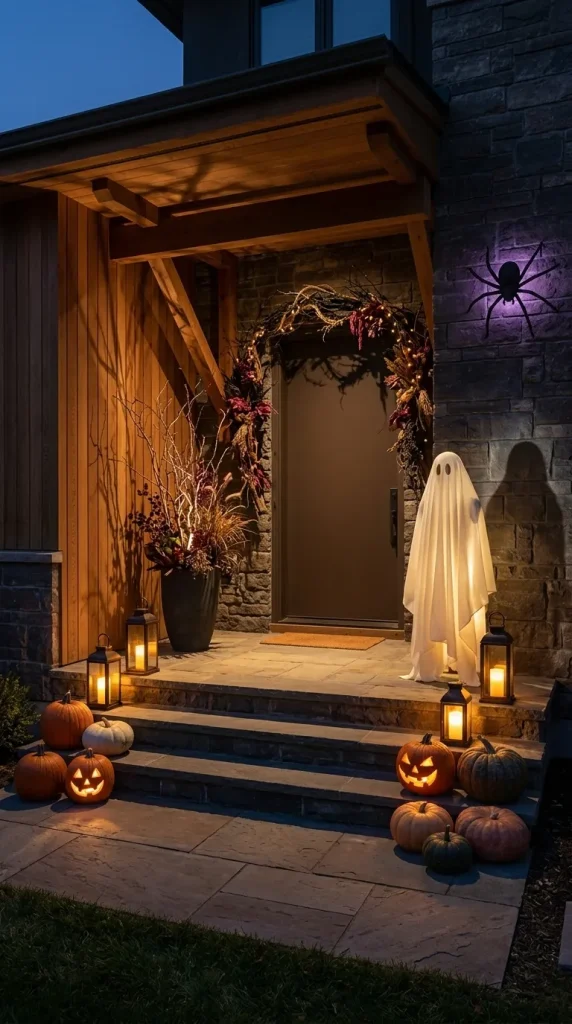
35. Layer Halloween lighting instead of relying on one porch bulb
Halloween decor becomes a different composition at night.
Use several small light sources rather than one, such as a lit arrangement, spider, or doorway arch.
Warm amber is usually the easiest starting point.
Purple can work as a limited accent.
Red can make a Gothic or haunted arrangement much more theatrical but should be used selectively.
A light behind a ghost does something different from a light pointed at a pumpkin.
Current outdoor Halloween guidance is placing particular emphasis on solar lanterns, faux flickering candles, illuminated decorations, and moody lighting because they change the atmosphere after sunset.
Use outdoor-rated products and inspect light sets for damaged wires or connections. CPSC also recommends tested lighting and warns against damaged sets.
Get more impact from DIY rather than more objects

36. Make your own bat silhouettes for a high-impact, low-cost wall display
Bats are one of the best DIY projects because the silhouette is simple and repetition makes inexpensive material look intentional.
Cut several sizes from suitable dark material.
Fold the wings slightly if they need dimension, and vary the spacing so the arrangement feels organic rather than evenly spaced.
HGTV’s bat-door project demonstrates how inexpensive cutout bats can create a substantial entrance treatment when combined with pumpkins, dark lanterns, and fall planting.
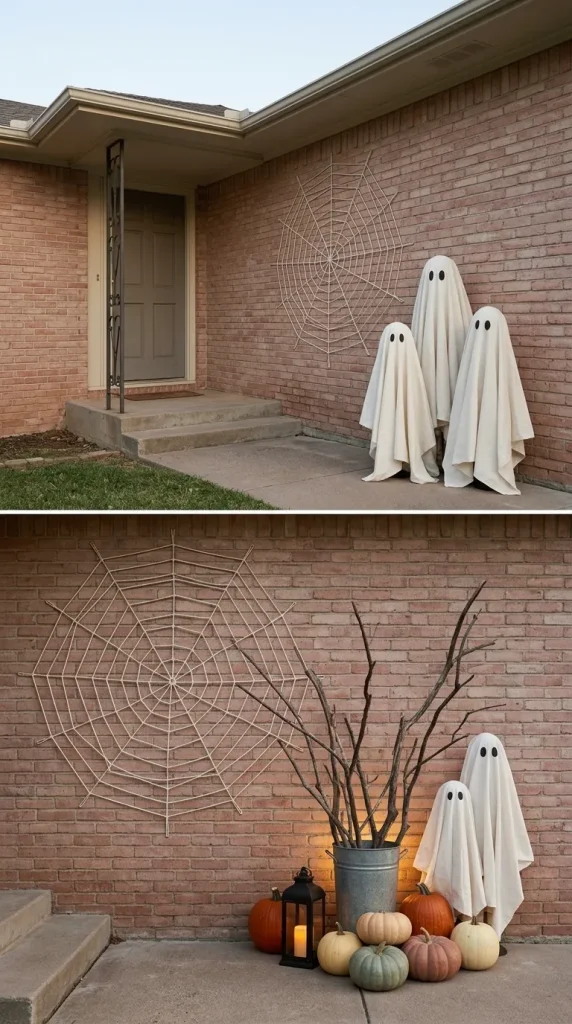
37. Make simple ghosts or webs instead of buying complicated props
DIY is most useful when the form itself is simple.
Ghosts need little more than shape, movement, and contrast.
Webs rely on line and scale.
Branches rely on silhouette.
These are good areas to save money.
A complex animatronic figure, by comparison, is rarely an efficient DIY project unless crafting is the point.
Concentrate homemade work where inexpensive materials can still create a large visual footprint.
Make inexpensive decorations look more coherent
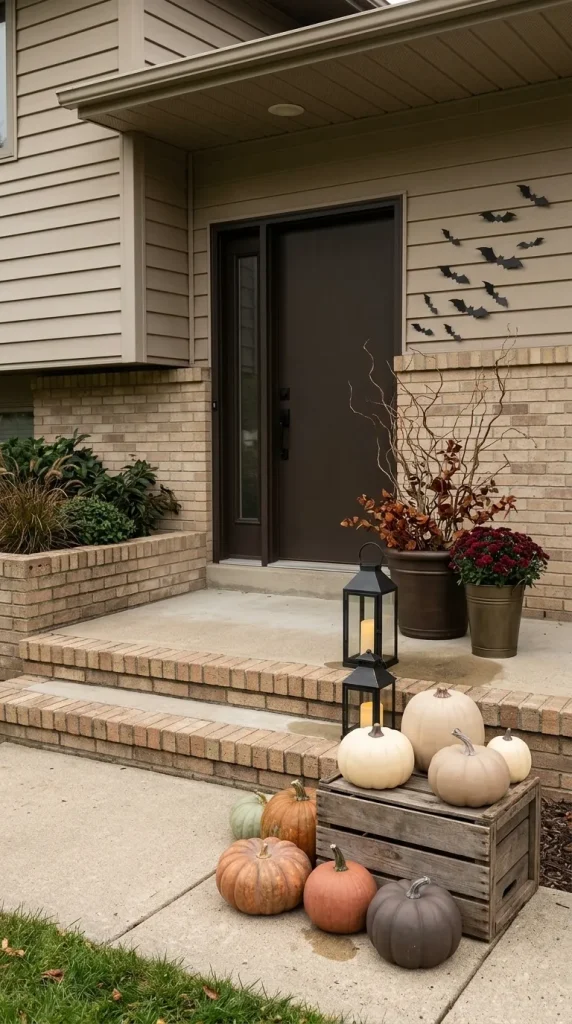
38. Repaint budget and thrifted Halloween decor into one palette
Cheap decor often looks cheap because the finishes do not relate to each other.
One object may be glossy orange. Another is purple plastic. Another has glitter.
Unify them with a coat of paint into shades such as a matte black-looking lantern, cream pumpkins, muted metallic accents, or dark brown or bronze containers.
Dollar-store and other inexpensive sources can be useful for basic forms, craft materials, faux pumpkins, bats, and small props. The important part is not making the entire porch read like one retailer’s seasonal aisle.
Mix budget objects with real pumpkins, branches, existing planters, and older pieces.
Repurpose what the porch already has
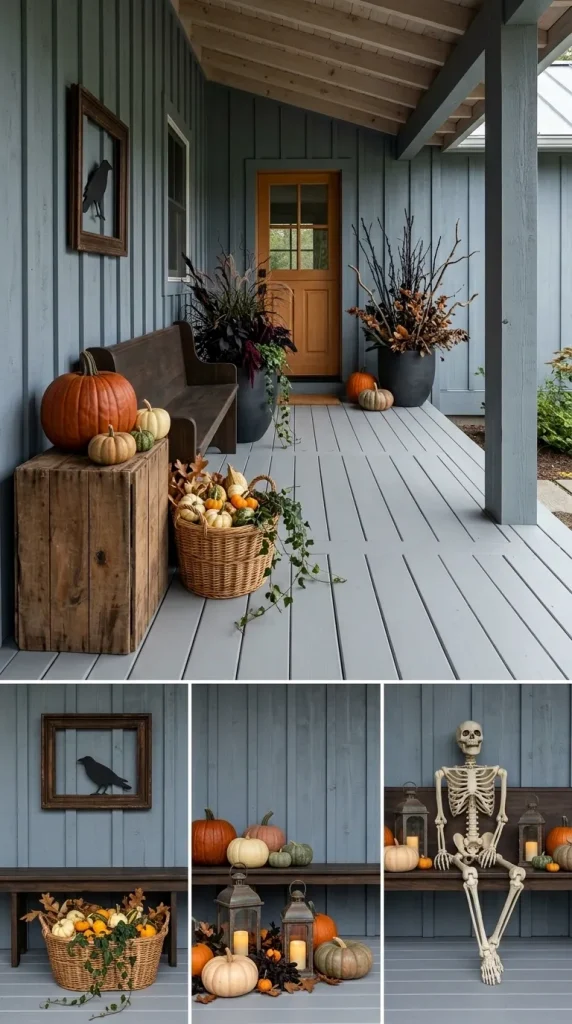
39. Turn crates, baskets, planters, frames, and furniture into Halloween structure
Before buying another prop, look at objects already around the house.
A wooden crate can raise a pumpkin.
A basket can hold gourds.
A dark planter can become a witch’s cauldron.
An old frame can hold a silhouette.
A lantern can switch from fall to Halloween simply by changing what surrounds it.
A porch bench can support a skeleton scene.
Existing urns can hold blackened branches.
This approach usually creates a more collected display because ordinary materials remain visually connected to the rest of the house.
Match the design to the porch you actually have
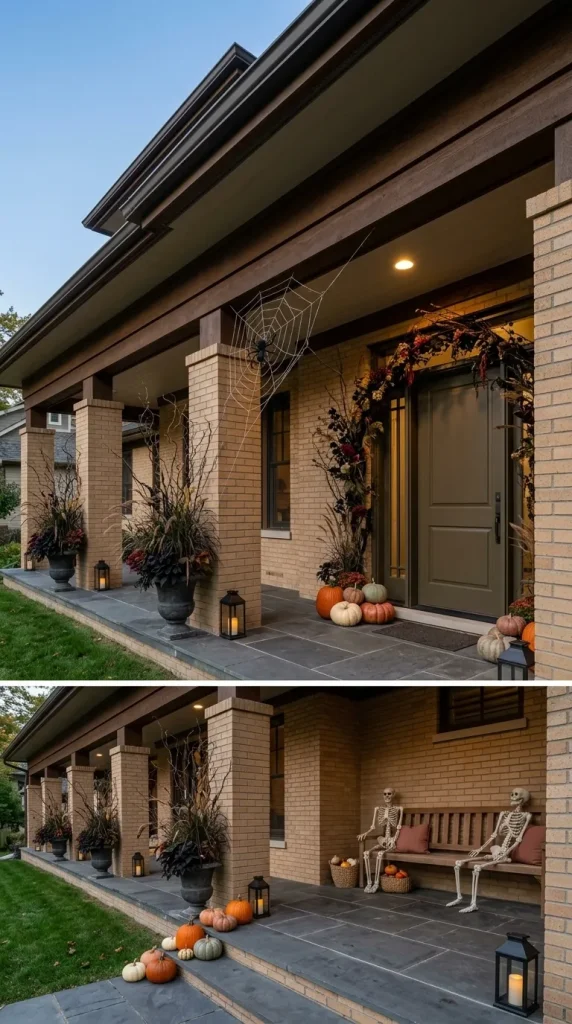
40. Decorate small porches vertically and large porches in zones
The size of the porch should change the strategy, not just the quantity.
For a small or narrow porch, protect the path to the door. Put more decoration on the door, wall, overhead area, or tight against the house.
A small porch might use:
- One wreath
- A vertical bat swarm
- One narrow planter
- Three pumpkins
- One ghost or skeleton
- One lantern
That can be enough.
Do not fill every remaining square foot just because Halloween decor is available.
For a large or long porch, the opposite problem appears. Five small objects can look stranded.
Create distinct zones instead.
The doorway might contain the main arch or pumpkin composition.
The seating zone might have skeletons or witch hats.
Columns could carry webs, bats, or vines.
Steps might repeat the pumpkin palette.
Lighting then connects the zones after dark.
Repeat two or three materials across those areas, such as black lanterns, branches, or one wreath style.
Give the columns, bench, and planters different jobs
It helps to give each architectural element a different job.
| Porch feature | Best Halloween role |
|---|---|
| Front door | Wreath, bats, doorway arch |
| Columns | Skeleton climbing, webs, vines, bats |
| Bench | Skeleton scene, pumpkins, basket |
| Planters | Branches, dark foliage, grasses |
| Steps | Pumpkin clusters, low lanterns |
| Railing | Web, restrained foliage, bats |
| Porch ceiling | Witch hats, lightweight ghosts |
| Wall | Bat swarm, silhouettes |
| Ground | Pumpkins, lanterns, large props |
The goal is not to use every option.
The table is useful because it prevents three different types of decoration from competing for the same small area.
If you already have a dramatic doorway arch, for example, the front door itself may not need a large wreath.
A stronger way to think about Halloween porch color
Instead of beginning with “Halloween colors,” begin with the color of the actual house.
A white or pale exterior provides strong contrast for black silhouettes.
Dark siding makes white ghosts and cream pumpkins stand out at range.
A green front door often works naturally with cream pumpkins, black lanterns, and burgundy foliage.
Natural wood looks particularly good with black, dried grasses, cream, and traditional pumpkin orange.
The house should get the first vote. Halloween is the temporary layer.
What makes Halloween decor look classy rather than cluttered?
Usually, it is not the price. It is hierarchy.
A classy porch tends to have:
- A controlled palette
- One clear focal area
- Several repeated materials
- Enough empty space to see the architecture
- A mixture of heights
- Lighting that supports the display
- Fewer novelty graphics
- Large forms instead of many tiny accessories
An inexpensive black lantern beside real pumpkins can look more convincing than a collection of expensive themed decorations if the first arrangement respects proportion and the second does not.
This is also why the current interest in more sophisticated Halloween decorating does not require homeowners to abandon fun or scale entirely. An oversized spider, five-foot ghost, and flashing sign do not all need to occupy the same visual field. Choose what matters.
Do not forget daylight
A porch designed only around night lighting may look like a collection of wires and plastic pieces during the day.
Natural pumpkins, foliage, branches, urns, baskets, and furniture give the display something to rely on before sunset.
Do not forget darkness either
The opposite problem is equally common.
A beautiful daytime pumpkin display can disappear completely once trick-or-treating begins.
Check the porch after sunset before Halloween night.
Do not block stairs and walkways
Keep props away from the center of steps, the door swing, and the natural walking line.
This matters particularly on Halloween because unfamiliar visitors, children, costumes, darkness, and porch obstacles all meet at once. CPSC specifically recommends clearing porch and step obstacles for trick-or-treaters.
Do not put open flames beside dry decorations
Corn stalks and other combustible decorations should stay away from heat and flame.
Do not confuse Gothic with random black objects
Gothic decorating needs shape, patina, shadow, dark botanical color, and a little romance.
Black plastic everywhere does not automatically create that effect.
Do not shrink every item on a small porch
One substantial pumpkin grouping and one large wall decoration may make the porch feel calmer than twelve miniature accessories.
Do not scatter tiny objects across a large porch
Large architecture needs larger gestures and repeated zones.
Try this if your Halloween porch still feels random
Remove every small accessory for a moment.
Now identify the strongest existing element.
Maybe it is the front door.
Perhaps it is a pair of columns.
Maybe you have a bench, large staircase, or beautiful planters.
Choose one focal Halloween idea for that element.
Next, establish your color palette.
Then add one tall piece, one middle-height piece, and one low grouping.
Add lighting. Step outside after dark and check the effect.
FAQ
How can I make my front porch look spooky for Halloween?
Start with atmosphere rather than props. Dark branches, directional lighting, shadows, black lanterns, an oversized web, bats, ghosts, or one strong skeleton arrangement can create a spooky porch without filling every surface. Decide whether you want subtle eeriness or a theatrical haunted-house effect before choosing decorations.
How can I decorate a Halloween porch on a budget?
Concentrate decoration around the doorway instead of spreading it across the entire porch. Use DIY bats, simple fabric ghosts, real branches, existing planters, thrifted lanterns, crates, baskets, and a few pumpkins. Repainting inexpensive decorations into one palette can also make mixed budget pieces look more cohesive.
What are some classy front porch Halloween ideas?
Use a limited palette such as black, ivory, burgundy, olive, and bronze. Choose fewer, larger decorative pieces. Dark foliage, black urns, sculptural branches, cream pumpkins, and restrained bats can create a sophisticated entrance without losing the Halloween mood.
How do I decorate a small porch for Halloween?
Decorate vertically and protect the walking surface instead of filling the floor. A bat swarm, hanging ghost, wreath, narrow planter, small pumpkin grouping, or single skeleton can create enough impact. Keep the route to the door completely open.
What Halloween decorations work well with fall porch decor?
Whole pumpkins, mums, ornamental grasses, dried branches, cornstalks, baskets, lanterns, planters, wreath bases, and autumn foliage all work well as a fall foundation. Add bats, skeletons, ghosts, witches, spiders, webs, or darker lighting temporarily for Halloween.
Make the porch tell one Halloween story
The strongest front porch Halloween ideas do not come from buying every decoration that catches your eye.
They come from deciding what kind of experience the entrance should create.
Maybe you want children to laugh at a skeleton relaxing on the bench. Maybe you want a huge spider crawling down a web between the columns. Perhaps the house itself suits something moodier, with black urns, oxblood foliage, bare branches, lanterns, and let lighting finish the composition after sunset.
The porch can be frightening, sophisticated, funny, Gothic, nostalgic, minimal, inexpensive, or wildly theatrical. It does not need to be all of those things at once.
That is usually the difference between a porch covered in Halloween decorations and a porch that actually feels designed.