
10 fall bedding ideas for a Cozy, Layered Bedroom
The first cold night of fall has a way of exposing bad bedding choices.
That thin summer quilt suddenly feels useless. The crisp white bed that looked fresh in August starts feeling a little stark. And somehow, adding the thickest blanket you own leaves you overheating by 2 a.m.
Good fall bedding ideas aren’t simply about making the bed heavier. They’re about building layers you can add and remove, choosing fabrics that suit how you sleep, and using richer color without buying an entirely new bedding set.
That approach fits 2026 bedroom design particularly well. Current bedding direction favors tactile layers, patterned quilts, warmer color, relaxed styling, and fewer decorative pillows rather than perfectly arranged hotel-style beds.
Here are ten ways I’d make a bedroom feel ready for fall while keeping the bed comfortable enough to actually sleep in.
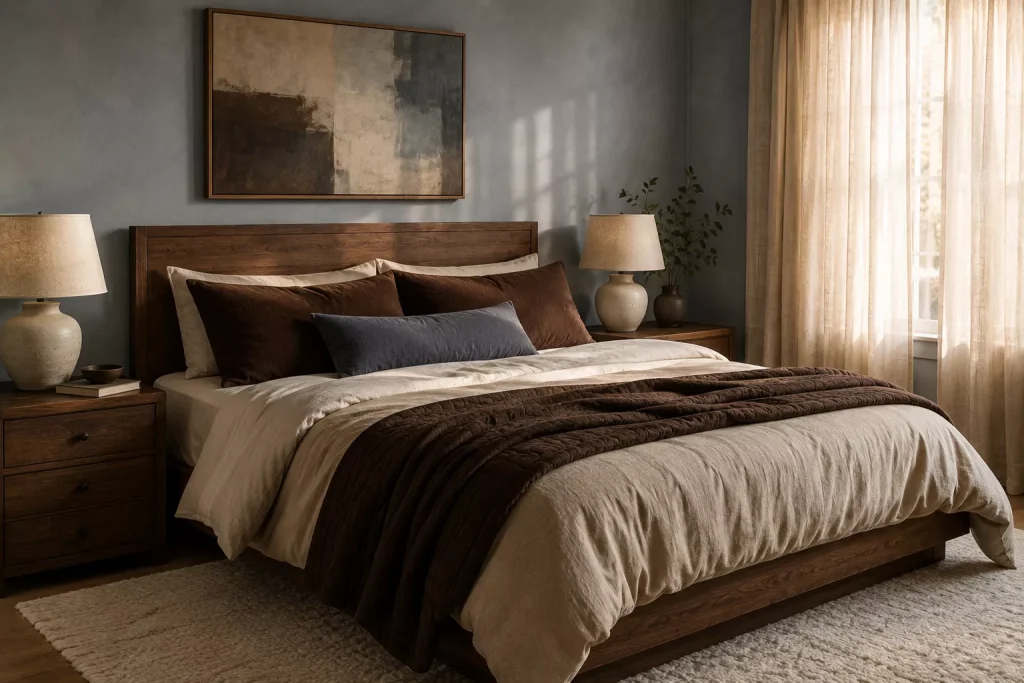
1. Start with chocolate brown instead of defaulting to rust
Idea 1: Use brown as the foundation of your fall bedding palette.
Rust and burnt orange are easy autumn choices, but chocolate brown feels richer and is much easier to keep after the season changes.
Fall 2026 color direction includes chocolate brown, maroon, terracotta, oxblood, bottle green, smoky violet, and navy, giving you far more options than the usual orange-and-beige combination.
Try chocolate pillowcases with warm ivory sheets.
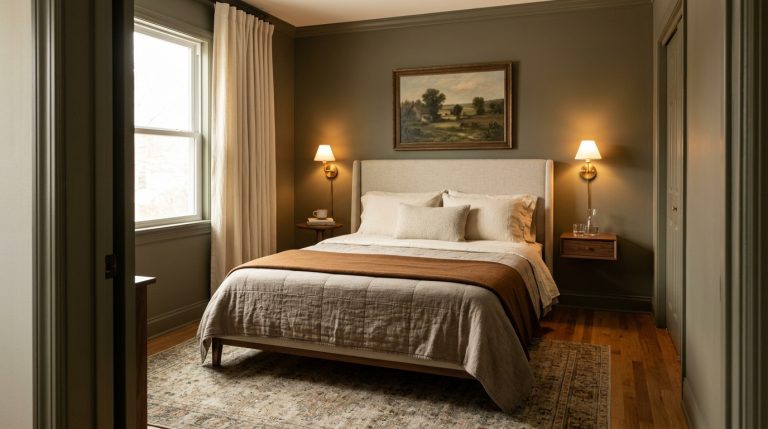
Pair a mushroom duvet with a cocoa-brown throw.
Or use a brown quilt against dusty blue walls.
One combination I particularly like is chocolate, pale blue, cream, and walnut. It feels autumnal without becoming themed.
Keep the strongest color near the foot of the bed
You don’t have to cover the entire mattress in a dark shade.
A deeper quilt folded across the lower third of a cream bed can provide enough visual weight.
This is useful in smaller bedrooms, where a completely dark bed can feel heavy.
And if your current bedding is mostly white, don’t replace everything.
Add brown through one coverlet or two pillowcases first. You may find that’s all the room needed.
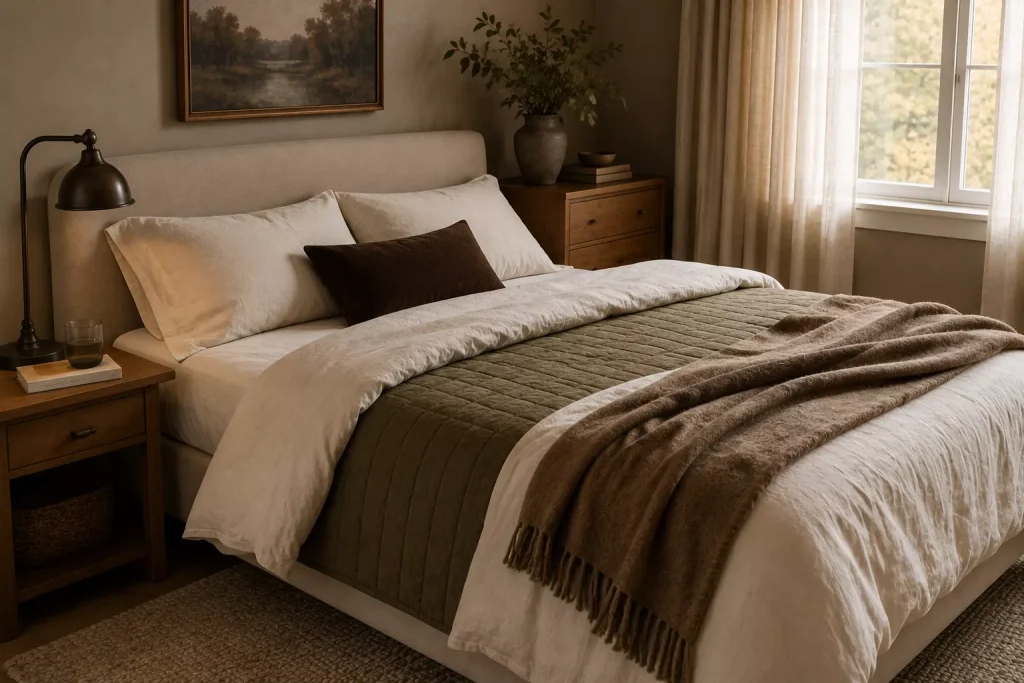
2. Add a lightweight quilt before reaching for a heavy duvet
Idea 2: Build warmth through removable layers.
One of the smartest early-fall changes is adding a quilt or coverlet between your sheets and heavier blanket.
That gives you options.
On a mild night, sleep beneath the quilt alone. When temperatures drop, pull the duvet over it.
Current fall bedding coverage is highlighting lightweight cotton quilts, linen-cotton layers, and breathable coverlets as useful pieces for moving from summer into cooler weather.
Cotton is especially practical because it provides texture without automatically making the bed extremely hot.
Look for channel stitching, hand-stitched effects, subtle quilting, or simple box patterns.
I’d choose a quilt that can stay on the bed most of the year.
Think olive, clay, tobacco, faded blue, burgundy, oatmeal, or cream rather than something printed exclusively with autumn leaves.
The downside is laundry.
Large quilts take up significant machine space, so check care instructions before buying. A beautiful king-size coverlet that only fits inside a commercial washer may become annoying quickly.
Real luxury is being able to clean your bedding without planning an expedition.
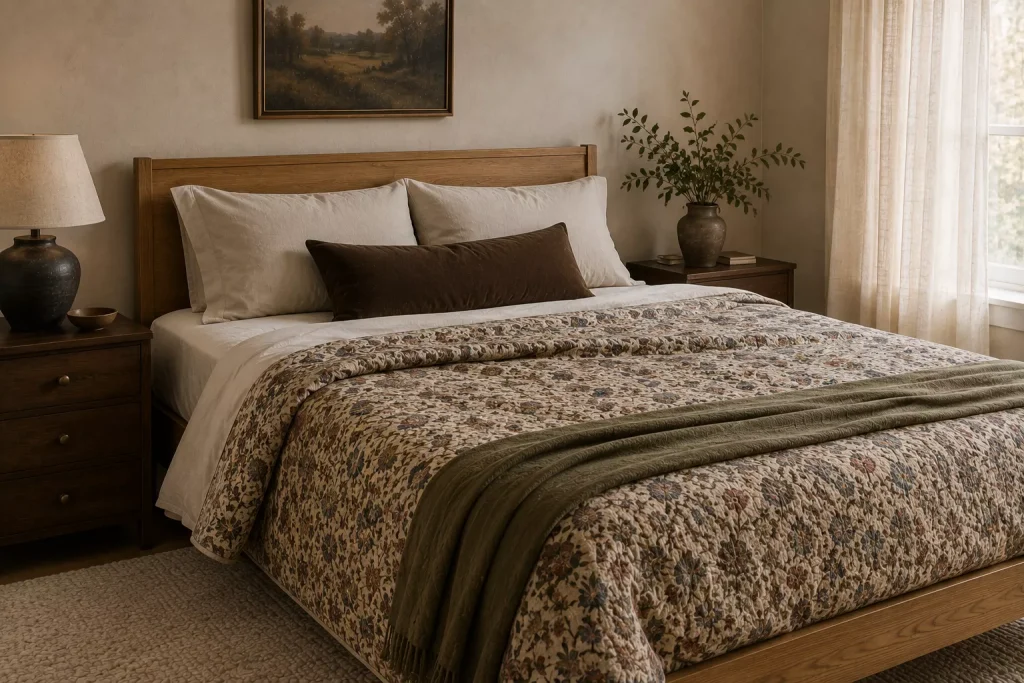
3. Try a patterned quilt instead of adding more decorative pillows
Idea 3: Let one large textile provide the pattern.
This is one of the more useful 2026 bedding shifts.
Patterned quilts are being used to give beds character without covering them in dozens of smaller decorative objects. Florals, patchworks, subtle stripes, applique, and vintage-inspired patterns are all appearing in current bedding styling.
That makes perfect sense for fall.
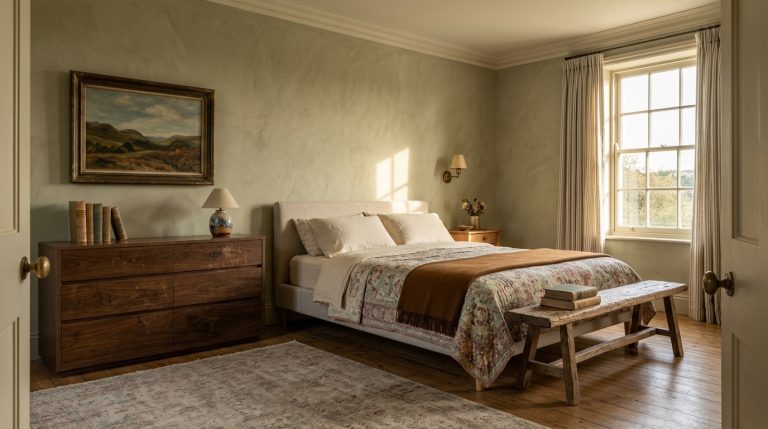
A faded floral quilt in olive and burgundy can turn plain cream sheets into a complete-looking bed.
A rust-and-blue striped coverlet works beautifully in a more modern bedroom.
For something quieter, choose a small block print in chocolate and beige.
If the quilt is busy, simplify everything else
Use solid pillowcases.
Keep the throw plain.
Let the rug provide texture rather than another strong pattern.
I’ve made the opposite mistake before, pairing a patterned quilt with several printed cushions because each individual fabric looked good.
The bed looked like a fabric sample drawer.
One dominant pattern is usually enough.
And patterned bedding has a practical advantage. It often disguises small creases, pet hair, and everyday wear better than a completely plain pale duvet.
That matters in a real bedroom.
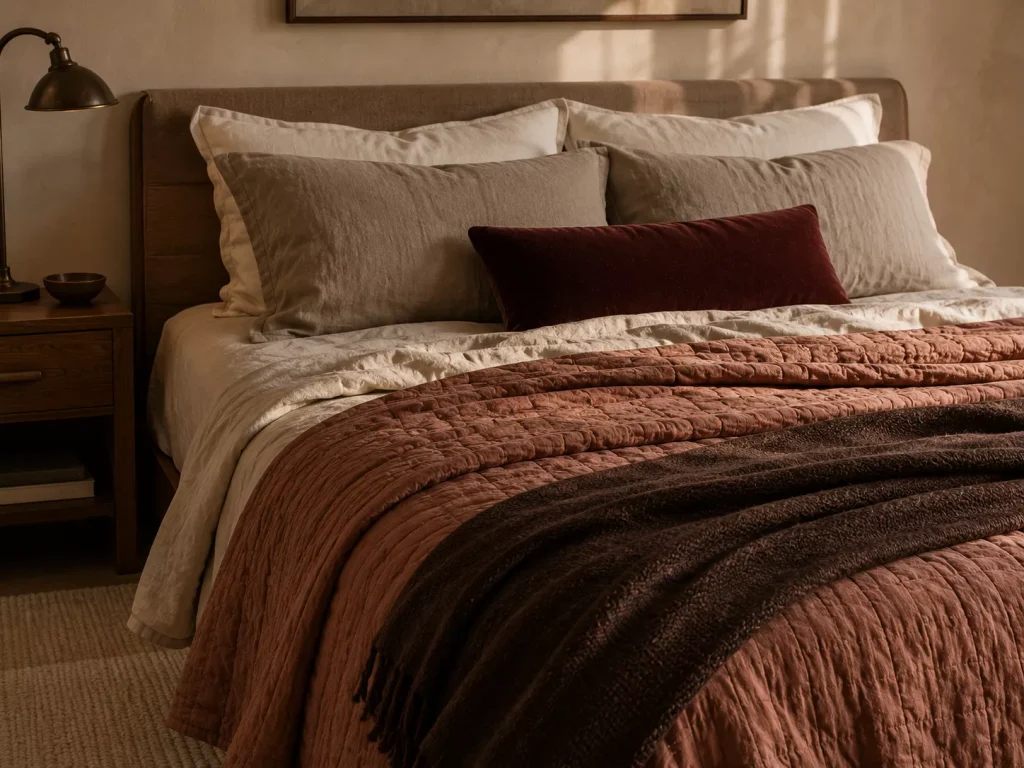
4. Mix linen sheets with a cotton or wool top layer
Idea 4: Layer fabrics according to how they feel, not just how they photograph.
Fall is a good time to mix materials.
Linen can remain comfortable into cooler months because it breathes well and has a relaxed texture. Cotton percale gives a crisper, cooler feel, while sateen tends to feel smoother and slightly more substantial.
Architectural Digest’s 2026 bedding guidance describes percale as crisp and cool to the touch, while linen remains popular for its breathable, relaxed feel.
Then add warmth above those sheets rather than changing the entire sleep surface.
Try:
| Bedding layer | Good fall choice | Best for |
|---|---|---|
| Sheets | Linen | Relaxed feel and breathability |
| Sheets | Cotton percale | Hot sleepers |
| Sheets | Cotton sateen | Smoother, slightly warmer feel |
| Middle layer | Cotton quilt | Flexible seasonal layering |
| Top layer | Wool-blend throw | Extra warmth at the foot |
| Decorative layer | Velvet cushion | Small dose of richer texture |
The key is not assuming “cozy” means fuzzy everything.
If you sleep warm, brushed fleece sheets and a thick duvet can become miserable long before winter.
Build the bed so each warm layer can be removed independently.
That’s far more useful than buying the thickest comforter available.
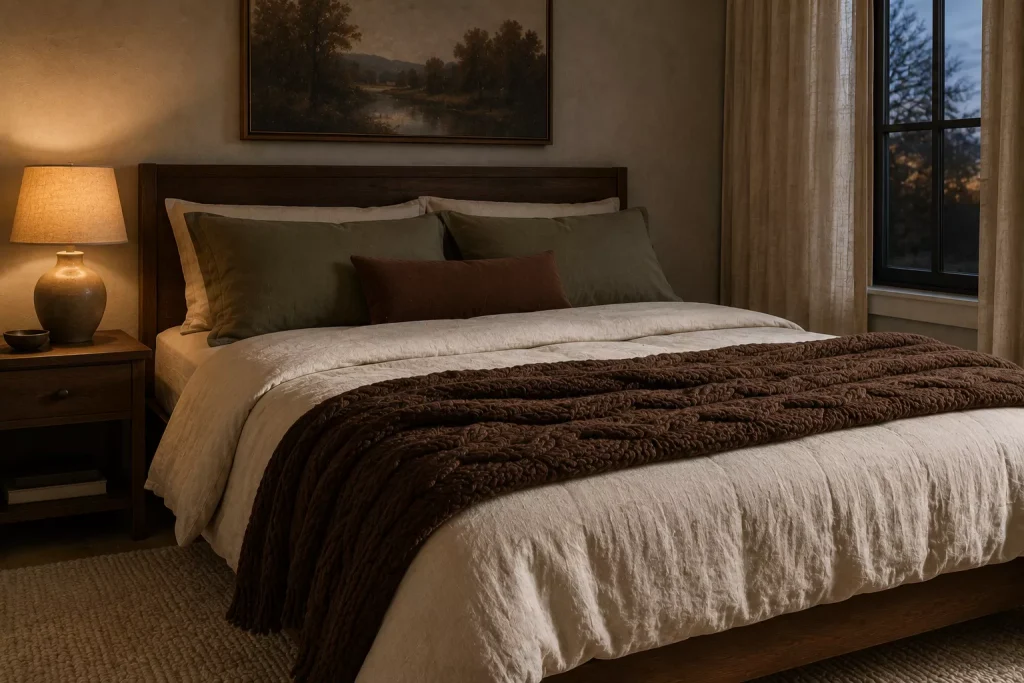
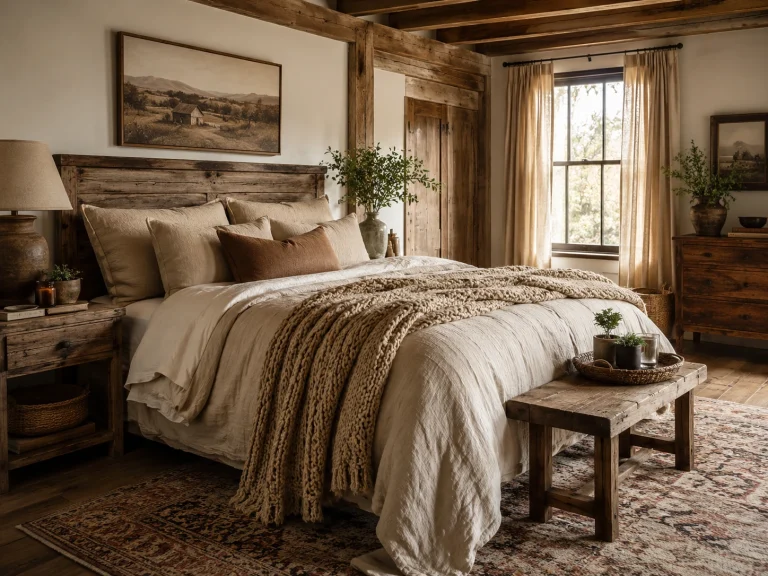
5. Use one fisherman knit or textured throw at the foot
Idea 5: Add visible texture where it won’t interfere with sleep.
A textured throw is probably the easiest fall bedding update.
Fisherman knits, cable patterns, waffle cotton, brushed wool, and chunky woven blankets all make a bed feel warmer before you even use them.
Better Homes & Gardens highlighted a cotton fisherman throw in terracotta for early fall 2026, noting the appeal of a breathable layer that still provides noticeable texture and warmth.
That’s exactly how I’d use one.
Fold it loosely across the bottom quarter of the bed rather than spreading it over the entire duvet.
It becomes extra warmth for your feet on cold nights, and it’s easy to remove if you get hot.
For a queen bed, a throw around 50 by 60 inches usually gives enough visual coverage. If you want it to drape generously across both sides, choose something wider.
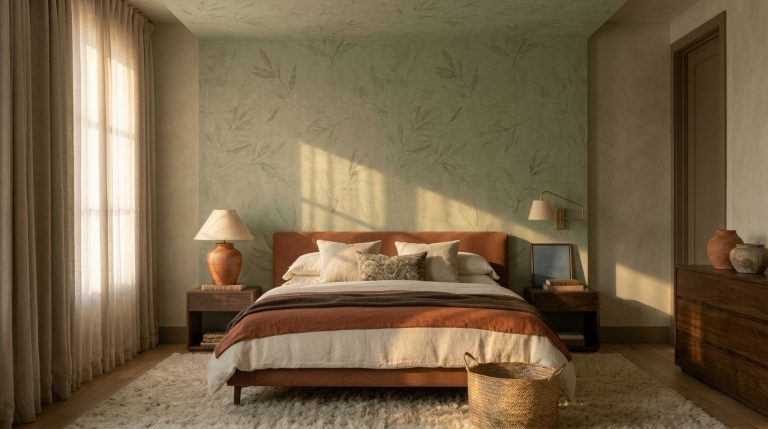
Try chocolate brown, moss green, terracotta, oatmeal, or burgundy.
My only warning is oversized chunky knits.
Some look beautiful but are extremely heavy, shed fibers, or stretch out of shape.
A tighter cotton or wool-blend weave is often easier to live with.
Texture is good.
A blanket that slowly disintegrates onto your pajamas is less charming.
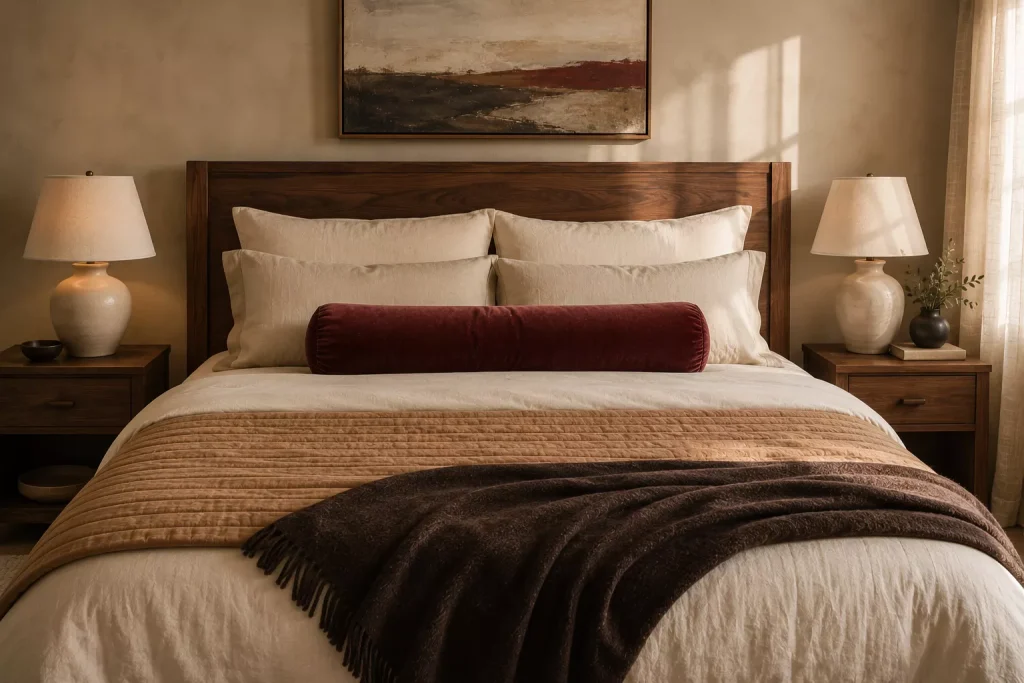
6. Replace the pillow pile with one long bolster
Idea 6: Use fewer pillows, but make the arrangement deliberate.
Fall beds often become pillow storage facilities.
Two sleeping pillows become four. Then three velvet cushions arrive, followed by a lumbar pillow shaped like a pumpkin.
By October, you’re moving half the bed onto a chair every night.
Current 2026 bedding direction is moving toward a cleaner arrangement, including one long bolster or lumbar cushion rather than piles of decorative pillows.
I’m fully in favor.
For a queen bed, try two standard sleeping pillows with two larger pillows behind them, then one long lumbar cushion across the front.
For a king, a longer bolster can make the wide mattress feel finished without requiring five individual cushions.
Use the bolster to introduce your strongest seasonal fabric.
Maybe that’s burgundy velvet.
Perhaps it’s a small olive floral.
Or a chocolate-and-cream stripe.
This gives you one focal point.
And because it’s a single piece, changing the room again in spring is easy.
Just replace one cover.
That’s a much better storage problem than finding somewhere for nine seasonal pillows.
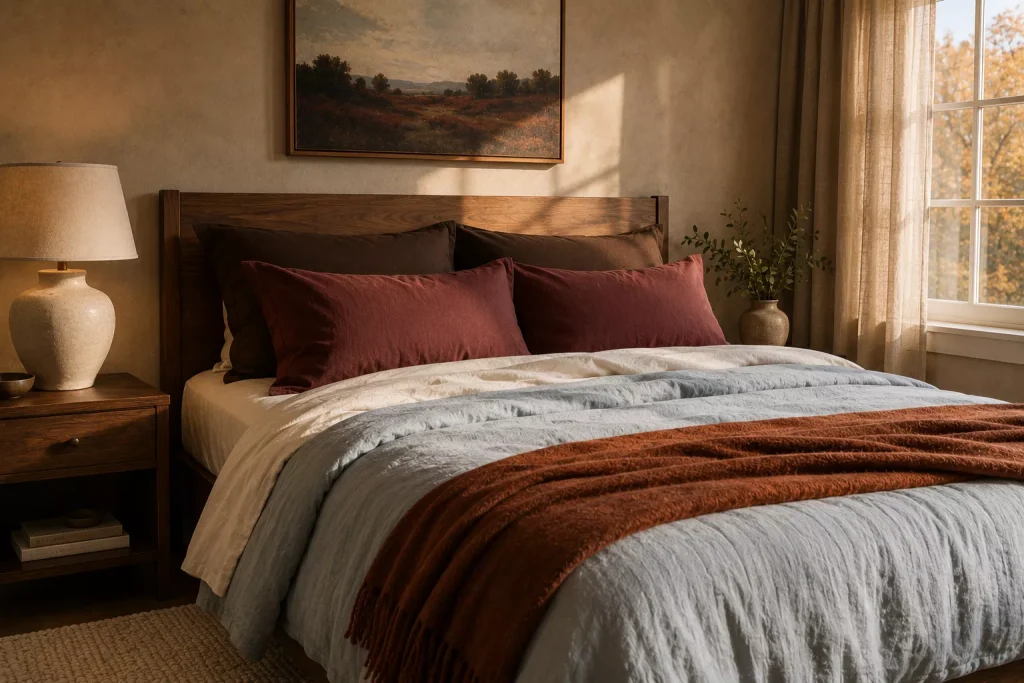
7. Bring in burgundy, olive, or smoky blue through pillowcases
Idea 7: Change the color closest to your face.
Pillowcases are an underrated seasonal decorating tool.
They’re small enough to store easily but visible enough to change the whole top half of the bed.
For fall 2026, maroon, bottle green, smoky violet, navy, and chocolate are all useful alternatives to traditional rust.
Try burgundy pillowcases against cream bedding.
Use olive against pale mushroom.
Or take a color that feels summery, such as ice blue, and pair it with chocolate brown for a more autumnal combination. Current styling has specifically paired cooler blue bedding with chocolate and deeper reds rather than keeping it purely coastal.
That’s a good reminder that you don’t need to put summer colors away completely.
Change what surrounds them.
A pale blue duvet with brown pillowcases and a rust throw suddenly feels very different.
I’d rather build fall color this way than buy a full matching set.
Matching sheet, duvet, pillowcases, and throw in one dark tone can flatten the bed.
Small changes in shade create depth.
Think chocolate beside camel, or olive beside moss, rather than five identical pieces.

8. Layer similar shades instead of matching everything exactly
Idea 8: Work tonally for a quieter fall bed.
Not every fall bedroom needs strong contrast.
One of the most polished current bedding approaches is tonal layering, using closely related colors but changing the texture and shade slightly.
For example:
Cream sheets
Oatmeal duvet
Camel quilt
Chocolate throw
Or:
Pale olive sheets
Moss quilt
Bottle-green lumbar cushion
Warm walnut headboard
The result feels rich because the surfaces change even though the palette stays controlled.
This works particularly well in small bedrooms where several bold colors might feel busy.
Make sure the textures are genuinely different
If every layer is smooth cotton in nearly the same beige, the bed may still look flat.
Mix crisp with rumpled.
Matte with slightly lustrous.
Fine weave with chunkier texture.
A linen duvet over cotton sheets with a wool throw gives the eye three distinct surfaces.
That’s why tonal rooms can feel interesting without using much pattern.
This also lets you add fall warmth gradually.
Start with the darkest layer at the foot of the bed. As winter arrives, introduce another deeper tone closer to the pillows.
The bed changes with the weather rather than undergoing one dramatic seasonal makeover.
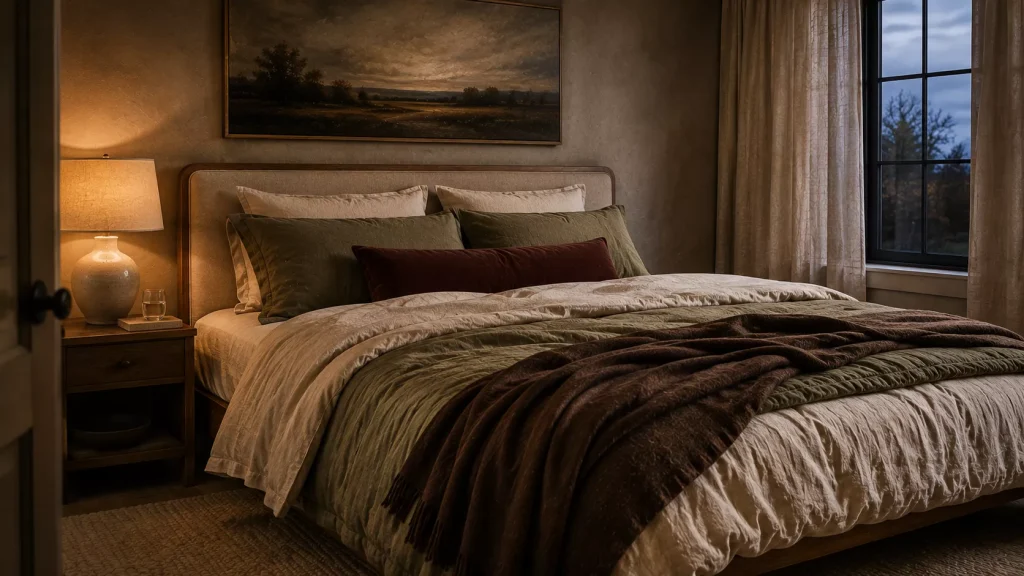
9. Let the bed look slightly relaxed instead of perfectly tucked
Idea 9: Style fall bedding for comfort, not inspection.
Perfect hospital corners and rigid pillow arrangements aren’t the only way to make a bed look finished.
Current 2026 bedding trends include a more relaxed mood, with loosely draped layers and intentionally softer arrangements replacing the ultra-polished hotel bed.
That’s especially appropriate for fall.
Fold the duvet back slightly to expose the sheets.
Let the quilt sit loosely rather than stretching it completely flat.
Drape the throw across the bottom instead of aligning it with military precision.
You’re trying to make the bed look comfortable.
There’s a difference between relaxed and messy, though.
Keep the main layers straight enough that the bed still has structure.
One rumpled linen duvet works.
A duvet, tangled throw, six mismatched pillows, yesterday’s sweater, and a laptop is less of a decorating style.
This approach also saves time.
A bed you can realistically make in two minutes every morning will stay looking better than an elaborate arrangement you abandon by Wednesday.
Good decor should survive your weekday routine.

10. Make your fall bedding warmer without buying an entire new set
Idea 10: Upgrade in a specific order.
If your current bedding is comfortable but looks too summery, don’t start over.
Use this sequence:
- Keep your current sheets.
- Add a quilt or coverlet in a deeper tone.
- Change two pillowcases.
- Add one textured throw.
- Introduce one bolster or lumbar cushion.
- Stop and live with the bed for a week.
You may only need steps two and three.
This approach works particularly well because 2026 bedroom direction favors layering, personality, natural fabrics, and richer color rather than perfectly coordinated bedding sets.
If you do spend more, spend where comfort changes.
Better sheets or a good quilt affect your sleep.
A decorative pillow does not.
And remember that fall is transitional.
The ideal October bed shouldn’t necessarily be your January bed.
Leave enough flexibility to add another blanket later instead of making the room unbearably warm in September.
What should you skip with fall bedding?
Skip literal seasonal bedding unless you genuinely love it.
Pumpkin-print sheets and leaf-covered duvet covers have a short decorating window and require storage for the rest of the year.
I’d also skip piling on heavy layers just because they look cozy.
Your sleep temperature matters more than the photograph.
And don’t assume all fall bedding needs to be brown, orange, and beige. Current 2026 color direction is much broader, with maroon, bottle green, smoky violet, navy, and dusky mauve giving you options that can remain useful year-round.
Finally, avoid replacing comfortable bedding solely because it doesn’t look seasonal.
A white duvet is an excellent base.
Add one brown quilt and a burgundy bolster and it may suddenly feel completely appropriate for October.
The smartest seasonal decorating usually changes the smallest number of things.
FAQ About Fall Bedding
What colors are best for fall bedding in 2026?
Chocolate brown, maroon, terracotta, bottle green, oxblood, smoky violet, navy, and dusky mauve are all strong current choices. Cream, camel, and warm white make easy supporting shades.
What bedding should I add first for cooler fall weather?
A breathable quilt or coverlet is usually the most flexible first layer. You can use it alone on milder nights and place it beneath a duvet once temperatures drop.
How can I make white bedding look more autumnal?
Add darker pillowcases, a colored quilt, and one textured throw. Chocolate, olive, burgundy, or terracotta can change the mood without replacing your white duvet.
How many blankets should be on a fall bed?
There’s no required number. For most people, one quilt or duvet plus an easily removable throw creates enough flexibility. Add layers according to how warm you actually sleep.
Build the bed for the temperature, then decorate it
The best 10 fall bedding ideas work because they solve two things at once.
The bedroom looks warmer, and the bed becomes easier to adjust as nights get colder.
Start with the layer your current bed is actually missing.
If you’re cold at 3 a.m., add a quilt.
If the bed feels visually flat, introduce a darker color.
If you already own enough warmth, swap two pillowcases or add one textured throw rather than buying another blanket.
And give yourself permission to leave some summer pieces in place.
Fall bedding doesn’t need to look like a seasonal display.
It should make climbing into bed on the first genuinely cold evening feel especially good.