
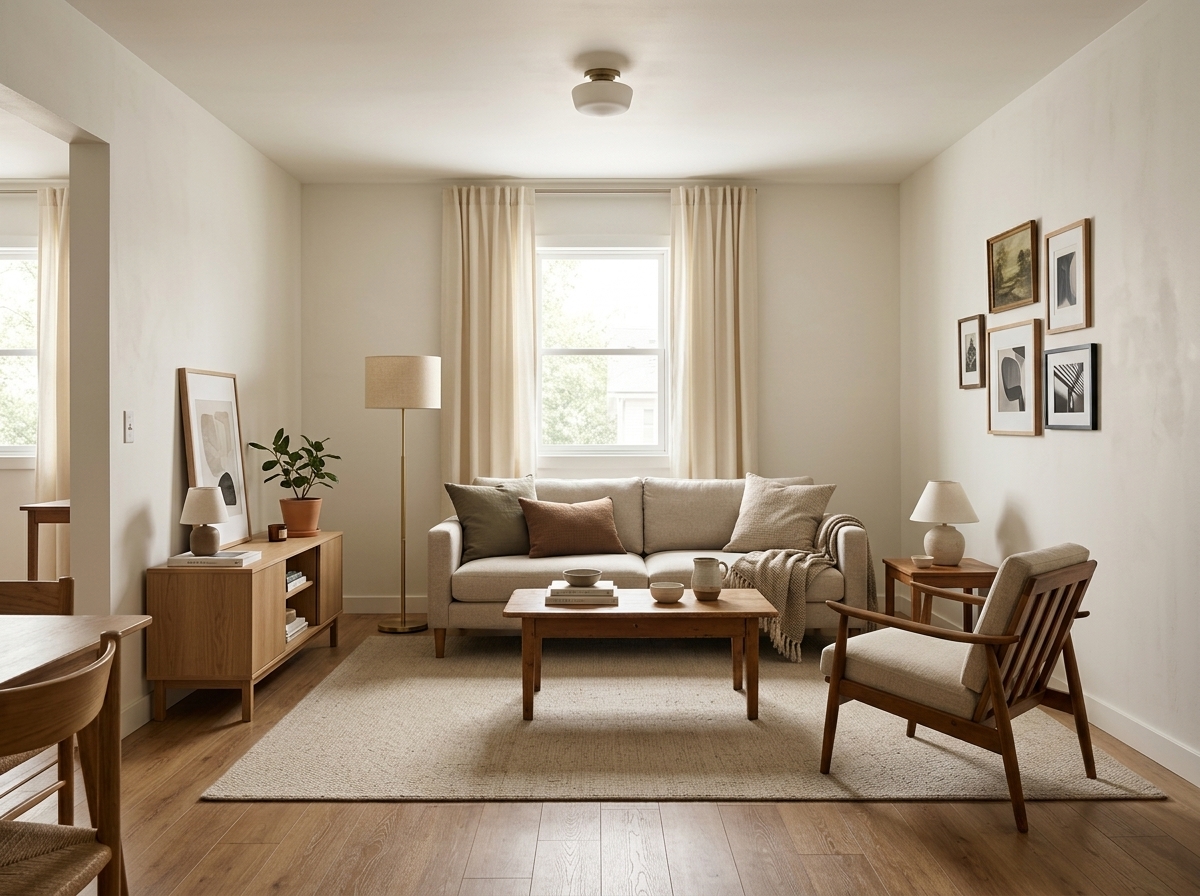
30 First Home Decor Ideas That Make a New Space Feel Finished Without Overspending
Decorating your first home can create an odd kind of pressure. You finally have rooms you can shape yourself, but suddenly every empty wall, bare window, missing lamp, and mismatched piece of furniture seems to demand a decision.
The temptation is to solve all of it quickly.
That is usually where expensive mistakes begin.
The strongest first home decor ideas are less about filling a house and more about establishing a good foundation. A comfortable sofa matters more than six decorative cushions. Proper lighting will change a room more than a shelf full of accessories. A correctly sized rug can make inexpensive furniture look more intentional, while an undersized one can make an otherwise attractive room feel disconnected.
There is also no requirement for a first home to look as though it was completed in one shopping trip. In fact, current 2026 design thinking is moving in the opposite direction. Architectural Digest has been documenting a stronger preference for personal, collected interiors with history, individual objects, vintage pieces, texture, and spaces that show signs of actual life rather than perfectly coordinated showroom styling.
So think of your first home as the beginning of a collection, not the end of a decorating project.
These 30 ideas will help you decide what to buy first, where to spend, where to save, how to make starter furniture look intentional, and how to create a home that can grow with you rather than requiring another complete redesign in two years.
Start with decisions that prevent expensive mistakes

1. Live in the home before trying to finish every room
An empty room makes people impatient.
But the first few weeks in a home teach you things no floor plan can.
You discover where morning light lands, whether you actually use the dining room every day, which corner becomes a natural reading spot, where shoes accumulate, where you need another outlet, and whether the beautiful blank wall you imagined filling with furniture is actually your most important circulation route.
Apartment Therapy’s first-apartment advice makes a similar point: treat the first version of a home as a foundation and allow your style and needs to develop instead of designing impulsively and replacing everything shortly afterward.
So make essential rooms comfortable first.
Then wait.
A room that feels slightly unfinished for two months is cheaper than a room filled with furniture you regret for five years.
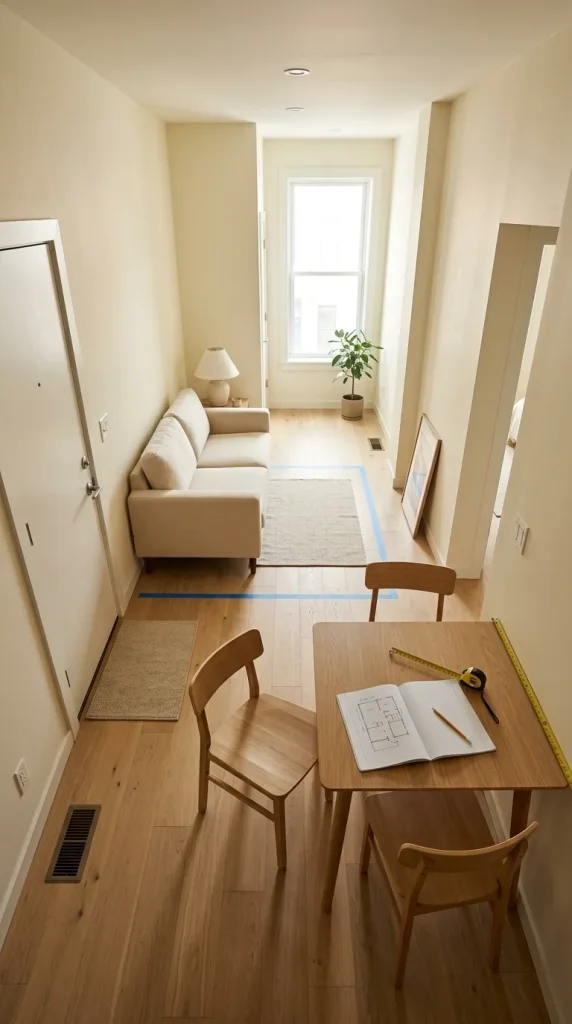
2. Measure the home before choosing furniture
Before buying a sofa because it looks perfect online, measure more than the wall where you intend to put it.
Measure:
- room width and length
- door openings
- hallways
- stair turns
- elevators where relevant
- ceiling height
- window locations
- radiator or vent positions
- electrical outlets
- door swings
- likely furniture clearances
Then sketch a simple floor plan.
It does not need to be professional.
Even graph paper or a basic room-planning app can prevent a sofa that blocks a doorway or a dining table that leaves no room to pull out the chairs.
As a rough starting point, around 30 to 36 inches can be comfortable for major circulation routes where the room allows it, but actual needs depend on household size, accessibility, furniture depth, and room shape.
In a compact first home, six inches can change whether a layout feels comfortable.
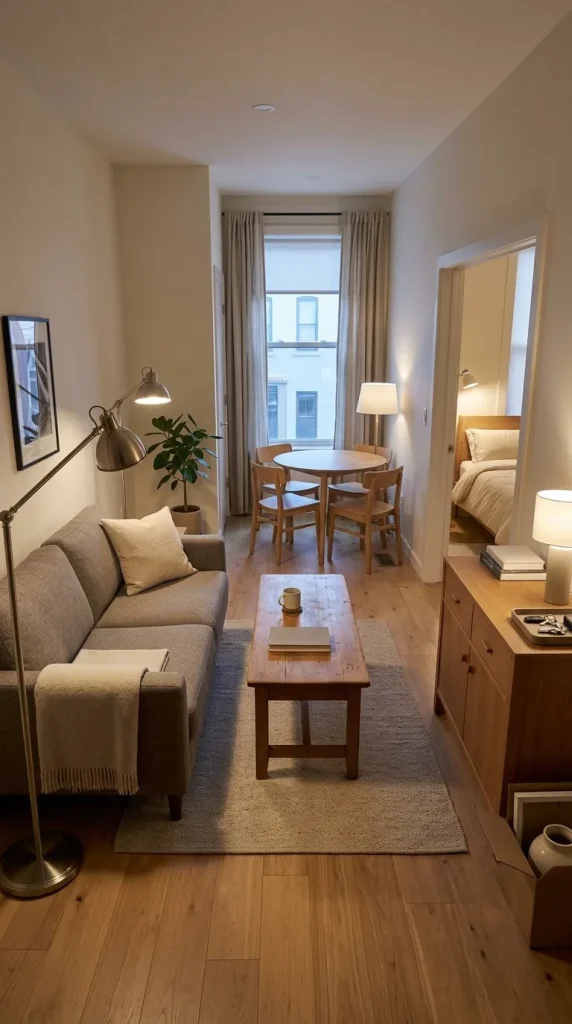
3. Buy the functional anchors before decorative objects
A first-home budget usually has too many demands competing for it.
Furniture.
Appliances.
Moving expenses.
Repairs.
Window coverings.
Storage.
Household basics.
It helps to separate anchors from finishers.
Anchors are the pieces that directly affect daily life:
A supportive mattress.
A comfortable sofa.
A functional dining setup.
Useful storage.
Good lighting.
Adequate window privacy.
Finishers include:
Vases.
Decorative bowls.
Extra cushions.
Seasonal objects.
Small side tables.
Frames.
Trays.
Decorative baskets.
There is nothing wrong with inexpensive decorative pieces. But ten attractive accessories will not compensate for a mattress you dislike or a room with nowhere comfortable to sit.

4. Spend more where your body interacts with the furniture
A useful first-home rule is to think about frequency of contact.
If you sleep on it every night, sit on it every evening, or use it every day, durability and comfort deserve more of the budget.
That often means prioritizing:
- mattress
- sofa
- office chair if you work from home
- dining chairs used daily
- frequently used storage hardware
- functional lighting
You can usually save more aggressively on:
- accent tables
- frames
- baskets
- vases
- decorative objects
- occasional chairs
- mirrors
- seasonal decor
This does not mean expensive automatically equals good.
It means your budget should reflect use.
A $25 thrifted side table that lasts ten years may be a much better purchase than a fashionable but poorly constructed $150 one.
Establish a style without trapping yourself in a label
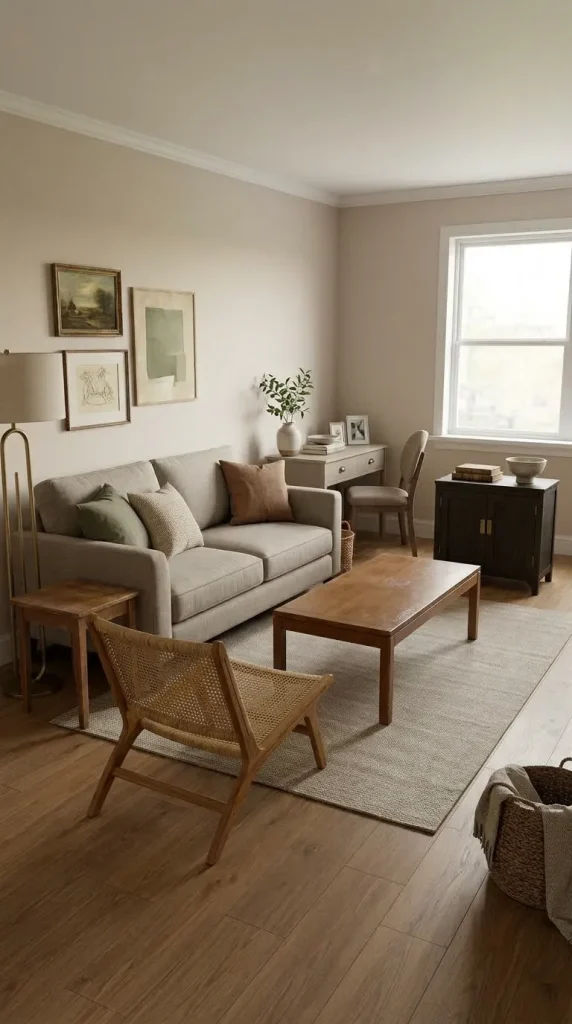
5. Define what you like through qualities, not style names
You do not need to decide whether your first home is “organic modern,” “English country,” “Scandinavian,” or “transitional” before buying a lamp.
Those labels can help with research, but they can also make first-time decorators think they have broken a rule whenever they love something outside the category.
Instead, identify five or six qualities that consistently appeal to you.
For example:
Warm wood + muted color + vintage pieces + linen + simple silhouettes
or:
Dark color + brass + sculptural lighting + velvet + old art
or:
Pale oak + woven materials + soft blue + clean lines + handmade ceramics
Those characteristics are far more useful when deciding whether a new object belongs in your home.
Your style can acquire a name later, if it ever needs one.
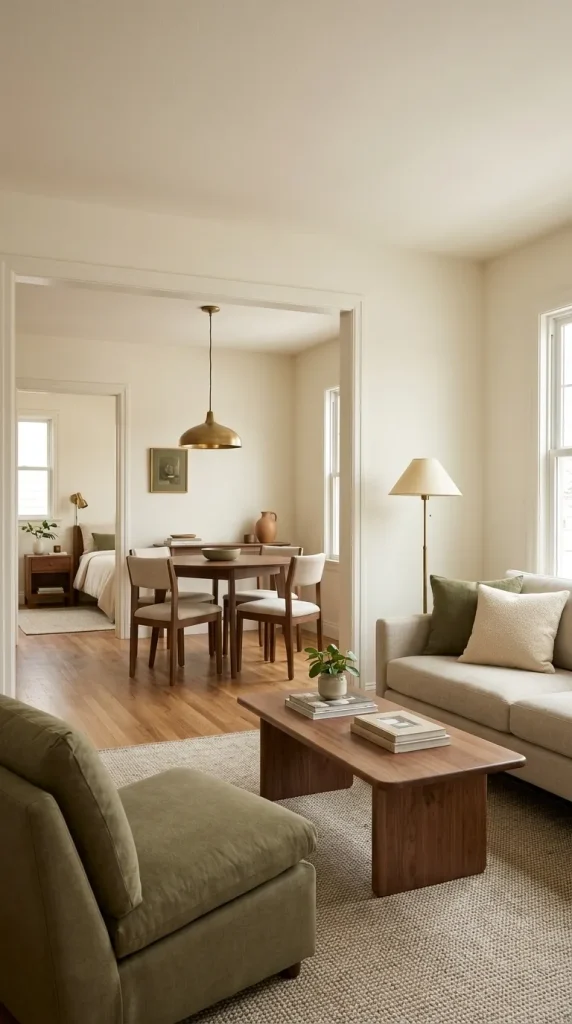
6. Build a loose whole-home color thread
Your rooms should relate to one another without being identical.
Choose a small group of recurring elements.
For example:
Warm ivory + walnut + olive + aged brass
Or:
Mushroom + medium oak + dusty blue + blackened metal
Or:
Cream + dark wood + burgundy + antique brass
You might use olive prominently in the living room, then repeat it subtly through a bedroom cushion or kitchen artwork.
The wood tone might appear in furniture throughout the house.
The same metal can repeat through lamps, frames, or hardware.
This repetition makes affordable or unrelated furniture feel more intentional.
But do not make every room use the exact same formula.
Continuity is useful.
Uniformity is not required.
Make the living room work before styling it
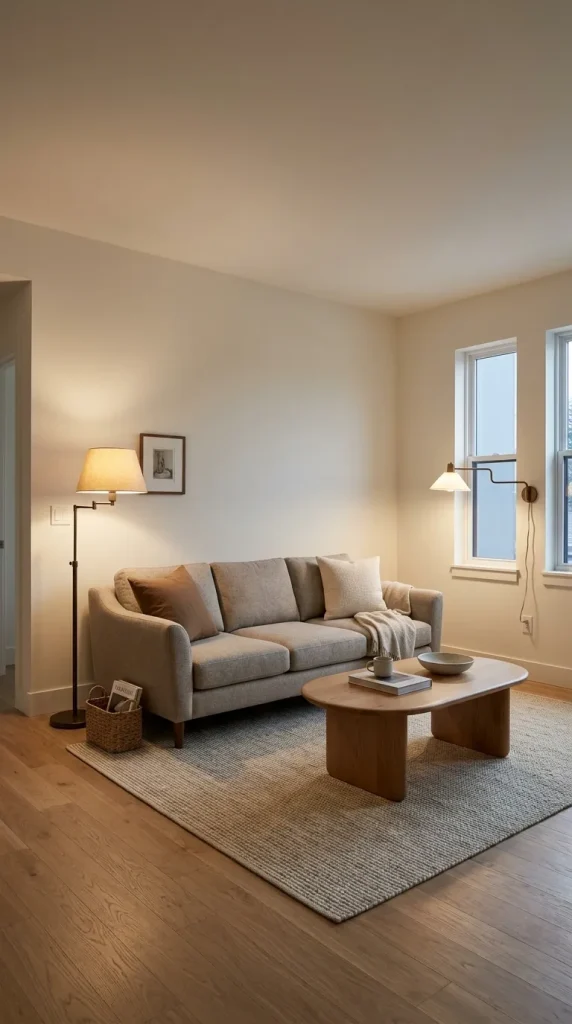
7. Start the living room with a sofa, rug, lighting, and one useful table
A first living room does not need a matching sofa, loveseat, coffee table, console, two side tables, and an accent chair on move-in day.
Start with the pieces that establish how the room works.
Usually:
A sofa.
A correctly scaled rug.
At least two useful light sources.
One coffee table, ottoman, or side table depending on the layout.
Then assess the empty spaces.
Perhaps you genuinely need a chair.
Perhaps what looked empty actually gives you valuable circulation.
The room can acquire books, art, cushions, plants, and smaller furniture gradually.
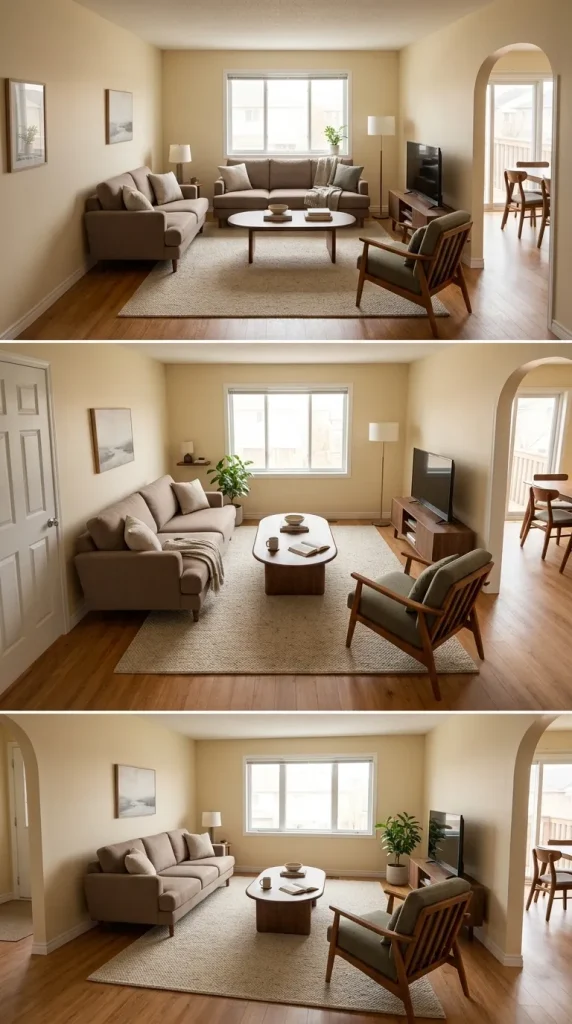
8. Arrange the living room around conversation and movement
One of the most common first-home layouts is furniture pressed tightly against every wall.
Sometimes that is necessary.
Often it is simply habit.
Where space permits, bring seating into a more deliberate relationship.
A sofa and chair should feel like they belong to the same conversation zone, not opposite sides of a waiting room.
Pay attention to natural movement between doors and adjoining rooms.
If everyone has to weave around the coffee table to cross the living room, styling is not the problem.
Layout is.
And if the television is important to daily life, acknowledge it rather than pretending it does not exist. Arrange the seating so television viewing and conversation can coexist comfortably.
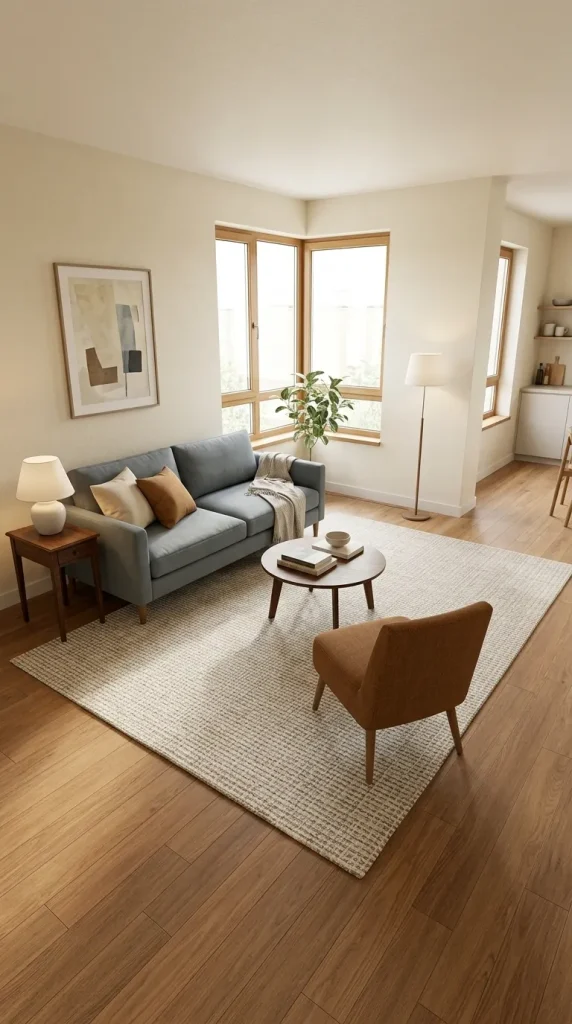
9. Choose a rug large enough to connect the furniture
An inexpensive rug in the right size can do more for a first living room than a costly rug that is too small.
A useful starting principle is to get at least the front legs of the main seating onto the rug where the layout allows.
That creates one visual zone.
A tiny rug floating beneath only the coffee table separates the pieces rather than connecting them.
Homes & Gardens describes rugs as doing substantial visual work by anchoring furniture and defining zones, which is especially useful when one room serves several functions.
The same logic applies in bedrooms and dining areas.
Scale matters before pattern does.
10. Layer lighting instead of depending on the ceiling fixture
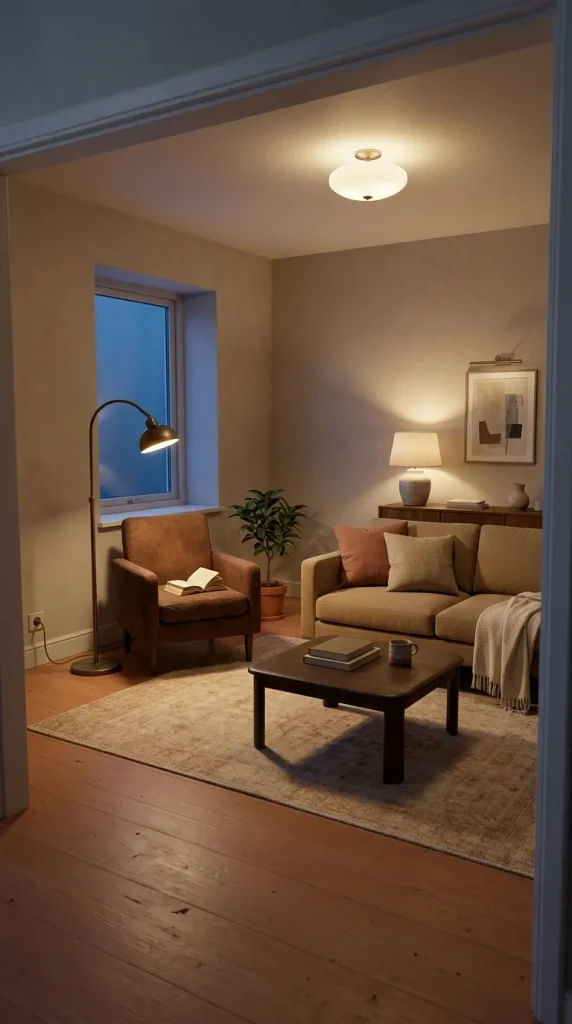
Few affordable changes improve an ordinary room faster than lighting.
A single bright ceiling fixture illuminates the room, but it rarely gives you flexibility.
Aim for layers.
Ambient light: ceiling fixture or general room illumination.
Task light: reading lamp, desk lamp, kitchen work light.
Accent light: table lamp, picture light, wall light, or low decorative lighting.
Designer Ashley Montgomery recently told Homes & Gardens that layered light should be considered as early as furniture layout rather than added as an afterthought, and current House Beautiful designer coverage has made the same argument for combining floor, table, and overhead lighting.
For a first home, lamps are especially useful because they are movable.
You can take them to another room or future property.
11. Treat curtains as architecture, not just privacy fabric
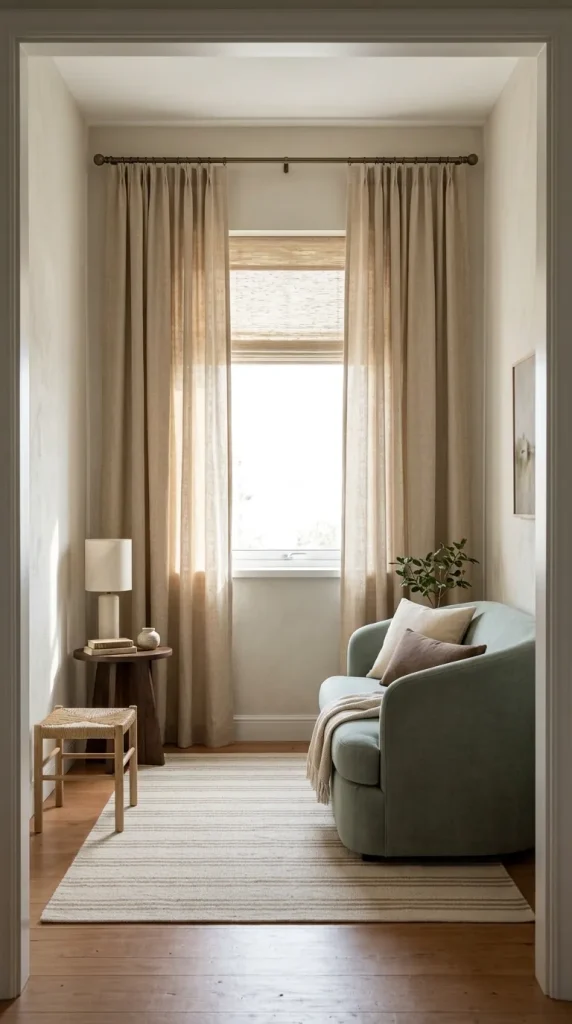
Bare windows can make an otherwise furnished room feel unfinished.
But badly proportioned curtains create another problem.
Where architecture allows, hanging the rod above the immediate window frame and allowing curtains to fall close to the floor can make the opening feel taller and more substantial.
Extend the rod far enough that opened curtains do not cover most of the glass.
You gain more daylight and give the window greater apparent width.
Neutral linen-look or cotton-blend curtains can be relatively affordable and flexible enough to move between rooms.
Current design coverage is even pushing window treatments further through layered shades and drapery, specifically because combining layers adds depth without requiring additional floor space.
You do not need that level of treatment everywhere.
But the broader principle is useful: windows are part of the room’s composition.
Make the first bedroom feel complete with fewer pieces
12. Build the bedroom around comfort before decoration
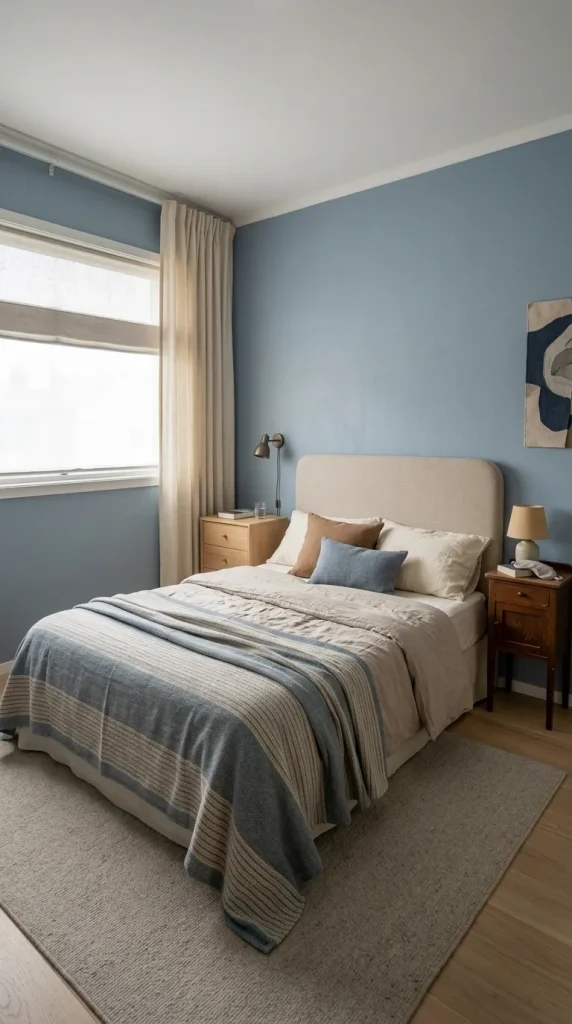
A first bedroom can feel polished with surprisingly little.
Start with:
Good bedding.
Bedside lighting.
Privacy at the windows.
Useful bedside storage.
A rug if the room needs softness.
One strong visual element.
That last element might be a headboard, artwork, wall color, or a beautiful bedspread.
You do not need six decorative cushions, a bench, matching bedside tables, a dresser, an armchair, and several wall objects just because styled bedrooms online contain them.
A bedroom usually benefits from slightly more visual quiet than a living room.
Let textiles carry some of the personality.
13. Give each side of a shared bedroom equal consideration
For couples setting up their first home together, the challenge is not finding a generic style both people can tolerate.
It is creating a room that feels shared.
Start with the functional decisions.
Does each person need a bedside surface?
Reading light?
Charging access?
Clothing storage?
Then develop a common design base through things both people genuinely like.
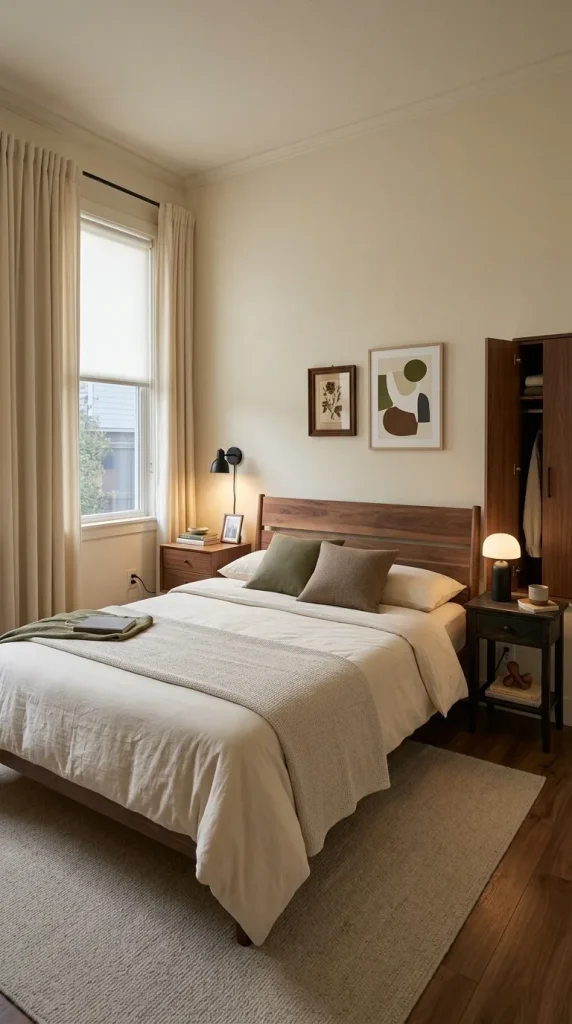
Perhaps the shared language is walnut furniture, warm cream bedding, olive accents, and black lighting.
Personal preferences can appear through art, books, textiles, photographs, and objects rather than forcing the room entirely toward one person’s previous aesthetic.
A shared room should look negotiated in the best sense, not neutralized.
Make functional spaces part of the decorating plan
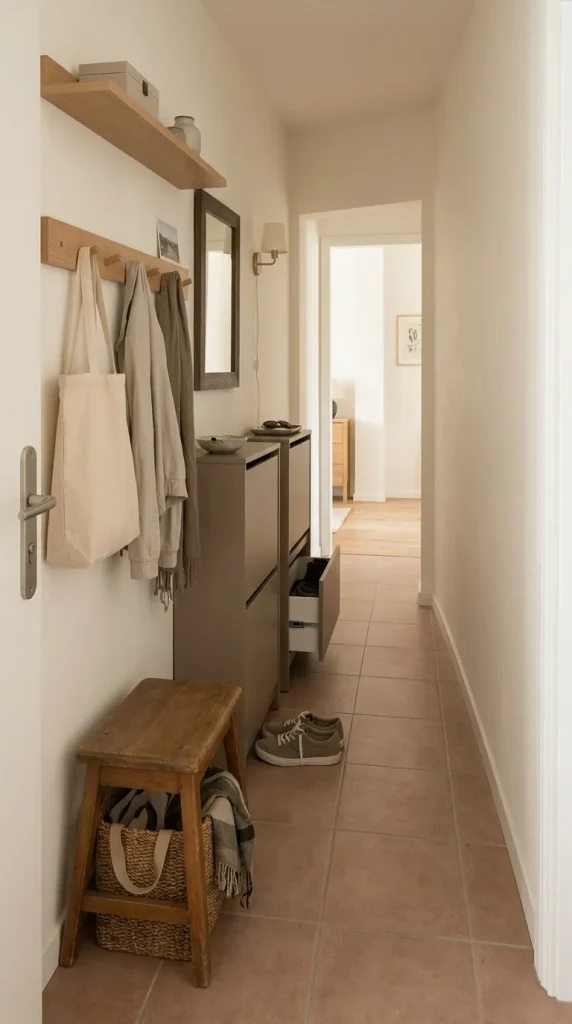
14. Create an entryway that catches everyday clutter
Even a tiny entrance benefits from having somewhere for the things that arrive with you.
Depending on space, use:
Hooks.
A narrow console.
A wall shelf.
Shoe storage.
A basket.
A tray.
A mirror.
A small stool.
This is decor doing real work.
An attractive bowl for keys is useful because keys actually need somewhere to go.
A beautiful basket is useful if it prevents shoes, bags, or scarves from migrating into the living room.
In very small entries, work vertically.
Apartment Therapy’s current small-space coverage continues to emphasize compact entryways and storage because these transitional areas have an outsized effect on how small homes function.
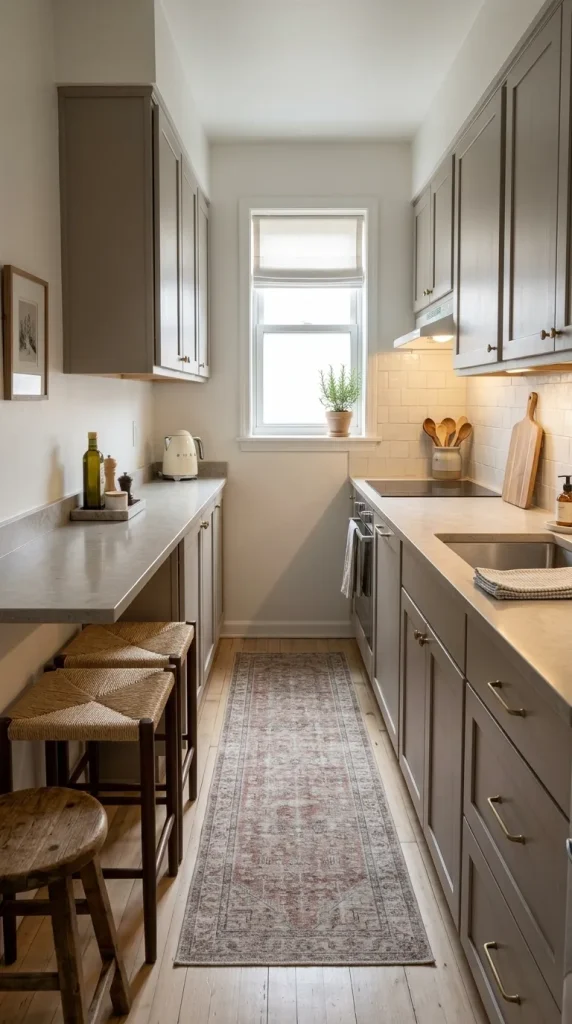
15. Keep the first kitchen visually edited
Kitchen decorating often goes wrong because every square inch of countertop becomes styling territory.
Remember what the surface is for.
Cooking.
Food preparation.
Cleaning.
Daily appliances.
Use decor to organize rather than crowd it.
A tray might contain oils and seasonings used every day.
A ceramic pot can hold utensils.
One plant or herb might soften a window.
A washable runner can introduce color.
New stools can change the visual weight around an island.
Replacing dated hardware can improve cabinetry without changing the cabinetry itself.
And where feasible, task lighting under cabinets can make the room more functional as well as more atmospheric.
The goal is not to decorate the countertop.
It is to make everyday objects look considered while leaving enough space to cook.
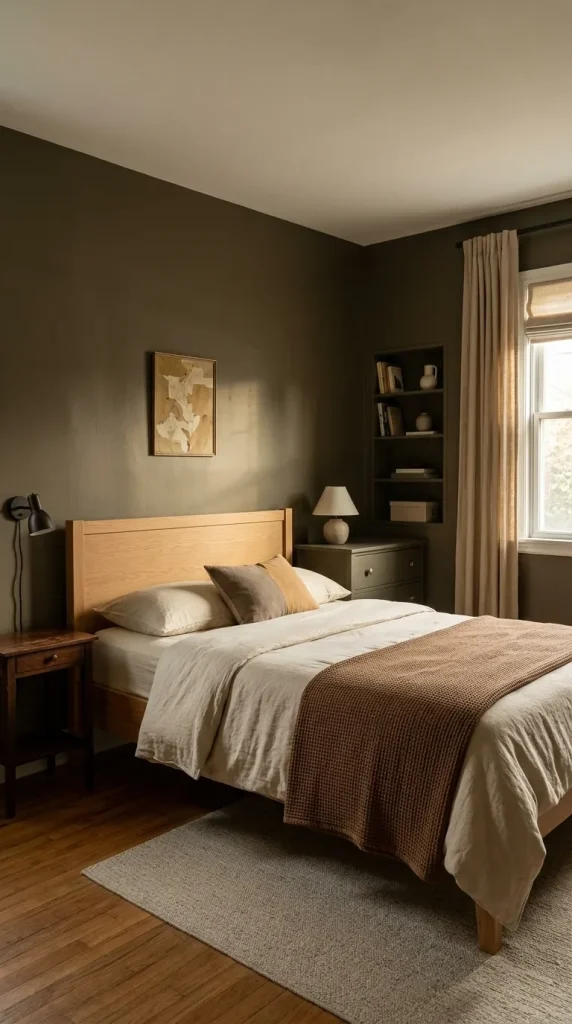
16. Use paint before assuming a room needs new furniture
Paint remains one of the highest-impact ways to change a first home, particularly for owners who have more freedom than renters.
But that does not mean every room needs a fashionable feature wall on move-in day.
Use paint strategically.
Perhaps a warm neutral fixes a cold living room.
A deeper bedroom color makes existing furniture look more substantial.
Painting old shelving the wall color reduces visual clutter.
Repainting an inexpensive dresser makes it belong beside a better bed.
Current AD renovation coverage continues to identify strategic paint as one of the ways homes can be meaningfully changed without a full reconstruction.
For renters, use removable treatments only where the lease and surface permit them.
Design a small first home around flexibility
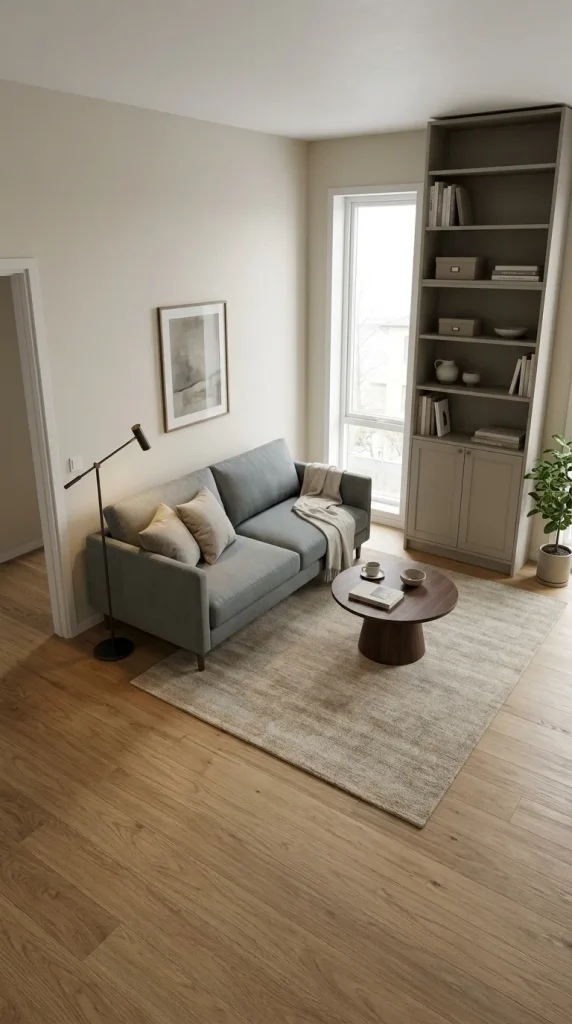
17. Do not automatically buy miniature furniture for a small home
A small room does not need ten tiny pieces of furniture.
Several undersized objects can actually make it feel busier.
Instead, prioritize fewer pieces with appropriate scale.
One comfortable sofa may work better than a tiny sofa plus two unnecessary chairs.
A reasonably generous rug can unify a small living room.
A full-height bookcase may use wall space more efficiently than three low storage units.
Visual breathing room matters as much as furniture dimensions.
The question is not simply, “Is this small?”
Ask:
“Does it leave useful circulation and perform enough functions to justify the space it occupies?”

18. Choose furniture that performs more than one job
Multifunctional furniture is especially valuable in starter homes and first apartments.
Useful examples include:
An ottoman with storage.
A dining table that doubles as a desk.
A bench with shoe storage.
A sleeper sofa when guests genuinely stay over.
A side table with drawers.
A console that can later serve as a desk or vanity.
A dresser used as a bedside table in a tight bedroom.
The best multifunctional piece does not advertise itself as clever.
It simply solves two real problems without taking twice the space.

19. Use vertical storage before adding more floor furniture
When a small first home starts feeling crowded, look upward before adding another cabinet.
Tall shelving.
Wall-mounted storage.
Hooks.
Over-door storage where appropriate.
Kitchen rails.
Upper wall shelving.
Bookcases.
Closed wall cabinets.
These options can preserve floor area.
But avoid filling every wall to the ceiling.
Vertical storage works best when it is concentrated where the storage problem actually occurs.
A kitchen may need vertical storage.
The calm wall behind a sofa might be better left largely empty.
Treat storage as part of the visual design
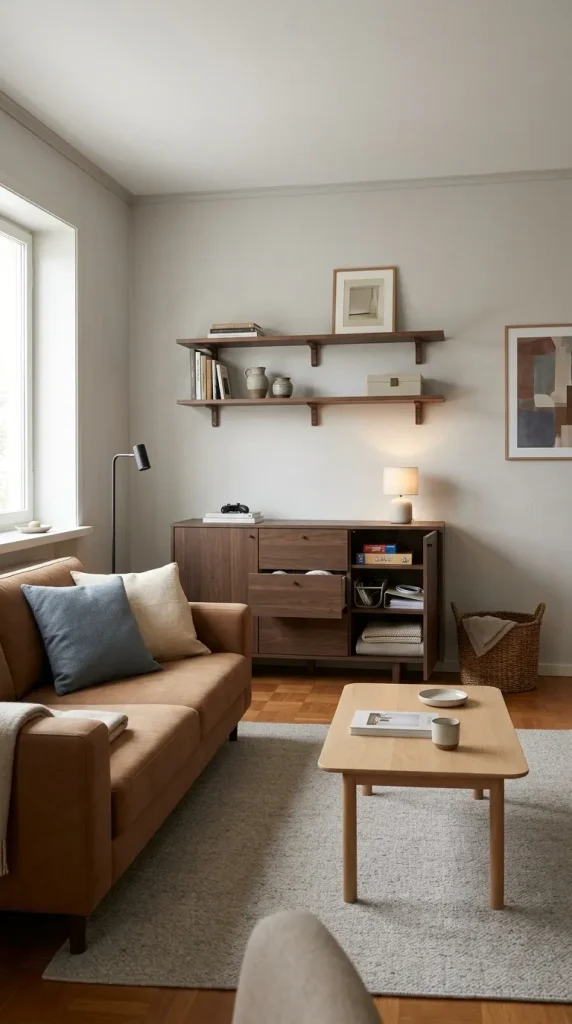
20. Hide unattractive everyday clutter before buying more decor
Storage is one of the most underrated first home decor ideas because a room can contain beautiful furniture and still feel unfinished when everyday objects have nowhere to go.
Use a combination of open and closed storage.
Open shelves work for:
Books.
Ceramics.
Art.
A few useful objects.
Closed storage works for:
Paperwork.
Chargers.
Games.
Cleaning products.
Extra linens.
Household supplies.
Do not expect decorative baskets to solve every storage problem either.
Five exposed baskets full of unrelated objects are still visually busy.
The best storage makes the room easier to reset.
Use secondhand pieces to create character and save money
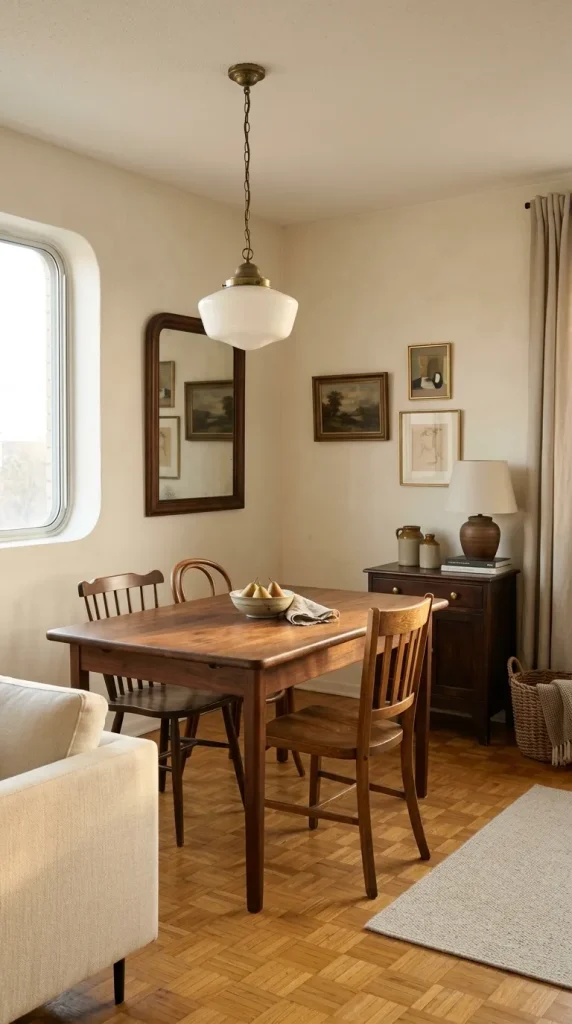
21. Buy secondhand where age improves the object
Some categories become more interesting with age.
Good candidates include:
Solid-wood side tables.
Dining tables.
Mirrors.
Wooden chairs.
Picture frames.
Ceramics.
Lamps.
Dressers.
Small cabinets.
Artwork.
Baskets.
Current designer commentary continues to favor vintage and antique pieces precisely because they prevent rooms from feeling generic or completely purchased from one showroom. House Beautiful’s 2026 coverage particularly highlights vintage mirrors, side tables, furniture, ceramics, art, lighting, and rugs for their character and craftsmanship.
Use more caution with mattresses and used upholstery where hygiene, pests, structural condition, and cleaning history may be uncertain.
The objective is not to make the whole home vintage.
It is to allow older pieces to interrupt the sameness of new furniture.
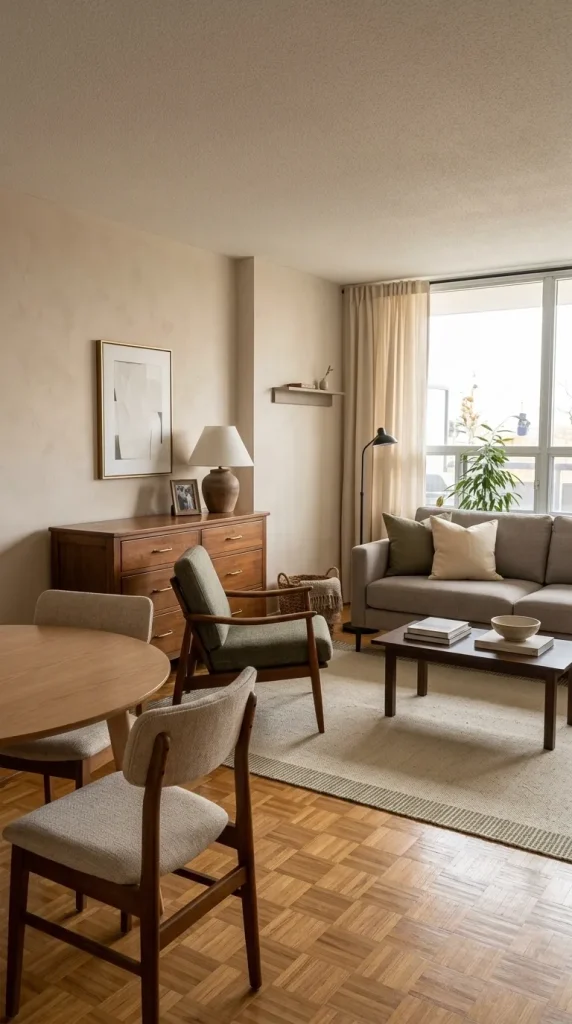
22. Mix hand-me-downs with new furniture instead of apologizing for them
Most first homes are assembled from several sources.
A family dresser.
A budget sofa.
A newly purchased bed.
Old dining chairs.
A thrifted lamp.
That mix can become an advantage.
Look for relationships rather than exact matches.
Perhaps two unrelated wood pieces share similar warmth.
Maybe changing the hardware connects an older dresser with newer brass lighting.
A slipcover or new cushion fabric can make an inherited chair relate to the living room.
Painting one piece may be enough.
Designers increasingly recommend mixing old and new precisely because rooms composed entirely of one era or one furniture range can feel staged rather than accumulated.
Use DIY where effort gives a meaningful return

23. Choose beginner DIY projects that change a large visual area
DIY is useful when the effort changes enough of the room to matter.
Good first-home projects include:
Painting a dresser.
Replacing cabinet knobs.
Framing inexpensive prints.
Creating simple artwork.
Upgrading a lampshade.
Painting shelves.
Adding removable wallpaper inside a bookcase or small niche where suitable.
Refinishing a basic table.
Creating straightforward storage from existing crates or baskets.
Avoid choosing advanced projects only because they appear inexpensive online.
A project requiring specialist tools, expensive materials, and several weekends may not actually be the budget option.
The best first-home DIY gives a large visual return for manageable skill and cost.
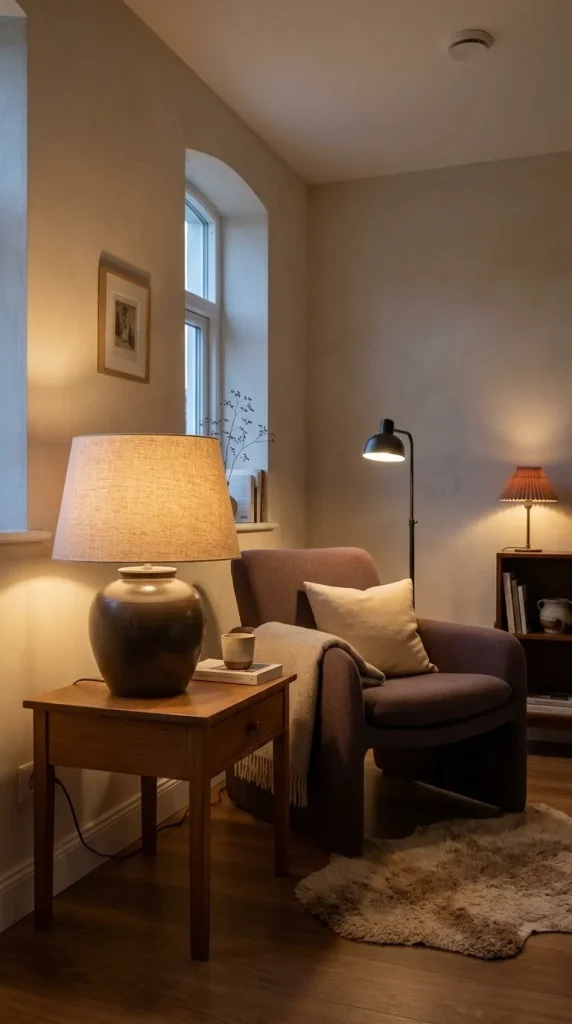
24. Upgrade lamps before replacing them
A basic lamp can often be improved dramatically with the right shade.
Consider proportion first.
A tiny shade on a substantial base looks unstable.
An oversized shade may overwhelm a narrow nightstand.
Then think about material.
Linen and fabric shades diffuse light.
Opaque metal directs it.
Pleated shades introduce more traditional character.
Colored shades can shift the mood.
House Beautiful has specifically highlighted lampshades as an important part of the current move toward “lampscaping,” where several smaller light sources create atmosphere rather than depending entirely on overhead lighting.
For a first home, this is a useful low-cost upgrade because a good lamp can move rooms many times.
Personalize the home without filling every surface
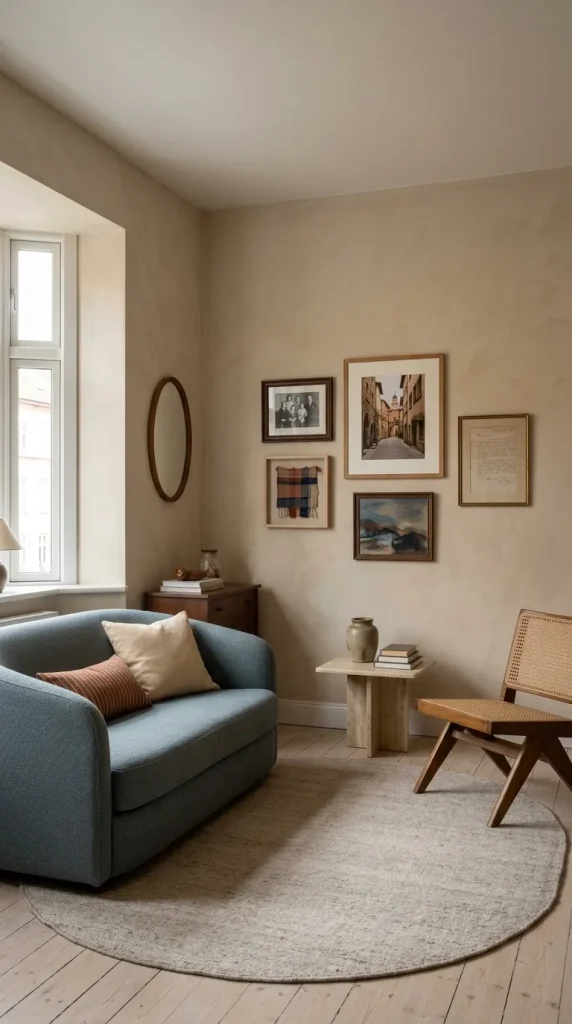
25. Buy less generic wall decor and display things that mean something
Your first home should not require an immediate order of twelve coordinated prints.
Start with things you would still care about without the room around them.
Family photographs.
Travel photography.
A textile.
An inherited piece.
A drawing.
A map.
An inexpensive print by an artist you genuinely like.
Thrifted artwork.
Children’s artwork where relevant.
A framed letter or meaningful document.
A mirror.
Current AD and BHG coverage both reflect a broader move away from anonymous mass-produced decor toward interiors with personal history, art, and idiosyncratic objects.
And leave some walls empty.
Negative space makes the pieces you do hang feel more intentional.

26. Use greenery where the room actually supports it
Plants can soften hard architectural lines and fill difficult corners relatively inexpensively.
But “add a plant” is not useful advice unless the plant can survive the location.
Consider:
Natural light.
Distance from the window.
Temperature.
Humidity.
Pet safety where relevant.
Your willingness to maintain it.
If a room receives very little usable daylight, a convincing faux plant may look better than a struggling real one.
Scale also matters.
One substantial plant can often do more for an empty corner than six tiny pots scattered through the room.
Coordinate instead of buying matching sets

27. Stop trying to make every furniture finish identical
Matching seems safe in a first home because it appears to guarantee cohesion.
But identical bed, nightstands, dresser, mirror, and chest can make a bedroom feel more like a furniture showroom than a personal space.
Coordinate instead.
A walnut bed can sit beside painted bedside tables.
Medium oak can coexist with darker wood if you repeat the darker tone elsewhere.
Black metal lighting can tie unrelated furniture together.
An old chest can work beside a modern sofa when the proportions and surrounding colors make sense.
BHG’s latest designer guidance likewise recommends complementary textures and vintage-inspired pieces over rigid matching sets because overly coordinated furniture can feel generic.
Repetition should come from relationships, not cloning.
Buy furniture that can survive your next move

28. Choose flexible early purchases over highly specific ones
Your first home may not be your last home.
That does not mean everything needs to be bland.
It means early furniture should have enough flexibility to live another life.
Useful examples include:
Simple bookcases.
A neutral or adaptable sofa.
Side tables that could later become bedside tables.
A small dining table that could become a desk.
A dresser with a straightforward shape.
Movable lamps.
Freestanding storage.
A bench that can work in an entryway, bedroom, or dining space.
Highly customized furniture can be worthwhile once you understand how long you expect to stay and how the property functions.
But buying it immediately can reduce flexibility.
This is particularly relevant to first apartments and starter homes.
Keep permanent choices calmer than movable personality

29. Put more personality into things you can change easily
For homeowners thinking about future flexibility or resale, you do not have to make the property anonymous.
Just be deliberate about where the boldest decisions live.
More permanent elements might stay relatively adaptable:
Major flooring.
Expensive cabinetry.
Large quantities of tile.
Some fixed fixtures.
Personality can then become stronger through:
Paint.
Wallpaper.
Art.
Rugs.
Furniture.
Curtains.
Lighting.
Textiles.
Decorative objects.
This approach gives you permission to create a distinctive home without expecting every future owner to love a highly specific permanent installation.
And even if resale is irrelevant, movable personality has another advantage.
Your taste can evolve without requiring demolition.
Let the home become more personal over time

30. Leave room for objects you have not found yet
This may be the most important first-home decorating idea.
Do not fill every shelf.
Do not complete every gallery wall.
Do not buy a decorative object simply because there is an empty corner.
Leave some space for the lamp you find at a flea market next year.
The photograph you take on a future trip.
The chair inherited from someone important.
The ceramic piece bought from a local maker.
The books you have not read yet.
The piece of furniture you can afford after saving rather than settling now.
Architectural Digest’s recent “jewelry-box” theory of decorating describes successful interiors as beginning with dependable foundations and then acquiring pieces with history and stronger character over time.
That is particularly good advice for a first home.
Your home does not become personal because you successfully fill it.
It becomes personal because the things in it gradually begin to have reasons for being there.
Where should you spend and where can you save?
There is no universal budget formula, but this is a practical starting framework.
| Category | Usually worth prioritizing | Often safe to save or thrift |
|---|---|---|
| Bedroom | Mattress, pillows you actually sleep on, useful lighting | Nightstands, frames, decorative cushions |
| Living room | Comfortable sofa, suitable rug size, functional lighting | Side tables, decorative objects, art frames |
| Dining | Comfortable everyday chairs, suitably sized table | Decorative centerpiece, occasional serving pieces |
| Kitchen | Useful task lighting, durable everyday tools | Trays, containers, art, decorative accessories |
| Storage | Pieces opened and used every day | Baskets, hooks, smaller organizers |
| Windows | Privacy and functional coverage | Decorative layering can come later |
| Decor | One or two meaningful pieces | Most small accessories can be gradual or secondhand |
The point is not to spend heavily in every “investment” category.
It is to avoid spending most of the decorating budget on the least functional layer.
The first-home decorating order that usually makes more sense
If your home currently feels empty and you do not know where to start, work roughly in this order:
First: measure and understand the room.
Second: solve essential furniture and storage.
Third: correct the layout.
Fourth: improve lighting.
Fifth: add window treatments and appropriately scaled rugs.
Sixth: establish the color and material relationships.
Seventh: add artwork and personal objects.
Eighth: fill remaining gaps only when you understand what they need.
This sequence is much less exciting than buying accessories first.
It is also much more likely to produce a room that eventually looks good.
Common first-home decorating mistakes
Buying everything before measuring
The most attractive sofa is useless if it cannot pass through the stairwell or leaves no comfortable circulation.
Choosing furniture that is too large
A room should not have to surrender all of its breathing room to one oversized sectional.
Buying furniture that is unnecessarily small
The opposite problem exists too. A room full of tiny pieces can appear fragmented.
Using an undersized rug
The rug should help connect furniture, not isolate the coffee table.
Depending entirely on overhead lighting
Rooms need more than one light level to feel comfortable throughout the day.
Filling every wall
Empty wall space is not automatically an unfinished problem.
Buying complete matching sets
Coordination can come through color, material, proportion, or repetition without buying every piece from one range.
Choosing style over storage
A beautiful living room that cannot contain ordinary life will become cluttered quickly.
Spending heavily on decorative accessories first
Solve comfort and function before styling.
Copying trends without considering the household
A home designed for someone else’s daily life will rarely function perfectly for yours.
Try this if your first home still feels unfinished
Do not go shopping yet.
Choose the room that bothers you most and remove small accessories from the equation.
Ask five questions.
Does the furniture layout work?
Is the rug properly scaled?
Is there enough lighting at different heights?
Are the windows visually finished?
Does everyday clutter have somewhere to go?
Correct those issues first.
Then look at the room again.
You may discover that what felt like a lack of decor was actually a lack of structure.
Only then add art, textiles, greenery, books, ceramics, or other personal layers.
This is one reason a temporary “no-buy” period can be revealing. A 2026 House Beautiful experiment found that rearranging, editing, and working with existing belongings could materially improve a room without purchasing more decorative objects.
Frequently Asked Questions
How should I decorate my first home on a budget?
Prioritize the pieces that affect daily comfort and function, then build decorative layers gradually. Use paint, furniture rearrangement, lighting, curtains, rugs, secondhand pieces, affordable artwork, and simple DIY projects for high-impact changes. Do not try to complete every room immediately.
What should I buy first for a new home?
Start with essentials such as a good mattress, functional seating, necessary dining furniture, useful lighting, privacy at windows, and enough storage for everyday life. Decorative tables, extra cushions, frames, vases, and seasonal accessories can usually come later.
How can I make my first living room look finished?
Focus on layout before accessories. Use a sofa positioned for conversation and circulation, a rug large enough to connect the seating, curtains that properly relate to the windows, and several light sources at different heights. Then add art, plants, books, and textiles gradually.
How do couples decorate their first home together?
Agree on broad qualities rather than forcing one specific style. Choose major furniture and permanent decisions together, then let each person’s character appear through artwork, books, color, textiles, and personal objects. Shared rooms should contain evidence of both people.
Should I buy matching furniture for my first home?
Usually, no. Matching sets make shopping easy, but mixing compatible pieces often produces a more personal room. Look for connections through wood tone, color, shape, metal finish, scale, or upholstery rather than requiring every item to match exactly.
Give your first home time to become yours
The most useful first home decor ideas are rarely about buying more.
They are about making better decisions in the right order.
Measure before buying furniture. Solve the layout before styling it. Invest where comfort and daily use justify the cost. Save on pieces that can be thrifted, repainted, replaced, or collected gradually.
Use lighting, rugs, curtains, color, storage, and furniture placement to establish the room before filling it with accessories.
And resist the idea that your home should look completely finished a few weeks after moving in.
A convincing home develops layers.
Some are practical.
Some are decorative.
Some are inherited, found, made, or remembered.
Your first home does not need to demonstrate that you bought everything you need.
It should gradually demonstrate how you live.