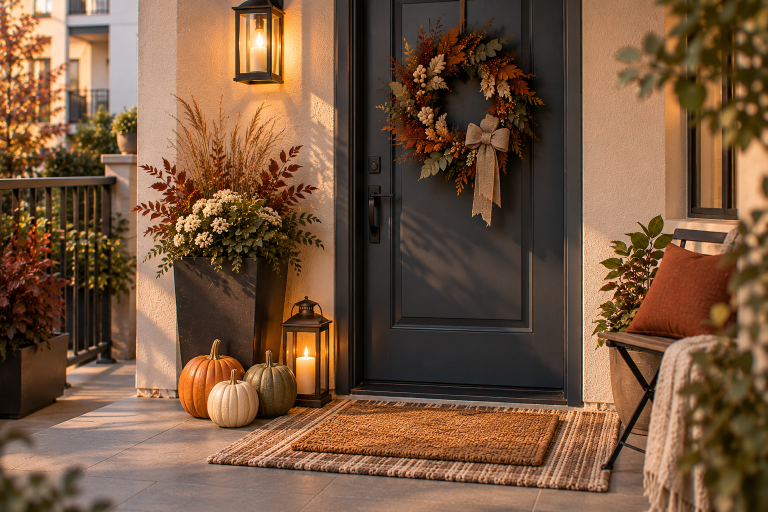
20 Fall Front Porch Garland, Rug and Doormat Ideas for a Layered Autumn Entry
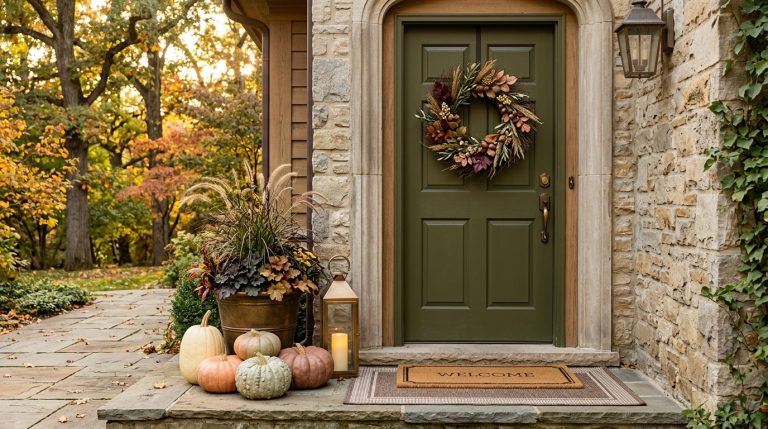
A front porch can have beautiful pumpkins and healthy mums and still feel unfinished if the doorway and floor have no connection. That is where garlands, outdoor rugs, and doormats become useful. They frame the entrance, add pattern without using valuable floor space, and help separate a deliberate fall display from a collection of seasonal objects.
The strongest fall front porch garland ideas for 2026 are also becoming less formulaic. Instead of bright orange leaf garlands paired with novelty mats, current outdoor fall styling is leaning toward layered natural foliage, deeper burgundy and ochre tones, understated wreaths, textured outdoor rugs, and pieces that can stay through Thanksgiving. HGTV’s September 2026 outdoor fall guidance specifically recommends refreshing the porch with a seasonal wreath, rug or doormat, planters, and other adaptable accessories rather than rebuilding the whole entrance.
These 20 practical ideas show how to combine all three layers without creating a busy or difficult-to-maintain doorway.
Frame the door with fall garland
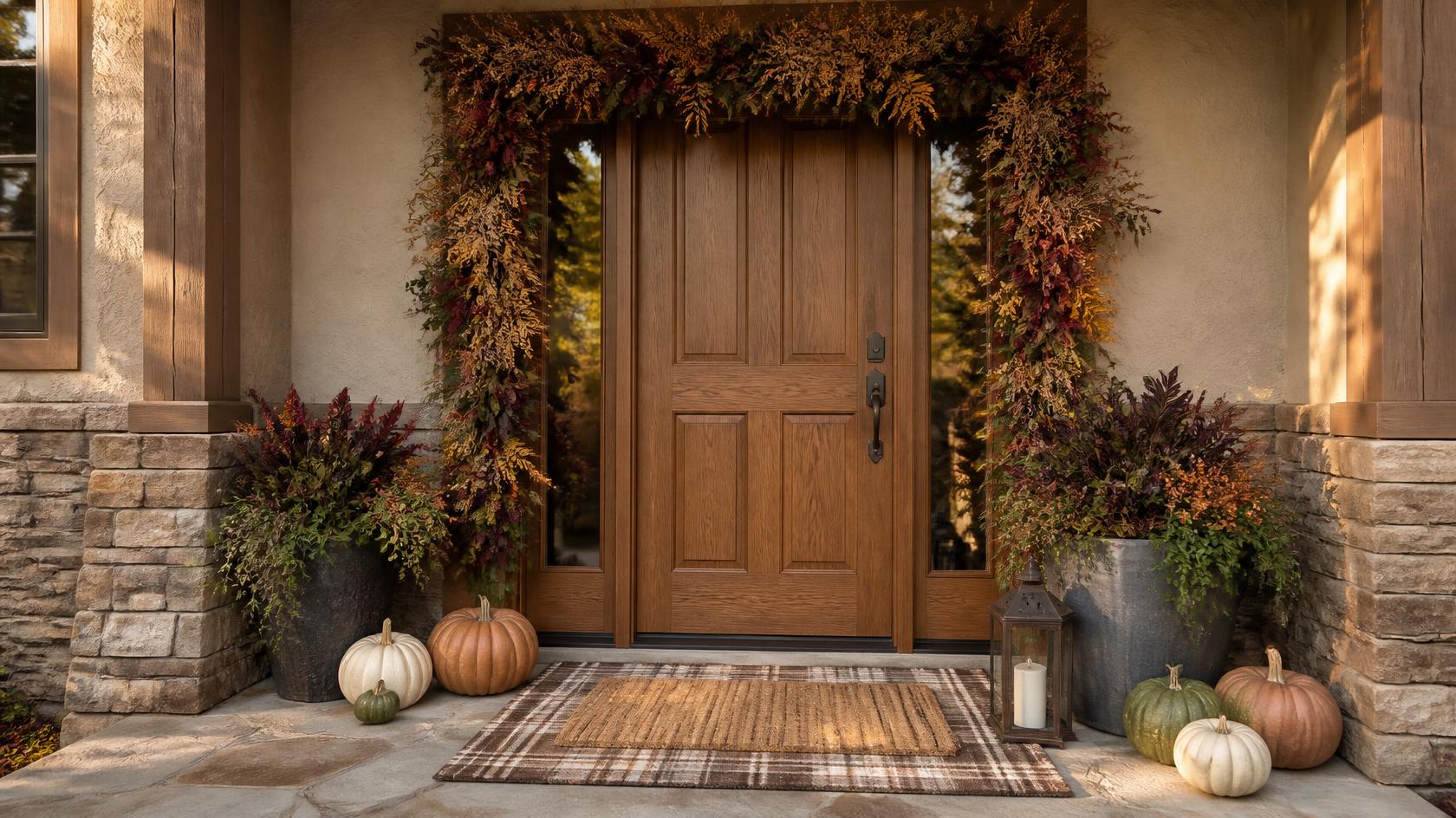
Idea 1: Drape one full garland around the door frame
A single substantial garland often looks better than several small strands. Run it across the top of the door and down both sides, keeping enough clearance that it cannot become caught in the door.
For a current fall palette, try burgundy leaves, golden fern, olive foliage, dried-look grasses, muted maple leaves, or small berry clusters. Homes & Gardens’ 2026 fall-garland coverage shows a wider range than traditional orange foliage, including burgundy florals, golden fern, and more nuanced botanical colors.
If the door already has a large wreath, use a relatively restrained garland so the two do not compete.
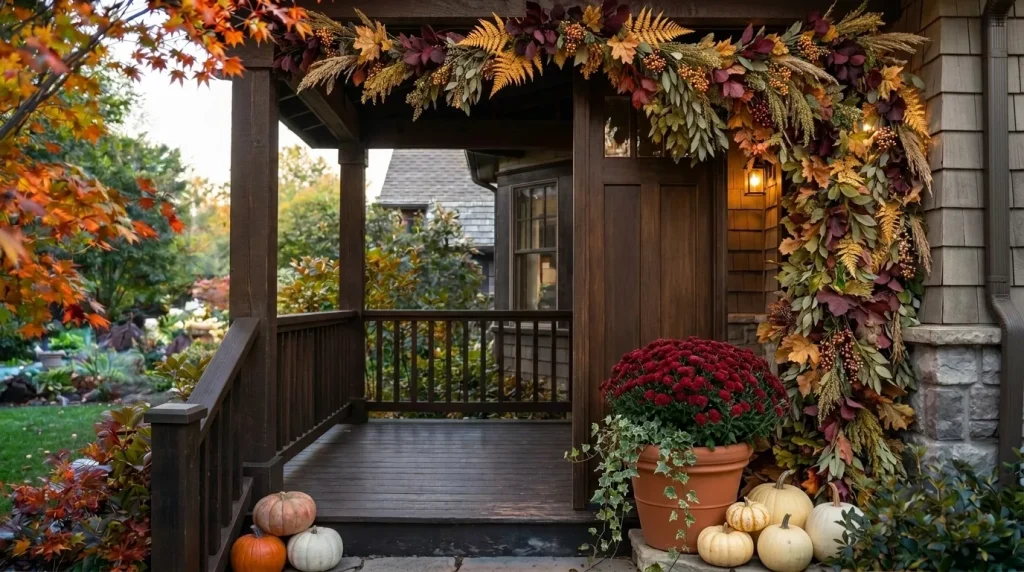
Idea 2: Hang an asymmetrical garland instead of framing the whole door
You do not need equal foliage on both sides. Attach the fullest part near one upper corner and let it trail down one side of the doorway. This works particularly well on small porches because it creates height without visually enclosing the whole entrance.
Add a planter or pumpkin cluster beneath the lower end so the garland feels connected to the floor. An asymmetrical arrangement also requires less material than a complete surround.
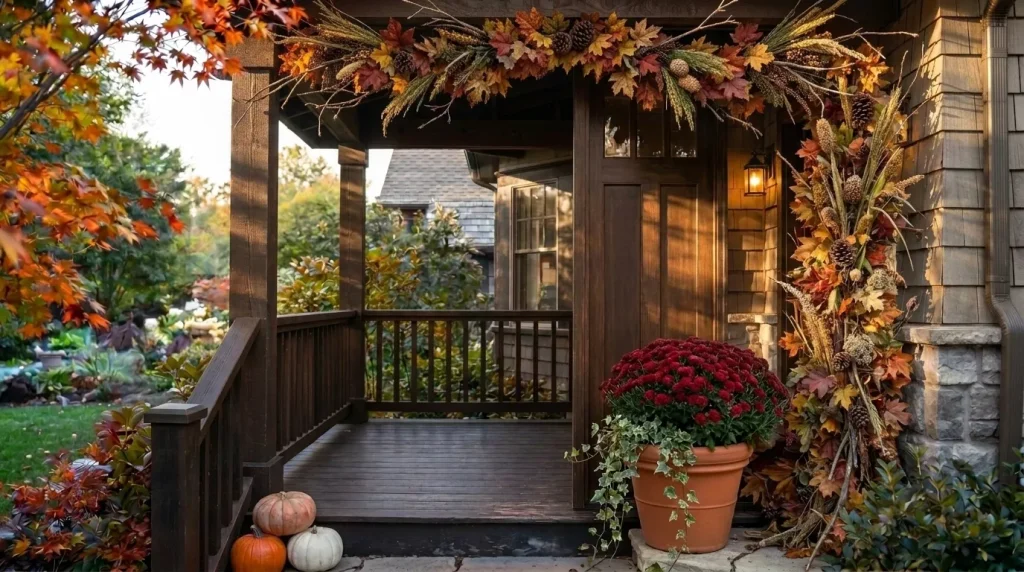
Idea 3: Make a garland from faux leaves and natural branches
A completely natural outdoor garland can be short-lived, while an entirely plastic one can look flat. Mix the two. Start with a reusable faux foliage base and wire in dried grasses, small branches, seed heads, pinecones, or locally available natural material.
Homes & Gardens recommends combining fresh greens and dried florals for fall entrances because the contrast creates a more layered, less predictable result. Use floral wire rather than permanent glue if you want to refresh the same base next year.
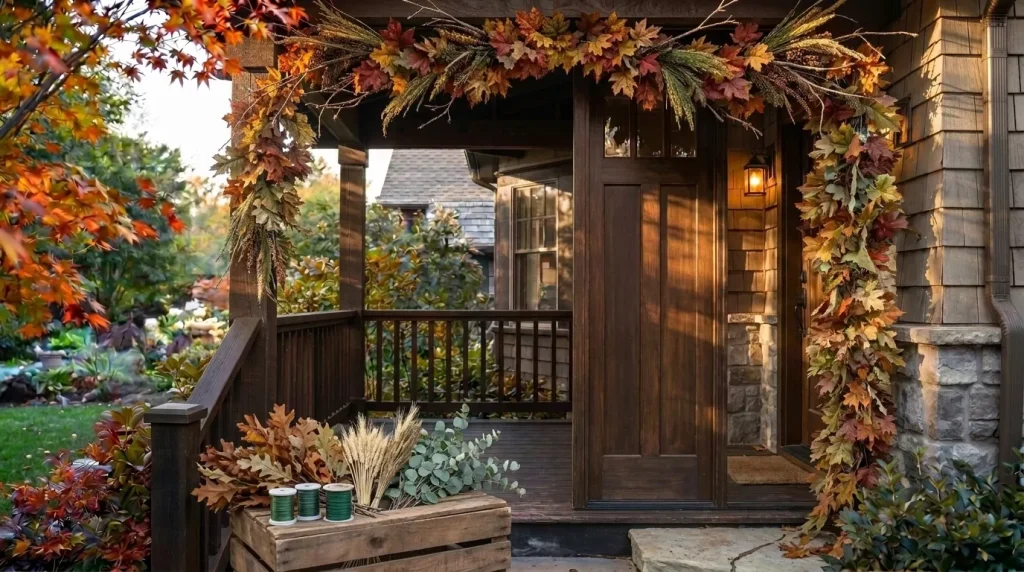
Idea 4: Build a simple fall leaf garland yourself
If you enjoy DIY projects, use faux leaves, flexible stems, or preserved-looking foliage to make a garland to fit your exact doorway. HGTV’s garland tutorial recommends hanging from hooks at the upper corners and adding center support if the garland becomes heavy.
Dry-fit the garland before securing anything. That tells you whether it is too long, too bulky, or hanging low enough to interfere with the door. A custom length almost always looks better than forcing a standard garland onto an awkward entrance.
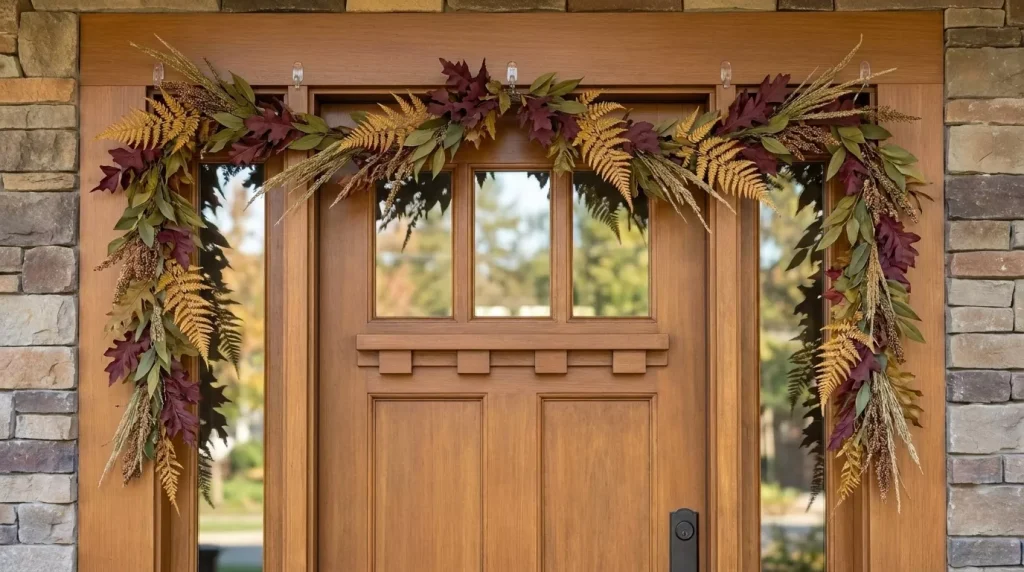
Idea 5: Use outdoor-rated removable hooks when appropriate
Renters and homeowners who do not want nail holes have several non-permanent options. Outdoor-rated adhesive hooks can work on suitable smooth surfaces when installed according to their manufacturer’s surface preparation, weight, and weather instructions. 3M specifically markets outdoor hooks for doors, siding, and trim, including exposure to moisture and temperature changes.
Do not assume any adhesive hook will work on every painted, textured, porous, or delicate surface. Follow the product instructions and keep heavy garlands within the rated load.
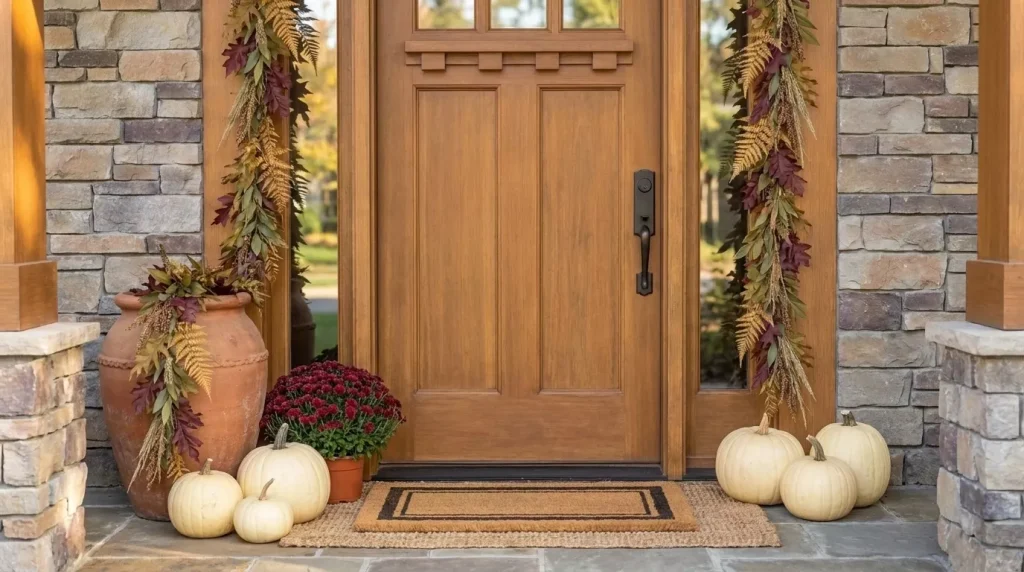
Idea 6: Keep the lower ends of the garland off the ground
A dramatic garland puddling on the porch can look beautiful in a photograph, but outdoors it also collects dirt, leaves, and moisture. Stop the garland several inches above the floor or let it finish near the top of a planter.
This is particularly important near the doormat, where repeated foot traffic can snag loose foliage. Your garland should frame the entrance, not become part of the walking surface.
Use garland beyond the doorway
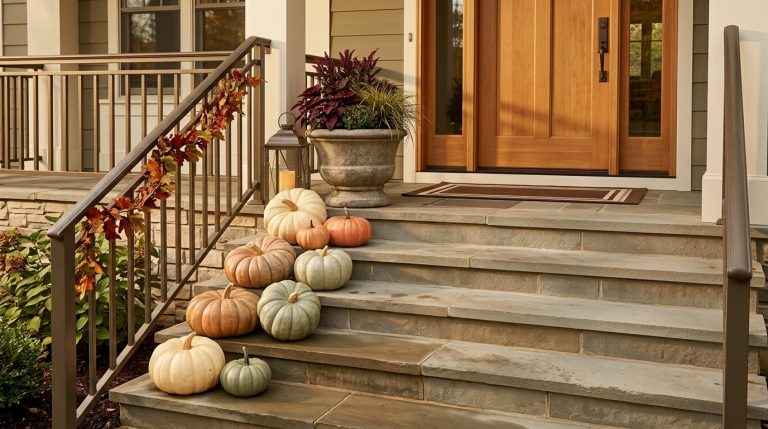
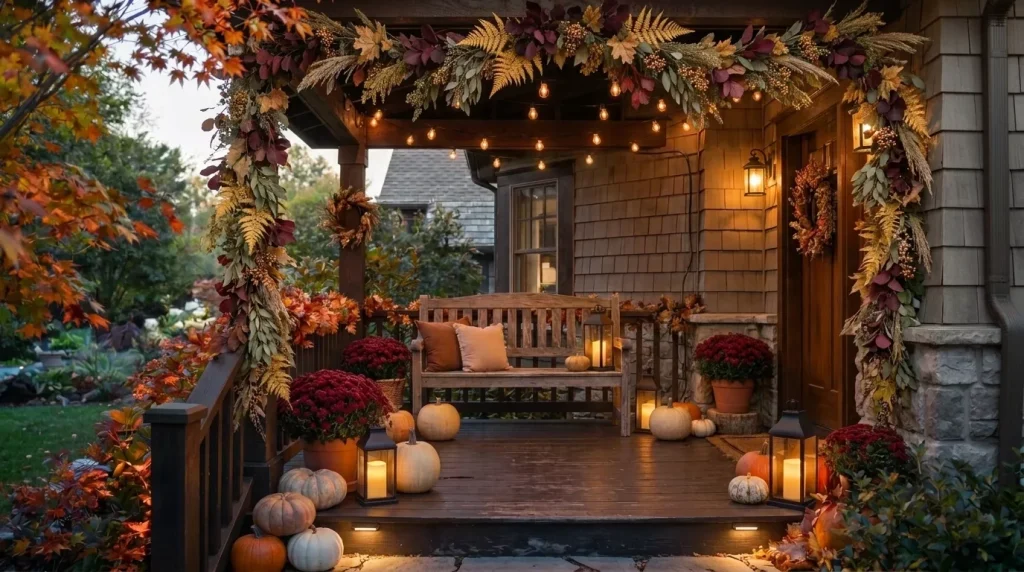
Idea 7: Drape garland across a porch railing
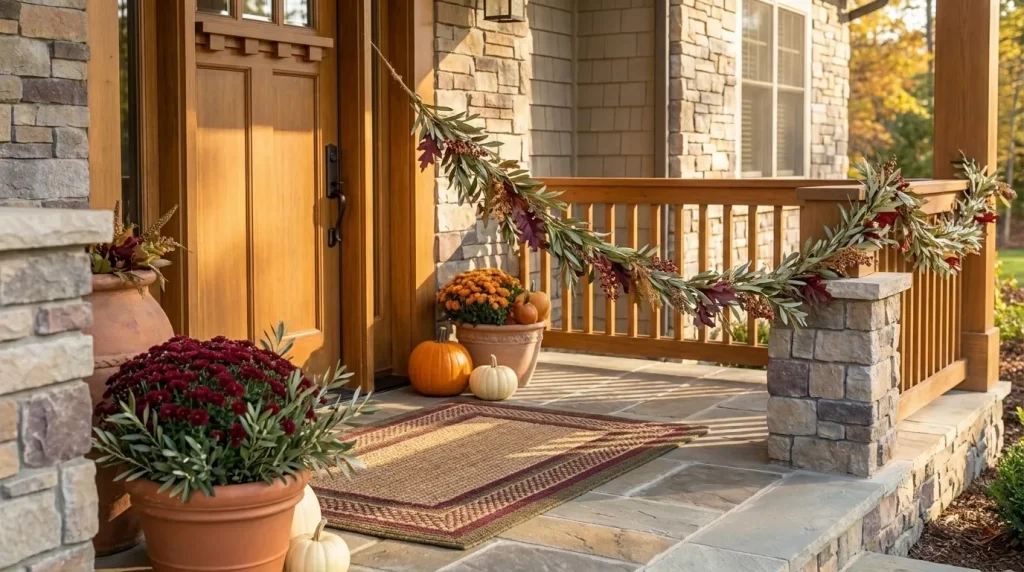
If the door already has a wreath, move the garland elsewhere. Run it along one section of railing and secure it at several points so it cannot sag into the stairs.
Use a lighter garland than you would around the door. Then repeat one color from the railing garland in your porch planters or doormat. The repetition ties the separate areas together without needing identical decor everywhere.
Idea 8: Use garland along the back of a porch bench
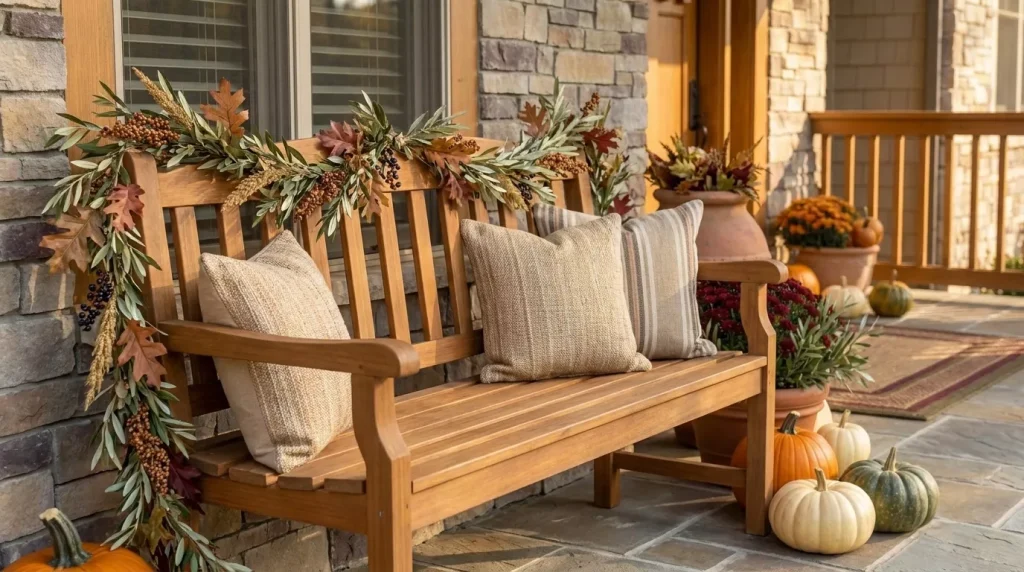
A bench gives you another horizontal surface for seasonal greenery. Drape a light garland along the back rail rather than covering the seat. HGTV notes that garlands can be displayed on benches as an alternative to framing a door, a nice pairing with the seating ideas in our 21 Fall Front Porch Bench and Rocking Chair Ideas.
Keep the garland secured enough that it will not fall onto anyone sitting there. For a farmhouse look, use olive, rust, dried-look foliage, and small berry clusters instead of a heavily glittered strand.
Build the floor layer with an outdoor rug
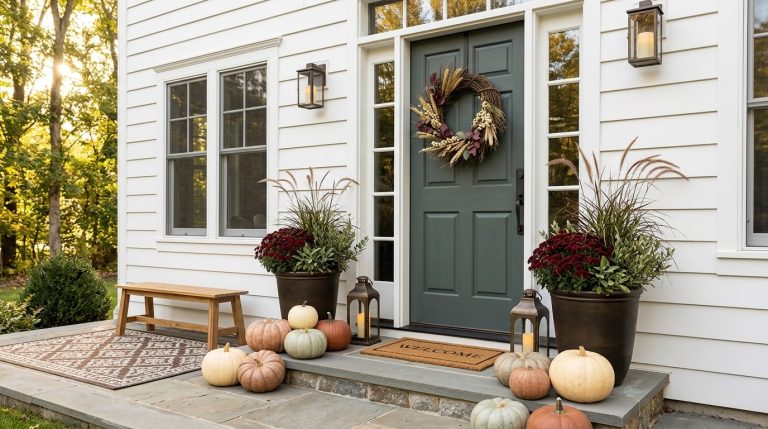
Idea 9: Layer a small outdoor rug beneath a coir doormat
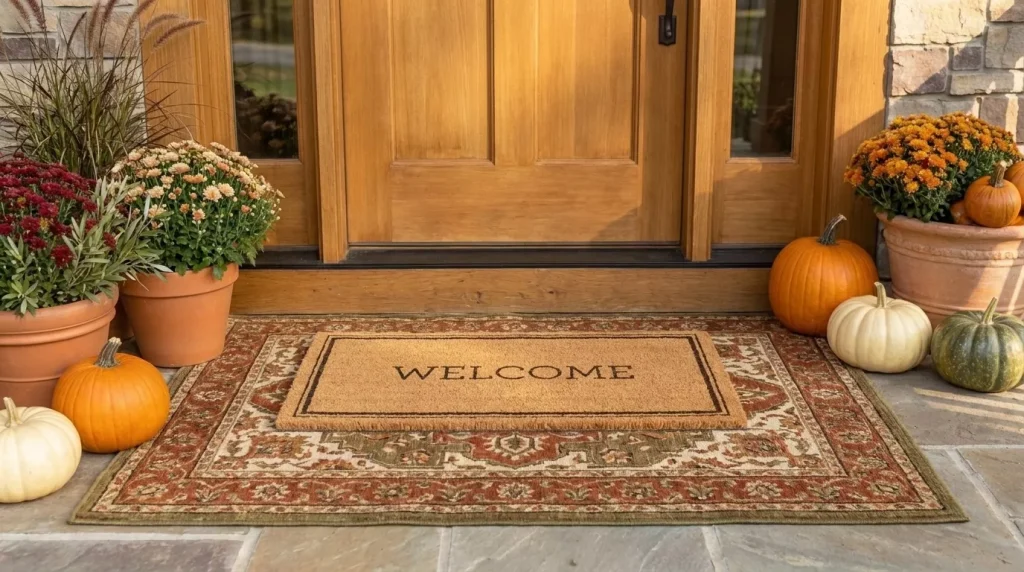
This is one of the easiest layered door mat ideas for a front porch in fall. Place a patterned outdoor rug beneath your regular doormat so several inches of the lower rug remain visible around the sides.
HGTV specifically recommends the layered rug approach for fall porches, using a plaid lower layer under a seasonal top mat. Country Living’s September 2026 advice suggests a small outdoor rug, around 2-by-3 feet or similarly compact depending on the doorway, beneath a natural-fiber doormat. Measure first. The door still needs to open freely over both layers.
Idea 10: Use brown-and-cream plaid instead of bright orange
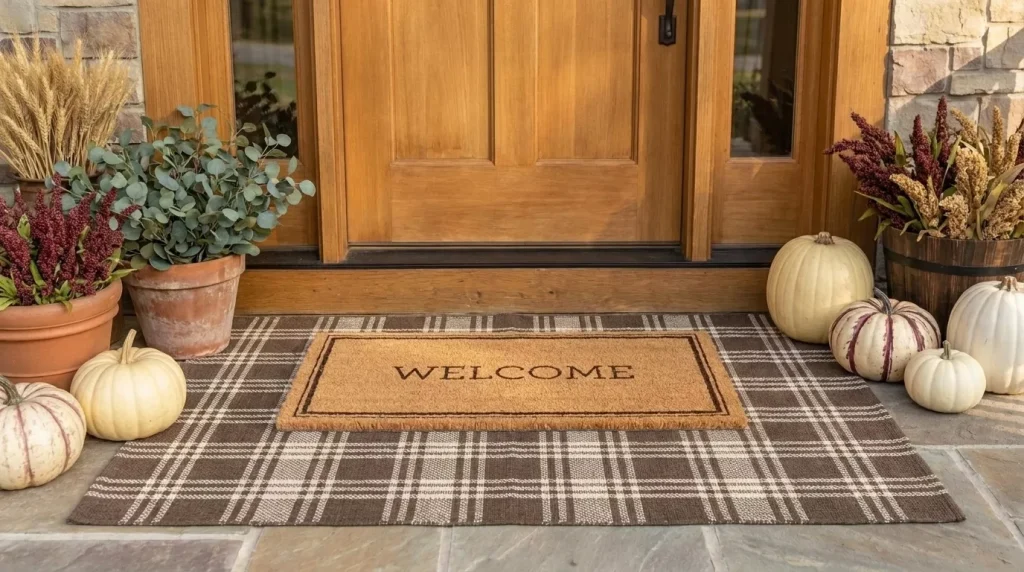
The bottom rug does not need literal pumpkins. A brown, cream, olive, burgundy, charcoal, or rust plaid can feel autumnal while staying usable beyond Thanksgiving.
Try chocolate with cream, olive with tan, burgundy with oatmeal, or rust with charcoal. A more general fall palette gives you greater flexibility if the top doormat already carries a seasonal motif.
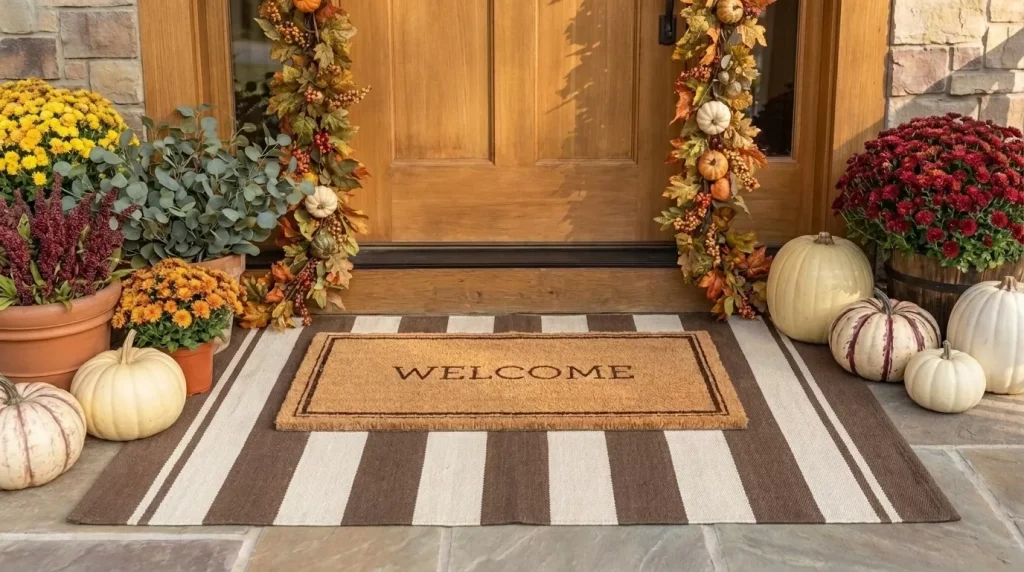
Idea 11: Try a simple stripe for a cleaner porch
If garland, pumpkins, and mums already provide plenty of detail, keep the rug quiet. A wide stripe is one of the easiest choices.
Better Homes & Gardens’ September 2026 porch roundup specifically highlights an inexpensive striped outdoor rug as a practical fall refresh because it adds color and durability without dominating the entrance. A brown-and-cream stripe works well with traditional decor, black and tan feels more graphic, and olive and cream can soften a farmhouse entrance.
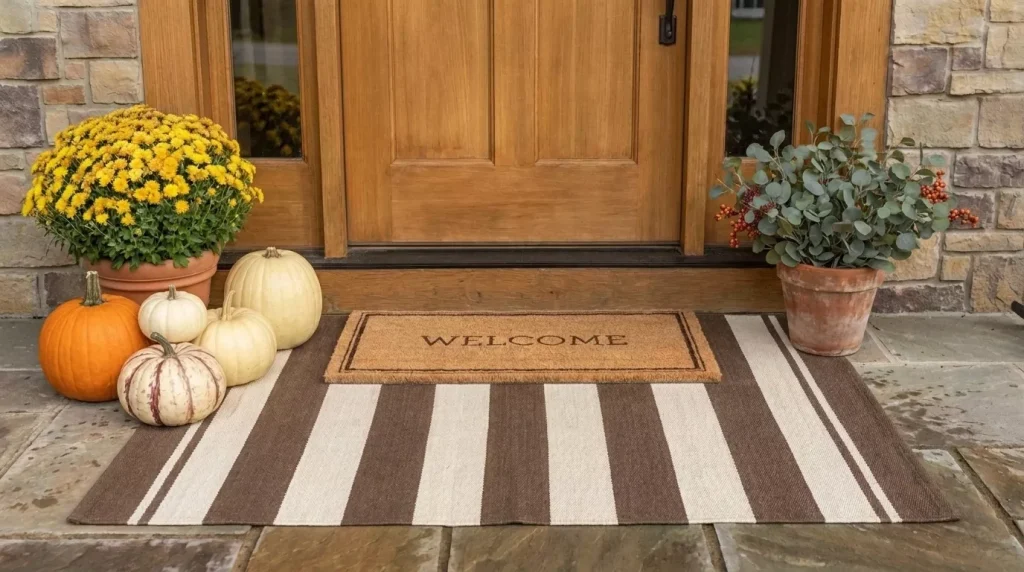
Idea 12: Choose an outdoor rug material based on exposure
A rug for an uncovered porch needs to handle weather very differently from one beneath a deep roof. Lowe’s current outdoor-rug guidance identifies polypropylene as a practical all-around option because it resists moisture, stains, mold, and mildew. Polyester can offer strong color retention, while jute and sisal are better suited to protected covered areas.
Architectural Digest likewise notes that outdoor rugs are built for higher durability than typical indoor rugs and commonly use materials such as polypropylene, polyester, olefin, nylon, jute, and sisal. Do not put a delicate indoor rug outside simply because its colors look perfect.
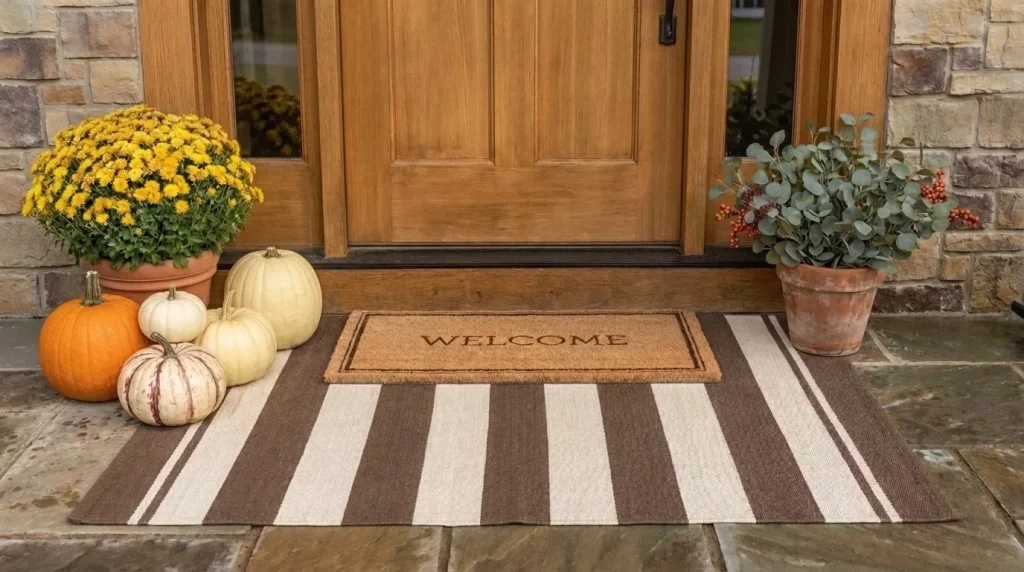
Idea 13: Keep moisture from becoming trapped underneath
Outdoor rugs need to dry. Better Homes & Gardens’ 2026 buying guidance warns that trapped moisture beneath a rug can damage the surface below, so rug material and exposure should suit the local climate and porch conditions.
After heavy rain, check whether the rug and porch floor are drying properly. On a highly exposed porch, a quick-drying synthetic rug may be more practical than a thick natural-fiber style. This matters more than whether the pattern photographs beautifully.
Make the top doormat work harder
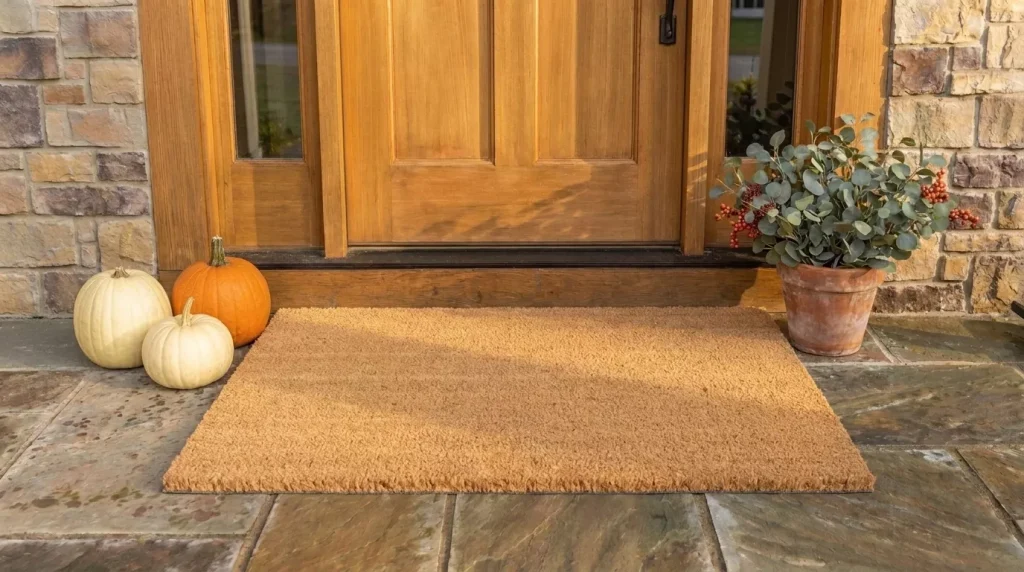
Idea 14: Replace a worn mat instead of adding decor around it
A front mat has a real job. If the coir is shedding heavily, the backing is cracked, or the edges curl into a trip hazard, replace it. Country Living’s current fall-entry guidance points out that natural-fiber mats eventually become worn and suggests using the seasonal change as a sensible time to reassess them.
A new mat can make a larger visual difference than another pumpkin.
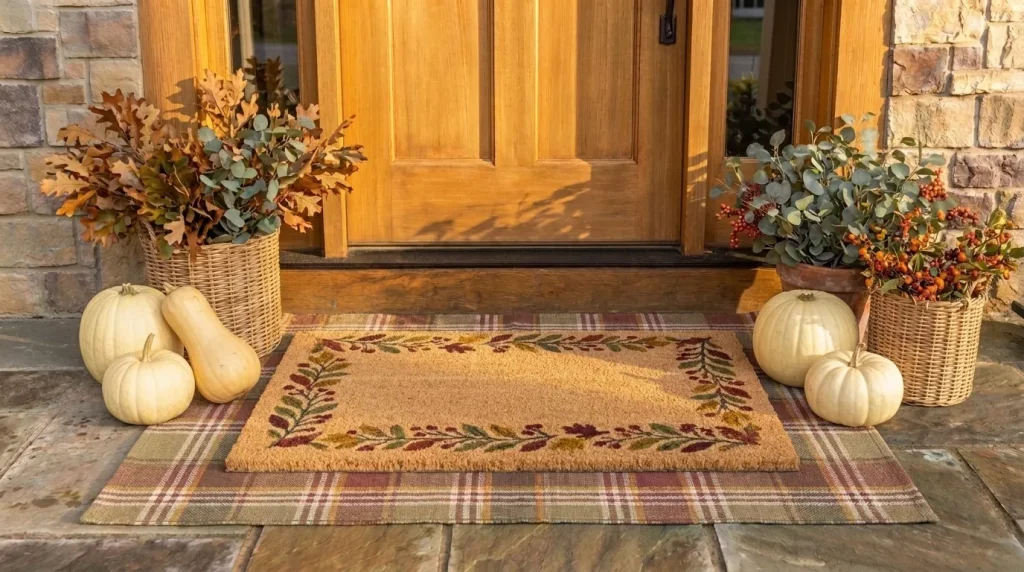
Idea 15: Choose a fall doormat that is seasonal but not Halloween-only
If you want the porch to last into November, avoid a design that becomes irrelevant on November 1. Consider a simple leaf motif, warm geometric pattern, subtle harvest wording, plaid, botanical border, or plain natural coir.
HGTV’s updated August 2026 fall-doormat guide includes both overt seasonal designs and more versatile autumn-toned options. A general fall mat also works better with garlands that contain leaves rather than Halloween motifs.
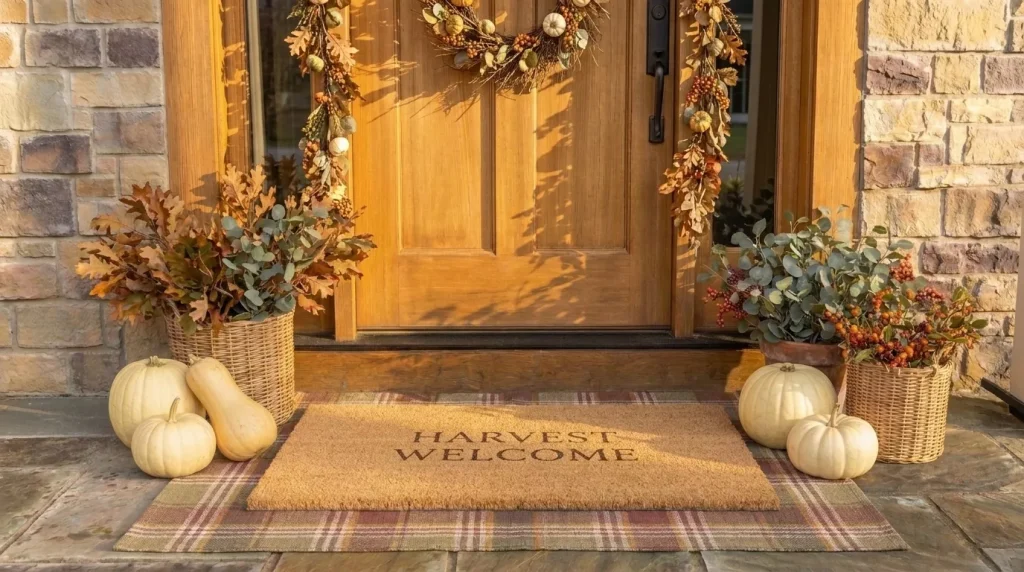
Idea 16: Let only one layer carry words
If the doormat says “Hello Fall,” the garland does not need a hanging sign and the wreath does not need another message. Use text once. Then let color, leaves, pumpkins, and plant material communicate the season.
Too many written elements can make the entry look more like a merchandise display than a home. A quieter lower rug helps the top mat remain the one graphic focal point.
Tie the garland and rug together
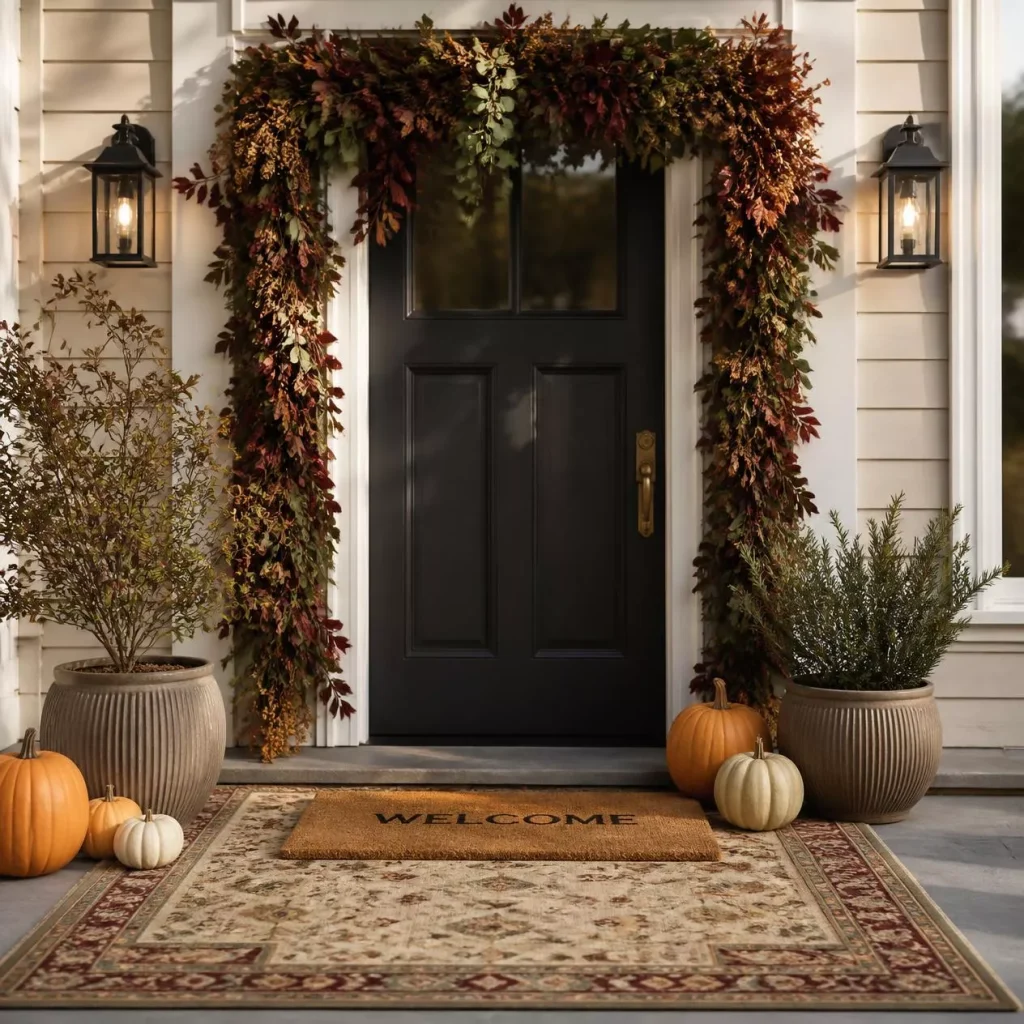
Idea 17: Repeat two colors from the garland in the rug
This is the easiest way to make the doorway and floor feel related. If the garland contains burgundy and olive, choose a rug with one of those colors. If it is golden brown and cream, repeat cream in the floor pattern.
You do not need an exact match. The colors only need to feel connected. Current 2026 fall porch examples show that repetition of a limited autumn palette creates a much more cohesive entrance than using every available seasonal color.
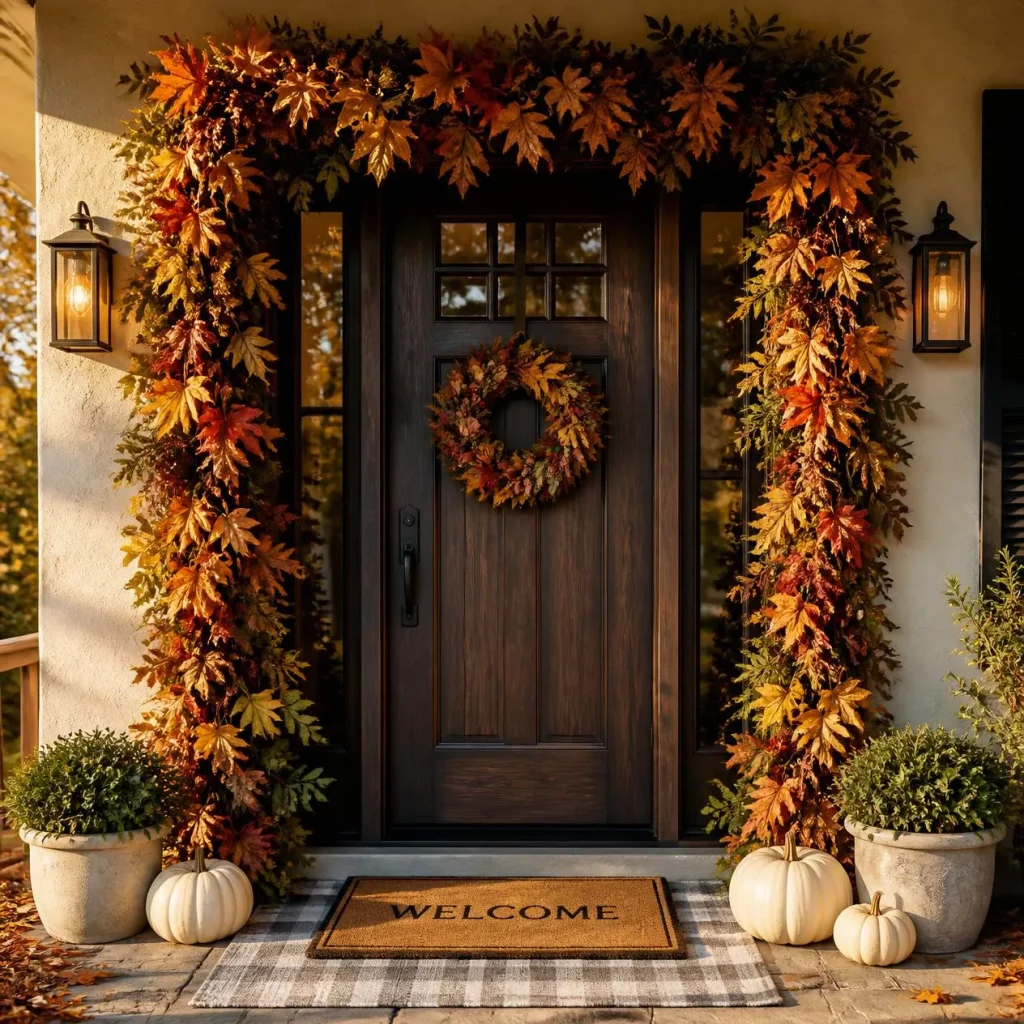
Idea 18: Keep one pattern strong and the other quiet
A leafy garland already creates a busy edge around the door. If it is full and colorful, use a simpler striped or checked rug. If the garland is almost solid olive or dried grass, the rug can carry more pattern.
Think of the entrance as one composition. The eye should not have to decide whether to look at the garland, the mat, the rug, the wreath, and the pumpkins all at once — the same restraint we emphasized in our 24 Fall Front Porch Decor Ideas With Crates and Galvanized Buckets.
Adapt the idea to small and large porches
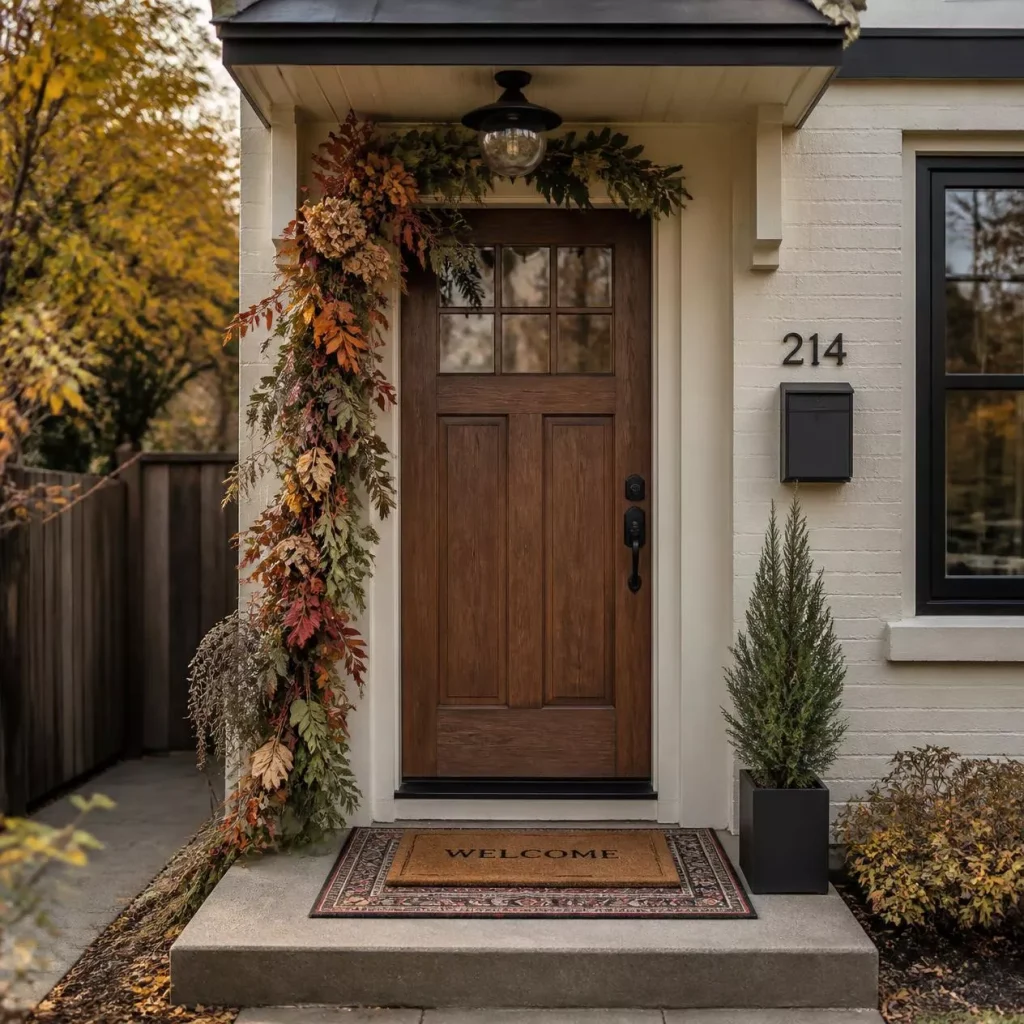
Idea 19: Use only a side garland and one layered mat on a tiny porch
For a narrow stoop, skip floor decorations entirely if necessary. Use one asymmetrical garland running down a single side of the door. Then layer a small rug beneath the functional doormat.
Add one planter only if the door still has plenty of clearance. This gives you color at both eye level and floor level without sacrificing valuable walking space. It is one of the most effective approaches for apartments, townhouses, and shallow entries.
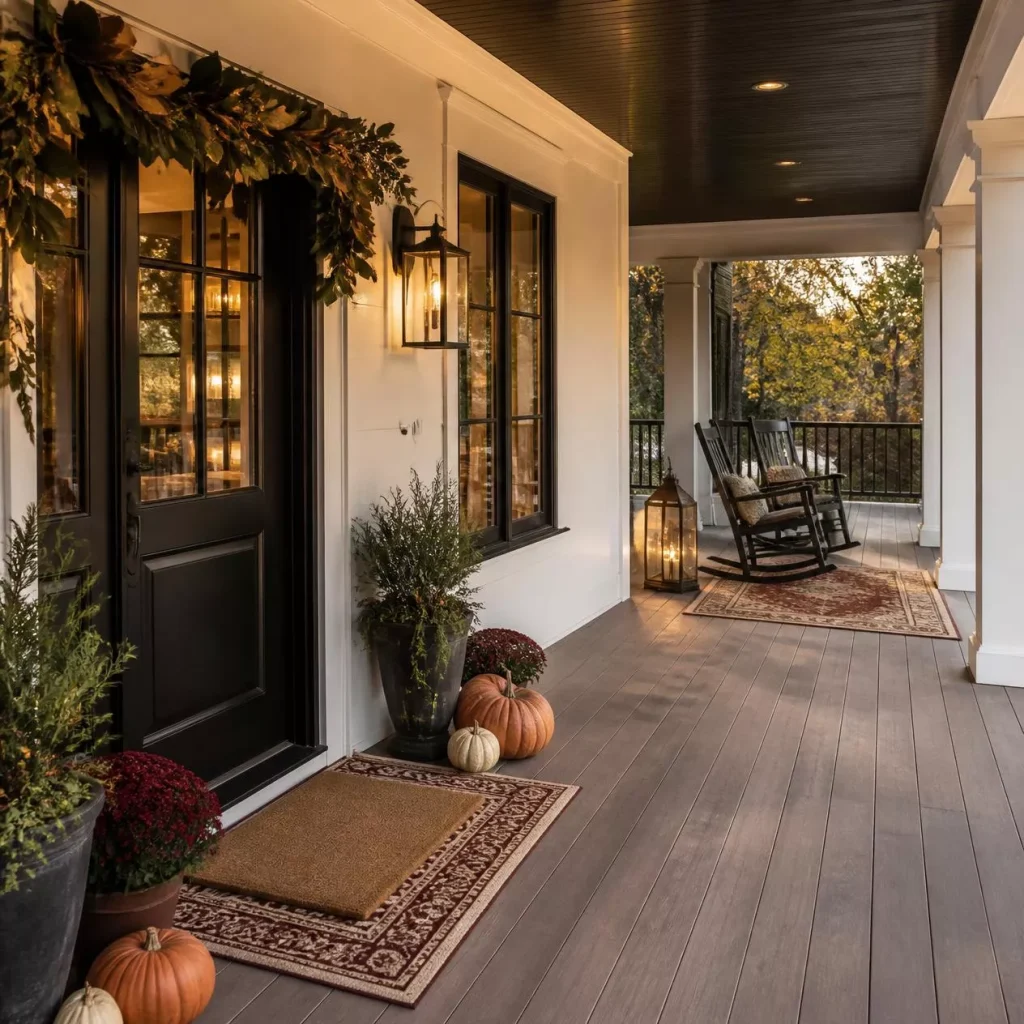
Idea 20: Extend the pattern onto a larger covered porch
A deep porch can handle a larger outdoor rug near the seating area in addition to the layered entry mat. Architectural Digest notes that outdoor rugs help ground outdoor furniture and give exterior areas clearer scale and definition.
Use the smaller layered mat at the door, then choose a related but not identical rug beneath a bench or rocking-chair zone, and add one lantern nearby for evening warmth as in our 23 Fall Front Porch Lantern and Lighting Ideas. Repeat one color across both. The porch then feels like one outdoor room rather than a decorated doorway with unrelated furniture farther away.
A practical garland, rug and doormat formula
A door garland frames the entrance and is best built from faux foliage plus natural accents. A side garland adds height through an asymmetrical drape. A lower rug adds pattern and should be a weather-suitable outdoor rug, while the top mat handles foot traffic and should be durable coir or an outdoor mat. Planters connect the door to the floor by repeating garland colors, and pumpkins add seasonal shape as long as they stay outside the walking path. A bench rug defines the seating area and works best as a larger outdoor-rated rug.
Like the container ideas in our 22 Fall Front Porch Planter Ideas With Ferns, Pots, Urns and Hanging Baskets, you do not need every layer. A garland, layered doormat, and two planters can already create a complete front entrance.
What should you avoid?
Do not let garland interfere with the door. Dry-fit it and add enough support that it cannot sag into the opening. HGTV specifically recommends center support to prevent garland from drooping into the doorway.
Do not use indoor rugs on exposed porches. Outdoor-rated materials are designed to handle substantially more moisture and traffic.
Do not create a tripping edge. Both rug layers should sit flat and allow the door to open.
Do not trap moisture indefinitely beneath rugs. Check drying after wet weather.
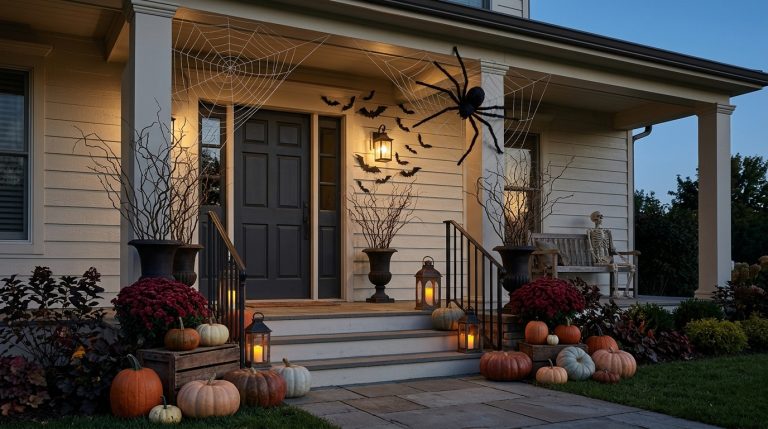
Do not use every fall motif together. Leaves, plaid, pumpkins, wording, florals, and Halloween graphics can overwhelm a small entry quickly.
Try this if your front door still looks unfinished
Remove the pumpkins and planters temporarily. Start with the architecture. Hang the garland first and make sure its width and height suit the door. Then place the outdoor rug and doormat.
Look at the entrance from several feet away. If the upper half feels heavy, simplify the garland. If the floor feels disconnected, repeat one garland color in the rug. Only then add the planters and pumpkins back. This order prevents accessories from hiding proportion problems.
FAQ
How do you hang a fall garland around a front door?
Dry-fit the garland first, then secure it at both upper corners and support the center if needed. Depending on the door and trim, appropriately installed hooks, nails, or outdoor-rated removable hooks may work. Always match the hanging method to the surface and garland weight.
How do you layer a fall doormat and rug?
Place a slightly larger outdoor rug beneath the functional doormat so several inches of the pattern remain visible. HGTV specifically recommends this layered approach for fall porch styling.
What type of rug is best for a front porch in fall?
For an uncovered porch, moisture-resistant synthetic materials such as polypropylene are among the most practical choices. Natural fibers such as jute or sisal are better suited to more protected porches where they will not experience frequent saturation.
What colors work best for fall porch rugs and garlands?
Rust, chocolate, olive, cream, burgundy, ochre, muted orange, and warm black all work well. Current 2026 fall styling is also embracing more nuanced burgundy, fern, and botanical tones rather than relying entirely on bright orange foliage.
Let the doorway and floor work as one composition
The strongest fall front porch decor ideas with garland do not stop at hanging foliage around the door.
Look downward too. A well-scaled outdoor rug can add pattern and width. A practical top doormat handles daily traffic. Then the garland repeats related colors above, visually connecting the whole entrance before pumpkins and planters are added.
If you change one thing first, strip the porch back to the garland, rug, and mat. Those three pieces establish the frame. Once they feel balanced, add only enough pumpkins, mums, lanterns, or seating to complete the entrance.
A fall porch often looks richer when its largest surfaces are coordinated first and the seasonal accessories are allowed to remain secondary.