22 Fall Front Porch Planter Ideas With Ferns, Pots, Urns and Hanging Baskets
A fall porch planter does not have to begin with throwing away everything that survived summer. If your ferns are still healthy, your large urns already suit the doorway, or your hanging baskets still have usable greenery, those pieces can become the foundation of the autumn display.
The most practical fall front porch planter ideas for 2026 are taking exactly that approach. Instead of replacing entire containers for a few weeks of seasonal color, gardeners are trimming back tired summer growth, keeping plants that still look good, and adding cooler-weather flowers, ornamental grasses, foliage plants, pumpkins, gourds, and branches. Better Homes & Gardens’ current fall-container advice specifically recommends refreshing existing planters rather than automatically rebuilding them from scratch.
These 22 ideas cover ferns, flower pots, urns, farmhouse hanging baskets, and front-door container arrangements that can realistically survive everyday porch life.
Keep useful summer plants in the fall plan
Idea 1: Keep healthy porch ferns and decorate around them
Do not remove a full, healthy fern just because September arrived.
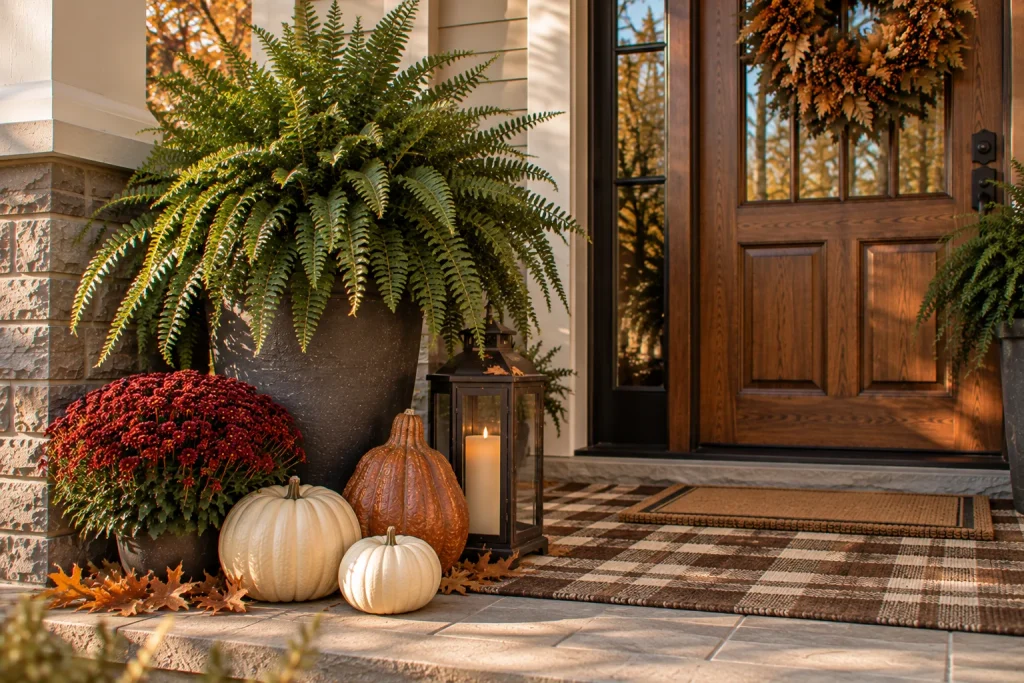
Large green ferns can make an excellent backdrop for fall color. HGTV’s updated 2026 porch inspiration specifically pairs giant ferns with multicolored mums and pumpkins on front steps.
Leave the fern in its existing planter and add autumn around the base.
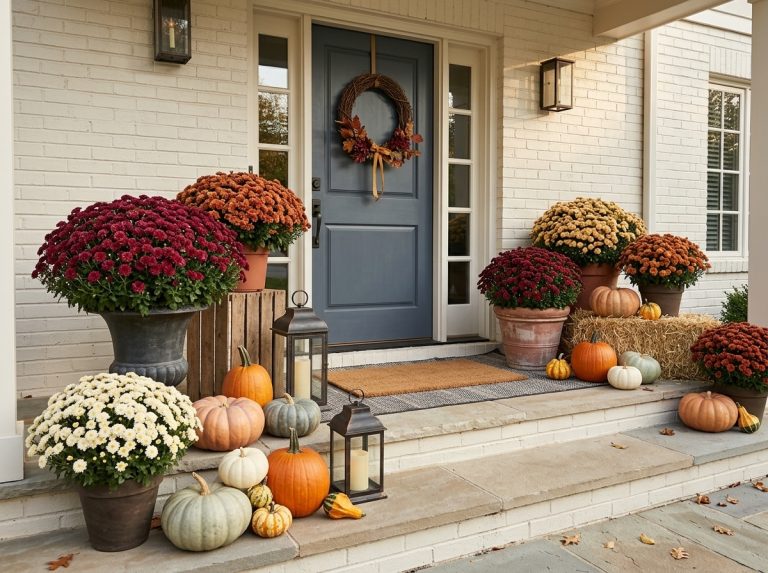
Try: burgundy mums, cream pumpkins, rust-colored gourds, a dark lantern, and a brown-and-cream outdoor rug.
The fern supplies volume that would otherwise cost money to replace. Just remember that many commonly used porch ferns are not cold-hardy in every climate. Watch your local temperatures and move tender plants indoors or protect them when required.
Idea 2: Put a fern inside a more substantial fall container
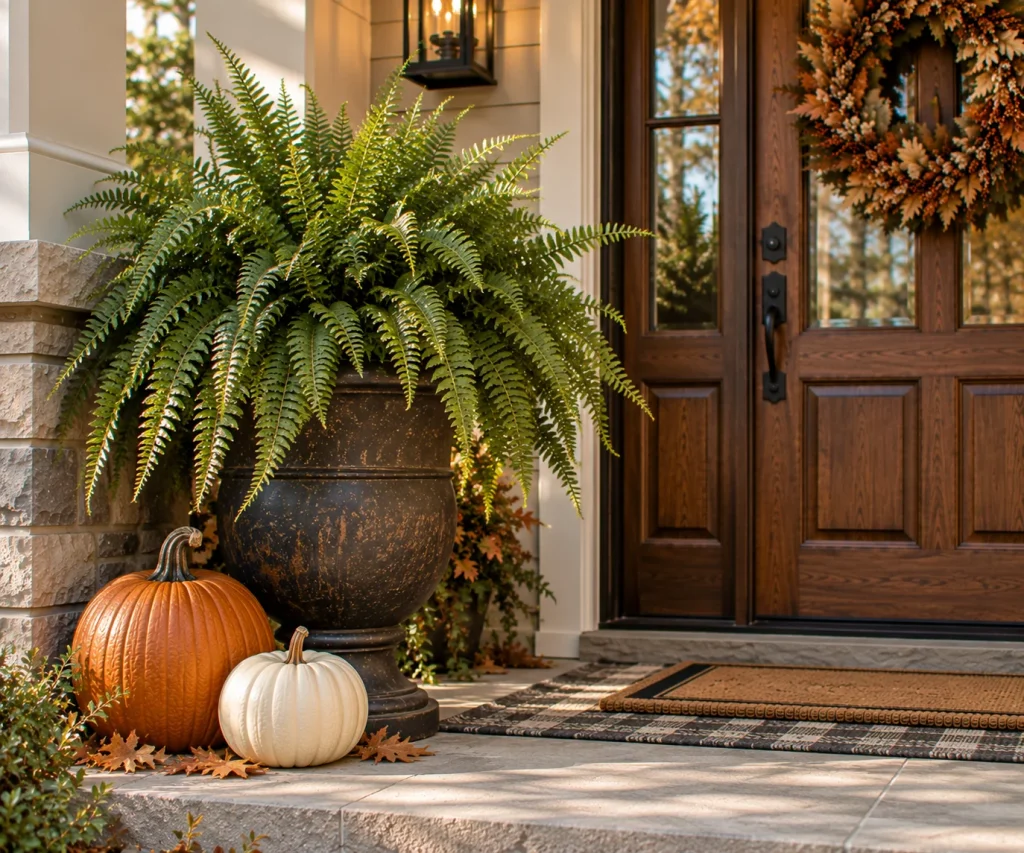
Sometimes the plant is fine but its plastic nursery pot makes the porch look unfinished. Slip the pot into a dark urn, weather-safe wicker-style planter, galvanized tub, terracotta pot, or black resin container.
This gives the fern more visual weight without disturbing its roots. Then place one or two pumpkins beside the base. The result reads as a fall composition even though the plant itself may have been there since spring.
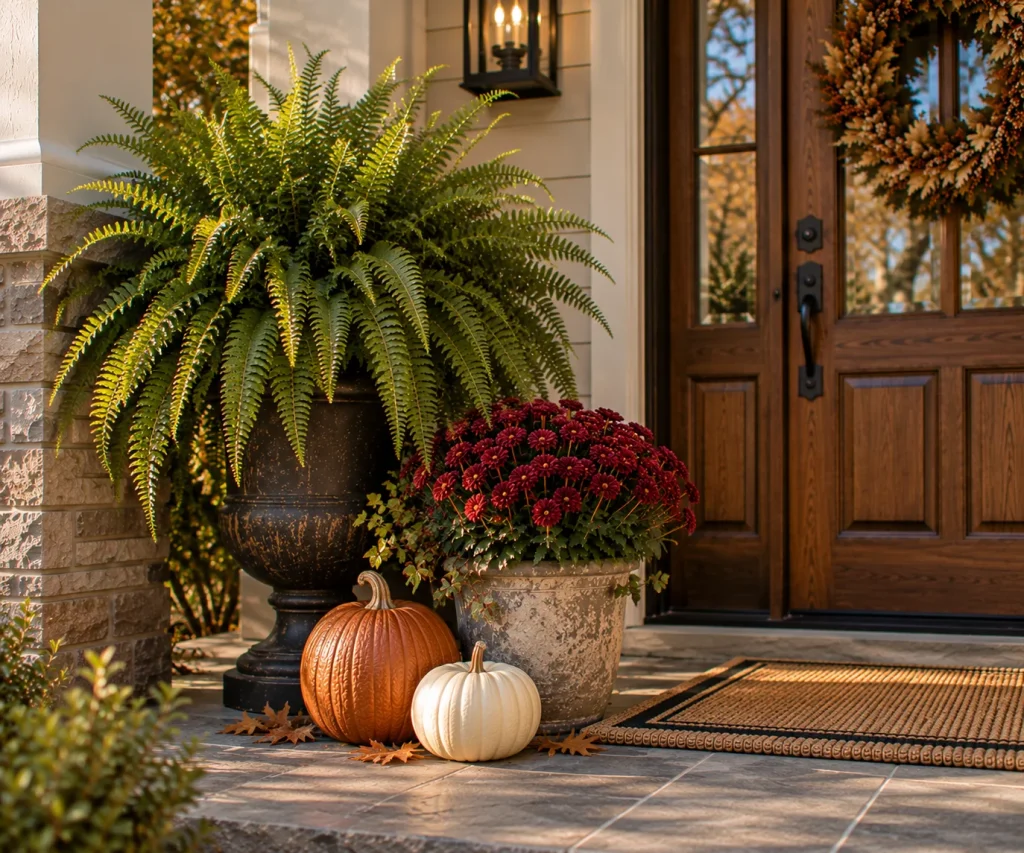
Idea 3: Pair ferns with one flowering fall pot
You do not need flowers in every container. Let one large fern remain completely green and place one smaller flowering planter beside it. Good partners may include mums, pansies, violas, or other plants appropriate to your local conditions.
The contrast between broad green foliage and concentrated fall color looks more natural than repeating identical mum pots across the entire porch — the same layered thinking behind our 21 Fall Front Porch Ideas With Mums, Pumpkins & More.
Use urns to frame the entrance
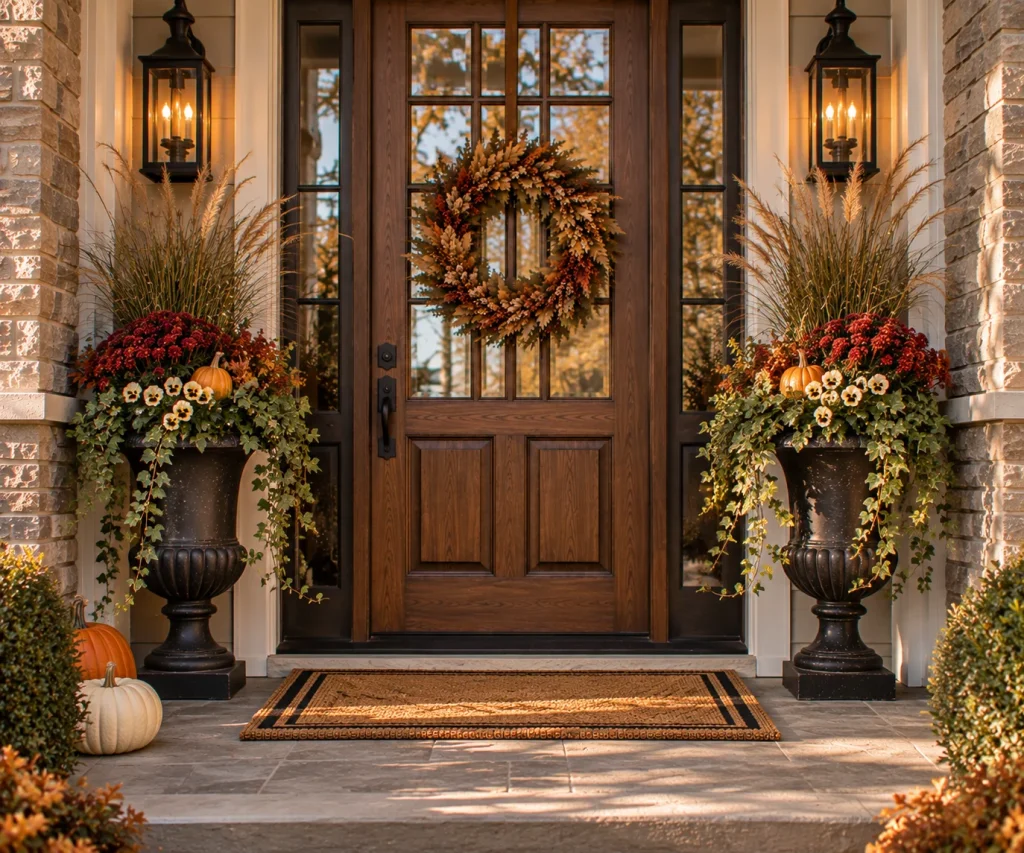
Idea 4: Flank the front door with two tall planted urns
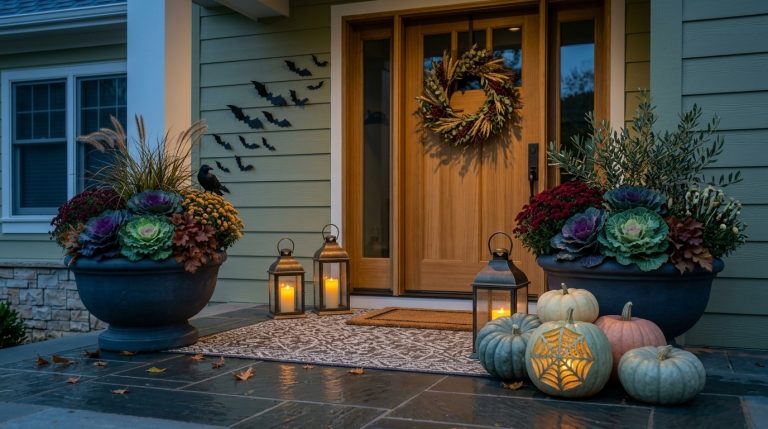
Matching urns remain one of the easiest ways to make a front entrance feel structured. HGTV’s current front-porch planter guidance still identifies matching planters on either side of a doorway as a reliable way to create visual balance and curb appeal.
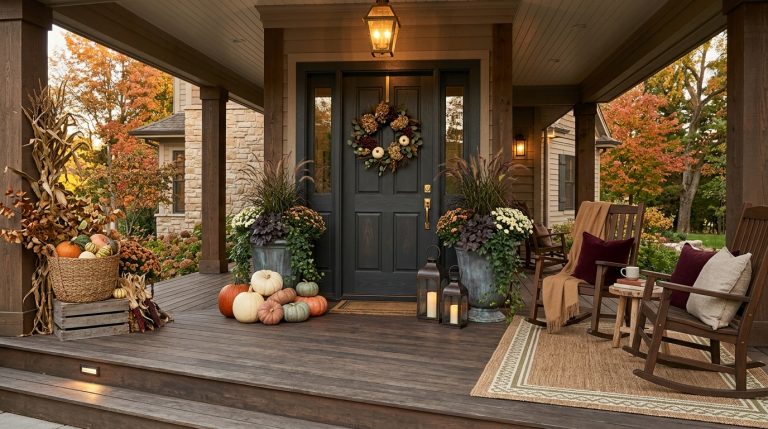
For fall, fill them with a combination such as ornamental grass for height, mums or pansies for color, trailing ivy for softness, and one or two small decorative gourds tucked near the rim.
If your doorway is narrow, choose taller rather than wider pots so the plants do not interfere with circulation.

Idea 5: Use burgundy or black urns instead of default terracotta
The planter itself can carry some of the fall color. Homes & Gardens recently highlighted burgundy resin planters as a practical fall option, suggesting combinations of purple heuchera, violas, and ornamental grasses.
A deep burgundy planter works beautifully with cream flowers, purple foliage, rust, olive, and golden grasses. Black creates a stronger, more architectural look, which is useful if your home already has black lighting, railings, or door hardware.
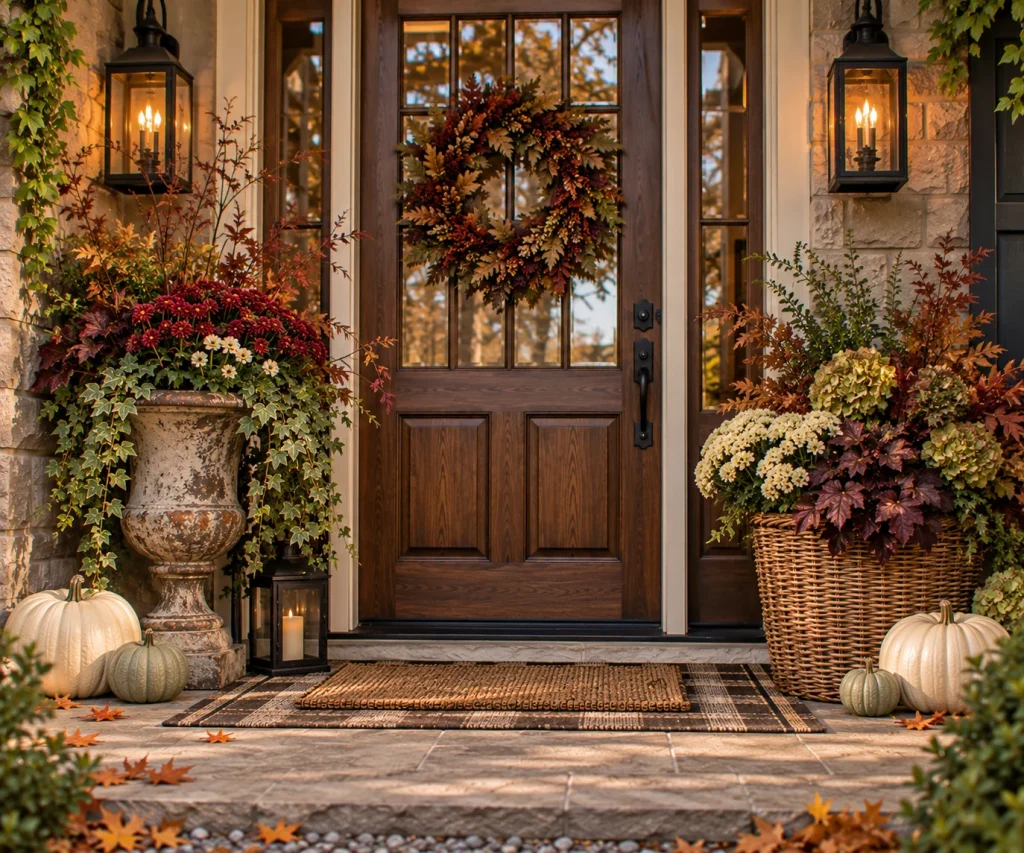
Idea 6: Let one antique-style urn break the symmetry
Perfectly matching containers are not mandatory. For a more collected farmhouse or cottage entrance, use one older-looking urn or crock on one side and balance its visual weight with a larger basket or planter on the other.
Keep the plant palette related so the arrangement still feels intentional, then repeat cream pumpkins across both sides.
Build stronger mixed fall planters
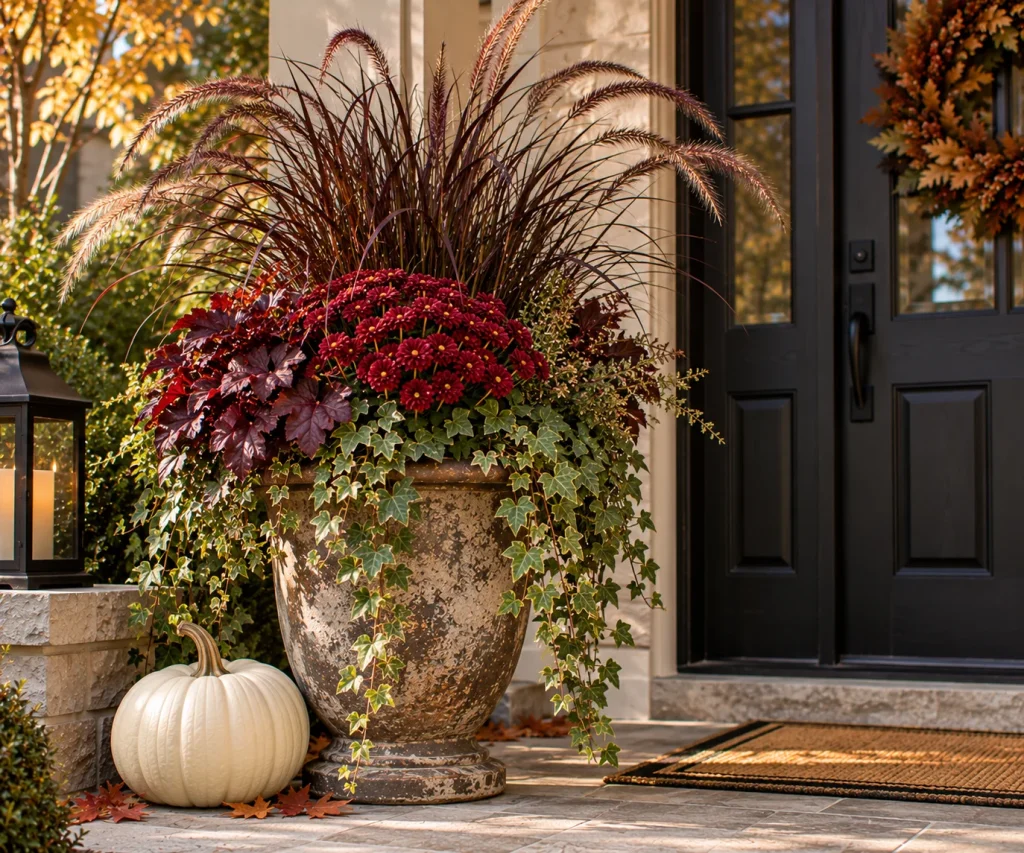
Idea 7: Use the thriller, filler, spiller formula
The classic container-gardening formula works especially well for fall pots. Better Homes & Gardens recommends combining plants according to height and habit, with a taller focal plant, fuller middle layer, and trailing plants around the edge.
For example: thriller — purple fountain grass; filler — mums or coleus; spiller — ivy or sweet potato vine where conditions allow. HGTV’s fall container inspiration similarly uses purple fountain grass, plummy coleus, and trailing plants to create layered autumn pots.

Idea 8: Build a planter around ornamental grass
Ornamental grass gives you instant height and movement. Use it in the center of a tall pot, then add lower seasonal plants around it — try purple fountain grass with burgundy mums and trailing ivy, or golden grass with cream pansies and dark heuchera.
A tall grass can replace decorative branches while remaining alive and dynamic. On windy porches, use a sufficiently heavy container so the combination remains stable.
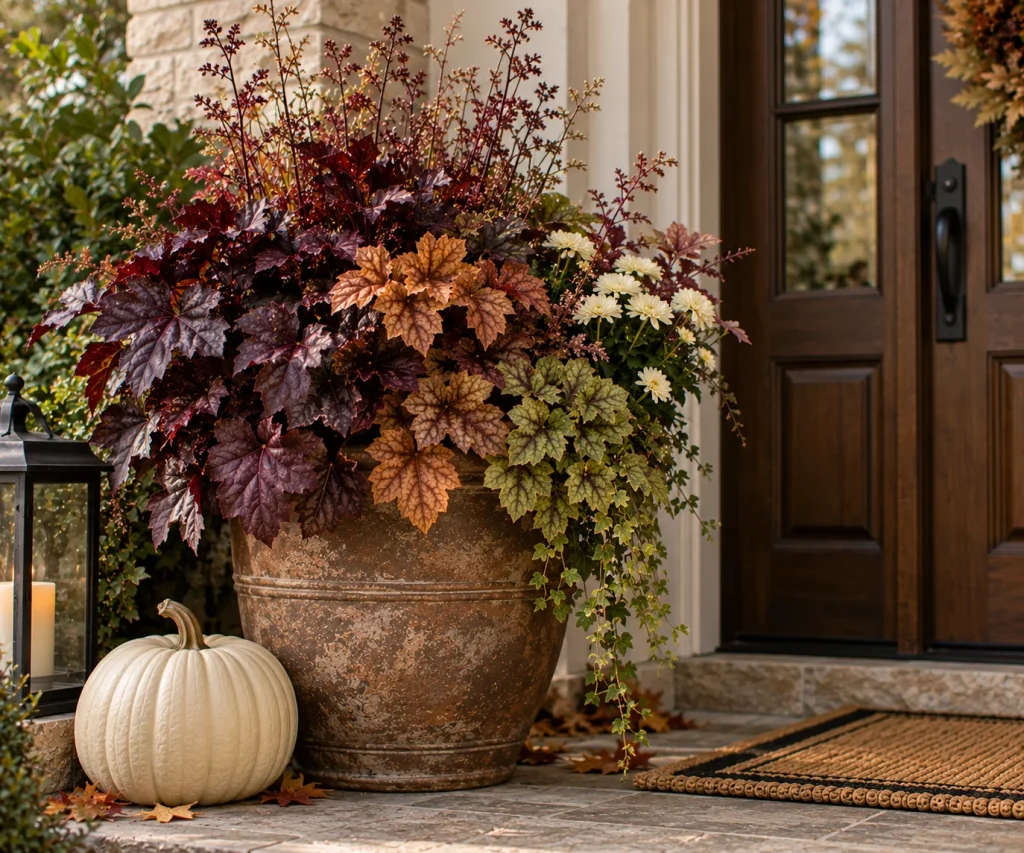
Idea 9: Use heuchera for foliage instead of relying only on flowers
Fall planters do not need to bloom constantly to look good. Heuchera, commonly called coral bells, comes in foliage colors ranging from plum and bronze to caramel and green.
Pair deep plum leaves with cream flowers and warm brown containers for a quieter porch than the standard orange-and-yellow palette.
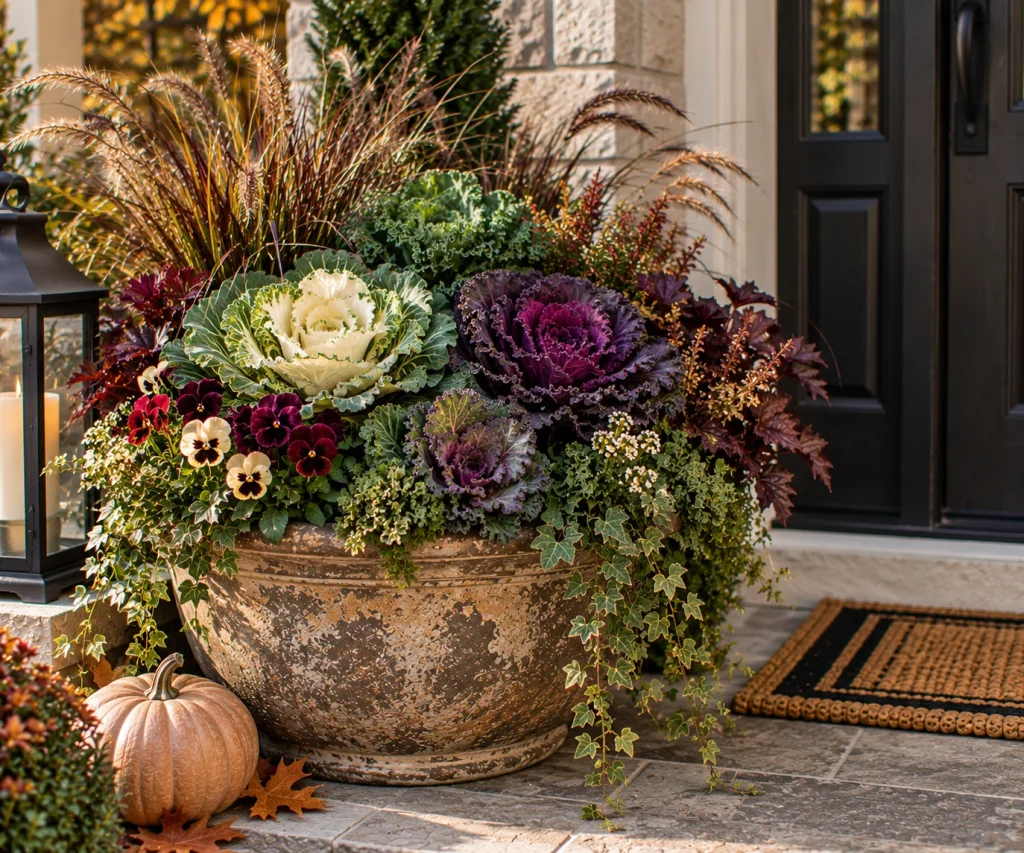
Idea 10: Add ornamental cabbage or kale for substantial texture
Ornamental cabbage and kale can give a fall planter a broad, sculptural center or filler layer. Use them with pansies, grasses, mums, or trailing greenery. They work especially well in wide low pots where their rosette shapes are easy to see. Choose plants appropriate to your climate and expected temperatures.
Refresh flower pots instead of replacing them
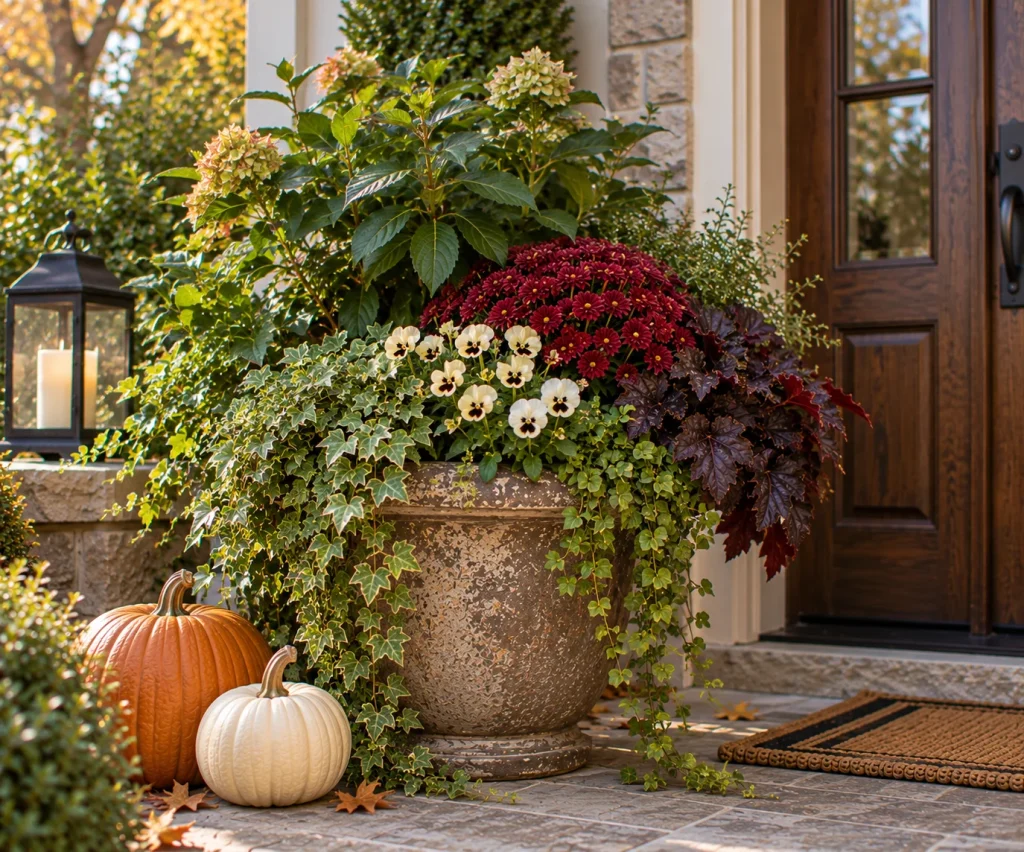
Idea 11: Trim tired summer plants and fill only the gaps
This is one of the most practical front porch fall planter ideas for an entrance. Before pulling out everything, remove dead blooms, yellow foliage, and plants that have genuinely finished, then evaluate what remains.
Better Homes & Gardens’ September 2026 expert guidance recommends trimming back leggy summer plants, refreshing containers with seasonal annuals, and simplifying overgrown arrangements rather than automatically starting over. If half the planter is still healthy, replace half — the same reuse-first approach behind our 23 DIY and Repurposed Fall Front Porch Ideas.
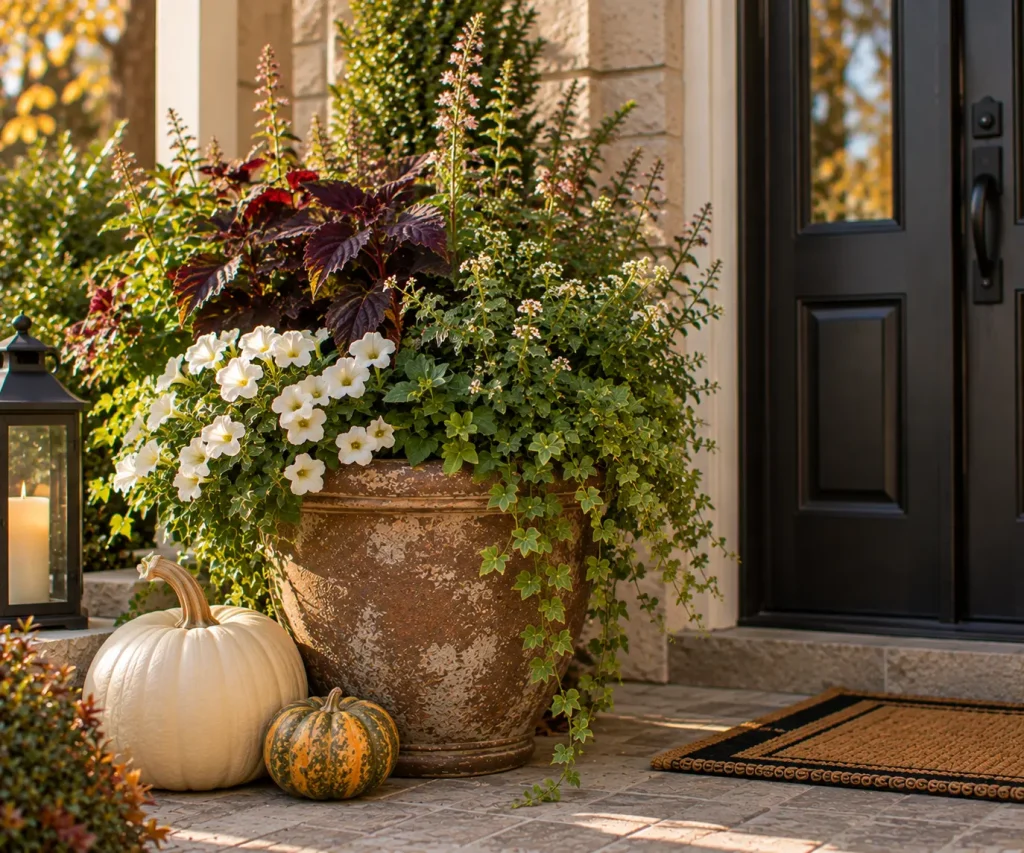
Idea 12: Add pumpkins directly around existing flower pots
A healthy container garden can become autumnal without changing any plants. Place one medium pumpkin and a smaller gourd around the base, choosing colors that complement the flowers: green planter with cream pumpkin, burgundy foliage with muted orange, or purple flowers with pale green gourd.
BHG’s current fall planter guidance specifically recommends adding pumpkins, gourds, and ornamental corn to existing containers for seasonal character — a low-cost approach similar to the ideas in our 22 Fall Front Porch Ideas on a Budget.
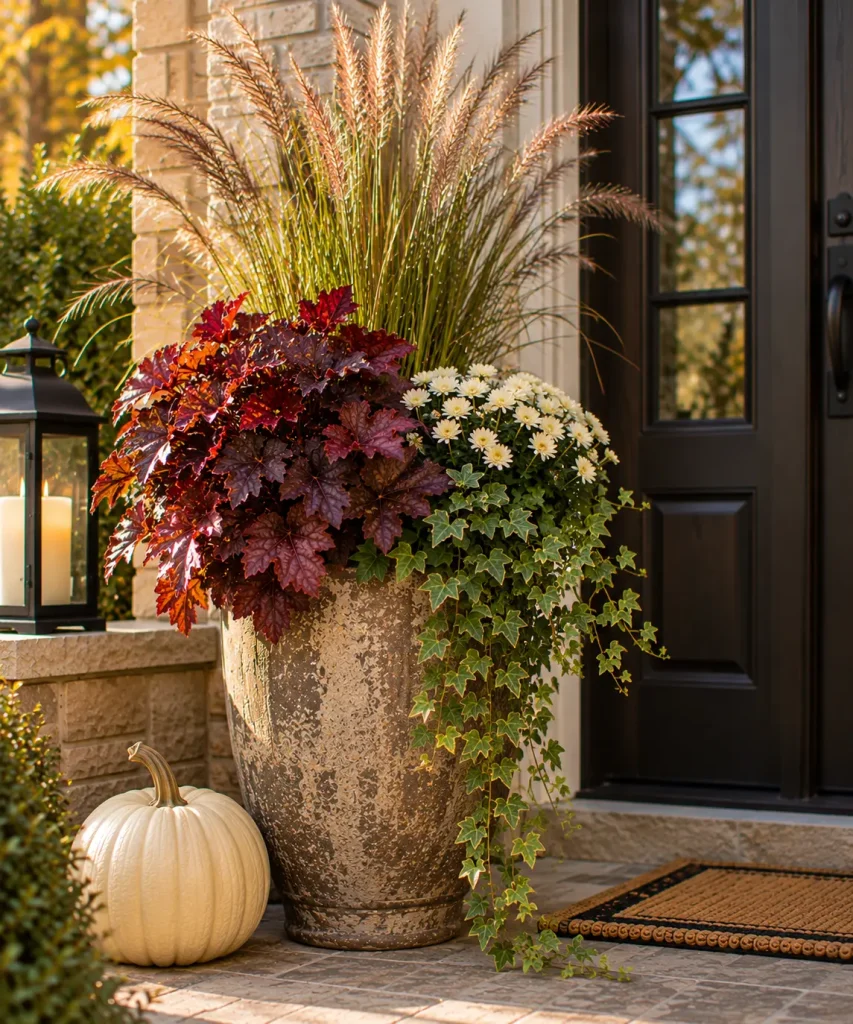
Idea 13: Simplify an overgrown summer planter
More plants do not always make a better fall arrangement. If a pot contains five tired plant varieties, remove the weakest ones and let two or three strong elements remain — one upright grass, one healthy foliage plant, one trailing vine — then add a small mum or pansy if needed.
Make hanging baskets work into fall
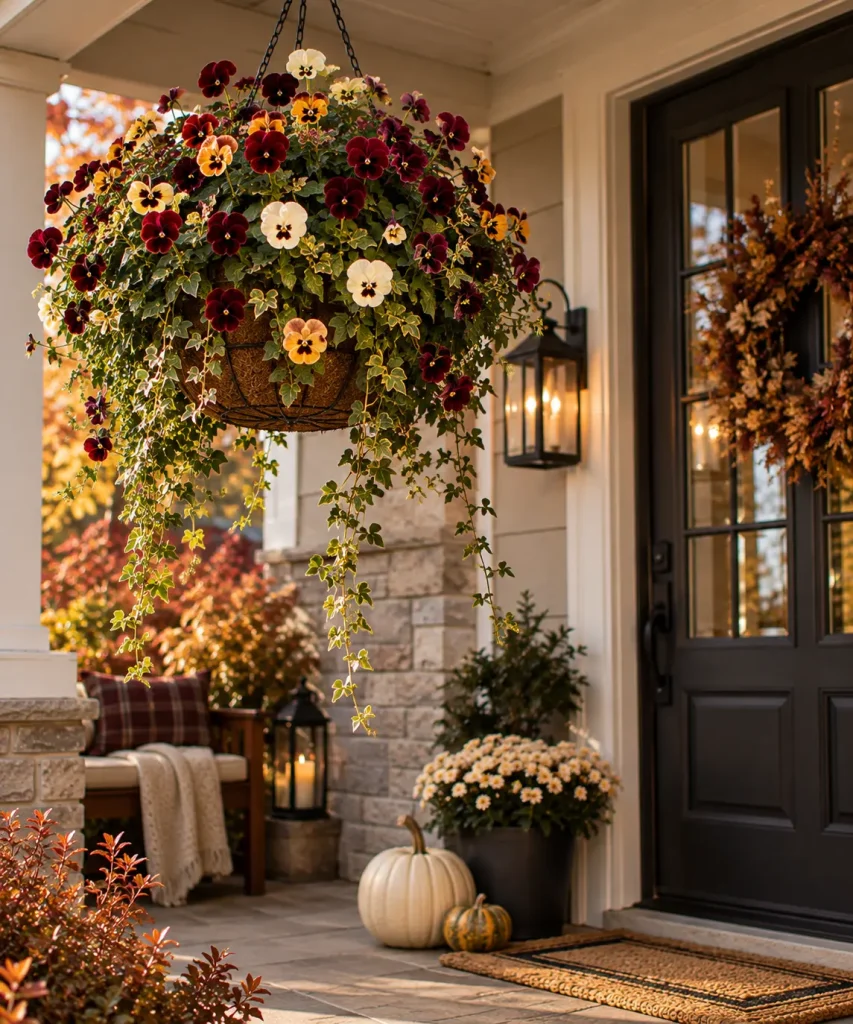
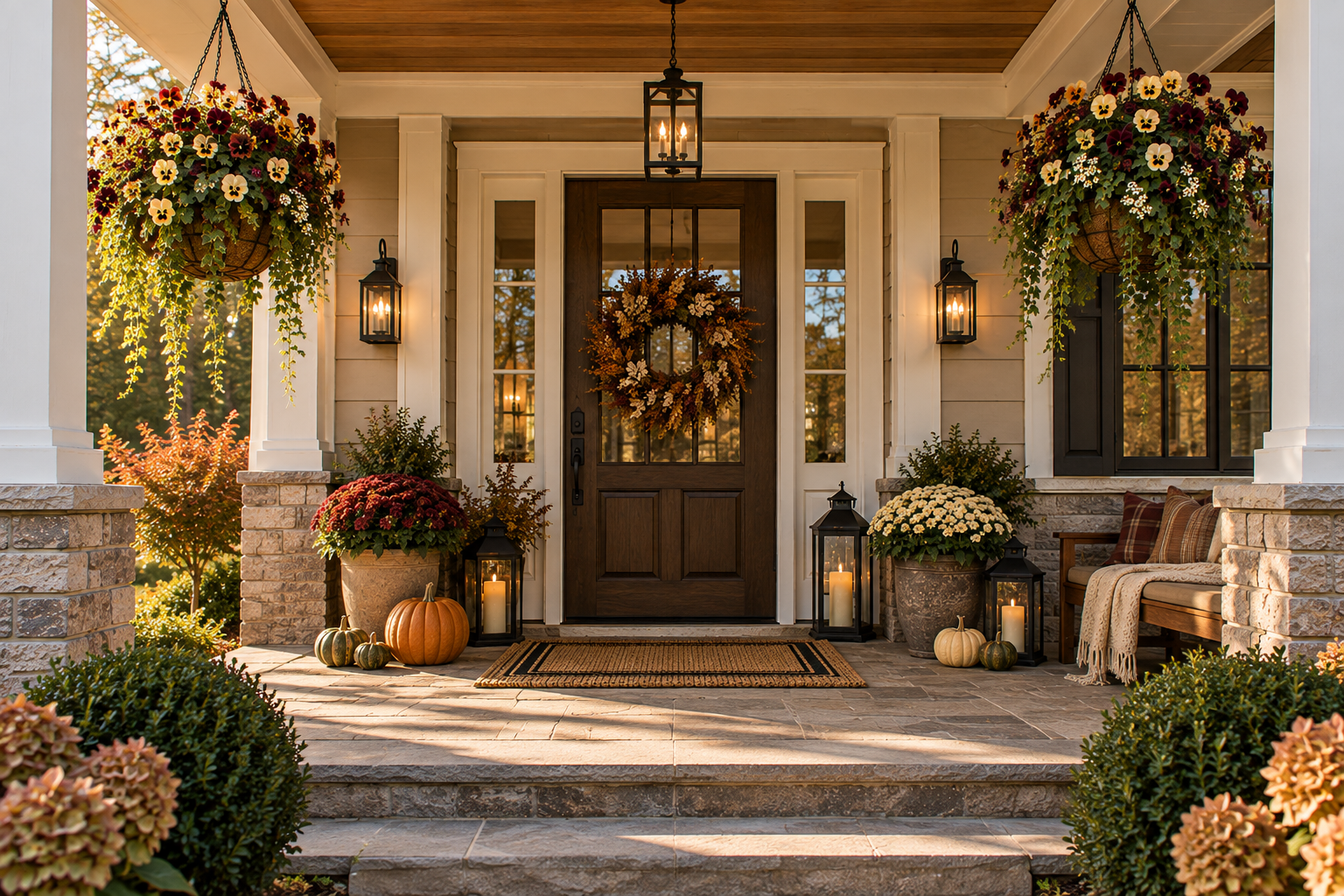
Idea 14: Replace fading summer baskets with trailing pansies
Hanging baskets are not only for spring and summer. HGTV’s September 1, 2026 guide to fall hanging baskets recommends trailing pansies because they can continue flowering into cooler weather and handle light frost better than many warm-season basket plants.
Choose colors that connect with the rest of the porch: rust and gold for a classic fall look, burgundy and cream for something quieter, or purple and yellow beside olive-green or black doors.
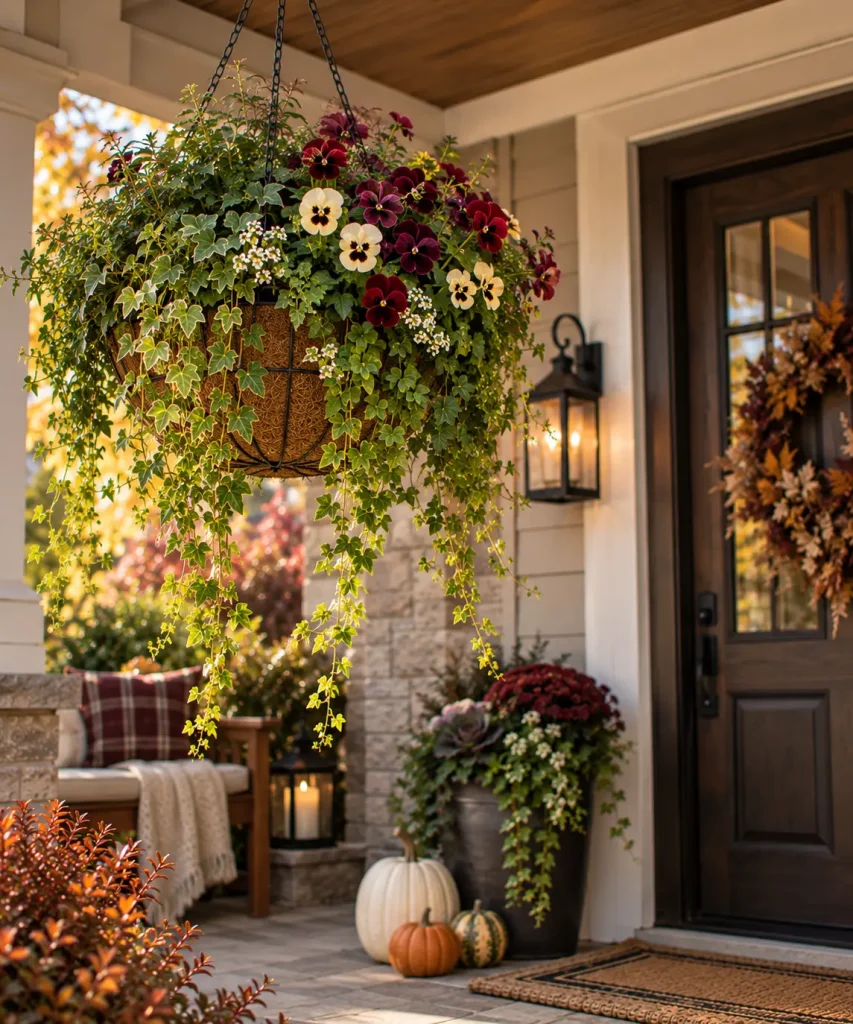
Idea 15: Refresh a summer hanging basket instead of replacing the whole thing
If your basket still contains healthy trailing greenery, keep it. Remove tired flowering annuals and replace only those sections with cooler-weather plants suitable for your region. Give the finished basket a trim so one aggressive summer plant does not overwhelm the new additions.
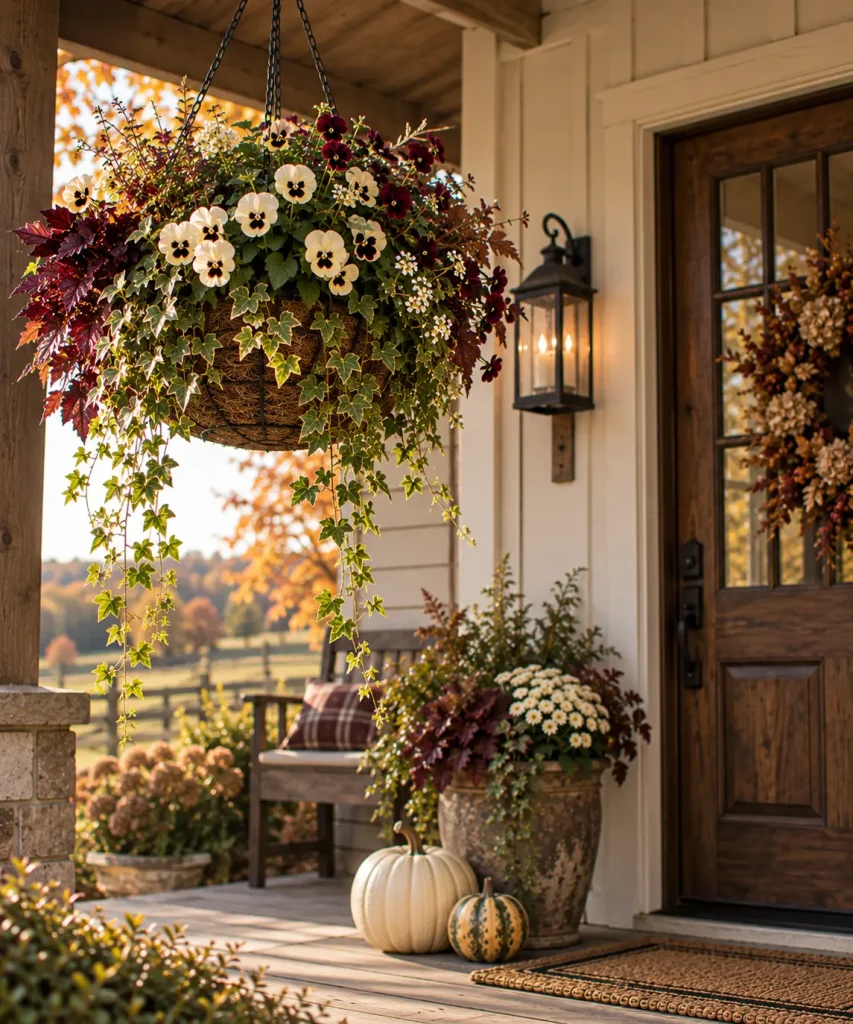
Idea 16: Create a farmhouse hanging basket with a restrained palette
For a farmhouse porch, avoid making the hanging basket overly colorful. Try cream pansies with trailing ivy, burgundy flowers with green foliage, soft yellow with dark purple foliage, or white flowers with bronze leaves.
Country Living’s current 2026 hanging-basket guidance emphasizes selecting trailing flowers according to whether the porch is sunny or shady rather than choosing purely for appearance.
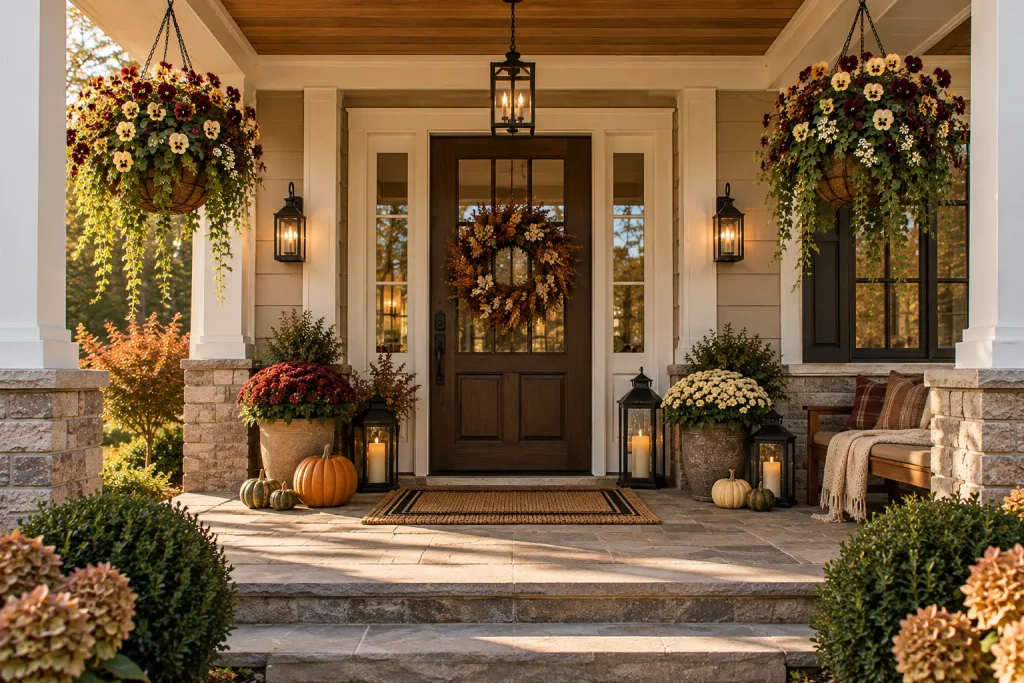
Idea 17: Hang baskets only where they do not interfere with movement
Hanging planters need to work with the porch architecture. Do not position a full basket where guests have to duck beneath it or where swinging plants repeatedly hit the siding or front door. And remember the added weight after watering — hardware should be appropriate for the filled basket, not merely its empty weight.
Use pots and planters to control porch scale

Idea 18: Use tall pots on a narrow porch
When floor space is limited, build upward. A tall urn with ornamental grass and a trailing plant can create as much visual impact as three smaller pots while taking up less horizontal room. Add one pumpkin at the base rather than another container.
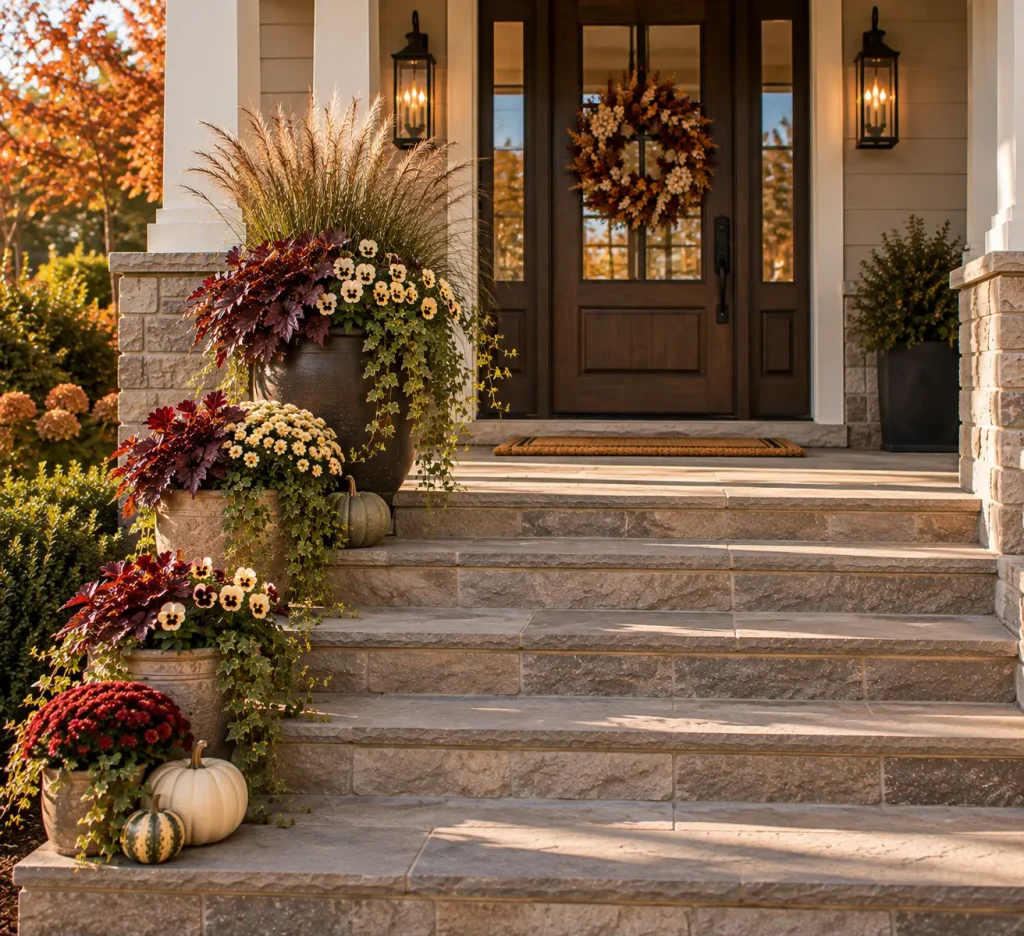
Idea 19: Cascade planters down only one side of the steps
HGTV’s current planter guidance recommends cascading containers down porch steps as a welcoming entry treatment. For everyday practicality, keep them on one side, use the largest pot at the top, and reduce the container size as you move downward. Repeat two or three colors so the collection looks connected.
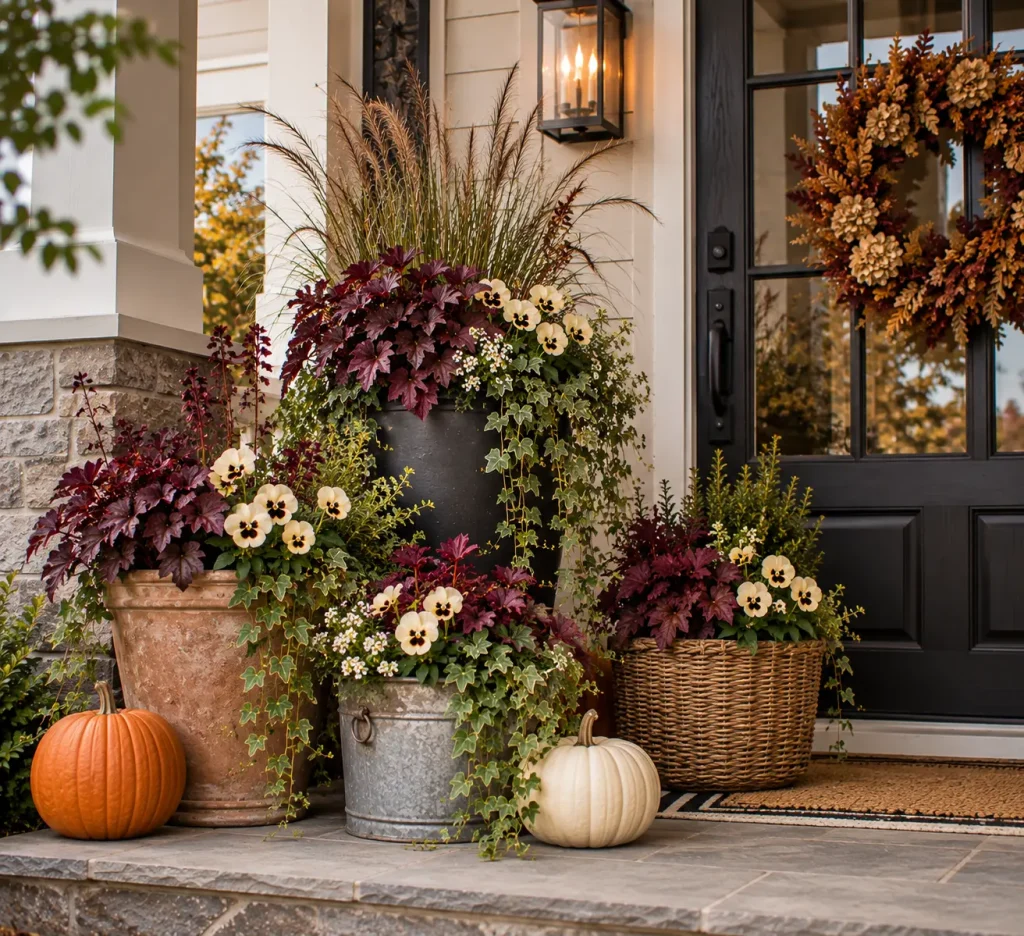
Idea 20: Use different pot materials but repeat the planting
Mixed containers can work if their contents establish the relationship. Combine terracotta, dark resin, galvanized metal, and a weather-safe basket, then repeat one plant, perhaps burgundy heuchera or cream pansies, across several containers. The repetition of plants does the visual organizing.
Build longer-lasting seasonal displays
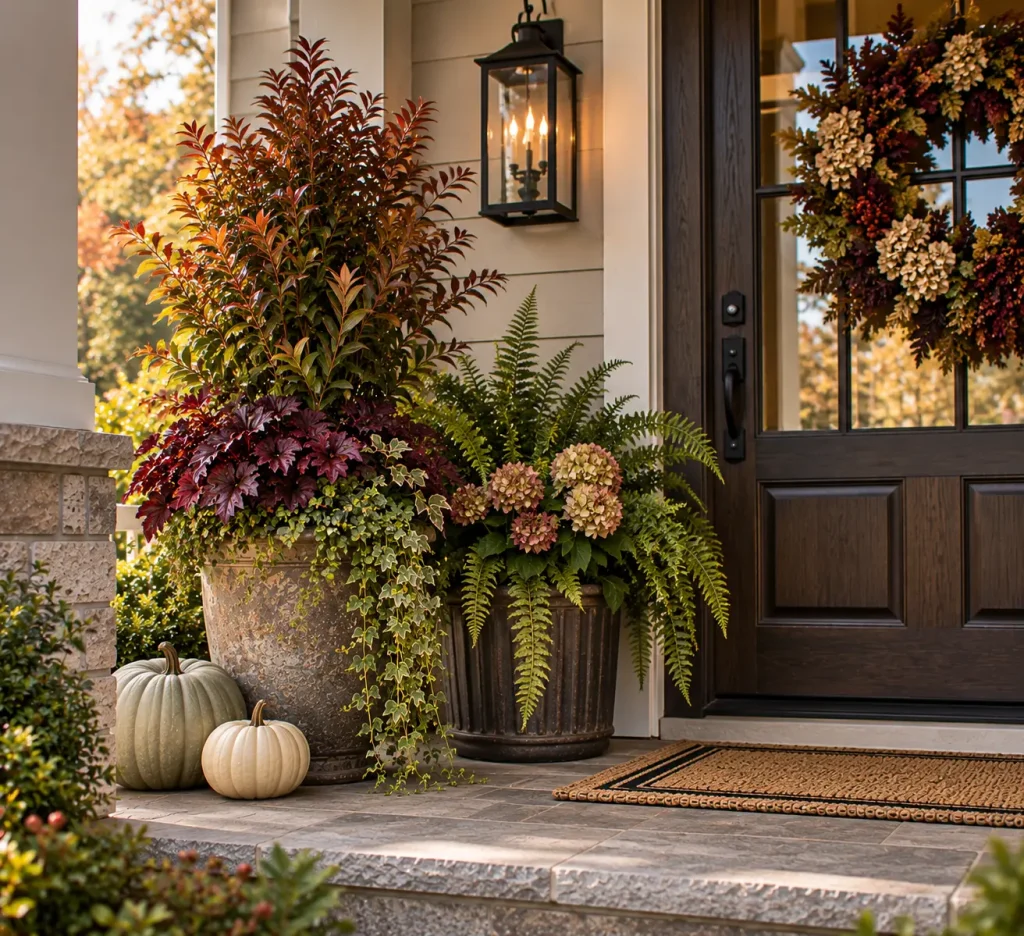
Idea 21: Use foliage-led pots instead of temporary pumpkin-heavy arrangements
A foliage-based porch can remain attractive well past Halloween. Joanna and Chip Gaines’ 2026 fall porch is a useful example, relying heavily on layered Japanese maples, hydrangeas, coleus, coral bells, ferns, and trailing vines rather than making pumpkins the entire seasonal strategy.
For a normal-sized porch, simplify that principle: one tall foliage plant, one colored-leaf filler, one trailing plant, then only a couple of pumpkins if desired.

Idea 22: Fill an urn with branches when live planting is impractical
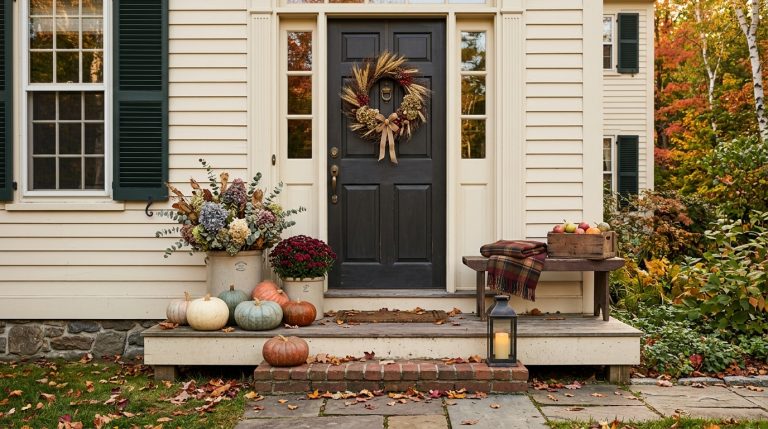
Not every fall urn needs soil and living flowers. On a covered porch, a tall urn can hold dried hydrangea, branches, seed heads, or other suitable seasonal material — the same harvest-forward structure we used in 24 Fall Front Porch Ideas With Hay Bales and Corn Stalks.
Weight tall arrangements appropriately and secure loose material against wind, and keep dried plant material away from open flames and heat sources.
A practical fall porch planter guide
Shady covered porches do best with ferns and shade-tolerant seasonal foliage. Sunny entrances suit grasses paired with suitable flowering annuals. A narrow stoop works well with one tall urn and one pumpkin, while a wide porch can support matching urns with smaller supporting pots. Farmhouse-style porches lean on wicker, galvanized metal, and terracotta. For a long fall season, choose a foliage-led mixed container, and for existing summer pots, trim, simplify, and refill the gaps. Hanging baskets should use trailing cool-season flowers suited to your climate.
Your local weather matters more than a photograph. A plant that thrives through November in one region may fail quickly in another.
What should you avoid with fall front porch planters?
Do not ignore drainage. Decorative urns and pots still need a way to handle excess water. If a container has no drainage, modify it where the material permits or use it as an outer cover for a properly drained nursery pot.
Do not combine plants with completely different care needs. BHG specifically recommends grouping container plants that prefer similar growing conditions.
Do not replace healthy ferns simply because it is fall. Use them as the green foundation and add seasonal color around them.
Do not fill every step with pots. Keep the entrance comfortable and safe.
Do not forget watering because the weather feels cooler. BHG’s current fall-container guidance notes that containers still require regular watering even as temperatures drop.
Try this if your porch planters still look like summer
Do not empty them immediately. First, cut back anything leggy or dead. Remove the plants that are clearly finished. Then identify the strongest remaining element.
If it is a fern, keep the fern and add one darker flowering pot nearby. If it is ornamental grass, use that as your height and replace the tired fillers. If the planter itself is good but everything inside has finished, rebuild it with one tall plant, one substantial filler, and one trailing element.
Finally, put two or three pumpkins around the containers rather than forcing seasonal decorations into the soil. A fall refresh often needs less replacement than you expect.
FAQ
Can I use ferns for fall front porch decor?
Yes. Healthy ferns can provide substantial green volume well into the transitional season, and HGTV’s 2026 fall porch examples specifically combine large ferns with mums and pumpkins. How long the fern can remain outdoors depends on the variety and your local temperatures.
What flowers are good for fall front porch pots?
Mums, pansies, violas, and other cool-season plants appropriate to your growing conditions are common options. Foliage plants such as heuchera, plus ornamental grasses and ornamental cabbage or kale, can add longer-lasting structure and color.
What can I put in fall hanging baskets?
Trailing pansies are one practical option for cooler weather, and HGTV’s September 2026 fall hanging-basket guide highlights varieties developed to trail over basket edges and tolerate autumn conditions. Always match the plant to your region and the amount of sun the basket receives.
How should I arrange fall planters around my front door?
For a formal entrance, flank the doorway with two substantial containers. For a small or asymmetrical porch, concentrate one taller planter and one or two supporting pots on a single side. Vary heights, keep the walking path clear, and repeat a small number of colors to connect the arrangement.
Let the plants carry more of the fall look
The strongest fall front porch planter ideas do not depend on replacing every container in September. Keep the fern that is still thriving. Trim the summer planter that only needs a refresh. Use an urn to add height, a hanging basket to bring color above eye level, and ornamental grass or burgundy foliage to make the transition feel unmistakably autumnal.
Then add pumpkins and lanterns as supporting pieces rather than asking them to carry the entire porch.
If you make one change first, inspect every planter you already own before visiting the garden center. You may discover that the structure is already there. A few carefully chosen plants, one stronger fall color, and better placement can turn the same pots into a completely different entrance.