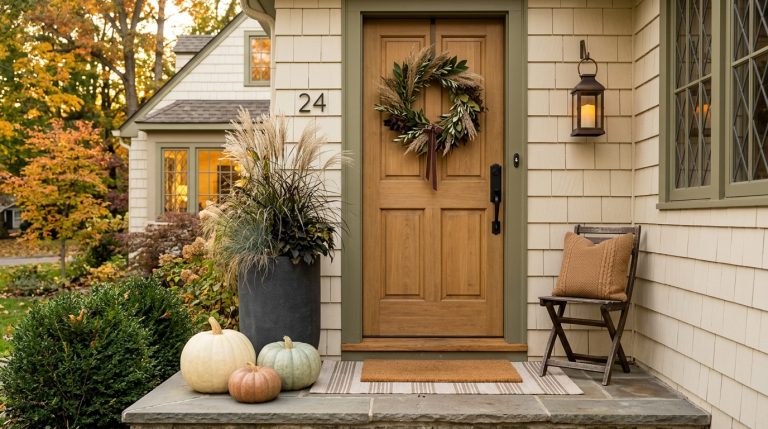
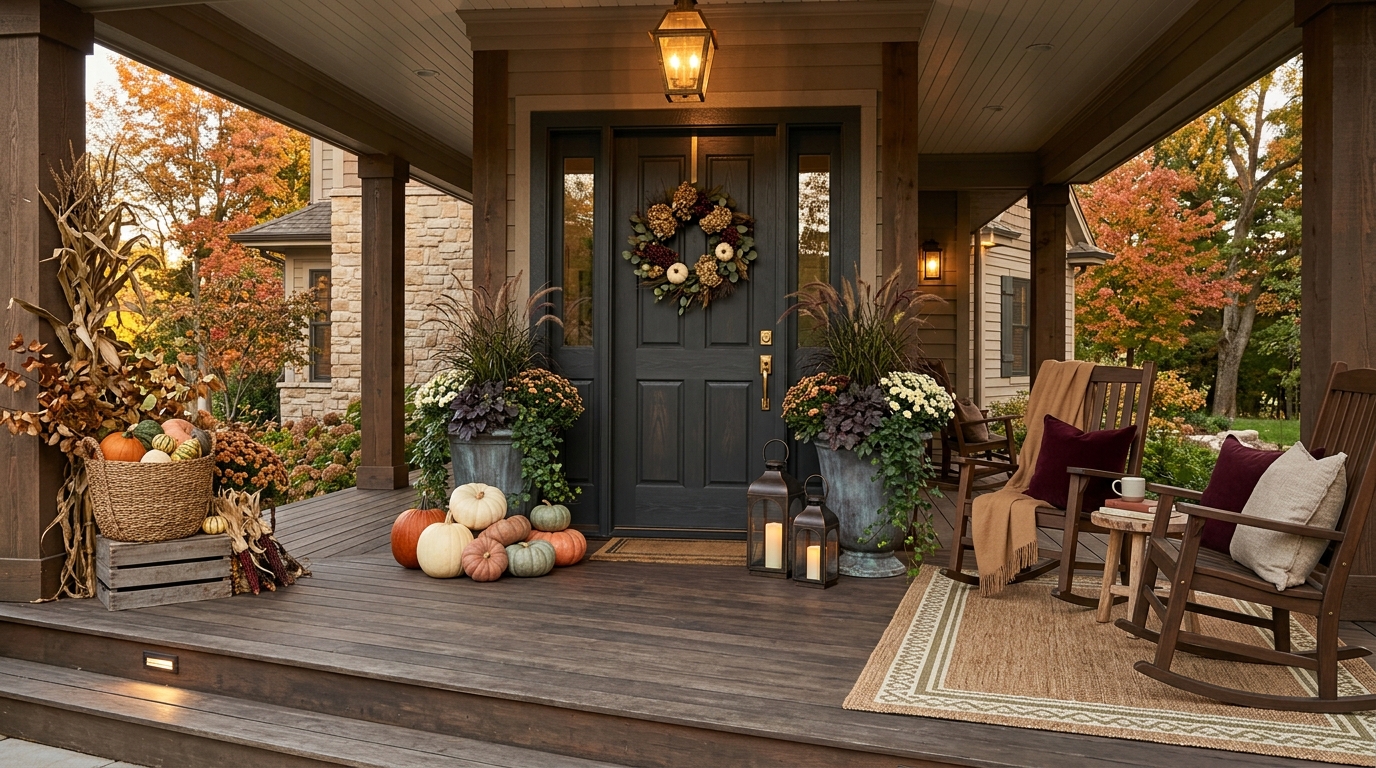
21 Large Fall Front Porch Ideas for a Warm, Well-Layered Entrance
A large front porch creates a different decorating problem from a small one. You have plenty of room, but spreading a pumpkin, planter, and lantern every few feet can make the space feel oddly empty rather than abundant.
The strongest large fall front porch decor ideas treat the porch as a series of connected zones. The front door needs a strong seasonal frame. Seating needs to remain comfortable. Steps need enough repetition to connect them to the porch above. And larger architectural features such as columns, railings, and long walls need enough scale to hold their own.
That approach reflects broader 2026 outdoor design thinking. Designers are increasingly treating substantial porches as outdoor rooms with deliberate seating, lighting, rugs, planters, and distinct functional zones rather than one long decorating surface.
Here are 21 ideas for making a big fall front porch feel warm, cohesive, and unmistakably autumnal.
Give the front door enough visual weight

Idea 1: Use two substantial planters instead of several small pots
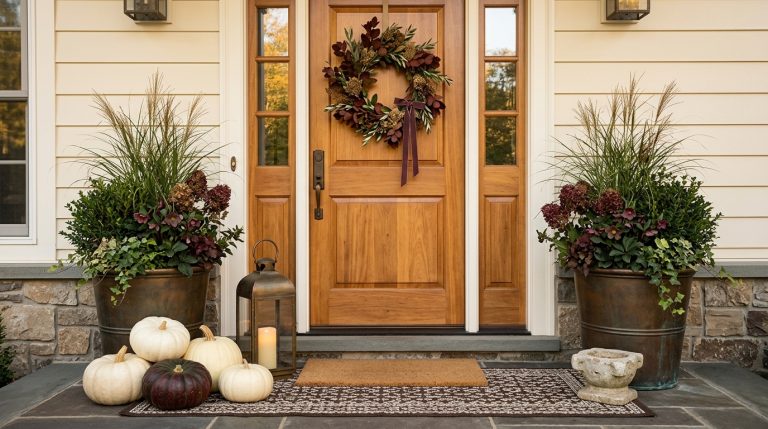
A wide porch can visually swallow ordinary nursery pots. Start with two larger containers flanking the entry and fill them with seasonal plants suited to your climate.
- Mums
- Ornamental grasses
- Ferns
- Heuchera
- Branches
- Mixed fall foliage
The pots do not need to be enormous. They simply need enough scale to relate to the doorway and porch height.

Idea 2: Make the doorway your strongest fall moment
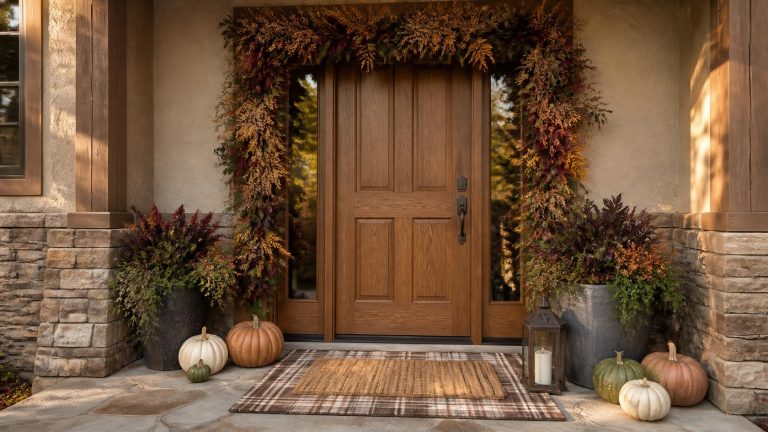
On a big porch, do not decorate every area equally. Create one visually strong entrance using one wreath, two planters, several grouped pumpkins, and one or two lanterns. Then let the rest of the porch be quieter. This gives the eye somewhere to land.
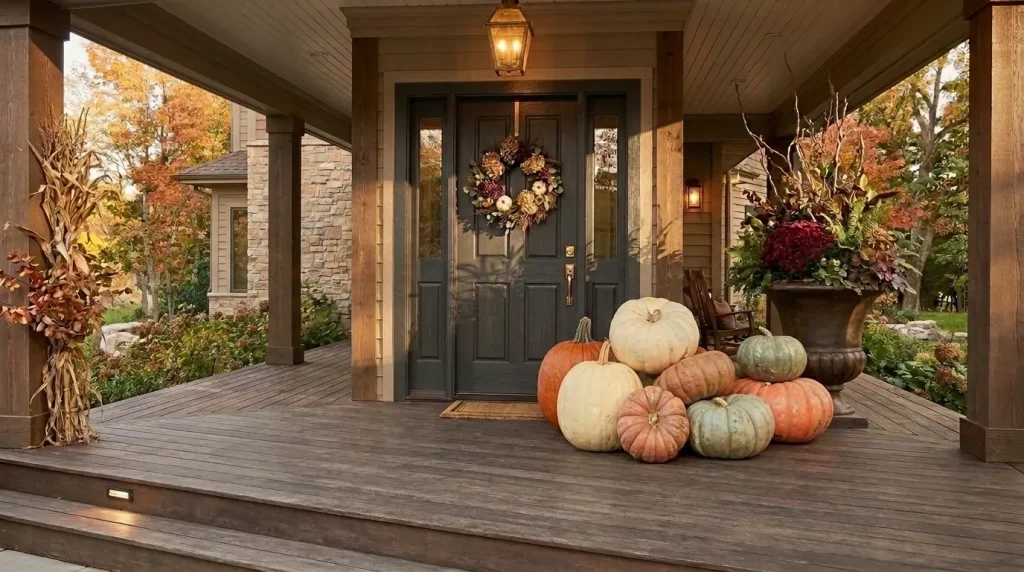
Idea 3: Use larger pumpkin groupings beside the door
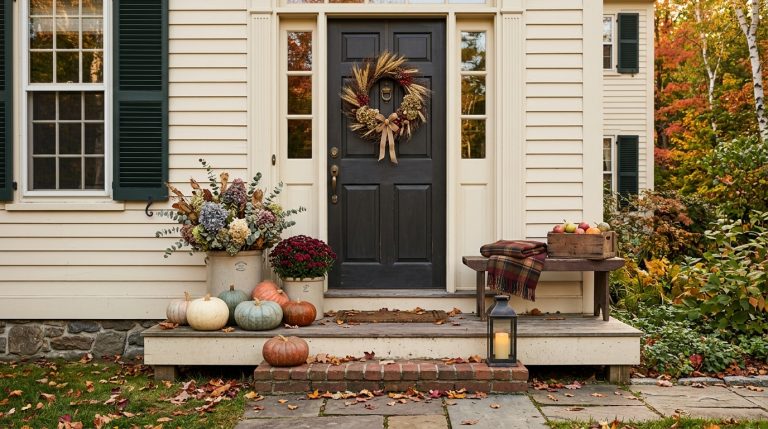
Three small pumpkins can disappear against a wide porch. Instead, use five to seven pumpkins of different shapes and sizes as one concentrated grouping. Keep the pumpkins tightly grouped rather than spreading them across several feet of floor.
Divide a big porch into purposeful zones

Idea 4: Separate the entrance zone from the seating zone
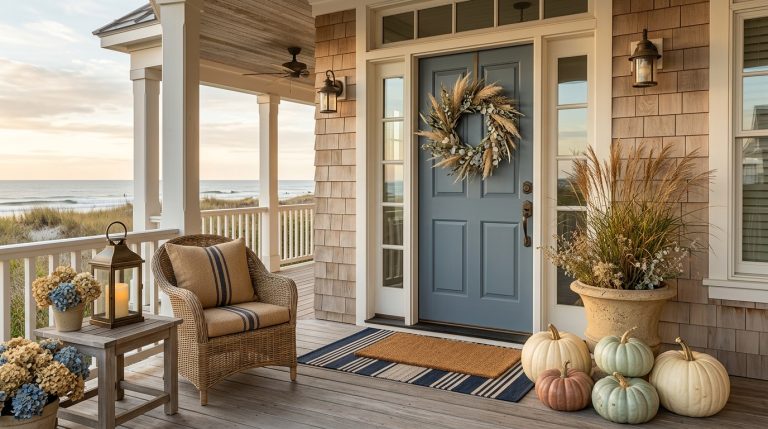
If your porch is long, the doorway and seating area do not have to share one giant arrangement. Treat them as two connected spaces: a door zone with wreath, planters, pumpkins, and lanterns, and a seating zone with chairs, rug, side table, textiles, and one planter.
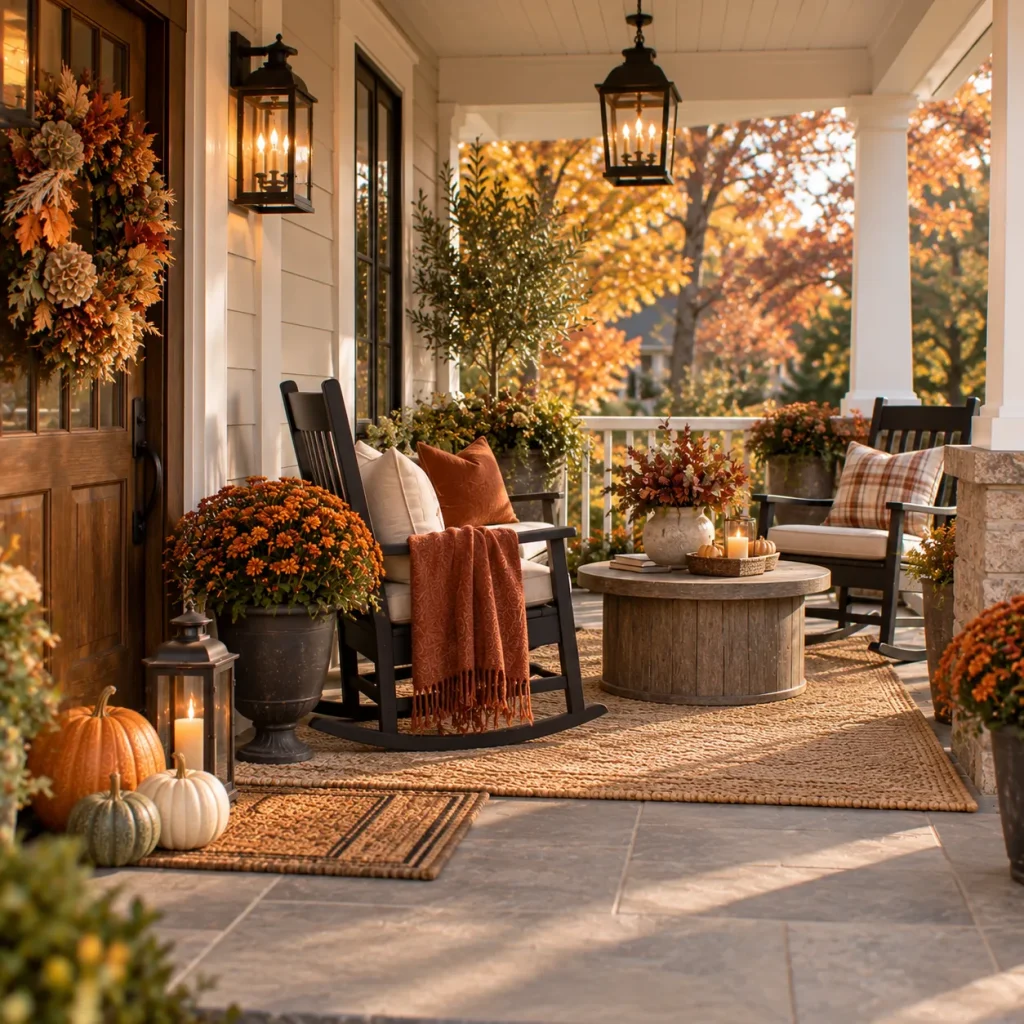
Idea 5: Create a real conversation area
Large porches often have room for more than two chairs pushed against a wall. Arrange seating so people can actually talk, whether that means two rocking chairs facing slightly inward, a bench opposite two chairs, or a porch swing with a nearby chair. Then use fall textiles rather than covering the furniture with decorative objects.
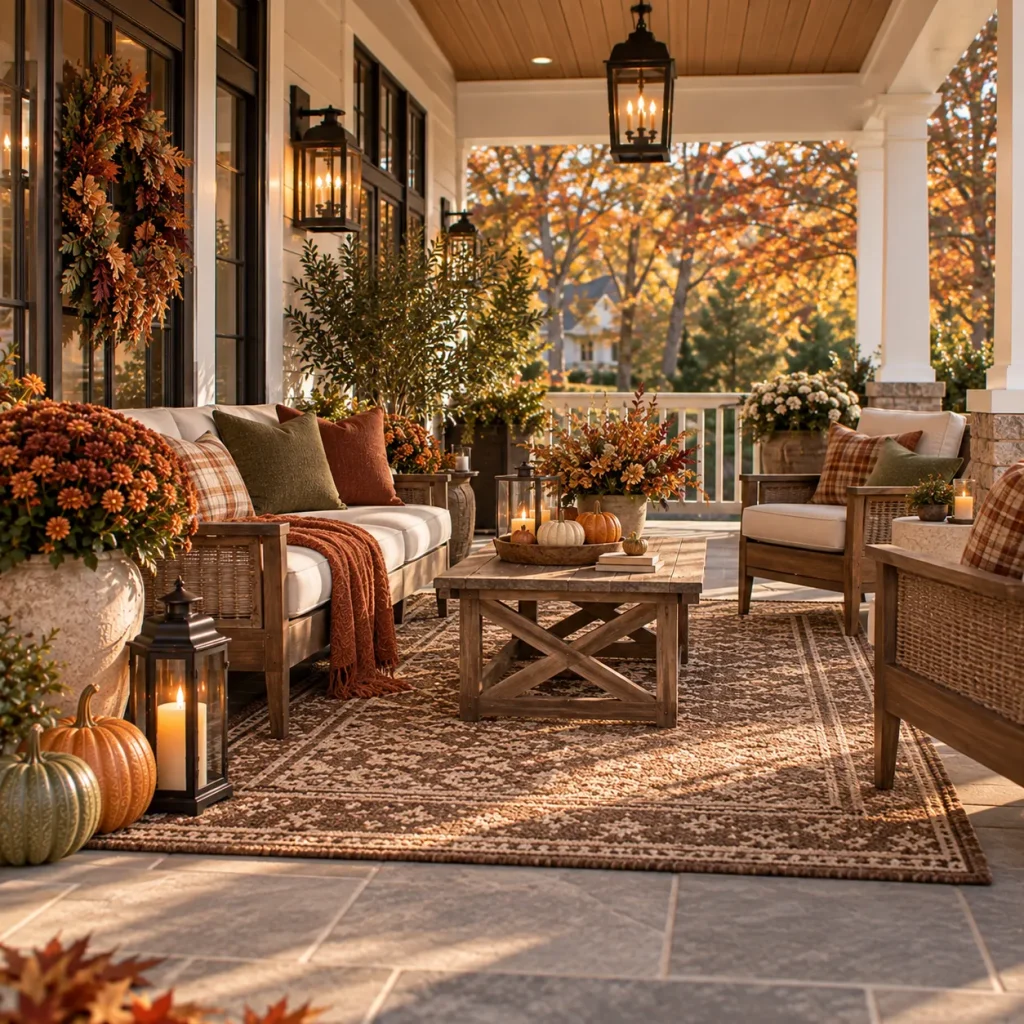
Idea 6: Define seating with an outdoor rug
A large rug helps furniture read as one intentional group. Use a weather-appropriate outdoor rug in brown and cream, olive, rust, muted plaid, or chocolate stripe. Choose a rug large enough that the seating does not look as though it is floating around its edges.
Make long stretches of porch feel connected
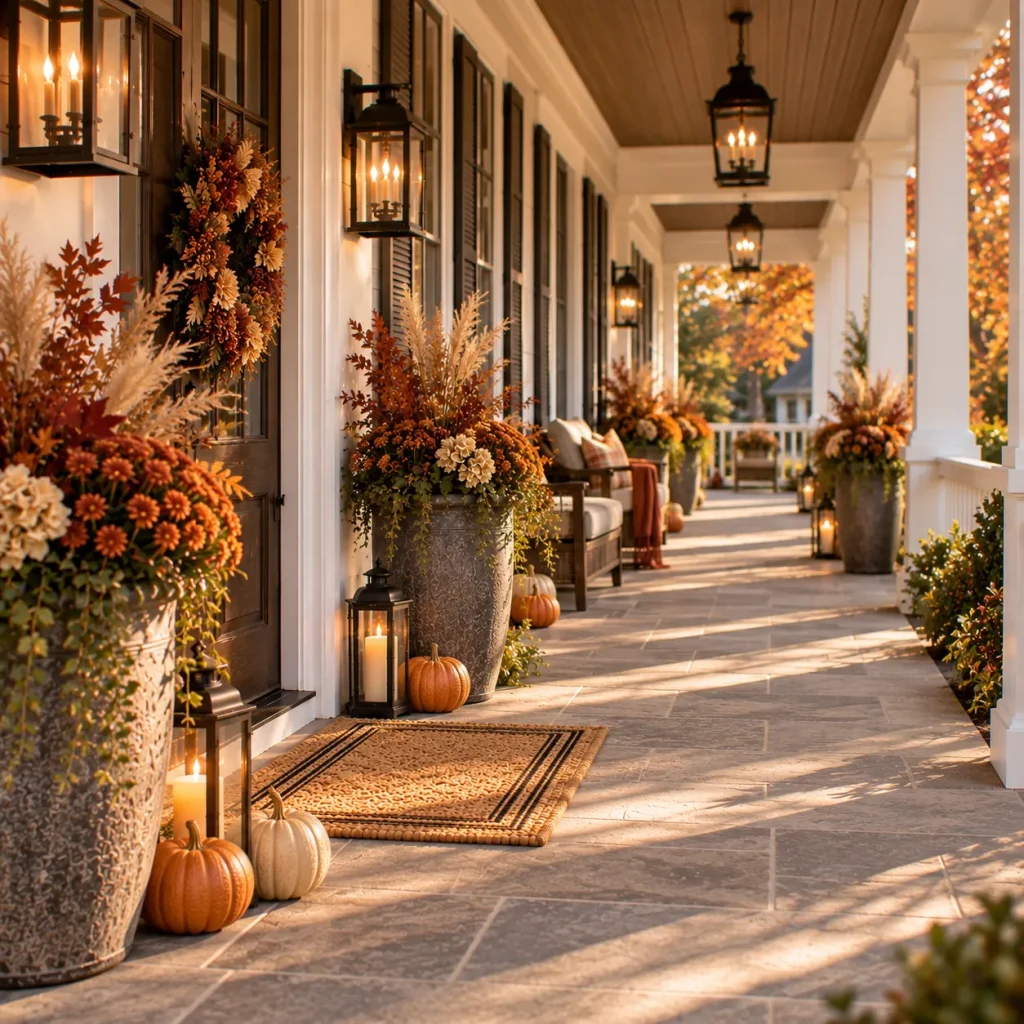
Idea 7: Repeat one planter style at intervals
If the porch has several columns or long open sections, repeat one container style rather than inventing a completely different vignette at every point. The repeated container visually connects the long porch.

Idea 8: Repeat one pumpkin color through the whole porch
Choose one pumpkin color that appears in every major zone, such as cream pumpkins at the door, one beside the bench, and another beside the far planter. This repetition creates rhythm without requiring identical arrangements.
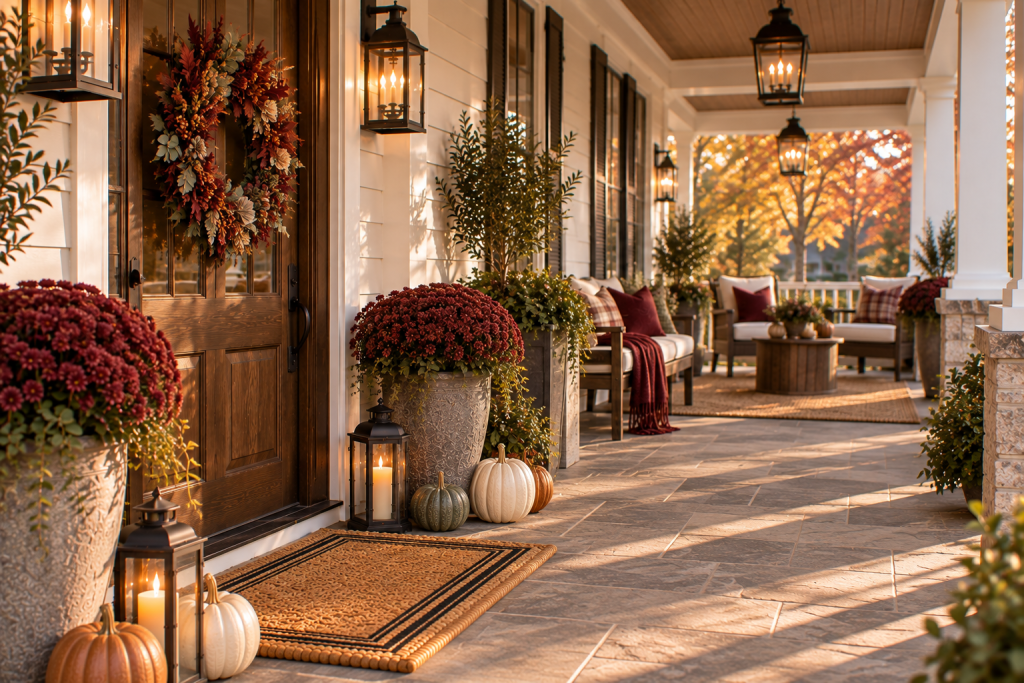
Idea 9: Use textiles to repeat color rather than adding more decor
If the door display contains burgundy mums, repeat burgundy in one outdoor cushion. This is more effective than placing another pumpkin in every empty area.
Use columns and railings for vertical decoration
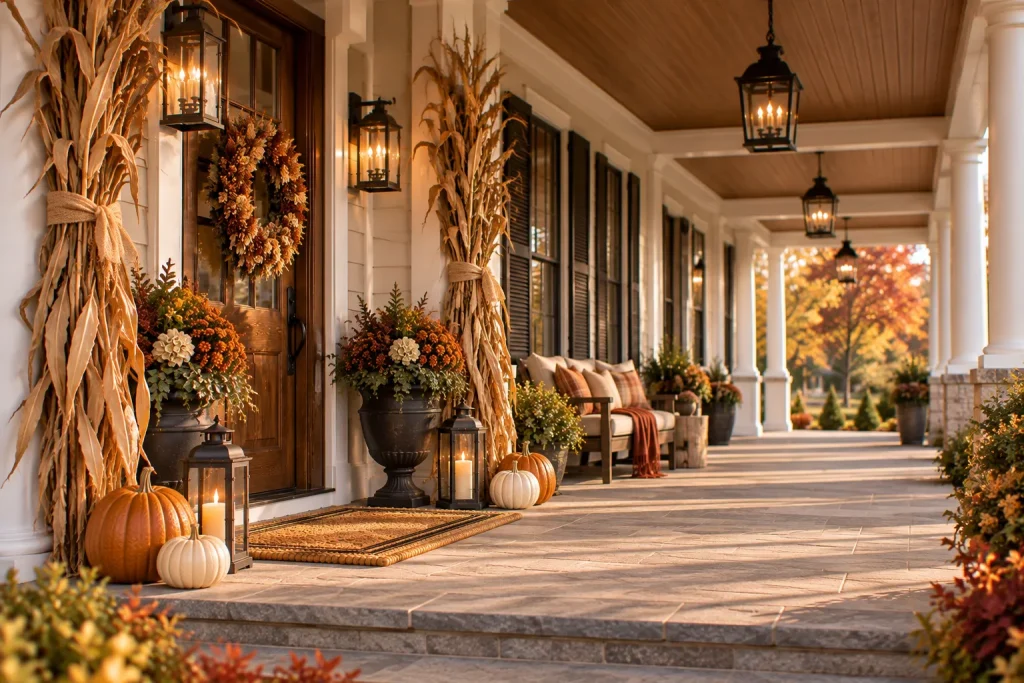
Idea 10: Add corn stalks to only the most important columns
A porch with six columns does not necessarily need six corn-stalk bundles. Frame the entrance columns or the two columns closest to the main seating area, then leave the others alone. Secure the stalks firmly and keep dried materials away from open flame and excessive heat.
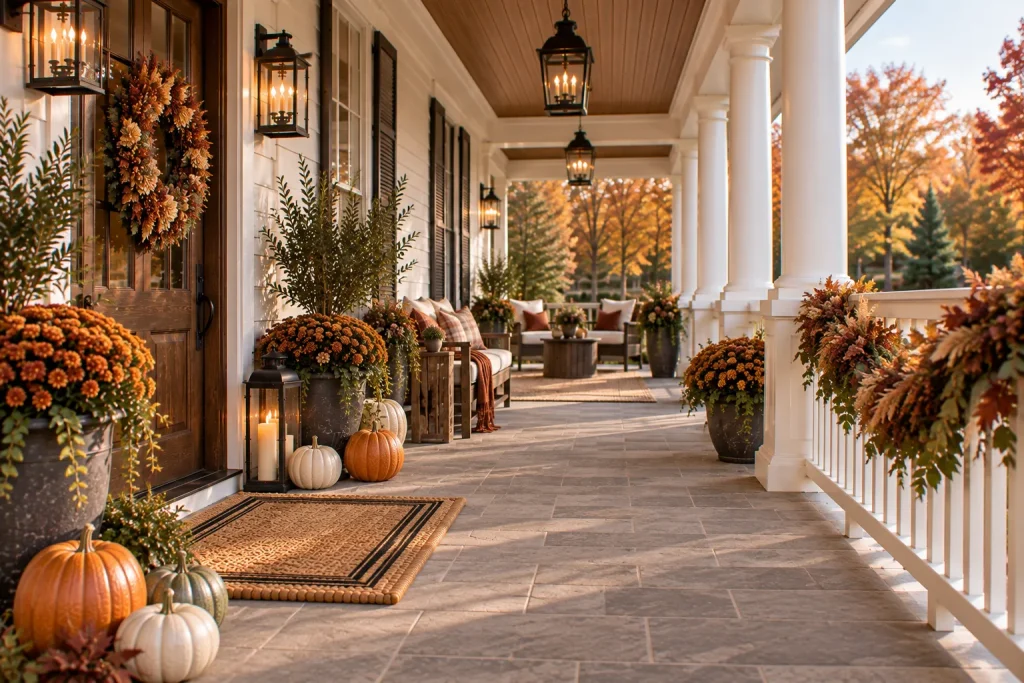
Idea 11: Use restrained garland along one railing section
A long porch railing can support seasonal greenery, but covering every foot may overwhelm the architecture. Try one prominent section near the entrance or seating area and leave some railing visible.
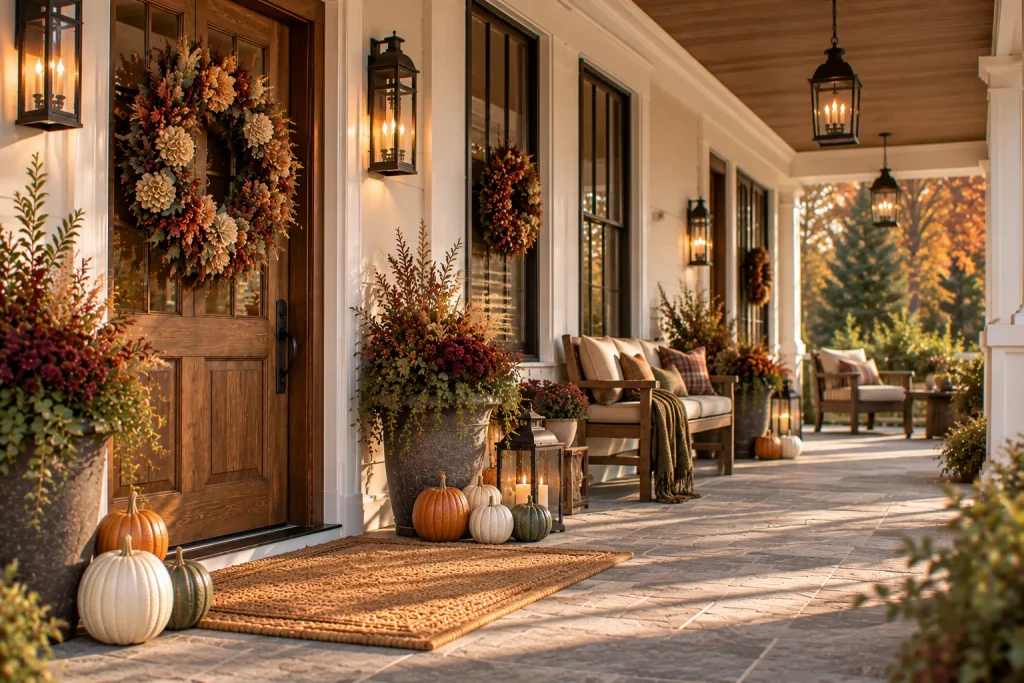
Idea 12: Hang wreaths only where the architecture supports them
If the porch has multiple doors or large windows, smaller matching or related wreaths can create rhythm, but do not attach a wreath to every available surface. One main front-door wreath should remain the strongest.
Scale harvest elements to a big porch
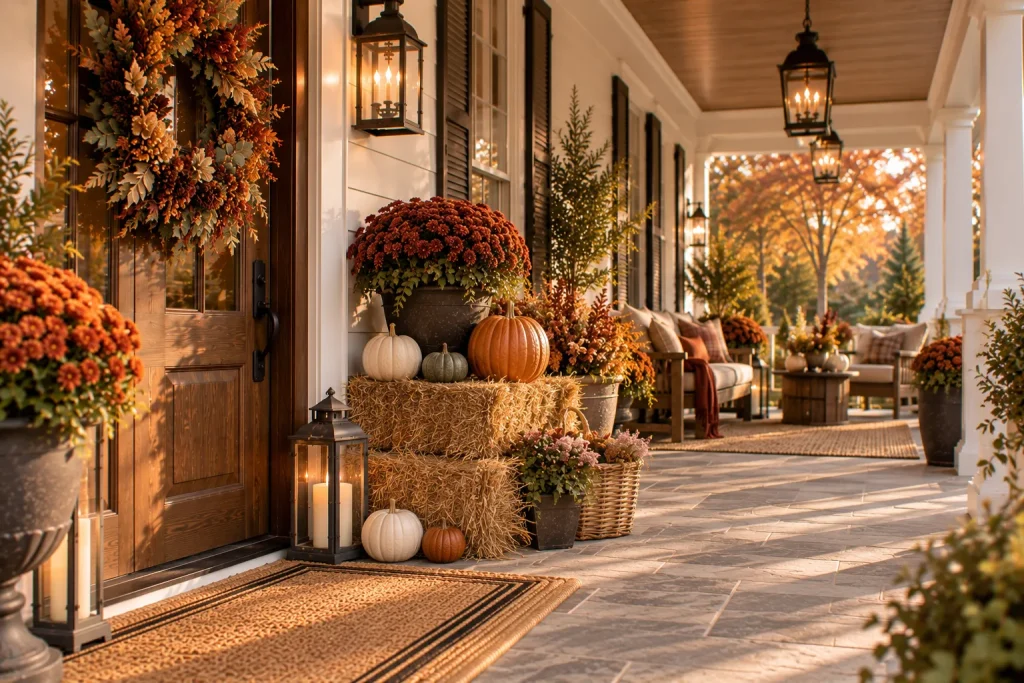
Idea 13: Use hay bales as actual risers
A large porch can support hay or straw bales better than a tiny stoop because there is room to keep them away from the walking path. Use one or two as low platforms for pumpkins, mums, baskets, or a planter.

Idea 14: Build one large harvest vignette instead of several mini ones
Choose one corner where scale makes sense: two bales or crates, one large planter, seven to nine mixed pumpkins, one basket, two lanterns, and perhaps a corn-stalk bundle. Then stop. One substantial arrangement often fills a big porch more convincingly than six small clusters.
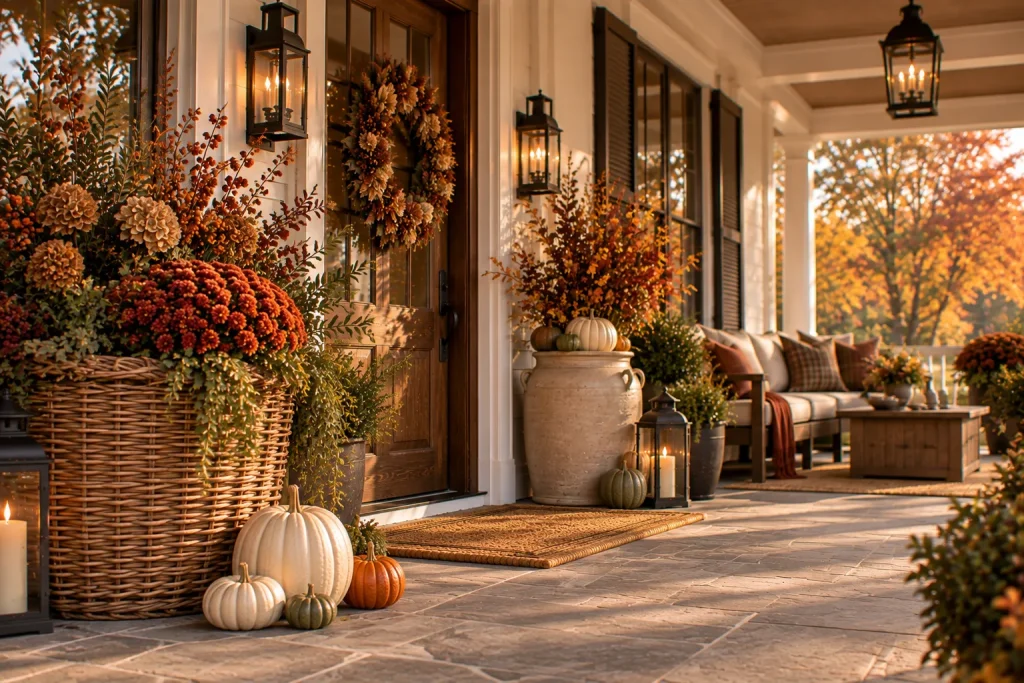
Idea 15: Use oversized baskets and crocks
Large architecture needs accessories with enough visual mass. A substantial basket containing a nursery pot or pumpkins will read better than several miniature baskets.
Make the porch usable through autumn
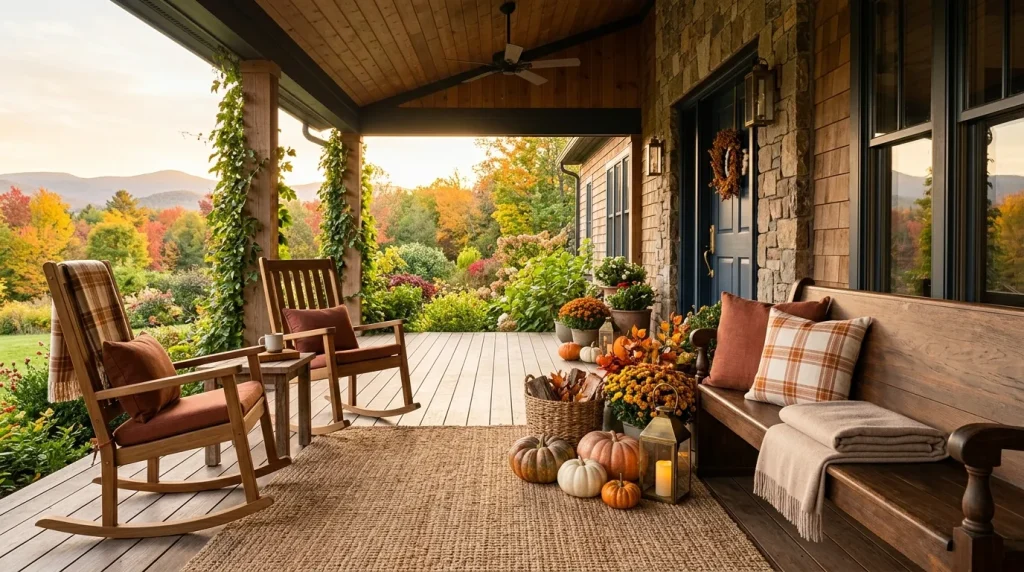
Idea 16: Keep the best seating available
One mistake on large porches is treating extra furniture as decorating surface. Do not cover every chair with pumpkins, baskets, and blankets. Keep most seating open, and add one or two fall cushions and perhaps a washable throw on a protected porch.
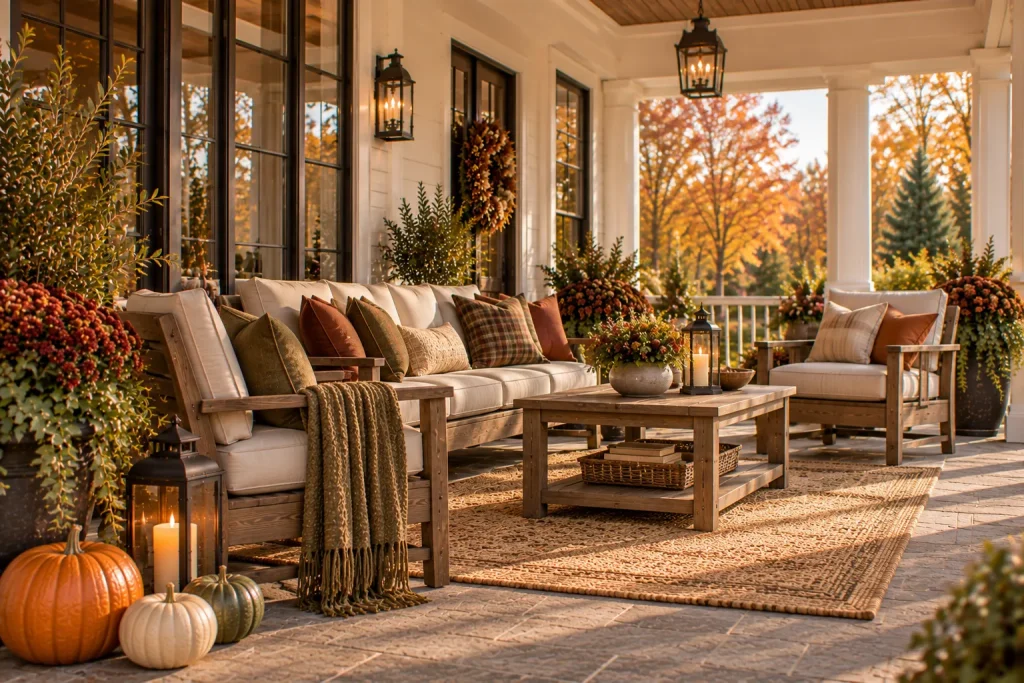
Idea 17: Add a side table or coffee table to the seating zone
A large seating area feels unfinished without somewhere to place a drink. Use a real outdoor table rather than filling the center with a decorative pumpkin arrangement. A bowl, lantern, or one small seasonal plant is enough for the tabletop.
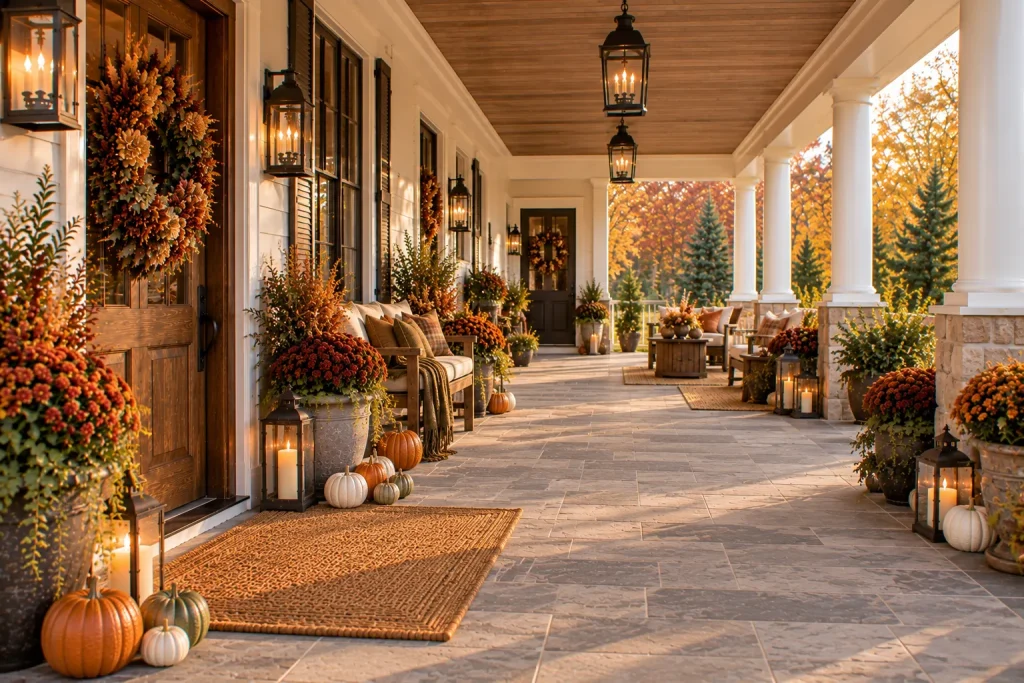
Idea 18: Keep a clear circulation route between zones
A large porch gives you enough space to create several areas, but they still need to connect naturally. Keep a comfortable route from steps to front door, door to seating, and seating to any side entrance.
Layer the porch for evening use
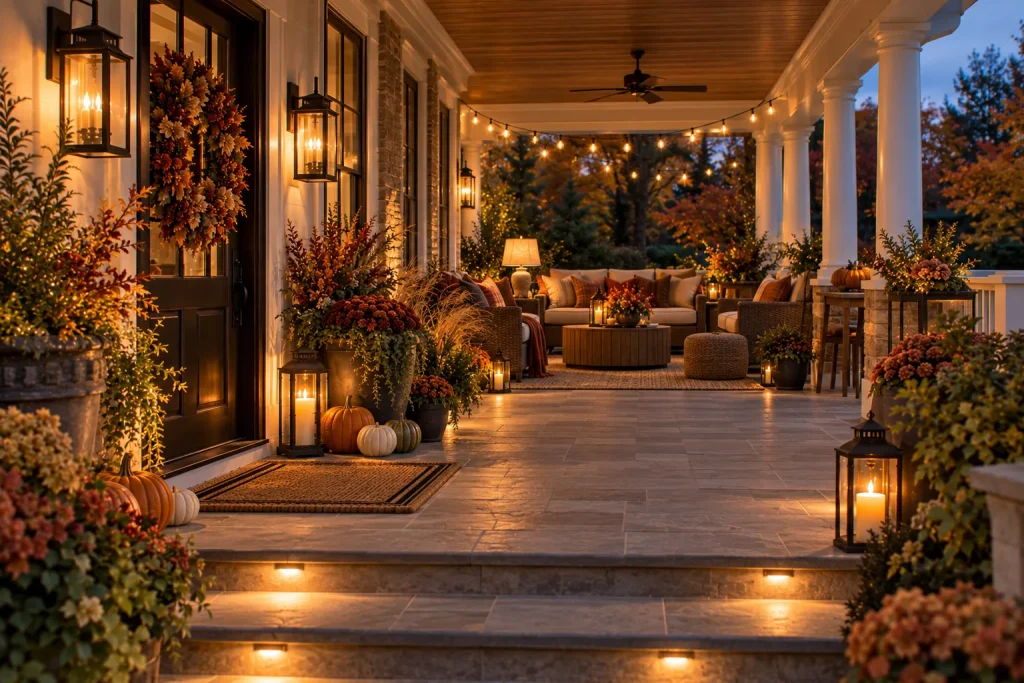
Idea 19: Use several lighting levels instead of one bright fixture
A big porch can feel particularly flat after sunset if all the light comes from one ceiling fixture. Layer permanent wall sconces, lanterns near pumpkin displays, a table lamp rated for outdoor conditions, low pathway or step lighting, and string lights over a covered seating zone if the architecture suits them.
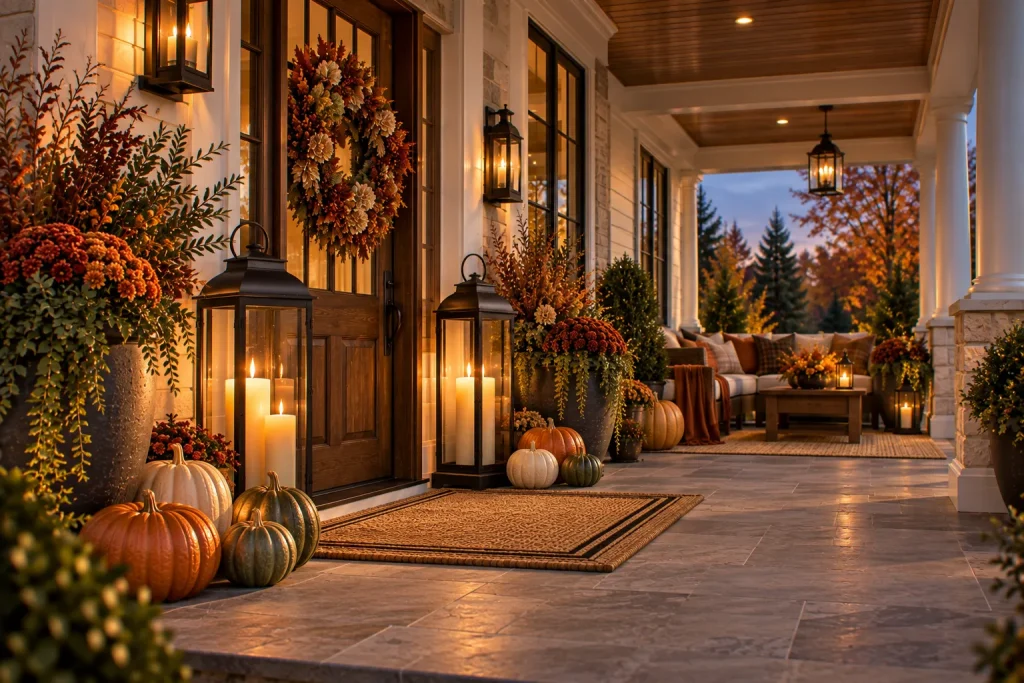
Idea 20: Use pairs of substantial lanterns instead of many small ones
Tiny lanterns can disappear on a large porch. Try one pair of taller floor lanterns near the main doorway and perhaps one smaller lantern near the seating area. Group them with pumpkins or planters rather than spacing lanterns evenly down the porch.
Make the display last beyond Halloween

Idea 21: Build the large porch around plants and furniture first
The easiest way to avoid a completely bare porch in November is to make pumpkins the removable layer, not the foundation. Start with seating, an outdoor rug, planters, foliage, lanterns, and a wreath, then add pumpkins and Halloween-specific pieces. After October 31, remove carved pumpkins and spooky decor. The underlying porch still looks intentionally autumnal.
A practical large fall porch zoning plan
| Zone | Main anchor | Fall layer | What to avoid |
|---|---|---|---|
| Front door | Large planters | Pumpkins and wreath | Too many tiny objects |
| Steps | Repeated pumpkins | Mums or lanterns | Blocking tread width |
| Seating | Furniture and rug | Cushions plus one planter | Covering seats with decor |
| Corner | Large harvest vignette | Bale, basket, pumpkins | Several unrelated displays |
| Railing | Architecture | One garland section | Covering every rail |
| Far end | Planter or bench | Repeated fall color | Creating another focal point |
| Evening | Sconces | Lanterns plus path lights | One harsh light source |
A big porch does not need every zone decorated heavily. It needs the zones to feel related.
What should you avoid on a large fall porch?
- Scattering small decor everywhere. Large spaces exaggerate the weakness of underscaled accessories.
- Decorating every column. Repetition is useful, but leave enough architecture visible.
- Creating five competing focal points. Make the front door strongest and let other zones support it.
- Buying enough pumpkins to cover the entire floor. Large grouped displays are usually more effective than continuous pumpkin borders.
- Ignoring furniture. A spacious porch should still function as outdoor living space.
Try this if your large porch still looks empty
Do not buy twenty more decorations. Stand at the sidewalk and identify the three biggest empty zones. Usually they are the front door, the seating area, and one distant corner. Give each zone one substantial anchor, such as two large planters at the door, a rug beneath the seating, and a tall branch arrangement or harvest display in the corner. Then repeat one fall color through all three. The porch will usually feel much fuller once the scale is correct.
FAQ
How do you decorate a large front porch for fall?
Divide the porch into a few functional zones instead of scattering decorations everywhere. Make the door the main focal area, create a usable seating zone, and use larger planters, pumpkin groups, rugs, and lighting to connect the spaces.
How many pumpkins do you need for a big fall porch?
There is no required number. Concentrated groups generally work better than an evenly spaced line. Start with around five to seven pumpkins near the main entry and add another smaller group only if another zone genuinely needs seasonal color.
How can I make a large porch feel cozy for fall?
Use appropriately scaled furniture, outdoor rugs, cushions, warm lighting, larger planters, and grouped seasonal decor. Current 2026 outdoor fall guidance emphasizes layered textiles, antiqued metals, substantial seating, and comfortable outdoor-room styling as temperatures cool.
Should a large porch be decorated symmetrically?
Not necessarily. Symmetry works especially well around a formal front door, but the entire porch can combine a symmetrical entrance with an asymmetrical seating or harvest zone. The important part is balancing visual weight rather than mirroring every object.
Give a big porch structure before giving it more stuff
The strongest big front porch fall decor ideas solve scale before quantity. A wide doorway needs substantial planters. A long porch needs zones. A deep seating area needs a rug and real furniture. And a large corner needs one strong arrangement rather than several undersized accessories.
If you make one change first, stop decorating object by object. Look at the porch as a whole and identify where people enter, where they sit, and where the architecture naturally creates a pause. Decorate those places first.
Once the structure feels right, pumpkins, mums, lanterns, wreaths, and fall foliage become the finishing layer rather than an attempt to fill empty square footage. If your porch is on the opposite end of the scale, these small front porch and these bench ideas show how the same seasonal logic adapts to a much smaller footprint.